 Sustainable synthesis of sodium silicate from agro waste ashes for green construction applications
ABSTRACT
The production of ordinary Portland cement (OPC) is a major contributor to global CO2 emissions, prompting the development of geopolymer concrete as a sustainable alternative. However, the dependence of geopolymer technology on commercially produced sodium silicate poses environmental and economic challenges due to its energy-intensive manufacturing process. This study investigates the synthesis of sodium silicate from agro-waste ashes, rice husk ash (RHA), sugarcane bagasse ash (SCBA), and palm oil fuel ash (POFA), and evaluates their effectiveness as alkaline activators in geopolymer concrete. Mixes were prepared with activator molarities ranging from 6M to 18M and assessed for fresh, mechanical, and durability properties. The results revealed that performance improved with increasing molarity up to 13M, beyond which strength and workability declined due to excess alkalinity, causing microcracking. RHA-based sodium silicate demonstrated the highest compressive strength (45 MPa), comparable to the control mix using commercial sodium silicate, followed by SCBA (43 MPa) and POFA (41.5 MPa). Durability assessments indicated superior acid resistance and lower water absorption in RHA- and SCBA-based mixes. The findings confirm that agro-waste-derived sodium silicate can effectively replace conventional activators, promoting sustainable geopolymer concrete production and significantly reducing environmental impacts.
Keywords:
Geopolymer concrete; Sodium silicate synthesis; Agro-waste ashes; Rice husk ash (RHA); Sustainable construction materials
1. INTRODUCTION
The global construction industry is undergoing a paradigm shift toward sustainability and low-carbon development. Concrete, the most widely used construction material, is largely dependent on Ordinary Portland Cement (OPC) as the primary binding agent. However, OPC production is associated with significant environmental concerns, particularly its contribution to global carbon dioxide emissions. It is well established that for every tonne of cement produced, approximately one tonne of CO2 is released into the atmosphere, mainly due to the calcination of limestone and the combustion of fossil fuels during clinker production. The cement industry alone is responsible for nearly 7-8% of the total anthropogenic CO2 emissions worldwide, placing it among the most energy- and carbon-intensive industries [1, 2]. This has created an urgent need to develop alternative binders and sustainable technologies that can reduce the carbon footprint of construction materials without compromising structural performance or durability. In response to this challenge, geopolymer concrete (GPC) has emerged as a promising and eco-friendly substitute for OPC-based systems. First introduced by Davidovits in the late 1970s, geopolymer binders are inorganic alumino-silicate materials formed through the reaction of alumina- and silica- rich industrial by-products, such as fly ash, metakaolin, and ground granulated blast furnace slag (GGBS), with alkaline activator solutions. The resulting three-dimensional alumino-silicate network provides high early strength, excellent chemical resistance, and superior durability properties compared to conventional cementitious binders [3, 4]. Geopolymer technology offers several environmental and economic advantages. By utilizing industrial waste materials, it significantly reduces the need for natural resources such as limestone and clay while also diverting large quantities of industrial by-products from landfills. Studies have reported that the carbon footprint of geopolymer concrete can be up to 60–80% lower than that of OPC concrete, depending on the type of precursor and activator used [5, 6]. Furthermore, the absence of high-temperature calcination during geopolymer synthesis drastically reduces energy consumption, making it a more sustainable alternative for future construction. Despite the environmental advantages of geopolymer technology, one of its critical limitations lies in the use of commercially manufactured alkaline activators, particularly sodium silicate (Na2SiO3) and sodium hydroxide (NaOH). Sodium silicate is produced through the high-temperature fusion of quartz sand (SiO2) and soda ash (Na2CO3) at temperatures ranging from 1300°C to 1500°C. This process is highly energy- intensive and contributes substantially to CO2 emissions, offsetting some of the environmental benefits achieved through the use of waste-based precursors [7]. The contradiction thus arises: while geopolymer concrete is termed a “green material,” one of its primary constituents, commercial sodium silicate, is not. Activator production alone can account for nearly 30–40% of the total embodied energy in geopolymer concrete, thereby weakening its claim to complete sustainability. Hence, developing greener and locally sourced alternatives to sodium silicate is imperative to ensure that the geopolymer system truly aligns with circular economy principles and low-carbon construction goals. Recent research has increasingly focused on using silica-rich waste materials as substitutes for industrial sodium silicate [8]. Among various potential sources—such as silica fume, nano-silica, waste glass powder, and micro-silica agro-waste ashes have gained particular attention due to their high silica content and abundant availability in agricultural economies like India [9, 10]. Agricultural residues such as rice husk ash (RHA), sugarcane bagasse ash (SCBA), and palm oil fuel ash (POFA) are generated in millions of tonnes annually, yet most of these wastes remain underutilized and are often disposed of through open dumping or uncontrolled burning, causing air and soil pollution [11, 12]. Rice husk ash (RHA) is particularly rich in amorphous silica, typically comprising 85–95% SiO2 when burned under controlled conditions below 700°C. This reactive silica can readily participate in alkali activation reactions, forming sodium silicate solutions suitable for geo-polymerization. Sugarcane bagasse ash (SCBA), a by-product of sugar industries, contains 60–80% SiO2 along with minor quantities of alumina and iron oxides. Similarly, palm oil fuel ash (POFA), derived from the combustion of palm oil residues, also contains substantial amounts of reactive silica, though its composition can vary depending on combustion parameters [13,14,15,16]. The valorization of these agro-wastes not only provides an alternative silica source for synthesizing sodium silicate but also contributes to waste management and resource efficiency. Utilizing these ashes for green activator production helps establish a circular materials economy by converting waste into value-added products, minimizing landfill disposal, and reducing dependence on high-energy industrial processes [17, 18]. Several studies have reported promising results in synthesizing sodium silicate from agricultural residues. HANDAYANI et al. [19] demonstrated that RHA-based sodium silicate could effectively replace commercial activators, producing geopolymer mortars with comparable compressive and flexural strength. PANITSA et al. [20] synthesized RHA-based solid activators and observed enhanced performance under ambient curing conditions. OTI et al. [21] reported that sodium silicate derived from RHA, when used in combination with sodium hydroxide, resulted in geopolymer concrete with mechanical and durability properties equivalent to those obtained using industrial-grade sodium silicate. In the case of sugarcane bagasse ash, previous investigations have shown that its high reactive silica and porous morphology make it an excellent candidate for synthesizing sodium silicate and sodium aluminate solutions. Studies also highlight that SCBA-based activators improve the mechanical strength and microstructural density of geopolymer matrices [22]. For palm oil fuel ash, IBRAHIM et al. [23] observed that POFA-derived sodium silicate contributes to the formation of a dense alumino-silicate gel, improving long-term durability and resistance to acid attack. Although these findings are encouraging, most studies have focused on individual agro-waste sources rather than a comparative evaluation of multiple ashes under similar conditions. Moreover, limited research has comprehensively assessed the performance of geopolymer concrete activated with agro-based sodium silicate in terms of its fresh, mechanical, and durability behaviour. From the above discussion, it is evident that geopolymer concrete represents a viable and sustainable replacement for OPC-based systems, yet its sustainability is partially compromised by the continued use of commercially produced sodium silicate. The conventional production of sodium silicate involves high-temperature furnaces, excessive energy use, and substantial CO2 emissions, which collectively undermine the environmental benefits of geopolymers. On the other hand, agricultural residues such as RHA, SCBA, and POFA are abundantly available in India and other tropical regions. These ashes are rich in amorphous silica and can potentially be utilized to synthesize sodium silicate in an eco-friendly and cost- effective manner [24]. However, research addressing the synthesis of sodium silicate from multiple agro-waste sources and evaluating their performance in geopolymer concrete remains limited. There is a lack of systematic studies examining how activators derived from different agro-wastes influence the rheological, mechanical, and durability characteristics of geopolymer concrete. Furthermore, the optimal molarity of alkali activation, the reaction kinetics involved, and the comparative influence of silica reactivity across different ash types are still not fully understood. Although geopolymer binders are widely regarded as environmentally favorable alternatives to ordinary Portland cement (OPC), increasing attention has been drawn to the environmental burden associated with conventional alkali activators, particularly commercially produced sodium silicate and sodium hydroxide [25]. Among these, sodium silicate solution is recognized as one of the most energy-intensive and carbon-intensive components of geopolymer systems, often dominating the overall embodied energy and CO2 footprint of geopolymer concrete. Commercial sodium silicate is typically manufactured through high- temperature fusion of quartz sand and sodium carbonate at temperatures exceeding 1200–1400 °C, followed by dissolution and refinement. This process involves substantial thermal energy consumption and indirect CO2 emissions associated with fuel combustion and raw material processing [26]. Several life cycle assessment (LCA) studies have reported that alkali activators can contribute 40–70% of the total embodied energy and a significant fraction of greenhouse gas emissions in geopolymer concrete, thereby diminishing the perceived environmental advantage over OPC-based systems when industrial activators are used without optimization. In this context, the development of alternative, low-impact alkali activators derived from industrial or agricultural by-products has emerged as a critical research priority. Agro-waste ashes such as rice husk ash (RHA), sugarcane bagasse ash (SCBA), and palm oil fuel ash (POFA) are particularly attractive due to their high silica content, widespread availability, and existing association with biomass energy or agro-processing industries [27]. When appropriately processed, these materials can serve as effective silica sources for sodium silicate synthesis, potentially reducing reliance on mined quartz and energy-intensive fusion processes. The approach adopted in the present study—synthesizing sodium silicate solutions from agro-waste ashes using alkaline dissolution-represents a functional shift from extractive, high-temperature manufacturing to waste valorization–based activation. Although the preparation of agro-waste ashes involves energy input through drying and controlled calcination, these processes operate at substantially lower temperatures (600–700 °C) than conventional sodium silicate production and do not involve intrinsic CO2-generating chemical reactions such as carbonate decomposition. Moreover, in many practical scenarios, agro-waste ashes are generated as by-products of existing thermal processes, allowing the possibility of energy integration or waste-heat utilization, which further reduces marginal environmental impact [28]. It is acknowledged that the environmental benefit of agro-waste–derived activators cannot be assumed to be zero, and a full life cycle assessment was not conducted in the present work. However, the experimental results demonstrate that sodium silicate solutions synthesized from RHA, SCBA, and POFA can match or outperform commercial activators in mechanical and durability performance, particularly at optimal molarity. This indicates that environmental gains can be achieved without compromising engineering performance, which is a key requirement for real-world adoption. Therefore, the novelty of the present study lies not only in demonstrating the technical feasibility of agro-waste–derived alkali activators, but also in advancing the broader objective of reducing the environmental intensity of geopolymer systems at the activator level, which remains one of the major bottlenecks in sustainable geopolymer technology. Future work incorporating detailed energy accounting and LCA will further quantify these benefits and support large-scale implementation. To bridge these research gaps, the present study focuses on synthesizing sodium silicate solutions from three major agro-waste ashes—rice husk ash, sugarcane bagasse ash, and palm oil fuel ash—and evaluating their performance as alkaline activators in geopolymer concrete. The study investigates a range of molarities from 6M to 18M and examines the resulting concrete mixes for fresh properties (workability and setting time), mechanical strength (compressive, split tensile, and flexural), and durability performance (acid resistance, water absorption, and sorptivity). This research not only aims to establish the technical viability of agro-based sodium silicate as a green activator but also provides insights into optimizing molarity levels for achieving superior mechanical and durability outcomes. By comparing the performance of RHA-, SCBA-, and POFA-based sodium silicate with commercial sodium silicate, the study seeks to demonstrate that agro-waste-derived activators can effectively replace industrial ones without compromising quality. The findings of this investigation are expected to contribute significantly to the advancement of sustainable geopolymer technology. By integrating waste valorisation with low-carbon construction materials, the study supports the global transition toward carbon neutrality and aligns with the United Nations Sustainable Development Goals (SDGs), particularly SDG 9 (Industry, Innovation, and Infrastructure), SDG 11 (Sustainable Cities and Communities), and SDG 12 (Responsible Consumption and Production).
2. MATERIALS AND METHODS
The present investigation was systematically carried out in three major stages: (i) collection and preparation of agro-waste ashes, (ii) synthesis of sodium silicate solution from agro-based ashes, and (iii) preparation and testing of geopolymer concrete mixes. Each stage was carefully designed to ensure reproducibility, accuracy, and compliance with relevant Indian Standards (IS) and ASTM specifications. Figure 1 shows the materials used for this experimental study.

Materials used for this study (a) rice husk ash, (b) sugarcane bagasse ash and (c) palm oil fuel ash.
2.1. Collection and preparation of agro-waste ashes
In the first stage of the study, agro-waste ashes, namely rice husk ash (RHA), sugarcane bagasse ash (SCBA), and palm oil fuel ash (POFA), were collected from local agro-processing units in Tamil Nadu, India. The raw agro residues were initially washed thoroughly with clean water to remove adhering dust, residual soil particles, carbonaceous matter, and other organic impurities that could adversely affect chemical reactivity. The cleaned materials were air-dried for 24 h and subsequently oven-dried at 105 ± 5 °C to eliminate residual moisture before thermal treatment. Controlled calcination of the dried agro residues was carried out in a muffle furnace at temperatures ranging from 600 °C to 700 °C for 2 h. This temperature range was selected to ensure complete combustion of organic matter while preserving the amorphous nature of silica, which is essential for enhanced dissolution under alkaline conditions and subsequent geopolymerization reactions. After calcination, the ashes were allowed to cool naturally to room temperature, ground using a ball mill to improve fineness, and sieved through a 75 µm IS sieve to obtain a uniform particle size distribution suitable for chemical activation and consistent reactivity. The physical characteristics of the ashes were determined in accordance with relevant Indian Standards. The specific gravity was measured as per IS: 2386 (Part III)–1963 [29], fineness was evaluated following IS: 4031 (PART I)–1996 [30], and loss on ignition (LOI) was determined using IS: 1727–1967 [31]. The results showed that RHA exhibited a specific gravity of 2.10, fineness of 320 m²/kg, and LOI of 6.1%. SCBA recorded a specific gravity of 2.25, fineness of 280 m2/kg, and LOI of 8.6%, while POFA showed a specific gravity of 2.30, fineness of 260 m²/kg, and LOI of 9.4%. For comparison, ground granulated blast furnace slag (GGBS) was also characterized and exhibited a specific gravity of 2.90, fineness of 380 m²/kg, and LOI of 2.1%. The relatively lower specific gravity and adequate fineness of the agro-waste ashes indicate their porous nature and higher surface area, which are advantageous for alkaline dissolution and chemical activation. The chemical composition of RHA, SCBA, POFA, and GGBS was determined using X-ray fluorescence (XRF) analysis, and the results are presented in Table 1. The analysis confirmed that all agro-waste ashes were highly siliceous, with RHA containing the highest SiO2 content (87.5%), followed by SCBA (64.2%) and POFA (56.7%). The comparatively low CaO and MgO contents further indicate that these ashes are more suitable as supplementary silica sources for alkaline activator synthesis, rather than as primary calcium-rich binders.
The physical and chemical properties of the agro-waste ashes reported in this study are broadly consistent with values documented in earlier investigations, confirming the reliability and representativeness of the materials used. The high silica content of RHA (87.5%) observed in the present work aligns well with previously reported ranges of 85–95% SiO2 for well-calcined rice husk ash, which are typically associated with high amorphous silica content and excellent reactivity in alkali-activated systems.Similar silica-rich compositions have been reported by KUMAR et al. [32] and ALI et al. [33], who emphasized the suitability of RHA as a reactive silica source for geopolymer and pozzolanic applications. For SCBA, the measured SiO2 content of 64.2% and CaO content of 8.2% fall within the commonly reported ranges of 60–70% SiO2 and 5–12% CaO, as documented in studies by RAVINDRARAJAH et al. [34] and SIDDIQUE et al. [35]. These studies noted that SCBA reactivity strongly depends on calcination conditions and residual carbon content, which is consistent with the moderate loss on ignition (8.6%) observed in the present work. The fineness and chemical composition achieved here are comparable to those reported for SCBA used successfully in geopolymer and blended cement systems. The chemical composition of POFA, characterized by 56.7% SiO2 and 9.8% CaO, is also in good agreement with literature values, where SiO2 contents typically range between 50–60% depending on combustion efficiency and grinding intensity. Previous studies by THOMAS et al. [36] and JI et al. [37] reported that POFA generally exhibits lower amorphous silica content and higher crystalline phases compared to RHA and SCBA, which explains its comparatively lower reactivity and mechanical performance—an observation that is consistent with the results of the present study. The loss on ignition (LOI) values of RHA (6.1%), SCBA (8.6%), and POFA (9.4%) are comparable to those reported in earlier studies on agro-waste ashes subjected to controlled calcination in the 600–700 °C range. Reported LOI values typically range from 4–7% for RHA, 7–10% for SCBA, and 8–12% for POFA, indicating that the thermal treatment adopted in this study was effective in reducing residual carbon while preserving silica reactivity. In comparison, the chemical composition of GGBS, dominated by CaO (38.4%), SiO2 (33.8%), and Al2O3 (13.9%), closely matches values reported in EN 15167-1: 2006 [38] and ASTM C989 [39]compliant slags, further validating the material selection. The synergy between calcium-rich GGBS and silica-rich agro-waste ashes observed in this study is consistent with earlier reports showing enhanced geopolymerization through the co-existence of C–A–S–H and N–A–S–H gel phases. Overall, the material properties reported in this study fall well within the ranges documented in the literature, indicating that the observed mechanical and durability performance trends are not anomalous but are instead consistent with established behavior of similar agro-waste-based geopolymer systems. Minor variations in properties can be attributed to differences in biomass source, combustion conditions, and post-processing methods, which are widely recognized factors influencing ash characteristics.
2.2. Synthesis of sodium silicate solution from agro-waste ashes
The second stage of the study involved synthesizing sodium silicate solutions from agro-waste ashes via alkaline dissolution of amorphous silica. For this purpose, analytical-grade sodium hydroxide pellets (purity > 98%) were used and directly mixed with the agro-waste ashes before water addition. The proportions of agro-waste ash, sodium hydroxide, and distilled water were maintained at a fixed ratio of 153:153:694 kg/m³, respectively. An identical preparation procedure was followed for all three agro-waste ashes to ensure consistency and comparability of results. Initially, the agro-waste ash and sodium hydroxide pellets were thoroughly dry-mixed in a stainless-steel container. Distilled water was then added gradually under continuous mechanical stirring to facilitate the rapid dissolution of the NaOH pellets and uniform dispersion of hydroxyl ions throughout the ash matrix. The mixture was subsequently heated to a controlled temperature of 90 ± 5 °C and maintained at that temperature for approximately 2 h under constant agitation. Under these conditions, the sodium hydroxide pellets dissolved completely within the early stage of heating, generating a homogeneous alkaline medium that promoted effective interaction between dissolved hydroxyl ions and the amorphous silica present in the ashes. The elevated temperature and prolonged reaction time enhanced silica dissolution and favored the formation of soluble sodium silicate, as described by Eq. (1):
After completion of the reaction, the mixture was allowed to cool to ambient temperature and filtered using Whatman No. 42 filter paper (pore size ≈ 2.5 µm) to remove unreacted ash particles and insoluble residues. The filtration process yielded a clear and homogeneous sodium silicate solution with no visible suspended solids or sedimentation during storage, indicating satisfactory filtration efficiency. Fine colloidal silica species that may pass through the filter remain soluble under alkaline conditions and are beneficial for geo-polymerization. The filtered sodium silicate solution was stored in airtight polypropylene containers to prevent carbonation before use. For the preparation of alkaline activators, sodium hydroxide solutions with molarities ranging from 6 M to 18 M were prepared using analytical-grade NaOH pellets. The required quantity of NaOH for each molarity was calculated following the method proposed by IBRAHIM et al. [23]. The NaOH solutions were allowed to cool to ambient temperature (25 ± 2 °C) before being combined with the synthesized sodium silicate solution for geopolymer concrete production. Particle size distribution is recognized as a key factor influencing workability, reaction kinetics, and surface-related effects in geopolymer concrete. In the present study, the agro-waste ashes were ground and sieved to pass a 75 µm sieve to ensure comparable fineness; however, detailed particle size distribution measurements were not performed. As a result, the discussion of fresh and hardened properties is primarily based on chemical composition, amorphous silica content, and activator characteristics. While this approach ensures consistency across mixes, future studies incorporating laser diffraction or sedimentation- based PSD analysis would enable a more comprehensive understanding of particle size effects on geopolymer performance.
2.3. Preparation of geopolymer concrete
In the third stage, geopolymer concrete (GPC) mixes were prepared using GGBS as the principal binder and the synthesized agro-waste-based sodium silicate solutions (RHA-, SCBA-, and POFA-based) as activators. The control mix incorporated commercial sodium silicate for comparison. The mix design was adopted to maintain a constant binder content of 400 kg/m3, with the alkaline activator-to-binder ratio fixed at 0.6. The sodium silicate-to-sodium hydroxide ratio was maintained at 2.5:1 for all mixes. The quantities of materials used per cubic metre of concrete were as follows: Ground granulated blast furnace slag – 400 kg/m3, Sodium silicate solution (agro-waste-based) – 174.28 kg/m3, Sodium hydroxide solution – 69.73 kg/m3, Manufactured sand (Zone II, IS 383:2016 [40]) – 472 kg/m3, Coarse aggregates (20 mm size) – 888 kg/m3. The fine and coarse aggregates were tested as per IS 2386 (Part III)–1963 [29] and IS 383:2016 [40]. The manufactured sand exhibited a specific gravity of 2.62 and water absorption of 1.1%, whereas the coarse aggregates showed a specific gravity of 2.70 and water absorption of 0.5%. Mixing was carried out in a pan mixer. The dry constituents (GGBS, fine, and coarse aggregates) were first blended for two minutes, followed by the gradual addition of the alkaline solution (a mixture of NaOH and agro-based Na2SiO3). Mixing continued for another four minutes until a homogeneous consistency was achieved. The fresh mix was immediately cast into 100 mm × 100 mm × 100 mm cube moulds, 100 mm × 200 mm cylinders, and 100 mm × 500 mm beams. All specimens were compacted using a table vibrator and covered with plastic sheets to prevent moisture loss. Curing was performed at ambient temperature (25–30°C) to simulate field conditions. To evaluate the performance of ash-derived sodium silicate solutions, a control mix was prepared using commercially available sodium silicate (SS) solution as the sole alkaline silicate source. Additional mixes incorporated ash-derived SS, either partially or fully, with commercial SS to maintain an overall silicate modulus and Na2SiO3-to-NaOH ratio similar to the control. The proportions of ash-derived and commercial SS were selected based on preliminary trial mixes to ensure adequate workability, proper coating of binder particles, and sufficient silicate availability for geopolymerization. These ratios were further optimized to reduce dependence on commercial SS while achieving mechanical strength and durability comparable to the control mix.
2.4. Testing of fresh and hardened properties
The fresh properties of geopolymer concrete were evaluated using the compaction factor test as per IS: 1199–1959 [41] to assess workability. The mechanical properties of hardened concrete were determined through: Compressive strength tests on cube specimens (100 mm × 100 mm × 100 mm) in accordance with IS: 516–1959 [42], Split tensile strength on cylindrical specimens (100 mm × 200 mm) as per IS: 5816–1999 [43], and Flexural strength on prism specimens (100 mm × 500 mm) according to IS: 516–1959 [42]. Testing was carried out at curing ages of 7, 28, and 56 days using a calibrated universal testing machine (UTM) of 2000 kN capacity. The durability performance of geopolymer concrete was assessed through two main tests: Acid resistance, evaluated by immersing 28-day cured specimens in a 5% H2SO4 solution for 28 days and measuring the corresponding weight loss and residual strength; and Water absorption, determined following ASTM C1898 – 2020 [44] and ASTM C1585 – 2020 [45] to assess the capillary porosity and permeability characteristics. All mechanical and durability tests were conducted on three replicate specimens per mix, in accordance with standard practices for concrete testing. The mean values of these replicates were reported in the results. Standard deviations were calculated to assess variability and ensure reproducibility. Additionally, microstructural analysis was carried out using Scanning Electron Microscopy (SEM) and Energy Dispersive X-ray (EDX) spectroscopy. The SEM images were used to observe the morphology, pore structure, and gel formation within the geopolymer matrix, while EDX analysis was employed to identify elemental composition and verify the presence of sodium alumino-silicate hydrate (N–A–S–H) and calcium alumino-silicate hydrate (C–A–S–H) phases. Although Indian Standards (IS) were primarily adopted in this study, the testing procedures are technically equivalent to widely used international standards, including ASTM C1585 – 2020 [45] and EN 12390-3 – 2019 [46] for compressive strength, ASTM C496 – 2017 [47] and EN 12390-6 – 2023 [48] for split tensile strength, ASTM C78 – 2010 [49] and EN 12390-5 – 2019 [50] for flexural strength, ASTM C642 – 2022 [51] and EN 13369 – 2018 [52] for water absorption–related properties, and ASTM C267 – 2020 [53] and EN 206 – 2013 [54] for durability evaluation, ensuring that the experimental results are fully comparable with global practice.
3. RESULTS AND DISCUSSION
3.1. Compaction factor test
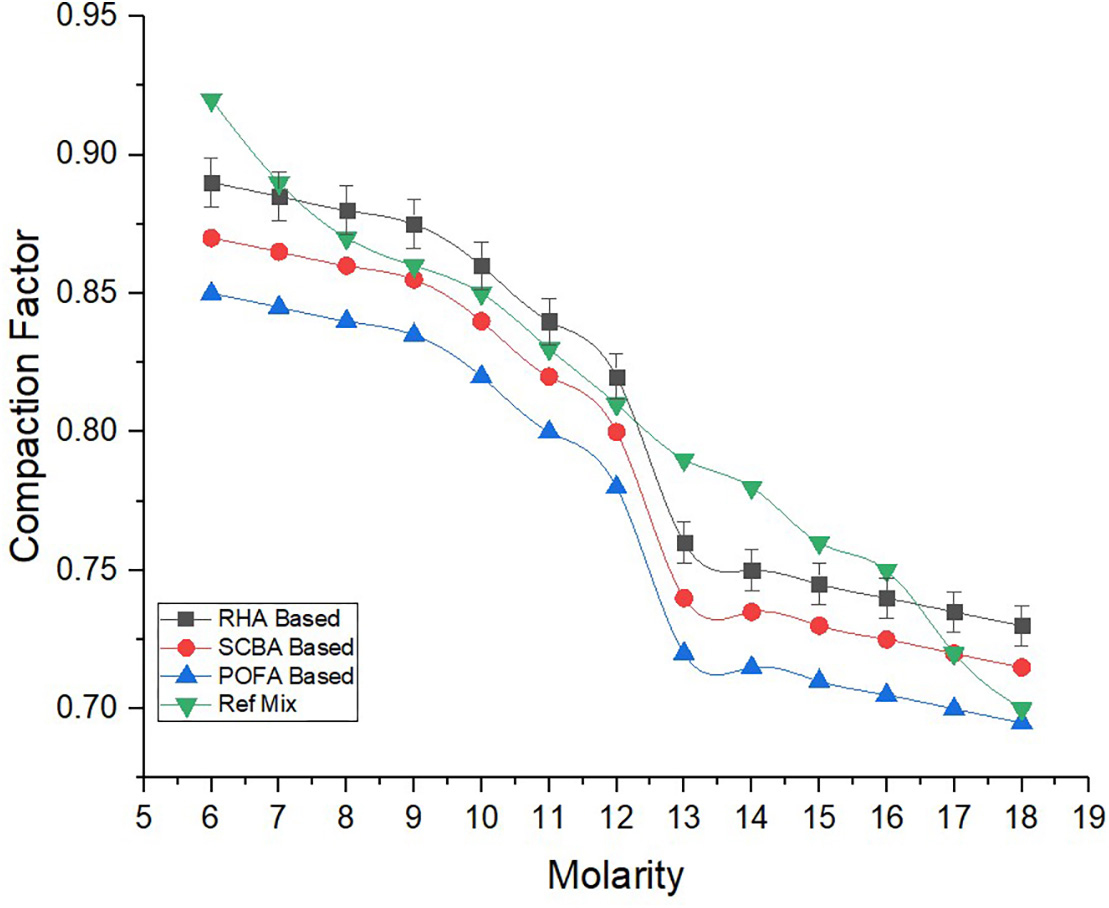
The results of the compaction factor test for geopolymer concrete mixes activated with rice husk ash (RHA), sugarcane bagasse ash (SCBA), and palm oil fuel ash (POFA)–derived sodium silicate solutions under varying molarities (6 M to 18 M) are presented in Figure 2. Workability is a critical parameter in geopolymer concrete production as it influences the ease of mixing, placing, and compaction of fresh concrete. In geopolymer systems, workability is strongly dependent on the concentration of the alkaline activator, as higher molarity typically increases the viscosity of the solution and reduces the fluidity of the mix.

The results indicate a consistent decrease in compaction factor with increasing molarity for all the activator systems. This reduction reflects the stiffening effect induced by higher concentrations of hydroxide ions, which accelerate the dissolution of silica and alumina, leading to rapid geopolymeric gel formation and reduced flowability. For the RHA-based activator, the compaction factor decreased gradually from 0.92 at 6 M to 0.84 at 13 M, representing an 8.7% reduction. Beyond 13 M, the values further dropped to 0.81 and 0.79 for 15 M and 18 M solutions, respectively—corresponding to an overall reduction of approximately 14% compared to the 6 M mix. The reduction in workability at higher molarity is attributed to faster polymerization reactions that promote early gel formation, increasing paste stiffness and reducing the lubricating effect within the mix. Similar findings were reported by HAMADA et al. [55], who observed a marked reduction in slump and compaction factor in RHA-based geopolymers with increasing alkaline concentration due to the accelerated setting of the binder matrix. The SCBA-based mixes showed a comparable trend. At 6 M, the compaction factor was 0.91, which decreased to 0.83 at 13 M, corresponding to an 8.8% drop. Further increases in molarity to 15 M and 18 M reduced the values to 0.80 and 0.78, respectively, resulting in a total reduction of about 14.3%. The relatively lower workability of SCBA mixes compared to RHA can be attributed to the irregular and porous morphology of bagasse ash particles, which increases surface area and water demand. The reduced workability of SCBA-based mixtures is more appropriately explained by particle morphology, residual carbon content, and internal porosity, rather than fineness alone. SEM observations revealed that SCBA particles possess a highly irregular, angular, and porous morphology, with rough surface texture and partially fused agglomerates. Such characteristics increase internal water absorption and friction between particles, leading to reduced flowability despite a lower overall specific surface area compared to RHA. In addition, the higher loss on ignition (LOI) of SCBA (8.6%), indicative of residual unburnt carbon, contributes to increased adsorption of the alkaline activator solution, further reducing effective free water available for flow. In contrast, although RHA exhibits higher fineness, its particles are predominantly lightweight, highly siliceous, and uniformly distributed, which facilitates better dispersion within the matrix and reduces interparticle friction. Similar observations have been reported in previous studies, where SCBA-based systems showed lower workability than RHA-based systems despite lower fineness, primarily due to particle shape, porosity, and carbonaceous content rather than surface area effects alone. Therefore, the workability behavior of agro-waste–based geopolymer concretes is governed by a combined effect of fineness, particle morphology, porosity, and residual carbon, rather than fineness in isolation. The revised interpretation aligns with the experimental results and established literature on biomass ash–based cementitious and geopolymer systems. This observation aligns with the findings of VANATHI et al. [56], who noted that the presence of unburnt carbon and angular particle shapes in SCBA adversely affects the fresh properties of geopolymer mixtures. The POFA-based activator exhibited the lowest workability among the tested systems. At 6 M, POFA mixes showed a compaction factor of 0.90, which decreased to 0.82 at 13 M, 0.79 at 15 M, and 0.77 at 18 M. The total reduction from 6 M to 18 M was approximately 14.4%. This significant reduction in workability can be attributed to the relatively higher crystalline content and lower amorphous silica reactivity of POFA, which delays dissolution and limits the formation of lubricating gels in the early stages. Furthermore, the coarser particle size of POFA contributes to higher inter-particle friction and increased paste viscosity. Similar findings were reported by SORTE et al. [57], who observed that POFA-based geopolymer concretes exhibited reduced workability due to the ash’s high water absorption capacity and poor particle packing characteristics. For comparison, the reference mix containing commercially produced sodium silicate exhibited a compaction factor of 0.93 at 6 M, which reduced to 0.85 at 13 M (an 8.6% decrease) and further to 0.80 at 18 M (a 14% reduction). Although the reference mix maintained marginally higher workability than the agro-waste–derived activators, all systems demonstrated a similar decreasing trend with increasing molarity [20]. The observed decline in workability with higher molarity can be explained by the rheological behavior of geopolymer systems. At low molarities, the dissolution of aluminosilicate sources occurs at a moderate rate, allowing adequate dispersion and lubrication of particles. However, as the molarity increases, the higher concentration of hydroxide ions enhances the rate of silica and alumina dissolution, promoting rapid polymerization and early gel formation. This process leads to an increase in mix stiffness, resulting in lower compaction factor values. The optimum molarity for balancing workability and strength was identified as 13 M. At this concentration, the mixes achieved acceptable workability while maintaining sufficient reactivity for geopolymerization. Beyond 13 M, further increases in molarity resulted in marginal strength improvements but severe loss in workability, which could cause practical difficulties in casting and potential microcracking due to poor compaction. From a field application standpoint, therefore, 13 M represents the best compromise between fresh and hardened properties. This observation is supported by findings from ADELEKE et al. [58], who emphasized that excessively high alkaline concentrations may enhance early strength but simultaneously reduce workability and increase microstructural brittleness. The reduced workability observed in SCBA-based geopolymer mixtures is more consistently explained by rapid gel formation and flash setting behavior rather than particle fineness. Although SCBA exhibits lower fineness than RHA, the compaction factor results indicate a pronounced loss of workability, particularly at higher molarity levels. This behavior can be attributed to the higher calcium content of SCBA, which accelerates the geopolymerization process and promotes early formation of C–A–S–H type gels in highly alkaline environments. The rapid development of reaction products increases mixture stiffness and reduces the available time for compaction, leading to a decline in measured workability. This interpretation aligns well with the experimental observations and with previous studies reporting that calcium-rich biomass ashes tend to induce faster setting and reduced workability in alkali-activated systems due to enhanced reaction kinetics and early gel precipitation. Therefore, the observed reduction in workability of SCBA mixtures is primarily governed by chemical reactivity and gel formation rate, rather than surface area effects.
3.2. Compressive strength
The compressive strength behavior of all geopolymer concrete mixes activated using agro-waste–derived sodium silicate solutions (RHA, SCBA, and POFA) and the reference mix (commercial sodium silicate) was evaluated at different molarities ranging from 6 M to 18 M. The results, summarized in Figure 3, show a clear trend across all mixes—compressive strength increased progressively with molarity up to 13 M and then decreased beyond this point.

This trend was consistent for all activator systems, although the magnitude of strength varied depending on the silica content, amorphous phase proportion, and overall reactivity of the corresponding ashes. For the RHA-based geopolymer concrete, compressive strength improved substantially as the molarity increased from 6 M (RHA-6M: 20.5 MPa) to 13 M (RHA-13M: 45.0 MPa), representing a total increment of 24.5 MPa, or nearly a 120% increase. At the optimum 13 M molarity, the RHA mix exhibited slightly higher strength than the reference mix (Ref-13M: 39.5 MPa), showing a 14% improvement. The superior performance of the RHA-based activator can be attributed to its high amorphous silica content (approximately 87.5%), which readily dissolves in alkaline conditions to form a dense, well-connected sodium aluminosilicate hydrate (N–A–S–H) gel. The enhanced geopolymerization reaction in RHA systems contributes to improved matrix densification and lower porosity. However, further increases in molarity beyond 13 M resulted in a strength decline—42.0 MPa at 15 M and 37.8 MPa at 18 M—indicating a 16% reduction relative to the optimum. The loss in strength at higher molarities is primarily due to excessive alkalinity, which promotes rapid gel formation and flash setting, resulting in internal microcracking and uneven gel distribution. Similar behavior was reported by JWAIDA et al. [59] and CASTILLO et al. [60], in which RHA-based geopolymers exhibited optimal performance within the 12–14 M range, beyond which strength deteriorated due to microstructural instability. For the SCBA-based mixes, a similar trend was observed. Compressive strength increased from 19.0 MPa at 6 M to 43.0 MPa at 13 M, corresponding to an overall gain of 24.0 MPa or about 126% improvement. The 13 M mix (SCBA-13M) achieved a 8.9% higher strength than the reference mix, confirming its potential as an effective activator precursor. However, strength decreased at higher molarities, recording 39.8 MPa at 15 M and 35.3 MPa at 18 M—a 17.9% reduction from the 13 M optimum. The slightly lower strength of SCBA-based geopolymers compared to RHA systems can be attributed to the higher unburnt carbon content and lower proportion of reactive amorphous silica. The porous, irregular morphology of SCBA particles also leads to increased water demand and less uniform gel formation. Earlier works by ABDULHALEEM et al. [61] emphasized that controlled calcination (at around 700 °C) is crucial to reducing residual carbon and enhancing the pozzolanic reactivity of SCBA. The POFA-based geopolymer concrete exhibited the lowest compressive strength among the three agro-waste systems. At 6 M, the mix achieved 18.0 MPa, and at the optimum molarity of 13 M, the strength peaked at 41.5 MPa—representing an increase of 23.5 MPa or about 131% compared to 6 M. Despite this improvement, the POFA-13M mix still showed slightly lower strength than the RHA and SCBA mixes, being 3.5 MPa (≈8%) lower than RHA-13M. Beyond the optimum, the compressive strength decreased to 38.4 MPa at 15 M and 34.2 MPa at 18 M, representing a 17.6% loss from the peak value. The inferior strength performance of POFA-based mixes is attributed to their lower amorphous silica content (≈56.7%) and the presence of inert crystalline quartz and feldspar phases, which resist dissolution during geopolymerization [32]. These factors limit the extent of N–A–S–H gel formation and result in a more porous microstructure. Similarly, this research reported that POFA-based geopolymers typically exhibit 15–20% lower mechanical performance than RHA-based counterparts due to reduced silica reactivity and higher crystalline content. When comparing all mixes at 13 M molarity, the following hierarchy in compressive strength was observed: RHA-13M (45.0 MPa) > SCBA-13M (43.0 MPa) > POFA-13M (41.5 MPa) > Reference (39.5 MPa). This comparison highlights that all agro-based activators outperformed the commercial sodium silicate system, demonstrating their potential as viable and sustainable alternatives for geopolymer activation. Among them, RHA proved to be the most effective precursor due to its higher amorphous silica proportion and finer particle morphology, followed by SCBA and then POFA. The improvement in strength with increasing molarity up to 13 M can be explained by the enhanced dissolution kinetics of aluminosilicate precursors. At moderate molarities, the increased concentration of hydroxide ions promotes the breakdown of Si–O–Si and Al–O–Si bonds, allowing more reactive species to participate in polymerization. This leads to the formation of a denser and more compact geopolymer network. However, excessive molarity (>13 M) leads to an imbalance between dissolution and condensation reactions, resulting in premature gelation and incomplete structure formation. The presence of excess sodium ions can also introduce osmotic pressure within the gel structure, leading to microvoids and cracking during drying, which ultimately reduces the overall strength. The reference mix, prepared using industrial-grade sodium silicate, followed a similar behaviour with strength increasing from 21.0 MPa at 6 M to 39.5 MPa at 13 M, and decreasing thereafter to 36.0 MPa (15 M) and 32.5 MPa (18 M). The results confirm that the effect of molarity on compressive strength is more pronounced in geopolymer concretes activated with waste-derived sodium silicate due to the variation in silica dissolution efficiency and gel formation rate. The experimental findings are consistent with previous studies [33], which have shown that increasing alkaline concentration initially enhances silica dissolution and geopolymer gel formation, but beyond an optimum threshold, excess alkalinity leads to microstructural weakness and brittleness. At very high molarities, the rapid precipitation of aluminosilicate species restricts further polymerization, creating a heterogeneous and weak matrix. Therefore, maintaining the balance between alkalinity and gel growth rate is critical for achieving high mechanical performance. In conclusion, the compressive strength results clearly establish 13 M as the optimum molarity for all mixes, providing the best balance between chemical reactivity and microstructural integrity. RHA-based activators demonstrated the highest compressive strength, followed closely by SCBA and POFA systems. The results substantiate that agro-waste–derived sodium silicate solutions not only match but can outperform commercial activators when properly optimized. This confirms their potential for sustainable, low-carbon geopolymer concrete production using regionally available waste materials.
While geopolymers are widely recognized as environmentally favorable alternatives to ordinary Portland cement (OPC), it is important to acknowledge that the processing of agro-waste–derived precursors is not entirely energy-free. In the present study, the preparation of rice husk ash (RHA), sugarcane bagasse ash (SCBA), and palm oil fuel ash (POFA) involved oven drying at 105 °C followed by controlled calcination at 700 °C for two hours, which inevitably requires thermal energy input. Therefore, the environmental impact of these agro-wastes cannot be assumed to be zero. However, the energy demand associated with these processing steps is substantially lower than that required for OPC clinker production, which typically involves kiln temperatures of approximately 1450°C and is responsible for significant process-related CO2 emissions due to limestone decarbonation. In contrast, the calcination of agro-wastes is primarily aimed at enhancing amorphous silica content and does not involve inherent CO2-generating chemical reactions. Moreover, in many practical scenarios, RHA, SCBA, and POFA are by-products of existing agricultural or industrial processes, where thermal energy is already available, thereby reducing the need for additional external energy input. It is also noted that the present study did not perform a full life cycle assessment (LCA) or quantify CO2 emissions associated with precursor processing. This represents a limitation of the current work and provides scope for future research to incorporate detailed energy and carbon accounting, including the use of waste heat, renewable energy sources, or alternative low-temperature activation methods. Despite these considerations, the overall environmental advantage of agro-waste-derived geopolymers remains significant when viewed in the context of reduced reliance on clinker-based binders, diversion of waste from landfills, and potential reductions in embodied carbon at the system level.
3.3. Split tensile strength
The split tensile strength of all geopolymer concrete mixes activated with agro-waste–derived sodium silicate (RHA, SCBA, and POFA) was evaluated at molarities ranging from 6 M to 18 M, as shown in Figure 4. The results reveal a consistent trend across all mixes: tensile strength increases progressively with molarity up to 13 M, followed by a gradual decline beyond this point. This behavior parallels the compressive strength trends, reflecting the interdependence between tensile and compressive performance.

The initial improvement is attributed to enhanced geo-polymerization and matrix densification, while the subsequent decrease is due to excessive alkalinity, which disrupts gel formation and induces microstructural embrittlement. For the RHA-based mixes, tensile strength increased from 2.3 MPa at 6 M to 4.7 MPa at 13 M, representing an improvement of approximately 104%. At higher molarities, strength declined marginally to 4.3 MPa at 15 M and 3.9 MPa at 18 M, corresponding to a 17% reduction relative to the optimum. The superior tensile performance of RHA mixes is attributed to their high reactive silica content, which facilitates the formation of a dense aluminosilicate gel network, enhancing resistance to crack propagation under tensile stresses. Previous studies have reported similar findings, highlighting that RHA-based binders exhibit refined pore structure and improved tensile properties compared to other agro-based ashes [34]. In the SCBA mixes, tensile strength increased from 2.1 MPa at 6 M to 4.5 MPa at 13 M, representing a 114% improvement. Beyond 13 M, strength declined to 4.1 MPa at 15 M and 3.7 MPa at 18 M, a reduction of approximately 18%. The slightly lower performance compared to RHA is attributed to the higher carbon content and reduced reactive silica in SCBA, which can hinder geopolymerization. Prior studies have emphasized that proper calcination of SCBA is essential to minimize carbon residues and improve tensile performance in geopolymer concretes [10]. The POFA mixes exhibited the lowest tensile strength among the three agro-waste ashes. Strength increased from 1.9 MPa at 6 M to 4.2 MPa at 13 M, an improvement of approximately 121%, but remained about 11% lower than the RHA-based mix. Beyond the optimum molarity, tensile strength decreased to 3.8 MPa at 15 M and 3.4 MPa at 18 M, corresponding to a 19% reduction. The lower performance of POFA mixes is associated with their lower amorphous silica content, higher crystalline phases, and relatively greater porosity, which limit effective gel formation. These observations are consistent with previous reports on POFA-based geopolymers [14].
3.4. Flexural strength
The flexural strength of geopolymer concrete mixes incorporating RHA, SCBA, and POFA at molarities ranging from 6 M to 18 M is presented in Figure 5. The observed behavior mirrors that of compressive and tensile strength, with values increasing steadily up to 13 M and decreasing slightly at higher molarities. Flexural strength reflects the capacity of the binder matrix to resist micro-crack initiation and propagation, which is enhanced by optimal geopolymerization and a uniform aluminosilicate gel network. For the RHA-based mixes, flexural strength increased from 3.4 MPa at 6 M to a maximum of 7.1 MPa at 13 M, corresponding to an improvement of approximately 108%. Beyond the optimum molarity, strength decreased to 6.5 MPa at 15 M and 6.0 MPa at 18 M, representing a 15% reduction from the peak value. The superior performance of RHA mixes is attributed to their high amorphous silica content, which promotes effective reaction with the alkaline medium to produce a dense, homogeneous gel matrix. Previous studies have also highlighted the ability of RHA to refine pore structure and enhance flexural properties through improved matrix cohesion [19]. The SCBA-based mixes exhibited a similar trend, with flexural strength increasing from 3.1 MPa at 6 M to 6.8 MPa at 13 M—a 119% improvement. At higher molarities, strength declined to 6.2 MPa at 15 M and 5.7 MPa at 18 M, representing a reduction of approximately 16%. The moderate performance of SCBA is associated with the presence of unburnt carbon and larger pore sizes, which reduce matrix stiffness. Earlier studies [6] indicated that proper calcination and particle fineness are essential for maximizing the flexural performance of SCBA-based geopolymer concretes.

For the POFA-based mixes, flexural strength was the lowest among the three agro-waste ashes. The strength increased from 2.9 MPa at 6 M to 6.3 MPa at 13 M, reflecting a 117% improvement. Beyond 13 M, strength decreased to 5.8 MPa at 15 M and 5.3 MPa at 18 M, a 16% reduction relative to the optimum. The lower performance of POFA mixes is attributed to their higher crystalline content and reduced reactivity, which limit gel formation and increase susceptibility to crack propagation. These observations are consistent with previous studies, which reported that POFA contributes less effectively to flexural strength compared to RHA and SCBA [32]. When compared with the reference mix (6.7 MPa at 13 M), RHA-based mixes showed an approximately 6% improvement, SCBA-based mixes were nearly equivalent, and POFA-based mixes were about 6% lower. Overall, RHA emerged as the most effective precursor for enhancing flexural performance, followed by SCBA and POFA. The results also confirm that 13 M represents the optimum molarity for all agro-waste activators. The improvement up to this molarity is attributed to enhanced dissolution of silica and alumina, promoting dense geopolymeric gel formation, while reductions at higher molarities are caused by excessive hydroxide ions, which induce micro-cracking and weaken the matrix. These findings agree with previous reports, which concluded that optimum alkali concentration is critical for maximizing flexural performance, while higher concentrations lead to embrittlement and reduced mechanical integrity.
3.5. Acid resistance
The acid resistance of geopolymer concrete mixes activated with sodium silicate derived from RHA, SCBA, and POFA was evaluated by immersing 28-day cured specimens in a 5% sulphuric acid (H2SO4) solution for 28 days. The percentage reduction in compressive strength after acid exposure at different alkaline molarities is presented in Figure 6. Across all mixes, resistance to acid attack improved with increasing molarity up to 13 M, beyond which a marginal increase in strength loss was observed. This trend indicates that an optimum alkaline concentration promotes the formation of a dense and stable aluminosilicate gel, while excessive alkalinity leads to microstructural instability, facilitating acid ingress. For RHA-based geopolymer concrete, the percentage reduction in compressive strength decreased markedly from 6.8% at 6 M to 3.2% at 13 M, representing an improvement of approximately 52.9% in acid resistance. At higher molarities, a slight increase in strength reduction was observed, with values of 3.5% at 15 M and 3.8% at 18 M, indicating the onset of microcracking and non-uniform gel formation at excessive alkalinity levels. The superior acid resistance of RHA-based mixes is attributed to their high amorphous silica content, which promotes the formation of a compact sodium aluminosilicate hydrate (N–A–S–H) gel with low permeability and improved chemical stability under acidic environments. Similar trends have been reported in earlier studies, where RHA-based geopolymer systems exhibited enhanced strength retention after acid exposure due to dense gel structure and reduced calcium content compared to OPC systems [47]. SCBA-based geopolymer concrete exhibited a comparable pattern, with strength reduction decreasing from 7.3% at 6 M to 3.9% at 13 M, corresponding to a 46.5% improvement in acid resistance. Beyond the optimum molarity, strength loss slightly increased to 4.1% at 15 M and 4.4% at 18 M. The relatively higher strength reduction observed in SCBA mixes compared to RHA systems can be attributed to the presence of residual unburnt carbon and lower reactive silica availability, which limit the extent of geopolymer gel densification and result in comparatively higher susceptibility to acid attack. Overall, the results confirm that 13 M is the optimum molarity for achieving maximum acid resistance in agro-waste–derived geopolymer concrete. The observed trends demonstrate that strength retention is strongly governed by the balance between alkaline activation and gel stability, and that excessive molarity, despite enhancing dissolution, adversely affects long-term durability under acidic exposure.

Previous research has highlighted that proper calcination of SCBA is essential to enhance acid resistance by promoting the formation of a reactive amorphous phase and reducing residual carbon content [10]. In the present study, POFA-based geopolymer mixes exhibited the lowest acid resistance among the three agro- waste–derived activator systems. The percentage reduction in compressive strength after acid exposure decreased from 8.1% at 6 M to 4.6% at 13 M, representing an improvement of approximately 43.2%. Beyond the optimum molarity, a marginal increase in strength loss was observed, with values of 4.8% at 15 M and 5.1% at 18 M. The comparatively inferior performance of POFA-based mixes is attributed to their lower reactive silica content, the presence of inert crystalline phases, and higher intrinsic porosity, which collectively restrict geopolymer gel development and facilitate deeper acid penetration. Similar observations have been reported in the literature, where POFA-based geopolymer concretes exhibited 15–20% higher strength degradation under acidic environments compared to RHA-based systems [14]. The reference mix activated with commercial sodium silicate demonstrated slightly superior acid resistance, with strength reduction decreasing from 6.4% at 6 M to 3.0% at 13 M, corresponding to a 53.1% improvement, followed by marginal increases to 3.3% and 3.5% at 15 M and 18 M, respectively. The comparable performance of RHA-based geopolymer concrete to the reference mix confirms the effectiveness of RHA-derived sodium silicate as a sustainable alternative to commercial activators. Overall, 13 M molarity was identified as the optimum for achieving maximum acid resistance across all mixes, with RHA-based systems performing nearly on par with the reference mix, while SCBA and POFA exhibited moderate resistance. These findings are consistent with previous studies indicating that geopolymer concretes with higher silica content and denser aluminosilicate gel structures exhibit superior resistance to acidic attack compared to OPC systems, primarily due to the absence of calcium hydroxide, which is highly vulnerable to acid dissolution [32].
3.6. Water absorption
Figure 7 shows the water absorption rate for various mixes with respect to their molarity. The durability of geopolymer concrete mixes incorporating sodium silicate derived from RHA, SCBA, and POFA was further evaluated through water absorption tests, conducted in accordance with ASTM C1898 – 2020 [44] and ASTM C1585 – 2020 [45]. Water absorption reflects the pore structure, density, and connectivity of capillary pores, and is directly related to the long-term durability of concrete, including its resistance to moisture ingress, chemical attack, and freeze–thaw cycles. For RHA-based mixes, water absorption decreased significantly with increasing molarity up to 13 M. The RHA-6 M mix exhibited a water absorption of 4.8%, which reduced to 2.5% at 13 M, corresponding to a 47.9% improvement. Beyond the optimum molarity, slight increases were observed, with values reaching 2.7% at 15 M and 2.9% at 18 M. The low water absorption is attributed to the formation of a dense and homogeneous aluminosilicate gel, which refines the pore structure and reduces capillary connectivity. The results indicate that RHA effectively contributes to durability enhancement in geopolymer concretes, consistent with previous studies reporting reduced permeability and enhanced compactness in RHA-based systems [55]. SCBA-based mixes demonstrated a similar trend. Water absorption decreased from 5.1% at 6 M to 2.9% at 13 M, representing a 43.1% reduction. At higher molarities, absorption increased slightly to 3.1% at 15 M and 3.3% at 18 M. The comparatively higher water absorption relative to RHA is associated with the presence of unburnt carbon, irregular particle morphology, and larger pore sizes in SCBA, which limit gel formation and create pathways for water ingress. Proper calcination and particle fineness are therefore critical for enhancing durability in SCBA-based geopolymer concretes [10]. POFA-based mixes exhibited the highest water absorption among the three agro-waste ashes. Values decreased from 5.4% at 6 M to 3.2% at 13 M (a 40.7% improvement), and increased marginally to 3.4% at 15 M and 3.6% at 18 M. The lower performance of POFA is attributed to its lower amorphous silica content, higher crystalline phases, and relatively greater porosity, which limit gel formation and reduce matrix compactness. Previous studies also reported that POFA-based concretes exhibit higher water absorption and lower durability compared to RHA and SCBA-based mixes [61].

The reference mix displayed slightly lower water absorption than the agro-based mixes, decreasing from 4.6% at 6 M to 2.4% at 13 M, and increasing slightly to 2.6% at 15 M and 2.8% at 18 M. This performance indicates that while commercial sodium silicate provides excellent densification and durability, RHA-based mixes achieve comparable results, confirming its potential as a sustainable alternative. Overall, the results indicate that 13 M molarity is optimal for achieving minimum water absorption and maximum durability across all mixes. The reduction in absorption at this concentration is primarily due to enhanced geopolymerization, improved gel formation, and refinement of the pore network, while higher molarities lead to slight deterioration due to microcracking and increased porosity. These findings are consistent with earlier studies, which have shown that geopolymer concretes with high silica content and dense gel networks exhibit superior resistance to water ingress and enhanced long-term durability relative to OPC concretes [62].
3.7. Sulphate resistance test
The sulphate resistance of geopolymer concrete prepared using agro-waste ash–derived sodium silicate solutions was evaluated by immersing 28-day cured specimens in a 5% sodium sulphate (Na2SO4) solution for exposure periods of 28, 56, and 90 days. The durability performance was assessed in terms of compressive strength retention, expressed as the percentage ratio of compressive strength after sulphate exposure to that of unexposed control specimens. Figure 8 illustrates the variation in compressive strength retention of geopolymer concrete mixes activated with commercial sodium silicate (control) and ash-derived sodium silicate solutions synthesized from RHA, SCBA, and POFA. All mixes exhibited a gradual reduction in compressive strength with increasing sulphate exposure duration; however, the extent of deterioration varied depending on the source of sodium silicate. At 90 days of sulphate exposure, the geopolymer concrete activated with RHA-derived sodium silicate demonstrated the highest strength retention (≈95%), followed by the control mix using commercial sodium silicate (≈94%). In comparison, SCBA- and POFA-derived activator systems showed slightly lower strength retention values of approximately 93% and 92%, respectively. The relatively lower reduction in strength for the RHA-based system indicates superior resistance to sulphate ingress and associated chemical degradation.

The observed sulphate resistance behavior of the geopolymer concrete can be attributed primarily to the dense aluminosilicate gel structure formed during geopolymerization. Unlike Portland cement systems, geopolymer binders contain negligible amounts of free calcium hydroxide, which significantly reduces the formation of expansive products such as gypsum and ettringite during sulphate exposure. As a result, all geopolymer mixes exhibited good intrinsic resistance to sulphate attack. The enhanced performance of the RHA-derived sodium silicate system is closely linked to its high amorphous silica content and improved SiO2/Na2O ratio, which promoted the formation of a highly cross-linked N-A-S-H gel matrix. This refined microstructure reduced pore connectivity and limited sulphate ion penetration, leading to lower strength loss even after prolonged exposure. In contrast, the slightly higher strength loss observed in SCBA- and POFA-based systems may be associated with their comparatively lower silica content and higher residual impurities, which can result in a less compact geopolymeric network [63]. Nevertheless, the performance of these mixes remained comparable to, and in some cases close to, that of the commercial sodium silicate control, demonstrating the viability of agro-waste ash–derived sodium silicate as an alternative alkaline activator. Overall, the results confirm that geopolymer concrete incorporating ash-derived sodium silicate solutions exhibits adequate to excellent resistance against sulphate attack, with performance trends consistent with those reported in previous studies on low- calcium geopolymer systems. The findings further support the sustainable utilization of agro-waste ashes not only as binder precursors but also as sources for activator synthesis, without compromising long-term durability. The mechanical and durability results of geopolymer concrete are presented as mean ± standard deviation (SD) with corresponding coefficient of variation (CV%) for three replicate specimens per mix (Tables 2 and 3). One-way ANOVA was conducted to evaluate the statistical significance of differences between mixes. As shown in Table 4, all measured properties, compressive, split tensile, and flexural strengths, as well as acid resistance, water absorption, and sulphate attack resistance, exhibited statistically significant variation (p < 0.05) depending on the type of agro-waste ash and activator composition. These analyses confirm that the trends observed in the study are robust and reproducible.
3.8. Microstructure studies
The SEM images of various concrete mixes are shown in Figure 9. The microstructure of geopolymer concrete mixes activated with sodium silicate derived from RHA, SCBA, and POFA was examined using Scanning Electron Microscopy (SEM) to evaluate gel formation, bonding mechanisms, and pore structure. Representative samples at 13 M molarity, which exhibited optimum mechanical and durability performance, were analyzed. RHA-based mixes exhibited a dense and homogeneous matrix with a well-interlocked network of geopolymeric gel. The SEM images revealed continuous N-A-S-H (sodium aluminosilicate hydrate) gel enveloping the binder particles, with minimal microvoids and microcracks. The refined pore structure and compact gel network explain the superior compressive, tensile, and flexural strengths observed, as well as low water absorption and high acid resistance. The high amorphous silica content of RHA facilitated efficient polymerization, resulting in a highly cohesive and durable microstructure. SCBA-based mixes displayed a moderately dense gel structure with occasional unreacted ash particles and microvoids.

The irregular particle morphology and presence of residual carbon hindered complete geopolymerization, producing a less uniform matrix than RHA mixes. Despite these limitations, the gel matrix provided sufficient bonding between particles and aggregates, supporting the moderate mechanical and durability performance of SCBA-based geopolymer concrete. POFA-based mixes showed a heterogeneous microstructure with higher porosity and several microcracks. SEM images revealed incomplete gel formation and the presence of inert crystalline phases, which reduced matrix cohesion and increased susceptibility to crack propagation. This microstructural observation aligns with the lower compressive, tensile, and flexural strengths, as well as higher water absorption and reduced acid resistance compared to RHA and SCBA mixes. Overall, SEM analysis confirmed that the type of agro-waste ash strongly influences the microstructural development of geopolymer concrete. RHA enabled the formation of a dense, continuous gel network, SCBA produced a moderately compact structure, and POFA resulted in a more porous and less reactive matrix. These microstructural characteristics directly correlate with the mechanical strength and durability outcomes observed in the study. Despite the promising outcomes of this research, several limitations must be acknowledged. Firstly, the chemical composition and properties of agro-waste ashes used for synthesizing sodium silicate can vary depending on their source, season, and combustion conditions, potentially affecting the consistency of the results [64]. Secondly, the study was conducted at a laboratory scale, and the scalability of the synthesis process for industrial applications requires further investigation. Additionally, the curing conditions and molarity of the synthesized alkaline activator were optimized within a limited range, which may not fully represent all practical scenarios. The mechanical and durability assessments were primarily short-term, and long-term performance under diverse environmental conditions remains unexamined. Furthermore, while the study demonstrates the environmental benefits of using agro-waste, a comprehensive life-cycle assessment and detailed economic feasibility analysis were not performed. Finally, microstructural analyses, although insightful, may not capture all the long-term chemical interactions within the geopolymer matrix. These limitations highlight areas for future research to validate and expand the applicability of the findings. Energy dispersive X-ray (EDAX) analysis was conducted to identify the elemental composition of rice husk ash (RHA), sugarcane bagasse ash (SCBA), and palm oil fuel ash (POFA) and to support the XRF results by providing localized chemical information at the microstructural level (Figure 10). The EDAX spectra confirmed that all three ashes are predominantly siliceous in nature, with variations in elemental distribution reflecting differences in raw material origin and combustion characteristics. Rice husk ash (RHA) exhibited a dominant presence of silicon (Si) and oxygen (O), confirming that silica is the principal constituent. Minor traces of potassium (K), calcium (Ca), magnesium (Mg), and aluminum (Al) were also detected. The high Si and O peaks indicate the presence of silica-rich phases, largely in amorphous form due to controlled calcination temperatures. The low calcium content observed in RHA is particularly beneficial for geopolymer applications, as it favors the formation of sodium aluminosilicate hydrate (N–A–S–H) gel rather than calcium-based reaction products. The relatively uniform elemental distribution observed in the EDAX mapping suggests homogeneous silica availability, which explains the superior reactivity and durability performance of RHA-based geopolymer systems. Sugarcane bagasse ash (SCBA) showed silicon and oxygen as major elements, although their relative intensities were lower than those observed in RHA. In addition to Si and O, noticeable amounts of carbon (C), aluminum (Al), potassium (K), iron (Fe), and calcium (Ca) were detected. The presence of residual carbon indicates incomplete combustion of bagasse fibers, which can reduce effective silica availability for geopolymerization.

The higher calcium content compared to RHA suggests partial participation of calcium in the reaction process, potentially leading to the coexistence of N–A–S–H and C–A–S–H type gels. While this may contribute to early strength development, it can also result in a less chemically stable matrix under aggressive environments, consistent with the moderate durability performance observed for SCBA-based geopolymer concrete. Palm oil fuel ash (POFA) exhibited a more complex elemental composition. Along with silicon and oxygen, relatively higher contents of calcium, magnesium, iron, and potassium were identified [65]. The silica peaks were less intense compared to RHA and SCBA, indicating a lower proportion of reactive silica. The elevated calcium and iron contents are attributed to the mineral impurities present in palm oil residues and soil contamination during fuel handling. These elements tend to form inert or partially reactive phases, which reduce the efficiency of geopolymer gel formation. Additionally, EDAX mapping revealed a less uniform elemental distribution, suggesting heterogeneous microstructural characteristics. This explains the comparatively lower strength and durability performance of POFA-based geopolymer systems. Overall, the EDAX analysis corroborates the XRF findings and confirms that RHA possesses the highest reactive silica content, followed by SCBA and POFA. The elemental composition obtained from EDAX provides a clear microchemical basis for the observed differences in geopolymerization efficiency, mechanical performance, and durability characteristics among the agro-waste ashes. The results further validate the suitability of RHA as a highly effective precursor and activator source for sustainable geopolymer concrete, while SCBA and POFA remain viable alternatives with moderate performance depending on processing conditions. It is acknowledged that SEM–EDX does not provide crystallographic information, and therefore cannot distinguish conclusively between amorphous and crystalline silica phases. Similarly, XRD and XRF analyses were not performed in the present investigation, which represents a limitation with respect to direct phase identification and bulk oxide quantification. However, SEM–EDX remains a widely accepted and informative technique for evaluating ash reactivity potential, as highly reactive biomass ashes typically exhibit irregular, porous, and angular morphologies with homogeneous silicon-rich elemental distribution, features that were clearly observed for all three agro-waste ashes examined in this study. Although similar trends were observed across compressive, split tensile, and flexural strength tests, these patterns can be attributed to the underlying geopolymerization mechanisms. The strength development of all mixes is primarily governed by the dissolution of amorphous silica from the agro-waste ashes, the subsequent formation of sodium aluminosilicate hydrate (N–A–S–H) gel, and densification of the binder matrix. Variations in strength among mixes are further influenced by ash chemistry, NaOH molarity, and the proportion of ash-derived versus commercial sodium silicate. Consequently, consistent trends across different mechanical tests are expected and reflect the intrinsic relationship between matrix densification and mechanical performance. The discussion below critically interprets these trends rather than merely describing the numerical results.
4. CONCLUSION
The present study successfully demonstrated the sustainable synthesis of sodium silicate from agro-waste ashes, including rice husk ash (RHA), sugarcane bagasse ash (SCBA), and palm oil fuel ash (POFA), and its application as an alkaline activator in geopolymer concrete. The experimental results highlight that the molarity of the synthesized activator significantly influences the performance of geopolymer concrete in both fresh and hardened states. Workability, assessed through the compaction factor test, improved gradually with increasing molarity up to 13 M and decreased slightly at higher concentrations due to excess alkalinity, which caused stiffening and potential microstructural instability. Compressive strength increased steadily from 6 M to 13 M, reaching peak values of 45 MPa for RHA, 43 MPa for SCBA, and 41.5 MPa for POFA mixes, closely matching the reference mix (39.5 MPa). Beyond 13 M, strength declined due to microcracking and reduced polymerization caused by excess hydroxide ions. Split tensile and flexural strength results exhibited similar trends, confirming 13 M as the optimum molarity for all activators. Durability assessments, including acid resistance and water absorption, indicated superior performance for RHA- and SCBA-based mixes compared to POFA, attributed to higher amorphous silica content, lower carbon residues, and enhanced reactivity. Overall, the findings confirm that agro-waste-based sodium silicate is a viable alternative to commercial sodium silicate, promoting sustainable geopolymer production while reducing energy consumption, carbon emissions, and waste disposal issues.
5. BIBLIOGRAPHY
-
[1] SUAREZ-RIERA, D., RESTUCCIA, L., FALLIANO, D., et al, “An overview of methods to enhance the environmental performance of cement-based materials”, Infrastructures, v. 9, n. 6, pp. 94, 2024. doi: http://doi.org/10.3390/infrastructures9060094.
» https://doi.org/10.3390/infrastructures9060094 -
[2] PEPERA, R., SHAFEI, B., “Advancing toward net zero: the role of fibers in sustainable concrete construction”, In: Kioumarsi, M., Shafei, B. (eds), The 1st International Conference on Net-Zero Built Environment. NTZR 2024, Lecture Notes in Civil Engineering, Cham, Springer, 2025. v. 237. doi: https://doi.org/10.1007/978-3-031-69626-8_31.
» https://doi.org/10.1007/978-3-031-69626-8_31 -
[3] KHASAWNEH, M.A., “Geopolymer concrete in construction projects: a review”, Discover Civil Engineering, v. 2, pp. 124, 2025. doi: http://doi.org/10.1007/s44290-025-00281-1.
» https://doi.org/10.1007/s44290-025-00281-1 -
[4] ANOOP KALLAMALAYIL, N., SAATHVIKA, S., SARAN, D., et al, “Durability assessment of sustainable one-part alkali activated concrete produced from agricultural and industrial waste activators under aggressive environmental conditions”, Construction & Building Materials, v. 486, pp. 141823, 2025. doi: http://doi.org/10.1016/j.conbuildmat.2025.141823.
» https://doi.org/10.1016/j.conbuildmat.2025.141823 -
[5] RICCIOTTI, L., FRETTOLOSO, C., FRANCHINO, R., et al, “Geopolymer materials: cutting-edge solutions for sustainable design building”, Sustainability (Basel), v. 17, n. 16, pp. 7483, 2025. doi: http://doi.org/10.3390/su17167483.
» https://doi.org/10.3390/su17167483 -
[6] WAN, X., REN, L., LV, T., et al, “Research on alkali-activated systems based on solid waste-derived activators: a review”, Sustainability (Basel), v. 17, n. 1, pp. 254, 2025. doi: http://doi.org/10.3390/su17010254.
» https://doi.org/10.3390/su17010254 -
[7] SIVASAKTHI, M., JEYALAKSHMI, R., RAJAMANE, N.P., “Effect of change in the silica modulus of sodium silicate solution on the microstructure of fly ash geopolymers”, Journal of Building Engineering, v. 44, pp. 102939, 2021. doi: http://doi.org/10.1016/j.jobe.2021.102939.
» https://doi.org/10.1016/j.jobe.2021.102939 -
[8] ATHIRA, V.S., CHARITHA, V., ATHIRA, G., et al, “Agro-waste ash-based alkali-activated binder: cleaner production of zero cement concrete for construction”, Journal of Cleaner Production, v. 286, pp. 125429, 2021. doi: http://doi.org/10.1016/j.jclepro.2020.125429.
» https://doi.org/10.1016/j.jclepro.2020.125429 -
[9] KOLADE, A.S., IKOTUN, B.D., OYEJOBI, D.O., “A review of the chemistry, waste utilization, mix design and performance evaluation of geopolymer concrete”, Iranian Journal of Science and Technology. Transaction of Civil Engineering, v. 49, pp. 5421–5454, 2025. doi: http://doi.org/10.1007/s40996-025-01801-w.
» https://doi.org/10.1007/s40996-025-01801-w -
[10] POZHHAN, M., JOEY, L., PRAPASSORN, N., et al, “Valorization of mine tailings for sustainable geopolymer production”, International Journal of Ceramic Engineering & Science, v. 7, n. 4, pp. e70014, 2025. doi: http://doi.org/10.1002/ces2.70014.
» https://doi.org/10.1002/ces2.70014 -
[11] ANOOP KALLAMALAYIL, N., PARTHIBAN, K., MURALI, G., “Fracture behaviour of sustainable activators-based fibrous alkali -activated concrete under mode I, I/III & III loading”, Structural Engineering and Mechanics, v. 93, n. 4, pp. 247–267, 2025. doi: http://doi.org/10.12989/sem.2025.93.4.247.
» https://doi.org/10.12989/sem.2025.93.4.247 -
[12] DAS, S.K., MISHRA, J., SINGH, S.K., et al, “Characterization and utilization of rice husk ash (RHA) in fly ash – Blast furnace slag based geopolymer concrete for sustainable future”, Materials Today: Proceedings, v. 33, pp. 5162–5167, 2020. doi: http://doi.org/10.1016/j.matpr.2020.02.870.
» https://doi.org/10.1016/j.matpr.2020.02.870 -
[13] SALONI, PARVEEN, PHAM, T.M., et al, “Performance of rice husk Ash-Based sustainable geopolymer concrete with Ultra-Fine slag and Corn cob ash”, Construction & Building Materials, v. 279, pp. 122526, 2021. doi: http://doi.org/10.1016/j.conbuildmat.2021.122526.
» https://doi.org/10.1016/j.conbuildmat.2021.122526 -
[14] ALNAHHAL, M.F., HAMDAN, A., HAJIMOHAMMADI, A., et al, “Hydrothermal synthesis of sodium silicate from rice husk ash: effect of synthesis on silicate structure and transport properties of alkali- activated concrete”, Cement and Concrete Research, v. 178, pp. 107461, 2024. doi: http://doi.org/10.1016/j.cemconres.2024.107461.
» https://doi.org/10.1016/j.cemconres.2024.107461 -
[15] ANOOP KALLAMALAYIL, N., PARTHIBAN, K., MURALI, G., et al, “Development and performance evaluation of novel sustainable one-part alkali-activated fibrous concrete subjected to drop weight impact loading: An experimental study”, Construction & Building Materials, v. 459, pp. 139754, 2025. doi: http://doi.org/10.1016/j.conbuildmat.2024.139754.
» https://doi.org/10.1016/j.conbuildmat.2024.139754 -
[16] ADISA, M.A., ODEYEMI, S.O., WILSON, U.N., et al, “Mechanical properties of geopolymer concrete with partial replacement of fly ash by agricultural waste ashes”, Discover Civil Engineering, v. 2, n. 1, pp. 113, 2025. doi: http://doi.org/10.1007/s44290-025-00272-2.
» https://doi.org/10.1007/s44290-025-00272-2 -
[17] ALYAMI, M., HAKEEM, I.Y., AMIN, M., et al, “Effect of agricultural olive, rice husk and sugarcane leaf waste ashes on sustainable ultra-high-performance concrete”, Journal of Building Engineering, v. 72, pp. 106689, 2023. doi: http://doi.org/10.1016/j.jobe.2023.106689.
» https://doi.org/10.1016/j.jobe.2023.106689 -
[18] MURALI, G., ANOOP KALLAMALAYIL, N., KATHIRVEL, P., et al, “Harnessing waste for sustainable construction: a novel synthesizing activators from waste for one-part geopolymer concrete and evaluating its fracture toughness”, Theoretical and Applied Fracture Mechanics, v. 134, pp. 104745, 2024. doi: http://doi.org/10.1016/j.tafmec.2024.104745.
» https://doi.org/10.1016/j.tafmec.2024.104745 -
[19] HANDAYANI, L., APRILIA, S., ABDULLAH, et al, “Sodium silicate from rice husk ash and their effects as geopolymer cement”, Polymers, v. 14, n. 14, pp. 2920, 2022. doi: http://doi.org/10.3390/polym14142920. PubMed PMID: 35890696.
» https://doi.org/10.3390/polym14142920 -
[20] PANITSA, O.A., KIOUPIS, D., KAKALI, G., “Advancing the sustainability of geopolymer technology through the development of rice husk ash based solid activators”, Sustainability (Basel), v. 16, n. 17, pp. 7243, 2024. doi: http://doi.org/10.3390/su16177243.
» https://doi.org/10.3390/su16177243 -
[21] OTI, J., ADELEKE, B.O., MUDIYANSELAGE, P.R., et al, “A comprehensive performance evaluation of GGBS-based geopolymer concrete activated by a rice husk ash-synthesised sodium silicate solution and sodium hydroxide”, Recycling, v. 9, n. 2, pp. 23, 2024. doi: http://doi.org/10.3390/recycling9020023.
» https://doi.org/10.3390/recycling9020023 - [22] HANDAYANI, L., APRILIA, S. ABDULLAH, et al, “Synthesis of sodium silicate from rice husk ash as an activator to produce epoxy-geopolymer cement”, Journal of Physics: Conference Series, v. 1845, n. 1, pp. 012072, 2021. https://iopscience.iop.org/article/10.1088/1742-6596/1845/1/012072/pdf. accessed in April, 2026.
-
[23] IBRAHIM, W.M.W., ABDULLAH, M.M.A.B., AHMAD, R., et al, “Chemical distributions of different sodium hydroxide molarities on fly ash/dolomite-based geopolymer”, Materials (Basel), v. 15, n. 17, pp. 6163, 2022. doi: http://doi.org/10.3390/ma15176163.
» https://doi.org/10.3390/ma15176163 -
[24] MOHD SUFIAN, A.N.B., RAHMAN, M.R., MOHAMAD SAID, K.A.B., et al, “A critical review of various types of palm oil fuel ash (POFA) utilization in enhancing concrete and mortar properties”, Journal of Building Pathology and Rehabilitation, v. 10, pp. 124, 2025. doi: https://doi.org/10.1007/s41024-025-00622-8.
» https://doi.org/10.1007/s41024-025-00622-8 - [25] SIDDIQUE, R., Waste materials and by-products in concrete, Cham, Springer, 2008.
- [26] MEHTA, P.K., MONTEIRO, P.J.M., Concrete: microstructure, properties, and materials, 4th ed., Ohio, McGraw-Hill Education, 2014.
-
[27] ONSONGO, S.K., OLUKURU, J., MUNYAO, O.M., et al, “The role of agricultural ashes (rice husk ash, coffee husk ash, sugarcane bagasse ash, palm oil fuel ash) in cement production for sustainable development in Africa”, Discov Sustainability, v. 6, n. 62, 2025. doi: https://doi.org/10.1007/s43621-025-00841-6.
» https://doi.org/10.1007/s43621-025-00841-6 -
[28] RODRÍGUEZ ROMERO, T.E., CABELLO ERAS, J.J., SAGASTUME GUTIERREZ, A., MENDOZA FANDIÑO, J.M., RUEDA BAYONA, J.G., “The Energy Potential of Agricultural Biomass Residues for Household Use in Rural Areas in the Department La Guajira (Colombia)”, Sustainability, v. 17, n. 3, 2025. doi: https://doi.org/10.3390/su17030974.
» https://doi.org/10.3390/su17030974 -
[29] BUREAU OF INDIAN STANDARDS, IS 2386 (Part III) – 1963 Methods of Test for Aggregates for Concrete, New Delhi, Bureau of Indian Standards. https://law.resource.org/pub/in/bis/S03/is.2386.3.1963.pdf accessed in April, 2026.
» https://law.resource.org/pub/in/bis/S03/is.2386.3.1963.pdf -
[30] BUREAU OF INDIAN STANDARDS, IS 4031 (Part I)–1996 Method of Physical Tests for Hydraulic Cement, New Delhi, Bureau of Indian Standards. https://law.resource.org/pub/in/bis/S03/is.4031.1.1996.pdf accessed in April, 2026.
» https://law.resource.org/pub/in/bis/S03/is.4031.1.1996.pdf -
[31] BUREAU OF INDIAN STANDARDS, IS 1727–1967 Methods of Tests for Pozzolanic Materials, New Delhi, Bureau of Indian Standards. https://law.resource.org/pub/in/bis/S03/is.1727.1967.pdf accessed in April, 2026.
» https://law.resource.org/pub/in/bis/S03/is.1727.1967.pdf - [32] KUMAR, R., SINGH, B., “Chemical and mineralogical characteristics of rice husk ash and their influence on cementitious systems”, Construction & Building Materials, v. 93, pp. 1111–1120, 2015.
-
[33] ALI, M., SOROUSHIAN, P., “Effect of sugarcane bagasse ash on properties of cement and concrete”, Cement and Concrete Composites, v. 32, n. 6, pp. 431–438, 2010. doi: http://doi.org/10.1016/j.cemconcomp.2010.03.007.
» https://doi.org/10.1016/j.cemconcomp.2010.03.007 - [34] RAVINDRARAJAH, R., NEITHALATH, N., “Characterization of Palm Oil Fuel Ash (POFA) for use as a supplementary cementitious material”, Materials and Structures, v. 41, n. 7, pp. 1185–1194, 2008.
-
[35] SIDDIQUE, R., KLAUS, J., “Influence of metakaolin on the properties of mortar and concrete: a review”, Applied Clay Science, v. 43, n. 3-4, pp. 392–400, 2009. doi: http://doi.org/10.1016/j.clay.2008.11.007.
» https://doi.org/10.1016/j.clay.2008.11.007 -
[36] THOMAS, M., “Supplementary cementing materials in concrete: review of mineral admixtures”, Cement and Concrete Research, v. 37, n. 7, pp. 1–13, 2007. doi: https://doi.org/10.1016/j.cemconres.2007.02.007.
» https://doi.org/10.1016/j.cemconres.2007.02.007 -
[37] JI, J., LI, L., QUAN, L., et al, “The effects of calcination process parameters on RHA reactivity and mortar mechanical properties”, Materials (Basel), v. 18, n. 13, pp. 3129, 2025. doi: http://doi.org/10.3390/ma18133129. PubMed PMID: 40649617.
» https://doi.org/10.3390/ma18133129 -
[38] EUROPEAN STANDARD, EN 15167-1: 2006 Ground Granulated Blast Furnace Slag for Use in Concrete, Mortar and Grout – Part 1: Definitions, Specifications, and Conformity Criteria, Brussels, EN. https://standards.iteh.ai/catalog/standards/cen/ff51b993-7c12-42cf-a561-ddafacccc108/en-15167-1-2006?srsltid=AfmBOop-wXOBRySB5iO3ZTiXG5A-UpQfamwC6o3ZHQ11danuYjaZWzTf accessed in April, 2026.
» https://standards.iteh.ai/catalog/standards/cen/ff51b993-7c12-42cf-a561-ddafacccc108/en-15167-1-2006?srsltid=AfmBOop-wXOBRySB5iO3ZTiXG5A-UpQfamwC6o3ZHQ11danuYjaZWzTf -
[39] AMERICAN SOCIETY FOR TESTING AND MATERIALS, ASTM C989 - 2022 Standard Specification for Slag Cement for Use in Concrete and Mortars, West Conshohocken, ASTM. https://store.astm.org/c0989_c0989m-25.html accessed in April, 2026.
» https://store.astm.org/c0989_c0989m-25.html -
[40] BUREAU OF INDIAN STANDARDS, IS 383 (2016)-Specification for coarse and fine aggregates from natural sources for concrete. https://law.resource.org/pub/in/bis/S03/is.383.1970.pdf
» https://law.resource.org/pub/in/bis/S03/is.383.1970.pdf -
[41] BUREAU OF INDIAN STANDARDS, IS 1199 – 1959. Methods of Sampling and Analysis of Aggregate, New Delhi, Bureau of Indian Standards. https://dn790002.ca.archive.org/0/items/gov.in.is.1199.1959/is.1199.1959.pdf accessed in April, 2026.
» https://dn790002.ca.archive.org/0/items/gov.in.is.1199.1959/is.1199.1959.pdf -
[42] BUREAU OF INDIAN STANDARDS, IS 516 – 1959 Methods of Tests for Strength of Concrete, New Delhi, Bureau of Indian Standards. https://law.resource.org/pub/in/bis/S03/is.516.1959.pdf accessed in April, 2026.
» https://law.resource.org/pub/in/bis/S03/is.516.1959.pdf -
[43] BUREAU OF INDIAN STANDARDS, IS 5816 – 1999 Splitting Tensile Strength of Concrete – Method of Test, New Delhi, Bureau of Indian Standards. https://law.resource.org/pub/in/bis/S03/is.5816.1999.pdf accessed in April, 2026.
» https://law.resource.org/pub/in/bis/S03/is.5816.1999.pdf -
[44] AMERICAN SOCIETY FOR TESTING AND MATERIALS, ASTM C1898 – 2020 Standard Test Methods for Determining the Chemical Resistance of Concrete Products to Acid Attack, West Conshohocken, ASTM. https://store.astm.org/c1898-20.html accessed in April, 2026.
» https://store.astm.org/c1898-20.html -
[45] AMERICAN SOCIETY FOR TESTING AND MATERIALS, ASTM C1585 – 2020 Standard Test Method for Measurement of Rate of Absorption of Water by Hydraulic-Cement Concretes, West Conshohocken, ASTM. https://store.astm.org/c1585-20.html accessed in April, 2026.
» https://store.astm.org/c1585-20.html -
[46] EUROPEAN STANDARD, EN 12390-3 – 2019 Testing Hardened Concrete - Part 3: Compressive Strength of Test Specimens, Brussels, EN. https://standards.iteh.ai/catalog/standards/cen/7eb738ef-44af-436c-ab8e-e6561571302c/en-12390-3-2019?srsltid=AfmBOor8LguFX_9BhOSUiM27shFE2_v1viDQ2iq0z1QFC4lk2PCP1KSi accessed in April, 2026.
» https://standards.iteh.ai/catalog/standards/cen/7eb738ef-44af-436c-ab8e-e6561571302c/en-12390-3-2019?srsltid=AfmBOor8LguFX_9BhOSUiM27shFE2_v1viDQ2iq0z1QFC4lk2PCP1KSi -
[47] AMERICAN SOCIETY FOR TESTING AND MATERIALS, ASTM C496 – 2017 Standard Test Method for Splitting Tensile Strength of Cylindrical Concrete Specimens, West Conshohocken, ASTM. https://store.astm.org/c0496-96.html accessed in April, 2026.
» https://store.astm.org/c0496-96.html -
[48] EUROPEAN STANDARD, EN 12390-6 – 2023 Testing Hardened Concrete - Part 6: Tensile Splitting Strength of Test Specimens, Brussels, EN. https://standards.iteh.ai/catalog/standards/cen/fb090705-62c2-4751-8bab-b945b6450a1c/en-12390-6-2023?srsltid=AfmBOoo9OVg5Rh3jVZOjYhorhg59cE9jlY2lgP_YlYoGFfBLvFZvGD4a accessed in April, 2026.
» https://standards.iteh.ai/catalog/standards/cen/fb090705-62c2-4751-8bab-b945b6450a1c/en-12390-6-2023?srsltid=AfmBOoo9OVg5Rh3jVZOjYhorhg59cE9jlY2lgP_YlYoGFfBLvFZvGD4a -
[49] AMERICAN SOCIETY FOR TESTING AND MATERIALS, ASTM C78 – 2010 Standard Test Method for Flexural Strength of Concrete (Using Simple Beam with Third-Point Loading), West Conshohocken, ASTM. https://store.astm.org/c0078-09.html accessed in April, 2026.
» https://store.astm.org/c0078-09.html -
[50] EUROPEAN STANDARD, EN 12390-5 – 2019 Testing Hardened Concrete - Part 5: Flexural strength of Test Specimens, Brussels, EN. https://standards.iteh.ai/catalog/standards/cen/5653c2c7-55a9-4bcb-8e13-5b1dfb0e3baf/en-12390-5-2019?srsltid=AfmBOorZsn2AeFdcpMUX32OlLYzcHydirfcMi7_0V00WM2EY-l74jiOT accessed in April, 2026.
» https://standards.iteh.ai/catalog/standards/cen/5653c2c7-55a9-4bcb-8e13-5b1dfb0e3baf/en-12390-5-2019?srsltid=AfmBOorZsn2AeFdcpMUX32OlLYzcHydirfcMi7_0V00WM2EY-l74jiOT -
[51] AMERICAN SOCIETY FOR TESTING AND MATERIALS, ASTM C642 – 2022 Standard Test Method for Density, Absorption, and Voids in Hardened Concrete, West Conshohocken, ASTM. https://store.astm.org/c0642-21.html accessed in April, 2026.
» https://store.astm.org/c0642-21.html -
[52] EUROPEAN STANDARD, EN 13369 – 2018 Common Rules for Precast Concrete Products, Brussels, EN. https://standards.iteh.ai/catalog/standards/cen/2a120f69-9ef6-44e9-afb4-1442e5ee8a85/en-13369-2018?srsltid=AfmBOors1mJqoQwadDg6nqgdoztdcfHMcKqbOfmbgR_E5z0i5v-HdwYn accessed in April, 2026.
» https://standards.iteh.ai/catalog/standards/cen/2a120f69-9ef6-44e9-afb4-1442e5ee8a85/en-13369-2018?srsltid=AfmBOors1mJqoQwadDg6nqgdoztdcfHMcKqbOfmbgR_E5z0i5v-HdwYn -
[53] AMERICAN SOCIETY FOR TESTING AND MATERIALS, ASTM C267 – 2020. Standard Test Methods for Chemical Resistance of Mortars, Grouts, and Monolithic Surfacings and Polymer Concretes, West Conshohocken, ASTM. https://store.astm.org/c0267-20.html accessed in April, 2026.
» https://store.astm.org/c0267-20.html -
[54] EUROPEAN STANDARD, EN 206 – 2013 Concrete - Specification, performance, production and conformity, Brussels, EN. https://standards.iteh.ai/catalog/standards/cen/4f3d2008-978a-47ec-bc12-5660aa40e04d/en-206-2013a2-2021?srsltid=AfmBOorS4pQ3AvydIbCL0tXgtb1Z-c-EBbvC7e-EY0glo9Jd0HpMP1xX accessed in April, 2026.
» https://standards.iteh.ai/catalog/standards/cen/4f3d2008-978a-47ec-bc12-5660aa40e04d/en-206-2013a2-2021?srsltid=AfmBOorS4pQ3AvydIbCL0tXgtb1Z-c-EBbvC7e-EY0glo9Jd0HpMP1xX -
[55] HAMADA, H.M., AL-ATTAR, A., BEDDU, S., et al, “Impact of rice husk ash on geopolymer concrete: a literature review and future directions”, Case Studies in Construction Materials, v. 22, pp. e04476, 2025. doi: https://doi.org/10.1016/j.cscm.2025.e04476.
» https://doi.org/10.1016/j.cscm.2025.e04476 -
[56] VANATHI, V., NAGARAJAN, V., JAGADESH, P., “Influence of sugarcane bagasse ash on mechanical properties of geopolymer concrete”, Journal of Building Engineering, v. 79, pp. 107836, 2023. doi: https://doi.org/10.1016/j.jobe.2023.107836.
» https://doi.org/10.1016/j.jobe.2023.107836 -
[57] SORTE, A.M., BURILE, A.N., CHAUDHARI, A.R., et al, “Utilisation of agro waste in the development of fired clay bricks – a review”, International Journal of Environment and Waste Management, v. 26, n. 4, pp. 531, 2020. doi: https://doi.org/10.1504/IJEWM.2020.110400.
» https://doi.org/10.1504/IJEWM.2020.110400 -
[58] ADELEKE, B.O., KINUTHIA, J.M., OTI, J., et al, “Physico-mechanical evaluation of geopolymer concrete activated by sodium hydroxide and silica fume-synthesised sodium silicate solution”, Materials (Basel), v. 16, n. 6, pp. 2400, 2023. doi: http://doi.org/10.3390/ma16062400. PubMed PMID: 36984280.
» https://doi.org/10.3390/ma16062400 -
[59] JWAIDA, Z., DULAIMI, A., MASHAAN, N., et al, “Geopolymers: the green alternative to traditional materials for engineering applications”, Infrastructures, v. 8, n. 6, pp. 98, 2023. doi: https://doi.org/10.3390/infrastructures8060098.
» https://doi.org/10.3390/infrastructures8060098 -
[60] CASTILLO, H., COLLADO, H., DROGUETT, T., et al, “Factors affecting the compressive strength of geopolymers: a review”, Minerals (Basel), v. 11, n. 12, pp. 1317, 2021. doi: https://doi.org/10.3390/min11121317.
» https://doi.org/10.3390/min11121317 - [61] ABDULHALEEM, K.N., HAMADA, H.M., MAJDI, A., et al, “Influence of palm oil fuel ash as agricultural waste on the environment and strength of geopolymer concrete”, Research on Engineering Structures and Materials, pp. 1–16, 2024. https://jresm.org/wp-content/uploads/resm2024.306ma0602rv.pdf. accessed in April, 2026.
-
[62] GADDAFI, A.K.F., “Impact of ground granular blast slag proportioning in fly ash geopolymer mortars with eco-processed pozzolana and palm oil clinker sand”, Discover Materials, v. 5, pp. 57, 2025. doi: https://doi.org/10.1007/s43939-025-00231-9.
» https://doi.org/10.1007/s43939-025-00231-9 -
[63] YIN, X., RAHMAN, M.M., SUN, Y., et al, “Sustainable soil–cement composites with rice husk ash and silica fume: a review of performance and environmental benefits”, Materials (Basel), v. 18, n. 12, pp. 2880, 2025. doi: http://doi.org/10.3390/ma18122880. PubMed PMID: 40573014.
» https://doi.org/10.3390/ma18122880 -
[64] ÖZTÜRK, E., INCE, C., BORGIANNI, Y., et al, “Enhancing concrete durability and resource efficiency through rice husk ash incorporation: a data-driven approach”, Sustainability (Basel), v. 17, n. 21, pp. 9382, 2025. doi: http://doi.org/10.3390/su17219382.
» https://doi.org/10.3390/su17219382 -
[65] TORRES ORTEGA, R., LUNA VELASCO, M., ARRIETA BALDOVINO, J., “Characterization of the pozzolanic potential of oil palm kernel shell ash obtained through optimization of physicochemical processes”, Materials (Basel), v. 18, n. 6, pp. 1248, 2025. doi: http://doi.org/10.3390/ma18061248. PubMed PMID: 40141530.
» https://doi.org/10.3390/ma18061248