 Clostridioides difficile infections in seven Brazilian hospitals during the COVID-19 pandemic: hand hygiene and antimicrobial consumption
ABSTRACT
This study aimed to evaluate the incidence density of Clostridioides difficile infections (CDIs), hand hygiene adherence, and antimicrobial consumption across Brazilian hospitals during the COVID-19 pandemic. An ecological study was conducted in seven Brazilian hospitals from June 2018 to December 2019 (pre-pandemic) and from June 2020 to December 2021(pandemic). Data on CDI incidence density, hand hygiene adherence, and antimicrobial consumption were collected. CDI incidence was assessed based on the number of monthly cases and the incidence density rate per 10,000 patient-days. This study involved hospitals from four states and included three public and four private institutions. Statistical analyses were performed using the Mann-Whitney U test in R (p < 0.05). Time series analysis used joinpoint regression to determine monthly percent change, average monthly percent change, and 95% confidence intervals. Although statistically insignificant, an upward trend occurred in CDI incidence (p = 0.081) from the pre-pandemic to the pandemic periods. Consumption of azithromycin (p < 0.01) and levofloxacin (p < 0.01) increased significantly, whereas ceftriaxone use decreased (p = 0.0038). The joinpoint regression analysis of antimicrobial consumption trends during the pandemic showed trend changes for vancomycin and meropenem defined daily dose, with higher consumption during the second wave of COVID-19 in Brazil. Hand hygiene adherence failed to differ significantly but showed a downward trend in 2020 and 2021. The dynamics of the COVID-19 pandemic and changes in protective measures may have influenced CDI incidence and antimicrobial consumption patterns across the study period.
Clostridioides difficile; COVID-19; Antibiotic consumption
INTRODUCTION
Despite the global nature of the COVID-19 pandemic, its impact varied significantly across countries. In Latin America, densely populated municipalities, previously strained health systems, and the limited availability of diagnostic tests resulted in some of the most severe health challenges of the century. This region struggled to control virus transmission and to provide adequate health care1. Brazil, in particular, stood among the countries that were hit the hardest by the pandemic2. It was the second most affected country globally, accounting for 5.48% of all infections and over 696,000 deaths, representing 10.21% of the all deaths worldwide2.
To mitigate the effects of the virus, Brazil significantly restructured its health system, which included increasing the number of intensive care unit (ICU) beds, hiring more healthcare providers, and optimizing state and municipal health transfers2. Despite these efforts, the Brazilian health system, particularly its public Unified Health System (SUS), which serves 75% of its population, faced challenges such as overcrowding, overburdened healthcare providers, and shortages of essential supplies, including personal protective equipment (PPE)3, oxygen, and mechanical ventilators4. Such high demand and inadequate care may have contributed to an increase in healthcare-associated infections, including those of Clostridioides difficile (CDI)5.
The impact of the COVID-19 pandemic on CDI requires further investigation, particularly in Latin America and Brazil6-9. The country shows a notable lack of epidemiological data on CDIs10,11 before and during the pandemic. This raises questions about how the pandemic may have influenced the incidence of CDI in public and private hospitals in Brazil.
This study aimed to assess the incidence density of CDIs during the COVID-19 pandemic and the preceding period in seven Brazilian hospitals and to evaluate hand hygiene compliance and antimicrobial consumption rates.
MATERIALS AND METHODS
Ethics
This project was approved by the Research Ethics Committee of the University of Sao Paulo, School of Medicine, Hospital das Clinicas on November 11, 2022 (CAAE nº 62937022.0.0000.0068).
Study design
This retrospective, observational, ecological, and multicenter study was carried out in seven Brazilian hospitals in four states (Sao Paulo, Espirito Santo, Rio de Janeiro, and Parana) that treated COVID-19 patients from June 2020 to December 2021. Data were collected for two periods: pre-pandemic (June 2018 to December 2019) and pandemic (June 2020 to December 2021) to evaluate CDI incidence, hand hygiene compliance, and antimicrobial consumption. Data collection involved the submission of standardized information from each hospital to the principal investigator for analysis. Data from March to May 2020 were excluded due to the initial disruption of infection prevention and control (IPC) committee activities at the onset of the COVID-19 pandemic, which resulted in insufficient data for reliable analysis.
CDI incidence was assessed by the absolute number of monthly cases and the CDI density rate per 10,000 patient-days for each hospital12. Cases were individually reviewed by the infection control committee of each hospital based on clinical criteria (unexplained and new-onset ≥3 unformed stools in 24 h), length of stay (>72 h), and positive laboratory tests [e.g., enzyme immunoassay for toxins A and B, glutamate dehydrogenase (GDH) assay, C. difficile DNA polymerase chain reaction, and/or immunochromatographic tests detecting GDH antigen and toxins A/B simultaneously]. According to laboratory-reported specifications of the immunochromatographic assay, GDH sensitivity and specificity total 98.1% and 90.7% and toxins A/B sensitivity and specificity, 65.0% and 97.0%, respectively13,14. Hand hygiene compliance was evaluated by the percentage of appropriate hand hygiene opportunities according to the five moments recommended by the World Health Organization: before patient contact, before aseptic procedures, after exposure to body fluids, after patient contact, and after touching nearby surfaces15. Only direct observation assessments, conducted as part of routine IPC committee activities in each institution by cross-sectional monthly observations, were included. Hand hygiene data based on alcohol-based hand rub consumption were ignored in the analysis.
Antimicrobial consumption was measured using the defined daily dose (DDD) for intravenous formulations of clindamycin, azithromycin, ceftriaxone, levofloxacin, meropenem, piperacillin-tazobactam, and vancomycin. DDD was defined as the average daily dose used by an adult for the main therapeutic indication. It was calculated by dividing the total amount of antimicrobial consumed (in grams) by the standard daily adult dose (70 kg, without renal failure), then dividing it by the number of patient-days in the evaluation period16. Additionally, data on the number of ward and ICU beds, patient-days, monthly hospital and ICU admissions, and COVID-19 admissions (both laboratory-confirmed and clinical radiological diagnoses) were collected. The proportion of ICU admissions relative to total hospital admissions and the proportion of COVID-19-related admissions were also evaluated. Information on antimicrobial stewardship programs, including team composition, antibiotic control strategies, and operations during the pandemic, was also gathered. Hospitals were categorized as public or private.
Statistical analysis
Categorical variables are shown as absolute numbers and percentages, whereas continuous ones, as medians with interquartile ranges. Comparisons of patient-days, total and ICU admissions, antimicrobial stewardship program operations, hand hygiene compliance rates, antimicrobial consumption (expressed as DDD), and CDI incidence density before the pandemic (June 2018 to December 2019) and during it (June 2020 to December 2021) were performed by the Mann-Whitney U test. Differences in the proportion of COVID-19 admissions across the seven centers were evaluated using the Pearson’s chi-squared test with pairwise comparisons that were adjusted by the Bonferroni correction. Differences in the overall proportion of ICU admissions between the pre-pandemic and pandemic periods were evaluated by a two-proportion z-test based on aggregated hospital data. Data analysis was conducted on R, version 4.1.0. A p-value <0.05 was considered statistically significant.
A time-series analysis of antimicrobial DDD during the pandemic was conducted, along with a comparison of CDI incidence density with COVID-19 admissions (including the proportion of COVID-19 admissions and total patient numbers) and DDD for meropenem, ceftriaxone, and levofloxacin. These antimicrobials were selected based on data availability across all centers and their established association with CDI risk. CDI incidence density was further analyzed using joinpoint segmented regression on the Joinpoint Regression Program (version 5.0; Statistical Research and Applications Branch, Surveillance Research Program, National Cancer Institute, Bethesda, Maryland, USA), estimating the monthly percentage change and the average monthly percentage change with 95% confidence intervals (95%CI). The number of joinpoints for each segment was automatically selected using the default settings of the software, and a logarithmic transformation of the outcome variables was applied prior to analysis.
RESULTS
This study evaluated data from seven hospital centers: six provided data from June 2018 to December 2019 (pre-pandemic) and from June 2020 to December 2021 (pandemic), whereas one only provided data for the pandemic. This sample included four private and three public hospitals, all classified as high complexity. Among the public hospitals, two were very large (over 500 beds) and one was large (151 to 500 beds). Among the private hospitals, two were large and two were medium-sized (51 to 150 beds).
Regarding C. difficile diagnosis, five institutions used simultaneous tests on fecal samples, with four employing immunochromatographic tests for toxins A and B and GDH and one using both tests separately. One center performed sequential testing with ELISA for toxins A and B followed by polymerase chain reaction for C. difficile DNA, whereas another used ELISA for toxins A and B alone. No hospital altered or suspended its diagnostic methods during the study period.
Regarding the antimicrobial stewardship program, six of the seven hospitals had formal programs. In total, three programs were led solely by infectious disease physicians, whereas the others included clinical pharmacists as part of their multidisciplinary teams. Overall, five hospitals used pre-authorization strategies for selected antimicrobials, and all hospitals conducted post-prescription audits, with one hospital performing these audits retrospectively. Only one hospital suspended its stewardship activities during the COVID-19 pandemic.
In the aggregate analysis, all hospitals showed low CDI incidence densities, with a median of less than two cases per 10,000 patient-days, except for one private hospital, which had a median of 5.17 and an interquartile range up to 8.22. This study evaluated hand hygiene compliance in five hospitals, with three private hospitals achieving over 75% adequacy, whereas one private and one public hospital had rates below 65%, with the public hospital showing the lowest compliance. This research collected antimicrobial consumption data for meropenem, ceftriaxone, levofloxacin, piperacillin-tazobactam, and vancomycin from all hospitals. Also, two hospitals also provided data for azithromycin and clindamycin. Table 1 shows detailed data from each hospital.
This study compared the pandemic and the pre-pandemic periods among the six hospitals that provided data for both timeframes (Table 2). This study found no statistically significant difference in the incidence density of CDI between the two periods, although the pandemic showed a higher median. This result was consistent across the institution types. Total hospital admissions were significantly lower during the pandemic, and patient-days showed a statistically significant reduction in 2020 and 2021. In the aggregated analysis, the proportion of ICU admissions differed between periods, with a significant increase of 5.40% during the pandemic (p < 0.0001; OR=1.488).
Hand hygiene compliance rates showed no statistically significant difference between the periods, with the lowest median observed from June 2020 to December 2021. However, antimicrobial stewardship program operation showed differences as one hospital suspended its activities during the COVID-19 pandemic. Antimicrobial consumption (expressed as DDD) varied between the periods; azithromycin and levofloxacin consumption increased during the pandemic, whereas ceftriaxone consumption decreased (Table 2). No significant changes occurred in the consumption of clindamycin, meropenem, piperacillin-tazobactam, or vancomycin.
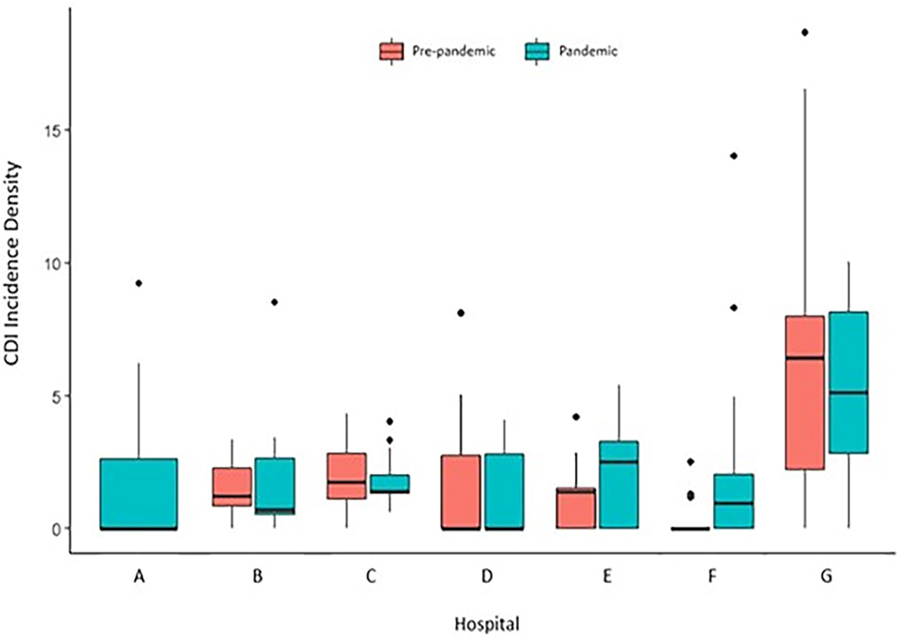
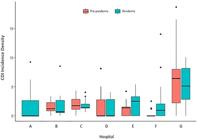
Figure 1 shows the comparison of CDI incidence density between the two periods, stratified by hospital center. Hospital G showed higher CDI incidence in both periods, although its median decreased during the pandemic. Hospitals E and F experienced an increase in incidence during the pandemic, whereas Hospital D showed stable incidence rates. Conversely, Hospitals B and C showed a reduction in median CDI incidence during the pandemic. Except for Hospital A, which provided data only for the pandemic, graphical analysis shows the differences in baseline median CDI incidence density among centers during the pre-pandemic.
The evaluation of the pandemic (June 2020 to December 2021) included data from all seven hospitals. The assessment of the proportion of COVID-19 admissions across centers showed statistically significant differences between the seven hospitals (p < 0.001). Hospital F had the highest proportion of COVID-19 hospitalizations (27.6%), followed by Hospital B (20.5%). The remaining hospitals showed lower proportions: Hospital C (11.6%), Hospital E (10.0%), Hospital A (9.4%), Hospital G (9.0%), and Hospital D (1.6%), as illustrated in Supplementary Figure S1.
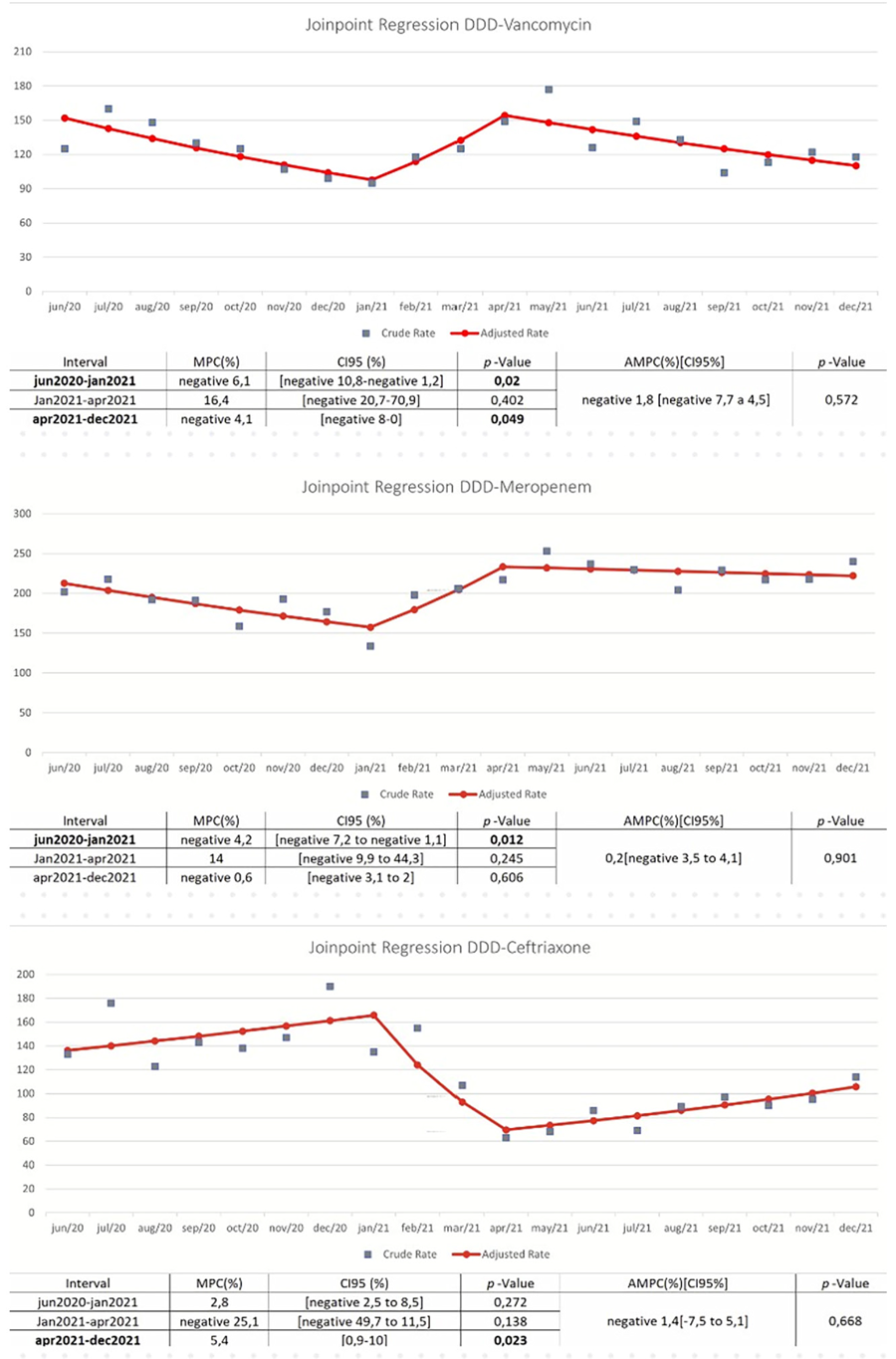
To analyze vancomycin, ceftriaxone, and meropenem consumption, this study evaluated time series data from June 2020 to December 2021 using joinpoint regression (Figure 2). Vancomycin DDD showed an average percentage reduction of 1.8% over the period, although this change was statistically insignificant. However, significant reductions occurred: 6.1% from June 2020 to January 2021 and 4.1% from April to December 2021 (p < 0.05). Ceftriaxone consumption showed an average percentage reduction of 1.4% over the entire period (p = 0.668) but a significant increase of 5.4% from April to December 2021. Conversely, meropenem DDD showed a numerical increase of 0.2% over the entire period, although this change was statistically insignificant (p = 0.091). Joinpoint analysis found a statistically significant reduction of 4.2% from June 2020 to January 2021.

Joinpoint regression of vancomycin, meropenem, and ceftriaxone DDD in seven Brazilian Hospitals, from 2020 to 2021.
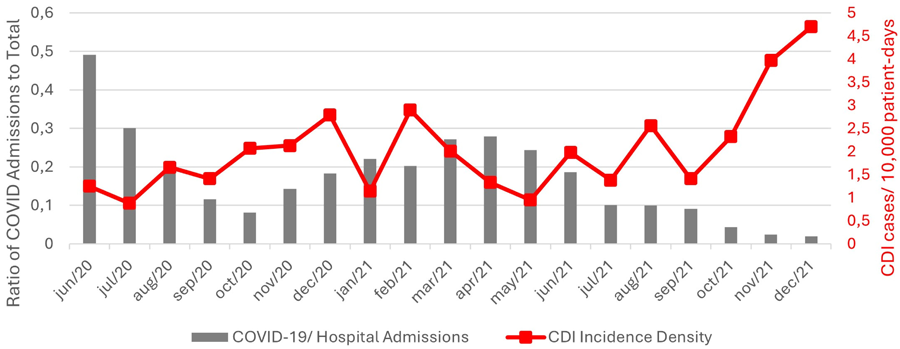
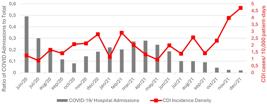
This study also performed a descriptive time-series analysis of the relationship between COVID-19 admissions, total admissions, and CDI incidence density during the pandemic period. It observed a higher proportion of COVID-19 admissions in June 2020 and in March to June 2021, corresponding to the peaks of the first and second waves of SARS-CoV-2 cases in Brazil. CDI incidence density showed no corresponding increase during these months but exhibited an upward trend from September 2021, coinciding with a significant reduction in the proportion of COVID-19 admissions, as illustrated in Figure 3.
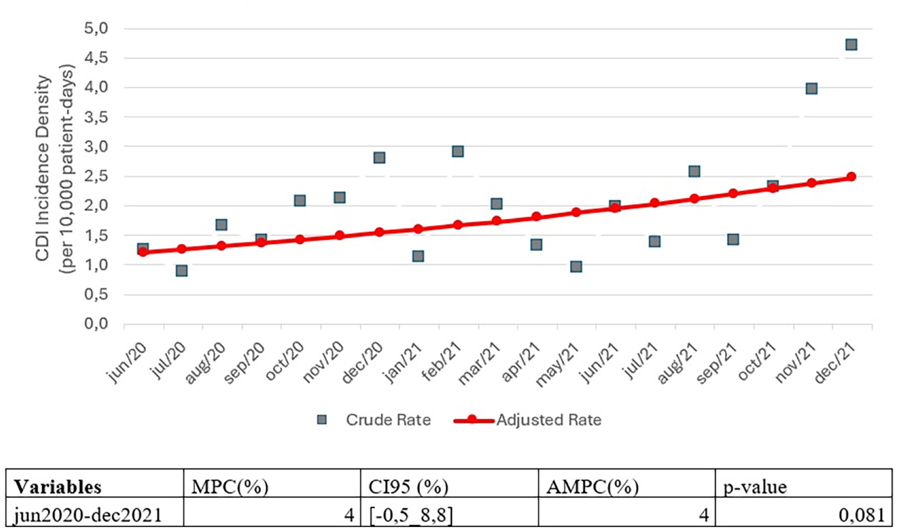
Joinpoint regression was performed to analyze the temporal trend of CDI incidence density, as illustrated in Figure 4. This study found no statistically significant distinctions in line segments and no significant inflection point (p = 0.081). However, it observed a mean percentage increase of 4% (95%CI −0.5-8.8) over the entire period and a 4% increase between years based on the adjusted rates.
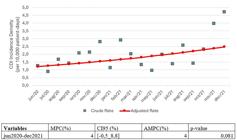
Joinpoint regression of Clostridioides difficile infection (CDI) incidence density in seven Brazilian hospitals during the COVID-19 pandemic
DISCUSSION
The impact of COVID-19 pandemic on CDI remains controversial in data from the U.S., Canada, and Europe5,6,8,9,17-21, with only one study from Latin America reporting a reduction in CDI incidence during the pandemic22. In this multicenter study, CDI incidence showed a non-significant upward trend during the pandemic. This research also found a decline in ceftriaxone consumption during the pandemic, followed by significant increase in the use of azithromycin and levofloxacin.
A pandemic caused by a virus transmitted via airborne and contact routes23 required universal precautions, including contact and droplet measures, and aerosol measures for COVID-19 patients24. Measures reinforced environmental cleaning and hand hygiene, along with the routine use of gowns and gloves during patient care. Given the importance of spore transmission in CDI, these infection control measures could have theoretically reduced CDI incidence.
The use of gloves may also have contributed to the control of CDI transmission12 as COVID-19 patients routinely placed under contact isolation with universal PPE recommendations. However, adherence to PPE varied widely across settings, ranging from 85% in Germany25, 90% in Ghana26, and 60% in the United States27. In Brazil, PPE adherence in 2020 reached approximately 70%28, further challenged by periods of limited equipment availability3.
Several studies have reported a significant increase in hand hygiene adherence during the pandemic29,30, particularly during the early waves of infection31,32. In contrast, our study observed no statistically significant differences in hand hygiene adherence between the pandemic and the pre-pandemic periods, although it found a downward trend throughout 2020 and 2021. Data on the impact of the pandemic on environmental hygiene remain limited, highlighting important gaps in the current literature. Therefore, this aspect was not assessed in the present study.
Conversely, the increased use of antimicrobials33,34—particularly broad-spectrum agents35,36—may have contributed to higher rates of CDI rates, especially in intensive care units. Prolonged hospitalization of older patients with multiple comorbidities20, particularly during the first wave of COVID-19, represents an additional non-modifiable risk factor for CDI.
This study observed an increase in azithromycin and levofloxacin during the pandemic when compared to the pre-pandemic period and a decrease in ceftriaxone consumption. We found no statistically significant changes in the consumption of meropenem, vancomycin, or piperacillin-tazobactam, consistent with previous Brazilian findings7,37. Although macrolides are generally considered to pose a lower risk for C. difficile infection, fluoroquinolones are strongly associated with CDI, as are cephalosporins38,39. Despite these findings, this study observed no statistically significant difference in CDI incidence density between the two periods.
Analysis of the historical series during the pandemic showed an upward trend in the incidence of CDI, albeit statistically insignificant, which may have been influenced by changes in testing frequency. Notably, CDI incidence density increased more markedly from September 2021 onward, coinciding with a decline in the number of hospitalized COVID-19 cases. Conversely, antimicrobial consumption did not show a corresponding decline, with an increased DDD of meropenem occurring in the final months of the pandemic. Joinpoint regression analysis found trend changes in vancomycin and meropenem DDD, with higher consumption during the second wave of COVID-19 in Brazil (November 2020 to April 2021).
Although no participating hospital halted laboratory testing for C. difficile during 2020 and 2021, CDI may have been underdiagnosed during this period. A global reduction in testing when compared with the pre-pandemic era has been reported, particularly given the overlap between gastrointestinal symptoms of SARS-CoV-2 infection and CDI and the reluctance to handle secretions from COVID-19-positive patients40. Since the number of performed CDI tests was not quantified in this study, we were unable to formally assess this hypothesis, potentially limiting comparisons between the two periods.
Limitations
As this was a retrospective study, complete standardization of diagnostic methods across centers was not possible. One participating hospital relied exclusively on ELISA for toxins A and B, a method with lower diagnostic sensitivity, which may have led to CDI case underestimation. Moreover, this study reported data on hand hygiene adherence according to the routine auditing practices of the IPC committee of each hospital, which may have introduced variability in measurement across institutions. Institutions also showed heterogeneity regarding the proportion of hospitalizations attributable to COVID-19.
Despite the increase in the proportion of ICU admissions during the pandemic, inferences regarding individual clinical severity were impossible to the ecological study design of this research. Furthermore, differences in ICU admission thresholds across participating centers limit the use of ICU utilization as a proxy for disease severity.
Additional limitations include the relatively small number of participating hospitals, which may reduce statistical power. The use of non-parametric tests on correlated data represents an additional limitation since monthly observations within the same hospital are not independent. However, the inclusion of large, high-complexity centers enabled the analysis of a substantial number of patient-days. Despite these limitations, this study provides important multicenter data from Brazil, a region with limited epidemiological information on CDI.
CONCLUSIONS
The dynamics of the COVID-19 pandemic and changes in protective measures may have influenced CDI in different ways. Although this study observed no statistically significant difference in CDI incidence between the pre-pandemic and pandemic periods, it found a non-significant upward trend in 2020 and 2021. Antimicrobial consumption patterns also changed, with a decline in ceftriaxone use and significant increases in azithromycin and levofloxacin consumption during the pandemic.
Supplementary Materials
SUPPLEMENTARY MATERIAL
REFERENCES
- 1 Ashktorab H, Pizuomo A, González NA, Villagrana ED, Herrera-Solís ME, Cardenas G, et al. A comprehensive analysis of COVID-19 impact in Latin America. Res Sq. 2021 In Press.
- 2 Bigoni A, Malik AM, Tasca R, Carrera MB, Schiesari LM, Gambardella DD, et al. Brazil's health system functionality amidst of the COVID-19 pandemic: an analysis of resilience. Lancet Reg Health Am. 2022;10:100222.
- 3 Martin-Delgado J, Viteri E, Mula A, Serpa P, Pacheco G, Prada D, et al. Availability of personal protective equipment and diagnostic and treatment facilities for healthcare workers involved in COVID-19 care: a cross-sectional study in Brazil, Colombia, and Ecuador. PLoS One. 2020;15:e0242185.
- 4 Noronha KV, Guedes GR, Turra CM, Andrade MV, Botega L, Nogueira D, et al. The COVID-19 pandemic in Brazil: analysis of supply and demand of hospital and ICU beds and mechanical ventilators under different scenarios. Cad Saude Publica. 2020;36:e00115320.
- 5 Porto AP, Borges IC, Buss L, Machado A, Bassetti BR, Cocentino B, et al. Healthcare-associated infections on the intensive care unit in 21 Brazilian hospitals during the early months of the COVID-19 pandemic: an ecological study. Infect Control Hosp Epidemiol. 2023;44:284-90.
- 6 Weiner-Lastinger LM, Pattabiraman V, Konnor RY, Patel PR, Wong E, Xu SY, et al. The impact of coronavirus disease 2019 (COVID-19) on healthcare-associated infections in 2020: a summary of data reported to the National Healthcare Safety Network. Infect Control Hosp Epidemiol. 2022;43:12-25.
- 7 Bentivegna E, Alessio G, Spuntarelli V, Luciani M, Santino I, Simmaco M, et al. Impact of COVID-19 prevention measures on risk of health care-associated Clostridium difficile infection. Am J Infect Control. 2021;49:640-2.
- 8 Reveles KR, Frei AL, Strey KA, Young EH. Prevalence and health outcomes of Clostridioides difficile infection during the coronavirus disease 2019 pandemic in a national sample of United States hospital systems. Open Forum Infect Dis. 2022;9:ofac441.
- 9 Vendrik KE, Baktash A, Goeman JJ, Harmanus C, Notermans DW, de Greeff SC, et al. Comparison of trends in Clostridioides difficile infections in hospitalised patients during the first and second waves of the COVID-19 pandemic: a retrospective sentinel surveillance study. Lancet Reg Health Eur. 2022;19:100424.
- 10 Trindade CN, Domingues RM, Ferreira EO. The epidemiology of Clostridioides difficile infection in Brazil: a systematic review covering thirty years. Anaerobe. 2019;58:13-21.
- 11 Maestri AC, Raboni SM, Morales HM, Ferrari LF, Tuon FF, Losso A, et al. Multicenter study of the epidemiology of Clostridioides difficile infection and recurrence in southern Brazil. Anaerobe. 2020;64:102238.
- 12 McDonald LC, Gerding DN, Johnson S, Bakken JS, Carroll KC, Coffin SE, et al. Clinical practice guidelines for Clostridium difficile infection in adults and children: 2017 update by the Infectious Diseases Society of America (IDSA) and Society for Healthcare Epidemiology of America (SHEA). Clin Infect Dis. 2018;66:e1-48.
- 13 Crobach MJ, Planche T, Eckert C, Barbut F, Terveer EM, Dekkers OM, et al. European Society of Clinical Microbiology and Infectious Diseases: update of the diagnostic guidance document for Clostridium difficile infection. Clin Microbiol Infect. 2016;22 Suppl 4:S63-81.
- 14 Johnson S, Lavergne V, Skinner AM, Gonzales-Luna AJ, Garey KW, Kelly CP, et al. Clinical practice guideline by the Infectious Diseases Society of America (IDSA) and Society for Healthcare Epidemiology of America (SHEA): 2021 focused update guidelines on management of Clostridioides difficile infection in adults. Clin Infect Dis. 2021;73:e1029-44.
-
15 World Health Organization. WHO guidelines on hand hygiene in health care. Geneva: WHO; 2009. [cited 2026 Mar 9]. Available from: https://www.who.int/publications/i/item/9789241597906
» https://www.who.int/publications/i/item/9789241597906 -
16 Brasil. Agência Nacional de Vigilância Sanitária. Diretriz nacional para elaboração de programa de gerenciamento do uso de antimicrobianos em serviços de saúde. Brasília: ANVISA; 2017. [cited 2026 Mar 9]. Available from: https://www.gov.br/anvisa/pt-br/centraisdeconteudo/publicacoes/servicosdesaude/publicacoes/diretriz-nacional-para-elaboracao-de-programa-de-gerenciamento-do-uso-de-antimicrobianos-em-servicos-de-saude.pdf/
» https://www.gov.br/anvisa/pt-br/centraisdeconteudo/publicacoes/servicosdesaude/publicacoes/diretriz-nacional-para-elaboracao-de-programa-de-gerenciamento-do-uso-de-antimicrobianos-em-servicos-de-saude.pdf/ - 17 Baker MA, Sands KE, Huang SS, Kleinman K, Septimus EJ, Varma N, et al. The impact of coronavirus disease 2019 (COVID-19) on healthcare-associated infections. Clin Infect Dis. 2022;74:1748-54.
- 18 Fakih MG, Bufalino A, Sturm L, Huang RH, Ottenbacher A, Saake K, et al. Coronavirus disease 2019 (COVID-19) pandemic, central-line-associated bloodstream infection (CLABSI), and catheter-associated urinary tract infection (CAUTI): the urgent need to refocus on hardwiring prevention efforts. Infect Control Hosp Epidemiol. 2022;43:26-31.
- 19 Rose AN, Baggs J, Kazakova SV, Guh AY, Yi SH, McCarthy NL, et al. Trends in facility-level rates of Clostridioides difficile infections in US hospitals, 2019-2020. Infect Control Hosp Epidemiol. 2023;44:238-45.
- 20 Lewandowski K, Rosolowski M, Kaniewska M, Kucha P, Meler A, Wierzba W, et al. Clostridioides difficile infection in coronavirus disease 2019 (COVID-19): an underestimated problem? Pol Arch Intern Med. 2021;131:121-7.
- 21 Choi KB, Du T, Silva A, Golding GR, Pelude L, Mitchell R, et al. Trends in Clostridioides difficile infection rates in Canadian hospitals during the coronavirus disease 2019 (COVID-19) pandemic. Infect Control Hosp Epidemiol. 2023;44:1180-3.
- 22 Ochoa-Hein E, Rajme-López S, Rodríguez-Aldama JC, Huertas-Jiménez MA, Chávez-Ríos AR, de Paz-García R, et al. Substantial reduction of healthcare facility-onset Clostridioides difficile infection (HO-CDI) rates after conversion of a hospital for exclusive treatment of COVID-19 patients. Am J Infect Control. 2021;49:966-8.
- 23 Meyerowitz EA, Richterman A, Gandhi RT, Sax PE. Transmission of SARS-CoV-2: a review of viral, host, and environmental factors. Ann Intern Med. 2020;174:69-79.
-
24 Brasil. Agência Nacional de Vigilância Sanitária. Nota técnica GVIMS/GGTES/ANVISA Nº 04/2020.Orientações para serviços de saúde: medidas de prevenção e controle que devem ser adotadas durante a assistência aos casos suspeitos ou confirmados de infecção pelo novo coronavírus (SARS-CoV-2): atualizada em 25/02/2021. [cited 2026 Mar 9]. Available from: https://www.gov.br/anvisa/pt-br/centraisdeconteudo/publicacoes/servicosdesaude/notas-tecnicas/2020/nota-tecnica-gvims_ggtes_anvisa-04_2020-25-02-para-o-site.pdf
» https://www.gov.br/anvisa/pt-br/centraisdeconteudo/publicacoes/servicosdesaude/notas-tecnicas/2020/nota-tecnica-gvims_ggtes_anvisa-04_2020-25-02-para-o-site.pdf - 25 Neuwirth MM, Mattner F, Otchwemah R. Adherence to personal protective equipment use among healthcare workers caring for confirmed COVID-19 and alleged non-COVID-19 patients. Antimicrob Resist Infect Control. 2020;9:199.
- 26 Ashinyo ME, Dubik SD, Duti V, Amegah KE, Ashinyo A, Asare BA, et al. Infection prevention and control compliance among exposed healthcare workers in COVID-19 treatment centers in Ghana: a descriptive cross-sectional study. PLoS One. 2021;16:e0248282.
- 27 Darwish OA, Aggarwal A, Karvar M, Ma C, Haug V, Wu M, et al. Adherence to personal protective equipment guidelines during the COVID-19 pandemic among health care personnel in the United States. Disaster Med Public Health Prep. 2022;16:1331-3.
- 28 Gir E, Silva AC, Reis RK, Rabeh SA, Sorensen W, Nogueira WP, et al. Use of recommended personal protective equipment among Brazilian health professionals during the COVID-19 pandemic. Work. 2022;73:69-78.
- 29 Israel S, Harpaz K, Radvogin E, Schwartz C, Gross I, Mazeh H, et al. Dramatically improved hand hygiene performance rates at time of coronavirus pandemic. Clin Microbiol Infect. 2020;26:1566-8.
- 30 Wang Y, Yang J, Qiao F, Feng B, Hu F, Xi ZA, et al. Compared hand hygiene compliance among healthcare providers before and after the COVID-19 pandemic: a rapid review and meta-analysis. Am J Infect Control. 2022;50:563-71.
- 31 Rüfenacht S, Kohler P, Kuhn R, Flury D, Widmer AF, Schlegel M, et al. Impact of the coronavirus disease 2019 (COVID-19) pandemic on the adherence to hand hygiene practice in hospitals: data from a Swiss national surveillance system. Infect Control Hosp Epidemiol. 2023;44:1522-5.
- 32 Moore LD, Robbins G, Quinn J, Arbogast JW. The impact of COVID-19 pandemic on hand hygiene performance in hospitals. Am J Infect Control. 2021;49:30-3.
- 33 Fukushige M, Ngo NH, Lukmanto D, Fukuda S, Ohneda O. Effect of the COVID-19 pandemic on antibiotic consumption: a systematic review comparing 2019 and 2020 data. Front Public Health. 2022;10:946077.
- 34 Grau S, Hernández S, Echeverría-Esnal D, Almendral A, Ferrer R, Limón E, et al. Antimicrobial consumption among 66 acute care hospitals in Catalonia: impact of the COVID-19 pandemic. Antibiotics (Basel). 2021;10:943.
- 35 Friedli O, Gasser M, Cusini A, Fulchini R, Vuichard-Gysin D, Halder Tobler R, et al. Impact of the COVID-19 pandemic on inpatient antibiotic consumption in Switzerland. Antibiotics (Basel). 2022;11:792.
- 36 Al-Hadidi SH, Alhussain H, Abdel Hadi H, Johar A, Yassine HM, Al Thani AA, et al. The spectrum of antibiotic prescribing during COVID-19 pandemic: a systematic literature review. Microb Drug Resist. 2021;27:1705-25.
- 37 Silva AR, Salgado DR, Lopes LP, Castanheira D, Emmerick IC, Lima EC. Increased use of antibiotics in the intensive care unit during coronavirus disease (COVID-19) pandemic in a Brazilian hospital. Front Pharmacol. 2021;12:778386.
- 38 Vintila BI, Arseniu AM, Morgovan C, Butuca A, Bîrlu?iu V, Dobrea CM, et al. A real-world study on the clinical characteristics, outcomes, and relationship between antibiotic exposure and Clostridioides difficile infection. Antibiotics (Basel). 2024;13:144.
- 39 Slimings C, Riley TV. Antibiotics and hospital-acquired Clostridium difficile infection: update of systematic review and meta-analysis. J Antimicrob Chemother. 2014;69:881-91.
- 40 Spigaglia P. Clostridioides difficile infection (CDI) during the COVID-19 pandemic. Anaerobe. 2022;74:102518.
-
DATA AVAILABILITY:
The complete anonymized dataset supporting the findings of this study is available from https://doi.org/10.48331/SCIELODATA.QHC4EB
-
FUNDING:
This study received no external funding.
Edited by
-
Editor:
Thelma Suely Okayhttps://orcid.org/0000-0001-9316-7288
The complete anonymized dataset supporting the findings of this study is available from https://doi.org/10.48331/SCIELODATA.QHC4EB