 Candidemia in a tertiary hospital in Southern Brazil
ABSTRACT
Invasive bloodstream infections caused by Candida spp. significantly impact global health and are associated with high mortality rates. This study describes a five-year retrospective analysis conducted in a tertiary hospital with 213 beds in Rio Grande, Rio Grande do Sul State, Brazil, aiming to provide clinical-epidemiological data on candidemia and the susceptibility profile of isolates in this region. From January 2019 to December 2023, 44 patients (26 adults, 15 neonates, and three pediatric individuals) were diagnosed with candidemia at our hospital and included in this study. Candida species accounted for 4.5% of all sepsis-causing agents (44/971). The overall incidence was 2.2 cases per 1,000 hospitalizations; however, when stratified by hospitalization unit, this rate reached 26 per 1,000 hospitalizations in the neonatal intensive care unit (NICU), followed by 13 per 1,000 hospitalizations in the intensive care unit (ICU). The mortality rate reached 92% among ICU patients and 40% among NICU patients. C. albicans was the most prevalent species (57%), while C. parapsilosis was the most common non-albicans species (∼30%). Resistance to at least one of the three antifungal classes tested was detected in 13% of the isolates. This study underscores the substantial impact of candidemia in ICU settings in a tertiary hospital in Southern Brazil, emphasizing the importance of improved awareness and surveillance to enhance diagnosis, control, prevention, and monitoring of antifungal resistance, aiming to reduce incidence and mortality rates.
KEYWORDS:
Candida spp; Epidemiology; Fungemia; Blood culture; Antifungal resistance
INTRODUCTION
Candidemia, a bloodstream infection, predominantly affects critically ill patients and is the leading hospital-acquired invasive fungal infection (IFI)1,2. Risk factors include a wide range of conditions, particularly hospitalization in intensive care units (ICU), total parenteral nutrition, chemotherapy, broad-spectrum antibiotic therapy, abdominal surgery, use of medical devices (central venous catheters, intravascular lines, or prostheses), neutropenia, and extremes of age (prematurity or advanced age)3,4.
Although candidemia is an important healthcare-associated infection (HAI), the non-mandatory reporting of cases and diagnostic challenges mean that its true burden is not precisely known. Global estimates of candidemia incidence range from 0.33 to 6.51 episodes per 1,000 admissions, with associated mortality rates of up to 60%2,5-8. In Brazil, Giacomazzi et al.9 estimated approximately 29,000 new candidemia episodes per year. However, a systematic review10 published in 2024 identified only 16 studies, comprising 2,305 candidemia episodes, compared with an estimated 203,000 expected cases for the 2017–2023 period based on Giacomazzi's projections. This discrepancy highlights the likely underdiagnosis and underreporting of candidemia in Brazil.
Candida albicans is the most common species, representing approximately ∼40% of candidemia cases in Brazil10. Additionally, concerns have been raised regarding the increasing incidence of invasive infections caused by non-albicans Candida (NAC) species, including C. parapsilosis, C. tropicalis, Nakaseomyces glabratus (former C. glabrata), Pichia kudriavzevii (former C. krusei), and Meyerozyma guilliermondii (former C. guilliermondii)11-13. Species distribution varies according to geographic region, type of ICU (adult or neonatal), host conditions, antifungal prophylaxis, and resources available for HAI prevention14-16.
Given the emergence of NAC species as multidrug-resistant pathogens and their association with outbreaks, together with the high prevalence of C. albicans and the severity of infections caused by these organisms, the World Health Organization has classified C. albicans, C. auris, C. parapsilosis, and C. tropicalis as critical/high-priority pathogens17. Considering the clinical impact of candidemia and the lack of data on this IFI in Southern Brazil, we aimed to evaluate clinical-epidemiological characteristics of candidemia and the susceptibility profile of isolates over a five-year period in a tertiary hospital in the Southern region of Rio Grande do Sul State, Brazil.
Ethics
This study was approved by the Research Ethics Committee of Universidade Federal do Rio Grande, process Nº 53413821.8.0000.5324.
MATERIALS AND METHODS
A retrospective study was conducted at Hospital Universitário Dr. Miguel Riet Correa Jr. (HU), affiliated with Universidade Federal do Rio Grande (FURG) and Empresa Brasileira de Servicos Hospitalares (EBSERH) (Rio Grande, Rio Grande do Sul State, Brazil). HU-FURG/EBSERH is fully integrated into the Brazilian Unified Health System (SUS – Sistema Unico de Saude) and has 213 beds, including six ICU beds and 10 neonatal ICU (NICU) beds. The hospital is a referral center for medium- and high-complexity care for over 20 municipalities within the 7th Regional Health Coordination in Southern Brazil.
All patients with positive peripheral blood cultures for Candida spp. from January 2019 to December 2023 were included in this study. Patients with a new episode of candidemia (defined as a positive peripheral blood culture for Candida spp. occurring 30 days after the initial diagnosis) were also included. Peripheral blood samples collected in BD BACTEC™ Plus Aerobic/F (Aero) bottles (Becton Dickinson, East Rutherford, USA) were incubated using the BD BACTEC™ FX 40 automated system (BD Diagnostics, Sparks, USA). Sequentially, isolates were purified in Sabouraud Dextrose Agar (KASVI, São José dos Pinhais, Brazil) and CHROMagar™ Candida (DIFCO, Michigan, USA), and identified based on protein profile using matrix-assisted laser desorption ionization–time of flight mass spectrometry (MALDI-TOF MS) (Bruker Corporation™, Billerica, Massachusetts, USA; database flex control version 3.4). The susceptibility profile of the clinical isolates to fluconazole (FCZ), amphotericin B (AMB), and micafungin (MICA) was evaluated according to the M27-A2 Clinical & Laboratory Standards Institute protocol18.
We analyzed the hospital database to obtain clinical-epidemiological data, including sex, age, hospital unit, comorbidities, length of hospitalization prior to candidemia diagnosis, Candida species, use of broad-spectrum antibiotics and/or steroids, antifungal therapy, mechanical ventilation, presence of central venous access, history of recent abdominal surgery, use of total parenteral nutrition, thrombocytopenia, and hospitalization outcome (death or hospital discharge). The hospital mortality rate was calculated for each evaluated unit. Moreover, for patients admitted to the NICU, gestational age (extremely preterm [< 28 weeks], very preterm [28 to < 32 weeks], moderate to late preterm [32 to < 37 weeks], and term [≥37 weeks]) and birth weight (extremely low weight [<1,000 g], very low weight [1,000 to <1,500 g], low weight [1,500 to < 2,500 g] and appropriate weight [≥2,500 g]) were evaluated.
Data were analyzed using SPSS 24.0 (SPSS, Chicago, IL, USA) using descriptive frequency and measures of central tendency. Overall and annual prevalence rates were calculated, and the incidence of candidemia per 1,000 hospitalizations (overall and stratified by hospitalization unit) was estimated. The impact of risk factors, treatment, and causative species on clinical outcomes (death or hospital discharge) among NICU patients was analyzed using the chi-square test. Statistical significance was set to p < 0.05.
RESULTS
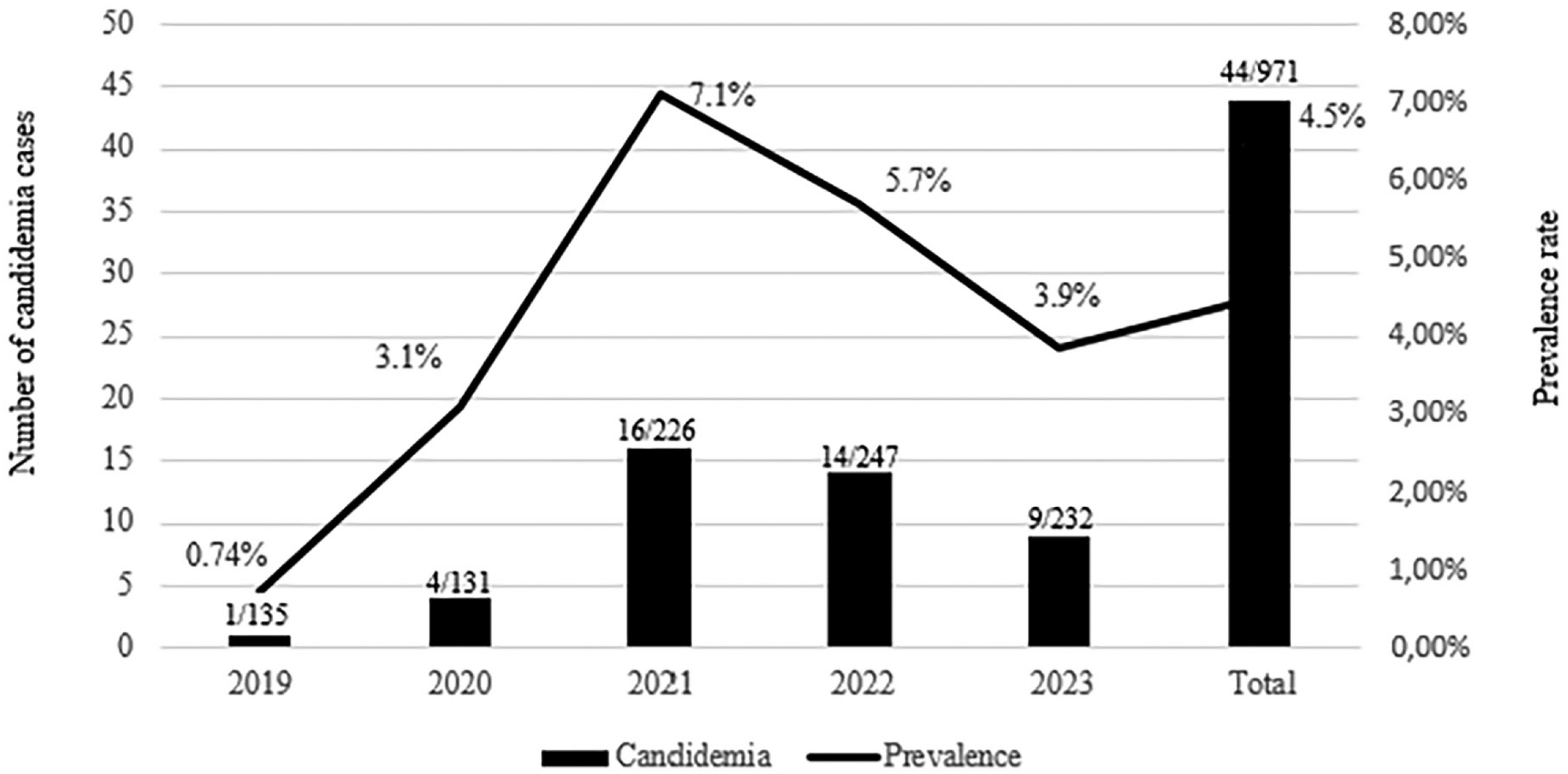
During the five-year study period, 44 patients were diagnosed with candidemia at HU-FURG/EBSERH. Overall, Candida species accounted for 4.5% (44/971) of all sepsis-causing agents identified in our hospital. The median number of candidemia cases was 8.8 cases/year, ranging from one to 16 cases, corresponding to prevalence rates ranging from 0.74% (1/135) to 7.1% (16/226) according to the study year (Figure 1).
Non-linear annual distribution of candidemia cases (number of cases and prevalence rate) diagnosed during the five-year study conducted at Hospital Universitario Dr. Miguel Riet Correa Jr.
Of the 44 candidemia cases, 26 occurred in adults, 15 in neonates, and three in pediatric patients. Regarding hospitalization units, 15 (34%) patients were admitted to the NICU, 14 (32%) to the adult ward, 12 (27%) to the ICU, two (4.5%) to the pediatric ward, and one (2.3%) to the pediatric ICU (Table 1).
Clinical-epidemiological data of 44 patients diagnosed with candidemia at Hospital Universitario Dr. Miguel Riet Correa Jr., 2019–2023.
The total number of hospitalizations during the study period at HU-FURG/EBSERH was 19,802, resulting in an estimated overall incidence of candidemia of 2.2 cases per 1,000 hospitalizations. When stratified by hospital unit, the incidence was considerably higher in the NICU, with 26 cases per 1,000 hospitalizations, followed by the ICU, with 13 cases per 1,000 hospitalizations. In pediatric and adult wards, the incidence was one case per 1,000 hospitalizations.
Candidemia in adult patients
Among adults diagnosed with candidemia (n=26) in the ICU and ward, the median age was 46 years (range: 16-83 years), and 53% (14/26) were male. All patients had at least one comorbidity, including kidney failure (50%; 13/26), systemic arterial hypertension (38%; 10/26), neoplasia (31%; 8/26), COVID-19 (23%; 6/26), diabetes mellitus, human immunodeficiency virus (HIV) infection and pulmonary tuberculosis (19% each; 5/26), anemia, chronic obstructive pulmonary disease and cerebral ischemia (15% each; 4/26), autoimmune diseases and hepatitis C virus infection (11% each; 3/26), and thyroid dysfunction, kidney transplant, and neurotoxoplasmosis (4% each; 1/26). Additionally, these patients were exposed to several risk factors (Table 1).
The mean duration of hospitalization prior to candidemia diagnosis was 21 days (range: 4–127 days). The average length of hospitalization between diagnosis and clinical outcome was 29 days (range: 17–169 days). C. albicans was the etiological agent in 62% (16/26) of cases, followed by C. parapsilosis (15%; 4/26). N. glabratus (formerly C. glabrata), M. guilliermondii (former C. guilliermondii), C. tropicalis, P. kudriavzevii (formerly C. krusei), and C. duobushaemulonii accounted for one case each (4%). One case was caused by a non-albicans species that could not be identified by MALDI-ToF and was therefore reported as Candida sp. (non-albicans) (Table 1).
Data on antifungal treatment and outcomes were available for 96% (25/26) of adult patients. Treatment with FCZ and/or AMB was administered to 13 patients; eight died before treatment initiation, one was transferred to another hospital, and in the remaining four cases, antifungal treatment was not prescribed (Table 1). The overall mortality rate among adult patients with candidemia was 64% (16/25), with a mean time of death of 22 days after diagnosis (range: 1–169). Mortality was 92% (11/12) among ICU patients and 36% (5/14) among patients in the adult ward (p=0.02). Among deceased patients, 81% (13/16) died within 30 days after diagnosis. No differences in mortality were observed among adult patients according to the etiological agent (Candida species). Regarding risk factors, mechanical ventilation and thrombocytopenia were associated with mortality (p=0.002).
Candidemia in neonate patients
All neonates with candidemia (n=15) were admitted to the NICU, with a median age of 46 days (range: 14-150 days old); 53% (8/15) were male (Table 1). All patients had at least one comorbidity, including respiratory distress syndrome (53%; 8/15), neonatal jaundice (13%; 2/15), renal injury, gastroschisis, esophageal atresia, necrotizing enterocolitis, and hypothyroidism (7% each; 1/15), and were exposed to well-established risk factors for candidemia, including extreme prematurity and extremely low birth weight (Tables 1 and 2).
Impact of risk factors, treatment, and causative species on clinical outcomes among 15 patients with candidemia in the neonatal intensive care unit at Hospital Universitario Dr. Miguel Riet Correa Jr., 2019–2023.
The mean duration of hospitalization prior to candidemia diagnosis was 21 days (range: 9–117 days). The average length of hospitalization between diagnosis and clinical outcome was 40 days (range: 0–117 days). C. albicans was the causative agent in 60% (9/15) of cases, while C. parapsilosis accounted for the remaining 40% (6/15) (Table 1). All patients received antifungal treatment with FCZ or AMB for a mean duration of 16 days (range: 6–40 days). The outcome of patients was death in 40% (6/15) of cases, with a mean time from diagnosis to death of seven days (range: 0–13). Among deceased patients, 50% (3/6) died within 30 days after diagnosis. According to the causative species, the mortality rate was 55.5% in C. albicans infections (5/9) and 16.7% in C. parapsilosis infections (1/6) (Tables 1 and 2).
Candidemia in pediatric patients
Among the three pediatric patients diagnosed with candidemia, admitted to the pediatric ICU or pediatric ward and aged six months, four years, and 10 years, most were female (66%; 2/3). Predisposing factors included broad-spectrum antibiotics (3/3), central venous access (3/3), recent abdominal surgery (2/3), total parenteral nutrition (2/3), and mechanical ventilation (1/3) (Table 1).
The interval between hospitalization and candidemia diagnosis was 47 days (range: 19–79 days), and C. parapsilosis was the etiological agent of all cases. The four-year-old patient showed clinical improvement and recovered from the infection, although treatment details were not available in the hospital database. Another patient recovered and was discharged after treatment with AMB and FCZ for 14 days, while one patient was lost to follow-up after being transferred to another hospital (Table 1).
Antifungal susceptibility
Antifungal susceptibility testing was performed on 39 of the 44 Candida isolates, revealing resistance to at least one antifungal agent in 13% (n=5) of cases. Susceptible dose-dependent (SDD) responses to FCZ were observed in three isolates (one C. albicans, one C. parapsilosis, and one P. kudriavzevii, an intrinsically resistant species). Resistance to MICA was detected in two isolates (C. tropicalis and C. parapsilosis, the latter also resistant to FCZ), whereas resistance to AMB was observed only in a C. duobushaemulonii isolate. Detailed minimum inhibitory concentration (MIC) values and susceptibility profiles are presented in Table 3.
Antifungal susceptibility profile of Candida spp. Isolates (n=39) recovered during a five-year study of bloodstream infection conducted at Hospital Universitario Dr. Miguel Riet Correa Jr., 2019–2023
DISCUSSION
Our study is the first to describe clinical-epidemiological data on candidemia in a tertiary hospital (HU-FURG/EBSERH), a referral center for 22 municipalities in the Southernmost region of Brazil. The findings reveal the impact of this infection, especially among critically ill patients. Although the overall incidence was 2.2 cases per 1,000 hospitalizations, higher rates were observed in ICUs, reaching 26 cases per 1,000 hospitalizations in the NICU and 13 per 1,000 hospitalizations in the ICU. These rates are much higher than the globally reported ICU incidence rates, which range from 6.51 to 7.07 cases per 1,000 hospitalizations7,8.
All patients diagnosed with candidemia had well-established risk factors commonly reported in the scientific literature19-21, including use of broad-spectrum antibiotics, mechanical ventilation, total parenteral nutrition, prematurity in neonates, and central venous or umbilical catheters. Moreover, our data reinforce that thrombocytopenia is an important prognostic marker among adults in ICUs, as it was associated with mortality (p=0.002), as previously reported20-22. However, the small sample size represents a limitation of our study. Another limitation was the lack of information regarding the removal of central venous catheters and the investigation of endophthalmitis and endocarditis, particularly in cases of persistent candidemia.
Our highest prevalence occurred during the pandemic years. The increase in candidemia incidence may have been influenced by COVID-19 infections, as patients with severe COVID-19 are at increased risk of developing candidemia. These individuals are exposed to multiple risk factors, including the use of antibiotics, corticosteroids, venous catheters, and dialysis23,24. Additionally, hospital overcrowding during the pandemic may have contributed to the increased number of candidemia cases.
Our study revealed a 40% mortality rate among neonates who developed candidemia. This finding, coupled with the absence of antifungal prophylaxis, highlights the urgent need for preventative measures in neonatal care settings. Current guidelines recommend antifungal prophylaxis in neonatal units where the incidence of invasive fungal infections is ≥2%25. Notably, our incidence was 26 cases per 1,000 hospitalizations, well above this threshold. The lack of prophylaxis in this high-risk population may have contributed to the high rate of poor outcomes. These findings underscore the need to implement antifungal prophylaxis to improve survival rates and reduce complications among neonates at risk of invasive fungal infections. Furthermore, the literature26 emphasizes the importance of strict catheter care and hand hygiene among healthcare staff, particularly given the high incidence of C. parapsilosis.
Only 65% of our patients received antifungal treatment in accordance with current guideline recommendations15,26-28, including therapy for at least 14 days after the first negative blood culture. Moreover, mortality ranged from 40% in the NICU to 92% in the ICU, reflecting the severity of illness in these settings. These rates are similar to or higher than those reported in other Brazilian studies5,29,30. It is important to highlight that appropriate antifungal therapy initiated within 24 hours of shock onset reduces mortality30, as does maintaining treatment for at least 14 days after the first negative blood culture31,32. However, in our series, 68% (15/22) of patients died before completing 14 days of therapy after diagnosis. Another relevant aspect is the absence of echinocandins in our hospital. These agents are not available as initial therapy, as recommended by current guidelines15,26-28, which may have contributed to the higher mortality observed in our study.
C. albicans was the most prevalent species, followed by C. parapsilosis as the leading non-albicans species, in agreement with global epidemiology33. No resistance was detected among C. albicans; only one isolate was classified as SDD to FCZ. C. parapsilosis is frequently implicated in HAIs, with healthcare workers or contaminated medical devices described as potential sources of infection, particularly in intensive care settings and during invasive procedures34,35. Its ability to form biofilms on medical devices enhances persistence and contributes to reduced susceptibility to antifungal treatments, posing therapeutic challenges and potentially resulting in adverse clinical outcomes34,35. Notably, we identified one C. parapsilosis isolate resistant to two of the three antifungal classes tested (azoles and echinocandins). This resistant isolate was recovered in 2023, indicating a possible emergence of resistance in this pathogen at our hospital, consistent with global trends10.
Additionally, the overall resistance rate of 13% to at least one of the three antifungals tested (FCZ, AMB, and MICA) observed in our study is slightly higher than rates reported in other studies conducted in Brazil and, particularly, in developed countries22,36,37. The increasing trend of resistance among Candida species has been associated with higher overall mortality38. Furthermore, widespread azole prophylaxis has been linked to an increase in infections caused by intrinsically resistant species (e.g., P. kudriavzevii) or less susceptible species, particularly N. glabratus, representing a global concern2,33,39. In our study, these two species were identified, along with one C. tropicalis isolate resistant to MICA and one C. duobushaemulloni isolate resistant to AMB. Fortunately, these resistant isolates represented a small proportion compared with C. albicans and C. parapsilosis.
CONCLUSION
This study highlights the substantial impact of candidemia among ICU patients, with notably high mortality rates. Effective prevention strategies must include rigorous training and surveillance of healthcare staff regarding infection control protocols, proactive monitoring to enable early diagnosis, and implementation of antifungal prophylaxis protocols to reduce the impact of candidemia and improve patient care and safety. These measures are especially critical in our NICU, given the high incidence observed.
DATA AVAILABILITY
The authors will not make additional data available due to ethical restrictions related to patient confidentiality.
ACKNOWLEDGMENTS
The authors are grateful to Coordenacao de Aperfeicoamento de Pessoal de Nivel Superior (CAPES), Conselho Nacional de Desenvolvimento Cientifico e Tecnologico (CNPq), Fundacao de Amparo à Pesquisa do Estado do Rio Grande do Sul (FAPERGS), and the Clinical Laboratory of HU-FURG/EBSERH for their support.
REFERENCES
- 1 Falcone M, Tiseo G, Tascini C, Russo A, Sozio E, Raponi G, et al. Assessment of risk factors for candidemia in non-neutropenic patients hospitalized in internal medicine wards: a multicenter study. Eur J Intern Med. 2017;41:33-8.p
- 2 Colombo AL, Almeida Júnior JN, Slavin MA, SChen SC, Sorrell TC. Candida and invasive mould diseases in non-neutropenic critically ill patients and patients with haematological cancer. Lancet Infect Dis. 2017;17:e344-56.p
- 3 Puig-Asensio M, Padilla B, Garnacho-Montero J, Zaragoza O, Aguado JM, Zaragoza R, et al. Epidemiology and predictive factors for early and late mortality in Candida bloodstream infections: a population-based surveillance in Spain. Clin Microbiol Infect. 2014;20:O245-54.p
- 4 Barchiesi F, Orsetti E, Mazzanti S, Trave F, Salvi A, Nitti C, et al. Candidemia in the elderly: what does it change? PLoS One. 2017;12:e0176576.p
- 5 Colombo AL, Nucci M, Park BJ, Nouér SA, Arthington-Skaggs B, Matta DA, et al. Epidemiology of candidemia in Brazil: a nationwide sentinel surveillance of candidemia in eleven medical centers. J Clin Microbiol. 2006;44:2816-23.p
- 6 Nucci M, Queiroz-Telles F, Alvarado-Matute T, Tiraboschi IN, Cortes J, Zurita J, et al. Epidemiology of candidemia in Latin America: a laboratory-based survey. PLoS One. 2013;8:e59373.p
- 7 Chakrabarti A, Sood P, Rudramurthy SM, Chen S, Kaur H, Capoor M, et al. Incidence, characteristics and outcome of ICU-acquired candidemia in India. Intensive Care Med. 2015;41:285-95.p
- 8 Bassetti M, Giacobbe DR, Vena A, Trucchi C, Ansaldi F, Antonelli M, et al. Incidence and outcome of invasive candidiasis in intensive care units (ICUs) in Europe: results of the EUCANDICU project. Crit Care. 2019;23:219.p
- 9 Giacomazzi J, Baethgen L, Carneiro LC, Millington MA, Denning DW, Colombo AL, et al. The burden of serious human fungal infections in Brazil. Mycoses. 2015;59:145-50.p
- 10 Hamburger FG, Gales AC, Colombo AL. Systematic review of candidemia in Brazil: unlocking historical trends and challenges in conducting surveys in middle-income countries. Mycopathologia. 2024;189:60. p
- 11 Zuo XS, Liu Y, Hu K. Epidemiology and risk factors of candidemia due to Candida parapsilosis in an intensive care unit. Rev Inst Med Trop Sao Paulo. 2021;63:e20.p
- 12 Rodrigues DK, Bonfietti LX, Garcia RA, Araujo MR, Rodrigues JS, Gimenes VM, et al. Antifungal susceptibility profile of Candida clinical isolates from 22 hospitals of São Paulo State, Brazil. Braz J Med Biol Res. 2021;54:e10928.p
- 13 García-Salazar E, Acosta-Altamirano G, Betancourt-Cisneros P, Reyes-Montes MD, Rosas-De-Paz E, Duarte-Escalante E, et al. Detection and molecular identification of eight candida species in clinical samples by simplex PCR. Microorganisms. 2022;10:374.p
- 14 Pfaller MA, Rhomberg PR, Messer SA, Jones RN, Castanheira M. Isavuconazole, micafungin, and 8 comparator antifungal agents susceptibility profiles for common and uncommon opportunistic fungi collected in 2013: temporal analysis of antifungal drug resistance using CLSI species-specific clinical breakpoints and proposed epidemiological cutoff values. Diagn Microbiol Infect Dis. 2015;82:303-13.p
- 15 Pappas PG, Kauffman CA, Andes DR, Clancy CJ, Marr KA, Ostrosky-Zeichner L, et al. Clinical practice guideline for the management of candidiasis: 2016 update by the Infectious Diseases Society of America. Clin Infect Dis. 2016;62:e1-50.p
- 16 Lortholary O, Renaudat C, Sitbon K, Desnos-Ollivier M, Bretagne S, Dromer F. The risk and clinical outcome of candidemia depending on underlying malignancy. Intensive Care Med. 2017;43:652-62.p
- 17 Casalini G, Giacomelli A, Antinori S. The WHO fungal priority pathogens list: a crucial reappraisal to review the prioritisation. Lancet Microbe. 2024;5:717-24.p
- 18 National Committee for Clinical Laboratory Standards. Reference method for broth dilution antifungal susceptibility testing of yeasts: approved standard. 2nd ed. Wayne: National Committee for Clinical Laboratory Standards; 2002.p
- 19 Poissy J, Damonti L, Bignon A, Khanna N, Von Kietzell M, Boggian K, et al. Risk factors for candidemia: a prospective matched case-control study. Crit Care. 2020;24:109.p
- 20 Zhang W, Song X, Wu H, Zheng R. Epidemiology, risk factors and outcomes of Candida albicans vs. non-albicans candidaemia in adult patients in Northeast China. Epidemiol Infect. 2019;147:e277.p
- 21 Rodrigues LS, Motta FA, Picharski GL, Vasconcelos TM, Riccieri MC, Dalla-Costa LM. Invasive candidiasis: risk factor for mortality in a pediatric tertiary care hospital in south of Brazil. Medicine (Baltimore). 2019;98:e15933.p
- 22 Medeiros MA, Melo AP, Bento AO, Souza LB, Bezerra Neto FA, Garcia JB, et al. Epidemiology and prognostic factors of nosocomial candidemia in Northeast Brazil: a six year retrospective study. PLoS One. 2019;14:e0221033.p
- 23 Richardson S, Hirsch JS, Narasimhan M, Crawford JM, McGinn T, Davidson KW, et al. Presenting characteristics, comorbidities, and outcomes among 5700 patients hospitalized with COVID-19 in the New York City Area. JAMA. 2020;323:2052-9. p
- 24 Nucci M, Barreiros G, Guimarães LF, Deriquehem VA, Castiñeiras AC, Nouér SA. Increased incidence of candidemia in a tertiary care hospital with the COVID-19 pandemic. Mycoses. 2021;64:152-6. p
- 25 Ferrando G, Castagnola E. Prophylaxis of invasive fungal infection in neonates: a narrative review for practical purposes. J Fungi (Basel). 2023;9:164. p
- 26 Colombo AL, Guimarães T, Camargo LF, Richtmann R, Queiroz-Telles F, Salles MJ, et al. Brazilian guidelines for the management of candidiasis: a joint meeting report of three medical societies: Sociedade Brasileira de Infectologia, Sociedade Paulista de Infectologia and Sociedade Brasileira de Medicina Tropical. Braz J Infect Dis. 2013;17:283-312.p
- 27 Antinori S, Milazzo L, Sollima S, Galli M, Corbellino M. Candidemia and invasive candidiasis in adults: a narrative review. Eur J Intern Med. 2016;34:21-8.p
-
28 Brasil. Agência Nacional de Vigilância Sanitária. Nota técnica GVIMS/GGTES/ANVISA n° 04/2021 Orientações para vigilância, identificação, prevenção e controle de infecções fúngicas invasivas em serviços de saúde no contexto da pandemia da COVID-19. Brasília: ANVISA; 2021. [cited 2026 Feb 9]. Available fromp: https://www.gov.br/anvisa/pt-br/centraisdeconteudo/publicacoes/servicosdesaude/notas-tecnicas/notas-tecnicas-vigentes/nota-tecnica-04-2021-infeccoes-fungicas-e-covid19.pdf/viewp
» https://www.gov.br/anvisa/pt-br/centraisdeconteudo/publicacoes/servicosdesaude/notas-tecnicas/notas-tecnicas-vigentes/nota-tecnica-04-2021-infeccoes-fungicas-e-covid19.pdf/viewp - 29 Doi AM, Pignatari AC, Edmond MB, Marra AR, Camargo LF, Siqueira RA, et al. Epidemiology and microbiologic characterization of nosocomial candidemia from a Brazilian national surveillance program. PLoS One. 2016;11:e0146909. p
- 30 Braga PR, Cruz IL, Ortiz I, Barreiros G, Nouér SA, Nucci M. Secular trends of candidemia at a Brazilian tertiary care teaching hospital. Braz J Infect Dis. 2018;22:273-7.p
- 31 Kollef M, Micek S, Hampton N, Doherty JA, Kumar A. Septic shock attributed to Candida infection: importance of empiric therapy and source control. Clin Infect Dis. 2012;54:1739-46. p
- 32 Araujo JM, Almeida Junior JN, Magri MM, Costa SF, Guimarães T. Guideline adherence and outcomes of patients with candidemia in Brazil. J Fungi (Basel). 2024;10:282. p
- 33 Arendrup MC, Arikan-Akdagli S, Jørgensen KM, Barac A, Steinmann J, Toscano C, et al. European candidaemia is characterised by notable differential epidemiology and susceptibility pattern: results from the ECMM Candida III study. J Infect. 2023;87:428-37.p
- 34 Asogan M, Kim HY, Kidd S, Alastruey-Izquierdo A, Govender NP, Dao A, et al. Candida parapsilosis: a systematic review to inform the World Health Organization fungal priority pathogens list. Med Mycol. 2024;62:myad131.p
- 35 Pristov KE, Ghannoum MA. Resistance of Candida to azoles and echinocandins worldwide. Clin Microbiol Infect. 2019;25:792-8.p
- 36 Cleveland AA, Farley MM, Harrison LH, Stein B, Hollick R, Lockhart SR, et al. Changes in incidence and antifungal drug resistance in candidemia: results from population-based laboratory surveillance in Atlanta and Baltimore, 2008-2011. Clin Infect Dis. 2012;55:1352-61.p
- 37 Marcos-Zambrano LJ, Escribano P, Sánchez C, Muñoz P, Bouza E, Guinea J. Antifungal resistance to fluconazole and echinocandins is not emerging in yeast isolates causing fungemia in a Spanish tertiary care center. Antimicrob Agents Chemother. 2014;58:4565-72.p
- 38 Salmanton-García J, Cornely OA, Stemler J, Barać A, Steinmann J, Siváková A, et al. Attributable mortality of candidemia: results from the ECMM Candida III multinational European Observational Cohort Study. J Infect. 2024;89:106229.p
- 39 Arendrup MC, Patterson TF. Multidrug-resistant candida: epidemiology, molecular mechanisms, and treatment. J Infect Dis. 2017;216 Suppl 3:S445-51. p
Edited by
-
Editor:
Gil Benard https://orcid.org/0000-0002-5469-3602