 Retrospective evaluation of the epidemiological importance of Triatoma infestans and Panstrongylus megistus in the transmission of Trypansoma cruzi in a region of southeastern Brazil
ABSTRACT
Panstrongylus megistus is the most important autochthonous vector of Trypanosom cruzi, the etiological agent of Chagas disease, in the midwest region of the Minas Gerais State, Brazil. This study investigates the vectorial roles of Triatoma infestans and P. megistus in Chagas disease in this geographical area during the late 1970s. A retrospective analysis of entomological and serological surveys from 1975–1983 was conducted, comparing the presence of T. infestans and P. megistus with the seroprevalence of T. cruzi infection in the human population within the Divinopolis Regional Health Superintendency. Panstrongylus megistus was recorded in all surveyed municipalities (52/52), whereas T. infestans co-occurrence with P. megistus was recorded in only 19.2% (10/52) of them. In the 41 municipalities where only P. megistus was found and relevant data were available, the mean seroprevalence of human T. cruzi infection was 17.8% ranging from 1.0% to 41.9%. In the municipalities where T. infestans occurred, the mean seroprevalence was higher, at 25.8%, ranging from 9.8% to 40.8%. Among the municipalities where only P. megistus was present, 19.5% had a low, 29.3% an intermediate, and 51.2% a high seroprevalence of human T. cruzi infection. In the ten municipalities where both T. infestans and P. megitus were found, 80% showed high seroprevalence, whereas only one municipality each showed low or intermediate levels. The findings highlight the significant role of P. megistus in T. cruzi transmission, even in the absence of T. infestans. The wide distribution of P. megistus increased the risk of transmission. P. megistus was the main household vector in the region in the 1970s. Nowadays, continuous surveillance remains essential for monitoring triatomine infestations and evaluating the current risk of T. cruzi transmission.
KEYWORDS:
Chagas disease; Prevalence; Survey; Vector control
INTRODUCTION
Triatominae (Hemiptera: Reduviidae) are insect vectors of the protozoa Trypanosoma cruzi (Chagas, 1909)1, the etiological agent of Chagas disease, an important illness that affects over seven million people across the Americas2. Currently, 158 triatomines species are recognized3. Vectorial transmission occurs when the insects feed on mammals and deposit infected feces on the skin, enabling the parasite to enter through breaks in the skin, eyes, or mouth4. In sylvatic environments, oral transmission is responsible for high infection rates among non-human vertebrates, particularly marsupials, rodents, and primates5, and has recently gained relevance in human transmission through the ingestion of contaminated food6.
In humans, Chagas disease gained greater epidemiological relevance following the domiciliation of triatomines, which invade and colonize human dwellings, forming large colonies and feeding on humans and their domestic animals4,5. This colonization often extends to the peridomestic environment, involving animals such as chickens, pigs, and other domestic or wild animals from these areas, thereby maintaining the transmission cycle near humans4. Consequently, vector control efforts target the epidemiological unit of the domicile, encompassing both the intra- and peridomestic areas7.
The ability to adapt to disturbed sylvatic and/or novel anthropogenic environments varies among triatomine species and is a major determinant of their importance as vectors. Triatomines of primary epidemiological relevance for T. cruzi transmission to humans are anthropophilic and form large indoor colonies. Those of secondary importance are mainly peridomestic, typically forming small indoor colonies. Other species are "invasive", which temporarily enter houses and intermittently transmit the parasite without establishing colonies8. Adaptation to anthropogenic habitats requires physiological adjustments that enable triatomines to feed off the blood of vertebrate hosts, different from those in their natural sylvatic environments9. In Brazil, triatomines species of primary importance include Triatoma brasiliensis (Neiva, 1911) in the semiarid Caatinga region of the Northeast and Panstrongylus megistus (Burmeister, 1835) in the Cerrado biome. However, extremely high prevalences of T. cruzi infection in humans have historically been associated with the presence of Triatoma infestans (Klug, 1834), which is native to Bolivia and was introduced and spread in Brazil via migratory flows10. Evidence indicates that T. infestans tends to outcompete native species and become predominant within two to three years, as demonstrated in Minas Gerais by Martins, Versiani, and Tupinamba in the 194011,12.
Panstrongylus megistus holds both epidemiological and historical significance, as it was in this species that Carlos Chagas first discovered and described the parasite T. cruzi. At that time, P. megistus was the only domiciliated triatomine species in the municipality of Lassance, in Minas Gerais State. Subsequently, T. infestans reached this region and became the dominant triatomine species13, a scenario that was replicated in the municipality of Bambui, also in Minas Gerais, in the late 1930s12.
Following the demonstration of the efficacy of benzene hexachloride for triatomine control, the so-called Chagas Disease Prophylaxis Program conducted vector control activities in Brazil until 1968. However, these efforts were irregular, inconsistent, and lacked continuity across the geographical area requiring intervention14. Acknowledging the fragmented nature of the available information derived from poorly integrated and haphazard initiatives, the Brazilian Ministry of Health decided to establish a baseline to guide large-scale control measures. As a result, several major national surveys were undertaken, including an entomological survey conducted between 1975 to 198315 and a seroprevalence survey conducted between 1975 and 198016.
This study cross-referenced data from national surveys conducted between 1975 and 1983 to investigate the roles of the most epidemiologically significant triatomine species in Minas Gerais, P. megistus and T. infestans, as vectors of T. cruzi during a historical period of intense transmission in the region. The analysis was based on entomological surveys and seroprevalence data from the Divinopolis Regional Health Superintendence (SRSD) in Minas Gerais State, Brazil.
MATERIALS AND METHODS
Study area
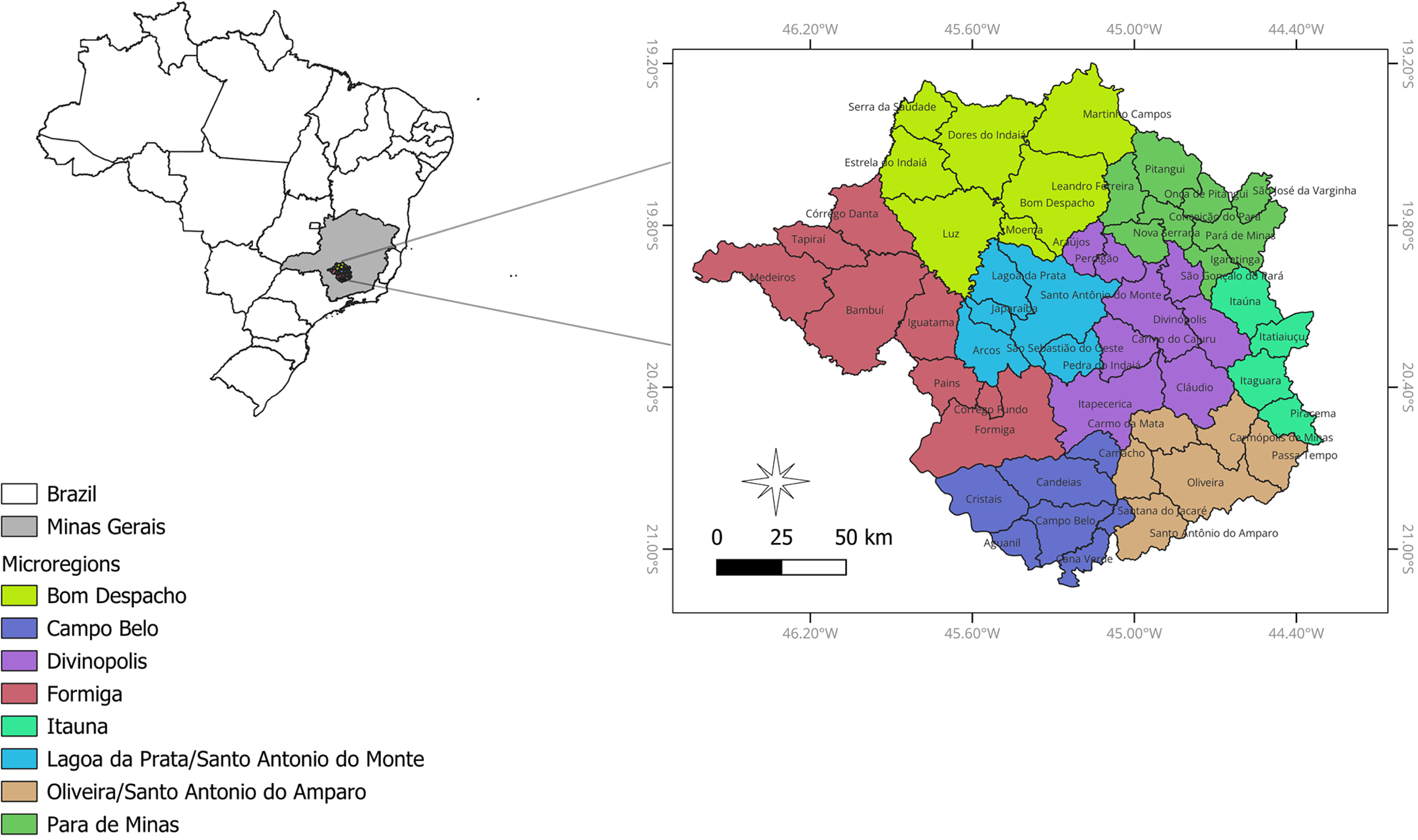
The study area is located in the midwest region of the state of Minas Gerais, Brazil, and currently comprises 53 municipalities under the jurisdiction of the Divinopolis Regional Health Superintendence (Figure 1). However, the municipality of Córrego Fundo was established in 1995, following its separation from the municipality of Formiga. Therefore, the analyses in this study are based on the 52 municipalities that existed prior to the creation of Córrego Fundo. These municipalities are organized into eight health "microregions": Bom Despacho, Campo Belo, Divinopolis, Formiga, Itauna, Lagoa da Prata, Oliveira, and Para de Minas, Figure 1.

The eight health microregions and their respective municipalities within the Divinopolis Regional Health Superintendence study area, showing the 52 municipalities that existed prior to 1995 and during the study period (1975 and 1983), in the mid-west region of the Minas Gerais State, Brazil.
Data source
Data from the published entomological survey reporting the geographic distribution of all the triatomine species captured, by municipality, across the national territory between 1975 to 1983 were used to assess the occurrence of P. megistus and T. infestans15. From these data, a specific subset was created for the municipalities comprising the SRSD, focusing exclusively on the occurrence of P. megistus and T. infestans. Similarly, prevalence data for Chagas disease in the SRSD municipalities between 1975 to 1980 were extracted from the published serological survey for that period16. The seroprevalence of human T. cruzi infection in each municipality was categorized into three groups: low (<10%), intermediate (>10% to <16%), and high (>16%).
Data analysis
The geographic coordinates of the 52 municipalities were obtained from the IBGE17. Thematic maps were generated to visualize the presence/absence of the two triatomine species in each municipality within the study area. Additionally, gradient maps were created to illustrate the seroprevalence of human T. cruzi infection across the SRSD region. All maps were constructed using QGIS software (version 3.30).
RESULTS
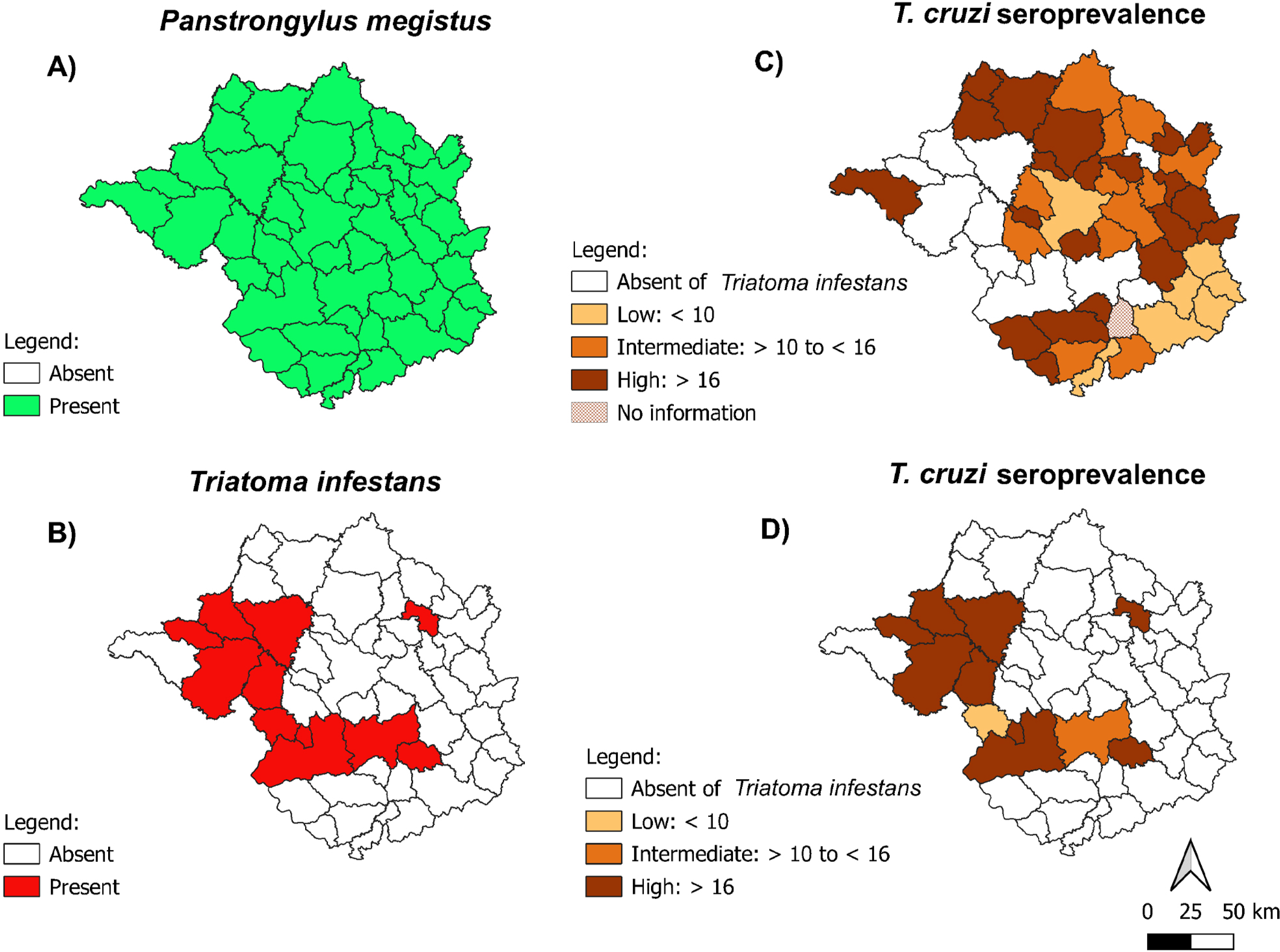
Data from Silveira et al.15 showed that P. megistus had a broad geographical distribution, being present in all studied municipalities (100%, 52/52) (Figure 2A). In contrast, T. infestans was detected, and therefore co-existed with P. megistus, in only 19.2% (10/52) of the municipalities (Figure 2B).
Comparison of the geographic distributions of the occurrence of Triatoma infestans and Panstrongylus megistus, and the seroprevalence of human Trypanosoma cruzi infection, in the municipalities of the Divinopolis Regional Health Superintendence study area in the mid-west region of Minas Gerais State, Brazil, between 1975 and 1983: (A) The absence and presence of P. megistus; (B) The absence and presence of T. infestans; (C) The seroprevalence of human T. cruzi infection (%), in the municipalities where T. infestans was absent, and only P. megistus was found; (D) The seroprevalence of human T. cruzi infection (%), in the municipalities where both T. infestans and P. megistus were found.
In the 41 municipalities where only P. megistus was detected and for which relevant epidemiological data were available, the mean seroprevalence of human T. cruzi infection was 17.8%, ranging from 1.0% to 41.9% (Figure 2C). In the 10 municipalities where T. infestans occurred, the mean seroprevalence was higher, at 25.8%, with a range of 9.8% to 40.8% (Figure 2D). Among the 41 municipalities with only P. megistus and available data, more than 50% were classified as having high seroprevalence. In contrast, 80% of the municipalities with T. infestans infestation were classified as having high seroprevalence of human T. cruzi infection (Table 1).
Comparison of the occurrence of Triatoma infestans and Pantrongylus megistus according to the level of the seroprevalence of human Trypanosoma cruzi infection in the municipalities of the Divinopolis Regional Health Superintendence (SRSD) in the midwestern region of Minas Gerais State, Brazil, between 1975 and 1983.
DISCUSSION
The western region of Minas Gerais State has historically been recognized as an endemic area for Chagas disease, which is significant in the history of the region. Several triatomine species have been consistently reported in the area since the 1970s, including Panstrongylus diasi Pinto & Lent, 1946; Panstrongylus geniculatus (Latreille, 1811); Rhodnius neglectus Lent, 1954; Triatoma sordida (Stål, 1859); and Triatoma pseudomaculata Corrêa & Espínola, 1964, with P. megistus remaining particularly significant due to its persistence18,19.
Panstrongylus megistus was the predominant triatomine species in Minas Gerais until the end of the 1930s, accounting for 79.8% of the reported distribution, including within the region now corresponding to the SRSD. During this period and shortly thereafter, T. infestans spread rapidly and extensively across Brazil, eventually surpassing P. megistus and becoming the dominant species by the early 1940s12, when it became the main vector in the state. In the 1970s, the natural infection rate was 8.7% for T. infestans and 3.4% for P. megistus20.
Previous studies have reported the coexistence of both species in Minas Gerais State15,21. Although the geographical distribution of T. infestans was more restricted than that of P. megistus, the intradomestic colonies of T. infestans generally had more individuals21–23, highlighting the competitive advantage of this exotic species over native triatomines within domestic environments24. The spread of T. infestans across Brazil displaced native species, leading it to become the predominant vector in its areas of occurrence and the greatest challenge for controlling Chagas disease transmission13.
Panstrongylus megistus was previously reported in 415 municipalities in Minas Gerais15 and was widely distributed across all municipalities within the SRSD, as also confirmed in this retrospective analysis. A comparison between the data from Silveira et al.15 and the one published by Villela et al.18 for the same study area revealed that P. megistus remained the most widely distributed species between 2003 to 2007 and was also the most frequently captured triatomine during that period.
The biological behavior of P. megistus supports its broad dispersion, as this species shows strong capacity for adaptation to both peridomestic and intradomestic environments. Typically, it has a single peak of adults during the rainy season, which is consistent with the occurrence of a single annual cycle23,25,26. Adults of P. megistus disperse from October to February, with frequent reports of insects invading homes and establishing new foci, coinciding with a time when residents are at increased risk of exposure to T. cruzi. In contrast, in areas subjected to sustained vector control over the past 30 years, where triatomine colonies are generally maintained at low densities, dispersal events from domestic units tend to be infrequent or rare27.
Among the municipalities where only P. megistus was present, 51.2% recorded a high seroprevalence of human T. cruzi infection (>16%), demonstrating the vectorial potential of this species in the absence of T. infestans. In general, P. megistus shows high rates of natural infection with T. cruz,13,28,29. Furthermore, this species can blood-feed on a broad range of vertebrate hosts, including humans (22.5%), which facilitates its adaptation to novel anthropogenic environments19. In previous studies, as is typical for triatomines that colonize peridomestic environments, birds—particularly chickens—were identified as the primary food source in this region. However, the proportion of insects feeding on human blood further underscores the anthropophilic behavior of P. megistus19,28.
CONCLUSION
The seroprevalence of human T. cruzi infection exceeded 16% in 80% of the municipalities where the T. infestans was present, highlighting its significant vectorial potential, which likely contributed to Minas Gerais State having the highest number of people infected by T. cruzi at the time15. T. infestans was the primary target of the Chagas Disease Control Program (PCDCH) until vector transmission by this species was eliminated in Brazil in 200630. Following its elimination, P. megistus re-emerged as the most important vector of T. cruzi in Minas Gerais State19,31, and currently represents the major challenge for triatomine control in municipalities within the SRSD.
DATA AVAILABILITYThe complete anonymized dataset supporting the findings of this study is included within the article itself.
ACKNOWLEDGMENTS
First and foremost, this article recognizes the work of Antonio Carlos Silveira, whose triatomine and serological surveys, which are the basis for this analysis and were conceptualized and implemented by him, were crucial in transforming and enabling the successful control of Chagas disease in Brazil. We also thank Luke Baton for commenting on, and revising, the original manuscript.
REFERENCES
- 1 Chagas C. Nova tripanozomiaze humana: estudos sobre a morfologia e o ciclo evolutivo do Schizotrypanum cruzi n. gen., n. sp., agente etiológico de nova entidade mórbida do homem. Mem Inst Oswaldo Cruz. 1909;1:159-218.
-
2 World Health Organization. Chagas disease (also know as American trypanosomiasis) Geneva: World Health Organization; 2025. [cited 2025 Sep 18]. Available from: https://www.who.int/en/news-room/fact-sheets/detail/chagas-disease-(american-trypanosomiasis)
» https://www.who.int/en/news-room/fact-sheets/detail/chagas-disease-(american-trypanosomiasis) - 3 Galvão C, Gil-Santana HR, Oliveira J. The taxonomic catalog of the Brazilian fauna: biodiversity and geographical distribution of Triatominae (Hemiptera: Reduviidae) in Brazil. Zoologia (Curitiba). 2024;41:e24006.
- 4 Lent H, Wygodzinsky P. Revision of the Triatominae (Hemiptera, Reduviidae), and their significance as vectors of Chagas’ disease. Bull Am Mus Nat Hist. 1979;163:125-520.
- 5 Roque AL, Jansen AM. Reservatórios do Trypanosoma cruzi e sua relação com os vetores. In: Galvão C, organizador. Vetores da doença de Chagas no Brasil. Curitiba: Sociedade Brasileira de Zoologia; 2014. p.75-87.
- 6 López-García A, Gilabert JA. Oral transmission of Chagas disease from a One Health approach: a systematic review. Trop Med Int Health. 2023;28:689-98.
- 7 Dias JC, Ramos Jr NA, Gontijo ED, Luquete A, Shikanai-Yasuda MA, Coura JR, et al. II Consenso Brasileiro em Doença de Chagas, 2015. Epidemiol Serv Saude. 2016;25 N Esp:7-86.
- 8 Diotaiuti L. Ecologia. In: Diotaiuti L, Barbosa S. Triatomíneos. Belo Horizonte: Centro de Pesquisas René Rachou; 2015. p.121-37.
- 9 Guarneri AA, Diotaiuti L, Gontijo NF, Gontijo AF, Pereira MH. Blood-feeding performance of nymphs and adults of Triatoma brasiliensis on human hosts. Acta Trop. 2003;87:361-70.
- 10 Belisário CJ, Pessoa GC, Silva EM, Rosa AC, Ferreira RE, Bedin C, et al. Genetic characterization of residual Triatoma infestans populations from Brazil by microsatellite. Genetica. 2017;145:105-14.
- 11 Guarneri AA, Pereira MH, Diotaiuti L. Influence of the blood meal source on the development of Triatoma infestans, Triatoma brasiliensis, Triatoma sordida, and Triatoma pseudomaculata (Heteroptera, Reduviidae). J Med Entomol. 2000;37:373-9.
- 12 Martins AV, Versiani V, Tupinambá AA. Sobre 25 casos agudos de moléstia de Chagas observados em Minas Gerais. Mem Inst Ezequiel Dias. 1940;3-4:6-51.
- 13 Dias JCP, Machado EM, Borges EC, Moreira EF, Gontijo C, Azeredo BV. Doença de Chagas em Lassance, MG: reavaliação clínico-epidemiológica 90 anos após a descoberta de Carlos Chagas. Rev Soc Bras Med Trop. 2002;35:167-76.
- 14 Silveira AC, Martins E. Histórico do controle da transmissão vetorial e situação epidemiológica atual. In: Galvão C, organizador. Vetores da doença de Chagas no Brasil. Curitiba: Sociedade Brasileira de Zoologia; 2014. p.10-25.
- 15 Silveira AC, Feitosa VR, Borges R. Distribuição de triatomíneos capturados no ambiente domiciliar, no período 1975-83, Brasil. Rev Bras Malariol Doenças Trop. 1984;36:15-312.
- 16 Camargo ME, Silva GR, Castilho EA, Silveira AC. Inquérito sorológico da prevalência de infecção chagásica no Brasil, 1975/1980. Rev Inst Med Trop Sao Paulo. 1984;26:192-204.
-
17 Instituto Brasileiro de Geografia e Estatística. Malha municipal. [cited 2025 Sep 18]. Available from: https://www.ibge.gov.br/geociencias/organizacao-do-territorio/malhas-territoriais/15774-malhas.html
» https://www.ibge.gov.br/geociencias/organizacao-do-territorio/malhas-territoriais/15774-malhas.html - 18 Villela MM, Souza JM, Melo VP, Dias JC. Avaliação do Programa de Controle da Doença de Chagas em relação à presença de Panstrongylus megistus na região centro-oeste do Estado de Minas Gerais, Brasil. Cad Saude Publica. 2009;25:907-17.
- 19 Villela MM, Rodrigues VL, Casanova C, Dias JC. Análise da fonte alimentar de Panstrongylus megistus (Hemiptera, Reduviidae, Triatominae) e sua atual importância como vetor do Trypanosoma cruzi, no Estado de Minas Gerais. Rev Soc Bras Med Trop. 2010;43:125-8.
- 20 Castro Filho J, Silveira AC. Distribuição da doença de Chagas no Brasil. Rev Bras Malariol Doenças Trop. 1979;31:85-98.
- 21 Martins AV, Versiani V, Peres JN. Distribuição geográfica dos triatomideos e seus índices de infecção pelo Schizotrypanum cruzi no Estado de Minas Gerais. Arq Saude Publica. 1951:63-79.
- 22 Pellegrino J. Novos dados sobre a distribuição de triatomíneos e sua infecção pelo Schizotrypanum cruzi no Estado de Minas Gerais. Mem Inst Oswaldo Cruz. 1950;48:639-67.
- 23 Dias E. Variações mensais da incidência das formas evolutivas de Triatoma infestans e Panstrongylus megistus em Bambui, Estado de Minas Gerais. Mem Inst Oswaldo Cruz. 1955;53:457-72.
- 24 Pereira MH, Penido CM, Martins MS, Diotaiuti L. Triatoma infestans is more efficient than Panstrongylus megistus in obtaining blood meals on non anaesthetized mice. Mem Inst Oswaldo Cruz. 1995;90:765-7.
- 25 Forattini OP, Ferreira AO, Rocha e Silva EO, Rabelo EV. Aspectos ecológicos da Tripanossomíase americana: IX-Variação e mobilidade de Panstrongylus megistus em ecótopos artificiais. Rev Saude Publica. 1977;11:199-213.
- 26 Forattini OP, Ferreira AO, Rocha e Silva EO, Rabelo EV. Aspectos ecológicos da Tripanossomíase americana: XII-Variação regional da tendência de Panstrongylus megistus à domiciliação. Rev Saude Publica. 1978;12:209-33.
- 27 Ferreira FC, Diotaiuti LG, Belisário CJ. Dynamics of Panstrongylus megistus infestation, the primary vector of Trypanosoma cruzi in Minas Gerais, Brazil. Acta Trop. 2022;235:106658.
- 28 Fernandes AJ, Chiari E. Casanova C. Dias JC, Romanha JA. The threat of reintroduction of natural transmission of Chagas’ disease in Bambuí, Minas Gerais state, Brazil, due to Panstrongylus megistus. Mem Inst Oswaldo Cruz. 1992;87:285-9.
- 29 Gurgel-Gonçalves R, Galvão C, Costa J, Peterson AT. Geographic distribution of Chagas disease vectors in Brazil based on ecological niche modeling. J Trop Med. 2012;2012:705326.
- 30 Dias JC. Chagas disease: successes and challenges. Cad Saude Publica. 2006;22:2020-1.
- 31 Neves NA, Zambe RH, Quintino ND, Barbosa CV, Ferreira RA, Veloso AB, et al. Perfil de infestação e infecção de triatomíneos capturados nas unidades domiciliares de municípios pertencentes à Superintendência Regional de Saúde de Divinópolis (SRSD), Minas Gerais. In: Anais do 57° Congresso da Sociedade Brasileira de Medicina Tropical; 2022 Nov 15-16; Belém, Brasil.