 Bond strength performance of mortar coatings in masonry prisms under applied displacements
Abstract
Abstract In coating systems, mortars must exhibit sufficient deformability to accommodate variations from structural loads, differential movements, and thermal cycles, ensuring adhesion to the substrate. This study evaluated the effect of applied displacements on masonry prisms under compression on the tensile bond strength of mortar coatings. For this purpose, prisms were constructed using two vertically perforated ceramic blocks (290 × 140 × 190 mm), laid with 10 mm mortar joints and coated with three mortar types (mixed, industrialized, and stabilized), employing a plastering mortar layer, with rolled slurry. After curing, the prisms were subjected to compression until displacements of 2 mm, 3 mm, and 4 mm were reached and subsequently loaded to failure. At each displacement level, the tensile bond strengths of the coatings were determined. Based on the acquired data, the prisms’ modulus of elasticity, resilience, and toughness were estimated from the stress–strain curves. The results showed that the mixed mortar coating, due to its higher deformability, provided greater resilience and lower influence on the modulus of elasticity of the prisms, resulting in a less pronounced reduction in bond strength (27.4%) at the highest displacement, compared to the industrialized (34.8%) and stabilized (37.3%) mortars, which exhibited reduced capacity to accommodate displacements without debonding. The higher modulus of elasticity of the industrialized mortar limited deformation absorption, leading to brittle debonding and lower prism resilience and toughness. These findings underscore the importance of selecting an appropriate mortar to ensure the performance and durability of coating systems applied to masonry structures subjected to deformations.
Keywords:
compressive strength; masonry prisms; deformability; coating mortars; pull-off test
Resumo
Resumo Em sistemas de revestimento, as argamassas devem apresentar deformabilidade suficiente para acomodar variações provenientes de cargas estruturais, movimentos diferenciais e ciclos térmicos, assegurando a aderência ao substrato. Esta pesquisa avaliou o efeito de deslocamentos aplicados a prismas de alvenaria submetidos à compressão na resistência de aderência à tração dos revestimentos. Para isso, foram construídos prismas constituídos por dois blocos cerâmicos com furos verticais (290 × 140 × 190) mm, assentados com junta de argamassa de 10 mm e revestidos com três tipos de argamassa (mista, industrializada e estabilizada), empregando chapisco rolado como ponte de aderência. Após a cura, os prismas foram submetidos à compressão até atingirem deslocamentos de 2 mm, 3 mm e 4 mm, sendo então carregados até a ruptura. Em cada nível de deslocamento, foram determinadas as resistências à tração dos revestimentos. A partir dos dados obtidos, os módulos de elasticidade, a resiliência e a tenacidade dos prismas foram estimados a partir das curvas tensão-deformação. Os resultados mostraram que o revestimento de argamassa mista, devido à sua maior deformabilidade, proporcionou maior resiliência e menor impacto no módulo de deformação dos prismas, resultando em uma redução menos acentuada da aderência (27,4%) no maior deslocamento, em comparação aos revestimentos de argamassa industrializada (34,8%) e estabilizada (37,3%), que apresentaram maior dificuldade em se movimentar sem descolar do substrato. O maior módulo de elasticidade da argamassa industrializada limitou a absorção de deformações, ocasionando ruptura frágil por descolamento, além de menores valores de resiliência e tenacidade dos prismas. Os resultados evidenciam a importância da escolha adequada da argamassa para assegurar o desempenho e a durabilidade dos sistemas de revestimentos em alvenarias submetidas a deformações.
Palavras-chave:
resistência à compressão; prismas de alvenaria; deformabilidade; argamassas de revestimento; resistência de aderência à tração
1 INTRODUCTION
Masonry is widely used in civil construction due to its practicality, cost-effectiveness, and durability, being designed to ensure the stability, safety, and habitability of buildings. In addition to providing thermal and acoustic insulation, mechanical strength, and watertightness, masonry contributes to efficient spatial compartmentalization [1]–[3]. From a structural perspective, masonry is characterized as an orthotropic, inelastic, and heterogeneous material, whose properties vary according to the orientation of applied loads on the units and joints. The combination of blocks or bricks and mortar, each with different mechanical properties and Poisson’s ratios, results in a complex stress state, including compression, tension, and shear, at the interfaces [4]–[6].
Its performance depends on various factors such as the strength and deformability of the constituent materials, joint thickness, geometry of the units, orientation of loads, as well as loading conditions [1], [7]. Tensile strength is significantly lower than compressive strength, primarily due to the presence of mortar joints. Therefore, unreinforced masonry structures are generally designed to withstand predominantly compressive loads. Masonry behavior is approximately linear-elastic under low stresses, becoming nonlinear as cracking and stress redistribution occur near failure [8].
To ensure adequate structural performance, it is essential that masonry materials have compatible properties. For example, the laying mortar should be resilient, capable of deforming without cracking and returning to its original shape, which is favored by a lower modulus of elasticity [9], [10]. Moreover, its strength is recommended to be lower than that of the block to avoid stress concentration at the interface and premature failure [1]. Adequate deformability allows uniform redistribution of internal stresses over time, maintaining system integrity.
In coating systems, mortars must resist bending tensile stresses to ensure adhesion to the substrate, in addition to exhibiting sufficient deformability to accommodate variations from structural loads, differential movements, thermal cycles, and shrinkage. This deformability contributes to stress redistribution in masonry, enabling the coating to absorb and dissipate part of the stresses through microcracks at the paste-aggregate interfaces or capillary cracks in the joints, which are generally imperceptible [11]–[13].
Considering the complexity involved in evaluating masonry behavior, large-scale experimental testing faces practical limitations related to cost, time, sample transportation, and equipment constraints [14]. As an alternative, masonry prisms have been widely used as simplified models, typically composed of two to five stacked units. These specimens are easier to construct and test, allowing representative analyses that consider material interaction and execution quality [7], [15], [16].
Most experimental studies with prisms or walls are conducted without applying mortar coatings [15], [17]–[19]. However, although fewer in number, there are also investigations considering coated prototypes, providing a closer approach to real use conditions. Oliveira et al. [20] analyzed the behavior of bricks, prisms, and small coated walls, observing different failure modes and highlighting that coatings can contribute to load absorption after cracking initiation in the blocks. Azevedo et al. [21], testing 195 ceramic prisms with and without coating, found that using conventional and reinforced mortar significantly increased the compressive load capacity of the tested elements. Nevertheless, it is important to emphasize that, according to NBR 16868-1 [22], mortar coatings should under no circumstances be considered as elements contributing to the effective thickness or compressive strength of walls in structural masonry design.
Given the relevance of coatings to the behavior of masonry and experimental evidence of their contribution stress redistribution, this research aimed to evaluate the adhesion of mixed, industrialized, and stabilized mortar coatings applied on ceramic block prisms under axial compression.
2 MATERIALS AND EXPERIMENTAL PROGRAM
2.1 Materials
2.1.1 Blocks
The ceramic blocks employed in this study were of the EST60 structural type, characterized by vertical perforations and nominal dimensions of 290 × 140 × 190 mm (length × width × height) (Figure 1). The blocks were stored under laboratory conditions, kept covered, dry, and well-ventilated until the time of use.

2.1.2 Mortars
The mortars used in this study comprised laying mortar (LM), plastering mortar (PM), and three types of coating mortars: (i) mixed mortar (MM), (ii) industrialized mortar (IM), and (iii) stabilized mortar (SM). The characteristics of the mortars are presented in Table 1.
The mixed mortar (MM) was prepared using CP II-F-32 Portland cement, with a unit weight of 1053.20 kg/m3 [23] and a specific gravity of 3.09 g/cm3 [24]; CH III hydrated lime, with a unit weight of 593.51 kg/m3 [23] and a specific gravity of 2.66 g/cm3 [24]; and natural quartz sand obtained from the Paraná River, Brazil. The granulometric distribution and physical properties of the sand are presented in Table 2, while the technical specifications of the CP II-F-32 cement, as provided by the manufacturer, are summarized in Table 3.
2.2 Methods
2.2.1 Characterization of blocks and substrates
The ceramic blocks were subjected to geometric, physical, and mechanical characterization in accordance with the specifications of NBR 15270-2 [28]. According to the standard, a sample of thirteen specimens was used to evaluate the geometric and mechanical properties, while a sample of six specimens was used for the physical properties. The results are presented in Table 4.
Average values, standard deviation (SD), and coefficient of variation (CV) of different properties of the ceramic blocks.
The ceramic substrates, with and without plastering mortar application, were physically characterized in terms of water absorption and initial rate of absorption (IRA) in accordance with [28], using a sample of six specimens. The surface roughness (Ra) of each specimen was measured with a profilometer (Mitutoyo, model SJ-410), following the procedures established in NBR ISO 4287 [29]. Measurements were taken at three different locations on each surface to obtain representative mean values. The characterization results for surface roughness and initial rate of absorption are summarized in Table 5.
2.2.2 Production of mortars
Mortars were prepared for the production of prisms. The stabilized mortars, used both for laying and coating, were produced in a mixing plant and supplied ready for use. Transportation was carried out by truck mixer, and the mortars were stored in 0.5 m3 metal containers, maintained under a water layer of approximately 2 cm during the stabilization period until the time of application. Prior to use, the stabilized mortar was manually remixed to restore adequate workability.
The mixed mortar (MM) was prepared in a laboratory setting using a tilting-drum mixer with a capacity of 150 liters. Due to the volume of materials, the mixing was performed in two stages, following the guidelines of NBR 16541 [30]. The consumption of materials (cement, lime, sand, and water) used in the preparation of the mixed mortar is presented in Table 6, along with the corresponding mix proportions by mass and volume, as well as the water-to-cement (w/c) and water-to-dry-materials (w/dm) ratios.
The industrialized mortars used as plastering and coating layers were prepared in a laboratory environment, according to NBR 16541 [30] and the manufacturer’s recommendations. The recommended water-to-dry material ratio was 4.5 liters per 20 kg bag for the industrialized mortar used as plastering and 4.0 liters per 20 kg bag for the coating mortar, respectively.
2.2.3 Characterization of mortars
Mortar samples were selected for characterization in both fresh and hardened states at the time of prism fabrication.
Fresh-state characterization included the consistency index [31], bulk density, and air content [32], as well as the rheological behavior evaluated by the squeeze-flow test [33] on different substrates. Consistency was determined as the average of three diameter measurements on the same specimen, with three repetitions conducted to calculate the final mean value. Bulk density and air content were measured on four specimens. For the squeeze-flow test, three repetitions were performed for each condition. The results of these tests are presented in Table 7 and Figure 2, respectively.
Average values, standard deviation (SD), and coefficient of variation (CV) of different properties of fresh mortars.

Hardened-state properties were evaluated on specimens with dimensions of 40 × 40 × 160 mm after 28 days of curing, including flexural strength, compressive strength [34], and dynamic modulus of elasticity [35]. Six specimens were tested for each property, and the results are summarized in Table 8.
Average values, standard deviation (SD), and coefficient of variation (CV) of the mechanical properties of hardened mortars.
2.2.4 Production of ceramic block prisms
The prisms were molded using two ceramic blocks with vertical perforations, each measuring 290 × 140 × 190 mm, laid with a 10 mm thick mortar joint, resulting in a total height of 390 mm (Figure 3a). Following a 14-day curing period to allow the prisms to settle, a 3 mm layer of plastering mortar was applied using a high-texture roller (Figure 3b), and the application was completed in a single day. After this, a minimum waiting period of 72 hours was observed before applying the mortar coating to the prism surfaces. During this interval, the prisms were maintained under consistent laboratory conditions.

The mortar coating was applied with an approximate thickness of 20 mm, ensuring uniformity with the molds (Figure 3c). Prism molding and coating application were performed in a controlled laboratory environment, maintaining a temperature of 23 ± 2 °C and relative humidity of 60 ± 15%, in accordance with the procedures established by NBR 16868-3 [36]. The prisms were molded by a qualified professional to ensure standardized execution, and the curing process was conducted under laboratory conditions for 28 days (Figure 3d). After the coating application was completed, the top surfaces of the prisms were sanded with coarse-grit sandpaper to remove debris and ensure proper surface alignment.
2.2.5 Mechanical characterization of prisms
For the mechanical characterization, the loads applied to the prisms and the tensile bond strength of the mortar coatings were simultaneously measured under four displacement conditions: (i) d0 (no displacement), (ii) d2 (2 mm), (iii) d3 (3 mm), and (iv) d4 (4 mm). The maximum displacement was set at approximately 80% of the maximum failure displacement determined in preliminary tests.
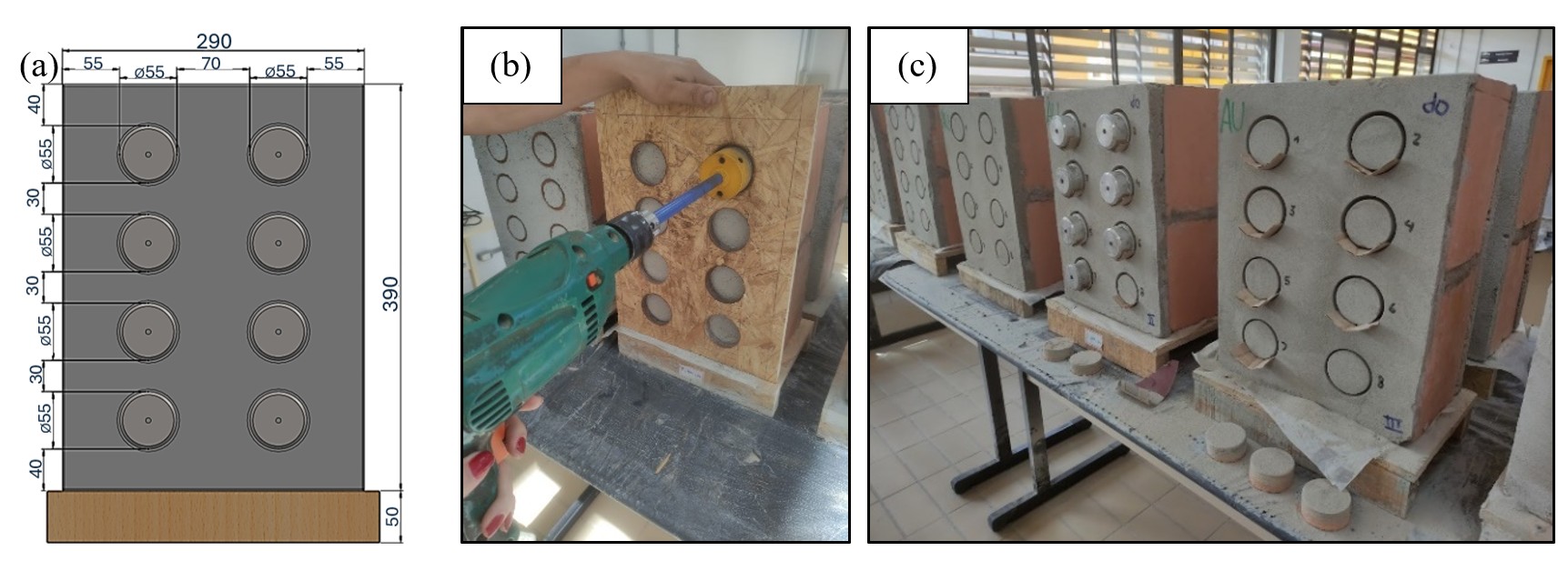
Prior to testing, the specimens were prepared in accordance with NBR 13528-2 [37]. Eight circular areas of 50 mm in diameter were marked on each prism face, centered on the ceramic blocks and avoiding the mortar joints (Figure 4a). Perpendicular cuts were performed on the coating using a diamond core drill (Figure 4b), and all debris was removed from the cavities and surfaces. Metallic studs were then bonded to the marked areas using the plastic adhesive specified in the standard, and the specimens were left to cure for at least four hours before testing (Figure 4c).

The prisms were subjected to compressive strength testing at a constant loading rate of (0.05 ± 0.01) MPa/s, according to NBR 15270-2 [28], using an EMIC hydraulic universal testing machine with a 300 kN load capacity. An EMIC electronic deflectometer model EE05, with a measurement range of 0-12.5 mm and a stroke length of 12.5 mm, was positioned vertically on the prism to measure displacement with high accuracy. Upon reaching the predetermined displacement limit (2 mm, 3 mm, or 4 mm), the machine piston was held stationary, maintaining the prism under sustained load. Under this condition, tensile bond strength tests were carried out on both prism faces in accordance with NBR 13528-2 [37], using a manual hydraulic pull-off device equipped with digital force display, peak memory, a capacity of 14,710 N, and a resolution of 9.81 N.
After failure of the 16 mortar coating specimens, compressive loading of the prism was resumed at the same constant rate of (0.05 ± 0.01) MPa/s until ultimate failure. The resilience of the prisms at displacements d2, d3, and d4, as well as their toughness up to failure, was determined from the area under the average stress–displacement curves. Figure 5 illustrates the testing setup, and Table 9 presents the identification and characterization of the prisms together with the corresponding test conditions.

Prisms testing: positioning (a, b); tensile bond strength (c); compressive strength until failure (d).
3 RESULTS AND DISCUSSIONS
3.1 Mechanical behavior of the prisms
The average stress–displacement curves of the prisms subjected to compression are illustrated in Figure 6.
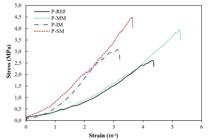
The stress-strain behavior of the prisms revealed that those coated with mixed mortar exhibited a curve profile similar to the uncoated specimens. However, the application of the coating improved the mechanical response, enabling the prisms to sustain higher stress levels prior to failure, thereby increasing their compressive strength. Under axial loading, prisms with mixed mortar coatings also demonstrated greater deformability compared to those coated with industrialized or stabilized mortars. In contrast, prisms coated with industrialized and stabilized mortars exhibited similar mechanical responses, characterized by steeper initial slopes in the stress-strain curves, indicative of higher stiffness. This behavior is associated with the higher modulus of elasticity of these mortars. Notably, these stiffer prisms required higher stress levels to achieve the same displacements levels observed in the more deformable, mixed mortar-coated and uncoated prisms. An increase in the individual modulus of elasticity of mortar does not necessarily translate to improved compressive strength of the masonry unit. Mortars with reduced deformability may lack sufficient capacity to accommodate imposed strains, limiting their energy absorption potential and, consequently, leading to premature failure of the coating-masonry system [38].
Despite presenting comparable stiffness levels, the prisms coated with industrialized mortar failed under lower stress levels than those coated with stabilized mortar. This behavior may be attributed to the higher modulus of elasticity of the industrialized mortar, which, while contributing to increased stiffness, likely reduced its ability to accommodate compressive deformations. As a result, the inability to effectively absorb stress may have led to premature failure of the coating. This aligns with the understanding that masonry exhibits approximately linear-elastic behavior under low stress levels, transitioning to nonlinear behavior as cracking initiates and stress redistribution occurs near the failure point [8].
Building on this analysis, the stress-strain were used to determine the average values of compressive strength, modulus of elasticity, and toughness of the prisms. These results are summarized and illustrated in Figure 7, providing a comprehensive comparison of the mechanical performance of each coating type.
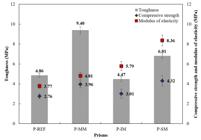
Statistical analysis performed between pairs with the closest compressive strength results, using the t-test, showed that the application of the industrialized mortar coating did not result in significant increases ( = 0.13) in the compressive strength of the prisms, despite this mortar exhibiting the highest individual values for mechanical properties. Moreover, the application of mixed and stabilized mortar coatings produced prisms with compressive strengths that were not statistically different from each other ( = 0.09). Although the mixed mortar exhibited the lowest mechanical properties among the mortars studied, its ductile behavior, with a delayed failure, contributed to an increase in compressive strength compared to the uncoated prism, similarly to the stabilized mortar.
Statistical analysis of the pairs with the closest modulus of elasticity results, also using the t-test, revealed significant differences between them ( = 0.001 between P-REF and P-MM) and ( = 0.006 between P-MM and P-IM). This behavior may be related to the individual stiffness of the mortars, as the modulus of elasticity results showed that the industrialized mortar was the stiffest, followed by the stabilized mortar, and lastly, the mixed mortar. In this sense, the lack of flexibility of the industrialized mortar may have restricted its movement, leading to failure at lower stress levels than those of the prisms coated with stabilized or mixed mortars.
The toughness results of the prisms followed a trend similar to that observed for compressive strength. Prisms coated with mixed mortar exhibited the highest toughness, while those coated with industrialized mortar showed the lowest. In general terms, the toughness of a ductile material is greater than that of a brittle one. Thus, the application of the more ductile and flexible mixed mortar allowed the prism to absorb more energy up to the point of fracture. On the other hand, the statistical analysis between pairs, performed using the t-test, indicated that the application of the industrialized mortar coating did not significantly affect the toughness of the prisms compared to the uncoated condition, showing no significant differences in toughness between them ( = 0.24).
The application of different predefined displacements on the prisms, during the simultaneous tensile bond strength testing of the mortars, resulted in different levels of energy absorption by the prisms at that moment, according to the individual characteristics of the constituent materials. Based on the average stress-strain curves of the coated prism specimens, the average resilience at displacements d2, d3, and d4, as well as the toughness at the point of fracture, were determined for each mortar type, as presented in Table 10.
All mortars showed increasing performance, reaching the highest toughness values at the point of fracture. The mixed mortar exhibited greater resilience at all displacement stages. Due to its higher ductility, this mortar allowed the coating to accommodate deformations without failure, which is reflected in the highest toughness value at fracture. This suggests that this mortar has greater resistance to crack propagation and a better ability to absorb energy before failure, indicating greater suitability for situations requiring higher fracture resistance.
At all displacement levels, prisms coated with mixed mortar were subjected to lower compressive stresses compared to those coated with the other mortars, as preliminarily predicted by the curves; however, they exhibited greater deformations due to their ductile behavior, resulting in higher toughness values.
On the other hand, the industrialized mortar showed the poorest performance, displaying the lowest resilience values at all displacements. Both the stress and displacement values of this mortar, as seen in the stress-strain curves, are lower than those of the other mortars. This indicates a lower energy absorption capacity throughout the entire process. The toughness of a brittle material is lower than that of a ductile material, which was reflected in the behavior of the prisms coated with industrialized mortar. Being stiffer, this mortar failed more quickly, demonstrating lower fracture resistance and less ability to absorb energy before failure.
The stabilized mortars exhibited higher stress values but lower displacement values compared to the mixed mortar. As previously observed, prisms coated with stabilized mortar were, in fact, the ones that withstood the highest compressive stresses before failure. The stabilized mortar showed intermediate performance. This analysis may assist in selecting the most appropriate mortar for different applications, depending on the required fracture resistance and energy absorption capacity before failure.
Masonry walls, due to their high stiffness, often have difficulty accommodating the deformations imposed by the reinforced concrete structure. As structural elements are subjected to higher service stresses without a corresponding increase in the modulus of elasticity of the materials, flexural members tend to become more flexible, resulting in greater deformations. Although these deflections may not compromise the aesthetics, stability, or overall strength of the building, they can be incompatible with the deformation capacity of the masonry walls. This incompatibility underscores the importance of selecting mortars with suitable ductility and toughness that can better absorb and accommodate deformations without premature failure, thus ensuring improved structural performance and durability [39], [40].
3.2 Impact of the applied displacements on prisms on the tensile bond strength of mortar coatings The average tensile bond strength results of the prisms subjected to the applied displacements, for the mixed, industrialized, and stabilized mortars, are presented in Table 11, along with the respective standard deviations and coefficients of variation.
Test-T was performed with a confidence level of 95%: a not statistically significant; A,B statistically significant. Columns 2, 5, 8: analysis between mortars in different displacements.
It is observed that, under all conditions, the tensile bond strengths of the mixed mortar were lower than those of the other mortars. The shorter plastic phase identified in the squeeze-flow test and the fresh-state bulk density of this mortar indicated a weaker bond strength due to its limited ability to deform and conform to the substrate’s recesses. The industrialized mortar showed intermediate values among the mortars studied. In the fresh state, it exhibited a wider plastic phase than the mixed mortar; however, its composition - with a higher proportion of industrial sand (calcium carbonate) compared to the other constituent materials (cement and natural sand) - may have hindered its application, compromising the coating’s adhesion, which became evident with the application of displacements. The stabilized mortar, in turn, exhibited the highest tensile bond strength values under all displacement conditions, as well as under normal conditions (d0). In the fresh state, the wider plastic phase shown by this mortar indicated a greater capacity for deformation and adaptation to surface irregularities during application and, consequently, better adhesion to the substrate. Figure 8 presents the percentages of bond strength reductions (indicated in parentheses) for the mortars at the three displacement levels compared to the normal condition (d0).
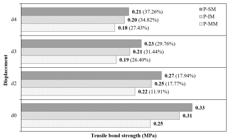
Under the action of displacements, it is observed that the bond performance of the mixed mortar was the least affected compared to the other mortars, as indicated by reduction percentages of 11.91%, 26.40%, and 27.43% for displacements d2, d3, and d4, respectively, relative to the bond strength under normal conditions (d0). The mixed mortar proved to be less susceptible to displacement variations, with a 15.52% reduction in bond strength when analyzing the displacement range from d2 to d4. Considering the reductions found for the mortars starting from the first displacement condition (d2), it is likely that the ductile behavior of the mixed mortar - that is, its greater capacity for deformation before failure -contributed to the lower impact on bond strength reduction. In the hardened state, more flexible mortars tend to exhibit a more extensive plastic phase, as represented in stress-strain, where the failure point occurs after greater strain compared to rigid mortars, and the rupture is less abrupt. This behavior aligns with observations from the preliminary compression tests on coated prisms.
When displacement d2 was applied, the industrialized and stabilized mortars showed similar bond strength reductions of approximately 17.77% and 17.94%, respectively, compared to d0. With an increase to displacement d3, the industrialized mortar was the most affected, while at displacement d4, the stabilized mortar suffered the greatest percentage reduction (37.26%). The bond strength results for displacements d0 and d2, as well as between d2 and d3, showed significant differences for all three mortar coatings. However, no significant differences were identified between displacements d3 and d4. These displacements, observed within the plastic phase of the stress-strain curves, did not cause substantial deformability in the prisms and coatings compared to the other displacement levels.
The industrialized mortar exhibited the highest modulus of elasticity (10.61 GPa), followed by the stabilized mortar (9.10 GPa), indicating a lower capacity to absorb and accommodate deformations under applied loads compared to the mixed mortar (5.42 GPa). In the hardened state, more rigid mortars exhibit a more restricted plastic phase compared to flexible mortars because they have limited capacity for plastic deformation. This behavior shows that for rigid mortars, deformation increases more rapidly relative to the applied stress; therefore, these mortars reach the failure point more quickly and in a brittle manner, without deforming much before failing.
Possibly under compression, the industrialized and stabilized mortars faced greater difficulty in moving without detaching from the substrate. This was evident in the bond strength reduction percentages, with variations of 17.05% and 19.12%, respectively, when analyzing the displacement range from d2 to d4. The stress-strain curves analyzed in the preliminary tests of the prisms already indicated that prisms coated with stabilized mortar, although exhibiting greater stiffness compared to those coated with mixed and industrialized mortars, still had the capacity to withstand higher loads until failure, characterized by the detachment of the coating from the substrate.
4 CONCLUSIONS
This study evaluated the adhesion performance of mixed, industrialized, and stabilized mortar coatings applied to ceramic block prisms under axial compression, using the applied displacement method. Based on the experimental results, the following conclusions can be drawn:
-
The mixed mortar coating, being the most deformable and having the greatest capacity to absorb and dissipate stresses, demonstrated higher resilience and a less pronounced reduction in tensile bond strength (27.4%) compared to the industrialized (34.8%) and stabilized (37.3%) mortar coatings at the highest displacement level, indicating its lower susceptibility to increases in the prisms’ modulus of elasticity.
-
Prisms coated with industrialized and stabilized mortars experienced greater difficulty accommodating movements without detaching from the substrate, as evidenced by bond strength reduction percentages of 17.05% and 19.12%, respectively, when analyzing the displacement range from d2 to d4 for both mortars.
-
The higher stiffness of the industrialized mortar may have limited the prisms’ capacity to absorb deformations under compressive load, leading to brittle failure characterized by detachment of the coating from the substrate, accompanied by lower resilience at all displacement levels and reduced toughness at fracture.
-
Financial support:
None.
-
Data Availability:
The data that support the findings of this study are available from the corresponding author, [R. S. P.], upon reasonable request
-
How to cite:
R. S. Paulino; M. R. M. M. Costa, “Bond strength performance of mortar coatings in masonry prisms under applied displacements”. Rev. IBRACON Estrut. Mater., vol. 18, no. 5, e18508, 2025, https://doi.org/10.1590/S1983-41952025000500008
REFERENCES FORMATS
-
1 E. S. Fortes, G. A. Parsekian, J. S. Camacho, and F. S. Fonseca, "Compressive strength of masonry constructed with high strength concrete blocks," Rev. IBRACON Estrut. Mater., vol. 10, no. 6, pp. 1273–1295, 2017., http://doi.org/10.1590/s1983-41952017000600008
» http://doi.org/10.1590/s1983-41952017000600008 -
2 N. Sathiparan and U. Rumeshkumar, "Effect of moisture condition on mechanical behavior of low strength brick masonry," J. Build. Eng., vol. 17, pp. 23–31, 2018., http://doi.org/10.1016/j.jobe.2018.01.015
» http://doi.org/10.1016/j.jobe.2018.01.015 -
3 K. Javed, M. I. Hassan, M. A. Farooq, and M. B. Sharif, "Detailed investigation of compressive and bond strength for sustainable brick masonry developed by using various types of bricks and green mortars," J. Build. Eng., vol. 84, no. 108477, pp. 108477, 2024., http://doi.org/10.1016/j.jobe.2024.108477
» http://doi.org/10.1016/j.jobe.2024.108477 -
4 S. B. Singh and P. Munjal, "Bond strength and compressive stress-strain characteristics of brick masonry," J. Build. Eng., vol. 9, pp. 10–16, 2017., http://doi.org/10.1016/j.jobe.2016.11.006
» http://doi.org/10.1016/j.jobe.2016.11.006 -
5 J. Witzany, R. Zigler, and K. Kroftová, "Strengthening of compressed brick masonry walls with carbon composites," Constr. Build. Mater., vol. 112, pp. 1066–1079, 2016., http://doi.org/10.1016/j.conbuildmat.2016.03.026
» http://doi.org/10.1016/j.conbuildmat.2016.03.026 -
6 J. Jing, C. Zhou, and C. Lin, "Compressive behavior of brick masonry columns confined with composites embedded in the horizontal mortar joint," Structures, vol. 57, no. 105120, pp. 105120, 2023., http://doi.org/10.1016/j.istruc.2023.105120
» http://doi.org/10.1016/j.istruc.2023.105120 - 7 Parsekian, G.; Hamid, A.; Drysdale, G. Comportamento e Dimensionamento de Alvenaria Estrutural São Carlos: EdUFSCar, 2012.
-
8 J. V. Mahesh, S. Ramya, B. M. Sreedhara, and R. M. Raveesh, "Bond strength characteristics of masonry using hemp fibre and chicken mesh reinforced mortar," Mater. Today Proc., In press, 2023., http://doi.org/10.1016/j.matpr.2023.03.704
» http://doi.org/10.1016/j.matpr.2023.03.704 -
9 A. Raj, A. C. Borsaikia, and U. S. Dixit, "Bond strength of autoclaved aerated concrete (AAC) masonry using various joint materials," J. Build. Eng., vol. 28, no. 101039, pp. 101039, 2020., http://doi.org/10.1016/j.jobe.2019.101039
» http://doi.org/10.1016/j.jobe.2019.101039 -
10 M. Donadello et al., "Analysis of compressive strength of masonry of ceramic blocks placed with cementitious mortar and polymeric compound" Materia (Rio J.), vol. 28, no. 1, 2023., http://doi.org/10.1590/s1517-707620230001.1335
» http://doi.org/10.1590/s1517-707620230001.1335 -
11 S. Deniz and S. T. Erdogan, "Prediction of elastic moduli development of cement mortars using early age measurements," J. Mater. Civ. Eng., vol. 27, no. 1, pp. 1–9, 2015., http://doi.org/10.1061/(ASCE)MT.1943-5533.0001025
» http://doi.org/10.1061/(ASCE)MT.1943-5533.0001025 - 12 L. L. M. Baía and F. H. Sabbatini Projeto e Execução de Revestimentos de Argamassa. São Paulo: O Nome da Rosa, 2016, 88 p.
-
13 P. K. V. R. Padalu and Y. Singh, "Variation in compressive properties of Indian brick masonry and its assessment using empirical models," Structures, vol. 33, pp. 1734–1753, 2021., http://doi.org/10.1016/j.istruc.2021.05.063
» http://doi.org/10.1016/j.istruc.2021.05.063 -
14 S. R. Sarhat and E. G. Sherwood, "The prediction of compressive strength of ungrouted hollow concrete block masonry," Constr. Build. Mater., vol. 58, pp. 111–121, 2014., http://doi.org/10.1016/j.conbuildmat.2014.01.025
» http://doi.org/10.1016/j.conbuildmat.2014.01.025 -
15 N. N. Thaickavil and J. Thomas, "Behavior and strength assessment of masonry prisms," Case Stud. Constr. Mater., vol. 8, pp. 23–38, 2018., http://doi.org/10.1016/j.cscm.2017.12.007
» http://doi.org/10.1016/j.cscm.2017.12.007 -
16 G. H. Nalon, C. F. R. Santos, L. G. Pedroti, J. C. L. Ribeiro, G. S. Veríssimo, and F. A. Ferreira, "Strength and failure mechanisms of masonry prisms under compression, flexure and shear: Components’ mechanical properties as design constraints," J. Build. Eng., vol. 28, pp. 101038, 2020., http://doi.org/10.1016/j.jobe.2019.101038
» http://doi.org/10.1016/j.jobe.2019.101038 -
17 P. Murthi, M. Bhavani, M. S. Musthaq, M. O. Jauhar, and V. Rama Devi, "Development of relationship between compressive strength of brick masonry and brick strength," Mater. Today Proc., vol. 39, pp. 258–262, 2020a., http://doi.org/10.1016/j.matpr.2020.07.040
» http://doi.org/10.1016/j.matpr.2020.07.040 -
18 P. Murthi, M. Akib, M. Imran, S. Ahmed, and V. Prasanna, "Studies on the strength variation of brick masonry using novel blended masonry mortar mixes and mortar thickness," Mater. Today Proc., vol. 39, pp. 126–130, 2020b., http://doi.org/10.1016/j.matpr.2020.06.395
» http://doi.org/10.1016/j.matpr.2020.06.395 -
19 G. H. Nalon et al., "Review of recent progress on the compressive behavior of masonry prisms," Constr. Build. Mater., vol. 320, no. 126181, pp. 126181, 2022., http://doi.org/10.1016/j.conbuildmat.2021.126181
» http://doi.org/10.1016/j.conbuildmat.2021.126181 -
20 R. A. Oliveira, F. A. N. Silva, C. W. A. P. Sobrinho, A. C. Azevedo, J. M. P. Q. Delgado, and A. S. Guimarães, "Structural performance of unreinforced masonry elements made with concrete and horizontally perforated ceramic blocks – Laboratory tests," Constr. Build. Mater., vol. 182, pp. 20–34, Sep 2018., http://doi.org/10.1016/j.conbuildmat.2018.06.092
» http://doi.org/10.1016/j.conbuildmat.2018.06.092 -
21 A. Azevedo, J. Quesado Delgado, A. Guimarães, F. Artur Silva, and R. Oliveira, "Compression behaviour of clay bricks prisms, wallets and walls – Coating influence," Rev. Constr., vol. 18, no. 1, pp. 123–133, 2019., http://doi.org/10.7764/RDLC.18.1.123
» http://doi.org/10.7764/RDLC.18.1.123 - 22 Associação Brasileira de Normas Técnicas, Structural Masonry – Part 1: Design, NBR 16868-1, 2021.
- 23 Associação Brasileira de Normas Técnicas, Aggregates – Determination of Bulk Density and Void Content, NBR 16972, 2021.
- 24 Associação Brasileira de Normas Técnicas, Portland Cement and Other Powdered Materials – Determination of Bulk Density. NBR 16605, 2017.
- 25 Associação Brasileira de Normas Técnicas, Aggregates – Determination of Particle Size Distribution - Test Method, NBR 17054, 2022.
- 26 Associação Brasileira de Normas Técnicas, Fine Aggregate – Determination of Density and Water Absorption, NBR 16916, 2021.
- 27 Associação Brasileira de Normas Técnicas, Portland Cement: Requirements, NBR 16697, 2018.
- 28 Associação Brasileira de Normas Técnicas, Ceramic Components – Hollow and Bricks for Masonry - Part 2: Test Method, NBR 15270-2, 2023.
- 29 Associação Brasileira de Normas Técnicas, Geometrical Product Specifications (GPS) - Surface Texture: Profile Method - Terms, Definitions and Surface Texture Parameters, NBR ISO 4287, 2002.
- 30 Associação Brasileira de Normas Técnicas, Mortar for Laying and Coating Walls and Ceilings: Preparation of the Mixture for Carrying Out Tests, NBR 16541, 2016.
- 31 Associação Brasileira de Normas Técnicas, Mortars Applied on Walls and Ceilings – Determination of the Consistence Index, NBR 13276, 2016,
- 32 Associação Brasileira de Normas Técnicas, Mortar for Laying and Coating Walls and Ceilings – Determination of Mass Density and Air Content, NBR 13278, 2005.
- 33 Associação Brasileira de Normas Técnicas, Rendering Mortar for Walls and Ceilings – Rheological Evaluation by Squeeze-Flow, NBR 15839, 2010.
- 34 Associação Brasileira de Normas Técnicas, Mortar – Determination of the Flexural and the Compressive Strength in the Hardened Stage – Method of Test, NBR 13279, 2005.
- 35 Associação Brasileira de Normas Técnicas, Mortar for Laying and Coating Walls and Ceilings: Determination of the Dynamic Modulus of Elasticity Through Ultrasonic Wave Propagation, NBR 15630, 2008.
- 36 Associação Brasileira de Normas Técnicas, Structural Masonry – Part 3: Test Methods, NBR 16868-3, 2020.
- 37 Associação Brasileira de Normas Técnicas, Render Made of Inorganic Mortars Applied on Walls – Determination of Tensile Bond Strength, NBR 13528-2, 2019.
-
38 R. S. Paulino and M. Costa, " Investigation of properties of different types of coating mortars and their impact on the behavior of ceramic block prisms," Ambient. Constr., vol. 25, pp. e138302, 2025., http://doi.org/10.1590/s1678-86212025000100807
» http://doi.org/10.1590/s1678-86212025000100807 - 39 E. Thomaz Trincas em edifícios: causas, prevenção e recuperação. São Paulo: Pini, 1989.
-
40 P. G. V. P. Florido, A. C. Lordsleem Jr, and Y. V. Póvoas, "Polymer-modified mortar flexibility of the masonry-concrete structure interface," Case Stud. Constr. Mater., vol. 20, no. e03225, pp. e03225, 2024., http://doi.org/10.1016/j.cscm.2024.e03225
» http://doi.org/10.1016/j.cscm.2024.e03225
Edited by
-
Editors:
Vladimir Haach, Daniel Cardoso.
The data that support the findings of this study are available from the corresponding author, [R. S. P.], upon reasonable request