 Modified Early Warning Score as a predictor of severe adverse events in adult trauma patients: a retrospective cohort study
ABSTRACT
Objective: To evaluate the performance of the Modified Early Warning Score (MEWS) in predicting severe adverse events (SAEs) in adult trauma patients.
Method: A retrospective cohort study was conducted in a trauma hospital between July and October 2022. Adult trauma inpatients were included. Demographic and clinical data, along with MEWS scores, were collected every 6 hours for 30 days. Performance was assessed at 6, 12, 18, and 24 hours prior to the outcome using ROC curves, sensitivity, specificity, predictive values, and likelihood ratios. The outcome was defined as an SAE (cardiac arrest, ICU admission, or death). The optimal cutoff point for prediction was determined.
Results: Medical records of 670 patients (mean age 49.4±21.3 years) were reviewed, with 20 (3%) requiring intensive care unit admission and no deaths. The best performance was observed within 6 hours prior to the outcome (AUC-ROC 0.86) at a cutoff of ≥4, with sensitivity of 80%, and specificity of 73%. Subgroup analyses indicated distinct optimal cutoff points.
Conclusion: MEWS demonstrated good predictive ability, particularly within six hours prior to the outcome, with a cutoff of ≥4, favoring early detection of clinical deterioration.
Keywords:
Early Warning Score; Clinical Deterioration; Trauma Centers; Trauma; Cohort Studies
RESUMO
Objetivo: Avaliar a performance do Modified Early Warning Score na predição de eventos adversos graves em adultos traumatizados.
Método: Coorte retrospectiva realizada em hospital de trauma, entre julho e outubro/2022. Foram incluídos adultos internados por trauma. Coletaram-se dados demográficos, clínicos e valor do escore a cada 6 horas durante 30 dias. Avaliou-se a performance do escore nas 6, 12, 18 e 24 horas anteriores ao desfecho por curva ROC, sensibilidade, especificidade, valores preditivos e razões de verossimilhança. O desfecho foi evento adverso grave (parada cardiorrespiratória, admissão em unidade de terapia intensiva ou óbito). Determinou-se o melhor ponto de corte para predição do desfecho.
Resultados: Foram avaliados prontuários de 670 pacientes (49,4±21,3 anos), com 20 (3%) admissões em unidade de terapia intensiva, nenhum óbito. O melhor desempenho do escore ocorreu nas 6 horas antecedentes ao desfecho (AUC-ROC 0,86), ponto de corte ≥ 4, sensibilidade 80% e especificidade 73%. A estratificação por subgrupos indicou pontos de corte ideais distintos.
Conclusão: O escore demonstrou boa capacidade em prever o desfecho, com ponto de corte MEWS ≥ 4, sobretudo nas seis horas anteriores, favorecendo a detecção precoce da deterioração clínica.
Descritores:
Escore de Alerta Precoce; Deterioração Clínica; Centros de Traumatologia; Trauma; Estudos de Coortes
RESUMEN
Objetivo: Evaluar el desempeño del Modified Early Warning Score en la predicción de eventos adversos graves en adultos traumatizados.
Método: Estudio de cohorte retrospectiva realizado en un hospital de trauma entre julio y octubre de 2022. Se incluyeron adultos hospitalizados por trauma. Se recopilaron datos demográficos, clínicos y el valor del puntaje cada 6 horas durante 30 días. Se evaluó el desempeño del puntaje a las 6, 12, 18 y 24 horas previas al desenlace mediante curva ROC, sensibilidad, especificidad, valores predictivos y razones de verosimilitud. El desenlace fue evento adverso grave (paro cardiorrespiratorio, ingreso en unidad de cuidados intensivos o muerte). Se determinó el mejor punto de corte para la predicción del desenlace.
Resultados: Se evaluaron las historias clínicas de 670 pacientes (49,4±21,3 años), con 20 (3%) ingresos en unidad de cuidados intensivos y ninguna muerte. El mejor desempeño del puntaje ocurrió en las 6 horas previas al desenlace (AUC-ROC 0,86), punto de corte ≥ 4, sensibilidad 80% y especificidad 73%. La estratificación por subgrupos indicó puntos de corte óptimos distintos.
Conclusión: El puntaje demostró buena capacidad para predecir el desenlace, con punto de corte MEWS ≥ 4, especialmente en las seis horas previas, favoreciendo la detección temprana del deterioro clínico.
Descriptores:
Puntaje de Alerta Temprana; Deterioro Clínico; Centros de Trauma; Trauma; Estudios de Cohorte
INTRODUCTION
Clinical deterioration is a process of physiological decompensation that occurs when a patient's health worsens or when a severe physiological disorder suddenly emerges. In such circumstances, the clinical condition tends to deteriorate, increasing the risk of morbidity and organ dysfunction, which can result in prolonged hospitalizations or, in more severe cases, death1.
Serious adverse events (SAEs) are defined as occurrences that can result in death, prolonged hospital stay, ICU admission, or permanent sequelae2-3. SAEs arise from clinical deterioration, which can be rapidly observed through changes in vital signs, though it is sometimes detected late in inpatient units, potentially worsening patient outcomes4-5. According to Maftoohian et al.3, a substantial proportion of in-hospital deaths could be predicted through early identification of clinical deterioration.
A recent study of trauma patients demonstrated that for every 1,000 hospitalized patients, 66.5 experienced clinical deterioration; the risk of death increased 22-fold among these patients6. In relation to specific SAEs such as cardiac arrest and death, the data are heterogeneous, ranging from 1 to 12 events per 1,000 patients7-8, and may reach 81 deaths per 1,000 patients, depending on the trauma profile9. Although extensively investigated, clinical deterioration continues to be widely discussed, with ongoing efforts to develop scores tailored to specific populations, settings, and clinical conditions10.
Early Warning Scores (EWS) are tools based on clinical prediction models, generally applied through the measurement of vital signs to monitor patients’ health during hospitalization, identifying the likelihood of clinical deterioration11. Most EWS rely on routine collection of vital signs, which can be supplemented with other clinical information and test results11. EWS are accurate tools that can be used systematically to predict adverse outcomes in various populations and have become ubiquitous in the recognition of deteriorating patients11.
Among the most studied scores are the Modified Early Warning Score (MEWS), National Early Warning Score (NEWS), National Early Warning Score 2 (NEWS2), Quick Sepsis Related Organ Failure Assessment (qSOFA), Rapid Emergency Medicine Score (REMS), Hamilton Early Warning Score (HEWS), Worthing Physiological Score (WPS), and VitalPac EWS (ViEWS), among others. These scores are calculated by combining vital signs, assessment of level of consciousness, oxygen supplementation, and other specific variables (e.g., age, laboratory test results, use of mechanical ventilation)12. This study used MEWS, as it is routinely applied for internal transfers between the emergency department and the inpatient units at the study setting.
MEWS evaluates five parameters for the rapid and objective identification of clinical deterioration: systolic blood pressure (SBP), heart rate (HR), respiratory rate (RR), axillary temperature (T), and level of consciousness13. MEWS scores range from 0 to 14, with higher scores associated with greater patient severity and clinical deterioration3. The cutoff point may vary according to the patient’s care profile and the resources available at the institution, and no standardized cutoff has been established in the literature3. It is an easy-to-apply score, as all parameters are obtained from bedside measurement of vital signs and assessment of the level of consciousness, eliminating the need for additional tests14-16.
As ICU and step-down beds are often limited, appropriately selecting patients who will benefit from these resources is crucial. Failure to recognize signs of clinical deterioration or to make timely decisions based on the patient's condition can result in cardiac arrest or preventable death13.
The cutoff for detecting clinical deterioration may vary according to patient profiles and the internal resources available4. Studies report different cutoff points for triggering additional resources, such as monitored beds, intensive care beds, emergency medical team activation, and equipment3-4. Therefore, studies are needed to define the ideal cutoff point for each hospital, considering patient profiles, available resources, operational intensive care beds, equipment, and healthcare professional4,17.
The study hypotheses are: a) MEWS values ≥ 4 are more effective in predicting the occurrence of SAEs in the study population; and b) sequential MEWS measurement (every 6 hours) allows the detection of clinical deterioration. The objective of this study was to evaluate the performance of the Modified Early Warning Score in predicting SAEs in adult trauma patients13.
METHOD
A retrospective cohort study was conducted to evaluate the MEWS cutoff point as a predictor of SAEs (cardiac arrest, ICU admission, or death) at the Hospital de Pronto Socorro de Porto Alegre, RS, Brazil. The study population comprised patients admitted to an inpatient unit or managed in the emergency department/post-anesthesia care unit while waiting transfer to an inpatient unit between July 1 and October 31, 2022.
The last two groups of patients were included due to overcrowding at the study setting, as many patients remained in those sectors awaiting transfer to an inpatient unit for several days. To map all patients requiring complex inpatient care and reduce selection bias, all patients who met the other inclusion criteria and required inpatient care were included in the study.
Hospital de Pronto Socorro de Porto Alegre is a referral center for several municipalities in Rio Grande do Sul for trauma victims. It serves an average of 350 patients per day and has 76 operational beds: 20 adult ICUs, 8 pediatric ICUs, 41 adult inpatient units, and 7 pediatric inpatient units.
Data were collected from participants’ medical records. Vital signs were obtained from physical medical records, which, according to the facility’s recording routine are documented every 6 hours for patients admitted to the inpatient units included in the study. Additional information was retrieved from electronic records, including the level of consciousness required for MEWS13 calculation, verified in the progress notes of the multidisciplinary team, who routinely document it at the beginning of each entry. Vital signs and MEWS13 scores were monitored for 30 days from admission until hospital discharge (for any reason) or the occurrence of an SAE (cardiac arrest, ICU admission, or death).
All trauma inpatients over 18 years of age who were hospitalized for at least 24 hours during the study period were included in a convenience sample. A minimum of 600 participants was determined based on pilot study data and considering the sample size required for the MEWS validation study13. Exclusion criteria included: medical records with no vital signs or level of consciousness, which prevented MEWS13) calculation; patients receiving palliative care; elective admissions (scheduled follow-up visits); patients admitted to the Post-Anesthesia Care Unit or Emergency Department who had not yet been transferred to an inpatient unit; and patients admitted to, or with an indication for admission to, a monitored bed or ICU bed. For these patients, data were included up to the date of ICU admission, and for individuals transferred back to an inpatient unit during the study period, data collection continued until completion of the 30-day follow-up. Patients admitted directly to the ICU during the collection period and discharged to the inpatient unit afterward were not included in the sample. Loss to follow-up was considered unlikely, as data were collected directly from medical records.
Demographic variables were sex (male, female), age (18-59 years, ≥60 years), and race/ethnicity (White, non-White). Length of hospital stay was categorized as 1-4 days or ≥5 days. Regarding patient conditions, the MEWS score13 and presence of comorbidities (0-1 or ≥2) were included. The outcome was defined as the occurrence or absence of SAEs: cardiac arrest, ICU admission, or death.
The MEWS13 score for detecting clinical deterioration is calculated using the following vital sign parameters: systolic blood pressure (mmHg), heart rate (beats/min - bpm), respiratory rate (breaths/min), temperature (?C), and level of consciousness (AVPU scale - alert, response to verbal stimulus, response to painful stimulus, and unresponsiveness). As shown in Table 1, each parameter is scored from 0 to 3 in the MEWS13, except for temperature, which ranges from 0 to 2. MEWS13 scores are obtained by summing all items, with possible values ranging from 0 to 14. The cutoff point may vary according to patients’ care profiles and the resources available in the hospital, and, therefore, must be validated individually in each institution.
MEWS13 scores were collected every 6 hours, according to the institutional routine for checking vital signs in patients requiring an inpatient unit bed. Patients with at least one complete set of vital signs recorded within 24 hours were included in the study, even if some values for vital signs or level of consciousness were missing at other times. To analyze associations between the groups, MEWS13 scores were measured at 6, 12, 18, and 24 hours prior to the occurrence of the outcome (group 1) and compared with the MEWS13 scores measured at the same time points prior to hospital discharge in patients without the outcome (group 2).
Data were recorded in a Microsoft Excel® spreadsheet and statistical analyses were conducted using IBM SPSS Statistics® version 25 and Stata® version 16.0. P-values <0.05 were considered statistically significant.
Data analysis described participant characteristics. Categorical variables were reported as absolute numbers and percentages, and continuous variables as means and standard deviations. Normality was assessed with the Shapiro-Wilk test. Poisson regression was used to estimate the association between independent variables and the incidence of SAEs, with confidence intervals and the Wald test. An adjusted Poisson regression model was performed, including variables significant in relation to the outcome. All variables were entered simultaneously, and those remaining significant (p<0.05) were included in the stratified analysis. The MEWS13 cutoff point that best predicted SAE occurrence was evaluated using the area under the ROC curve (AUC-ROC), sensitivity, specificity, positive predictive value (PPV), negative predictive value (NPV), likelihood ratios (LR+ and LR-). The optimal cutoff point was defined by analyzing sensitivity and specificity with the Youden Index and Liu's method. An AUC-ROC >0.8 was considered indicative of good performance18.
The study complied with Resolution No. 466/2012 of the National Health Council. Data were collected from medical records using numerical codes to preserve participants’ anonymity, which dispensed with the need for free and informed consent forms. The project was approved by the Institutional Review Board of the Universidade do Vale do Rio dos Sinos - UNISINOS (CAEE 73586023.1.0000.5344) and by the Municipal Health Department of Porto Alegre, RS, Brazil (CAEE 73586023.1.3001.5338).
RESULTS
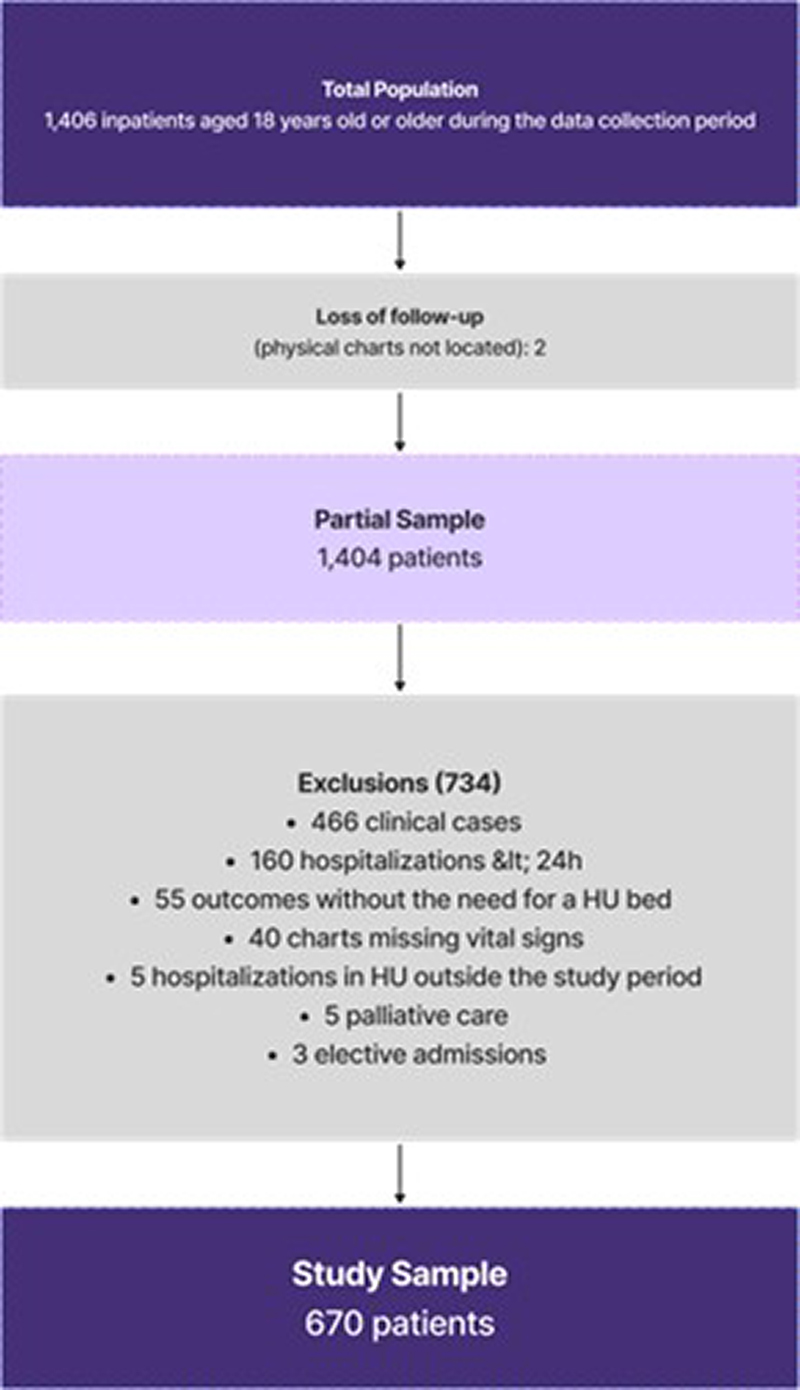
During the study period, 1,406 patients aged 18 years or older were admitted. Two cases were lost due to missing physical records, and 734 were excluded (Figure 1), resulting in a sample of 670 patients followed for up to 30 days.
Flowchart of study participant selection, Hospital de Pronto Socorro de Porto Alegre, Rio Grande do Sul, Brazil, 2025. Source: Study data, 2025. Notes: h: hour, HU: hospitalization unit.
The main causes of treatment were traffic accidents (n=157, 23.4%), ground-level falls (n=150, 22.4%), and assault (n=123, 18.4%). The most frequent types of physical trauma were extremity trauma (n=255, 38.1%), multiple trauma involving two or more sites (n=151, 22.5%), and traumatic brain injury (n=52, 7.8%).
Twenty SAEs occurred among patients admitted to inpatient units, representing 3.0% of the total sample. All cases required ICU admission. No deaths or cardiac arrests occurred in the inpatient units during the study period.
Regarding sample distribution, the majority were men (68.4%) and White patients (79.0%) (Table 2). Ages ranged from 18 to 101 years, with a mean age of 49.4 years (±21.33). Most patients were between 30 and 49 years old (33.9%), and 31.6% were aged (60 years. A total of 57.6% of patients had up to one comorbidity. The mean length of stay was 6.9 days (±9.3), with 77.5% hospitalized for up to 7 days and 49.3% discharged within 3 days (Table 2).
In the unadjusted analysis, women were four times more likely to experience an SAE compared with men (Wald test, p=0.003). Individuals aged ≥60 years were five times more likely to experience an SAE (Wald test, p=0.001) (Table 2).
Patients with two or more comorbidities had a fivefold higher risk of experiencing an SAE compared with those with one or none (Wald test, p=0.002). Participants with a hospital stay of ≥5 days had a twofold higher risk of SAEs (Wald test, p<0.0001). Race/ethnicity was not associated with the outcome (Table 2).
Variables associated with a higher risk of the outcome were examined in the adjusted analysis. Sex (RR 2.78, 95%CI 1.35;5.76, p=0.006), age (RR 2.98, 95%CI 1.22;7.28, p=0.016) and length of stay (RR 9.08, 95%CI 3.71;22.25, p≤0.01) remained significantly associated with the outcome, whereas comorbidities (RR 2.22, 95%CI 0.75;6.58, p=0.152) were excluded from the analysis.
The MEWS scores in the last 24 hours ranged from 0 to 8. Assessments at 6, 12, 18, and 24 hours prior to the occurrence of SAEs showed variations in sensitivity, specificity, positive predictive value (PPV) and negative predictive value (NPV), positive and negative likelihood ratios (LR+ and LR-), area under the ROC curve (AUC-ROC) and cutoff points (Table 3).
Sensitivity declined from 80.00% at 6 hours to 40.00% at 18 hours, with a partial recovery to 63.16% at 24 hours. Specificity showed less fluctuation, remaining relatively stable between 73% and 77% across the time intervals.
The positive and negative predictive values of MEWS in the last 6, 12, 18, and 24 hours prior to an SAE showed notable variations. The PPV remained low across all time windows, peaking at 18 hours (2.41%; 95%CI 1.01-3.81%), indicating that the score had limited ability to confirm an SAE among patients with a positive result.
The highest LR+ was observed in the last 6 hours (14.01), indicating that a positive score substantially increased the probability of an SAE. In contrast, at 18 hours, the LR+ was 1.57, showing limited clinical utility for confirming risk in this interval.
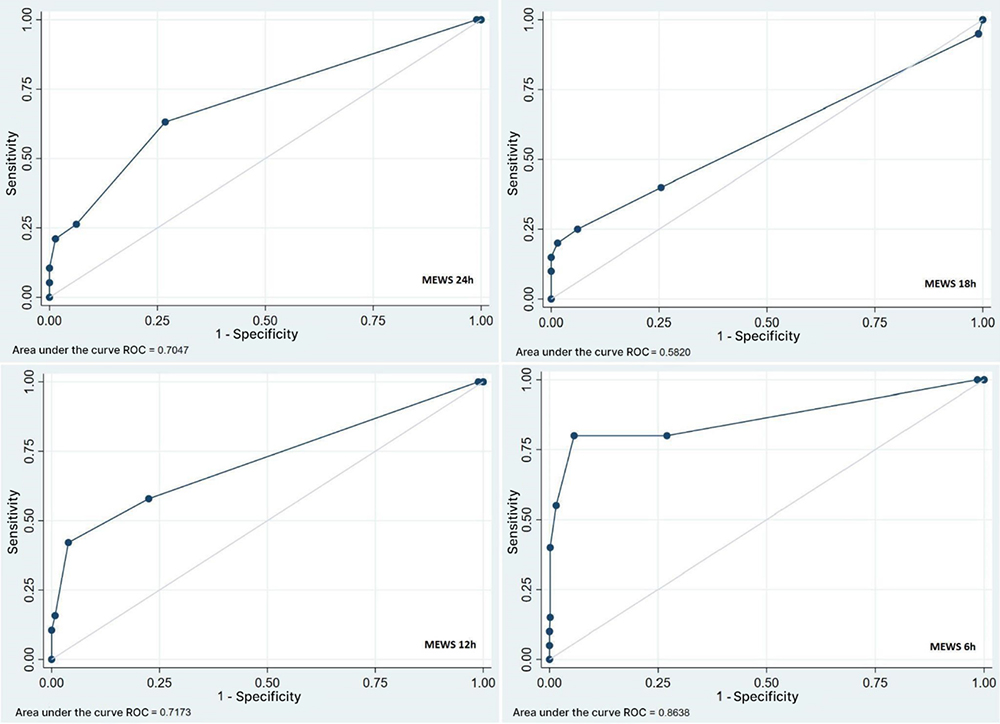
As shown in Table 3, MEWS performed best at 6 hours, with an AUC-ROC of 0.86, indicating excellent discriminative ability. At 12 hours, performance declined to an AUC-ROC of 0.72 (moderate), reaching its lowest at 18 hours (0.58). At 24 hours, the score partially recovered, with an AUC-ROC of 0.70.
The MEWS cutoff points that best predicted the occurrence of SAEs were determined using the AUC-ROC (Figure 2). In the overall analysis, the optimal cutoff in the last 6 hours was MEWS ≥ 4 (AUC-ROC 0.86, p<0.0001, 95%CI 1.93;2.42), with high sensitivity (80%), specificity (72.99%), excellent discriminative capacity (NPV 100.00%) and a strong LR+ (14.01) (Table 3). At 12, 18, and 24 hours, the optimal cutoff was MEWS ≥ 3, with AUC-ROC values of 0.72, 0.58, and 0.70, respectively (all p<0.0001).
ROC curve plots of the MEWS at 24, 18, 12, and 6 hours prior to serious adverse events, 2025. Source: Study data, 2025.
Stratified analyses revealed differences in the MEWS cutoff points by sex, age, and length of stay (Table 4). In the comparison by sex, women showed superior results across all time intervals. At 6 hours, MEWS performance in women was robust, with an AUC-ROC of 0.93, accompanied by high sensitivity (92.31%) and specificity (92.96%). However, as the interval increased to 12, 18, and 24 hours, both sensitivity and AUC-ROC gradually declined, although performance remained moderate when considering the balance between sensitivity and specificity. In contrast, men consistently showed lower sensitivity, particularly at 12 and 18 hours, with AUC-ROC values of 0.60 and 0.49, respectively. Stratification also showed that men had higher cutoff points than women in the last 6 and 12 hours before SAE occurrence, (MEWS ≥ 6 x MEWS ≥ 4 and MEWS ≥ 4 x MEWS ≥ 3, respectively) (Table 4).
When stratified by age, older patients showed superior performance compared with those aged ≤59 years across all evaluated periods (Table 4). In older adults, MEWS scores showed a high AUC-ROC (0.8892) at 6 hours, with sensitivity of 85.71% and specificity of 92.39%. However, at longer intervals, such as 18 hours, performance declined markedly, with an AUC-ROC of 0.5910. Among adults aged 18-59 years, the AUC-ROC at 6 hours was 0.7918, indicating good discrimination, but dropped below 0.53 at 12 and 18 hours. For adults, the optimal cutoff point was considerably higher, with MEWS ≥ 6 at 6, 12, and 18 hours (p<0.0001). For older adults, cutoff points ranged from ≥ 4 and ≥ 2. Only at 24 hours did both groups share the same cutoff point (p<0.0001). Subgroup analysis revealed that MEWS ≥ 6 was most effective for men and younger adults, whereas MEWS ≥ 4 was more accurate for women and older adults.
When stratified by length of stay, patients with a short hospital stay (1-4 days) showed better MEWS performance across all time periods, particularly at 6 hours, with an AUC-ROC of 0.8762, sensitivity of 83.33%, and specificity of 94.32% (Table 4). At longer intervals, such as 18 hours, performance decreased but remained within moderate to acceptable discrimination at 24 hours (AUC-ROC 0.7826). In contrast, patients hospitalized for ≥5 days had poorer performance, with a greater decline at intermediate periods (18 hours), where the AUC-ROC was 0.5867. Even at 6 hours, despite an AUC-ROC of 0.8556, overall results were less favorable compared with short-stay patients. Regarding cutoff points, values were similar between short- and long-stay patients, except at 24 hours, when a reduction in the cutoff point was observed (MEWS ≥ 2, AUC-ROC 0.6559, p< 0.0001, 95%CI 1.00;1.57) (Table 4).
DISCUSSION
The cutoff point that best predicted the risk of SAEs in adults hospitalized for trauma was MEWS ≥ 4. However, subgroup analyses revealed different optimal cutoff points: MEWS ≥ 6 performed better for men and adults aged 18-59 years, whereas MEWS ≥ 4 was more accurate for women and older adults (≥ 60 years).
The MEWS cutoff point may vary depending on the population and study context. Studies conducted in the United States, Europe, and Asia have reported heterogeneous performance of the score in predicting SAEs, with cutoff points ranging from 3 to 5, sensitivity between 17.0% and 98.0%, and specificity between 46.1% and 99.4%19-28.
The main results of this study highlight the usefulness of MEWS in predicting outcomes with good performance, particularly in short periods such as the 6 hours preceding SAE occurrence. Similar findings were reported by Chae et al.29 (2022) in a retrospective study conducted in a South Korean hospital, which evaluated the predictive capacity of MEWS for the need for massive transfusion in patients with traumatic brain injury (AUC-ROC 0.81). A Chinese study with patients with multiple trauma also showed good discrimination for trauma severity, with MEWS ≥ 3, AUC-ROC of 0.77, sensitivity of 52%, and specificity of 92%30.
The performance of MEWS varied according to sex, age, and length of hospital stay. Women had significantly better results in the 6 hours preceding SAE occurrence. Among older adults, MEWS showed greater accuracy in predicting SAEs within 6 hours, with high sensitivity and specificity. Variation in the performance of Early Warning Scores (EWS) by age has been reported in a systematic review and meta-analysis that evaluated five EWSs in predicting clinical deterioration. The study found age to be the only variable explaining the heterogeneity of EWS results in predicting the 30-day in-hospital mortality, accounting for 92% of the variance between studies31.
Length of stay was an important factor. Among patients admitted for short periods (1-4 days), MEWS performed better across all time windows analyzed. No recent studies were found that investigated the correlation between length of stay and MEWS performance in predicting adverse outcomes.
The PPV was low at 18 hours, indicating a high probability of false positives. PPVs reported in recent international studies assessing the predictive capacity of MEWS for SAE occurrence varied widely, ranging from 1.8% to 97%21-25,27, depending on the cutoff points used.
The LR+ was highest during the last 6 hours, indicating excellent discriminatory capacity for the risk of SAEs among patients with high MEWS scores. A recent Iranian study reported that MEWS showed reasonable discriminatory capacity (LR+ = 6.3) for predicting the risk of in-hospital mortality in polytrauma patients with high MEWS scores27. Another multicenter Iranian study found that for MEWS ≥ 4, the LR+ was 1.95 for predicting mortality and 2.29 for predicting poor outcomes23.
As the interval between score collection and SAE occurrence increased, the overall performance of MEWS decreased. The AUC-ROC reached its lowest point at 18 hours; while specificity remained relatively stable, sensitivity showed greater variation. Similar findings were reported in recent international studies21,25,32, indicating that MEWS performs better in shorter time windows between measurement and SAE occurrence.
This study has important limitations. Reliance on hospital records for data collection may have introduced selection bias, particularly in cases of incomplete documentation, although only two cases were lost for this reason. Measurement bias may have occurred, as MEWS was calculated based on vital signs measured and recorded by nursing staff in patients’ physical medical records. Furthermore, the study was conducted in a single trauma-specialized hospital, and the optimal MEWS cutoff point may differ for patients admitted to general hospitals treating other conditions/specialties or in institutions with fewer resources. Therefore, the generalization of these findings should be made with caution.
Because this is a trauma institution, prospective studies combining MEWS with other trauma scores or incorporating trauma-specific variables are recommended to improve the positive predictive value for SAEs. Additional multicenter prospective studies, involving different care profiles and resource settings, could validate these findings and explore possible adjustments to the score cutoff.
CONCLUSION
The MEWS demonstrated satisfactory performance in predicting SAEs (cardiac arrest, ICU admission, or death) in adult patients hospitalized for physical trauma, particularly when applied within six hours prior to the outcome, showing high sensitivity, specificity, and negative predictive value. The most appropriate overall cutoff point was MEWS ≥ 4, although stratified analyses revealed important variations by sex, age group, and length of hospital stay. These findings highlight the usefulness of MEWS as a periodic assessment tool for inpatients receiving less complex care.
The findings of this study highlight the potential of MEWS as a clinical surveillance tool with strong risk-exclusion capacity, contributing to the early detection of clinical deterioration and helping to reduce the occurrence of SAEs. Moreover, the study reinforces the importance of systematic and standardized assessment of vital signs, strengthening the role of nurses in clinical decision-making and in proactive responses to changes in patient condition.
ACKNOWLEDGMENTS
The authors acknowledge the support of the Coordination for the Improvement of Higher Education Personnel (CAPES), Brazil.
REFERENCES
-
1. Santos GS, Santos GB, Carvalho LM, Borges BEC, Botarelli FR, Vitor AF. Aplicabilidade da National Early Warning Score na detecção precoce da deterioração clínica: uma revisão integrativa. Rev Enferm Atual Derme [Internet]. 2023[cited 2025 Mar 20];97(ed. esp):e023090. Available from: https://mail.revistaenfermagematual.com.br/index.php/revista/article/view/1744
» https://mail.revistaenfermagematual.com.br/index.php/revista/article/view/1744 -
2. Álvarez EET, Mediavilla KAG, Solís CR, González NV, Balanza JAL. Factores de riesgo de reingreso en UCI y análisis de la mortalidad intrahospitalaria. Med Clin. 2021;158:58-64. https://doi.org/10.1016/j.medcli.2020.11.035
» https://doi.org/10.1016/j.medcli.2020.11.035 -
3. Maftoohian M, Assarroudi A, Stewart JJ, Dastani M, Rakhshani MH, Sahebkar M. Evaluating the use of a Modified Early Warning Score in predicting serious adverse events in iranian hospitalized patients: a prognostic study. J Emerg Nurs. 2020;46(1):72-82. https://doi.org/10.1016/j.jen.2019.10.015
» https://doi.org/10.1016/j.jen.2019.10.015 -
4. Montenegro SMSL, Miranda CH. Evaluation of the performance of the modified early warning score in a Brazilian public hospital. Rev Bras Enferm. 2019;72(6):1502-9. https://doi.org/10.1590/0034-7167-2017-0537
» https://doi.org/10.1590/0034-7167-2017-0537 -
5. Ruangsomboon O, Boonmee P, Limsuwat C, Chakorn T, Monsomboon A. The utility of the rapid emergency medicine score (REMS) compared with SIRS, qSOFA and NEWS for Predicting in-hospital Mortality among Patients with suspicion of Sepsis in an emergency department. BMC Emerg Med. 2021;21(1):2. https://doi.org/10.1186/s12873-020-00396-x
» https://doi.org/10.1186/s12873-020-00396-x -
6. Pereira TLCS, Silva AC, Xavier LL, Rodrigues AFSS, Almeida AKA, Silva ES, et al. Deterioração clínica em pacientes traumáticos. Rev Eletr Acervo Saúde. 2023;23(7):e12142. https://doi.org/10.25248/reas.e12142.2023
» https://doi.org/10.25248/reas.e12142.2023 -
7. Penketh J, Nolan JP. In-hospital cardiac arrest: the state of the art. Crit Care. 2022;26(1):376. https://doi.org/10.1186/s13054-022-04247-y
» https://doi.org/10.1186/s13054-022-04247-y -
8. Le Lagadec MD, Dwyer T, Browne M. Patient Deterioration in Australian Regional and Rural Hospitals: is the Queensland Adult Deterioration Detection System the Criterion Standard? J Patient Saf. 2021;17(8):e1879-e1883. https://doi.org/10.1097/PTS.0000000000000689
» https://doi.org/10.1097/PTS.0000000000000689 -
9. Sherrod BA, Young JB, Wilkerson CG, Bisson EF, Dailey AT, Mazur MD. Epidemiology of Gunshot-Related Spinal Injuries and Related Risk Factors for In-Hospital Mortality in the United States from 2015-2019: a national trauma data bank analysis. J Neurotrauma. 2024;41(9-10):1112-21. https://doi.org/10.1089/neu.2023.0081
» https://doi.org/10.1089/neu.2023.0081 -
10. Gondim ES, Gomes EB, Matos JHF, Pinto SL, Oliveira CJ, Alencar AMPG. Technologies used by nursing to predict clinical deterioration in hospitalized adults: a scoping review. Rev Bras Enferm. 2022;75(5). https://doi.org/10.1590/0034-7167-2021-0570pt
» https://doi.org/10.1590/0034-7167-2021-0570pt -
11. Spencer W, Smith J, Date P, Tonnerre E, Taylor DM. Determination of the best early warning scores to predict clinical outcomes of patients in the emergency department. Emerg Med J. 2019;36(12):716-21. https://doi.org/10.1136/emermed-2019-208622
» https://doi.org/10.1136/emermed-2019-208622 -
12. Vilaça LV, Chavaglia SRR, Bernadineli FCP, Souza IF, Pereira CBM, Silva SA. Early warning scales to track clinically deteriorating in emergency medical services: an integrative review. Enferm. Glob. 2022;21(68):587-637. https://doi.org/https://dx.doi.org/10.6018/eglobal.502451
» https://dx.doi.org/10.6018/eglobal.502451 -
13. Subbe CP, Kruger M, Rutherford P, Gemmel L. Validation of a modified Early Warning Score in medical admissions. QJM. 2001;94(10):521-6. https://doi.org/10.1093/qjmed/94.10.521
» https://doi.org/10.1093/qjmed/94.10.521 -
14. Alexandre AR, Gomez C, Marques A, Nunes A, Gomes JA. Medicina Interna. Modified early warning score como preditor de readmissões precoces numa unidade de cuidados intensivos: um estudo de caso-controlo. Med Intern. 2019;26(3):208-13. https://doi.org/10.24950/rspmi/O/93/19/3/2019
» https://doi.org/10.24950/rspmi/O/93/19/3/2019 -
15. Saba A, Nunes MDPT. Is Modified Early Warning Score associated with clinical outcomes of patients admitted to a university internal medicine ward? J Clin Nurs. 2023;32(7-8):1065-75. https://doi.org/10.1111/jocn.16327
» https://doi.org/10.1111/jocn.16327 -
16. Bhatnagar M, Sirohi N, Dubey AB. Prediction of hospital outcome in emergency medical admissions using modified early warning score (MEWS): Indian experience. J Family Med Prim Care. 2021;10(1):192-8. https://doi.org/10.4103/jfmpc.jfmpc_1426_20
» https://doi.org/10.4103/jfmpc.jfmpc_1426_20 -
17. Olino L, Goncalves AC, Strada JKR, Vieira MLP, Molina KL et al. Effective communication for patient safety: transfer note and Modified Early Warning Score. Rev Gaúcha Enferm. 2019;40(e20180341):1-9. https://doi.org/10.1590/1983-1447.2019.20180341
» https://doi.org/10.1590/1983-1447.2019.20180341 -
18. Çorbacıoğlu ŞK, Aksel G. Receiver operating characteristic curve analysis in diagnostic accuracy studies: a guide to interpreting the area under the curve value. Turk J Emerg Med. 2023;23(4):195-8. https://doi.org/10.4103/tjem.tjem_182_23
» https://doi.org/10.4103/tjem.tjem_182_23 -
19. Hajipoor KN, Zardoshti L, Balafar M, Harzand-Jadidi S, Rahmani F, Shahsavarinia K, et al. Correlation Between Shock Index, TRISS, MGAP, NTS, MESS, and MEWS for Prediction of Outcome in Patients with Multiple Trauma. Trauma Mont [Internet]. . 2024[cited 2025 Mar 20];29(2):1070-80. Available from: https://www.traumamon.com/article_198349.html
» https://www.traumamon.com/article_198349.html -
20. Shaikh MA, Punshi A, Talreja ML, Rasheed T, Bader N, Zuberi BF. Comparison of within 7 Day All-Cause Mortality among HDU Patients with Modified Early Warning Score of ≥5 with those with Score of <5. Pak J Med Sci. 2021;37(2):515-9. https://www.doi.org/10.12669/pjms.37.2.2832
» https://www.doi.org/10.12669/pjms.37.2.2832 -
21. Edelson DP, Churpek MM, Carey KA, Lin Z, Huang C, Siner JM, et al. Early Warning Scores With and Without Artificial Intelligence. JAMA Netw Open. 2024;7(10):e2438986. https://doi.org/10.1001/jamanetworkopen.2024.38986 Erratum in: JAMA Netw Open. 2024; e2448969. https://doi.org/10.1001/jamanetworkopen.2024.48969
» https://doi.org/10.1001/jamanetworkopen.2024.38986 -
22. Yu Z, Xu F, Chen D. Predictive value of Modified Early Warning Score (MEWS) and Revised Trauma Score (RTS) for the short-term prognosis of emergency trauma patients: a retrospective study. BMJ Open. 2021;11:e041882. https://doi.org/10.1136/bmjopen-2020-041882
» https://doi.org/10.1136/bmjopen-2020-041882 -
23. Khari S, Zandi M, Yousefifard M. Glasgow Coma Scale Versus Physiologic Scoring Systems in Predicting the Outcome of ICU admitted Trauma Patients; a Diagnostic Accuracy Study. Arch Acad Emerg Med. 2022;10(1):e25. https://doi.org/10.22037/aaem.v10i1.1483
» https://doi.org/10.22037/aaem.v10i1.1483 -
24. Rahmatinejad Z, Tohidinezhad F, Rahmatinejad F, Eslami S, Pourmand A, Abu-Hanna A, et al. Internal validation and comparison of the prognostic performance of models based on six emergency scoring systems to predict in-hospital mortality in the emergency department. BMC Emerg Med. 2021;21(1):68. https://doi.org/10.1186/s12873-021-00459-7
» https://doi.org/10.1186/s12873-021-00459-7 -
25. Ko RE, Kwon O, Cho KJ, Lee YJ, Kwon JM, Park J, et al. Quick Sequential Organ Failure Assessment Score and the Modified Early Warning Score for Predicting Clinical Deterioration in General Ward Patients Regardless of Suspected Infection. J Korean Med Sci. 2022;37(16):e122. https://doi.org/10.3346/jkms.2022.37.e122
» https://doi.org/10.3346/jkms.2022.37.e122 -
26. Tan ADA, Permejo CC, Torres MCD. Modified Early Warning Score vs Cardiac Arrest Risk Triage Score for Prediction of Cardiopulmonary Arrest: a case-control study. Indian J Crit Care Med. 2022;26(7):780-5. https://doi.org/10.5005/jp-journals-10071-24242
» https://doi.org/10.5005/jp-journals-10071-24242 -
27. Heydari F, Majidinejad S, Ahmadi A, Nasr-Esfahani M, Shayannejad H, Al-Sadat Fatemi N. A comparison between Modified Early Warning Score, Worthing Physiological Scoring System, National Early Warning Score, and Rapid Emergency Medicine Score in Predicting Inhospital Mortality in Multiple Trauma Patients. Arch Trauma Res[Internet]. 2021[cited 2025 Mar 20];10(4):188-94. Available from: https://archtrauma.kaums.ac.ir/article_156271.html
» https://archtrauma.kaums.ac.ir/article_156271.html -
28. Veldhuis LI, van der Weide L, Nanayakkara P, Ludikhuize J. The accuracy of predicting hospital admission by emergency medical service and emergency department personnel compared to the prehospital MEWS: a prospective multicenter study. BMC Emerg Med. 2024;24(1):111. https://doi.org/10.1186/s12873-024-01031-9
» https://doi.org/10.1186/s12873-024-01031-9 -
29. Chae HR, Lee DH, Lee BK, Kim DK. Predictive value of modified early warning score for massive transfusion in patients with traumatic brain injury. Ulus Travma Acil Cerrahi Derg. 2022;28(8):1082-7. https://doi.org/10.14744/tjtes.2021.13611
» https://doi.org/10.14744/tjtes.2021.13611 -
30. Jiang X. An improved modified early warning score that incorporates the abdomen score for identifying multiple traumatic injury severity. PeerJ. 2020;8:e10242. https://doi.org/10.7717/peerj.10242
» https://doi.org/10.7717/peerj.10242 -
31. Guan G, Lee CMY, Begg S, Crombie A, Mnatzaganian G. The use of early warning system scores in prehospital and emergency department settings to predict clinical deterioration: a systematic review and meta-analysis. PLoS One. 2022;17(3):e0265559. https://doi.org/10.1371/journal.pone.0265559
» https://doi.org/10.1371/journal.pone.0265559 -
32. Moffat LM, Xu D. Accuracy of Machine Learning Models to Predict In-hospital Cardiac Arrest: a systematic review. Clin Nurse Spec. 2022;36(1):29-44. https://doi.org/10.1097/NUR.0000000000000644
» https://doi.org/10.1097/NUR.0000000000000644
The dataset supporting this study is available from the corresponding author upon reasonable request.