
 Analysis of spatial and temporal patterns of fetal mortality: ecological study, Pernambuco, 2010-2021
ABSTRACT
Objective: To analyze the spatial pattern and time series of fetal mortality in Pernambuco, Brazil, from 2010 to 2021.
Method: An ecological study was conducted using municipalities as spatial units of analysis and months as temporal units. Data were obtained from the Mortality Information System and the Live Birth Information System. Maps displaying annual fetal mortality rates were constructed. Three classes of time series models were tested, and the model with the lowest mean absolute percentage error on a validation dataset was selected to perform projections.
Results: A total of 18,810 fetal deaths were recorded, with a mean monthly fetal mortality rate of 11.3 fetal deaths per 1,000 births. The spatial distribution showed the highest fetal mortality rates in municipalities located in the Sertão, São Francisco, and Agreste regions. The overall mean rate of the series was 13.3 (±1.1) fetal deaths per 1,000 births. A stationary trend was observed, ranging from 8.1 to 14.4 per 1,000 births per month, with outliers in May 2020 (+29%) and November 2020 (−24.1%).
Conclusion: The spatial distribution of fetal mortality rates revealed variations among municipalities, while the temporal trend remained stationary. These findings can support the monitoring of actions aimed at reducing fetal mortality in the state and inform nursing practices to enhance preventive care and reduce avoidable deaths.
Descriptors:
Fetal Mortality; Spatial Analysis; Interrupted Time Series Analysis; Practical Nursing; Ecological Studies
RESUMO
Objetivo: Analisar o padrão espacial e a série temporal da mortalidade fetal em Pernambuco, 2010 a 2021.
Método: Estudo ecológico, tendo como unidades de análise os municípios (espacial) e os meses (temporal). Utilizaram-se dados dos Sistemas de Informações sobre Mortalidade e Nascidos Vivos. Elaboram-se mapas com as taxas de mortalidade fetal anuais. Aplicaram-se três classes de modelos para séries temporais, onde o melhor (estabelecido pela métrica do erro percentual absoluto médio numa base de validação) foi escolhido para fazer suas projeções.
Resultados: Registraram-se 18.810 óbitos fetais, com taxa de mortalidade média mensal de 11,3 óbitos por 1.000 nascimentos. A distribuição espacial revelou as maiores taxas nos municípios do Sertão, São Francisco e Agreste. O valor da série foi 13,3 (±1,1) óbitos fetais por 1.000 nascimentos. Observou-se tendência estacionária, oscilando de 8,1 a 14,4 por 1.000 nascimentos por mês, e com valores atípicos nos meses de maio/2020 (+29%) e novembro/2020 (-24,1%).
Conclusão: A distribuição espacial das taxas de mortalidade fetal demonstrou variações entre os municípios. A tendência foi estacionária. Esses resultados podem ser empregados no monitoramento das ações de redução da mortalidade fetal em Pernambuco, além de subsidiar melhores práticas de enfermagem no aprimoramento de cuidado de prevenção de óbitos evitáveis.
Descritores:
Mortalidade Fetal; Análise Espacial; Análise de Séries Temporais Interrompidas; Enfermagem Prática; Estudos Ecológicos
RESUMEN
Objetivo: Analizar el patrón espacial y la serie temporal de la mortalidad fetal en Pernambuco, Brasil, de 2010 a 2021.
Método: Estudio ecológico, teniendo como unidades de análisis los municipios (espacial) y los meses (temporal). Se utilizaron datos de los Sistemas de Información sobre Mortalidad y de Nacidos Vivos. Se elaboraron mapas con las tasas anuales de mortalidad fetal. Se aplicaron tres clases de modelos de series temporales, y el mejor (determinado por la métrica del error porcentual absoluto medio en una base de validación) fue seleccionado para realizar las proyecciones.
Resultados: Se registraron 18.810 muertes fetales, con una tasa de mortalidad fetal media mensual de 11,3 muertes fetales por cada 1.000 nacimientos. La distribución espacial reveló las mayores tasas en los municipios de las regiones del Sertão, São Francisco y Agreste. El valor medio de la serie fue de 13,3 (±1,1) muertes fetales por cada 1.000 nacimientos. Se observó una tendencia estacionaria, oscilando entre 8,1 y 14,4 por 1.000 nacimientos al mes, con valores atípicos en mayo de 2020 (+29%) y noviembre de 2020 (−24,1%).
Conclusión: La distribución espacial de las tasas de mortalidad fetal mostró variaciones entre los municipios. La tendencia fue estacionaria. Estos resultados pueden emplearse para el seguimiento de las acciones dirigidas a reducir la mortalidad fetal en el estado, además de servir de apoyo para mejorar las prácticas de enfermería en la prevención de muertes evitables.
Descriptores:
Mortalidad Fetal; Análisis Espacial; Análisis de Series de Tiempo Interrumpido; Enfermería Práctica; Estudios Ecológicos
INTRODUCTION
Fetal mortality is a significant indicator of the quality of care provided by a health system during pregnancy and childbirth, and it poses a challenge in low- and middle-income countries1. It consists of the death of the conceptus before its complete expulsion or extraction from the mother's body, evidenced by the absence of breathing or other signs of life, such as heartbeat, umbilical cord pulsation, or effective movements of voluntary muscles2.
One of the main challenges in monitoring countries' progress in reducing fetal mortality lies in the ability to account for the number of fetal deaths. To this end, a clear definition of who should be counted, considering the gestational age at the time of death, is fundamental3. The International Statistical Classification of Diseases and Related Health Problems (ICD), 10th revision, defines fetal deaths as those weighing 500g or more, or 22 completed weeks of gestation or more1, being this definition also adopted in Brazil.
Globally, a reduction in the number of fetal deaths has been observed. Between 1990 and 2021, the estimated number of fetal deaths at 20 weeks or more of gestation fell from 5.1 million to 3.0 million, a decline of 39.8%3. Similarly, there was a reduction in the fetal mortality rate (FMR), varying from 37.1 in 1990 to 23.0 per 1,000 births in 2021, a decrease of 37.8%4.
Despite the magnitude of this indicator, fetal mortality has remained invisible on national and international policy agendas when compared to other child health indicators5,6. This invisibility results in reduced attention, despite the impacts on families and, particularly, on the mental health and well-being of women. The discussion about fetal deaths was not included in the Millennium Development Goals (MDGs) nor in the Sustainable Development Goals (SDGs) of the United Nations (UN), global agreements that set targets for the decline in maternal and infant mortality6. The health community has recognized the urgent need to prevent fetal mortality, which has become an essential part of global child survival initiatives and goals.
The Action Plan for All Newborns7, launched in 2014, aimed to achieve equitable and high-quality care coverage for all women and newborns through linkages with other global and national plans, and measurement and accountability frameworks. It set a target for countries to achieve a MMR of 12 or fewer deaths by 2030 (intermediate target), and 10 deaths per 1,000 total births by 2035 (final target). Furthermore, it proposes targets for the coverage of essential reproductive, maternal, neonatal and child health interventions, including an impact framework, milestones and indicators to measure progress. In turn, the Global Strategy for Women's, Children's and Adolescents' Health (2016-2030) aims to eradicate all preventable maternal, neonatal and child deaths, including fetal deaths, by 2030, as well as improve their overall health and well-being8.
To reduce fetal mortality, one of the main needs is the availability of timely and accurate data, with the registration of all fetal deaths6,7. Brazil, aiming to achieve the goals established in international agreements and to improve the quality of data on these deaths, instituted the Surveillance of Infant and Fetal Deaths. This is a fundamental strategy for understanding the determinants of preventable deaths and the quality of care provided, as well as enabling the implementation of prevention and control measures9,10. The role of nursing in this surveillance stands out, with the investigation of deaths, identification of the factors involved in the chain of events that resulted in fetal death, and the proposal of measures to prevent the occurrence of new deaths in similar circumstances.
Epidemiological analyses are well-known for their role in identifying and monitoring prevention strategies. Research analyzing the spatial and temporal dynamics of stillbirth can aid in planning actions within the care pathway for pregnant women and fetuses, aiming to reduce potentially preventable deaths. Monitoring fetal mortality trends is fundamental for continuous progress towards the goal agreed upon in the Action Plan for All Newborns.
In Brazil, the analysis of the spatiotemporal trend of fetal mortality11, referring to the period from 1996 to 2021, demonstrated that the country registered a daily average of 94 fetal deaths. There were a total of 886,878 deaths, with a gestational age equal to or greater than 20 weeks, corresponding to a mortality rate of 11.4 per 1,000 births 11. In Pernambuco, a study that analyzed the fetal mortality rate between 2010 and 2017 identified a rate of 10.9 per 1,000 births12. From this perspective, this study aimed to analyze the spatial pattern and time series of fetal mortality in Pernambuco, from 2010 to 2021.
METHOD
This is a mixed ecological study, with municipalities as the spatial unit of analysis and months from 2010 to 2021 as the temporal unit. The study period considered 2010 as the initial year, in which the mandatory surveillance of infant and fetal deaths was implemented in Brazil for all public and private services that are part of the Unified Health System (SUS). This was in addition to the need for a series that would allow for a consistent analysis of fetal mortality trends. Total records per month/year were counted, allowing the creation of a time series with 144 observations.
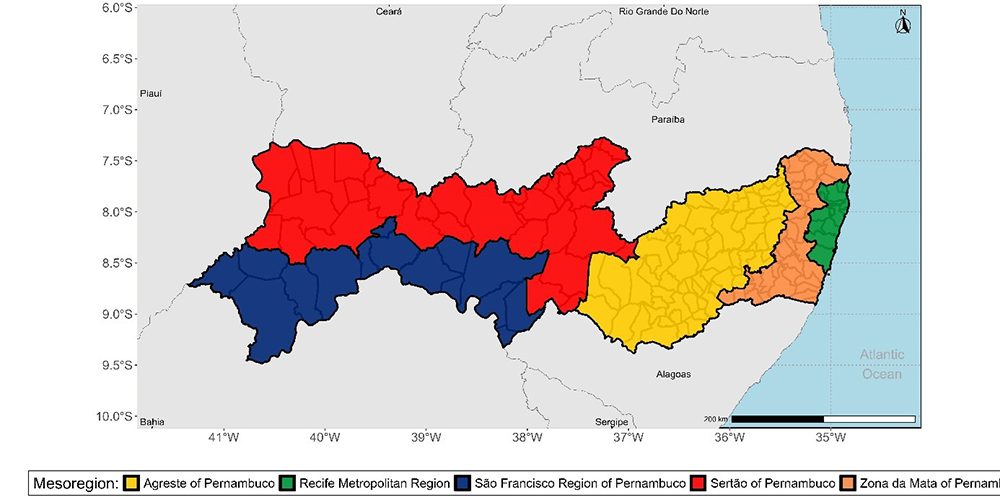
The study was conducted in the state of Pernambuco, located in the Northeast Region of Brazil. The state has a territorial area of 98,067.877 km², divided into five mesoregions and 184 municipalities, in addition to the Fernando de Noronha archipelago (Figure 1). The health network is regionalized. Primary care coverage was 85.9%. Among the health network facilities, the state has approximately 2,781 basic health units, 81 routine risk maternity hospitals, nine high-risk maternity hospitals, and 2,667 obstetric beds.

The study population consisted of fetal deaths with a gestational age of 22 weeks or more, registered in the Mortality Information System. Data on live births obtained from the Live Birth Information System (SINASC), accessed on August 21, 2023, were used to calculate the fetal mortality rates (FMRs).
For the calculation of fetal mortality rates, the numerator included deaths with a gestational age greater than or equal to 22 weeks, and the denominator included the total number of births to resident mothers; this included the sum of live births and fetal deaths12.
where FMR = Fetal mortality rate per 1,000 births; OBT = Deaths with gestational age greater than or equal to 22 weeks; NV = Live births.
In the numerator and denominator, the number of fetal deaths with unknown or incomplete gestational age were added together to minimize the underreporting of fetal deaths and the scarcity of available information on the duration of gestation12.
Initially, the descriptive analysis examined the behavior of the absolute numbers of total fetal deaths per year. Subsequently, a similar analysis was applied to fetal mortality rates (FMRs). Means, standard deviations, and coefficients of variation were calculated for each indicator over the years.
The second stage involved creating thematic maps using the R® version 4.2.2, showing the annual distribution of the fetal mortality rate (per 1,000 births) by municipality in Pernambuco, except for the Fernando de Noronha archipelago, which was excluded from the analysis due to the absence of bordering municipalities. The quintile method was used to categorize the fetal mortality rate values.
The third stage analyzed the time series of FMRs in Pernambuco to verify whether, during the COVID-19 pandemic (from March 2020 onwards), the observed values followed the projections of the statistical models. For this, the database was divided into training, validation, and testing sets. The training set was used to define which class of models best fit the data, and the following classes were tested: Autoregressive Integrated Moving Average (ARIMA) model 13, Exponentially Smoothed State Space Model (ETS) 13, Model with Box-Cox Transformation, ARMA Errors, Trend and Seasonal Components - BATS 13 Trigonometric Seasonality Model, Box-Cox Transformation, ARMA Errors and Bias - TBATS 13. To determine which model was best, projections were calculated based on the validation data, and the Mean Absolute Percent Error (MAPE) was computed. The model with the lowest MAPE (lowest error) would be the chosen model.
where Y = Actual value, E = Estimated value, i = month/year, and n = size of observations.
After the experimentation phase for choosing the statistical model class, the training and validation datasets were combined, and the final model was estimated using this dataset. The adjusted values, along with their projections, were shown in graphs where it was expected that the actual observations during the projection period would follow the projected values. To determine if the difference between the projected and actual values was significant, it was verified whether the actual values exceeded the 95% projection interval. If the actual values exceeded the interval, it was found that the series showed divergences from what was projected. Such cases are shown in the figure with points. All calculations were performed using the R® statistical programming language, version 4.2.2. For time series modeling, the forecast® package, version 8.20, was used 13.
The training, validation, and test sets were defined as follows: the training set consisted of the first 110 observations (Jan/2010 to Feb/2019); the validation set, 12 observations (Mar/2019 to Feb/2020); and the test set, 22 observations (Mar/2020 to Dec/2021). The augmented Dickey-Fuller test was applied to verify if the series had stationary behavior.
Secondary data from the public domain were used, aggregated and not allowing for individual identification. Therefore, there was no need for review by a Research Ethics Committee involving Human Beings, in accordance with Resolutions No. 466 of December 12, 2012, and No. 674 of May 6, 2022, of the National Health Council.
RESULTS
During the study period, 18,810 fetal deaths of residents in Pernambuco were recorded. The average monthly fetal death rate was 11.3 fetal deaths per 1,000 births, ranging from 8.1 to 14.4, with a standard deviation and coefficient of variation of ± 1.1 and 9.5%, respectively (Table 1).
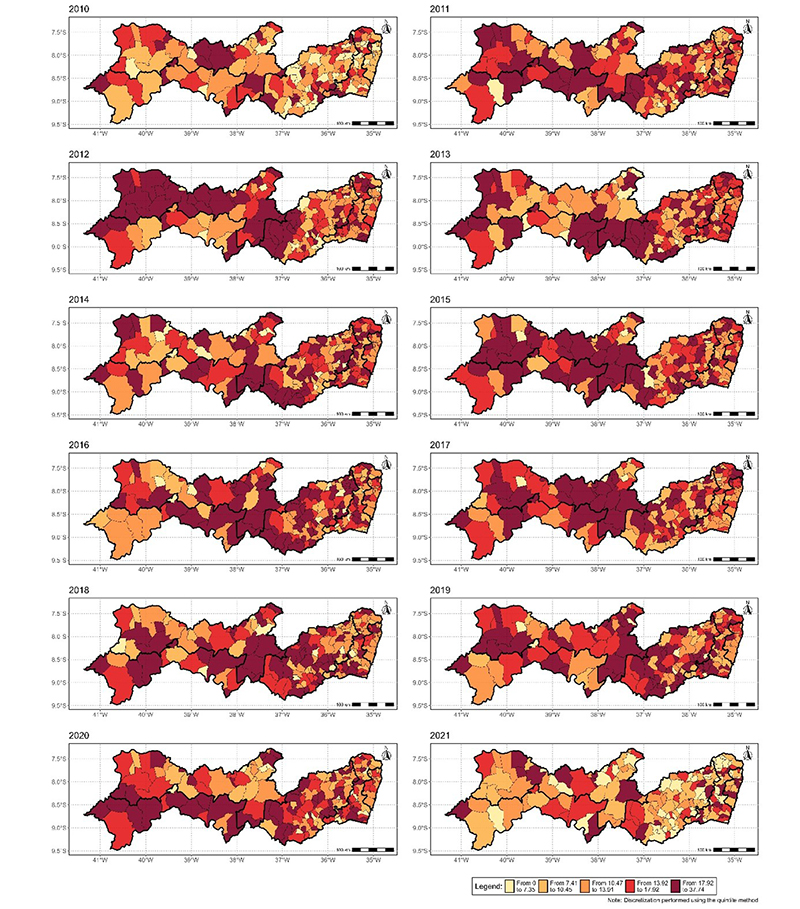
Figure 2 presents maps showing the annual fetal mortality rates by municipality in Pernambuco, between 2010 and 2021. It can be observed that the mesoregions of Sertão, São Francisco, and Agreste consistently concentrate the municipalities with the highest rates throughout the period. In these regions, clusters of municipalities belonging to the top two quintiles of the distribution stand out, especially in the central and western areas of the state. In temporal terms, no graphic evidence of a consistent trend of increase or decrease in rates was identified, indicating a relatively stable spatial pattern over the years, with occasional fluctuations in intensity.

Annual fetal mortality rate (per 1,000 births) by municipality of residence and year, Pernambuco, 2010 to 2021
Figure 3 presents the time series of the monthly fetal mortality rate in Pernambuco. The original series value was 13.3 (±1.1) fetal deaths per 1,000 births, ranging from 8.1 (July 2016) to 14.4 (January 2016), with a coefficient of variation of 9.5%. The series demonstrated a stationary behavior, which is confirmed by the augmented Dickey-Fuller test (p-value = 0.01).
Analyzing the projections made from the beginning of the COVID-19 pandemic - March 2020 - (Figure 3), it was observed that the model presented a mean absolute percentage error (MAPE) of 7.2% in the validation period (March 2019 to February 2020). Although most of the projected points were within the projected intervals, two significant deviations were observed between the projected and observed values. The first occurred in May 2020, when the observed rate was 13.3 fetal deaths per 1,000 births, while the projection indicated 10.3, representing an excess of 29.0%. The second deviation was recorded in November 2020, with a difference of -23.7% between the projected value (11.4 per 1,000 births) and the observed value (8.7 per 1,000 births).

Time series with projections for the monthly fetal mortality rate (per 1,000 births), Pernambuco, 2010 to 2021
DISCUSSION
The study results identified an average monthly fetal mortality rate (11.3 per 1,000 births). A study that analyzed the FMR in the period 2009-2019 showed similar rates for the states of Ceará (11.0 per 1,000 births), Alagoas and Sergipe (11.4 per 1,000 births)14. Furthermore, the FMR found was similar to the average rate in Brazil (11.4 per 1,000 births) for the period from 1996 to 202111. Progress was observed in the reduction of fetal mortality, with the average FMR for the study period falling below the intermediate target for 2030. However, the FMR is still above the final target for 2035 established in the Action Plan for All Newborns7. Despite this progress, the need to reduce social inequalities and inequalities between regions of the state persists.
Reducing fetal mortality requires a series of actions involving access to and quality of essential care for pregnant women, redesigning health systems, investing in the infrastructure of community-level health units, improving notification records, and correctly classifying deaths4. Epidemiological surveillance of deaths and the work of mortality committees are essential to understanding the factors associated with perinatal death and identifying the main deficiencies in the provision of healthcare. Therefore, it should be used to improve the quality of perinatal care, as well as to contribute to improving records, notification, and knowledge about the causes of death4,9.
In the surveillance of fetal deaths and the management of health information, nursing plays a fundamental role. The active participation of nurses in infant and fetal mortality committees contributes to the critical analysis of cases, identification of failures in the care network, and proposal of corrective measures. This activity enhances the notification, investigation, and feedback processes of primary care teams, promoting institutional learning and continuous improvement of care. Thus, nurses act not only as providers of care but also as agents connecting surveillance and clinical practice, strengthening the problem-solving nature of actions in maternal and child health.
The spatial distribution of mortality rates showed variations among the municipalities of the state. In all the years analyzed, there was a clear pattern with the highest rates concentrated in the municipalities located in the mesoregions of Sertão, São Francisco, and Agreste, which are the furthest from the state capital (Recife). Explanations for these findings relate to greater social vulnerability and access to specialized health services3. In general, it is observed that the reduction in mortality rates is not uniform, varying significantly between countries and even within them, influenced by socioeconomic gradients15. Addressing inequalities in maternal and child health coverage, improving the quality of maternal health care, and enhancing record-keeping are fundamental conditions for reducing fetal mortality1,3. State health policies need to be linked to the efforts of the care pathway in health units and municipalities. Furthermore, adequate obstetric care with access to sufficient structural and human resources is essential for fetal survival.
The mesoregions identified in the study are classically identified as having the highest mortality rates and social vulnerability 12,16. An analysis of the relationship between fetal mortality and social vulnerability identified priority areas in the Sertão, Agreste, and São Francisco regions, with municipalities exhibiting medium, high, and very high social vulnerability16. A study that analyzed the determinants of disparities in fetal mortality rates in India 17 observed that the burden of fetal mortality generally decreases with socioeconomic improvement. Therefore, the differentiated risk patterns between regions highlight the need for comprehensive and evidence-based strategies that integrate education, health care, nutrition and sanitation15.
From a healthcare perspective, these three mesoregions have the fewest maternity beds18. While the Metropolitan Region of Recife and Zona da Mata together account for approximately 40% of beds dedicated to maternal and child health care, these are areas that need to be prioritized in maternal and child health initiatives to reduce mortality. One factor related to inequalities in maternal and child mortality rates is the insufficient focus on the quality of pre-conception, prenatal, and intrapartum care services3. The role of nursing as a strategic axis for mitigating these deaths is essential, especially in prenatal care, where it can identify risk factors early and monitor high-risk pregnancies, contributing to improved fetal prognosis.
In this context, the role of nurses in Primary Health Care is strategic for improving the quality of care for pregnant women and reducing fetal mortality. By developing actions based on a humanized model, centered on listening, bonding, and health education, nurses contribute directly to the early detection of risks, the strengthening of reproductive planning, and the management of more effective prenatal care19. Their role is not limited to performing clinical procedures, but also involves preparing pregnant women for a safe, respectful childbirth based on maternal autonomy and empowerment.
The quality of nursing care has a direct impact on health indicators, especially when performed by a multidisciplinary team, with well-defined workflows and coordinated communication between different levels of care20. For these results to be sustainable, it is essential to ensure adequate staffing levels, strengthening the integration between epidemiological surveillance and clinical nursing practice. Therefore, investment is proposed in continuing education, the use of computerized monitoring systems, and the implementation of sentinel rooms for real-time surveillance of fetal deaths, enabling timely response and continuous improvement in the quality of care. Professional recognition allows nursing to continue playing its leading role in the care of the mother-child dyad and in promoting effective and equitable perinatal care.
The time series analysis of the FMR carried out in this study identified a stationary trend. This was also observed for Brazil and its macro-regions, except for the Central-West region, which showed an increasing trend. In the Northeast region, five states (Maranhão, Ceará, Rio Grande do Norte, Pernambuco, and Sergipe) presented a stationary trend 14. The stationary temporal trend of fetal mortality in Brazil and its regions persists as a challenge. Globally, the rate of decline in fetal mortality is slow, reflecting the need for attention and resource allocation to improve the quality and coverage of prenatal and intrapartum care services, which are essential for reducing preventable fetal deaths 21.
The fetal mortality rate fluctuated between 8.1 and 14.4 per 1,000 births per month, with unexpected variations in May 2020 (+29%) and November 2020 (-24.1%). These changes coincide with the critical period of the COVID-19 pandemic, raising hypotheses about the impacts of the health crisis on prenatal and obstetric care. Analysis of the spatiotemporal trend of fetal mortality in Brazil from 1996 to 2021 showed a decreasing trend, with a slowdown during the pandemic period. Among the various challenges to achieving the goals for reducing global fetal mortality are the direct and indirect impacts of the COVID-19 pandemic on reproductive health and, in particular, on maternal and neonatal healthcare22. Among the indirect impacts observed are increased fetal mortality rates 23,24. In South Korea, the fetal mortality rate increased from 11.3 per 1,000 births in 2018 to 11.6 in 2019, continuing to rise to 12.0 in 202125.
A systematic review with meta-analysis found an odds ratio of 1.71 for intrauterine fetal death or stillbirth in 256 women with COVID-19, compared to 6,730 women without the virus 26. Intrauterine and perinatal deaths associated with SARS-CoV-2 have been observed, likely resulting from placental insufficiency and hypoxic-ischemic fetal injury 27. Although COVID-19 infection can be a risk factor in severe cases, aspects such as gestational age, quality of care, and timely access to perinatal care are important determinants for preventing fetal mortality 28.
Other possible reasons for the increase in fetal mortality may be due to reduced attendance at prenatal appointments due to fear of COVID-19 infection, cancellation of in-person appointments, and reduced staffing in maternity services, which decreased the routine care for pregnant women 29. Furthermore, the unavailability of emergency obstetric services may have triggered pregnant women to wander through the maternal and child health network, and consequently, the delayed performance of procedures essential to fetal survival 30. Furthermore, existing global inequalities have been exacerbated by the impacts of the pandemic, potentially increasing the risk of fetal mortality during and after the pandemic 5.
This study presented limitations such as the use of secondary data from health information systems, which may contain underreporting, data incompleteness, and problems in the classification of deaths, impacting the accuracy of the analyzed rates and the interpretation of the results. Although the quality of vital records in Pernambuco is considered adequate, these limitations may lead to underestimation of the indicators. An inherent limitation of ecological studies is the risk of ecological fallacy, where associations at the group level may not be true at the individual level; therefore, no causal relationship can be established from this study. The spatial unit of analysis used (municipality) may obscure inequalities that would be observed in smaller units such as neighborhoods and census tracts. Furthermore, the study did not analyze socioeconomic variables relevant to fetal mortality. Also, the geographical limitation of analyzing a state in a region of Brazil with a low Human Development Index (HDI) should be considered, making it impossible to generalize to other contexts. Future studies using spatiotemporal modeling could improve the accuracy of fetal mortality estimates and strengthen the monitoring of intervention outcomes over time.
CONCLUSION
The spatial distribution of fetal mortality rates in Pernambuco showed variations among municipalities, with the highest rates located in the Sertão, São Francisco, and Agreste regions. The series value was 13.3 (±1.1) fetal deaths per 1,000 births. The time series analysis identified a stationary trend, varying from 8.1 to 14.4 per 1,000 births per month. There was a point of increase during the COVID-19 pandemic, in May 2020 (+29%), and a decrease in November 2020 (-24.1%). The spatial pattern and temporal trend detected can be used in the planning and monitoring of actions to reduce fetal mortality in the state. In this scenario, nursing plays a fundamental role in strengthening the surveillance of fetal deaths, improving prenatal care, and promoting safe and equitable care.
Acknowledgements
This research was conducted with the support of the Pernambuco Foundation for the Support of Science and Technology (APQ-0389-4.06/20), through the Research Program for the Unified Health System: Shared Management in Health (PPSUS/PE-2020).
REFERENCES
-
1. Hug L, You D, Blencowe H, Mishra A, Wang Z, Fix MJ, et al. Global, regional, and national estimates and trends in stillbirths from 2000 to 2019: a systematic assessment. Lancet. 2021;398(10302):772-85. https://doi.org/10.1016/S0140-6736(21)01112-0
» https://doi.org/10.1016/S0140-6736(21)01112-0 -
2. Sun SY, Mattar R, Carvalho N, Braga Neto AR. Óbito fetal: protocolo Febrasgo Obstetrícia, nº 39 [Internet]. São Paulo: Febrasgo; 2018[cited 2024 Dec 10]. Available from: https://docs.bvsalud.org/biblioref/2020/11/1129010/femina-2019-347-349.pdf
» https://docs.bvsalud.org/biblioref/2020/11/1129010/femina-2019-347-349.pdf -
3. Comfort H, Blencowe H, Rankin J, Liu L, Perin J, Perinatal and Reproductive Health Group, et al. Global, regional, and national stillbirths at 20 weeks' gestation or longer in 204 countries and territories, 1990-2021: findings from the Global Burden of Disease Study 2021. Lancet. 2024;404(10466):1955-88. https://doi.org/10.1016/S0140-6736(24)01925-1
» https://doi.org/10.1016/S0140-6736(24)01925-1 -
4. Abrampah Mensah NA, Pillay Y, Kassa S, Ababor S, Semrau KEA, Souza JP, et al. Global stillbirth policy review - outcomes and implications ahead of the 2030 Sustainable Development Goal agenda. Int J Health Policy Manag. 2023;12:7391. https://doi.org/10.34172/ijhpm.2023.7391
» https://doi.org/10.34172/ijhpm.2023.7391 -
5. Homer CSE, Lewis L, Kavle JA, Blencowe H, Lawn JE, Vesel L, et al. Counting stillbirths and COVID-19: there has never been a more urgent time. Lancet Glob Health. 2021;9(1):e10-e11. https://doi.org/10.1016/S2214-109X(20)30456-3
» https://doi.org/10.1016/S2214-109X(20)30456-3 -
6. Bernis L, Kinney MV, Stones W, ten Hoope-Bender P, Vivio D, Leisher SH, et al. Stillbirths: ending preventable deaths by 2030. Lancet. 2016;387(10019):703-16. https://doi.org/10.1016/S0140-6736(15)00954-X
» https://doi.org/10.1016/S0140-6736(15)00954-X -
7. World Health Organization (WHO), United Nations Children’s Fund (UNICEF). Every newborn: an action plan to end preventable deaths [Internet]. Luxembourg: WHO; UNICEF; 2014[cited 2024 Dec 10]. Available from: https://www.who.int/publications/i/item/9789241507448
» https://www.who.int/publications/i/item/9789241507448 -
8. World Health Organization (WHO). Global strategy for women’s, children’s and adolescents’ health (2016-2030): survive, thrive, transform [Internet]. Geneva: WHO; 2015 [cited 2023 May 28]. Available from: https://www.who.int/publications/i/item/A71-19
» https://www.who.int/publications/i/item/A71-19 -
9. Gutman A, Harty T, O'Donoghue K, Greene R, Leitao S. Perinatal mortality audits and reporting of perinatal deaths: systematic review of outcomes and barriers. J Perinat Med. 2022;50(6):684-712. https://doi.org/10.1515/jpm-2021-0363
» https://doi.org/10.1515/jpm-2021-0363 -
10. Marques LJP, Barros DCL, Araújo EM, Mendes ACG. Intra-urban differentials of fetal mortality in clusters of social vulnerability in São Paulo Municipality, Brazil. Sci Rep. 2021;11:24256. https://doi.org/10.1038/s41598-021-03646-5
» https://doi.org/10.1038/s41598-021-03646-5 -
11. Rocha JBF, Santos GC, Silva MO, Oliveira AC, Lima RJ, Ferreira TN, et al. Space-time trends in fetal mortality in Brazil, 1996-2021. Rev Saude Publica. 2025;59:e2. https://doi.org/10.11606/s1518-8787.2025059006194
» https://doi.org/10.11606/s1518-8787.2025059006194 -
12. Canuto IMDB, Lira PIC, Bueno LGA, Vidal SA. Spatial patterns of avoidable fetal mortality and social deprivation. Rev Bras Epidemiol. 2021;24:e210007. https://doi.org/10.1590/1980-549720210007.supl.1
» https://doi.org/10.1590/1980-549720210007.supl.1 -
13. Hyndman RJ, Khandakar Y. Automatic time series forecasting: the forecast package for R. J Stat Softw. 2008;27(3):1-22. https://doi.org/10.18637/jss.v027.i03
» https://doi.org/10.18637/jss.v027.i03 -
14. Marques LJP, Silva ZP, Almeida MF. Desigualdades regionais na enumeração dos registros de óbitos fetais nos sistemas de informações sobre estatísticas vitais no Brasil. Rev Bras Estud Popul. 2024;41:e0261. https://doi.org/10.20947/S0102-3098a0261
» https://doi.org/10.20947/S0102-3098a0261 -
15. Maugeri A, Barchitta M, Schillaci G, Agodi A. Spatial patterns and temporal trends in stillbirth, neonatal, and infant mortality: an exploration of country-level data from 2000 to 2021. J Glob Health. 2025;21(15):04034. https://doi.org/10.7189/jogh.15.04034
» https://doi.org/10.7189/jogh.15.04034 -
16. Silva MO, Lopes JM, Alves MCGP. Spatial dynamics of fetal mortality and the relationship with social vulnerability. J Perinat Med. 2022;50(6):645-52. https://doi.org/10.1515/jpm-2021-0444
» https://doi.org/10.1515/jpm-2021-0444 -
17. Venkatesh U, Bera OP, Grover A, Shastri S, Chakraborty S. Epidemiology and determinants of stillbirth disparities in India: a geospatial hotspot clustering study using integrated population-level data. Lancet Reg Health Southeast Asia 2025;40:100647. https://doi.org/10.1016/j.lansea.2025.100647
» https://doi.org/10.1016/j.lansea.2025.100647 -
18. Lima SS, Braga MC, Vanderlei LCM, Luna CF, Frias PG. Avaliação do impacto de programas de assistência pré-natal, parto e ao recém-nascido nas mortes neonatais evitáveis em Pernambuco, Brasil: estudo de adequação. Cad Saúde Pública. 2020;36(2):e00039719. https://doi.org/10.1590/0102-311X00039719
» https://doi.org/10.1590/0102-311X00039719 -
19. Ruoff AB, Andrade SR de, Schmitt MD. Atividades desenvolvidas pelos comitês de prevenção do óbito infantil e fetal: revisão integrativa. Rev Gaúcha Enferm. 2017;38(1):e67342. https://doi.org/10.1590/1983-1447.2017.01.67342
» https://doi.org/10.1590/1983-1447.2017.01.67342 -
20. Carmo ADN, Silva SLA, Campos EMS. Temporal analysis of Family Health Strategy indicators from the perspective of the Brazilian National Primary Health Care Policy. Cad Saúde Pública . 2023;39(8):e00042523. https://doi.org/10.1590/0102-311XPT042523
» https://doi.org/10.1590/0102-311XPT042523 -
21. Boerma T, Requejo J, Victora CG, Amouzou A, George A, Countdown to 2030 Collaboration, et al. Countdown to 2030: tracking progress towards universal coverage for reproductive, maternal, newborn, and child health. Lancet. 2018;391(10129):1538-48. https://doi.org/10.1016/S0140-6736(18)30104-1
» https://doi.org/10.1016/S0140-6736(18)30104-1 -
22. Alabi QK, Fakeye TO, Bello SR, Sanni OK, Adeyeye AO. Impact of COVID-19 pandemic on mother and child health in Sub-Saharan Africa: a review. Pediatr Res. 2023;94:1278-83. https://doi.org/10.1038/s41390-023-02651-w
» https://doi.org/10.1038/s41390-023-02651-w -
23. Ashish KC, Gurung R, Kinney MV, Kc N, McDougall L, Basnet O, et al. Effect of the COVID-19 pandemic response on intrapartum care, stillbirth, and neonatal mortality outcomes in Nepal: a prospective observational study. Lancet Glob Health . 2020;8:e1273-81. https://doi.org/10.1016/S2214-109X(20)30345-4
» https://doi.org/10.1016/S2214-109X(20)30345-4 -
24. Kumar M, Shekhar S, Kumar A, Kumar N. Stillbirths and the COVID‐19 pandemic: looking beyond SARS‐CoV‐2 infection. Int J Gynaecol Obstet. 2021;153(1):76-82. https://doi.org/10.1002/ijgo.13564
» https://doi.org/10.1002/ijgo.13564 -
25. Lee SM, Lee JY. Trends in maternal, fetal, and infant mortality in South Korea: 2011-2021. Obstet Gynecol Sci. 2024;67(6):485-94. https://doi.org/10.5468/ogs.24264
» https://doi.org/10.5468/ogs.24264 -
26. Jeong Y, Kim MA. The coronavirus disease 2019 infection in pregnancy and adverse pregnancy outcomes: a systematic review and meta-analysis. Obstet Gynecol Sci . 2023;66(4):270-89. https://doi.org/10.5468/ogs.22323
» https://doi.org/10.5468/ogs.22323 -
27. Schwartz DA, Avvad-Portari E, Babál P, Baldewijns M, Blomberg M, Bouachba A, et al. Placental tissue destruction and insufficiency from COVID-19 causes stillbirth and neonatal death from hypoxic-ischemic injury: a study of 68 cases with SARS-CoV-2 placentitis from 12 countries. Arch Pathol Lab Med. 2022;146(6):660-676. https://doi.org/10.5858/arpa.2022-0029-SA
» https://doi.org/10.5858/arpa.2022-0029-SA -
28. Loyola EM, Montenegro Cruz I, Cruzate Cabrejos V, Marcelo Pacheco H, Arce Benitez M, Pelaez Chomba M, et al. Gestación en tiempos de pandemia COVID-19: Hospital Nacional Docente Madre Niño San Bartolomé, Lima, Perú. Rev Peru Ginecol Obstet [Internet]. 2020[cited 2023 May 28];66(3):00003. Available from: http://www.scielo.org.pe/pdf/rgo/v66n3/2304-5132-rgo-66-03-00003.pdf
» http://www.scielo.org.pe/pdf/rgo/v66n3/2304-5132-rgo-66-03-00003.pdf -
29. Khalil A, Vieira DN, Lees C, Khalil A, Smith GCS, Shennan A, et al. Change in the incidence of stillbirth and preterm delivery during the COVID-19 pandemic. JAMA. 2020;324(7):705. https://doi.org/10.1001/jama.2020.12746
» https://doi.org/10.1001/jama.2020.12746 -
30. Kale PL, Andreazza R, Almeida MF, Mendes ACG, Schilithz AOCF. Fetal and infant mortality trends according to the avoidability of causes of death and maternal education. Rev Bras Epidemiol . 2021;24:e210008. https://doi.org/10.1590/1980-549720210008.supl.1
» https://doi.org/10.1590/1980-549720210008.supl.1

 Source: Territorial maps of the Brazilian Institute of Geography and Statistics, 2023.
 Source: Mortality Information System and Live Birth Information System.
 Source: Mortality Information System and Live Birth Information System.