 Clinical profile and analysis of adherence to self-care in patients with type 2 diabetes: a cross-sectional study, Goiânia, Goiás, Brazil, 2024
Abstract
Objective To characterize the clinical profile of patients with type 2 diabetes and analyze their adherence to self-care.
Methods A cross-sectional epidemiological study was conducted at a state-level center specializing in diabetes care in Goiânia, Goiás state, Brazil, between August and November 2024. The study involved administration of a sociodemographic questionnaire, investigation of health history, anthropometric assessment and administration of the Diabetes Self-Care Activities Questionnaire (DSCQ). The data are presented as absolute and relative frequencies, means and standard deviations. Associations were analyzed using multiple linear regression models, with a 95% confidence interval (95%CI) and a 5% significance level.
Results The sample of 199 participants had a mean age of 64.9 (9.3) years, predominance of females (66.30%), more than 10 years since diagnosis (67.30%), and more than 80% were overweight or obese. The majority were sedentary (84.40%), non-smokers (94.50%) and non-drinkers (77.90%). Regarding diabetes complications, 45.60% reported having only one, with neuropathy being the most frequently cited (64.32%), followed by retinopathy (25.12%) and nephropathy (13.56%). The DSQC revealed low adherence to self-management, especially regarding physical activity (88.90%), following professional dietary guidelines (63.80%), avoiding fatty foods (62.30%), monitoring blood glucose (63.80%) and examining feet (64.30%). There was unsatisfactory adherence to most DSQC items.
Conclusion These are individuals in their sixth decade of life, overweight or obese, diagnosed for more than 10 years and with low adherence to self-care.
Keywords
Diabetes Complications; Self-Management; Endocrinology; Noncommunicable Diseases; Cross-Sectional Studies
Resumo
Objetivo Caracterizar o perfil clínico de pacientes com diabetes tipo 2 e analisar a adesão ao autocuidado desses indivíduos.
Métodos Estudo epidemiológico de corte transversal, realizado em um centro estadual especializado no atendimento do diabetes em Goiânia, Goiás, entre os meses de agosto e novembro de 2024. Foi realizada aplicação de questionário sociodemográfico, investigação do histórico de saúde, avaliação antropométrica e aplicação do Questionário de Atividades de Autocuidado com o Diabetes (QAD). Dados apresentados em frequência absoluta e relativa, média e desvio padrão. As associações foram analisadas por modelos de regressão linear múltipla, com intervalo de confiança de 95% (IC95%) e nível de significância de 5%.
Resultados A amostra de 199 participantes apresentou idade média de 64,9 (9,3) anos, predominância do sexo feminino (66,30%), mais de 10 anos de diagnóstico (67,30%) e mais de 80% com sobrepeso ou obesidade. Maioria de sedentários (84,40%), não fumantes (94,50%) e não etilistas (77,90%). Sobre complicações do diabetes, 45,60% relataram possuírem apenas uma, e a neuropatia foi a mais citada (64,32%), seguida de retinopatia (25,12%) e nefropatia (13,56%). O QAD revelou baixa adesão ao autogerenciamento, especialmente quanto à atividade física (88,90%), seguir orientações alimentares profissionais (63,80%), evitar alimentos gordurosos (62,30%), monitorizar a glicemia (63,80%) e examinar os pés (64,30%). A maioria dos itens do QAD apresentou adesão insatisfatória.
Conclusão Tratam-se de indivíduos na sexta década de vida, com sobrepeso ou obesidade, com mais de 10 anos de diagnóstico e com baixa adesão ao autocuidado.
Palavras-chave
Complicações do Diabetes; Autogestão; Endocrinologia; Doenças não Transmissíveis; Estudos Transversais
Resumen
Objetivo Caracterizar el perfil clínico de pacientes con diabetes tipo 2 y analizar su adherencia al autocuidado.
Métodos Se realizó un estudio epidemiológico transversal en un centro estatal especializado en diabetes en Goiânia, estado de Goiás, Brasil, entre agosto y noviembre de 2024. Se aplicó un cuestionario sociodemográfico, una investigación de antecedentes de salud, una evaluación antropométrica y el Cuestionario de Actividades de Autocuidado de la Diabetes (CAD). Los datos se presentan como frecuencias absolutas y relativas, media y desviación estándar. Las asociaciones se analizaron mediante modelos de regresión lineal múltiple, con un intervalo de confianza del 95% (IC95%) y un nivel de significancia del 5%.
Resultados La muestra de 199 participantes tenía una edad media de 64,9 (9,3) años, un predominio de mujeres (66,30%), más de 10 años desde el diagnóstico (67,30%) y más del 80% tenía sobrepeso u obesidad. La mayoría eran sedentarios (84,40%), no fumadores (94,50%) y no bebedores (77,90%). Con respecto a las complicaciones de la diabetes, el 45,60% reportó tener solo una, siendo la neuropatía la más frecuentemente citada (64,32%), seguida de la retinopatía (25,12%) y la nefropatía (13,56%). El CAD reveló baja adherencia al autocuidado, especialmente con respecto a la actividad física (88,90%), seguir las guías dietéticas profesionales (63,80%), evitar alimentos grasos (62,30%), monitorear la glucosa en sangre (63,80%) y examinar los pies (64,30%). La mayoría de los ítems del CAD mostraron una adherencia insatisfactoria.
Conclusión Se trata de personas en la sexta década de la vida, con sobrepeso u obesidad, con más de 10 años de diagnóstico y baja adherencia al autocuidado.
Palabras clave
Complicaciones de la Diabetes; Automanejo; Endocrinología; Enfermedades no Transmisibles; Estudios transversales
This research respected ethical principles, having obtained the following approval data:
Research ethics committee: Hospital Estadual Alberto Rassi
Opinion number: 6,030,934
Approval date: 17/4/2023
Certificate of submission for ethical appraisal: 67329423.4.0000.0035
Informed consent form: Obtained from all participants prior to data collection.
Introduction
Diabetes is a chronic metabolic illness characterized by accumulation of serum glucose, influenced by external factors and clinical conditions [1]. Its etiology is composed of non-modifiable risk factors, such as age, sex and heredity, and modifiable factors, such as lifestyle habits [2]. Diabetes is classified into two types: type 1, which has a strong genetic predisposition and requires continuous treatment with insulin [3]; and type 2, whereby, although it also has a genetic component, controlling it is related to lifestyle changes [4].
Occurrence of type 2 diabetes increases with age and has higher incidence between 55 and 59 years of age, affecting men at younger ages [5]. In 2021, Brazil was the country with the sixth highest number of people with the disease and, according to estimates, this number will increase by 47% in 20 years [6].
Self-care routines for type 2 diabetes should include management of medication and lifestyle habits, such as proper nutrition, physical exercise, water intake, cessation of alcohol and/or tobacco use, and monitoring foot health to prevent chronic complications of the disease [7]. However, these individuals often have inadequate habits and lower adherence to non-pharmacological treatments [8]. Poor management of type 2 diabetes influences the appearance of new conditions [9], and individuals may present, for example, elevated body mass index (BMI), lipid deposition and osteomyoarticular dysfunction [8].
In this context, self-care assessment tools are important for mapping the main factors detrimental to the health and quality of life of people with type 2 diabetes [10]. Using questionnaires that analyze the level of adherence to treatment in these patients enables identification of problems and the need for guidance involving a self-care plan associated with clinical management [10]. To this end, the Diabetes Self-Care Activities Questionnaire (DSCQ) is a highly reliable instrument that assesses the level of adherence to self-care by analyzing the frequency of doing certain activities on a weekly basis [11].
In view of this, there is a need to investigate adherence of individuals with type 2 diabetes to their management activities in order to identify aspects that influence it. As such, this study aimed to characterize the clinical profile of patients with type 2 diabetes and analyze their adherence to self-care.
Methods
Design
This is a cross-sectional epidemiological study.
Setting
This study was conducted at a state referral center for the care of people with diabetes, located in Goiânia, capital of the state of Goiás, from August to November 2024. Data from the State Health Department indicate that, in Goiás, self-reported prevalence of diabetes among adults is 6.4% [12]. In addition to prevalence, the rate of hospitalizations attributed to diabetes reached 57.44%, with the highest costs associated with elderly people with chronic complications of the disease [13]. These complications, frequently resulting from absence or inadequacy of self-care, constitute the main focus of this investigation, given their significant impact on morbidity and mortality and health costs [8,9].
Participants
Individuals over 18 years of age, of both sexes, diagnosed with type 2 diabetes, with a minimum of three months of follow-up at the health institution, and who signed the informed consent record were included in the study. Exclusion criteria were individuals unable to answer the anamnesis due to cognitive and/or biological issues or who chose to withdraw their consent to participate in the research.
The researchers presented the informed consent record to the volunteers and informed them about the objectives and procedures they would undergo, as well as all the risks and benefits.
Variables
The dependent variables were self-care behaviors measured by the DSCQ, encompassing the domains of “overall diet”, “specific diet”, “physical activity”, “blood glucose monitoring”, “foot care”, “medication use” and “smoking”.
The independent variables were as follows:
Sociodemographic data:
-
sex (male; female);
-
age group (in years: 18-29; 30-39; 40-49; 50-59; 60-69; 70-79; 80-85);
-
monthly income (less than one minimum wage; between one and two minimum wages; more than two minimum wages); and
-
schooling (no schooling; incomplete elementary; complete elementary; incomplete high school; complete high school; incomplete higher education; complete higher education).
Clinical data:
-
weight (in kilograms – kg);
-
height (in meters – m);
-
BMI (in kilograms per square meter – kg/m2; classified as: healthy weight, overweight, obesity);
-
tobacco smoking (yes; no);
-
alcohol use (yes; no);
-
time since diagnosis (<10 years since diagnosis; ≥10 years since diagnosis);
-
doing physical exercise (active; sedentary);
-
medication therapy (tablets; insulin therapy; both);
-
number of complications (none; only one; two associated; three associated);
-
amputation (yes; no);
-
history of lesions (yes; no); and
-
acute lesions (yes; no).
Data sources and measurement
The data were collected by means of interviews and questionnaires administered by trained professionals experienced in the treatment of type 2 diabetes. The language was adapted to the target audience to ensure understanding of the topics covered and reliability of the responses. Cognitive deficits were determined based on the professionals’ perception during the interview, backed by analysis of medical records.
A sociodemographic questionnaire compiled by the authors themselves was used to collect sociodemographic data and health history, with questions regarding age, sex, monthly income, education level, weight, height, BMI, time since diagnosis of type 2 diabetes, diabetic complications, medication therapy, smoking, alcohol consumption, physical exercise, history of foot lesions and amputation.
The DSCQ was administered for the purpose of assessing self-care. It is a revised and standardized questionnaire with scores that assess adherence of individuals with type 2 diabetes to self-care as part of treatment of the disease [14]. The translated, adapted and validated version of the DSCQ for use in Portuguese was administered [15]. The DSCQ is composed of 15 items that analyze five aspects of diabetes treatment, grouped into seven dimensions of self-care: i) overall diet; ii) specific diet; iii) physical activity; iv) blood glucose monitoring; v) foot care; vi) medication use; and vii) smoking [16].
For each item, the patient is asked about the number of days per week they do a particular self-care activity [16]. The alternatives range from 0 to 7 days, with “0 days” considered the least expected response, indicating lower adherence to self-care, and “7 days” the most expected, indicating better self-management of the disease [17]. However, in the last two items of the “specific diet” dimension, the values are reversed, whereby the patient is asked about consumption of foods high in fat and sugar [17]. For these items, the response “0 days” is the most expected, and the response “7 days” is the least expected [17].
Behavior is classified as desirable when the average number of days for each item is greater than 4 or, in the case of items 2.2 and 2.3 of the “specific diet” dimension, when the average number of days is ≤4 [18]. The “overall diet”, “physical activity” and “blood glucose monitoring” dimensions, due to having good correlations between their items, were assessed according to total mean number of days between them [15]. The items of the other dimensions were assessed individually and presented as frequencies, due to the weak correlation between them [15].
Bias
Some data were based on self-reported information, which is subject to both information bias and recall bias, meaning participants might forget relevant aspects of their health history.
Study size
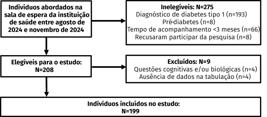
This is a non-probabilistic convenience sample. The sample was based on the work schedules of health professionals at a specialized state center, including doctors, nutritionists, podiatrists, nurses and physiotherapists. Patients invited to participate in the research were approached on Wednesdays and Fridays in the morning while waiting for their appointments in the waiting room. After being approached, they were directed to a private room with good lighting and air conditioning to ensure patient privacy.
Considering an average of 15 patients per period, the data collection period lasted four months, from August to November 2024. This strategy aimed to align the selection with the institution’s routine. The selection stages are shown in Figure 1.
Statistical methods
In descriptive terms, the continuous variables were expressed as mean and standard deviation, while the categorical variables were presented as absolute and relative frequencies.
Multiple linear regression models were used to investigate associations between sociodemographic and clinical variables and self-care scores (assessed using the DSCQ), taking the means of the DSCQ dimensions as continuous outcomes. The model was adjusted for variables such as sex, age, BMI, time since diagnosis, education level and income. The assumptions of the linear regression models were checked, including normality of residuals, homoscedasticity and absence of multicollinearity. The results were expressed by the estimated beta (β) coefficients, with respective 95% confidence intervals (95%CI). The data were analyzed using the Statistical Package for the Social Sciences (SPSS) software, version 25.0, taking a fixed 5% significance level.
Statistical significance was interpreted with caution, also considering the magnitude of the effects and their clinical relevance, in accordance with current methodological recommendations in the field of public health [19].
Results
The study was conducted with a sample of 199 patients. Mean age was 64.9 (9.3) years, with 43.7% being in the sixth decade of life and with females predominating (66.3%). Most individuals reported earning more than one minimum wage per month (92.0%). Only 1.5% of individuals had completed a university degree and 12.1% had never attended educational institutions [Table 1].
Sociodemographic characterization of the sample shown by absolute and relative frequency. Goiânia, Goiás, 2024 (n=199)
The average weight of the sample was 77.1 (16.1) kg and average height was 1.61 (0.09) m, resulting in an average BMI of 29.6 (5.7) kg/m2, with 41.2% classified as overweight and 40.2% as obese. The majority of the sample consisted of non-smokers (94.5%), non-drinkers (77.9%) and sedentary individuals (84.4%). Most had been diagnosed for more than 10 years (67.3%), used only tablets as medication therapy (51.3%) and presented only one complication related to type 2 diabetes (45.6%). Regarding complications, neuropathy was the most frequently cited (64.32%), followed by retinopathy (25.12%) and nephropathy (13.56%). Other data characterizing the clinical profile of the sample are presented in Table 2.
Characterization of the clinical profile of patients with type 2 diabetes shown by absolute and relative frequency. Goiânia, Goiás, 2024 (n=199)
The DSCQ activities regarding physical exercise (items 3.1 and 3.2) showed the poorest adherence. Other activities with low adherence were: i) item 1.2 – “followed professional dietary guidance”, with 63.8% reporting less than 4 days per week; ii) item 2.2 – “ate foods high in fat”, with 62.3% reporting poor diet; iii) item 4.1 – “monitored capillary blood glucose”, with 63.8% of unexpected responses; iv) item 4.2 – “monitored capillary blood glucose as recommended”, with 72.9% of unexpected responses; and v) item 5.1 – “examined feet”, with 64.3% reporting that they did not routinely assess foot health, considering the risk of developing lesions related to type 2 diabetes.
Activity 1.1, even with a larger number of people following a healthy diet, showed minimal difference between the scores of the expected response (50.8%) and the unexpected response (49.2%). The item with the best adherence was 2.3, related to the consumption of sweetened food. The other activities that presented scores within the expected range are those related to items 2.1, 5.2, 5.3, 6.1, 6.2 and 6.3. The frequencies related to the first six dimensions of the DSCQ are shown in Table 3.
Absolute and relative frequency of adherence to activities for self-care of the first six dimensions of the Diabetes Self-Care Questionnaire (DSCQ). Goiânia, Goiás, 2024 (n=199)
The adherence scores for the “overall diet”, “physical activity” and “blood glucose monitoring” dimensions were 3.42 (3), 1.12 (1.98) and 2.58 (3), respectively. Adherence was observed to be below the expected level for self-care in relation to these dimensions, as they presented means lower than four.
When using multiple linear regression models, it was found that BMI showed a statistically significant result in the “overall diet” dimension, whereby higher BMI is associated with a poorer score (β=-0.21; 95%CI -0.38; -0.39; p-value<0.001). This dimension also showed statistical association with sex, whereby females demonstrated a more adequate diet (β=-0.15; 95%CI -0.30; -0.08; p-value 0.03). No statistically significant associations were found between the other variables [Table 4].
Multiple linear regression models presented using the beta coefficient (β) and 95% confidence intervals (95%CI), taking the means of the Diabetes Self-Care Questionnaire (DSCQ) dimensions according to sociodemographic and clinical variables as continuous outcomes. Goiânia, Goiás, 2024 (n=199)
Regarding the smoking dimension, 6.5% of participants had smoked at least one cigarette or taken at least one puff in the week prior to the interview. It was also observed that 66.8% had never smoked, 26.1% had not smoked for more than two years, 1.5% quit smoking between one and two years ago, 0.5% smoked their last cigarette in the month prior to the approach, and 5.1% had smoked on the day of the interview. The reported mean number of cigarettes consumed per day was 10 (5.55) units.
Discussion
When assessing clinical profile and adherence to self-care in people with type 2 diabetes, a predominantly female sample was identified, mostly over 60 years of age and mostly classified as overweight or obese. The sample presented low adherence to self-care, inadequate lifestyle habits and clinical repercussions of the disease.
The predominance of females and individuals in their sixth decade of life can be justified by the large hormonal and metabolic changes typical in women at this stage, which increase the risks for type 2 diabetes [20]. The high frequency of overweight and obesity and the presence of inadequate dietary patterns, evidenced by the “overall diet” dimension of the DSCQ, point to the need for specific nutritional interventions, since excess weight worsens glycemic dysregulation and favors the progression of type 2 diabetes complications [21,22].
Regarding self-management of type 2 diabetes, assessed by the DSCQ, low adherence was observed among the participants and this behavior is influenced by several factors [23]. Individuals with low education levels are more likely to adopt negative attitudes towards self-management of the disease [24]. Although no statistically significant results regarding education were found in this sample, it was observed that more than 40% of individuals had low education levels, which may compromise their understanding of the disease, since it is a fundamental element for the development of the skills necessary for self-care management.
Time since diagnosis can also influence low adherence to diabetes self-management, since, as complications arise, motivation for self-care tends to decrease [25]. In this study, despite the absence of statistically significant relationships, most individuals reported more than 10 years since diagnosis, and most did not perform self-examination of the feet, this being a fundamental practice for preventing diabetic foot [26]. Although some preventive measures, such as checking footwear and drying the spaces between the toes, were mentioned, worrying rates of complications were found in this sample: 32.2% reported previous lesions, 11.0% had active lesions and 8.5% had already undergone amputations.
Low adherence to physical exercise was found. Most participants stated that they were sedentary. The “physical activity” dimension, as per items 3.1 and 3.2 of the DSCQ, showed the poorest performance among all dimensions assessed, with 88.9% reporting absence of physical activity in their daily routines and lack of regular exercise. These findings highlight the need to improve adherence to non-pharmacological interventions, because, despite their influence on glycemic control and their promoting discipline and autonomy in the self-care process, adherence to such practices is a challenge in this population [27].
Poor adherence to treatment can lead to chronic type 2 diabetes complications, triggering poor prognosis and metabolic disorders, potentially interfering with glycemic control [28]. Most participants in this study had complications related to type 2 diabetes. Among these, neuropathy was the most prevalent, followed by retinopathy and nephropathy. It is noteworthy that 21% of individuals reported the concomitant presence of two complications and 5% reported three complications, which makes the clinical picture more complex and potentially hinders therapeutic management [29].
Although people with type 2 diabetes generally have high rates of smoking, high sugar consumption and low consumption of fruit and vegetables [21], in this study, participants showed low prevalence of smoking, adequate consumption of fruit and/or vegetables and reduced sugar intake. This result can be attributed to specialized professional support in the treatment of type 2 diabetes, which provides guidance on nutrition, self-care and harm associated with inadequate habits. The good adherence observed in all items of the “medication” dimension also emphasizes the importance of professional support and guidance [30].
This study contributes to the understanding of the clinical profile and self-care practices in a specific population, highlighting the presence of important risk factors and barriers to diabetes self-management, assessed through a validated and specific questionnaire administered by experienced professionals. These findings highlight the need for the development of integrated approaches to improve care for these individuals. However, the study has limitations, including: the single-center design, convenience sampling and absence of follow-up laboratory tests. Further studies are recommended in order to assess the clinical repercussions of lack of self-management on the health of individuals with type 2 diabetes, as well as multicenter studies to broaden the assessment of self-care and the clinical profile of these patients.
The individuals with type 2 diabetes assessed by this study were predominantly women in their sixth decade of life, overweight and sedentary, who had been diagnosed for more than 10 years and at who had least one type 2 diabetes complication. Adherence to self-care, according to the DSCQ, was unsatisfactory, especially regarding diet, physical exercise, blood glucose monitoring and foot health assessment. Regression analysis indicated that individuals with higher BMI had poorer dietary habits, while females demonstrated more appropriate dietary choices.
-
Peer Review Administrator
Izabela Fulone (https://orcid.org/0000-0002-3211-6951)
-
Peer Reviewer
Ana Roberta Vilarouca da Silva (https://orcid.org/0000-0001-5087-4310)
-
Data availability
The database and the analysis codes used in this research are available upon request made by the peer reviewers.
-
Use of generative artificial intelligence
Not used.
References
- 1 Galicia-Garcia U, Benito-Vicente A, Jebari S, Larrea-Sebal A, Siddiqi H, Uribe KB, et al. Pathophysiology of type 2 diabetes mellitus. Int J Mol Sci. 2020;21(17):62-75. DOI: 10.3390/ijms21176275
- 2 Landgraf R, Aberle J, Birkenfeld AL, Gallwitz B, Kellerer M, Klein H, et al. Therapy of type 2 diabetes. Exp Clin Endocrinol Diabetes. 2019;127(S1):S73-92. DOI: 10.1055/a-1018-9106
- 3 Sunil B, Ashraf AP. Dyslipidemia in pediatric type 2 diabetes mellitus. Curr Diab Rep. 2020;20(53):1-9. DOI: 10.1007/s11892-020-01336-6
- 4 Petersmann A, Müller-Wieland D, Müller UA, Landgraf R, Nauck M, Freckmann G, et al. Definition, classification and diagnosis of diabetes mellitus. Exp Clin Endocrinol Diabetes. 2019;127(S 01):S1-7. DOI: 10.1055/a-1018-9078
- 5 Khan MAB, Hashim MJ, King JK, Govender RD, Mustafa H, Al Kaabi L. Epidemiology of type 2 diabetes – global burden of disease and forecasted trends. J Epidemiol Glob Health. 2020;10(1):107-11. DOI: 10.2991/jegh.k.191028.001
- 6 Sun H, Saeedi P, Karuranga S, Pinkepank M, Ogurtsova K, Duncan BB, et al. IDF Diabetes Atlas: global, regional and country-level diabetes prevalence estimates for 2021 and projections for 2045. Diabetes Res Clin Pract. 2022;183:109-19. DOI: 10.1016/j.diabres.2021.109119
- 7 American Diabetes Association. Foundations of care: education, nutrition, physical activity, smoking cessation, psychosocial care, and immunization. Diabetes Care. 2015;38(Suppl 1):S20-30. DOI: 10.2337/dc15-S007
- 8 Aune D, Sen A, Norat T, Janszky I, Romundstad P, Tonstad S, et al. Body mass index, abdominal fatness, and heart failure incidence and mortality: a systematic review and dose-response meta-analysis of prospective studies. Circulation. 2016;133(7):639-49. DOI: 10.1161/CIRCULATIONAHA.115.016801
- 9 Freire MF, Ferreira CM. Adesão ao tratamento medicamentoso e não medicamentoso de pessoas com hipertensão arterial e diabetes mellitus. Rev Bras Promoç Saúde. 2024;37:1-10. DOI: https://doi.org/10.5020/18061230.2024.14290
- 10 Belchior A de B, Nascimento FG, de Sousa MC, da Silveira ABM, de Oliveira SKP. Instrumentos de avaliação do autocuidado com os pés de pessoas com diabetes: revisão de escopo. Rev Bras Enferm. 2023;76(3):e20220555. DOI: https://doi.org/10.1590/0034-7167-2022-0555pt
- 11 Amaro AVS, Martins VH da S, de Mattos RM, Belfort LRM, de Oliveira IM, Gomes KR, et al. Qualidade de vida e capacidade de autocuidado de pacientes diabéticos do submédio Vale do São Francisco. Rev Ibero-Am Humanid Ciênc Educ. 2024;10(8):1901-16. DOI: https://doi.org/10.51891/rease.v10i8.15235
- 12 Sardinha A de SF, Garcia LPR de R, Tavares SA de O. Diabetes mellitus no estado de Goiás. Boletim Epidemiológico. 2021;22(2):1-12.
- 13 Isaac IGM, Sardinha A de SF, Tavares SA de O, de Carvalho MM. Internações hospitalares por diabetes no estado de Goiás no ano de 2022. Boletim Epidemiológico. 2024;25(5):1-15.
- 14 Toobert DJ, Hampson SE, Glasgow RE. The summary of diabetes self-care activities measure: results from 7 studies and a revised scale. Diabetes Care. 2000;23(7):943-50. DOI: 10.2337/diacare.23.7.943
- 15 Michels MJ, Coral MHC, Sakae TM, Damas TB, Furlanetto LM. Questionnaire of diabetes self-care activities: translation, cross-cultural adaptation and evaluation of psychometric properties. Arq Bras Endocrinol Metab. 2010;54(7):644-51. DOI: https://doi.org/10.1590/S0004-27302010000700009
- 16 Ferreira GRS, Viana LR de C, Pimenta CJL, da Silva CRR, da Costa TF, Oliveira J dos S, et al. Autocuidado de pessoas idosas com diabetes mellitus e a relação interpessoal enfermeiro-paciente. Rev Bras Enferm. 2022;75(1):e20201257. DOI: https://doi.org/10.1590/0034-7167-2020-1257
- 17 Coelho ACM, Villas Boas LCG, Gomides D dos S, Foss-Freitas MC, Pace AE. Atividades de autocuidado e suas relações com controle metabólico e clínico das pessoas com diabetes mellitus. Texto Contexto - Enferm. 2015;24(3):697-705. DOI: https://doi.org/10.1590/0104-07072015000660014
- 18 Eid LP, Leopoldino SAD, Oller GASA de O, Pompeo DA, Martins MA, Gueroni LPB. Fatores relacionados às atividades de autocuidado de pacientes com diabetes mellitus tipo 2. Esc Anna Nery. 2018;22(4):e20180046. DOI: 10.1590/2177-9465-EAN-2018-0046
- 19 Davis SL, Johnson AH, Lynch T, Gray L, Pryor ER, Azuero A, et al. Inclusion of effect size measures and clinical relevance in research papers. Nurs Res. 2021;70(3):222-30. DOI: 10.1097/NNR.0000000000000494
- 20 Martins-Filho AOF, Leal C dos S, Eymael D de A, Kilpp DS, Borges LR, Marques A y C, et al. Comportamento alimentar de pacientes com diabetes tipo 2 e/ou hipertensão. Rev Atenção Saúde. 2024;22(1):e20249249. DOI: https//doi.org/10.13037/ras.vol22.e20249249
- 21 Regufe VMG, Lobão MA, Cruz Martins N, Luís C, von Hafe P, Pinto CB. Clinical and sociodemographic profile, self care, adherence and motivation for treatment, and satisfaction with social support in Portuguese patients with type 2 diabetes. J Clin Med. 2024;13(21):e6423. DOI: https://doi.org/10.3390/jcm13216423
- 22 de Assumpção D, Ruiz AMP, Borim FSA, Neri AL, Malta DC, Francisco PMSB. Hábito alimentar de idosos diabéticos e não diabéticos: Vigitel, Brasil, 2016. Arq Bras Cardiol. 2022;118(2):388-97. DOI: https://doi.org/10.36660/abc.20201204
- 23 Tavares VB, de Farias AL, da Silva ASA, de Souza e Souza J, da Silva HP, Bastos M do SCB de O, et al. Amazon Amandaba-sociodemographic factors, health literacy, biochemical parameters and self-care as predictors in patients with type 2 diabetes mellitus: a cross-sectional study. Int J Environ Res Public Health. 2023;20(4):e3082. DOI: 10.3390/ijerph20043082
- 24 Portela R de A, Silva JRS, Nunes FBB de F, Lopes MLH, Batista RFL, Silva ACO. Diabetes mellitus tipo 2: fatores relacionados com a adesão ao autocuidado. Rev Bras Enferm. 2022;75(4):e20210260. DOI: https://doi.org/10.1590/0034-7167-2021-0260
- 25 Borba AK de OT, Arruda IKG, Marques AP de O, Leal MCC, Diniz A da S. Conhecimento sobre o diabetes e atitude para o autocuidado de idosos na atenção primária à saúde. Ciênc Saúde Colet. 2019;24(1):125-36. DOI: https://doi.org/10.1590/1413-81232018241.35052016
- 26 Lopes GSG, Rolim ILTP, Alves R de S, Pessoa TRRF, Maia ER, Lopes M do SV, et al. Representações sociais sobre pé diabético: contribuições para atenção primária à saúde no Nordeste brasileiro. Ciênc Saúde Colet. 2021;26(5):1793-803.
- 27 da Rocha RB, Silva CS, Cardoso VS. Self-care in adults with type 2 diabetes mellitus: a systematic review. Curr Diabetes Rev. 2020;16(6):598-607. DOI: 10.2174/1573399815666190702161849
- 28 de Castro RMF, Silva AM do N, da Silva AK dos S, de Araújo BFC, Maluf BVT, Franco JCV. Diabetes mellitus e suas complicações – uma revisão sistemática e informativa. Braz J Health Rev. 2021;4(1):3349-91. DOI: 10.34119/bjhrv4n1-263
- 29 Wang Q, Cheng H, Jiang S, Zhang L, Liu X, Chen P, et al. The relationship between diabetic retinopathy and diabetic nephropathy in type 2 diabetes. Front Endocrinol (Lausanne). 2024;15:e1292412. DOI: 10.3389/fendo.2024.1292412
- 30 Lopes P, Junges JR. Gerenciamento do diabetes por profissionais e usuários da atenção primária à saúde. Physis: Rev Saúde Colet. 2021;31(3):e310325. DOI: https://doi.org/10.1590/S0103-73312021310325
Edited by
-
Editor-in-Chief
Jorge Otávio Maia Barreto (https://orcid.org/0000-0002-7648-0472)
-
Scientific Editor
Everton Nunes da Silva (https://orcid.org/0000-0001-8747-4185)
-
Associate Editor
Elisângela Aparecida da Silva Lizzi (https://orcid.org/0000-0001-7064-263X)
The database and the analysis codes used in this research are available upon request made by the peer reviewers.

