 The contributions of Public Food Procurement in the construction of Sustainable Food Systems: a methodological proposal
Abstract
The importance of Public Food Procurement (PFP) in promoting Sustainable Food Systems (SFS) is widely recognised. However, few studies have addressed the evaluation of these purchases at a local level (municipality), taking into account the particularities of organizations and the dimensions of SFS. This study proposes a methodology to assess public food procurement in the municipality of São Luís (Maranhão, Brazil), based on five dimensions of SFS: food and nutritional security, sociocultural, economic, environmental and food democracy. The method involves constructing metrics to assess 12 categories and 48 indicators, which are combined to obtain an overall score (0-100). The aim is to check how close public food procurement is to SFS. The survey focused on 2019 and assessed public organizations in different sectors (education, health, security and social assistance) and management models (concession or self-management). In general, the scores were less than ideal for all categories and dimensions. The performance of the organizations was not linked to the management model or the sector, but rather to the way in which the public authorities conducted procurement, considering the legislation in force and the players involved.
Keywords:
family farming; evaluation method; sustainability; food policy
Resumo
É amplamente reconhecida a importância das Compras Públicas Alimentares (CPA) na promoção de Sistemas Alimentares Sustentáveis (SAS). Contudo, poucas pesquisas abordaram a avaliação dessas aquisições públicas em nível local (município), considerando as particularidades das organizações e as dimensões dos SAS. Este estudo propõe uma metodologia de avaliação destinada a analisar as compras públicas de alimentos no município de São Luís (Maranhão, Brasil), com base em cinco dimensões dos SAS: segurança alimentar e nutricional, sociocultural, econômica, ambiental e democracia alimentar. O método envolve a construção de métricas para avaliar 12 categorias e 48 indicadores, que são combinados para obter uma pontuação geral (0-100). O objetivo é verificar o grau de proximidade das compras públicas de alimentos em relação aos SAS. A pesquisa se concentrou no ano de 2019 e avaliou as organizações públicas em diferentes setores (educação, saúde, segurança e assistência social) e modelos de gestão (concessão ou autogestão). De modo geral, as pontuações se mostraram aquém do ideal para todas as categorias e dimensões. O desempenho das organizações não estava necessariamente ligado ao modelo de gestão ou ao setor, mas sim à forma como as aquisições eram conduzidas pelo poder público, considerando o aparato legal existente e os atores públicos envolvidos nas aquisições.
Palavras-chave:
agricultura familiar; método de avaliação; sustentabilidade; política alimentar
1 Introduction
In recent years, there has been a growing recognition of the importance of addressing food issues from multiple dimensions, processes and practices related to food production, access and consumption, losses and waste, and waste treatment (Rahal et al., 2020). This understanding has gained prominence in the academic and political sphere as a response to the systemic challenges posed by Industrial Food Systems (IPS), notably with regard to their negative impacts on food and nutritional security and on the health of individuals, the environment, biodiversity and the increase of climate change (Swinburn et al., 2019; Daviron, 2021; Food and Agriculture Organization of the United Nations, 2023). At the same time, the demands and proposals for the construction of Sustainable Food Systems (SFS) are growing.
The SFS perspective enables a multidimensional analysis of sustainability across multiple scales, taking into account the complex, multilevel networks of actors involved (Brunori and Galli, 2016; Moragues-Faus et al., 2017). Although it is extensive and still under construction, the Food and Agriculture Organization of the United Nations (FAO) (Food and Agriculture Organization of the United Nations, 2018), in line with the Sustainable Development Goals (SDGs), emphasizes, with this concept, the importance of ensuring food and nutritional security for all, without compromising the economic, social and environmental foundations necessary for future generations.
Among the essential elements for transforming food systems, Food and Agriculture Organization of the United Nations (2021) emphasize the need to redirect public support, eliminating ineffective, unsustainable or inequitable measures, in order to align with the SDGs. Public Food Procurements (PFP) is highlighted as a tool to promote sustainability, as it can provide “health food and food, and [they address] nutritional, socioeconomic, environmental and development concerns” (Grisa et al., 2020, p. 73). Based on recent studies (Swensson & Tartanac, 2020; Swensson et al., 2021), this article argues that the State, through Public Food Procurement, is the most influential organization in driving changes in food systems.
Considering this premise, this article analyzes the contributions of public food procurement to the construction of SFS in the municipality of São Luís1 (Maranhão, Brazil). To this end, we proposed an evaluation method that considers 12 categories and 48 indicators, covering five dimensions of SFS: food and nutritional security, sociocultural, environmental, economic and food democracy. The sum of these categories totals 100 points, with a higher score indicating greater sustainability. The research focused on public procurement carried out in 2019 and evaluated 290 public organizations (federal, state and municipal) in different sectors (education, health, security and social assistance), and management models (concession or self-management)2.
This research is relevant given the potential of public procurement in terms of the public served and budgets mobilized, and also given the scarcity of studies aimed at building methods for evaluating public food procurement with a focus on SFS. We observed that most of the research aims to evaluate institutional purchases related to the global context (Chaudhary et al., 2018), national and sub-national (Carvalho et al., 2021) from specific organizations or experiences (school feeding, family farming purchases, etc.) (Smith et al., 2016; Valette et al., 2020). There are few studies that offer a more systemic and integrated reading of public food procurement at the local level, considering the various dimensions related to SFS (Goggins & Rau, 2015; Braga & Grisa, 2022).
In this research, we worked with three hypotheses. The first highlights the limited relevance of PFP in terms of its commitment to building Sustainable Food Systems, despite the broad debate on Sustainable Public Procurement (SPP), which has gained prominence both internationally and nationally in recent years. The second hypothesis points to significant differences among sectors, predicting that the educational sector will present greater relevance compared to the others. This is largely due to Brazil’s pioneering role in implementing policies that promote the inclusion of family farming products in school meals, even prior to the enactment of Law No. 11,947/2009 (Brasil, 2009), which established a mandatory minimum allocation of 30% of funds toward the procurement of family farming products. Finally, the third hypothesis concerns the management models of Public Food Procurement. We infer that organizations operated by outsourced companies are more distant from the criteria that define SFS, whereas those managed under a self-management model by the requesting institutions themselves demonstrate greater alignment with the objectives of such systems.
The rest of this document is organized as follows. Section 2 discusses the potential of public food procurement in advancing SFS. Section 3 outlines the methodological approach used in this research. Section 4 presents the study's results, while Section 4.1 analyzes these results to assess how public food procurement in São Luís, MA aligns with sustainable food systems. Finally, the last section provides brief concluding remarks on the topic.
2 Theoretical Foundation
Institutional markets are tools that reflect Keynesian principles about the role of the State as responsible for generating effective demand, boosting production, markets and achieving development (Thies et al., 2021). According to Swensson et al. (2021), since the 1980s, with the growth of neoliberalism, public procurement for development purposes, which were previously predominant in the social welfare regime, began to be seen as financial inefficiency of the State. The authors state that “new procurement rules have been established around these ideologies, placing values such as 'lowest cost' and 'full and open competition' at the center of procurement systems” (Swensson et al., 2021, p. 5). However, this scenario starts to change with the revival of new political and economic ideologies, and the growing debate about sustainable development.
Faced with these new demands, the State, through government purchases, comes to be interpreted as an important actor for the balance between human and environmental health, also taking into account the multidimensional implications of food production in society, which encompass nutritional concerns, socioeconomic, environmental and development (Sonnino, 2019; Grisa et al., 2020). In this context, the debate on “Public Procurement oriented towards Sustainable Food Systems” arises. According to Swensson et al. (2021), institutional food purchases are considered a “game changer”, that is, they are entry points to promote SFS and healthy diets. This is because government purchases have the potential to define what type of food will be purchased, who will be the supplier and what type of production will be valued.
This debate has gained strength in recent years, with public procurement being explicitly recognized by the SDGs. Objective 12.7, which deals with “ensuring sustainable production and consumption patterns”, highlights the importance of promoting “sustainable public procurement practices, in accordance with national policies and priorities”. For this reason, there has been an increase in recognition of the role of public food purchasing in promoting sustainable development.
Public Procurement oriented towards the Sustainable Food System has the main objective of promoting integration between agriculture, nutrition and health. Food supply is not only considered to be a service, but as an opportunity to promote health through access to healthy and sustainable meals, reduce cases of obesity and overweight, feed people in vulnerable situations, and offer more nutritious and healthy food. Furthermore, the purchase of food by the State can promote sustainable practices and has direct effects on the local economy and territories, especially when purchased from family farming (Swensson, 2015; Sonnino, 2019).
However, incorporating a model that considers SFS generally comes up against short-term cost savings and economic efficiency by public institutions, given that the current food regime is convenient and cheap, which is one of the biggest challenges in building public procurement oriented towards SFS (Sonnino, 2019). Another challenge refers to the need to promote the coordination of actors and sectors of society (agriculture, health, education, nutrition, economy, etc.) which, in general, have been operationalized in a disjointed way. Indeed, to achieve multisectoral and multidisciplinary policies, integrated food policies are required (Parsons, 2019) that consider the interrelationships between the different parts of the Food Systems, especially with policy efforts that aim at the transition to SFS.
For the successful implementation of public sector food procurement, it is crucial to establish coordinated interventions on both demand and supply. This requires the construction of a solid regulatory framework and the implementation of appropriate policy instruments (Swensson et al., 2021). Furthermore, Swensson et al. (2021) highlight the importance of rigorous evaluation systems for public food procurement, a topic addressed by this article and detailed in the next section.
3 Methodology
This study encompasses three types of research to achieve its objectives: exploratory, descriptive, and explanatory. Considering the nature of the study, a mixed-methods approach was adopted, allowing for both quantitative and qualitative investigation. The research began with an exploratory phase, involving a systematic literature review on the topic and mapping of entities that receive food at different levels of government (federal, state, and municipal) through documentary research. The main data sources were the websites of the Maranhão State Court of Accounts and the Federal Government Procurement Portal, which provided access to Terms of Reference for bidding notices, contracts with outsourced companies (concessionaires), as well as public calls related to the purchase of food products from family farming.
In addition, the database of the National Fund for the Development of Education was consulted to obtain information on the National School Feeding Program. During the documentary analysis of bids, contracts, and public calls, it was observed that not all contracts were initiated in 2019. Therefore, only contracts that had been in operation for more than six months within that year were included in the analysis. This criterion was applied to ensure a representative set of contracts for the study period.
Moreover, contact was established with various secretariats and organizations via the ombudsman portal, and informal conversations were conducted with state and municipal managers responsible for government procurement. This step allowed us to identify tools for accessing official data from the organizations studied, as well as to recognize that some programs were not operational in São Luís during 2019, as was the case with the Family Farming Procurement Program3.
Information on entities operating through concessionaires was also collected, and key stakeholders were contacted during the course of the research. Following the exploratory phase, the next step was to develop the evaluation method and define the Sustainable Food Systems dimensions prioritized in this study.
The selection of SFS dimensions adopted in this research was based on three main criteria. First, we considered the literature on an integrated and holistic approach to SFS. Second, we focused on dimensions relevant to the Brazilian context. Finally, we analyzed which dimensions could be applied specifically to the topic of PFP. These criteria provided a solid foundation for the development of the evaluation method.
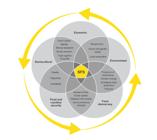
Based on these considerations, five fundamental dimensions were identified to assess the impact of public food procurement on the promotion of SFS. The selection of these dimensions considered both their relevance to the local context and their ability to provide a comprehensive analysis of public food procurement. The five dimensions are: food and nutritional security (quality, availability, and regularity of food); sociocultural (food culture and identity; ethical standards; social inclusion; inequality reduction); environmental (biodiversity protection; climate change; pollution); economic (decent work; social and gender equity; local production); and food democracy (access to food; social control; dialogue; socio-productive inclusion) (Goggins & Rau, 2015; Smith et al., 2016; Foodinsider, 2015; Roudelle, 2019; Valette et al., 2020; Carvalho et al., 2021).
Figure 1 illustrates these dimensions and their interrelationship. We recognize that the dimensions of SFS cannot be rigidly defined, as there are interconnections and interdependencies between them. This means that specific actions within each dimension have a direct impact on outcomes related to food systems as a whole.
For the development of the evaluation method for public food procurement, we highlight the central role of the Foodscale method, presented by Goggins & Rau (2015). Foodscale is a tool for assessing the sustainability of food served in public and private restaurants in Ireland, and aims to address the environmental, social, economic and health dimensions, covering all stages of the food system, from production to waste disposal. The method was based on a questionnaire containing 11 categories and 36 indicators. Scores were set for each category and, in the end, all 11 categories should total 100 points. Regarding the indicators, scores ranged from 1 to 6, with the maximum score for each indicator not exceeding the weight assigned to its respective category. The final result was based on the sum of the points for each indicator, calculated using both the geometric mean and the arithmetic mean. Therefore, the higher the score, the more sustainable the organization.
Based on the analysis of the original questionnaire (Goggins, 2016) and relevant studies (Smith et al., 2016; Foodinsider, 2015; Gustafson et al., 2016; Chaudhary et al., 2018; Roudelle, 2019; Valette et al., 2020; Carvalho et al., 2021), we sought to identify which criteria would be most suitable for the context of public food procurement in São Luís/MA. Complementarily, and following a procedure similar to that adopted by Goggins & Rau (2015), the categories and indicators were submitted to evaluation by experts in food systems and public procurement, who, based on their experience in the field, suggested adjustments, including modifications to the scoring and the incorporation of new criteria that were not previously considered.
To better reflect the local reality, we established 12 categories and 48 indicators. Two questionnaires were developed with minor differences, tailored to the specificities of food procurement and supply processes managed by concessionaires versus self-managed operations (Table 1). The five dimensions are: food and nutritional security (quality, availability, and regularity of food); sociocultural (food culture and identity; ethical standards; social inclusion; combating inequality); environmental (protection of biodiversity; climate change; pollution; ecologically-based production); economic (decent work, social and gender equity, local production); and, food democracy (access to food; social control; dialogue; socio-productive inclusion)4. Together, these categories total 100 points. Each sustainability indicator was assigned a score ranging from 0.5 to 6 points. The final assessment was based on the sum of the points for each indicator, which were calculated using the geometric mean and the arithmetic mean, with the higher the score, the greater the sustainability of food purchases5.
Having established the categories and indicators, we opted to prepare two questionnaires, with few changes between them, but which covered the peculiarities present in the process of purchasing and supplying food carried out by the concessionaires and another for self-management operation6. Table 1 demonstrates the chosen categories with their respective scores, the indicators, and the organizations’ management model.
A total of 27 questionnaires were administered to representatives of concessionaires and government entities. It is important to note that, in some cases, a single organization or concessionaire was responsible for managing multiple Food and Nutrition Units, which made this number of questionnaires representative within the context of the analyzed data, covering a total of 282 organizations7.
Furthermore, the information provided by respondents from each organization was complemented and cross-checked with observations and documentation, such as menus, financial reports, Terms of Reference from bidding notices, contracts, and public calls8. These documents also played a crucial role in the characterization phase of PFP in São Luís, enabling the mapping of all relevant organizations.
4 Results and Discussion
Table 2, below, presents the evaluation of public procurement in São Luís - MA based on the average scores obtained by each sector (education, health, security and social assistance), highlighting the differences between the management of purchases in the self-managed model and those operated by concessionaires.
- Average scores in the education, health, security, social assistance sectors, according to method categories, cases studied and management model (self-management and concession).
The education sector is represented here by university schools and restaurants located in the municipality of São Luís. This sector stood out for the significant number of questionnaires answered in comparison to the other sectors surveyed. There were four cases for concessionaires and 11 cases for self-management9. The results of the methodology indicated a final average score of 47.4 for the sector as a whole. In self-management, the average was 51.68, while in the concession model, the average was 37.38, revealing a better performance of the first compared to the second.
State schools and one university, operating under the self-management model, adopted measures that contributed to the higher score, namely: carrying out public calls for purchasing food from family farming; presence of seasonal foods; promotion of local food culture; measures to reduce solid waste; donation of uneaten food; and, more active social participation, involving councils and the local community in the decision-making and evaluation process. On the other hand, in the concession model, in the case of municipal schools and some universities, the measures implemented were more aligned with the principle of economy.
In the health sector, we administered a questionnaire to self-management and three to representatives of the concession. We identified the presence of outsourced companies in the concession model10, making access difficult for actors involved in public procurement11. In terms of scores, the health sector had an average of 32.25 points, with the self-management model scoring 35.0 points and the concession model scoring 31.33. We observed that, in healthcare organizations, the central concern was meeting the nutritional needs of patients and ensuring the adequacy of therapeutic diets, regardless of sustainability criteria.
In the security sector, we conducted two questionnaires with representatives of the self-management model and two with concessionaires12. The sector achieved an average of 34.5 points, with self-managed organizations obtaining 40.0 points, while concessionaires achieved 29.0 points. It is important to highlight that there was a significant difference between the two cases analyzed in self-management, with one of them having a score of 27.0 and the other reaching a total of 53.0 points. This variation was manifested in several of the categories analyzed, especially those that assessed the presence of purchases from family farming, as the highest scoring case used public calls in 2019 to purchase food directly from local production. In the concession, the difference was 24.0 and 34.0 points. This sector also stands out for its public service, as the lowest scores represented prison units, while the best performing ones were related to the service provided by public servants. As for the population deprived of liberty, the concern with the inclusion of seasonal foods, local food culture, food education for health and sustainability proved to be irrelevant in the interviewees' discourse, while in organizations that served other audiences, there were more specific actions aimed at these criteria.
The last sector evaluated was social assistance13. We analyzed one case under the self-management model and three cases under the concession model. The sector's average score was 44.5 points, with a value of 28.0 points for self-management and 50.0 points for concessions. Unlike the other sectors evaluated, cases involving contracts with outsourced social assistance companies had a more significant impact on the score. The highlight of the concession is due to the fact that the contracts established the mandatory allocation of at least 30% of the budget to products from family farmers, with an invoice being necessary for proof before inspection bodies. In turn, the self-management cases argued that their choices of food suppliers were based on criteria of price, regular supply and quality of products, criteria that, according to the interviewees, were not met by local family farming.
4.1 Interfaces of public procurement with the dimensions of Sustainable Food Systems
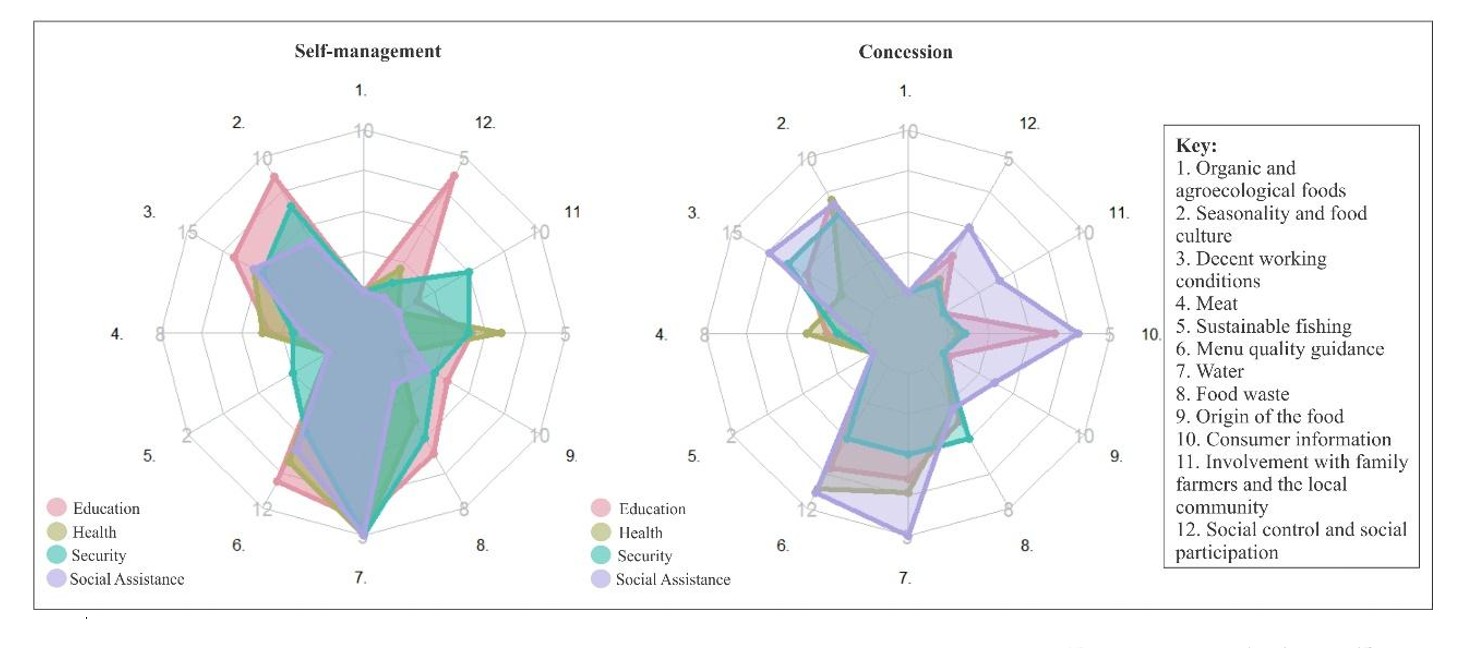
In this section, we analyze how public food procurement in São Luís encompass the different dimensions of SFS (food and nutritional security; sociocultural food adequacy; environmental preservation; economic sustainability; and food democracy). Figure 2 presents an overview of the sectors mentioned in the previous section in relation to the categories that contribute to the construction of SFS.
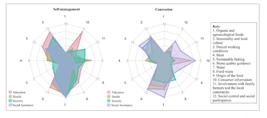
Representation of the sectors involved in public food purchasing in São Luis, by categories and management model, in 2019.
Figure 2 shows that the lines closest to the ends represent the sectors that obtained the highest scores in the evaluation, according to the 12 categories analyzed, numbered from 1 to 12. The first observation on the graph is the differences between the management models according to the category and sector analyzed. The education and security sectors in self-management occupied larger spaces in the graph, and achieved higher averages, specifically 51.68 and 40.0 (Table 2). On the other hand, in the concession modality, social assistance achieved a score of 50.5. In the health sector, the categories showed similarities in both management modalities, indicating that the way these acquisitions are managed follows more or less consistent standards, regardless of the management model. The security sector stood out in the self-management model, mainly due to the case studied that mobilized public calls from family farming.
In the context of self-management, the “water” category (7) performed well in all four sectors, while in the concession, the responses had a more uniform prominence in the category that evaluates “consumer information” (10). For the other categories, we did not see a pattern in the results, as each case analyzed and each sector demonstrated more pronounced trends in certain criteria compared to others.
Regarding categories, we observed significant differences between sectors. In Figure 2, it is evident that the categories “organic and agroecological foods” (1), as well as “sustainable fishing” (5) were those that received the lowest scores. This fact points to the need to strengthen policies that promote the organic and agroecological transition and the valorization of sustainable fishing in São Luís.
Deepening our analysis into the dimensions of SFS, we realized that public food procurement in São Luís had a significant impact on promoting food and nutritional security, as well as on sociocultural and economic dimensions. However, we observed that the dimensions that evaluated environmental criteria and food democracy were less prominent.
With regard to “food and nutritional security”, the most influential categories were those that assessed seasonality and food culture and quality of menus, which are significant in the Chart. All areas studied, addressed to some extent, issues such as supplying food in adequate quantity and quality, reducing ultra-processed foods, education on healthy eating, cooking techniques that minimize the use of oils and fats, among others. However, in the security sector, in both management models, this dimension proved to be less representative, especially in the criterion that evaluated the consumption of processed and ultra-processed foods. Despite demonstrating greater representation compared to other dimensions, this area still remained within a scope of discussion that is centered predominantly on the perspective of nutrition, emphasizing factors such as adequate quantities, nutritional and health quality of food. This observation highlights the importance of addressing food and nutrition security more comprehensively, incorporating not only nutritional aspects but also cultural, social and economic considerations for a more holistic and integrated approach.
Within the scope of the sociocultural and economic dimensions, these were considered of intermediate importance in the result of the method. In the sociocultural dimension, specifically, the most influential categories were seasonality and food culture, origin of food and consumer information. The relevance of considering foods in menus according to the cultural habits of the population was highlighted. However, we observed limited representation in the overall assessment, indicating the need to develop appropriate communication tools with consumers, informing them about the importance of food for health, nutrition and sustainability. This aspect was particularly notable in the security sector, especially when it came to organizations focused on serving people in prisons. This last point deserves attention, especially in light of the results of some research that has debated the low quality of food in prison facilities, highlighting aspects such as hygiene and little food variety (Sousa et al., 2020).
The dimension of the economy assumed greater relevance in the categories of seasonality and food culture, decent work, food waste, origin of food and involvement with family farmers and the local community. Some criteria that contributed to these dimensions included compliance with labor laws, the generation of employment and income, as well as the adoption of economic principles, such as the elimination of the use of disposable cups, the provision of free filtered water and the adaptation of food to the diners' palate to reduce waste. In this dimension, the education sector stood out with greater emphasis on self-management and social assistance on concessions, due to the priority given to criteria such as: acquisitions of Micro and Small Businesses; purchases from family farming; and hiring employees with the aim of social inclusion and income generation in the community. This reality reinforces the relevance of Lehtinen's (2012) argument, which highlights the need for a sustainable food system to also be socially fair. Furthermore, some organizations stood out for purchasing food from family farming. This question emphasizes the importance of having public policies that establish a direct connection between family farmers and purchases made by the public sector (Thies et al., 2021).
With regard to environmental criteria and food democracy, these stood out as the most fragile dimensions in the general context. The environmental dimension was manifested in several of the categories analyzed, with greater emphasis on those that addressed organic and agroecological foods, meat, sustainable fishing, water, food waste, food origin and, in part, in the information to the consumers. The graphical analysis unequivocally reveals that these mentioned categories showed low prominence when considered together with all categories. Some initiatives are worth highlighting, such as the management of organic waste intended for animal feed in some organizations, in addition to cases in which measures to reduce solid waste, such as not using disposables, were adopted. In general, the actions mobilized were punctual and, although they reflected positively on environmental issues, the intention was focused on the economic factor. In the case of the environmental dimension, it is important to highlight the State's low ecological response capacity. This reflects the adoption of regulations that guide or not these acquisitions in accordance with SFS principles and guidelines. For example, we note the absence of environmental criteria in the notices, such as law no. 12,305 of 2010, which establishes the National Policy on Solid Waste.
In a similar way, the situation was repeated in the context of the food democracy dimension, evidenced mainly in the categories that evaluated consumer information, involvement with family farmers and the local community and social control and social participation. According to Figure 2, the education and social assistance sectors were the most prominent in this dimension, thanks to health promotion and sustainability activities, and the search for proximity to family farmers. Furthermore, the active participation of the Food and Nutrition Security Council (CONSEA), as well as class councils and student mobilizations, is highlighted. On the other hand, in other sectors, the emphasis was only on carrying out opinion polls among diners, with little or no involvement with the local community and its social organizations. Furthermore, there was little notice of involvement with private entities and civil society organizations.
5 Conclusions
Considering the findings presented, the results indicate that, although there are differences between the SFS dimensions and among the sectors analyzed, the performance of public food procurement remains distant from the construction of Sustainable Food Systems, corroborating the first hypothesis. This observation highlights the need for greater state intervention, both in the implementation of national laws on sustainable procurement and in the development of integrated policies in coordination with implementing organizations, to foster new sustainability-related values among consumers.
The study's results illustrated distinct performance levels across sectors and management models. The education sector operating under the self-management model and the social assistance sector in the concession context achieved the highest scores. Conversely, self-managed social assistance and concession-based security performed less effectively.
These outcomes directly address the study's hypotheses: The finding supports the second hypothesis—that the education sector would perform better—but refutes the third hypothesis, which posited that the self-management model would always align better with Sustainable Food Systems (SFS) objectives than the concession model. The results therefore indicate that best performance wasn't primarily linked to the management model adopted. Instead, success was tied to how public authorities conducted acquisitions—specifically, their effective use of existing legal frameworks or the discretionary power of the actors involved. It is noteworthy, nevertheless, that in the two most successful cases, sustainability initiatives originated from the public entities themselves.
In the case of concession-based procurements, the inclusion of contract clauses mandating the allocation of 30% of the budget for purchases from family farming, with verification through invoices, was particularly notable. This underscores the importance of an active public sector in overseeing contracts with private providers. Even with explicit contractual clauses, close public involvement is imperative to ensure proper implementation, as observed in the concession-based social assistance cases. For the education sector, this aspect was especially evident due to the integration of family farming through the National School Feeding Program, as well as resolutions promoting a healthy and balanced approach to school meals.
When we categorically analyze the reason why these sectors were closer to SFS, we noticed that the cases with the highest scores shared a common characteristic: the incorporation of purchases from family farming. Conversely, those with the worst performance shared the lack of acquisitions from family farming. This points to the importance of this social category in the construction of SFS. The security and social assistance sectors draw attention due to their lower scores when the target population consists of people deprived of liberty or are homeless. This raises a warning regarding the conduct of public food procurement in relation to marginalized audiences.
While there are differences in the performance of public food procurement (PFP) across the dimensions of Sustainable Food Systems (SFS) and the sectors analyzed, the overall results remain distant from the ideal SFS model. This scenario underscores the need for greater state intervention to implement existing national laws on sustainable procurement, develop integrated policies, and work collaboratively with implementing organizations.
In this context, future research could build upon this study not only by mapping the weaknesses of the analyzed dimensions but also by proposing more concrete strategies to address them, including examples of public policies, programs, or existing initiatives that could inspire practical solutions in alignment with the Sustainable Development Goals.
Finally, it is essential to highlight that no sustainability assessment method is free from limitations. However, this methodology adapted to the reality of a Brazilian municipality represents a significant effort to help local governments and research organizations understand the public sector's commitment to building SFS through public food procurement.
Acknowledgements;
The authors would like to thank the Postgraduate Program in Rural Development at the Federal University of Rio Grande do Sul, the Group for Studies and Research in Agriculture, Food and Development (GEPAD), the Coordination for the Improvement of Higher Education Personnel (CAPES) and CAPES-COFECUB through the project “Agri-food systems and public policies: Building theoretical and methodological innovations for the analysis of international experiences” coordinated by Dr. Cátia Grisa and Eric Sabourin.
1
2
3
4
5
6
7
8
9
10
11
12
13
How to cite:
Financial support:
Ethics approval:
Data availability:
JEL Classification:
6 References
- Braga, C. L., & Grisa, C. (2022). Sistemas alimentares sustentáveis e compras públicas alimentares nos restaurantes universitários de São Luís-Maranhão: uma proposta metodológica. In C. Grisa, E. Sabourin, L. Eloy & R. S. Maluf (Eds.), Sistemas alimentares e territórios no Brasil (pp. 205-231). Porto Alegre: Editora da UFRGS.
- Braga, C. L. (2023). Compras públicas alimentares em São Luís (Maranhão) e a construção de sistemas alimentares sustentáveis (Ph.D. thesis). Federal University of Rio Grande do Sul, Porto Alegre.
-
Brasil. (1993). Law No. 8,666, of June 21, 1993 (Regulates public procurement and administrative contracts within the Public Administration). Diário Oficial [da] República Federativa do Brasil, Brasília. Retrieved in 2023, October 2, from https://www.planalto.gov.br/ccivil_03/leis/l8666cons.htm
» https://www.planalto.gov.br/ccivil_03/leis/l8666cons.htm -
Brasil. (2009). Law No. 11,947, of June 16, 2009 (Provides for school feeding and other measures). Diário Oficial [da] República Federativa do Brasil, Brasília. Retrieved in 2023, October 1, from https://www.planalto.gov.br/ccivil_03/_ato2007-2010/2009/lei/l11947.htm
» https://www.planalto.gov.br/ccivil_03/_ato2007-2010/2009/lei/l11947.htm -
Brunori, G., & Galli, F. (2016). Sustainability of local and global food chains: introduction to the special issue. Sustainability, 8(8), 765. https://doi.org/10.3390/su8080765
» https://doi.org/10.3390/su8080765 -
Carvalho, A. M., Verly Junior, E., Marchioni, D. M., & Jones, A. D. (2021). Measuring sustainable food systems in Brazil: a framework and multidimensional index to evaluate socioeconomic, nutritional, and environmental aspects. World Development, 143, 105470. https://doi.org/10.1016/j.worlddev.2021.105470
» https://doi.org/10.1016/j.worlddev.2021.105470 -
Chaudhary, A., Gustafson, D., & Mathys, A. (2018). Multi-indicator sustainability assessment of global food systems. Nature Communications, 9(1), 848. https://doi.org/10.1038/s41467-018-03308-7
» https://doi.org/10.1038/s41467-018-03308-7 -
Daviron, B. (2021). Aux origines de l’agriculture industrielle. In N. Bricas, D. Conaré & M. Walser (Eds.), Une écologie de l’alimentation (pp. 71-81). Versailles: Editions Quæ. https://doi.org/10.35690/978-2-7592-3353-3/c4
» https://doi.org/10.35690/978-2-7592-3353-3/c4 - Food and Agriculture Organization of the United Nations – FAO. (2018). Sustainable food systems, concept and framework. Rome: FAO.
- Food and Agriculture Organization of the United Nations – FAO. United Nations Children’s Fund – UNICEF. International Fund for Agricultural Development – IFAD. World Food Programme – WFP. World Health Organization – WHO. (2023). Résumé de L’État de la sécurité alimentaire et de la nutrition dans le monde 2023. Urbanisation, transformation des systèmes agroalimentaires et accès à une alimentation saine le long du continuum rural-urbain Rome: FAO.
- Food and Agriculture Organization of the United Nations – FAO. United Nations Development Programme – UNDP. United Nations Environment Programme – UNEP. (2021). A multi-billion-dollar opportunity – Repurposing agricultural support to transform food systems Rome: FAO.
-
Foodinsider. (2015). Enjoy good Food. Test Pasto Sostenibile Retrieved in 2021, May 10, from http://www.foodinsider.it/classifica-menu-mense-scolastiche/test-pasto-sostenibile
» http://www.foodinsider.it/classifica-menu-mense-scolastiche/test-pasto-sostenibile -
Goggins, G., & Rau, H. (2015). Beyond calorie counting: assessing the sustainability of food provided for public consumption. Journal of Cleaner Production, 112, 257-266. https://doi.org/10.1016/j.jclepro.2015.06.035
» https://doi.org/10.1016/j.jclepro.2015.06.035 - Goggins, G. (2016). Public food consumption and sustainable food systems: Exploring the role of large organizations (Ph.D. thesis). National University of Ireland Galway, Galway.
- Grisa, C., Schneider, S., & Vasconcelos, F. C. F. (2020). As compras públicas como instrumentos para a construção de sistemas alimentares sustentáveis. In P. V. Preiss, S. Schneider & G. Coelho-de-Souza (Eds.), A Contribuição brasileira à segurança alimentar e nutricional sustentável (pp. 69-92). Porto Alegre: Editora da UFRGS.
-
Gustafson, D., Gutman, A., Leet, W., Drewnowski, A., Fanzo, J., & Ingram, J. (2016). Seven food system metrics of sustainable nutrition security. Sustainability, 8(3), 196. https://doi.org/10.3390/su8030196
» https://doi.org/10.3390/su8030196 - Instituto Brasileiro de Geografia e Estatística – IBGE. (2021). Pesquisa de Orçamentos Familiares: POF 2021 Rio de Janeiro: IBGE.
-
Lehtinen, U. (2012). Sustainability and local food procurement: a case study of Finnish public catering. British Food Journal, 114(8), 1053-1071. https://doi.org/10.1108/00070701211252048
» https://doi.org/10.1108/00070701211252048 -
Moragues-Faus, A., Sonnino, R., & Marsden, T. (2017). Exploring European food system vulnerabilities: Towards integrated food security governance. Environmental Science & Policy, 75, 184-215. https://doi.org/10.1016/j.envsci.2017.05.015
» https://doi.org/10.1016/j.envsci.2017.05.015 - Parsons, K. (2019). Brief 3: Integrated Food Policy: What is it and how can it help connect food systems. In City University of London (Ed.), Rethinking food policy: a fresh approach to policy and practice (pp. 1-8). London: Centre for Food Policy.
- Rahal, L. S., Gentil, P. C., & Souza, E. (2020). A política de Segurança Alimentar e Nutricional no Brasil. In P. V. Preiss, S. Schneider & G. Coelho-de-Souza (Eds.), A Contribuição brasileira à segurança alimentar e nutricional sustentável (pp. 17-26). Porto Alegre: Editora da UFRGS.
- Roudelle, O. (2019). Les impacts d’un projet de restauration scolaire “durable” (Master’s dissertation). Université Toulouse Jean Jaurès, Toulouse.
-
Smith, J., Andersson, G., Gourlay, R., Karner, S., Mikkelsen, B. E., Sonnino, R., & Barling, D. (2016). Balancing competing policy demands: The case of sustainable public sector food procurement. Journal of Cleaner Production, 112(Part 1), 249-256. https://doi.org/10.1016/j.jclepro.2015.07.065
» https://doi.org/10.1016/j.jclepro.2015.07.065 -
Sonnino, R. (2019). Translating sustainable diets into practice: the potential of public food procurement. Redes, 24(1), 14-29. https://doi.org/10.17058/redes.v24i1.13036
» https://doi.org/10.17058/redes.v24i1.13036 -
Sousa, L. M. P., Matos, I. N. B., Paiva, T. R. L., Gomes, S. M., & Freitas, C. H. S. M. (2020). Regime da escassez: a alimentação no sistema penitenciário feminino. Ciência & Saúde Coletiva, 25(5), 1667-1676. https://doi.org/10.1590/1413-81232020255.34612019
» https://doi.org/10.1590/1413-81232020255.34612019 -
Swensson, L. F. J., & Tartanac, F. (2020). Public food procurement for sustainable diets and food systems: the role of regulatory framework. Global Food Security, 25, 100366. https://doi.org/10.1016/j.gfs.2020.100366
» https://doi.org/10.1016/j.gfs.2020.100366 - Swensson, L. F. J. (2015). Compras institucionales de alimentos de los pequeños productores: El caso del Brasil. Rome: FAO.
-
Swensson, L. F. J., Hunter, D., Schneider, S., & Tartanac, F. (2021). Public food procurement as a game changer for food system transformation. In L. F. J. Swensson, D. Hunter, S. Schneider & F. Tartanac (Eds.), Public food procurement for sustainable food systems and healthy diets (Vol. 1). Rome: FAO. https://doi.org/10.1016/S2542-5196(21)00176-5
» https://doi.org/10.1016/S2542-5196(21)00176-5 -
Swinburn, B., Kraak, V. I., Allender, S., Atkins, V. J., Baker, P. I., Bogard, J. R., Brinsden, H., Calvillo, A., De Schutter, O., Devarajan, R., Ezzati, M., Friel, S., Goenka, S., Hammond, R. A., Hastings, G., Hawkes, C., Herrero, M., Hovmand, P. S., Howden, M., Jaacks, L. M., Kapetanaki, A. B., Kasman, M., Kuhnlein, H. V., Kumanyika, S. K., Larijani, B., Lobstein, T., Long, M. W., Matsudo, V. K. R., Mills, S. D. H., Morgan, G., Morshed, A., Nece, P. M., Pan, A., Patterson, D. W., Sacks, G., Shekar, M., Simmons, G. L., Smit, W., Tootee, A., Vandevijvere, S., Waterlander, W. E., Wolfenden, L., & Dietz, W. H. (2019). The global syndemic of obesity, undernutrition, and climate change: the Lancet Commission report. Lancet, 393(10173), 791-846. https://doi.org/10.1016/S0140-6736(18)32822-8
» https://doi.org/10.1016/S0140-6736(18)32822-8 - Thies, V. F., Grisa, C., Schneider, S., & Belik, W. (2021). Public purchasing of family farming products under the Brazilian National School Feeding Programme (2011−2017). In L. F. J. Swensson, D. Hunter, S. Schneider, F. Tartanac (Eds.), Public food procurement for sustainable food systems and healthy diets (Vol. 2, pp. 2-27). Rome: FAO.
- Valette, E., Schreiber, K., Conaré, D., Bonomelli, V., Blay-Palmer, A., Bricas, N., Sautier, D., & Lepiller, O. (2020). An emerging user-led participatory methodology mapping impact pathways of urban food system sustainability innovations. In A. Blay-Palmer, D. Conaré, K. Meter, A. Di Battista & C. Johnston (Eds.), Sustainable food system assessment: Lessons from global practice (pp. 19-41). New York: Routledge.
Authors’ contributions:
Conflicts of interest:
*
Corresponding author: Camila Lago Braga. camila.lago@academico.ufs.brAssociate Editor:

 Source: Prepared by the authors
 Source: Prepared by the authors