 Comparative analysis of different heterodox interpretations about the end of the “Golden Age” of Western capitalism
ABSTRACT
This paper aims to contribute to the understanding, in the field of heterodoxy, of the end of the Golden Age of Western capitalism. In this regard, this object is examined through a comparative analysis of three different theoretical approaches, which have in common the adoption of the Principle of Effective Demand and the influence of Marx’s framework: the regulation school and the neo-Kaleckian and Sraffian approaches.
KEYWORDS:
Golden Age; political economy; Kalecki; regulation school; Sraffa
RESUMO
O presente artigo tem por objetivo contribuir para a compreensão, no campo da heterodoxia, acerca do fim da Era de Ouro do capitalismo ocidental. Neste intuito, tal objeto é examinado a partir de uma análise comparativa entre três abordagens teóricas distintas, mas que possuem em comum a adoção do Princípio da Demanda Efetiva e uma nítida influência da contribuição de Marx: a neokaleckiana, a do regulacionismo francês e uma abordagem sraffiana.
PALAVRAS-CHAVE:
Era de Ouro; economia política; Kalecki; escola da regulação; Sraffa
1 - INTRODUCTION
The “Golden Age” of Western capitalism is the period from the end of World War II to the mid-1970s, characterized by high output and productivity growth rates and low levels of unemployment and inflation (Marglin and Schor, 1990). Furthermore, a process of redistribution of income, both personal and functional, has been observed in the major market economies.
Throughout the 1970s, however, this scenario of prosperity and stability began to change. Several factors contributed to the transition in this accumulation pattern, from those related to international geopolitics, with the relative weakening of the Soviet Union, to aspects limited to the scope of nations, such as those related to the dynamics of distributive conflict. Also, there were other historical, social, and technological issues in addition to changes in the economic theory itself.
From the 1980s onwards, lower growth rates associated with a clear movement towards income concentration were observed in the central countries of capitalism. This process persists to this day, with all the problems regarding social implications, especially after the 2008 financial crises and the pandemic crises.
One hypothesis posits that the inflection observed from the 1970s onwards-between a regime of high growth rates and income redistribution and another with lower growth and income concentration-was fundamental in shaping the current accumulation pattern. Accepting this premise, a better understanding of this shift is crucial for comprehending the processes that brought us here, as well as the characteristics and limitations of this pattern and possible future paths that our economies and societies may follow. Specifically, given the dominance of the mainstream narrative about these events, examining this subject from diverse heterodox perspectives is especially insightful.
This paper aims precisely to contribute to the understanding of the end of the Golden Age of Western capitalism in the context of heterodoxy. For this purpose, this subject is examined from a comparative analysis among three theoretical approaches, which incorporate the Principle of Effective Demand and a clear influence of Marx’s contribution: the French regulation school, the neo-Kaleckian, and Sraffian approaches.
The next section briefly presents the Golden Age and what happened from the end of the 1960s onwards. Next, such approaches and their interpretations will be explained in sections 3, 4, and 5, and section 6 makes a brief comparative analysis among them. Finally, section 7 concludes the paper with a critical evaluation (in terms of economic theory and political implications) of such approaches.
2 - THE GOLDEN AGE AND ITS DEMISE
Capitalist countries began to intensify their economic interventions after the Great Depression, even prior the so-called “Keynesian revolution” (Klein, 1947). Furthermore, this process was accelerated with the onset of World War II, which firmly established state intervention in the economy.
The conditions for a quick economic recovery and vigorous future expansion were provided at the end of the conflict. The United States of America (USA) not only kept its productive park practically intact but also evolved rapidly in developing productive techniques and became the great global creditor, reorganizing the world system in the Bretton Woods framework. Moreover, with the threat of the spread of socialism in the world, it was in their interest to enable-or even encourage-the rapid development of other capitalist nations, especially in Western Europe and Japan. In this sense, the US maintained low and stable interest rates, was lenient with the protectionist policies of other nations, and-for certain countries-transferred technology, granted privileged access to their market, and even implemented economic aid plans.
Special circumstances such as the unilateral opening of the US market; the maintenance of devalued exchange rates favorable to the competitiveness of allies within the Bretton Woods system; tolerance with tariff and non-tariff protection policies; technical aid missions; and the strong stimulus to the expansion of American multinationals helped alleviate the external constraint in these countries. This allowed European countries and Japan to quickly adopt a regime of convertibility to the dollar and enabled a wave of supposed national “miracles” of economic reconstruction or growth. (Medeiros and Serrano, 1999, p. 11, our translation).
In this context, the world, driven by the major economies of capitalism (in Western Europe and Japan), grew vigorously. As a result, even with the population growing at the highest rates observed from the 19th century to the end of the 20th century, production increased even more impressively, resulting in a record average growth of per capita output.

If, on the one hand, nation-states carried out expansionary economic policies and provided societies with social safety nets, on the other hand, rapid productivity growth enabled real wage gains without squeezing profits, generating sufficient levels of demand to meet the growing production. As Table 1 shows, productivity, as measured by the average annual growth rate of GDP per hour worked, grew exceptionally compared with previous and subsequent periods.
The sharing of productivity gains with the working class was possible due to distributive agreements. According to these, in exchange for the improvement of their material conditions (due to the increase in real wages and the social safety net), this class committed to moderate union activity (Bowles et al., 1986; Serrano, 2004; Panitch and Gindin, 2012).
This accord involved an explicit and implicit quid pro quo, assuring management control over enterprise decision-making (with union submission and cooperation) in exchange for the promise to workers of real compensation rising along with labor productivity, improved working conditions, and greater job security-in short, a share in capitalist prosperity. (Bowles et al., 1986, p. 140)
This distributive agreement is evident when different indicators of the labor movement are analyzed, such as the number of strikes initiated per year and the number of workers involved. The case of the US is quite representative of what was observed in the developed world: with the end of the war and the return of the soldiers, the labor movement exploded, with millions of workers demanding better wages and working conditions (Panitch and Gindin, 2012, p. 82-83). As a result, the number of strikes and workers involved skyrocketed at the end of the 1940s. However, from the beginning of the following decade, with the aforementioned agreement, the numbers plummeted rapidly until the mid-1960s.
Maintaining low unemployment rates increasingly strengthened the bargaining power of the working class, not only cyclically in the short term but also structurally. Over longer periods of a heated labor market, in addition to demands for better wages and working conditions, this class increasingly influences the evolution of the political, social, and institutional framework (Stirati, 2001).
From the 1960s onwards, a rapid intensification of union activity was observed (Graph 2), and, in addition to the hostility of the labor movement, several other sectors began to intensify their political activity, as observed in the student, feminist, Black, hippie, etc., especially after the protests of May 1968 (Hobsbawm, 1995, p. 292-293).

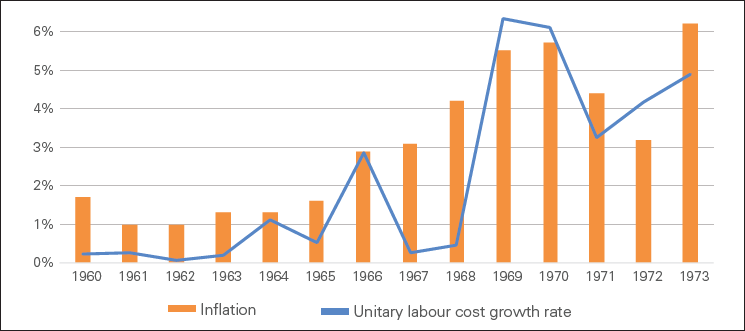
The intensification of activity by social movements began to generate a climate of growing instability, which was contaminated by-and was contaminating-the economic scenario. As the wage demands of the labor movement began to outstrip (diminish) productivity gains, inflation began to rise, even before the oil shocks1. Once again, the case of the US is emblematic: with the acceleration of unit labor cost (ratio of nominal wages to productivity), prices also accelerated and inflation increased, mainly from the mid-1960s onwards (Graph 3).

Real wage gains had already implied an increase in the wage share in the income of different countries after the war, but now, with wages continuously growing more than productivity and the intensification of international competition resulting from European and Japanese reconstruction, a process of profit-squeeze began to be observed-in addition to the increase in inflation rates. As discussed in the following sections, this process of profit squeeze is central to the explanations of different interpretations of the end of the Golden Age, especially the French regulation and neo-Kaleckian schools.
3 - THE END OF FORDISM: THE VERSION OF THE FRENCH REGULATION SCHOOL
The French regulation school emerged in the mid-1970s, aiming to revisit and critically update the Marxist approach by developing new and less abstract concepts to analyze the long-term trajectories of capitalist economies, especially in North America and France. With this objective in mind, Michel Aglietta elaborated his thesis, published as a book in 1976, A Theory of Capitalist Regulation: The US Experience, which is considered the founding work of the school.
Based on this proposal, several basic concepts were elaborated, such as the accumulation regime, which consists of a set of regularities that would guarantee the general process of capital accumulation (Boyer, 1990, p. 35) or, in the structural form of allocation of the social product that reconciles, in the long term, the transformations of supply conditions and final demand (Lipietz, 1987, p. 14; Possas, 1988, p. 201).
The period of prosperity that followed World War II is explained precisely by the advent of the Fordist accumulation regime. This would combine the form of organization of production from Taylorism with a specific wage relation obtained from an intense process of union negotiations around production conditions and wage dynamics. In this sense, Fordism would essentially be “the linkage of the norms of production and consumption over a given economic space” (Boyer, 1990, p. 99).
This new wage relationship-which precisely differs Fordism and Taylorism-would result from the aforementioned distributive agreement between the workers and the capitalist class. Such an agreement implied the acceptance, without resistance, of Taylorist methods, with the acceleration of production and productivity, generating margins for capitalists to give real wage gains to workers. In conjunction with Keynesian demand stabilization policies, this factor generated the demand necessary to meet the increasing production, implying a virtuous cycle (Boyer, 1990, p. 86-87).
On one side, workers and unions accept capitalist modernization and do not jeopardize scientific management and the taylorian methods. On the other side, managers agree to share productivity gains with wage earners, so that the wage norm is now that employees benefit from economic progress (...). Thus, this new form of collective bargaining is diffusing through the whole system and is generating a permanent improvement in consumption norms. Since simultaneously, investments are creating new and modern capacities, the process becomes now self-sustained. More demand for consumption goods induces investment opportunities in the related sectors, hence outlets for equipment goods producers who earn high profit. Thus, a virtuous circle in which the monopolist regulation mode is both stabilizing growth and promoting it. (Boyer, 1987, p. 29)
From the 1960s onwards, however, a slowdown in productivity was observed due to the “exhaustion of the Taylorian and Fordist methods of organizing work as a support for the valorization of value, which came around its social and economic limits” (Coriat, [1979] 2000, p. 146, our translation). According to Boyer (1987, p. 31-32), such exhaustion could be explained in part by the spread of Fordism, whose efficiency would be lower when deepened than when introduced: “(...) Fordism is fairly efficient as regards labor and capital productivity when it replaces older systems, but it becomes harder to get the same results when the issue is to deepen-and no more to extend-the same organizational methods.”
The slowdown of productivity is a central point in the crisis of Fordism and the end of the Golden Age. In the authors’ opinion, productivity would have a technical and a social aspect, the latter being predominant.
(…) the successes and failures of Taylorist and then Fordist principles of the organization of labor were manifest (…). The slowdown in the increase in fixed capital per capita in the 1960s was easy to relate to the spread of work teams, an expedient which came up against social limits, and quite simply obvious material limits. The slowdown in productivity gains could clearly be linked to the “technical” problems of the scientific organization of labor (balancing work stations, lack of flexibility, etc.), and especially to “social” limits which became explosive in the late 1960s (insubordination of the working masses, disruptive strikes, absenteeism, wastage, etc.) (Lipietz, 1988, p. 31)
Lipietz and Aglietta point out that the dynamics of productivity, despite its technical aspect, must be mainly related to the class struggle in the sphere of production, in the work process itself. “It is thus correct to impute the crisis to ‘class struggle,’ but class struggle within the labor process (absenteeism, micro-conflictuality), rather than within distribution” (Lipietz, 1986, p. 21-22). Aglietta reinforces the argument:
(…) the crisis of Fordism is first of all the crisis of a mode of labour organization. It is expressed above all in the intensification of class struggles at the point of production. By challenging conditions of work bound up with the fragmentation of tasks and intensification of effort, these struggles showed the limits to the increase in the rate of surplus-value that were inherent in the relations of production organized in this type of labour process. This was the root of the crisis (Aglietta, 1976, p. 150).
In the context of high economic growth and low unemployment rates, workers had high bargaining power to demand and achieve increasing wage gains. Since a slowdown in productivity was observed, this process implied an increase in unit labor cost. To the extent that this was not passed on to prices and there was no decrease in the organic composition of capital (that is, in the ratio between constant and variable capital), there would be a fall in the rate of profit, which would imply an accumulation crisis. Thus, the decline of Fordism is explained by the weakening of counter-trends-namely, increased productivity and the reduction in organic composition-to the falling rate of profit, which implied a crisis of over-accumulation, with new capital generating less surplus value.
At the end of the sixties, in all the major industrial capitalist countries, there was a fading of the two main counter-tendencies to the fall of the rate of profit.
- A fall in the rate of growth of productivity led in some countries to a downward pressure on the rate of exploitation.
-- The “productivity of capital,” an index of the inverse of the OCC [organic composition of capital], began to fall everywhere.
These two factors led to what Marx has called a “relative overaccumulation of capital,” where new capital produces relative less surplus-value. (Lipietz, 1986, p. 27)
It is noteworthy that, although regulationist authors work with a causal relationship between the falling rate of profit and the accumulation crisis, they do not formally establish an investment function. This fact is admitted by Lipietz (1986, p. 27): “there is there is still a need to make explicit by what concrete mechanisms a ‘decline in profitability’ leads to a fall in investments, unemployment, etc.”
While these authors do not employ a specific economic model2 or formalize an investment function, they infer that investment is a function of the rate of profit, aligning them more closely with the neo-Kaleckian school. In general, the explanation for the end of the Golden Age is the same for both schools, being caused by the profit squeeze process. However, regulationist authors emphasize the slowdown in productivity while neo-Kaleckians pay more attention to wage increases.
4 - THE PROFIT-SQUEEZE: THE NEO-KALECKIAN INTERPRETATION
The original contribution of Polish economist Michal Kalecki is undoubtedly one of the main pillars of today’s heterodox economics. The author, recognized alongside Keynes as one of the formulators of the Principle of Effective Demand, emphasized investment as a central element in his theoretical framework due to its dual role as both a driver of demand and a generator of productive capacity. Other fundamental points of his theoretical contribution are the analysis of society into social classes and the understanding that production costs dictate price dynamics.
Several authors followed the line of research developed by Kalecki, but the emergence of the neo-Kaleckian school is generally attributed to Josef Steindl (Blecker, 2002, p. 130; Dweck, 2015, p. 33). The investment function used by the author, very similar to that developed by Kalecki in Theory of Economic Dynamics (1985), included the company’s internal capital accumulation, its degree of leverage, the rate of profit, and the degree of utilization of productive capacity (Steindl, 1952, p. 129).
In the 1980s, the first generation of neo-Kaleckian growth models, known as “canonical models,” emerged upon this investment function. In such models, elaborated by the contributions of Rowthorn (1981), Taylor (1983), and Dutt (1984), the investment function had three elements, one autonomous, one associated with the degree of utilization, and another with the rate of profit (Blecker, 2002, p. 132; Lavoie, 2014, p. 361). This function can be synthesized in the following equation:
In the equation above, the investment growth rate (gi) is composed of the autonomous term α (which may be associated with structural factors, innovations, or the animal spirits of capitalists, for example); the degree of utilization (u) multiplied by the parameter β; and the rate of profit (r) multiplied by γ.
Criticism of this investment function led to a new generation of models in this tradition based on the contributions of Bhaduri and Marglin. The authors argued that an unequivocal increase in the investment growth rate due to an increase in the degree of utilization at a constant profit rate would be problematic, as it would imply a reduction in the profit share in income, which, in turn, should negatively impact investments3 (Bhaduri and Marglin, 1990, p. 380). For the authors, such a direction would be ambiguous.
(...) it is by no means certain or even especially likely to be the case that an increase in the rate of capacity utilization will induce additional investment when the profit rate is held constant. The reason is a simple one: if the rate of capacity utilization increases while the rate of profit remains constant, it must be the case that the profit margin and share fall. So the effect on investment is the resultant of two forces: the positive impact of higher capacity utilization and the negative impact of lower unit profits. (Marglin and Bhaduri, 1991, p. 140)
The authors propose the analytical separation of demand effects, reflected in the degree of utilization, from those related to supply, expressed in the profit share (π). This idea is reflected in the investment function elaborated by the authors4:
Despite the similarity with the one used in the canonical models, this function makes it possible to obtain completely different results (even incompatible with Kalecki’s original contribution). Depending on the parameters, such a function makes room for profit-led regimes, in which higher profit shares are related to higher growth rates, as in the case where investments are very sensitive to profit share and relatively insensitive to the degree of utilization. This type of growth regime is at the heart of the neo-Kaleckian explanation for the end of the post-war prosperity regime.
The most comprehensive analysis of this school of thought regarding the end of the Golden Age is found in Profit Squeeze and Keynesian Theory by Marglin and Bhaduri (1991). The authors argue that the trauma of the 1929 crisis largely explains the period of prosperity that followed World War II. As such a crisis resulted from insufficient demand in a context of high profitability, capitalists would have been more reluctant to invest in response to increases in profits. Instead, they would start to pay more attention to expected demand so that “the strategy of wage-led growth may have been the best-indeed, the only-game in town” (Marglin and Bhaduri, 1991, p. 147).
In a wage-led regime, real wage gains (allied to growing public spending) implied a demand that induced increasing levels of investment, leading to output and productivity growth, and in the aforementioned virtuous cycle that characterized the Golden Age.
The period of prosperity itself, however, would have reversed this situation. The absence of a crisis like that of 1929 and the high profits likely increased the sensitivity of investments to profits, leading to a profit-led regime. Additionally, low unemployment increased workers’ bargaining power, resulting in higher growth rates for nominal wages and a slowdown in productivity. “In short, high employment encouraged the growth of wages and inhibited the growth of productivity; this put pressure on profits, and the resulting pressure on profits led to a crisis of accumulation” (Marglin and Bhaduri, 1991, p. 124).
Other elements contributed to this process, such as the oil shocks, the increase in the technical capital/product ratio at full capacity, less expansionist economic policies, and the interest rate shocks at the end of the 1970s. However, the economic dynamics would already be doomed to crisis.
As explained in sections 2 and 3, the acceleration of wages and the deceleration of productivity increased unit labor cost. This increase squeezed profit rates and was partly passed on to prices, triggering the inflationary process. In a context where investments respond primarily to the rate of profit (and, therefore, growth regimes were profit-led), this would have generated the accumulation crisis that marked the end of the Golden Age.
5 - POLITICAL ECONOMY INFLECTION: A SRAFFIAN INTERPRETATION
The Sraffian approach addressed here5 originates from Piero Sraffa’s contribution in the first half of the 20th century and is based on the resumption and critical development of the classical political economy of Smith, Ricardo, and Marx. In this sense, Sraffa not only pointed out the analytical difficulties present in the theory of value of these authors but also gave solutions for them by the simultaneous determinations of the endogenous distributive variable and the relative prices, as well as by the so-called “standard commodity” (Sraffa, 1960).
In line with the contribution of classical political economy, Sraffa understood that the supply side dictated price dynamics. Market prices would gravitate around the production price, determined by the costs (of the dominant technique in the normal utilization of productive capacity) and for a given distribution, and would already include a minimum acceptable level of profitability.
Based on these theoretical foundations, Garegnani sought to make them compatible with the Principle of Effective Demand, extending it to the long term. Following this line of research, Serrano would propose the Sraffian Supermultiplier model, consistent with the contribution of the two authors.
According to the Sraffian Supermultiplier model (Serrano, 1995), investments in productive capacity for the private sector-even though they require a minimum level of profitability to occur-are determined by the expectation of demand and, therefore, can be modeled as income-induced. Thus, the level of output is determined by autonomous spending and the Supermultiplier (similar to the Keynesian multiplier, but incorporating the marginal propensity to invest), and the growth rate of such spending determines the economy’s growth rate. The main autonomous spending involves public expenditure and investments, residential investments, autonomous consumption, and exports.
The evolution of these variables is central to the Sraffian explanation for the end of the Golden Age of capitalism. Concerning the study of the end of this period of prosperity, the most detailed analysis is explained in the article by Cavaliere, Garegnani, and Lucii called Full Employment and the Left, presented for the first time in 1994 and published a decade later.
In the Sraffian interpretation, the 1929 crisis was important in helping to build a consensus on the need for state intervention to avoid insufficiencies in demand. Still, the crucial point in understanding the advent of the Golden Age lies in the strengthening of socialism as a viable alternative to capitalism after World War II. As explained above, at the international level, the US made possible (or even encouraged) the rapid development of other countries to contain the spread of socialism. Internally, in turn, distributive agreements were made to reduce the questioning impetus of the working class. According to this view, the weakening of the Soviet Union and the dismantling of such agreements were crucial to the end of this period of prosperity (Cavalieri et al., 2009).
The dynamics of the Golden Age and the beginning of its demise in the Sraffian interpretation resemble the regulationist and neo-Kaleckian versions presented in the previous sections. Expansionist economic policies, social safety nets, and real wage gains generated demand to induce investments that implied high output and productivity growth rates, which eased the distributive conflict. As in the other interpretations, the situation begins to change with the strengthening (conjunctural and structural) of the working class, which began to demand increasing wage gains in relation to productivity and changes in the technical conditions of production.
Other expressions of the greater strength of wage workers in society, when they are no longer in thrall to the fear of unemployment, can be seen in working times and rhythms, physical conditions on the job and, in general, the capacity of workers to bargain on those conditions. And all these factors also have their effect on the profit rate through what economic theory calls the technical conditions of production. (Cavalieri et al., 2009, p. 351)
As explained above, wage increases in relation to productivity raise unit labor cost, generating pressure on prices and profit rates. In addition to these economic changes (increasing wage share, falling profit rates, etc.), there were institutional, political, and social changes unfavorable to the capitalist class. As shown in section 2, an example is reflected in the intensification of social movements that contributed to the instability observed in the period, especially from the late 1960s.
(...) the Golden Age of the post-war years stands out as a period during which the position of wage earners in distributive conflicts was stronger than ever before. Increased organizational capacity in unions and left-wing political parties, as well as the generally high demand for labour, contributed to strengthening their position. As a result, the functional distribution of income was changed in their favor, with the share of wages showing an increasing trend and profits becoming squeezed. In the 1960s and 1970s widespread conflicts flared up, such as the events in France in May 1968, the ‘hot autumns’ in Germany and Italy, and the prolonged miners’ strike in Britain in 1973-74. These developments appear eventually to have led to a reconsideration of conflict strategies. (Korpi, 1991, p. 334)
According to the Sraffian interpretation, a decrease in profit rates does not necessarily lead to a reduction in the pace of investments and an accumulation crisis. That is because investments respond to expected demand, so there is no reason for them to slow down in the context of heated demand, even with decreasing profit rates. The only problem concerning profit rates would be if they were below a minimum acceptable level of profitability, which, as the maintenance of the pace of accumulation shows, was not observed. Thus, the observed shift to lower growth rates requires an explanation regarding autonomous spending. These slowed down, but due to changes in economic policy. It is, therefore, necessary to explain the reasons for such a change.
At the international level, there was a relative weakening of the Soviet Union and, on the capitalist side, the dissolution of the Bretton Woods system in 1971 and the deregulation of international capital flows in the following years removed national governments’ degrees of freedom to carry out economic policies.
(…) the Bretton Woods agreement had enabled governments to control cross-border capital flows, something that gave them considerable leverage in relation to national capital interests and possibly steering economies to maintain full employment. After the dissolution of this system in 1971, from the mid-1970s to the mid-1980s (…) there was a wave of deregulations of capital movements. Governments thus came to lose a major tool for full employment economic policies. The result was a globalization of capital, a globalization that affected national relations of power in favor of capital and limited the scope of government policy making. (Korpi, 2002, p. 393)
On the domestic front, the rise in inflation resulting from the increase in unit labor cost catalyzed by the oil shocks justified the adoption of contractionary economic policies and reduced their electoral impact. While the working class strained the distributive agreement by increasing union activity and its demands, the capitalist class found itself less and less favored and more interested in reversing the situation, especially in a context where socialism lost attractiveness in the world. This reversal would come through pressure on governments to implement increasingly less expansionist (and eventually contractionary) economic policies.
Governments in different countries raised their interest rates and reduced the growth rate of their spending, which strongly impacted the growth rate of autonomous spending. The case of the US is quite representative of what was observed. After 1973, public spending grew by less than half of what it had been growing, while consumption of durable goods and residential investment were strongly affected by contractionary monetary policy.
It is worth mentioning that although exports had a small weight in the aggregate demand of the main countries of capitalism6, their deceleration due to the reduction in the growth rates of world output and global trade also contributed to the economic slowdown in different countries.
After the economic and political instability that marked the 1970s, with inflation associated with economic stagnation, the final blow to the Golden Age came with the US interest rate shock. According to the St. Louis Fed, US short-term interest rates increased from 1979 to 1981 from 11.1% to 16.3% in nominal terms and from 0% to 5.2% in real terms. As a result, the US, the world’s largest economy, not only decelerated its production more sharply but also forced the other countries to carry out sharp increases in interest rates due to the risk of capital flight and balance-of-payments crises, in a context of growing deregulation of the international flow of capital.
6 - A BRIEF COMPARATIVE ANALYSIS
As discussed in earlier sections, the three interpretations analyzed, despite their differences, have similar explanations for the advent of the Golden Age and the beginning of its crisis. That is because they all use the Principle of Effective Demand and an interpretation of the dynamics of the distributive conflict largely influenced by Marx’s contribution. According to the latter, lower unemployment rates are associated with greater bargaining power of the working class and better conditions to obtain increasing wage gains and change the technical conditions of production in its favor, raising unit labor cost.
In these perspectives, the Golden Age is attributed to the rapid expansion of demand, fueled by expansionary economic policies and real wage increases, which, along with social safety nets, ensured high consumption levels. Demand induced the investments that fed back the dynamic. And with the whole world growing and integrating, world trade, reflected in exports, contributed to the process.
As time passed, low unemployment caused changes that ended up reversing this situation. This reversal is endogenous in the regulationist and neo-Kaleckian interpretation, and exogenous, mediated by changes in economic policy, in the Sraffian approach presented. This fact brings the latter closer to the analysis carried out by Kalecki in his famous 1943 article Political Aspects of Full Employment.
In the view of the first two schools, the increases in unit labor cost implied a compression of profits, almost mechanically reducing the pace of investments and generating an accumulation crisis. The basic difference between the two is that the regulation school focuses on slowing down productivity and the neo-Kaleckian on accelerating wages. “We should therefore draw a distinction between ‘Wage-Push-PS [profit squeeze]’ explanation (the most popular PS explanation among Marxist scholars since Kalecki) and a ‘Productivity-Pull-PS’ explanation” (Lipietz, 1986, p. 21-22). However, the fall in profit rates at the end of the 1960s did not directly imply a reduction in the pace of accumulation. On the contrary, as the cases of the US and Japan show, a certain detachment between the two variables was observed7.
As Graph 4 shows, the profit rate fell from 1965 onwards in the US while the growth rate of the capital stock began to decline only after 1970, and even then remained at high levels. The disconnection among variables is even more evident in Japan: the profit rate fell at the beginning of the 1960s and the 1970s, but accumulation remained at a vigorous pace.

These stylized facts, however, are fully compatible with the Sraffian interpretation, since, in this approach, investments are not an increasing function of profits. On the contrary, falling profit rates only contributed to a series of other economic and political changes that favored the working class over the capitalist one.
Capitalists sought and managed to reverse the government’s economic policies, resulting in lower growth rates via a reduction in public spending and, with increasingly contractionary monetary policies, reductions in autonomous consumption and residential investment. The decrease in demand growth implied a reduction in the pace of investment expansion, not the other way around. Moreover, as the economic slowdown spread across the globe, there was a drop in export growth rates, reinforcing the process.
The three interpretations emphasize different specific aspects of the origins of the Golden Age, but all attribute it to a virtuous cycle understood in the light of the Principle of Effective Demand. Thus, there is little divergence in the analysis of such a period of prosperity, even though the regulation school places more emphasis on the wage relationship, neo-Kaleckians focus on the sensitivity of investments to profits, and the Sraffian approach highlights the dynamics of geopolitics reflected both in the interstate world system and the distributive agreements internal to nations.
The three approaches also attribute the onset of the crisis mainly to the strengthening of the working class within the scope of the distributive conflict. However, the reason that led to the outcome of the crisis shared by the regulation and neo-Kaleckian schools is different from that pointed out by the Sraffian approach. This divergence is mainly due to differences in investment functions (although not formalized in the regulationist case).
Here lies the main analytical difference between the schools, that is, between the regulationist and neo-Kaleckian schools on one side, and the Sraffian school on the other. As the experience of the end of the Golden Age shows, investments respond to the pace of effective demand, to adjust productive capacity to it. The reason for this is that, even at declining profit rates (but not below a minimum level that justifies investments), capitalists are compelled to make investments to meet demand, risking losing market share and compromising future profits if they don’t. This is why, as indicated by Graphs 4 and 5, the rate of capital accumulation remains at high levels, even in the face of an unequivocal decline in profitability. Therefore, as was sought to demonstrate, despite some similarities among the approaches analyzed here, the Sraffian explanation is the only one consistent with the lack of a direct connection between profit rates and capital stock growth.

7 - CONCLUSION
The regulation and neo-Kaleckian schools face some empirical and theoretical difficulties with their respective interpretations of the end of the Golden Age. Although this article focuses on comparative analysis, it is worth at least highlighting some of them8.
Regarding the regulation school, the absence of a theoretical framework for causal relationships among macroeconomic variables is evident. Still, perhaps the most critical aspect of this interpretation consists of two points. Firstly, demand explains the Golden Age (after all, this is what differentiates Taylorism from Fordism), but plays no role in its downfall, which is explained entirely by the supply side. Secondly, what determines the end of this period of prosperity is the weakening of the counter-trends to the falling profit rate. This explanation could be obtained directly from Marx’s original contribution, regardless of the entire regulationist theoretical construct.
The neo-Kaleckian school, in turn, has a more formalized and robust economic framework, but its explanation for the end of the Golden Age has some crucial flaws. The main ones concern: 1) the ad-hoc change from a wage-led to a profit-led regime (since this is a central point of the analysis and is not properly explained); and 2) the difficulty arising from formulating investment as an increasing function of profit. As explained above, the disconnection between the two variables is a point of extreme weakness in both this interpretation and the regulationist one.
In addition to the theoretical and empirical difficulties, the greatest criticism that must be made of these two interpretations is eminently political. By treating investment as an increasing function of profit, such schools associate economic growth with the profit rate, which the neo-Kaleckian school synthesizes in the concept of profit-led. This analytical option is problematic not only because it does not match the concrete reality, but mainly due to its political and social implications.
If profits drive a growth regime, it may benefit society for the government to pursue policies that favor profitability through institutional changes that disadvantage the working class and potentially lead to contractionary economic policies causing unemployment and wages reductions to enable accumulation process. This process corresponds exactly to the one observed from the 1970s onwards, with policies based on the monetarist theoretical framework that did not result in growth acceleration.
It is noteworthy that both schools of thought explicitly set out to defend the interests of the working class. The objective of the Marglin-Bhaduri model was to reconcile the vision of social democracy with that of radical Marxism, the two main political currents to defend the interests of the working class (Bhaduri and Marglin, 1990, p. 383; McColloch, 2017, p. 565). The regulationist authors are even more explicit. Boyer (1990, p. 84), for instance, stated-referring to the regulation school-that “[i]t is true that its members’ intellectual work is much more closely related to a declared commitment to the left than is the case for many other scholars” (Boyer, 1990, p. 84).
The Sraffian approach, in turn, has none of these theoretical or empirical difficulties and its framework contains no element that justifies pro-capital measures. As investment is a function of expected demand, demand must be stimulated to increase the level of output, a result notoriously obtained by real wage gains and increases in the wage share of income, given that the working class has a higher propensity to consume. To increase economic growth, on the other hand, the growth rate of autonomous spending must increase, a result easily obtained by accelerating public expenditure, for example.
In the absence of external restrictions, the only limitation to growth is essentially political, and full employment situations are not endogenously reversed by profit squeeze processes, as advocated by the regulationist and neo-Kaleckian approaches. As in the Golden Age, the contexts of high growth and low unemployment favor the working class in the economic, social, and political spheres, but the reversal of such a situation stems from changes in economic policy, necessarily the object of political dispute within society. In the absence of endogenous mechanisms that reverse full employment positions, it is up to society to decide (or not) for more prosperous and egalitarian regimes.
REFERENCES
- Aglietta, M. ([1979] 2015) “A theory of capitalist regulation: The US experience”. Verso.
- Barros, L. A. (2022) “O fim da “Era de Ouro” do capitalismo: análise crítica de algumas interpretações”. Instituto de Economia da UFRJ.
- Bhaduri, A. and Marglin, S. (1991) “Unemployment and the real wage: the economic basis for contesting political ideologies”, Cambridge Journal of Economics, 14 (4), pp. 375-93.
- Blecker, R. (2002) “Distribution, Demand and Growth in Neo-Kaleckian Macro Models”. In Setterfiel, M. (ed.) Demand-Led Growth: Challenging the Supply-side Vision of the Long Run, Edward Elgar.
- Bowles, S. et al. (1986) “Power and profits: the social structure of accumulation and the profitability of the postwar US economy”. Review of Radical Political Economics, v. 18, n. 1-2, p. 132-167.
- Boyer, R. (1987) “Technical change and the theory of regulation”. CEPREMAP.
- Boyer, R. (1990) “The regulation school: a critical introduction”. Columbia University Press.
- Cavalieri, T; Garegnani, P; Luc, M. (2009) “Full Employment and the Left. In: Theory and practice of economic policy”. Tradition and change. Selected Papers from the 9th Aispe Conference: Tradition and change. Selected Papers from the 9th Aispe Conference. FrancoAngeli, p. 334.
- Coriat, B. ([1979] 2000) “El taller y el robot: ensayos sobre el fordismo y la producción en masa en la era de la electrónica”. siglo XXI.
- Dutt, A. K. (1984) “Stagnation, income distribution, and monopoly power”. Cambridge Journal of Economics , 8(1), March, 25-40.
- Dweck, E. (2015) “Macroeconomia kaleckiana”. Escolas da macroeconomia / Conselho Regional de Economia 1ª região. 1.ed. Rio de Janeiro: Albatroz.
- Hobsbwam, E. (1995) “Era dos Extremos: o Breve Século XX (1914 - 1989)”; tradução Marcos Santarrita; revisão técnica Marica Cecília Paoli: - São Paulo: Companhia das Letras.
- Klein, L. R. (1947) “The keynesian revolution”. New York: Macmillan.
- Korpi, W. (1991) “Political and economic explanations for unemployment: A cross-national and long-term analysis”. British Journal of Political Science, p. 315-348.
- Korpi, W. (2002) “The great trough in unemployment: A long-term view of unemployment, inflation, strikes, and the profit/wage ratio”. Politics & Society, v. 30, n. 3, p. 365-426, 2002.
- Lavoie, M. (2014) “New Foundations of Post-Keynesian Economics”. Edgar.
- Lipietz, A. (1986) “Behind the Crisis: The Exhaustion of a Regime of Accumulation”. A” regulation school” perspective on some French empirical works. Review of Radical Political Economics , v. 18, n. 1-2, p. 13-32.
- Lipietz, A. (1987) “Mirages and miracles”. London: verso.
- Lipietz, A. (1988) “Accumulation, Crises, and Ways Out”. International Journal of Political Economy, 18:2, 10-43.
- Maddison, A. (2001) “The World Economy: A Millennial Perspective”, Paris: OECD.
- Marglin, S.; Bhaduri, A. (1991) “Profit squeeze and Keynesian theory”. Nicholas Kaldor and Mainstream Economics. Palgrave Macmillan, London, 123-163.
- Marglin, S. and Schor, J. (1990) “The golden age of capitalism”, Oxford University Press.
- McColloch, W. (2017) “Profit-led growth, social democracy, and the left: an accumulation of discontent”. Review of Radical Political Economics , v. 49, n. 4, p. 559-566.
- Medeiros, C. and Serrano, F. (1999) “Padrões Monetários Internacionais e Crescimento”, in: Fiori, J. L. (org.) Estados e moedas no desenvolvimento das nações. Ed. Vozes, Petrópolis.
- Moreira, V. G. and Serrano, F. (2018) “Demanda efetiva no longo prazo e no processo de acumulação: o debate sraffiano a partir do projeto de Garegnani (1962)”. Economia e Sociedade, v. 27, n. 2, p. 463-492.
- Palumbo, A. and Trezzini, A. (2003) “Growth without normal capacity utilization”. European Journal of the History of Economic Thought, v. 10, n. 1, p. 109-135.
- Panitch, L. and Gindin, S. (2012) “The making of global capitalism: the political economy of the American Empire”. Verso Books.
- Possas. M. L. (1988) “O projeto teórico da Escola da Regulação”. Novos Estudos Cebrap, v. 21, p. 195-212,.
- Roncaglia, A. (2000) “Piero Sraffa. His life, thought and cultural heritage”.
- Rowthorn, R. E. (1981) “Demand, real wages and economic growth”. Thames Papers in Political Economy, Autumn, 1-39.
- Serrano, F. (1995) “Long period effective demand and the sraffian supermultiplier”, Contributions to Political Economy, v. 15.
- Serrano, F. (2004) “Relações de poder e a política macroeconômica americana, de Bretton Woods ao Padrão Dólar Flexível”, In: Fiori, José Luís (Org.). O poder americano. Petrópolis: Vozes, p. 190-204.
- Sraffa, P. (1960) “Production of Commodities by Means of Commodities: Prelude to a Critique of Economic Theory”. Cambridge University Press, Cambridge.
- Steindl, J. (1952) “Maturity and Stagnation in American Capitalism”, Oxford, Basil Blackwell.
- Stirati, A. (2001) “Inflation, Unemployment and Hysteresis: an alternative view”, Review of Political Economy, Volume 13, No. 4.
- Taylor, L. (1983) “Structuralist Macroeconomics”, New York, Basic Books.
- Trezzini, A. (1995) “Capacity utilisation in the long run and the autonomous components of aggregate demand”. Contributions to Political Economy, v. 14, p. 33-66.
- Trezzini, A. (1998) “Capacity utilisation in the long run: some further considerations”, Contributions to Political Economy , v. 17, p. 53-67.
- Trezzini, A. and Palumbo, A. (2016) “The theory of output in the modern classical approach: main principles and controversial issues”. Review of Keynesian Economics, v. 4, n. 4, p. 503-522.
-
1
As Cavalieri et al. (2009, p. 352) pointed out, “(…) the drastic increase in oil prices in 1973, to which, as we noted, the wages and prices explosion is often traced, simply accentuated an inflationary tug-of-war begun in the preceding five years, and which can therefore be seen clearly as a result of the long period of full employment policies in the capitalist world’s leading countries.”
-
2
According Boyer (1990, p.70), “(...) it would be vain to insist at all costs on applying a single, ultra-simplified model, whether monetarist, Keynesian, or even Kaleckian, to every case. Everything depends on the precise type of regulation that prevails.”
-
3
A simple way to explain the argument is decomposing the rate of profit (r), given by the ratio between the mass of profits (P) and the capital stock (k), between the profit share (π = P/Y), the degree of utilization (u)—given by the ratio between current output (Y) and potential output (Y*)—and the technical ratio capital over potential output (v = k/Y*). Once this technical relationship is fixed, for a given rate of profit, increases in the degree of utilization necessarily imply reductions of the same magnitude in the profit share:
-
4
It is worth mentioning that, for the authors, the investment growth rate would be an increasing function of the expected profit rate, which, in turn, would depend on the share of profits (expressing the conditions of realization) and the degree of utilization (which would reflect demand conditions) (Marglin and Bhaduri, 1991, p. 136).
-
5
The approach presented here, the Sraffian Supermultiplier, is one of the different lines within the Sraffian school. For the school-internal debate, see Trezzini (1995; 1998), Roncaglia (2000), Palumbo and Trezzini (2003), Trezzini and Palumbo (2016), and Moreira and Serrano (2019).
-
6
Except for Germany at the end of the century. According to data from Maddison (2001, p. 361-362), from 1950 to 1998, exports increased their share in GDP from 2.2% to 13.4% in Japan, from 3% to 10.1% in the US, and from 6.2% to 38.9% in Germany. In the three countries, the growth rate of export volume fell between the period from 1950 to 1973 and from 1973 to 1998.
-
7
This fact is admitted by Marglin and Bhaduri (1991, p. 158), who still defend their investment function: “(…) this resilience of the investment share to the fall in profitability should not suggest that profits are irrelevant for accumulation.”
-
8
For an in-depth critical analysis of these interpretations for the end of the Golden Age, see Barros (2022).

 Source:
  Source: Handbook of U.S. Labor Statistics (2001).
 Source: Organisation for Economic Co-operation and Development and Bureau of Labor Statistics.
 Source: Armstrong and Glyn (1986). The profit rate is given by net profits divided by the capital stock (mid-year) of companies (public and private) in the non-agricultural and non-financial sectors.
 Source: Armstrong and Glyn (1986). The profit rate is given by net profits divided by the capital stock (mid-year) of companies (public and private) in the non-agricultural and non-financial sectors.