
 Asymmetric effects from exchange to inflation: evidence to Brazil via NARDL models
This paper tests the pass-through effect for Brazil from 1999 to 2024 using nonlinear distributed lag autoregressive models (NARDL). Inflation (IGP-M; IPCA; monitored; free; tradable and non-tradable) cointegrates with the exchange rate and the vector of covariates. The ECM, on the other hand, points to inflation resilience in the short term, indicating nominal rigidity. Dynamic multipliers reveal that the exchange rate pass-through to inflation is asymmetric, but heterogeneous. The IPCA and free and non-tradable prices have positive asymmetry, in which the pass-through in the face of exchange rate depreciations is greater than that of appreciations. The other prices showed negative asymmetry.
KEYWORDS:
Inflation; exchange rate; NARDL; Bounds Testing; dynamic multipliers
 Thumbnail
 Thumbnail
 Thumbnail
 Thumbnail
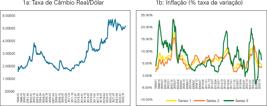
 Fonte: Taxa de Câmbio: Banco Central do Brasil. Inflação: Instituto Brasileiro de Geografia e Estatística IBGE. Nota: Taxa de Câmbio R$/US$ comercial - compra - média. Inflação Acumulada em 12 meses.
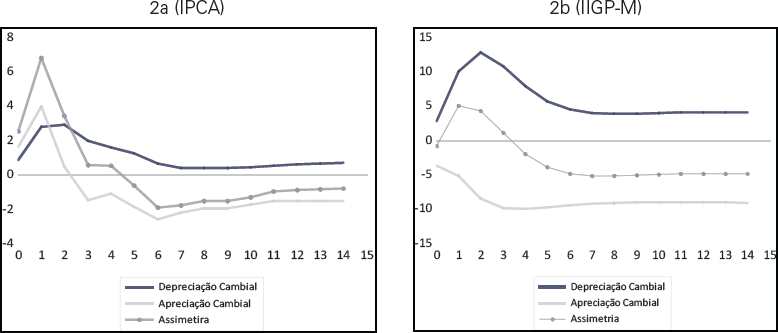 Fonte: Elaboração própria.
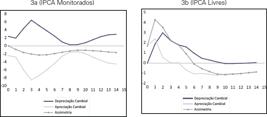
 Fonte: Elaboração própria.
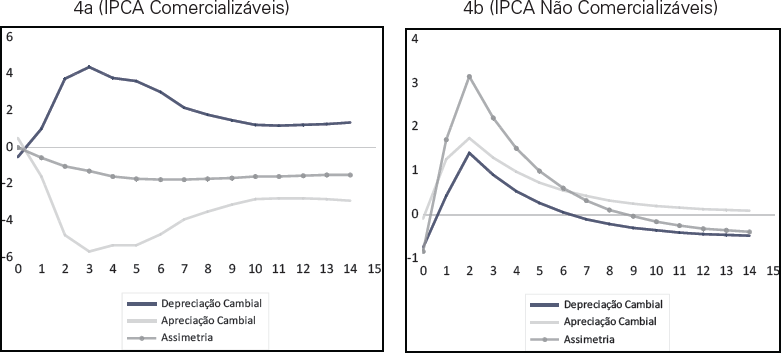 Fonte: Elaboração própria.