
 Can China maintain high growth rates under the “dual-circulation” decoupling?
ABSTRACT
In 2020, after decades of “great international circulation” - a strategy of pursuing economic growth and development through export-oriented production - China announced that it would adopt a “dual-circulation” strategy. As was argued, “this means that, while China will continue to engage with global markets and supply chains, it will rely on domestic markets rather than external demand to drive economic growth” (Yu, 2023). What happens to the Chinese growth rates under the dual circulation strategy? Is it inevitable that the dramatic slowdown of growth that occurred since 2007 will become permanent? This paper argues that the slowdown of the Chinese growth is due not only to the objective factors (slowdown of population increase, approach to the technological frontier), but also to policy choices made well before the “dual-circulation” strategy emerged. It is due first and foremost the cessation of foreign reserve accumulation after the “Great Recession” of 2008-09 that led to the appreciation of the yuan, decline in the growth of export and investment. It is also argued that there are not only temporary costs of decoupling associated with restructuring (reorientation from foreign to domestic markets), but also permanent costs caused by the decline in international specialization and division of labor. It means that high growth rates could be maintained only at a higher price, in particular only with an even higher share of investment in GDP. Such a strategy can be justified only by security consideration, not economic ones.
KEYWORDS:
Dual-circulation strategy; Chinese growth; export/GDP ratio; exchange rate undervaluation; foreign exchange reserves accumulation
RESUMO
Em 2020, após décadas de “grande circulação internacional” - uma estratégia de busca por crescimento e desenvolvimento econômico por meio da produção orientada para a exportação - a China anunciou a adoção de uma estratégia de “dupla circulação”. Como argumentado, “isso significa que, embora a China continue a se envolver com os mercados e cadeias de suprimentos globais, ela dependerá dos mercados domésticos, em vez da demanda externa, para impulsionar o crescimento econômico” (Yu, 2023). O que acontece com as taxas de crescimento chinesas sob a estratégia de dupla circulação? É inevitável que a desaceleração drástica do crescimento que ocorreu desde 2007 se torne permanente? Este artigo argumenta que a desaceleração do crescimento chinês se deve não apenas a fatores objetivos (desaceleração do crescimento populacional, aproximação da fronteira tecnológica), mas também a escolhas políticas feitas bem antes do surgimento da estratégia de “dupla circulação”. Isto se deve, antes de tudo, à interrupção do acúmulo de reservas cambiais após a “Grande Recessão” de 2008-09, que levou à valorização do yuan, à queda no crescimento das exportações, do investimento e do PIB. Argumenta-se também que existem não apenas custos temporários de desvinculação associados à reestruturação (reorientação dos mercados externos para os domésticos), mas também custos permanentes causados pela diminuição da especialização e divisão internacional do trabalho. Isso significa que altas taxas de crescimento só poderiam ser mantidas a um preço mais alto, em particular, apenas com uma participação ainda maior do investimento no PIB. Tal estratégia só pode ser justificada por considerações de segurança, e não econômicas.
PALAVRAS-CHAVE:
Estratégia de dupla circulação; crescimento chinês; relação exportação/PIB; subvalorização da taxa de câmbio; acúmulo de reservas cambiais
INTRODUCTION
In 2007, Chinese GDP grew by 14%. Since then, growth rates have gradually declined to 5% in 2023. The five-year moving average growth rate in 2023 fell to the lowest level since reforms began in 1978, over four decades ago (figure 1).

China survived COVID pandemic way better than other countries: growth rates remained positive in both 2020 and 2021, whereas in other G20 countries (with the exception of Turkey) there was a reduction of output. Life expectancy grew to 78 years in 2021, exceeding that of the US, where it fell to 76 in 2021. However, the post-pandemic growth rates remained sluggish by Chinese standards (3% in 2022 and 5% in 2023-25).
VIEWS ABOUT “DUAL-CIRCULATION” AND THE SLOWDOWN OF GROWTH
The debate about the possibility of maintaining high growth rates of the 1980s-2000s is ongoing in China for over a decade. In May 2014, President Xi Jinping referred to the need to “adapt to the new normal”, understood as the transition from double digit growth rates to a more moderate growth of 5 to 7%. Later, in 2020, after the break out of COVID pandemic and proliferation of sanctions and embargoes in the world economy, China announced the strategy of the “dual-circulation” envisaging the focus on the domestic markets. But it seems like decoupling from the international markets is understood as the inevitable consequence of more hostile Western attitude and sanctions, not like a deliberate Chinese strategy (Lin, Wang, 2022).
It may well be that even Western sanctions would not lead to the decline in the international trade and other economic contacts between China and the world. Even more so that most non-Western countries are not ready to follow such a policy and those that try to follow are not very successful. Verma (2023) argued that “self-reliance India campaign” is infeasible.1 So Chinese “dual-circulation” strategy may be regarded as a contingency plan in case there would be a collapse of international trade like in the 1930s.
Economists have offered various explanations for the slowdown of China’s growth, including the decline in the population growth rate and the ageing of the Chinese population. These factors are real but should not be exaggerated. The working age population and employment both grew at 2% annually from the 1980s, but such growth declined earlier this century before coming to a complete halt in 2014 for working age population and in 2020 for the total population. This could explain the decline in GDP growth rate by two percentage points yearly.
Another factor is exhaustion of the advantages of economic backwardness: it is easier to catch up from a low base, especially because cutting-edge innovation is more difficult and costlier than copying existing technologies, whether for free or even by buying patents and copyrights. Developed economies have rarely grown for extended periods at the breakneck pace rate of the East Asian ‘miracle’ economies when they were ‘catching up’ or converging, and growth tends to slow in fast-growing economies as they approach the technological frontier.
After all, only five countries/territories have successfully gone from ‘developing’ (i.e., less than a fifth of US per capita income) to ‘developed’ (over half of US per capita income) status. These were Japan, South Korea, Taiwan, Hong Kong (HK), and Singapore. But their growth slowdowns have taken place after their per capita incomes reached over half the US level, whereas Chinese per capita GDP (even at purchasing power parity, i.e., in comparable prices) is currently under a quarter of the US level (figure 2). In fact, marked slowdowns have only occurred in Japan and HK, whereas the other ‘tigers’ have continued to grow rapidly, avoiding the allegedly inevitable infamous ‘middle-income trap’. If these experiences are any guide, China’s growth slowdown is still a couple of decades away, if it happens at all (Lin, 2017).

Many Chinese economists speculate whether the slowdown of growth is temporary or permanent. Lin (2017) believes there is a need for industrial policy to avoid the “middle income trap”, whereas Zhang (2017) argues that the market alone can fix the problem, if only obstacles for entrepreneurial innovations are removed. In 2016, Lin, Wang, and Morgan (2016) argued that the main factors that led to the slowdown since 2010 are external and cyclical, and were optimistic that a reacceleration to 8% in the medium run is possible under favorable conditions.
However, China’s growth slowdown also appears to be due to policy choices, involving economic policy changes. The slowdown started over a decade ago - after the “Great Recession” of 2008-09, i.e., before COVID pandemic, before the new wave of sanctions, and before the initiation of “dual-circulation” strategy.
UNDERVALUATION OF THE EXCHANGE RATE AS AN EXPORT-ORIENTED GROWTH-PROMOTING INDUSTRIAL POLICY
There is an argument (Polterovich, Popov, 2004; Rodrik, 2008; Popov, 2010b, 2013, 2019, 2020; Popov, Jomo, 2020) that breathtaking Chinese growth in the 1980s-2000s, quite like the rapid growth of Japan, Korea, Taiwan, and a number of ASEAN countries, has been driven by deliberate exchange rate undervaluation through rapid accumulation of foreign exchange reserves (FOREX), promoting exports and discouraging imports.
Management of the exchange rate is an important tool of non-selective industrial policy (Popov, 2020) - the maintenance of the undervalued real exchange rate via accumulation of foreign exchange reserves (above the normal amount needed to ensure smooth trade and capital account transactions) is the important instrument of promoting economic growth based on export of tradable goods, although at the expense of non-tradables (Polterovich, Popov, 2004).
There are important differences between import duties and devaluation of the exchange rate. “Exchange rate protectionism” is more efficient policy to stimulate growth because decisions on import duties and government taxes/spending are affected by a poor quality of institutions (corruption and low efficiency of implementation), whereas low exchange rate policy is indiscriminate and nonselective by nature: it cannot be captured and “privatized” by particular interest groups - this makes it especially efficient growth promoting instrument in poor and middle income countries that generally suffer from corruption (Polterovich, Popov, 2004).
As it is stated in the UN flagship report (UN WESP, 2016), “reserve accumulation can have positive externalities on the production and export of tradables and industrial development and can thus be a feature of the country’s development model. Undervaluation of the exchange rate can increase the competitiveness of exports, without the need for sector- or firm-specific subsidies or interventions”.
As Griffith-Jones and Ocampo (2010) observe, the rationale for the accumulation of foreign exchange reserves “is usually found in either one of two explanations: the “competitiveness” (or, in more pejorative terms, “mercantilist”) and the “self-insurance” motives. This mercantilist view that undervaluation of exchange rate via accumulation of foreign exchange reserves is in fact an industrial policy - aimed at promoting export oriented growth by benefiting the producers of tradables and exporters at the expense of the producers of non-tradables and importers - is gaining support in the literature (Dollar, 1992; Easterly, 2001; Rodrik, 2008; Bhalla, 2012; Greenwald, Stiglitz, 2013). If there are externalities from export and production of tradables (industrialization, development of high-tech sectors), undervaluation of the exchange rate resulting from the accumulation of reserves is an efficient way to provide a subsidy to these activities and this subsidy is automatic, i.e., does not require a bureaucrat to select possible beneficiaries.
In short, this is a non-selective industrial policy promoting export and production of tradables that seems to be quite efficient especially in countries with high corruption and poor quality of institutions. The formal model demonstrating how the accumulation of reserves can spur growth, as well as the empirical evidence, is presented in Polterovich and Popov (2004). It is also shown that accumulation of reserves in practice leads to disequilibrium exchange rate, which in turn causes increase in export/GDP and trade/GDP ratios, which stimulates growth. There is strong evidence that accumulation of reserves can spur long-term growth in developing countries, although not in rich countries (Polterovich, Popov, 2004). If all countries use these policies, all will lose, of course, and, on top of that, for developed countries the policy does not work. But for developing countries it works, and there are good reasons, why these countries should have sufficient policy space to use this tool to promote catch up development.
The policy of reserve accumulation is often considered to be self-defeating because to avoid inflation (that would eat up the impact of devaluation on real exchange rate) it is necessary for the monetary authorities to carry out sterilization policy, i.e. to sell government bonds to neutralize the impact of purchases of foreign currency on ballooning money supply. But sales of government bonds lead to higher interest rates that, in turn, cause the inflow of capital from abroad that contributes to increase in foreign exchange reserves that again should be sterilized, which creates a vicious circle. That is why economists talk about “impossible trinity”: a country cannot maintain at the same time an open capital account, managed exchange rate and independent monetary policy.
But many developing countries exercise control over capital flows (China and India would be the prime examples) and even without such a control capital mobility - especially for large economies - cannot be considered perfect. In practice, as the statistics shows, the accumulation of foreign exchange is financed through government budget surplus and debt accumulation, but not through money printing (Polterovich, Popov, 2004). That is to say, most countries that accumulated reserves rapidly exhibited low inflation and low budget deficit (or budget surplus), but increasing holdings of government bonds by the public (see Polterovich, Popov, 2004).
WHEN CHINA STOPPED ACCUMULATING FOREX, GROWTH SLOWED DOWN
Since the beginning of market-oriented reforms in the late 1970s China was accumulating FOREX: they increased from 5% of GDP in 1980 to nearly 50% in 2010 (figure 3). The result was the undervaluation of the exchange rate - real exchange rate, as measured by the ratio of Chinese to US prices, stayed within 25%-40% in 1990-2007 (figure 4) - this was way lower than for countries at a similar level of economic development (per capita income).


Real exchange rate of Chinese renminbi (ratio of Chinese to international prices, as measured by the ratio of dollar GDP at the official exchange rate to PPP GDP, %)
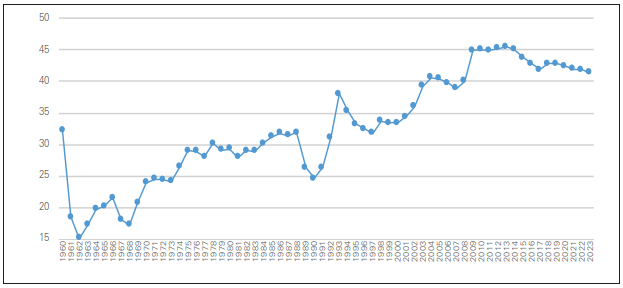
After the “Great Recession” of 2008-09, however, China stopped completely FOREX accumulation (figure 3), so RMB appreciated - from 40% in 2007 to over 60% in 2021 (figure 4). As a result, exports growth slowed down - China’s exports as a share of GDP peaked at 35% in 2005, but fell to about below 20% in 2016-23 (figure 5). Domestic consumption rose, savings, investments and growth inevitably declined (Popov, 2010b; Popov, 2013). The investment share of GDP peaked in 2013 at 45% before declining to 41% in 2023 (figure 6).


The US, the International Monetary Fund, the World Bank and the G7 accused China of ‘currency manipulation’ to gain ‘unfair’ advantage in international trade, causing ‘global imbalances’, including the huge US current account deficit with China (Popov, 2010b, 2013). Whether the decision of China to stop the accumulation of FOREX and to allow yuan to appreciate was made under the pressure of the US (or whether there was a deal reached with the US on that issue) is not exactly known. However, the consequences of this policy change were obvious - China’s positive current account, virtually a mirror image of the US current account deficit, declined from 10% of GDP in 2007 to zero in 2018, whereas US current account in the same period improved (figure 7).

Since 2015, however, the real appreciation of the Chinese yuan stopped and there was even some devaluation in 2017-23 (figure 4), and the Chinese current account balance improved in 2018-23 (figure 7). The deterioration of the China - US relations, trade disputes, sanctions and imposition of higher tariffs on Chinese imports by the Biden and Trump administrations seems to be stimulating China to resort to the previous policy of low exchange rate. This time it is also assisted by the increased export of private capital from China - since 2014 China is more often than not a net exporter rather than an importer of capital (figure 8).

CAN CHINA RETURN TO EXPORT-ORIENTED GROWTH MODEL BASED ON FOREX ACCUMULATION?
Accumulation of reserves means that the country saves more than it invests, produces more than it consumes, providing its savings to finance investment and consumption in other countries. This may sound like a drag on development; it is often argued that capital should flow from rich to poor countries because capital-labor (K/L) ratios are lower in developing countries and hence the returns on capital are greater. However, there may be crowding out of domestic savings by the foreign savings, so the national debt grows, but investment does not increase and economic development does not accelerate.
Besides, this is only one effect, the other effect is a dynamic one and it works in a completely opposite direction: if a country manages somehow to become competitive in the world markets (either via higher productivity or through lower wages or via low exchange rate), it starts to export more than it imports and develops a trade surplus. If this surplus is stored in the form of foreign exchange reserves, the exchange rate gets undervalued and the trade surplus persists. That is why countries that develop faster than the others usually have a trade surplus (United States since the Civil War of 1861-65 and until the 1970s, Japan and Germany after the Second World War, East Asian Tigers and Dragons and China, of course, more recently). Accumulation of reserves (that are invested in reliable short-term government securities and yield very low interest rates) implies losses to the national economy, but every policy has costs - this is a price to pay for promoting growth.
In fact, countries that managed to achieve high growth rates were mostly net creditors, not net borrowers; their current accounts were positive, i.e., they were saving more than they were investing (figure 9). Even controlling for the level of development, PPP GDP per capita in the middle of the period, 1975, the relationship between the current account surplus and growth rates in 1960-2000 is still positive and significant2 (Popov, 2010a).

This is known as the Feldstein-Horioka puzzle - high correlation between domestic savings and investment even among countries with relatively open capital accounts, contrary to the prediction of the theory that capital should flow to countries with better investment climate and rates of return on investment. With high domestic savings rate comes high investment rate, which usually, although not always, leads to faster growth.
In the words of Paul Krugman, writing during the Great Recession of 2008-09, since the early 1980s, there have been three big waves of capital inflows to developing countries, but none of them resulted in a growth miracle.
“The first wave was to Latin American countries that liberalized trade and opened their markets in the wake of the 80s debt crisis. This wave ended in grief, with the Mexican crisis of 1995 and the delayed Argentine crisis of 2002.
The second wave was to Southeast Asian economies in the mid-90s, when the Asian economic miracle was all the rage. This wave ended in grief, with the crisis of 1997-8.
The third wave was to eastern European economies in the middle years of this decade. This wave is ending in grief as we speak.
There have been some spectacular development success stories since 1980. But I’m not aware of any that were mainly driven by external finance. The point is not necessarily that international capital movement is a bad thing, which is a hotly debated topic. Instead, the point is that there’s no striking evidence that capital flows have been a major source of economic success3”.
In view of this evidence, the developing countries’ thrust and determination to rely on external financing are ironic. It is also ironic that while development economists are preoccupied by “capital flowing uphill” problem (from developing to developed countries), the best growth record is exhibited exactly by countries with positive current accounts and large reserve accumulation that are generating this uphill movement of capital.
Marshal plan for Western Europe right after the Second World War may have been the first and the last success story of foreign financing contributing substantially to economic revival. But even in this case it could be argued that without appropriate domestic (European) institutions and mobilization of domestic savings, the (relatively) rapid growth would not happen. Foreign financing of Japan after the Second World War was insignificant, on the contrary, Japan maintained current account surplus and accumulated foreign exchange reserves (thus financing other countries), but the Japanese postwar growth was more impressive than Europe. Economic miracles happened only in countries that relied on mobilization of domestic savings, not in countries that were seeking to bridge the financing gap through borrowing abroad, as development economists suggested.
Finally, there is one more argument against the policy of reserve accumulation and undervaluation of the exchange rate for developing countries: there are fears that “exchange rate protectionism” can result in “beggar-thy-neighbor policies”. Obviously, all countries cannot exercise these policies at the same time to achieve undervaluation of their exchange rates. Even if only poor countries would pursue this policy, developed countries would finally accumulate unsustainable levels of debts and the inevitable subsequent adjustment may be painful.
True, trade surpluses resulting from undervaluation of the exchange rate due to reserve accumulation may lead to what is now called “global imbalances”, driving the other countries into debt, but there is some room for such a scenario. In a sense this will only reverse the opposite trend of the 19th-20th centuries (US enjoyed a trade surplus for nearly 100 years after the Civil War of the 1860s driving many developing countries into debt - see Popov, 2010a, b; 2011 for details).
Today the debt of the rich countries is not that high. France, Greece, Portugal, Spain the UK and the US are net international debtors (US - over 100% of GDP), but Canada, Germany, Japan, the Netherlands, Norway, South Korea, Switzerland are net creditors.
So reserve accumulation can work as a powerful industrial policy development tool (theoretically, every externality could be taken care of through taxes, but in practice selective policies rarely work). Besides, until 2025 Trump tariffs protectionism was de facto outlawed by WTO, so exchange rate protectionism was the only available tool for promoting catch up development, in a way - the instrument of last resort. Reserve accumulation in poor countries will not continue forever, it will come to an end, once they will catch up with the West. Meanwhile, developed countries get a chance to consume more than they produce. Why not go into debt to help the global South catch up with the West sooner?
Acceptance by the West of global imbalances (current account deficits leading to debt accumulation) would help to overcome the major disproportion of our times - income gap between developed and developing countries. This gap was widening for 500 years and only recently, after the Second World War, there are some signs that this gap is starting to close (Popov, 2015). Chances to eliminate this gap sooner rather than later would be better, if the West would go into debt allowing developing countries to have trade surpluses that would help them develop faster. Previously, in 16th-20th century, it was the West that was developing faster, accumulating surpluses in trade with “the rest” and using these surpluses to buy assets in developing countries, while “the rest” were going into debt. Now it is time for “the rest” to accumulate assets and for the West - to go into debt.
CONCLUDING REMARKS
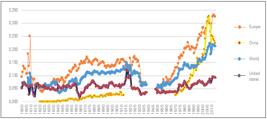
Growth of productivity, labor productivity, as well as total factor productivity, is associated with the expansion of the international trade, which over the years, as available data suggest, was growing faster than GDP (figure 10). In fact, trade in general and international trade in particular has been one of the sources of productivity growth due to specialization and division of labor. Had it not been for the outstripping growth of the international trade, the productivity increases and economic growth would be slower.
Exporting to world markets, especially to developed countries, enables the upgrading of quality and technology standards and yields social returns in excess of returns to particular exporters. The greatest increases in productivity are registered at companies that export to advanced (Western) markets and that export hi-tech goods (Harris, Li, 2007; Shevtsova, 2012). It has been also shown that the gap between the actual level of development and the hypothetical level that corresponds to the degree of sophistication of a country’s exports is strongly correlated with productivity growth rates (Hausmann et al., 2005). To put it differently, it pays off to promote exports of sophisticated and high tech goods. Not all the countries that try to promote such exports succeed, but those that do not try, virtually never engineer growth miracles.4
There is no doubt that the growth of all countries would suffer in case of decoupling; if international trade declines, it is even possible that the world would enter in a recession similar to the “Great Depression” of the 1930s (figure 10). China as the largest economy in the world is better prepared for the isolation and decoupling, it will suffer less than others from the collapse of the international trade, but of course even for China there would be costsly. It means that high growth rates in case of decoupling could be maintained only at a higher price, in particular only with an even higher share of investment in GDP.
As Yu (2003) argues, “even if the geopolitical situation deteriorates further, China cannot disengage fully from global supply chains - at least not without paying a heavy price. But the same is true of the West, which may be tempted by the idea of forcing China out. Just as Chinese industry would suffer massively from the economy’s isolation, so would Western businesses”.
Hence the best dual circulation strategy for China is the one that does not lead to the reduction of international trade and decoupling from the world markets. The only reasonable raison d’etre for the isolation and self-sufficiency policy could be the national security considerations, not economic ones. The reversal of globalization and the growth of international trade is currently imposed on China by Trump’s protectionist policies anyway, but there it is obviously in the best interests of China to resist such developments.
Data Availability Statement
The research data is available in a repository.
REFERENCES
- Bhalla, S. (2012). Devaluing to Prosperity. Misaligned Currencies and Their Growth Consequences. Washington, D.C.: Peterson Institute for International Economics, 2012.
- Dollar, D. (1992). Outward-oriented developing economies really do grow more rapidly: evidence from 95 LDCs, 1976-1985. In: Economic Development and Cultural Change, Vol. 40, No. 3, April, Chicago: University of Chicago Press, April 1992, pp. 523-44.
- Easterly, W. (2001). The Lost Decades: Explaining Developing Countries Stagnation 1980-1998; Washington, D.C.: The World Bank, February 2001.
- Greenwald, B., Stiglitz, J. E. (2013). Learning and Industrial Policy: Implications for Africa. In: Stiglitz, J., Lin, J., Patel, E. (Eds). The Industrial Policy Revolution II. Africa in the XXI century. International Economic Association Series. London: Palgrave MacMillan, 2013.
-
Griffith-Jones, S., Ocampo, J. A. (2008). Sovereign Wealth Funds: A Developing Country Perspective. Paper prepared for the workshop on Sovereign Wealth Funds organized by the Andean Development Corporation. London, February 18 2008. Available at: http://www.stephanygj.net/papers/SovereignWealthFundsDevelopingCountryPerspective2010.pdf
» http://www.stephanygj.net/papers/SovereignWealthFundsDevelopingCountryPerspective2010.pdf -
Harris, R. and Li, Q. C. (2007). Learning-by-Exporting? Firm-Level Evidence for UK Manufacturing and Services Sectors. Glasgow: Business School - Economics, University of Glasgow, 2007. Available at: http://www.gla.ac.uk/media/media_36279_en.pdf
» http://www.gla.ac.uk/media/media_36279_en.pdf -
Hausmann, R., Hwang, J., Rodrik, D. (2005). What You Export Matters, In: NBER WORKING PAPER SERIES, NBER Working Paper No. 11905. Cambridge, MA: National Bureau of Economic Research, December 2005. Available at: http://www.nber.org/papers/w11905.pdf
» http://www.nber.org/papers/w11905.pdf -
Lin, Justin Yifu (2017). Industrial policies for avoiding the middle-income trap: a new structural economics perspective. Journal of Chinese Economic and Business Studies, 15: 1, 5-18, DOI: 10.1080/14765284.2017.1287539
» https://doi.org/10.1080/14765284.2017.1287539 - Lin, Justin Yifu, Guanghua Wan, Peter J. Morgan (2016). Prospects for a re-acceleration of economic growth in the PRC. Journal of Comparative Economics, vol. 44 (4), pages 842-853.
-
Lin, Justin Yifu & Xiaobing Wang (2022) Dual Circulation: a New Structural Economics view of development. Journal of Chinese Economic and Business Studies, 20: 4, 303-322, DOI: 10.1080/14765284.2021.1929793
» https://doi.org/10.1080/14765284.2021.1929793 - Maddison Project Database, version 2020. Bolt, Jutta and Jan Luiten van Zanden (2020), “Maddison style estimates of the evolution of the world economy. A new 2020 update”.
- Polterovich, V. and V. Popov (2004). Accumulation of Foreign Exchange Reserves and Long Term Economic Growth. In S. Tabata and A. Iwashita (eds). Slavic Eurasia’s Integration into the World Economy. Hokkaido University, Sapporo. Updated version, 2006.
- Popov, V. (2010a). Development Theories and Development Experience. CEFIR and NES working paper #153. Moscow: Centre for Economic and Financial Research at New Economic School, December 2010.
- Popov, V. (2010b). Global Imbalances: An Unconventional View. CEFIR and NES working paper #160. May 2010.
- Popov, V. (2011). Стратегии экономического развития <Strategies of Economic Development>. Moscow: The Higher School of Economics Publishing House, 2011.
-
Popov, V. (2013). Currency Wars: Why Russia and China Are Rapidly Accumulating Foreign Exchange Reserves. PONARS Policy Memo 256. June 2013. http://pages.nes.ru/vpopov/documents/PONARS-June_2013-accumulation%20of%20FOREX,%20Russia,%20China.pdf
» http://pages.nes.ru/vpopov/documents/PONARS-June_2013-accumulation%20of%20FOREX,%20Russia,%20China.pdf - Popov, V. (2015). Catching Up: Developing Countries in Pursuit of Growth. MPRA Paper No. 65878, August 2015.
- Popov, V. (2019). Slowdown of growth in China: Circumstances or choice. If the past experience of economic miracles is any guide, the slowdown of growth in China should either take place in a couple of decades rather than now, or it should not happen at all. DOC-RI website, January 28 2019.
- Popov, V. (2020). Successes and failures of industrial policy: Lessons from transition (post-communist) economies of Europe and Asia. Oxford Handbook on Industrial Policy. Ed. by Arkebe Oqubai, Christopher Cramer, Ha-Joon Chang, Richard Kozu-Wright. OUP, 2020, p. 779-810.
- Popov, V., K. S. Jomo, (2017). Are Developing Countries Catching Up?. In: Cambridge Journal of Economics, Volume 42, Issue 1, 10 January 2018, Oxford: Oxford University Press, pp. 33-46, 2017.
-
Popov, V., K.S. Jomo (2020). Exchange Rate Undervaluation and Growth in China. Development 63, 120-125 (2020). https://doi.org/10.1057/s41301-020-00248-y
» https://doi.org/10.1057/s41301-020-00248-y -
Rodrik, D. (2008). Real Exchange Rate and Economic Growth. Undervaluation is good for growth, but why? - Brookings Papers on Economic Activity, Fall 2008. https://drodrik.scholar.harvard.edu/files/dani-rodrik/files/real-exchange-rate-and-growth.pdf
» https://drodrik.scholar.harvard.edu/files/dani-rodrik/files/real-exchange-rate-and-growth.pdf - Shevtsova, Y. (2012). International Trade and Productivity: Does Destination Matter?. In: Discussion Papers in Economics 12/18. Heslington: University of York, 2012.
- UN DESA (2016). World Economic Situation and Prospects 2016. WESP Report. New York: United Nations Department of Economic and Social Affairs, United Nations, 2016.
-
Verma, Raj (2023). India’s Economic Decoupling from China: A Critical Analysis. Asia policy, volume 18, number 1 (January 2023), 143-66. http://asiapolicy.org
» http://asiapolicy.org - Yu Yongding (2023). China’s Response to Decoupling. Project Syndicate, June 28 2023.
-
Zhang, Weiying (2017) China’s future growth depends on innovation entrepreneurs, Journal of Chinese Economic and Business Studies, 15: 1, 19-40, DOI: 10.1080/14765284.2017.1287540
» https://doi.org/10.1080/14765284.2017.1287540
-
1
“Economic decoupling from China is infeasible in the near to medium term because the Chinese economy is deeply intertwined with the Indian economy. It will be expensive, and in some cases impossible, to replace China as a supplier in economic value chains. Moreover, reducing imports from China or restricting Chinese investment does not greatly hurt or punish China because its exports to and investments in India are a very small proportion of its global exports and investments. On the contrary, restricting investments from China into India will damage India much more than it will China. Chinese investments in India can play an important role in enhancing economic growth in the post-pandemic period by creating employment, strengthening the manufacturing sector, improving infrastructure, and increasing exports under Indian government’s Atmanirbhar Bharat Abhiyan (“self-reliant India campaign”) - (Verma, 2023).
-
2
N=91, R2=0.23, robust standard errors, T-statistics in brackets below, where GROWTH - annual average growth rates of per capita GDP in 1960-99, %, Ycap - logarithm of per capita PPP GDP in 1975, CA - average current account to GDP ratio in 1960-99, %.
-
3
Krugman, Paul (2009). Finance mythbusting, third world edition. Nov 10, 2009. - Paul Krugman’s blog: http://krugman.blogs.nytimes.com/2009/11/09/finance-mythbusting-third-world-edition/.
-
4
One exception could be Botswana that had one of the highest rates of per capita GDP growth during a good half of a century (5% during 1960-2010), which was primarily driven by exports of primary commodities (namely, diamonds) and not of high-tech goods. The other exception may be Oman: out of 20 economies with average growth rates of GDP per capita in 1950-2010 of 3% and more a year, Oman was the only oil rich state (nearly 5% growth a year) - (Popov, Jomo, 2017). True, many other oil and gas exporters in the Persian Gulf and elsewhere quickly became rich in recent decades, but this was due not to higher growth rates of output (these were moderate), but to the improvement in the terms of trade - their income from resource exports grew much faster than their output and exports.
-
JEL Classification:
O11; O24; O47; O53.

 Source: World Development Indicators.
 Source:
  Source: World Development Indicators.
 Source: World Development Indicators.
 Source: World Development Indicators.
 Source: World Development Indicators.
 Source: World Development Indicators.
 Source: World Development Indicators.
 Source: World Development Indicators.
 Source: Federico, Giovanni; Tena Junguito, Antonio, 2018, “Openness_1800_2014_Ftwthd_201710_V01.Xlsx”, Federico-Tena World Trade Historical Database.