
 Comminution of amethyst quartz waste for coarse and fine aggregatess
Abstract
In the northern region of Brazil, enormous amethyst quartz waste is generated in mining, currently with no final destination, being stored without commercial value. However, it can be used to produce artificial aggregates, aiming to provide a solution to the storage problem of this material. To reduce the waste, crushing and grinding were used, investigating the factors influencing comminution, such as mineralogical properties and size settings, filling, speed and grinding time. Fragmentation was carried out on a laboratory-scale using a jaw crusher and ball mill. The factors in crushing depend on the gap and set, constants, while in grinding, with constant critical speed, the filling factor, the balls:sample ratio and grinding times were considered variables. The fineness modulus for fine aggregates was used. Based on the particle size distribution of crushing and grinding products, the production of coarse particles in crushing is the highest (75%), being considered as coarse aggregates, while the production of fine particles in grinding is lower (25%) and is considered as fine aggregates. The banded quartzite influences the comminution, more favorable to produce a coarse aggregate. The distribution of particle size shows that within the coarse aggregates, 40% corresponds to G1 gravel. Crushing is determined by the size settings and grinding by the grinding time. For longer grinding times, there is a greater reduction in grain sizes, and for shorter times, the reduction is smaller. The waste could be fed into comminution to produce coarse and fine aggregates for civil construction, achieving a long-term sustainable supply of aggregates in the required quantities.
Keywords:
crushing; grinding; sterile; tailings; aggregates
1. Introduction
The consumption of aggregates in civil construction has increased considerably in the world, being considered a critical aspect of any country’s development, especially in fast-developing countries like Brazil, where in 2020, the consumption of sand and gravel was 353Mt and 252Mt respectively, totaled 605Mt (Sindipedras 2020). The extraction of fine (sand) and coarse (gravel) aggregates generates significant environmental impacts, and the quarries and sand deposits are becoming exhausted near the big cities, whereby the price of aggregates is increasing. Infrastructural development requires a constant concrete supply, whose primary component aggregates are procured from a natural source (Singh et al. 2022).
Aggregates for civil construction are obtained from a variety of rock materials, consolidated or granular, fragmented naturally or through an industrial process. They can come from sedimentary rocks, such as sandstones and siltstones, among others; metamorphic ones, such as quartz- ites, limestones and gneisses; igneous materials, such as granite, syenites, basalts and diabases (Almeida & Luz 2009; Kirthika et al. 2020). Granites, gneisses, diorites and basalts are rocks are commonly used as aggregates in Brazil (Martins et al 2023), but alternatives, such as natural gravel is being used as recycled coarse aggregate and promote the use of recycled fine aggregate (Behera et al. 2019; Pavlu et al. 2019). Mine tailings can also be used as aggregates. These tailings having characteristics that are harmful to the environment due to disposal and storage, generally have a low commercial value, as they are not the main object of the mining project. This material is an inconvenience to the main activity, as large areas must be made available for temporary or permanent storage. Waste products need to be controlled to maintain the environment and prevent contact with workers, thereby preventing accidents and the spread of diseases (Carvalho et al. 2022). Fine aggregates used in the production of concrete and mortars are basically natural sand from riverbeds, and there is a tendency to use artificial aggregates from rock crushing. However, aggregates produced by crushing rocks, such as limestone, granite and basalt, lose in quality to natural aggregates, due to their angular and flaky shapes (Raut & Ugale 2016) which usually produce poor workability (Bajad & Sakhare 2018; Kirthika et al. 2020; Cao et al. 2022).
Brazil is one of the largest producers and exporters of minerals in the world, having 95% of the world reserves of sand and gravel. The largest explorations occur in the states of Pará and Minas Gerais, thus producing high waste as sterile and tailings. This last material has emerged as a viable alternative to natural aggregates, being abundant near the mines. In Pará, there are the deposits of Marabá (Alto Bonito) where amethyst gems are produced from the ore sorting of the quartzites, as well as, producing amethyst waste (sterile and tailings) of large size, normally deposited in open-air yards without economic use. Crushing and grinding processes are necessary to produce coarse and fine aggregates with the granulometry required by the Brazilian standards NBR 7211:2019, which establishes the characteristics required in the reception and production of aggregates, fine and coarse, of natural origin, found fragmented or resulting from rock crushing. Quartzite is a granoblastic metamorphic rock mainly consisting of quartz, and formed by recrystallization of sandstone or flint by contact or regional metamorphism, which can provide high quality aggregates (Smith & Collis 2001; Almeida & Luz 2009; Carvalho et al. 2022). However, few studies involving the use of the quartzite as an aggregate in the civil construction are available in Brazil (Collares et al. 2012) because the quartzite is basically used as coating stone, and thus, should be extracted in plaques, obeying width and length standards. All the material extracted not obeying this standard is disposed as waste and used for ceramics (Collares et al. 2012; Cabello et al. 2013; Martins et al. 2023).
In the treatment of ores, comminution, such as crushing and grinding, is usually used to release the ore minerals, and subsequently, separate them by mineral concentration, obtaining a concentrate and tailings; or achieve the required grain size of the mineral raw materials. Only crushing and grinding can also be applied to the treatment of amethyst waste as aggregates, having a very important role in terms of the final quality of the aggregates. It is possible to achieve the optimization of aggregate production, and thus, achieve a long-term sustainable supply of aggregates in the required quantities (Hartmut 2012; Pacana et al. 2021). Crushing and screening is the first controlled size reduction stage in the process. This is the main process in aggregate production and a preparation process for further size reduction.
The comminution using crushing and grinding processing is the most energy- consuming technological process with energy costs between 5-7% for crushing and 80-90 % for grinding (Jeswiet & Szekeres 2016), being complex their processing. In the crushing, the particle size distribution, composition and physical properties of the feed, including size settings (OSS and CSS), speed, and the choke level, as well as the power draw and chamber pressure, are factors that influence this operation (Wills 2006; Asbjörnsson et al. 2022; Yamashita et al. 2022). In the grinding, hardness, density, brittleness, mud content, distribution characteristics, particle size, grinding fineness and other properties of the ore have an important effect on the production capacity of the mill. Dry or wet grinding, steel ball size or shape, feed particle size, grinding concentration, grinding time, filling factor, rotational rate and other operating conditions will also significantly influence this operation, which must be studied to understand the reduction of suitable sizes to be used in the civil construction industry.
Meanwhile, the extraction of amethyst in the Alto Bonito mine, Pará/Brazil, has been done mostly in a rudimentary way, extracting fragments of crystals for cutting or well-used as ornamental pieces with low recovery. This generates enormous banks of unquantified waste with no final destination, causing huge ecological and environment damage, causing landscape degradation, contamination by dust, and the silting of rivers. Quartz waste has emerged as a viable alternative to gravel and river sand as artificial aggregates in civil construction, aiming to provide a solution to the storage and environmental problem of this material with no commercial value in the northern region of Brazil. Laboratory tests of crushing and grinding were done to analyze the viability of reducing the size of coarse material to a finer one to be used as raw material in industrialized mortars and concrete components.
2. Materials and methods
2.1 Material
The material collected in the Alto Bonito mine, 200kg, consists of centimet- ric blocks (Figure 1) of white colored rocks with light pinkish to lilac tones, medium or fine-grained, and rarely coarse of centimeter crystals of amethyst quartz. The rocks correspond to metamorphic silicic acid rocks, classified as quartzite, with polycrystalline granoblastic and banded textures of fine to medium granulation consisting mainly of quartz (98%) and sericite (2%) (Figures 2a, 2b). These pretrographic studies were confirmed by X-ray diffraction (XRD). The material has a hardness of 7 on the Mohs scale. The chemical composition of the waste was determined by X-ray fluorescence (XRF) and shows greater amounts of SiO2:90% and minor amounts of Al2O3, Fe2O3 and K2O (Gorayeb et al. 2023) confirming the petrographic tests.


a) Polycrystalline granoblastic quartz, b) Banded quartz and sericite alternated. Crossed-polarized light of amethyst quartz waste.
2.2 Methods
2.2.1 Crushing
The crushing operation was carried out in a jaw crusher on laboratory-scale with 10 cm x 18 cm gap opening and 24 cm depth of crushing chamber. The maximum size of the crushed waste is 18 cm at the gap of the crusher, being the range of the set size between 8 to 20 mm, which determines the grain size to be used in grinding. Before comminution, the blocks’ material was crushed down to small fragments using a sledgehammer until reaching the size of feed for the crusher, with a grain size of 10–16 cm compatible with the jaw crusher. The jaw crusher was used for the direct crushing of 200kg raw material in order to obtain the desired granulation close to coarse aggregate, as well as to process for initial grinding. The crushed waste was homogenized and divided in a Jones splitter.
In this first stage of comminution, the crushed material was sieved according to norm NBR 7211:2019 obtaining sizes with nominal size aggregates: Gravel 0 (4.8-12.5mm), Gravel 1 (12.5-25mm), Gravel 2 (25-50mm), Gravel 3 (50-76) and Gravel 4 (76-100mm) (ABNT NBR 7225:2009). To separate the granulometric fractions, a vibrating ROTAP screening equipment was used.
2.2.2 Grinding
The grinding operation was carried out on a laboratory-scale, using a cylindrical ball mill Matoli with specifications set for the grinding conditions shown in Table 1. The operational speed is 65 rpm corresponding to 87% of its critical speed.
Measurement of the charge height (F) within a mill is a convenient method to estimate the charge volume (Gupta & Yan, 2016). As a general rule, the Charge height (%) was used (Equation 1).
where Hc (cm) is the height of top of the balls under the mills liners, and R (cm) is the mill’s ratio. This equation is profitable for determining the whole mill load volume, which includes stone and metallic balls.
With these specifications, the parameters for the grinding tests were determined, where Hc is 21, 20 and 19, and F is 28, 31 and 38. The grinding tests were performed at various grinding times (3, 5, 10, 15 and 20 min). These times were chosen because grinding was carried out for 30 minutes on the same material with the balls:sample ratio (1:0.1) (Gorayeb et al. 2023) resulting in very fine material, thus, defining the balls: sample relationship as 1:0.25; 1:0.5 and 1:1.
In this second stage of comminution, the ground material was sieved according to norm NBR 7211:2019, obtaining sizes with nominal fine aggregates having fractions of 19.1 mm, 12.7 mm, 9.52 mm, 6.35 mm, 4.76 mm, 2.38 mm, 1.19 mm and 0.6 mm.
2.2.3 Fineness modulus
For aggregates used in concretes, another common gradation description for fine aggregate is the fineness modulus (FM). This is not an indicator of the particle size, since an infinite number of particles have the same value for the fineness modulus. FM is an index to determine the granulometric characteristics of the aggregates and is defined as the number that is obtained when dividing per 100 the sum of the retained portions accumulated in sieves of the standard series, being described in NBR 7211:2019. A typical fineness modulus for fine aggregate used in concretes is between 2.70 and 3.00.
3. Results
3.1 Crushing
The results of the particle size fractions of the amethyst residue obtained during crushing are shown in Figure 3a, as well as their percentage classification according to the type of coarse aggregate (Figure 3b) following the norm NBR 7211:2019 and NBR 7225:2009, being Gravel 0 (4.8-12.5mm), Gravel 1 (12.5-25mm), Gravel 2 (25-50mm), Gravel 3 (50-76) and Gravel 4 (76-100mm).
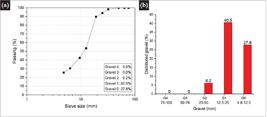
In Figure 3a, the d80 passing corresponds to 18mm, and indicates that the aggregate is finer than G1 (12.5-25mm). Thus, only 20% passes as G2, G3. G4 and G5. This data in G1 is limited by the maximum opening set (20mm) of the jaw crusher opening. The aggregate fractions are distributed between groups of gravel G2 (6.2%) G1 (40.5%) and G0 27.8% being 25.5% passing for fine aggregate production (Figure 3b).
3.2 Grinding
Obtaining fine aggregates through grinding showed varied results, as shown in Figures 4, 5 and 6. The balls:sample ratio was evaluated as a function of grinding time and vice versa time as a function of the balls:sample ratio.

Granulometric distribution curves for the balls:sample ratio with grinding time. a) 1:0.25; b) 1:0.5, c) 1:1.

Granulometric distribution curves to grinding time with balls:sample ratio. a) 20 min; b) 15 min; c) 10 min; d) 5 min; e) 3 min.

Behavior of the grinding time with production of fine aggregates (2mm sand) in function of the balls:sample ratio.
Analysis of the balls:sample ratio (1:0.25; 1:0.5 and 1:1) with grinding time (20, 15, 10, 5, 3 min) (Figure 4) shows granulometric distribution curves significantly differentiated from each other, showing the influence that the grinding time has.
For the 1:0.25 ratio and 20 minutes of grinding, the curve shows a d80 with a smaller grain size of 13 mm, but as the grinding time decreases, these sizes have to increase to 15 mm, with smaller grain size reduction (Figure 4a). The curves tend to be parallel to the edge of the sieve size, indicating that they are constant in the production of material at a constant time.
For the 1:0.5 ratio, the d80 of the granulometric curve distribution has a grain size of less than 13mm, being similar in all curves (Figure 4b). At times greater than grinding (20, 15 and 10 min), the curves tend to be parallel to the axis of sieve size, indicating to be constant in the production of material at a constant time, but at smaller grinding times (5 and 3 min); the trend is a minor reduction in size fed to the mill.
For the 1:1 ratio, the d80 of the granulometric curves distribution shows grain sizes less than 13 mm, similar in all curves (Figure 4c). The difference of the granulometric curves of this 1:1 relationship with the other proportions, is that the curves are not parallel to the sieve size axis, as well as decreasing the grain size.
Analysis of grinding time (20, 15, 10, 5, 3 min) with the balls:sample ratio (1:0.25; 1:0.5 and 1:1) (Figure 5) shows granulometric distribution curves slightly differentiated from each other, showing that the curves are similar at longer grinding times, but decrease at shorter grinding times following the balls:sample ratio.
In all granulometric curves (Figures 5a, 5b, 5c, 5d and 5e), the d80 are a closely smaller grain size of 13 mm, but after this grain size, there is a gradual decrease between the curves for different grinding times. When considered the d50, this is not observed in longer grinding times (20, 15 and 10min) except for 1:1 ratio. However, d50 shows homogeneous grain sizes at shorter grinding times (5 and 3 min).
Based on the data from the particle size distribution curves, the behavior of the grinding time for the production of fine aggregates (2mm sand) in function of the balls:sample ratio was plotted (Figure 6). Comparing the passing (%) with the sieve size which corresponds to the sand fraction (fine aggregate: 2 mm), there is produced approximately 70%, 62%, 55%, 52% and 45% of fine aggregate, decreasing with grinding time, but with slight differences between balls:sample ratio, i.e. similar to the behavior of grinding with 1:0.25 ratio. The finer the aggregate, the shorter the grinding time. Thus, at all grinding times, a gradual reduction of the material occurs. This clearly shows that grinding time is a factor that determines the granulometry of the material.
3.3 Fineness modulus for fine aggregates
The results obtained from the fineness modulus are shown in Figure 7, with the curves of the fineness modules being plotted according of NBR 7211:2019 showing a zone between the lower limit 2.3 and upper limit 3.0 for the production of fine aggregate, which corresponds to different groups of sand indicated as selected grading.

Fineness modulus curves for different processing times grinding and balls:sample ratio with selected grading zone.
4. Discussion
4.1 Coarse aggregate
There are few parameters that can be modified in the jaw crusher, and few studies have been found to compare the data obtained. However, the following can be considered:
The sizes of crushed waste from the jaw crusher are limited and determined by the set (8mm to 20mm), 80% of which corresponds to a maximum of 18mm, and only 20% are sizes between 18mm and 50mm. Of the 100% of sample waste, 75% can be used as gravel, distributed between G2, G1 and G0 with a higher proportion for G1 (40% between 12.5mm to 25mm). The mechanism involved in mineral breakage during comminution in jaw crushed are a combination of impact fracture and cleavage of particle under compression (Wills 2006), pressing particle of bed textures (Abouzeid et al. 2020) or foliated quartzite (Martins et al. 2023) to break coarse particles similar to banded textures, but the granoblastic textures, of fine to medium grain are present in the coarse particles. The results of the coarse aggregates with 75%, such as G2, G1 and G0m showed high uniformity of the jaw crusher, when producing banded textures.
The size of the fraction fed to the jaw crusher with 18cm at the gap did not have a significant effect on the average crushing, with the texture and form being more important (Omary et al. 2016). Thus sizes larger than the set (20mm) passed this aperture due to the metamorphic class of granoblastic and banded rock. The cause of the difference between the gravel aggregates resulted from this texture shape and form. Banded textures in amethyst waste indicate high shearing stresses in their formation, which induce a reduction in grain sizes in aligned elongate rock fragments, but the anisotropic weaknesses reduce the abrasion resistance of concretes (Smith & Collis 2001) similar to aggregates produced from quartzites in the state of Minas Gerais, Brazil (Martins et al. 2023).
It is important to pay attention to the minerals that occur in the waste (Pacana et al. 2021), with major quartz and hardness 7 on the Mosh scale because this influences the crushed fractions. Quartzite with high silica and microcrystalline quartz, when occurring in a particle with different crystal sizes and average hardness, affect the microstructure and collision behavior during particle crushing, as well as, the mechanical properties of abrasion resistance, shear stiffness, etc. Quartz in granite, diabase (Wang et al. 2021) and diorite (Gaesenngwe et al. 2021) make them have similar performance in mechanical behavior, which also shows a high level of hardness, a fact that can occur with amethyst quartz waste. Variations in silica decide the big difference in the general properties of a particle (Wang et al. 2021).
The data shows that the main advantage of this first stage of comminution is the large production of coarse aggregates, 75%. However, if the coarser fractions are returned to crushing, they can generate less coarse aggregate, increasing the amount of fraction for grinding. The problem related to crushing is the fact that it is a random process (Abouzeid et al. 2020) not only in occurrence from circumstance, but also in geometry, composition of the minerals, and the particle orientation at which the rocks are smashed.
4.2 Fine aggregate
Based on the grinding results of three different balls:sample ratios and five grinding times, varied and distinctive granulometric distribution curves were obtained, providing this unit operation, granulometric fractions with characteristics of fine aggregates, but with a grinding behavior depending on the grinding time. All these characteristics are summarized in Figure 6, when compared with the sand grain size (2mm, constant).
Figure 6 shows that at longer grinding times, for example 20 minutes, there is a significant granulometric reduction verified by the greater % of passing material accumulation. As for shorter grinding times, for example 3 minutes, the reduction decreases with fewer % passing material accumulated. This means that the longer the grinding time, the higher the energy expenditure and vice versa, the shorter the grinding time, the lower the energy expenditure. This is because the amount of energy required for breakage is inversely proportional to particle size, grain size and grain orientation of the host rock material (Wills 2006; Gaesenngwe et al. 2021).
Various authors (Fuerstenau & Somasundaran, 1963; Luz et al. 2018; Kohobhange et al. 2018) show that the granulometric distribution of the grinding products, with the variation of the grinding time, at long grinding times, regardless of the type of grinding load, greater production is generated of fine particles, due to the high surface energy. The production of fine aggregate, sand, is affected by the grinding time.
It is also observed that the balls:sample ratios are slightly different, but do not affect the decrease in reduction with the grinding time. With constant grinding times, it can be seen that the % of passing material accumulated is similar, with little variation, showing that under these grinding conditions the filling factor does not influence the size reduction. But when the grinding time decreases, the filling factor influences the size reduction, with a greater proportion of coarse fractions produced, Therefore, the effect of filling factor on amethyst waste is not obvious, suggesting that in the grinding process of this material, the impact mechanism of grinding media (Ma et al. 2022; Ma et al. 2023) has an important contribution to the formation of coarse particle sizes in the product.
When the grinding time is shorter, the % of passing material accumulated decreases for all fillings. In extreme cases, accumulated curves d70 < 10mm are observed in the gravel margin for 20 min and accumulated curves d40 < 2 mm for 3 min in the sand margin. As noted, grinding time is a significant factor affecting the particle size composition, and with the extent of grinding time, the curves of fine particle size basically decreases linearly (Ma et al. 2022).
Similarly with crushing, it is important to pay attention to the granoblastic and banded texture of quartzite, constituted mainly by quartz and chemical composition. The waste is homogeneous, which can give rise to a constant grindability of the quartz (Rosa & Luz, 2011), with a break in the limits of the grains with high surface energy (Beke, 1981). Feldspar (banded) is broken faster than quartz (crystalline), as well as, silica values are high in the material. Feldspar particles will be reduced more quickly than quartz, but the quartz will have more efficient breakage (Umucu & Deniz 2014). According to this approach, banded particles of amethyst waste with equigranular shape (Figure 2), are easier to grind.
As a consequence of this second stage of comminution, it can be observed that grinding produces fine aggregates with a high dependence on grinding time.
Following the fineness modulus (Figure 7), there can be discussed:
-
- A grinding time of 10 to 20 minutes with a 1:1 balls:sample ratio is necessary to produce fine aggregates.
-
- It takes 7 to 12 minutes of grinding with the balls:sample (1:0.5) ratio, to produce fine aggregates
-
- With the balls:sample (1:0.25) ratio, 5 to 15 minutes are the needed minutes of grinding to produce fine aggregates
As a consequence of the previous points, a reduction with longer grinding time, must consume more energy, but the amount of fine aggregate produced would be greater, since reduction with shorter grinding time has a lower consumption of energy, but the amount of fine aggregates produced is smaller. Therefore, it is necessary to evaluate the cost:benefit ratio from an economic point of view. Aggregate plays a vital role in concrete, representing more than two thirds of the concrete (ABNT NBR 7211) for example in a 1:2:3 or 1:2:4 traces to concrete, coarse aggregate occupies about 50 – 60 % (30 – 35% occupied by fine aggregates) (Kirthika et al. 2020), which means that the production of coarse aggregate from amethyst waste at 75% can result in a marketable end product, at the same time, considering that the cost between 5 – 7% for cheaper crushing (Jeswiet 6 Szekeres, 2016), suggests that it is more viable to fragment in this unit operation.
The aggregates production from comminuted amethyst waste was separated into size fractions to generate the finished product being the size distribution of the comminuted product is of great importance, principally for coarse aggregate. The particle size distribution of the comminuted product determined the yield of salable products that can be obtained by sizing alone without recrushing. The production of the various sizes should obviously match market demands as closely as possible in order to maximize the economic return to miners, although with a certain degree of flexibility in the process, especially using crusher equipment.
5. Conclusions
The waste (sterile and tailings) generated in amethyst mining could be fed into comminution operations for use as coarse and fine aggregates in civil construction, achieving a long-term sustainable supply of aggregates in the required quantities.
In the two stages of comminution on a laboratory scale, the crushing fragmented 75% of the coarse aggregate, gravel, whereby 25% is fragmented during grinding as fine aggregate, sand. The morphology of amethyst waste, as banded texture and polycrystalline granoblastic quartzite and mineralogical properties influence the particle size distribution, being in this condition more favorable to produce coarse aggregate.
In crushing, there are few parameters to be controlled in the equipment, and the fractions obtained are determined by the crusher’s gap and set. However, despite grinding, the parameters that affect the obtaining of fractions are the balls:sample ratio and the grinding time. The factor that determines smaller particle sizes, under laboratory conditions (critical speed and filling factor), is the grinding time. The longer the grinding times, the greater the energy expenditure, while the shorter the grinding times, the lower the energy expenditure, due to the high surface energy.
Therefore, it is confirmed that for longer grinding times, there is a greater reduction in grain sizes, and for shorter times, the reduction is smaller. Also, for equal grinding times, the filling factor has no influence on the grain size reduction, being independent of that factor.
As a consequence of the grinding, a reduction with a longer grinding time consumes more energy at a higher cost, but the volume of fine aggregate produced is greater, while a reduction with a shorter grinding time consumes less energy at a lower cost and with less volume of fine aggregates produced.
Acknowledgements
To Francisco do Socorro Botelho da Silva, business person and miners from COOPERGEMAS MARABA, for providing the very important amethyst waste for carrying out this study.
References
- ABOUZEID, A. M.; ABDALLA, G. Z.; SEIFELNASSR, A. Grindability of quartz under compressive and impact forces. Journal of Petroleum and Mining Engineering, v. 22, n. 2, 2020.
- ALMEIDA, S.; LUZ, A. Manual de agregados para construção civil. Rio de Janeiro: Centro de Tecnologia Mineral - CETEM; Ministério da Ciência e Tecnologia - MCT, 2009.
- ASBJÖRNSSON, G.; TAVARES, L.; MAINZA, A.; YAHYAEI, M. Different perspectives of dynamics in comminution processes. Minerals Engineering, v. 176, p. 107326, 2022.
- ASSOCIAÇÃO BRASILEIRA DE NORMAS TÉCNICAS. ABNT NBR 7211. Agregados para concreto - especificação. Rio de Janeiro, RJ: ABNT, 2019.
- ASSOCIAÇÃO BRASILEIRA DE NORMAS TÉCNICAS. ABNT NBR 7225. Materiais de pedra e agregados naturais. Rio de Janeiro, RJ: ABNT, 2009.
- BAJAD, M.; SAKHARE, S. Influence of artificial sand on the properties of concrete and mortar. International Journal of Civil Engineering and Technology, v.9, p. 447-454, 2018.
- BEHERA, M.; MINOCHA, A. K.; BHATTACHARYYA, S. K. Flow behavior, microstructure, strength and shrinkage properties of self-compacting concrete incorporating recycled fine aggregate. Construction and Building Materials, v. 228, p. 116819, 2019.
- BEKE, B. Grindability of materials. In: The process of fine grinding. Dordrecht: Springer. 1981. v.1. (Developments in mineral science and engineering Series).
- CABELLO, M.; PERES, A.; MARTINS, A.; PEREIRA, C. Use of quartzite quarries wastes in civil construction. Key Engineering Materials, v. 548, p.135-140, 2013.
- CAO, Y.; WANG, Y.; ZHANG, Z.; WANG, H. Recycled sand from sandstone waste: a new source of high-quality fine aggregate. Resources, Conservation & Recycling, v. 179, p. 106116, 2022.
- CARVALHO, F.; NOBRE, J.; CAMBRAIA, R.; SILVA, A.; FABRIS, J.; REIS, A.; BERNAT, V. Quartz mining waste for concrete production: environment and public health. Sustainability, v. 14, n. 1, p. 389, 2022.
- COLLARES, E.; FRANCKLIN J. R. I.; MOTTA, L. Evaluation of the aggregate produced from wastes of quartzite mining sites to use in concrete. Soils and Rocks, São Paulo, v.35, n. 3, p. 251-266, 2012.
- FUERSTENAU, D. W.; SOMASUNDARAN, P. Comminution kinetics. In: INTERNATIONAL MINERAL PROCESSING CONGRESS, 6, 1963, Cannes. Proceedings [...]. London, p. 25-34, 1963.
- GAESENNGWE, G.; MAMVURA, T.; DANHA, G.; SIBANDA, V. A comparative study on the comminution behavior of diorite rocks. Heliyon, v.7, 2021.
- GORAYEB, E. S. J.; FERNANDEZ, O. J. C. H.; GOMES., L. G.; COSTA, W. A. P.; GORAYEB, P. S. S Amethyst quartz tailings in cement mortars production. Matéria, v. 28, 2023.
- GUPTA, A.; YAN, D. S. Mineral processing design and operations: an introduction. 2. ed. Amsterdam: Elsevier, 2016.
- HARTMUT, B. W. Quality requirements of quartz sand in the building industry. In: GÖTZE, J.; MÖCKEL, R. Quartz: deposits, mineralogy and analytics. Berlin: Ed. Heidelberg; Springer-Verlag, p. 53-70, 2012. Cap. 3.
- JESWIET, J.; SZEKERES, A. Energy consumption in mining comminution. Procedia CIRP, v. 48, p.140-145, 2016.
- KIRTHIKA, S. K.; SINGH, S. K.; CHOURASIA, A. Alternative fine aggregates in production of sustainable concrete - a review. Journal of Cleaner Production, v. 268, 2020.
- KOHOBHANGE, S. P. K.; MANORATNE, C. H.; PITAWALA, H. M. T. G. A.; RAJAPAKSE, R. M. G. The effect of prolonged milling time on comminution of quartz. Powder Technology, v. 330, p. 2 66-274, 2018.
- LUZ, A. B; FRANÇA, S. C. A.; BRAGA, P. F. A. Tratamento de minérios. 6. ed. Rio de Janeiro: CETEM, 2018.
- MA, S.; LI, H.; YANG, X.; XU, W.; DENG, X.; YANG, J. Study on impact crushing characteristics of minerals based on drop weight tests. Minerals, v.13, p.632, 2023.
- MA, S; LI, H.; SHUAI, Z.; YANG, J.; DENG, X.; XU, W. Research on grinding law and grinding parameters optimization of polymetallic complex ores. Minerals, v.12, n. 10, p.1283, 2022.
- MARTINS, L.; PEIXOTO, R.; MENDES, J. Quartzite tailings in civil construction materials: a systematic review. Clean Technologies and Environmental Policy, v.25, n.5, 2023.
- OMARY, S.; GHORBEL, E.; WARDEH, G. Relationships between recycled concrete aggregates characteristics and recycled aggregates concretes properties. Construction and Building Materials, v. 108, p. 16-174, 2016.
- PACANA, A.; SIWIEC, D.; BEDNAROVA, L.; SOFRANKO, M.; VEGSOOVA, O.; CVOLIGA, M. Influence of natural aggregate crushing process on crushing strength index. Sustainability, v. 13, n. 15, p. 8353, 2021.
- PAVLŮ, T.; KOČÍ, V.; HAJEK, P. Environmental assessment of two use cycles of recycled aggregate concrete. Sustainability, v. 11, n. 21, p. 6185, 2019.
- RAUT, H. R.; UGALE, A. B. Effect of artificial sand on compressive strength and workability of concrete. International Journal of Engineering and Technical Research, v. 5, n. 3, p. 673-674, 2016.
- ROSA, G.; LUZ, J. Cominuição a seco de mesclas de quartzo e dolomita. REM - Revista Escola de Minas, Ouro Preto, v. 64, n. 1, p. 97-104, 2011.
- SHEN, W.; YANG, Z.; CAO, L.; CAO, L.; LIU, Y.; YANG, H.; LU, Z.; BAI, J. Characterization of manufactured sand: particle shape, surface texture and behavior in concrete. Construction and Building Materials, v. 114, p. 595-601, 2016.
-
SINDIPEDRAS. Agregados. Produção. Volume de agregados. São Paulo, Brasil. Available at: https://www.sindipedras.org.br/site/volume.php,2023.
» https://www.sindipedras.org.br/site/volume.php,2023. - SINGH, R.; NAYAK, D.; PANDEY, A.; KUMAR, R.; KUMAR. V. Effects of recycled fine aggregates on properties of concrete containing natural or recycled coarse aggregates: a comparative study. Journal of Building Engineering, v. 45, p. 103442, 2022.
- SMITH, M. R.; COLLIS, L. Aggregates: Sand, gravel and crushed rock aggregates for construction purposes. 3. ed. London, 2001. (Engineering Geology Special Publications, n.17).
- UMUCU, Y.; DENIZ, V. The evaluation of grinding behaviors of quartz and feldspar. The Online Journal of Science and Technology, v. 4, n. 1, 2014.
- WANG, C.; WANG, H.; OESER, M.; HASAN, M. Investigation on the morphological and mineralogical properties of coarse aggregates under VSI crushing operation. International Journal of Pavement Engineering, v. 22, n. 12, p. 1611-1624, 2021.
- WILLS, B. Mineral Processing Technology. 7. ed. Austrália: Elsevier, 2006.
- YAMASHITA, A.; THIVIERGE, A.; EUZÉBIO, T. A review of modeling and control strategies for cone crushers in the mineral processing and quarrying industries. Minerals Engineering, v. 170, n. 15, 2021.


