 Topological optimization of three-dimensional composite structures - via evolutionary structural optimization
Abstract
One of the major challenges in Civil Engineering is the gradual search for more viable and efficient solutions to improve structural performance. In this case, Structural Engineering has been encouraged to create and develop materials and methods that allow for the production of more slender structures that are at the same time safe and economical. One of these solutions is structural optimization. This article addresses topological optimization in three-dimensional problems considering volume minimization based on a stress criterion. The method used is Evolutionary Structural Optimization (ESO) with the aid of the structural analysis software Salome-Meca®, via the Finite Element Method (FEM). For this, an algorithm in Python® programming language is implemented to be the input file of the free numerical analysis software Code-Aster® solver of Salome-Meca®. In the ESO process, underutilized elements of the structural system are removed, that is, elements whose stress have values lower than the maximum limit stress of the structure. This optimization is performed using a combination of two isotropic materials, with the aim of studying the influence of different constitutive models on the optimal topologies of the proposed problems, analyzing the topological structural behavior, as well as investigating how the mechanical and physical properties impact the final topology. Finally, based on the considerations and research in question, the optimization of composite structures is interesting because it obtains a more efficient structure that takes advantage of the positive complementary characteristics of two materials working together.
Keywords:
topology optimization; evolutionary structural optimization; finite element method; composite structures; Salome-Meca®.
1. Introduction
Engineers and researchers focused on technology, safety, and cost management recognize optimization as a promising path to addressing current construction challenges. The sector faces obstacles, such as a shortage of skilled labor, rising material and service costs, pressure for higher productivity and efficiency in projects, and the growing demand for more sustainable construction practices. Structural optimization seeks an efficient distribution of material within the design domain, based on criteria and constraints, ensuring structural performance even with modified or removed elements (Leite and Pereira Junior, 2019; Ferro and Pavanello, 2023).
The optimization of a problem uses a numerical formulation with design variables, objective function, and constraints. Design variables are adjustable data to solve the optimization problem (Rahman and Szabó, 2021). The objective function, which depends on these variables, must be minimized or maximized to find its optimal values (Rahman and Szabó, 2021). Constraints define the limits of the problem.
The nature of the system analysis is influenced by the objective function and constraints. If they are linear equations or inequalities of the design variables, we have linear mathematical programming; otherwise, it is nonlinear (Hernández and Pollman, 2021; Vagaská et al., 2022).
Structural optimization can be divided into three main approaches: size, shape, and topology (TO). In size optimization, the dimensions of the structural part are adjusted, while in shape optimization, the boundary regions of the element are modified (Huang and Xie, 2010). TO differs from these approaches by allowing changes to the structural layout and expanding the design space, contributing to the conceptual design (Simonetti et al., 2010; Zhu et al., 2021). However, depending on the methodology employed, the initial configuration can influence the final result-as occurs in the ESO method, which starts from a completely solid domain and gradually removes the least efficient material (Huang and Xie, 2010). TO inserts voids into the fixed domain of the structure, modifying its topology with each iteration until the optimal solution is reached. In general, this process involves the redistribution or removal of material, with the aim of minimizing or maximizing one or more objective functions, while respecting the design constraints (Tyflopoulos and Steinert, 2022). Figure 1 shows an example of TO.

TO is a computational procedure that seeks the optimal design of a structure subjected to loads and boundary conditions. The method works by dividing the structure into finite elements and then removing or redistributing underutilized material to generate a configuration with better performance. (Amaral et al., 2023). There are different approaches to TO in continuous structures: microapproaches, based on material properties, such as the SIMP (Solid Isotropic Material with Penalization) method, and macroapproaches, focused on geometry and cavity insertion, exemplified by the TSA (Topological Sensitivity Analysis) and ESO (Evolutionary Structural Optimization) methods (Eschenauer and Olhoff, 2001).
This study focuses on the ESO method, a unidirectional heuristic that gradually removes the least efficient material from the structure. Unlike bidirectional techniques such as BESO (Bi-directional Evolutionary Structural Optimization), ESO does not reintroduce material after its removal (Huang and Xie, 2010). Despite its simpler formulation, it remains relevant due to its ease of implementation, low computational cost, and suitability for academic studies. Furthermore, it allows for a clear understanding of the physical behavior of the optimization process, useful in validation and research.
For the application of the method, the Finite Element Method (FEM) is essential, as it evaluates the material efficiency at each iteration, solving partial differential equations and simplifying complex structures (Azhir et al., 2024). The simulations were performed using Salome-Meca®, an open-source, free-to-use integrated environment that combines preand post-processing tools with the Code-Aster® solver. Code-Aster®, also open-source, performs the finite element analyses, while Python® scripts control the process, defining parameters, boundary conditions, and material removal criteria. This integration provides a robust, flexible, and completely free platform, eliminating the need for proprietary licenses and facilitating implementation in academic settings.
In summary, this article proposes the study of the optimization process of structures composed of two distinct isotropic materials, working together, using the ESO method and a linear analysis implemented in Python®. The objective of this study is to understand the behavior of the structure during the optimization process and evaluate how the combination of materials with different properties can improve structural efficiency and reduce the volume of material used, while maintaining rigidity and stability. Furthermore, we seek to analyze the behavior of stresses throughout the process iterations and demonstrate the potential of the ESO method as a simple and accessible alternative for the design of optimized structures, using free tools such as Code-Aster® from Salome-Meca®. Despite the recent improvement in literature on topology optimization, few studies explore the use of more than one material, which reinforces the relevance of this study and its potential to reduce costs and expand design possibilities in structural engineering.
2. Materials and methods
2.1 Evolutionary structural optimization
The ESO method basically consists of changing the topology of the structure by gradually removing finite elements from the generated mesh, based on a specific rejection criterion, taking into account the locations that do not effectively contribute to the structural set. This method, proposed by Xie and Steven (1993), is considered a “hard-kill” method, since the removal of material is performed abruptly and effectively at each iteration. The element is removed in such a way that the inefficient elements of the structures have their matrices abruptly reduced (Simonetti et al., 2014).
The advantages of ESO include its simplicity of implementation, low computational cost, and ease of integration with classical finite element codes. Because it is a heuristic method, it does not require the calculation of objective function gradients, which simplifies implementation and speeds up execution. However, like most topology optimization techniques, ESO tends to converge to local optima, depending on the initial configuration of the structure and the design domain. Despite these limitations, the method remains relevant for academic studies, algorithm validation, and conceptual exploration of topologies.
The first rejection criterion for ESO was by Von Mises equivalent stresses (VMS), which is characterized by the gradual reduction of a structure by rejecting a ratio of low stress elements, deleted iteratively until an equilibrium state is reached; that is, until an optimal topological structure is defined (Kaufmann and Vallée, 2022). Therefore, at each iteration, areas with stress below the pre-established limit are penalized until an optimal remaining volume is obtained (Lanes and Greco, 2013).
Mathematically, we have the Von Mises criterion:
By replacing the shear stresses by the principal stresses, σ1, σ2eσ3, and considering the uniaxial tensile test with σ1 = G, σ2 = σ3 = 0, the final mathematical formulation of the Von Mises criterion is obtained as:
It is considered σ1 = G = σevm, that is, that the flow G occurs for a given VMS in the element ‘e’ (σevm), and in terms of the components of the general state of stresses in the system of axes x, y, z, the VMS is written by:
The plane state of stress:
Therefore, the maximum Von Mises stress is:
Once the maximum Von Mises stress of the structure has been defined, the stresses of each element are evaluated, using the inequality:
Where FRR is the rejection radius factor. Elements whose stresses satisfy this inequality; that is, the least stressed elements are removed from the structure in each iteration. The process repeats until the inequality is no longer satisfied in new elements. Once the equilibrium condition is reached, but the optimal configuration is not found, and since there is a change in the stress field in the remaining elements, it is necessary to redefine the evolutionary process, adding an evolutionary removal factor, the FER, to FRR:
This procedure is executed at each iteration until a pre-established stopping criterion is reached or as chosen by the designer, thus obtaining the optimal final topology of the system. The mathematical formulation of the ESO removal process is described by:
Where De represents the stiffness matrix of element j, and D(j) is the stiffness matrix associated with point j belonging to the domain of the structure Ω, given by Ω = Γ + ; Γ is the set of elements that remain in the structure, defined as
and correspond to the finite elements removed from the structural mesh, being
The ESO process can be summarized in a few steps, which are:
Once the initial domain of the structure has been defined, it is discretized into a finite element mesh, from which the applied forces and boundary conditions are inserted.
Calculation of the principal stresses and, subsequently, the Von Mises stress corresponding to each element. Calculation of the maximum VMS.
Removal of elements that satisfy inequality (7);
Repeat processes 2 to 3 until equilibrium or/and until there are no more elements to be removed;
Add the FER, according to Equation (8), and start a new removal of elements from the mesh, repeating steps 2 to 4.
ESO is characterized by a binary removal heuristic (0 or 1) and the evolution occurs within the extended fixed domain. The values are updated based on the stress distributions at each iteration.
2.2 Materials
To optimize, it is necessary to understand the physical and mechanical properties of the materials, which are defined according to the type of project. The choice of the structural system directly affects the costs and architecture of the project. This article deals with steel, aluminum and titanium.
Steel is widely used in civil construction, both in steel structures and in reinforced and prestressed concrete. The correct design of the steel structure can be done by observing ABNT NBR 8800:2024. Because it has excellent mechanical properties, with high strength to compression, traction and bending, and allows chemical and thermal processes, among other qualities, it is considered the most efficient material to be used in construction.
Aluminum stands out for its characteristics, such as lightness, corrosion resistance, good thermal and electrical properties, adaptability and wide variability of its alloy (Khanna et al., 2021; Capasso et al., 2024). However, because it has low tensile strength when pure, it is necessary to add alloying elements to improve its mechanical properties (Al-Furjan et al., 2021; Zhang and Peng, 2023). To optimize the models proposed in this study, ASTM 6061-T6 aluminum was selected.
Titanium is a metal that has high mechanical strength, high compatibility, excellent corrosion resistance, low specific mass and modulus of elasticity, good heat resistance, among other characteristics that allow the use of this material in structural components subjected to high temperatures and as a construction material (Santos et al., 2006; Severino et al., 2012). Titanium elements, due to their very low coefficient of linear thermal expansion, have been used in the restoration of buildings and monuments, as in the case of the Parthenon in Athens and the Colonna Antonina in Rome (Mazzolani and Mandara, 2002). According to Mazzolani and Mandara (2002), this is due to the greater efficiency of titanium compared to steel, since the latter suffers more cracks due to corrosion and excessive thermal expansion.
Researchers in the field of engineering and materials are looking for lighter yet resistant elements, motivated by issues of economy and energy efficiency. Table 1 the mechanical and physical properties of titanium, steel and aluminum can be observed.
Mechanical and physical properties of titanium, aluminum and steel. Adapted from Yang et al. (2022); Devarajan et al. (2023); ABNT NBR 8800:2024.
2.3 Optimization of composite structures: methodology and process
The main objective of this research is to optimize structures composed of two distinct isotropic materials. The analyses performed are linear and the optimization is single-objective, focused on volume reduction using the Von Mises stress criterion. The volume is reduced to a pre-established minimum, taking into account the number of iterations. A total interaction analysis is considered, without relative sliding and with a perfect connection, eliminating any interference from shear.
To develop the ESO process, an algorithm (script) based on the Python® programming language was used. Salome-Meca served as an integrated preand post-processing environment, being used for geometric modeling, mesh generation, and visualization of results, while Code-Aster® acted as the finite element solver. The Python® script defined the material data, mathematical expressions, and boundary conditions, and was interpreted by Code-Aster®, which performed the numerical analyses. This integration allowed for the necessary modifications to find the optimal structure for the proposed problems.
Discretization was performed using linear tetrahedral elements (TETRA4), primarily due to compatibility with the Python script developed for Salome-Meca/Code_Aster, which was specifically structured for this type of mesh. First-order elements were used because adopting quadratic elements would require significant modifications to the script, exceeding the scope of this study. A coarser mesh was adopted for computational reasons, reducing the cost of the ESO method iterations.
It is worth noting that hexahedral elements tend to have higher computational costs and greater complexity in automatic mesh generation when compared to tetrahedral elements. Even so, future research will include tests with more refined meshes and higher-order elements. Fernandes et al. (2017) present an overview of FEM and describe the types of elements also employed in this study.
The program execution begins with the definition of the model. Subsequently, after determining the geometry of the structure, the input characteristics are entered and the mesh is computed. Then, the boundary conditions and applied forces are entered, and the optimization parameters are established. Once the mesh is analyzed, the iterative ESO optimization process begins, using the Von Mises criterion. The material removal per iteration depends directly on the calibration parameters defined before the start of the structural analysis. Thus, whenever the inequality that compares the Von Mises stress of the elements with the maximum allowed limit is satisfied, the corresponding elements will be permanently removed in each iterative process.
In this study, the stopping criterion of the optimization algorithm was defined by the user based on the desired number of iterations. Tests were carried out to adjust this number, seeking to ensure that the final structure maintained between 40% and 55% of the initial volume of material. The objective was to balance the computational cost and avoid numerical instabilities, while ensuring the stability of the structure.
The optimization parameters for all examples were adopted empirically, using values below 5% for the FRR and below 1% for FER. It is observed that low removal coefficients imply a high computational cost, while high removal factors can make the evolutionary process unfeasible, resulting in numerical instabilities in both scenarios.
3. Results and discussion: Numerical examples
Two numerical examples are presented below where the structures were modeled in the Salome-Meca® software version 2019/2020 and analyzed in 3D. The proposed problems aimed to find the optimal structural configuration within this range of 40% to 55% of the initial volume.
3.1 Example 1
The structure is a beam composed of two isotropic materials, where the outer part (shell) is of one material and the inner part (core) of another, with the outer part having a thickness of 25 mm. The characteristics of this beam are illustrated in Figure 2, and it has four supports, one at each end. The mesh used for the problem is shown in Figure 2. The data required for the optimization process are presented in Table 1. In addition, the following parameters were considered: Rejection Radius Factor (FRR = 4.1%), Evolutionary Rejection Factor (FER = 1%) and Number of Iterations (8).

Example 1. (a) Initial domain of the structure for the optimization (b) Mesh generated by Salome-Meca® of the internal and external part of the structure.
3.1.1 Internal part in steel and external part in titanium
It begins with the optimization for a structure whose internal material is steel and the external material is titanium. The mesh generated in Code-Aster® has 9163 TETRA4 elements (Figure 2), with 4712 elements corresponding to titanium and 4451 to steel. The properties of the materials in question are considered here.
During the optimization steps, the least efficient material was removed from the structure. The final optimized topology and corresponding stress field are shown in Figure 3.

It can be seen that the elements with the highest stresses are those closest to the applied load and the supports. From this, the topology is formed in such a way that these elements remain present. Table 2 and Figure 4 correlate the volume of remaining elements of the model and the maximum stress per number of iterations.
Volume and maximum stress values per iteration for the structure composed of steel and titanium.

Volume and maximum Von Mises per iteration for example 1 for the steel and titanium structure.
The maximum stress increases after the first removal and remains little changed during the following iterative steps. This situation infers that the remaining elements support well the load initially imposed on the model. The volume decreases linearly with the iteration process due to the progressive removal of material from the structure.
3.1.2 Internal part in steel and external part in aluminum
In this case, the internal part of the structure is made of steel and the external part of aluminum. The mesh generated in Code-Aster® has 9163 TETRA4 elements (Figure 2), with 4712 elements corresponding to aluminum and 4451 to steel. The properties of steel and aluminum are considered.
The characteristics of the evolutionary process for this composition are the same as the previous one. In addition, the optimal topology has the same aspects (Figure 5). It can be seen in the stress field (Figure 5) that the highest stress values are also located at the locations where the boundary conditions and the applied force are. Table 3 and Figure 6 correlate the remaining volume in the structure and the maximum stress values with the iteration steps.
Volume and maximum stress values per iteration for the structure composed of steel and aluminum.


Volume and maximum Von Mises per iteration for example 1 for the steel and aluminum structure.

The topology is created, as can be seen, based on the shortest distance between the supports and the applied force. In this case, there is also a redistribution of stress and a minor change in the maximum stress during the iterative process.
3.1.3 Internal part in Aluminum and external part in Titanium
For this optimization process, there is a structure whose internal material is aluminum and the external material is titanium. The mesh generated in Code-Aster® has 9163 TETRA4 elements (Figure 2), with 4712 elements corresponding to titanium and 4451 to aluminum.
Again, the characteristics of the evolutionary process for this composition follow the same as the previous one, as does the optimal topology (Figure 7). The stress field is given by Figure 7. Table 4 and Figure 8 show the correlation of the remaining volume in the structure and the maximum stress values with the iterative steps. The properties of the materials in question are considered.
Volume and maximum stress values per iteration for the structure composed of aluminum and titanium.

Volume and maximum Von Mises per iteration for example 1 for the aluminum and titanium structure.
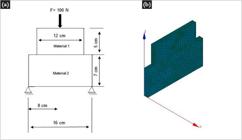
Example 2. (a) Initial domain for the optimization process. (b) Finite element mesh generated by Salome-Meca®.
The obtained topologies present visually similar geometries because the portion of the structure that remains after optimization removals corresponds to the shortest and most efficient paths between the load application points and the supports. This occurs because boundary and loading conditions predominate over material variation, determining the overall shape of the topology, while local stresses vary according to the mechanical properties. All materials used in this research are ductile, and the element removal criterion in the ESO method acts only by penalizing the modulus of elasticity (E) in the global stiffness matrix, without significantly altering the overall behavior of the structure. Furthermore, the same strength criterion (Von Mises) was applied to all materials. Future research with materials whose stress-strain behavior is significantly different will likely lead to distinct topological responses.
Each structure was evaluated based on the remaining volume after the last iteration and the resulting stress behavior. Because material densities remain constant and the current model does not differentiate between the volumes of each material, the total volume was used as an estimate of the final mass. The remaining volumes were similar (≈43.26% of the initial volume, approximately 1.25 × 10² m3), with only the stress levels varying depending on the material. Structural efficiency was analyzed considering volumetric reduction and stress distribution. The titanium and steel and titanium and aluminum configurations showed better overall performance, with lower stresses associated with equivalent volumes. It should be noted that individual material mass determination is not yet performed automatically by the code, but is planned for future implementations.
3.2 Example 2
This problem aims to study the characteristics of the structural optimization composed of two isotropic materials for the two-plate structure, as illustrated in Figure 9. The data required for the optimization process are presented in Table 1. Furthermore, the Number of Iterations was considered to be 7. Figure 9b shows the mesh used for the problem.
3.2.1 Steel and titanium structure
Initially, the optimization is performed for the structure composed of two steel and titanium plates, where material 1 corresponds to steel and material 2 to titanium. The mesh generated in Code-Aster® is composed of 7283 TETRA4 elements (Figure 9b), with 3996 titanium elements and 3287 steel elements. All material properties were considered in this process.
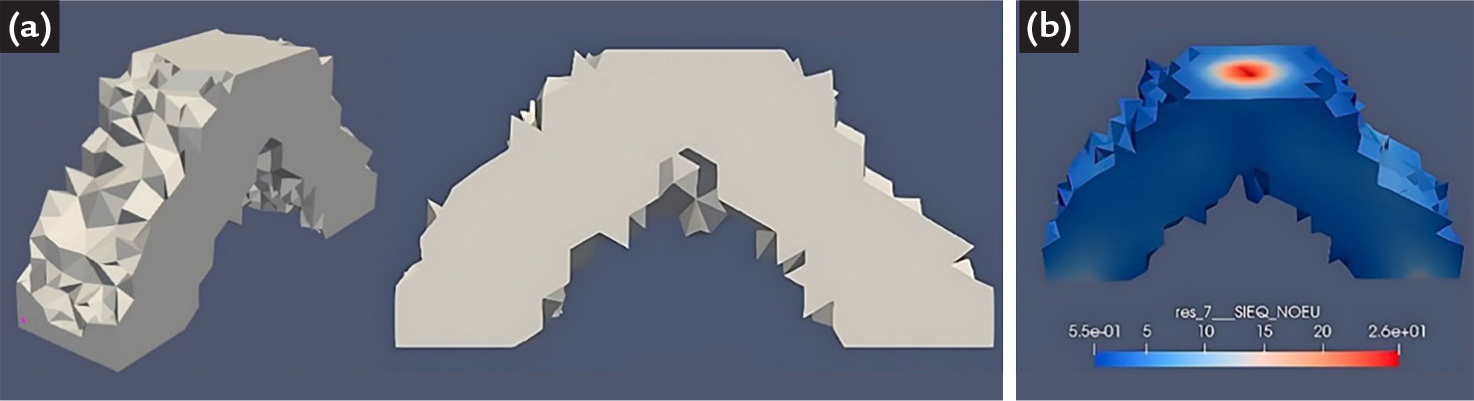
The optimization parameters defined were a FRR of 3.8% and a FER of 1%. The removal process occurred at each iteration, eliminating the elements of little relevance to the structure. The resulting optimal topology is shown in Figure 10, and the stress field of this topologically optimized structure can be seen in Figure 10.

The final topology is formed by the elements located at the shortest distance between the boundary conditions and the load applied to the structure. It can be seen that the central region where the plates meet, just below the point of application of the force, concentrates the highest stresses, and is therefore an integral part of the final optimal topology. Table 5 and Figure 11 correlate the remaining volume in the structure and the maximum stress values with the iteration steps.

Volume and maximum Von Mises per iteration for example 2 for the steel and titanium structure.

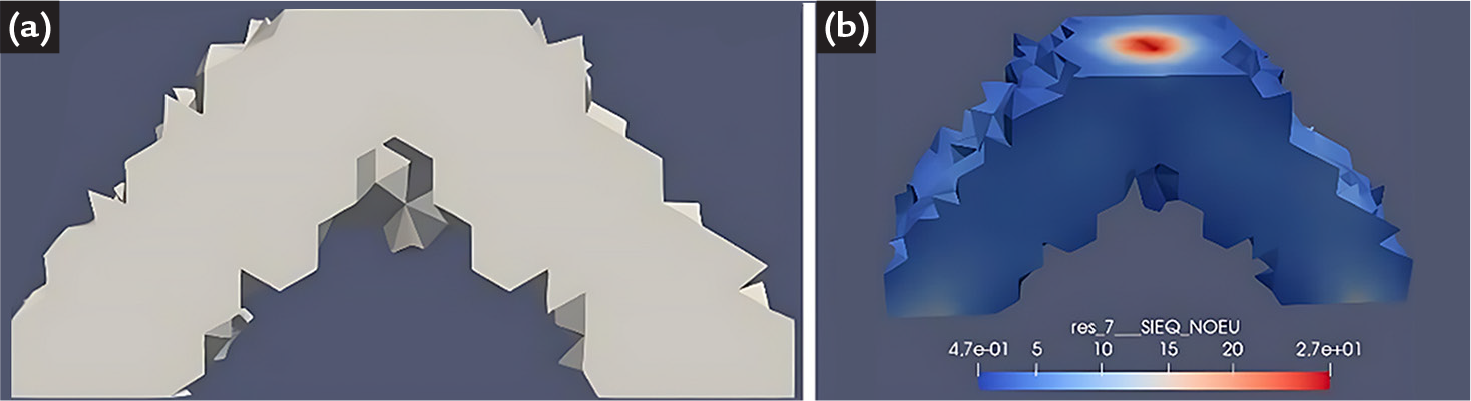
Aluminum and titanium structure in example 2. (a) Final optimal topology (b) Stress field.
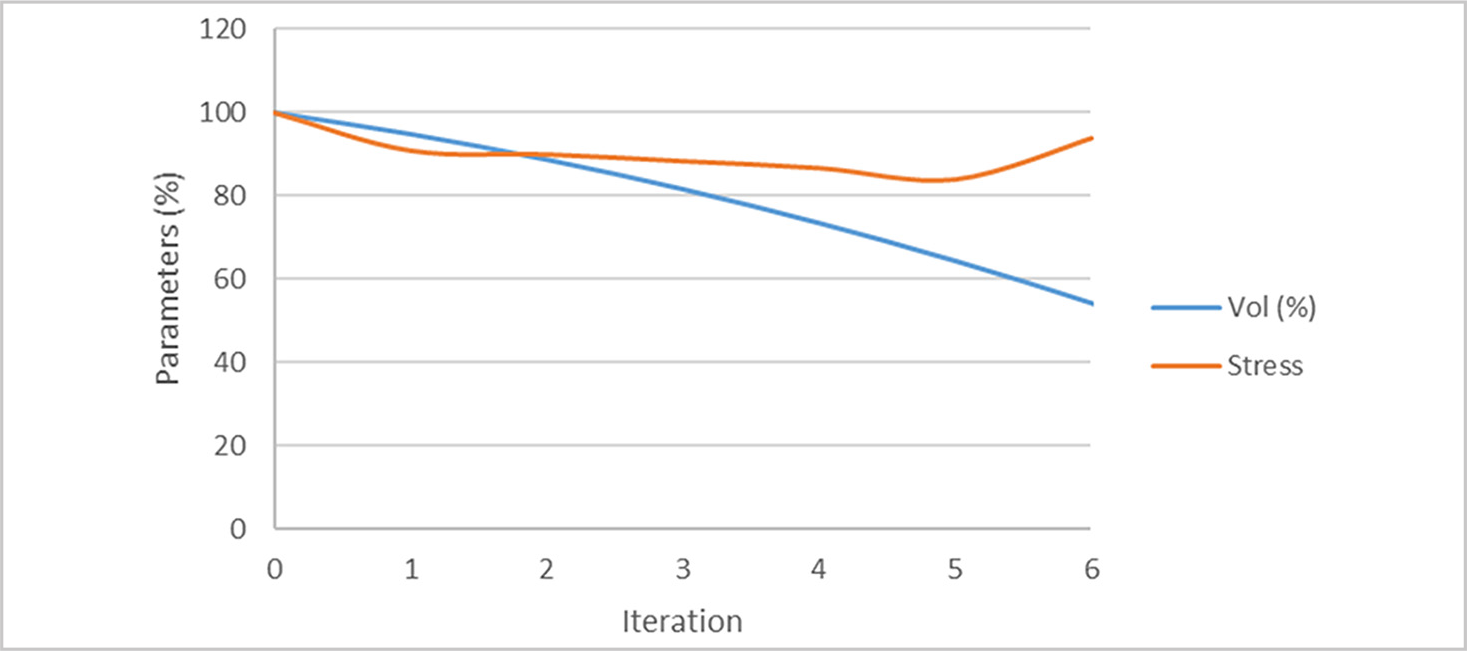
The volume of material decreases linearly and gradually throughout the iteration steps. The stress increases in the first iteration process and remains with little change until the last iteration step, when it has a significant jump. When there is this stability of the stress, it means that the material not removed from the structure supports all the forces imposed on the initial model.
In addition to this increase in stress in the last iteration, which is common because it significantly reduces the material present in the structure, attention must be paid to the stability of the model.
3.2.2 Aluminum and titanium structure
In this situation, material 1 corresponds to aluminum and material 2 to titanium. The mesh generated in Code-Aster® has 7283 TETRA4 elements (Figure 9b), with 3996 elements corresponding to titanium and 3287 to aluminum. The properties of the materials in question are considered here. The rejection radius factor (FRR) is 4.1% and the evolutionary rejection factor (FER) is 1%.
The optimal topology found for this structural composition is demonstrated in Figure 12. The stress field of the optimized structure is seen in Figure 12. Figure 13 represents the data from Table 6 that associates the remaining volume and maximum stress with each iterative step.
Volume and maximum stress per iteration of the two-plate structure in aluminum and titanium.

Volume and maximum Von Mises per iteration for example 2 for the aluminum and titanium structure.
It can be seen by comparing Figure 10 and Figure 12 that the optimal topologies have similar characteristics, regardless of the material used and even with different removal percentages. The stress in this solution starts higher, after the first iteration there is a drop and in the last iteration the stress increases considerably again. The stresses change based on the material used in the model.
Each structure was evaluated based on the remaining volume after the last iteration and stress behavior. Considering that material densities are constant, the remaining volume was adopted as a representative parameter for the final mass. In Example 2, the final volumes were similar, approximately 54% of the initial volume, equivalent to approximately 1.0 × 10 m3, with only the stress levels varying depending on the material combination. The titanium and steel configuration showed better structural stability, while aluminum and titanium showed greater stress variations.
4. Conclusion
From the results, it was possible to observe that the topology of the structure evolves at each iterative step, with the progressive removal of the areas furthest from the applied forces and boundary conditions. Consequently, the elements closest to the load and the supports, as well as those in the line of shortest distance between them, exhibit the highest stresses. The final optimal topology is therefore shaped so that these essential elements are preserved, a characteristic consistently confirmed in the solution of the proposed problems.
It was observed that the mechanical and physical properties of the materials influence the maximum stress values, but do not significantly alter the tendency of forming the optimal structural topology. As expected, stress redistribution occurred in both examples. In Example 1, the variation in maximum stress was minimal throughout the iterative process, while in Example 2, there was a more expressive increase in stress in the last iteration. The removal of material causes a redistribution of stress in the remaining elements, which continue to support the imposed load. This variation in stress values is influenced by the material used, its location in relation to the total applied load and the boundary conditions, as well as the percentage of elements removed per iteration.
The characteristics of the optimal topology remained independent of the composition of the two isotropic materials, except for small variations resulting from the change in material and instabilities that affected the first regions of element removal.
Finally, structural optimization is crucial because it allows maximum use of structural performance, by observing the characteristics of the initial model. Through optimization, it is possible to obtain a more efficient structure with a stable configuration, capable of performing its function even with a significant reduction in the volume of material. The benefit of this reduction is directly linked to the reduction in the weight of the structure, and consequently, to its cost reduction. Thus, and based on the considerations presented, the optimization of composite structures is particularly advantageous, since it exploits the complementary positive characteristics of two materials working together, such as strength and cost. Additionally, it is recognized that mesh refinement and increasing the number of iterations can contribute to more accurate results, even if they imply higher computational costs, and this improvement is expected for future studies.
Acknowledgements
The Federal University of Ouro Preto (UFOP) for all academic assistance. In addition, FAPEMIG for financial support and for encouraging our interest in research, so as to add knowledge and study bases in the area of Civil Engineering. CAPES and CNPq for promoting research in the country. CIDENG for developing research between the universities UFOP and UFJF. This work was supported by FAPEMIG - Fundação de Amparo à Pesquisa do Estado de Minas Gerais, through the master's scholarship [grant number: 5.43/2021], awarded to the first author.
-
Funding information
Fundação de Amparo à Pesquisa do Estado de Minas Gerais. Processo: 5.43/2021.
Data availability
The data that support the findings of this study are available from the corresponding author upon reasonable request.
References
- AL-FURJAN, M. S. H.; HAJMOHAMMAD, M. H.; SHEN, X.; RAJAK, D. K.; KOLAHCHI, R. Evaluation of tensile strength and elastic modulus of 7075-T6 aluminum alloy by adding SiC reinforcing particles using vortex casting method. Journal of Alloys and Compounds, v. 886, 161261, 2021.
- AMARAL, R. R.; ROSSI, R. C. U.; BARAZZUTTI, L. F.; ISOLDI, L. A.; GOMES H. M. Verification of a topology optimization algorithm with geometric nonlinearity. Scientia Plena Journal, v. 19, n. 11, p. 1-9, 2023.
- ASSOCIAÇÃO BRASILEIRA DE NORMAS TÉCNICAS - ABNT. NBR 8800:2024: projeto de estruturas de aço e de estruturas mistas de aço e concreto de edificações. Rio de Janeiro, 2024.
- AZHIR, P.; MARNANI, J. A.; PANJI, M.; ROHANIMANESH, M. S. A Coupled Finite-Boundary element method for efficient dynamic Structure-Soil-Structure interaction modeling. Mathematical and Computational Applications, v. 29, n. 2, p. 24, 2024.
- BENDSØE, M.; SIGMUND, O. Topology optimization: theory, methods and applications. New York, USA: Springer, 2003.
- CAPASSO, I.; ANDREACOLA, F. R.; BRANDO, G. Additive manufacturing of metal materials for construction engineering: an overview on technologies and applications. Metals, v. 14, n. 9, p. 1033, 2024.
- DEVARAJAN, K.; KARUPPANAN, V. V. S.; DURAISAMY, T.; BHAVIRISETTY, S. K.; LAXMAIAH, G.; CHAUHAN, P. K.; RAZAK, A.; ASIF, M.; LINUL, E. Experimental investigation and characterization of friction StirSpot-Welded dissimilar aluminum copper metallic lap joints. ACS Omega, v. 8, n. 39, p. 35706-35721, 2023.
- ESCHENAUER, H. A.; OLHOFF, N. Topology optimization of continuum structures: a review. Applied Mechanics Reviews, v. 54, n. 4, p. 331-390, 2001.
- FERNANDES, W. S.; GRECO, M.; ALMEIDA, V. S. Application of the smooth evolutionary structural optimization method combined with a multi-criteria decision procedure. Engineering Structures, v. 143, p. 40-51, 2017.
- FERRO, R. M.; PAVANELLO, R. A Simple and efficient structural topology optimization implementation using Open-Source software for all steps of the algorithm: modeling, sensitivity analysis and optimization. Computer Modeling in Engineering & Sciences, v. 136, n. 2, p. 1371-1397, 2023.
- HERNÁNDEZ, A.; POLLMAN, A. Bounding the solution space of complex systems in terms of Non-Numeric and/or uncontrollable scenario variables. Systems, v. 9, p. 89, 2021.
- HUANG, X.; XIE, Y. M. Evolutionary topology optimization of continuum structures: methods and applications. Chichester, UK: John Wiley & Sons, 2010.
- KAUFMANN, M.; VALLÉE, T. Topology optimization of adhesively bonded double lap joints. International Journal of Adhesion and Adhesives, v. 118, 103238, 2022.
- KHANNA, V.; KUMAR, V.; BANSAL, S. A. Mechanical properties of aluminium-graphene/carbon nanotubes (CNTs) metal matrix composites: advancement, opportunities and perspective. Materials Research Bulletin, v. 138, 111224, 2021.
- LANES, R. M.; GRECO, M. Application of a topological evolutionary optimization method developed through python script. Science & Engineering Journal, v. 22, n. 1, p. 1-11, 2013.
- LEITE, M. B.; PEREIRA JUNIOR, W. M. Utilização de técnicas de otimização no dimensionamento de vigas de concreto armado. Holos, Ano 35, v. 3, e6282, 2019.
- MAZZOLANI, F. M.; MANDARA, A. Modern trends in the use of special metals for the improvement of historical and monumental structures. Engineering Structures, v. 24, p. 843-856, 2002.
- RAHMAN, M. M.; SZABÓ, G. Multi-objective urban land use optimization using spatial data: a systematic review. Sustainable Cities and Society, v. 74, 103214, 2021.
- SANTOS, L. C. O.; MATLAKHOVA, L. A.; MATLAKHOV, A. N.; TOLEDO, R. Efeito da têmpera na estrutura das ligas Ti-Nb-2%Al. In: CBECIMat - CONGRESSO BRASILEIRO DE ENGENHARIA E CIÊNCIA DOS MATERIAIS, 17, 2006. Foz do Iguaçu. Anais […]. Foz do Iguaçu, Paraná, 2006.
- SEVERINO, B. P.; AGUIAR, C. L.; CASTAGNET, M.; COUTO, A. A.; REIS, D. A. P.; NETO, C.M. Estudo do comportamento mecânico em temperaturas elevadas da liga Ti-6Al-4V termicamente oxidada. In: CONGRESSO ABM - INTERNACIONAL, 67, 2012, Rio de Janeiro. Anais […]. Rio de Janeiro, 2012.
- SIMONETTI, H. L.; ALMEIDA, V. S.; NETO, L. O. A smooth evolutionary structural optimization procedure applied to plane stress problem. Engineering Structures, v. 75, p. 248-258, 2014.
- SIMONETTI, H. L.; NEVES, F. A.; ALMEIDA, V. S. Otimização topológica via uma suavização do ESO em problemas da elasticidade plana. Revista CIATEC - UPF, v. 2, n. 1, p. 28-44, 2010.
- TYFLOPOULOS, E.; STEINERT, M. A Comparative Study of the Application of Different Commercial Software for Topology Optimization. Applied Sciences, v. 12, n. 2, p. 611, 2022.
- VAGASKÁ, A.; GOMBÁR, M.; STRAKA, L’. Selected Mathematical Optimization Methods for Solving Problems of Engineering Practice. Energies, v. 15, p. 2205, 2022.
- XIE, Y.; STEVEN, G. A Simple Evolutionary Procedure For Structural Optimization. Computers & Structures, v. 49, n. 5, p. 885-896, 1993.
- YANG, H.; CHEN, X.; HUANG, G.; SONG, J.; SHE, J.; TAN, J.; ZHENG, K.; JIN, Y.; JIANG, B.; PAN, F. Microstructures and mechanical properties of titanium-reinforced magnesium matrix composites: Review and perspective. Journal of Magnesium and Alloys, v. 10, n. 9, p. 2311-2333, 2022.
- ZHANG, J.; PENG, J. A review on aluminum alloy conductors influenced by alloying elements and thermomechanical treatments: microstructure and properties. Journal of Materials Research, v. 38, p. 1488-1509, 2023.
- ZHU, J.; ZHOU, H.; WANG, C.; ZHOU, L.; YUAN, S.; ZHANG, W. A review of topology optimization for additive manufacturing: status and challenges. Chinese Journal of Aeronautics, v. 34, n. 1, p. 91-110, 2021.
Edited by
-
Associate Editor
Herlander Mata Fernandes Lima