| 1. The depth of sedation during anesthesia is monitored subjectively or objectively. |
• Baseline audit: 10 observations of anesthesiologists during the procedure with patients with risk factors for POD.
• Follow-up audit: 10 observations of anesthesiologists during the procedure with patients with risk factors for POD. |
• Direct observation by the anesthesiologist during the procedure in patients with risk factors for POD to verify whether the depth of sedation was monitored through subjective or objective measurement.
Subjective measure: “Yes” – application of the sedation scale; “No” – no record.
Objective measure: “Yes” – use of equipment to guide anesthesia (e.g.: Bispectral Index Monitoring – BIS); “No” − not used. |
| 2. Preoperative risk assessment for POD is performed. |
• Baseline audit: 10 nursing records of patients with risk factors for POD.
• Baseline audit: 10 nursing records of patients with risk factors for POD. |
• Review of nursing records to verify if there was a nursing diagnosis of “Risk for acute confusion”.
“Yes” – presence of the nursing diagnosis “Risk for acute confusion”; “No” – absence of the nursing diagnosis “Risk for acute confusion”. |
| 3. Screening for POD is performed as early as possible in the PACU. |
• Baseline audit: number of patients with positive screening for POD in 10 records in electronic nursing systems of patients at risk of POD.
• Follow-up audit: number of patients with positive screening for POD in 10 records in electronic nursing systems of patients at risk of POD. |
• Review of electronic nursing record systems for patients at risk for POD.
“Yes” – if there is a CAM-ICU score; “No” – if there is no CAM-ICU score. |
| 4. The tools Nursing Delirium Screening Scale (Nu-DESC) or Confusion Assessment Method (CAM-ICU) are used for screening. |
• Baseline audit: number of patients screened for POD using the CAM-ICU tool across 10 patient observations.
• Follow-up audit: number of patients screened for POD using the CAM-ICU tool across 10 patient observations. |
• Nursing documentation in the patient's medical record.
“Yes” – presence of CAM-ICU score recorded in the electronic nursing record system; “No” – absence of CAM-ICU score recorded in the electronic nursing record system. |
| 5. The screening tool is easily accessible in the PACU. |
• Baseline audit: presence of printed CAM-ICU tool available in the PACU on 10 occasions.
• Follow-up audit: presence of printed CAM-ICU tool available in the PACU on 10 occasions. |
• Presence of copies of the CAM-ICU tool in the PACU.
“Yes” – Copy of the CAM-ICU tool available in the PACU to assess patients with risk factors for POD; “No” – Copy of the CAM-ICU tool not available in the PACU to assess patients with risk factors for POD. |
| 6. Clinicians receive training in the use of Nu-DESC and/or CAM-ICU. |
• Baseline audit: 10 nurses.
• Follow-up audit: 10 nurses. |
• Interview with 10 nurses using a structured form to verify whether the professional received training for the use of CAM-ICU in the last year.
“Yes” – if the professional received training; “No” – if the professional did not receive training. |
| 7. Physicians receive training on DSM-5 and/or ICD-10 reference standards. |
• Baseline audit: 10 anesthesiologists.
• Follow-up audit: 10 anesthesiologists. |
• Interview with 10 anesthesiologists using a structured form.
“Yes” – if the professional received training on DSM-5 and/or ICD-10 in the past year. “No” – if the professional did not receive training on DSM-5 and/or ICD-10 in the past year. |
| 8. Multimodal postoperative pain control is administered. |
• Baseline audit: 10 post-operative medical prescriptions accompanied by the respective anesthetic prescription.
• Follow-up audit: 10 post-operative medical prescriptions accompanied by the respective anesthetic prescription. |
• Review of 10 postoperative medical prescriptions for patients at risk of POD who reported pain during their PACU stay.
“Yes” – if the patient received an opioid analgesic combined with a non-opioid; “No” – if the patient did not receive an opioid analgesic combined with a non-opioid. |
| 9. When necessary, low-dose haloperidol or low-dose atypical neuroleptics are given to treat POD. |
• Baseline audit: 10 postoperative medical prescriptions of patients with POD who received haloperidol or atypical neuroleptics in the PACU.
• Follow-up audit: 10 postoperative medical prescriptions of patients with POD who received haloperidol or atypical neuroleptics in the PACU. |
• Review of 10 postoperative medical prescriptions of patients with POD who received haloperidol or atypical neuroleptics in the PACU.
“Yes” – if the patient received haloperidol or low-dose atypical neuroleptics; “No” – if the patient did not receive haloperidol or low-dose atypical neuroleptics. |

 Prevención y manejo del delirio postoperatorio en pacientes adultos: proyecto de implementación de mejores prácticas
 Thumbnail
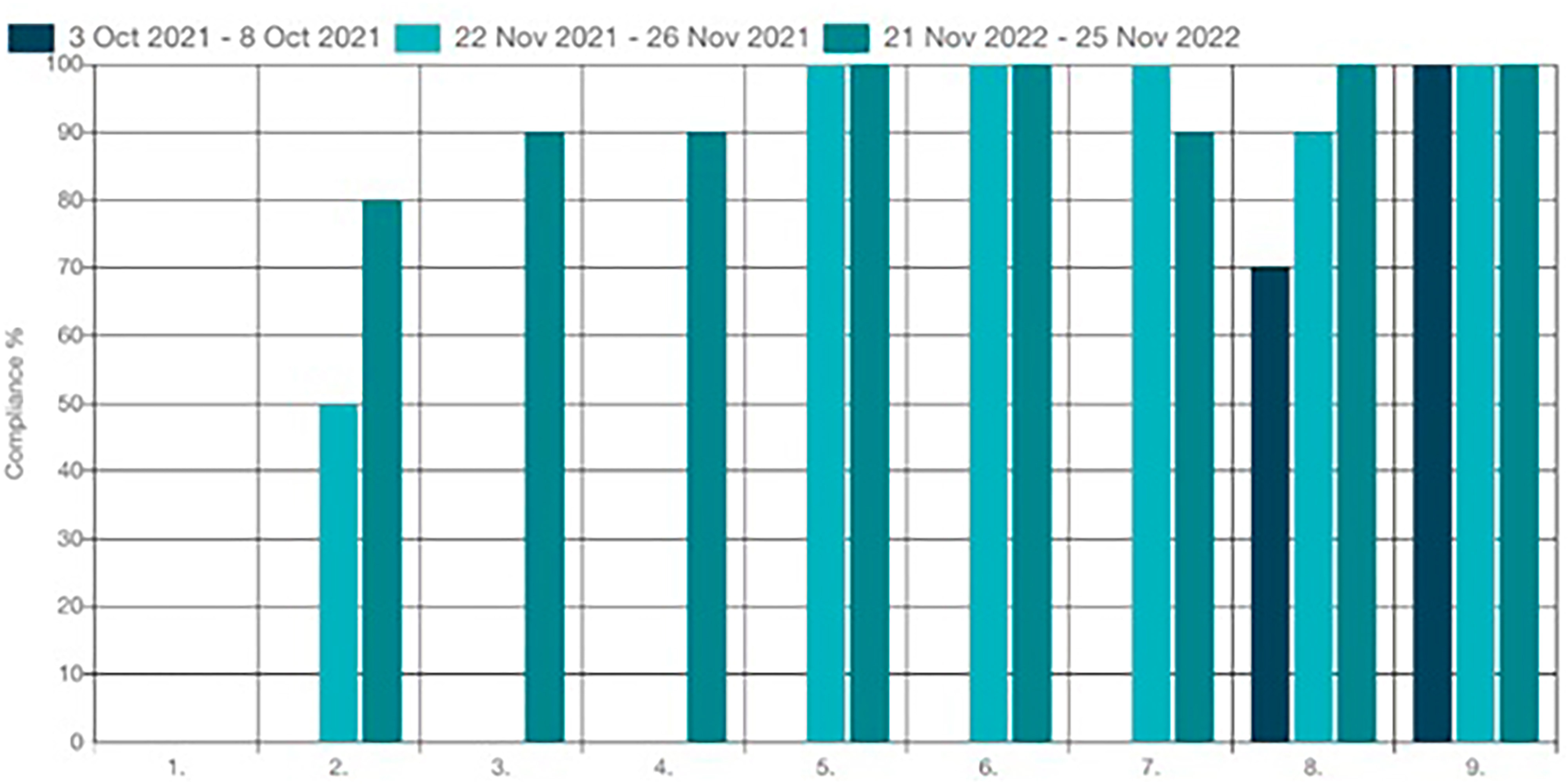 Audited criteria (legend):1- The depth of sedation during anesthesia is monitored subjectively or objectively.2- Preoperative risk assessment for POD is performed.3- Screening for POD is performed as early as possible in the PACU.4- The tools Nursing Delirium Screening Scale (Nu-DESC) or the Confusion Assessment Method (CAM-ICU) are used for screening.5- The screening tool is easily accessible in the PACU.6- Clinicians receive training in the use of Nu-DESC and/or CAM-ICU.7- Physicians receive training on DSM-5 and/or ICD-10 reference standards8- Multimodal postoperative pain control is administered.9- When necessary, low-dose haloperidol or low-dose atypical neuroleptics are administered to treat POD.