| Boter et al. (2004)(8) |
Netherlands |
Randomized Controlled Trial (RCT) |
Case: 263 Control: 273 |
Both |
64.5 |
Outreach nursing care program |
5 |
Experienced trained stroke nurses |
Short-Form Health Survey (SF-36) |
Nursing intervention can subsequently affect the quality of life among the patients. |
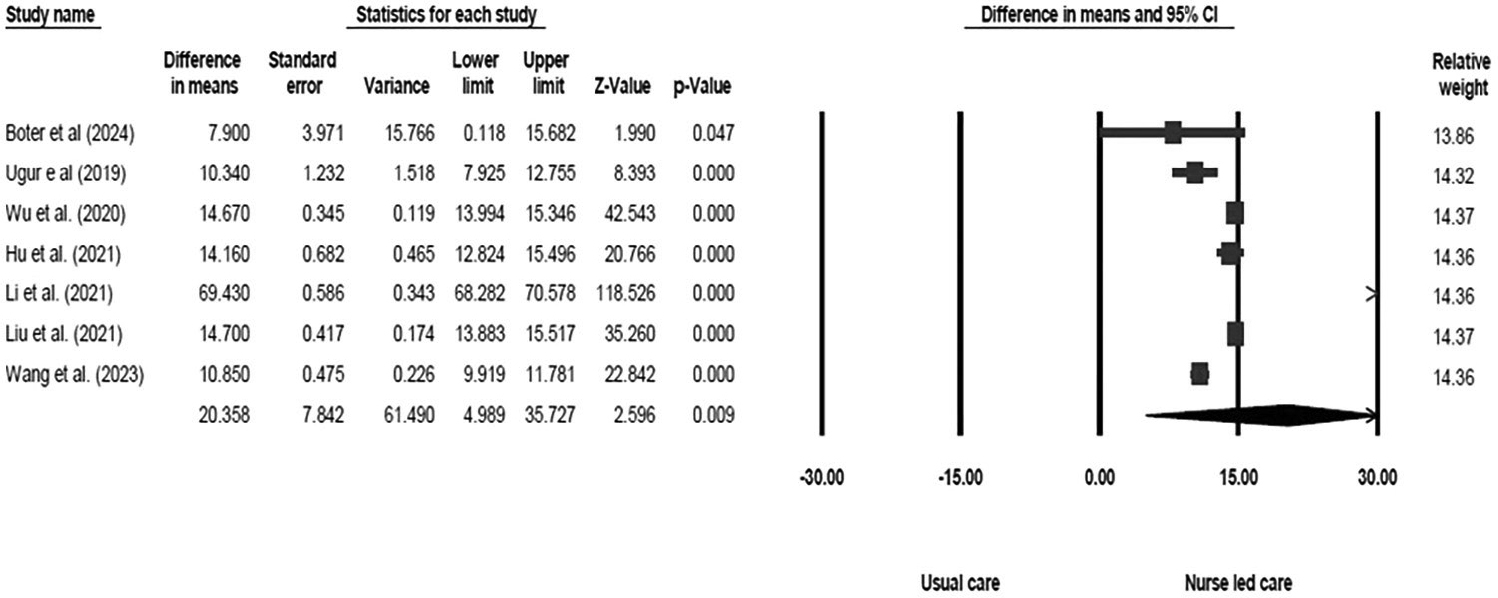
Quality of life: Mean difference: 7.9 (95% CI: 0.1 – 15.7) |
H |
| Jönsson et al. (2014)(21) |
Sweden |
Randomized Controlled Trial (RCT) |
Intervention Group: 232 Control Group: 227 |
Both |
74.3 |
Nurse-led Intervention |
3 |
Specialist nurse |
EuroQol-5 Dimensions (EQ-5D) |
Nursing intervention could decrease referrals, anxiety, and depression and increase self-reported health. |
Referrals: Intervention group: 62% Control group: 75% (p = 0.009) Anxiety/Depression: Intervention group: 40% Control group: 52.5% (p = 0.04) Self-reported Health: Intervention group: 75% Control group: 67% (p = 0.05) |
M |
| Deen et al. (2018)(22) |
United States |
Cohort |
61 |
Both |
65.3 |
Stroke nurse navigation program |
12 |
Two part-time stroke nurse navigators |
EuroQol-5 Dimensions (EQ-5D) |
There were significant improvements in mobility, self-care, and usual activities (p < 0.001), but no significant changes in pain/discomfort and anxiety/depression. |
Mobility: (F = 4.91, p < 0.001) Self-care: (F = 6.53, p < 0.001): Usual activities (F = 3.21, p < 0.001). |
M |
| Jie et al. (2019)(23) |
China |
Randomized Controlled Trial (RCT) |
82 |
Both |
68.5 |
Neurological rehabilitation nursing intervention |
- |
Trained neurological nursing staff |
Quality of life questionnaire |
Quality of life and satisfaction scores in the observation group were higher than those in the control group (P < 0.05). |
- |
P |
| Ugur et al. (2019)(24) |
Turkey |
Randomized Controlled Trial (RCT) |
Intervention: 43 Control: 43 |
Both |
76.51 |
Nursing care (Model of Daily Living Activities) |
2.5 |
Public health nurses |
Short-Form Health Survey (SF-36) |
There were improvements in mental role and vitality among subdimensions of SF-36 (p < 0.05). |
Overall: Mean difference: 10.34 (95% CI: 7.89 – 12.79) Mental Role: Mean difference: 16.28 (95% CI: 2.41 – 30.15) Vitality: Mean difference: 9.30 (95% CI: 1.63 – 16.97) |
M |
| Zhang et al. (2019)(25) |
China |
Randomized Controlled Trial (RCT) |
Intervention: 48 Control: 48 |
Both |
64.33 |
Early rehabilitation nursing |
1 |
Advanced nurses |
quality of life evaluation form |
The experimental group, compared to the control group, had higher scores of quality of life after 4 weeks of intervention (P < 0.05). |
- |
H |
| Wu et al. (2015)(26) |
Taiwan |
Cohort |
Intervention Group: 41 Control Group: 41 |
Female |
54.95 |
Comprehensive assessment and education for lifestyle modification, self-management strategies, social services, and physical therapy |
6 |
Advanced practice nurses |
Short-Form Health Survey (SF-36) |
It was observed that there are significant improvements in physical component summary (p = 0.010) but not in mental component summary (p > 0.05). |
Overall: Mean difference: 1.63 (95% CI: 1.09 – 2.17) Physical component summary: Mean difference: 4.72 (95% CI: 0.58–8.86) Mental component summary: Mean difference: 1.36 (not statistically significant). |
P |
| Wu et al. (2020)(27) |
China |
Randomized Controlled Trial (RCT) |
Intervention Group: 30 Control Group: 31 |
Both |
57.92 |
Internet-based remote rehabilitation nursing |
2.5 |
Nurses, rehabilitation therapists, counselors, and caregivers |
Stroke-Specific Quality of Life Scale (SS-QOL) |
The intervention group exhibited a higher quality of life than the control group (intervention group = 190.57 ± 5.09 vs. control group = 175.90 ± 5.78, p < 0.05). |
Quality of life: Mean difference: 14.67 (95% CI: 13.98 – 15.36) |
M |
| Hu et al. (2021)(28) |
China |
Randomized Controlled Trial (RCT) |
Control Group: 70 Study Group: 53 |
Both |
55.72 |
Early rehabilitation nursing |
0.5 |
Nursing staff and rehabilitation therapists |
WHOQOL-BREF for quality of life (QOL) |
Nursing intervention can improve the quality of life in the patients (control group: 44.23 ± 8.93 vs study group: 58.39 ± 10.28, P < 0.05). |
Quality of life: Mean difference: 14.16 (95% CI: 12.81 – 15.51) |
M |
| Li et al. (2021)(29) |
China |
Randomized Controlled Trial (RCT) |
Control Group: 60 Observation Group: 60 |
Both |
64.60 |
Interactive rehabilitation nursing |
12 |
Nursing staff and rehabilitation therapists |
Stroke Specific Quality of Life Scale (SS-QOL) |
Rehabilitation nursing can enhance the quality of life in the patients (control group: 127.42 ± 7.15 vs observation group: 196.85 ± 8.31, P < 0.05). |
Quality of life: Mean difference: 69.43 (95% CI: 68.27 – 70.59) |
M |
| Liu et al. (2021)(30) |
China |
Randomized Controlled Trial (RCT) |
Control Group: 40 Experimental Group: 40 |
Both |
Not reported |
Rehabilitation nursing |
3 |
Nursing staff and rehabilitation therapists |
Stroke Specific Quality of Life Scale (SS-QOL) |
The experimental group had a better quality of life than the control group (experimental group: 176.26 ± 3.69 vs control group: 190.96 ± 2.86, p < 0.05) |
Quality of life: Mean difference: 14.70 (95% CI: 13.87 – 15.53) |
M |
| Yu et al. (2021)(31) |
China |
Cohort (Prospective) |
Case: 48 Contro:49 |
Both |
66.6 |
Early systematic rehabilitation nursing |
3 |
Nursing staff |
Generic Quality of Life Inventory-74 (GQOLI-74) |
Nursing intervention improved quality of life in the patients (experimental group: 188.85 ± 13.38 and control group: 180.80 ± 14.49, P < 0.05) |
Quality of life: Mean difference: 8.05 (95% CI: 6.94 – 9.16) |
M |
| Li et al. (2022)(32) |
China |
Cohort (Retrospective) |
Case: 30 Contro:30 |
Both |
62.41 ± 3.27 |
Home remote rehabilitation cooperative nursing combined with home rehabilitation nursing |
12 |
Nursing staff |
Quality of life scores |
Nursing intervention improved quality of life in the patients. |
Overall: Mean difference: 15.75 (95% CI: 14.02 – 17.48) Psychological function: Mean difference: 16.33 (95% CI: 13.00 – 19.66) Social function: Mean difference: 15.54 (95% CI: 13.55 – 17.53) Material life: Mean difference: 16.44 (95% CI: 16.22 – 16.66) Somatic function: Mean difference: 13.22 (95% CI: 11.11 – 15.33) |
P |
| Yang et al. (2022)(33) |
China |
Randomized Controlled Trial (RCT) |
Intervention Group: 55 Control Group: 55 |
Both |
56.13 |
Neurology nursing intervention |
- |
Neurologists, nurses, and rehabilitation therapists. |
Short-Form Health Survey (SF-36) |
The quality of life in the intervention group was obviously higher than that in the control group (intervention group: 83.23 ± 5.87 vs control group: 72.14 ± 4.79, P < 0.05). |
Quality of Life: Mean difference: 11.09 (95% CI: 10.01 – 12.17) |
P |
| Zhang et al. (2022)(34) |
China |
Quasi-Experimental Study |
Control group: 20 Study group: 20 |
Both |
- |
Nursing and rehabilitation measures |
- |
Nurses and physiotherapists |
Lifestyle Assessment Questionnaire (LAQ) for quality of life |
Nursing intervention could improve quality of life in all dimensions of physical function, psychological function, social performance, and general health performance (P = 0.048). |
- |
P |
| Zuo and Sun (2022)(35) |
China |
Cohort (retrospective) |
Observation group: 40 Control group: 40 |
Both |
72.33 |
All-inclusive and hierarchical rehabilitation nursing model combined with acupuncture |
3 |
Nurses and rehabilitation physiotherapists |
Stroke-Specific Quality of Life Scale (SS-QOL) |
After nursing intervention, all dimensions of quality of life including energy, family roles, language, mobility, mood, personality, self-care, social roles, thinking, upper extremity function, vision, and work/productivity, were improved (P < 0.025). |
Quality of Life: Mean difference: 1.13 (95% CI: 0.43 – 1.83) |
H |
| He et al. (2023)(36) |
China |
Randomized Controlled Trial (RCT) |
Case group: 161 Control group: 124 |
Female |
67.21 |
Nurse-led rapid rehabilitation |
12 |
Nurses, neurologists, rehabilitation physicians, therapists, and dietitians. |
EuroQol-5 Dimensions (EQ-5D) |
There were substantial differences in the overall quality of life in groups (P = 0.017). |
- |
M |
| Nordin et al. (2019)(37) |
Malaysia |
Randomized Controlled Trial (RCT) |
Case Group: 45 Control Group: 46 |
Male |
58.9 |
Home-based carer-assisted therapy |
3 |
Carers (family members) trained to assist patients. |
EuroQol-5 Dimensions (EQ-5D) |
Significant improvements in health-related quality of life in the intervention were observed (P > 0.05). |
- |
H |
| Wang et al. (2023)(38) |
China |
Randomized Controlled Trial (RCT) |
Intervention group: 64 Control group: 64 |
Male |
77.74 |
Brain-computer interface (BCI) training combined with mindfulness therapy. |
6 |
Nurses and rehabilitation therapists |
WHOQOL-BREF for quality of life |
Notable improvement in the quality of life was observed in the intervention group compared to the control group. (intervention group: 66.08 ± 5.32 and control group: 55.23 ± 5.04, P < 0.001) |
Quality of Life: Mean difference: 10.85 (95% CI: 9.91 – 11.79) |
H |
| Qiao et al. (2024)(39) |
China |
Randomized Controlled Trial (RCT) |
Case group: 50 Control group: 50 |
Both |
- |
Dyadic Coping Intervention of Social Participation (DCISP) |
3 |
Nurses for recruitment |
Stroke-specific Quality of Life Scale (SS-QOL) |
The intervention was linked to an improvement in quality of life (P < 0.05). |
- |
H |
| Yu et al. (2024)(40) |
China |
Randomized Controlled Trial (RCT) |
Case group: 50 Control group: 50 |
Both |
66.37 |
Rehabilitation management based on goal management theory |
- |
A head nurse and experienced clinical nurses |
Short-Form Health Survey (SF-36) |
The observation group compared to the control group exhibited a significant enhancement in quality of life (P < 0.05). |
- |
M |

 O efeito das intervenções lideradas por enfermeiros na qualidade de vida de pacientes com acidente vascular cerebral: uma revisão sistemática e meta-análise
 Thumbnail
 Thumbnail