
 THE MONETARY IMPLICATIONS OF BRAZILIAN DEVELOPMENT BANK: A DIDACTIC APPROACH
This article discusses the monetary policy consequences of the Brazilian Development Bank (BNDES). In particular, we show that BNDES loans with long-term interest rates (TJLP): i) raised the neutral interest rate (r-star or r*) of Brazilian economy; ii) increased the volatility of the monetary policy instrument. For this, we use a simple macroeconomic model, as proposed by Romer (2000), with an IS curve, a Phillips curve, and a monetary policy rule. Lastly, we show how the BNDES implications for monetary policy are weakened when we consider specific characteristics of the BNDES operational policy and/or when we assume the hypothesis that BNDES has positive effects on potential GDP by stimulating investment and accumulation of physical capital.
KEYWORDS:
BNDES; monetary policy; development banks; TJLP
 Thumbnail
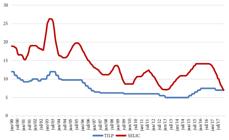
 Fonte: Elaboração própria com base em dados do BCB e BNDES.