 Programs on spirituality in nursing students in the Americas: scoping review
ABSTRACT
Objectives: to evaluate the state of the art regarding programs to strengthen spirituality and spiritual care implemented in nursing students in the Americas.
Methods: scoping review guided by PRISMA-ScR. Four electronic databases were consulted using MeSH and DeCS terms to include original studies published in peer-reviewed journals, conducted in the Region of the Americas, in English, Spanish, and Portuguese, with no date restriction.
Results: most studies were conducted in the United States, with students in their final years of study and at religiously affiliated universities. Four educational interventions and five programs were identified, in which mainly reflective and experiential educational strategies were employed.
Conclusions: the scarcity of educational initiatives in the Americas contrasts with the consensus on the importance of integrating spirituality into nursing education.
Descriptors:
Spirituality; Students, Nursing; Holistic Nursing; Religion; Program
RESUMEN
Objetivos: evaluar el estado del arte acerca de los programas de fortalecimiento de la espiritualidad y los cuidados espirituales implementados en estudiantes de enfermería en la Región de las Américas.
Métodos: revisión de alcance guiado por PRISMA-ScR. Se consultaron cuatro bases de datos electrónicos utilizando los términos MeSH y DeSC, para incluir estudios originales publicados en revistas revisadas por pares, realizados en la Región de las Américas, en inglés, español y portugués, sin restricción de tiempo.
Resultados: la mayoría de los estudios fueron realizados en los Estados Unidos, en estudiantes de los últimos años de estudios y en universidades de filiación religiosa. Se identificaron cuatro intervenciones educativas y cinco programas, en las que emplearon, principalmente, estrategias educativas reflexivas y experienciales.
Conclusiones: la escasez de iniciativas educacionales en las Américas contrasta con el consenso sobre la importancia de integrar la espiritualidad en la formación en enfermería.
Descriptores:
Espiritualidad; Estudiantes de Enfermería; Enfermería Holística; Religión; Programa
RESUMO
Objetivos: avaliar o estado da arte sobre os programas de fortalecimento da espiritualidade e dos cuidados espirituais implementados em estudantes de enfermagem na Região das Américas.
Métodos: revisão de escopo guiada por PRISMA-ScR. Consultaram-se quatro bases de dados eletrônicas utilizando os termos MeSH e DeSC, para incluir estudos originais publicados em periódicos revisados por pares, realizados na Região das Américas, em inglês, espanhol e português, sem restrição de tempo.
Resultados: a maioria dos estudos foi realizada nos Estados Unidos, com estudantes dos últimos anos de curso e em universidades de filiação religiosa. Identificaram-se quatro intervenções educacionais e cinco programas, nos quais foram empregadas, principalmente, estratégias educacionais reflexivas e experienciais.
Conclusões: a escassez de iniciativas educacionais nas Américas contrasta com o consenso sobre a importância de integrar a espiritualidade na formação em enfermagem.
Descritores:
Espiritualidade; Estudantes de Enfermagem; Enfermagem Holística; Religião; Programa
INTRODUCTION
Historically, nursing care has been conceived as a practice that involves holistic attention to the person. However, despite this recognition, the formal integration of spirituality into nursing education programs remains incipient in the Region of the Americas(1). As theories of care have evolved, it has been recognized that people’s spiritual values, beliefs, and practices are fundamental to the healing process and well-being(2). In this sense, the impact of spirituality on healing, favorable health outcomes, and the ability to cope with and adapt to illness is undeniable(3).
In the scientific community, there is a tendency to confuse spirituality with religiosity, which creates confusion about how to address spiritual needs during professional training without imposing personal and religious beliefs(4). On the other hand, nurses face significant challenges in incorporating this competency into their practice due to the lack of specific training and the clinical environment, which often prioritizes the physical dimension over emotional and spiritual aspects(5).
Therefore, the spiritual dimension in nursing care has emerged as a crucial aspect that requires attention and development in professional practice. Its origin can be traced back to the need to approach human beings in a holistic manner, recognizing that health encompasses not only physical, social, emotional, and mental aspects, but also spiritual ones. This comprehensive approach is based on the premise that spirituality is inherent to the human condition and plays a crucial role in overall well-being(6).
Most nursing education programs do not include a robust component on spiritual care in their curricula, which may limit the ability of future professionals to provide holistic care(7,8). For this reason, the American Nurses Association(9) and the American Association of Colleges of Nursing(10) consider spirituality and spiritual care to be essential elements in nursing practice and education.
A synthesis of evidence that analyzed spiritual education programs implemented in Korean universities showed that promoting educational interventions on spirituality during nursing training effectively improves spiritual competence(11). Similarly, another systematic review with meta-analysis that examined studies conducted in China, Ethiopia, and Iran highlights that academic training, courses on spirituality, religious beliefs, work hours, and the work environment are factors that significantly influence the competence to offer spiritual care(12). In Latin America, nursing training programs tend to incorporate spirituality more implicitly, influenced by predominant religious traditions. In countries with a strong Catholic tradition, such as Mexico or Brazil, spirituality may be more present, although not always in a formalized way, in the curriculum(13).
The current state of professional training in spiritual competencies reflects a shift toward a more holistic and comprehensive approach to healthcare(14). As the importance of addressing the spiritual needs of both patients and professionals is recognized, it is crucial to continue developing and implementing educational programs that integrate these competencies. The evolution toward a more inclusive and comprehensive education will benefit not only patients but also the personal and professional development of nurses(15).
This review is justified due to the growing relevance of spirituality in the training of nursing students and the fact that strategies for teaching spirituality vary according to geographical region, due to factors such as regulatory frameworks, cultural and religious traditions, and health policies. In this sense, mapping educational interventions that strengthen spirituality will serve to identify the best teaching strategies and propose recommendations for the implementation of new educational programs, thus ensuring the holistic care and well-being of future nursing professionals.
OBJECTIVES
To assess the state of the art regarding programs to strengthen spirituality and spiritual care in nursing students in the Region of the Americas.
METHODS
Ethical aspects
As this was a scoping review, it was not considered necessary to submit the protocol to the Research Ethics Committee for review, as it did not involve the collection of primary data from human subjects. Similarly, the studies that comprised the final sample were duly cited.
Study design
This scoping review was conducted using the methodology proposed by the JBI, which comprises nine steps(16). The Preferred Reporting Items for Systematic Reviews and Meta-Analyses for Scoping Reviews (Prisma-ScR)(17) were considered for reporting purposes.
Protocol and registration
The study protocol was registered on the Open Science Framework (OSF) platform, which was assigned the DOI 10.17605/OSF.IO/MVNCD.
Research question
The PCC (population, concept, and context) strategy was used to formulate the research question. Nursing students were considered the population (P); spirituality programs and spiritual care were considered the concept (C); and the Region of the Americas was considered the context (C). Therefore, the guiding research question was: What is the state of the art of programs to strengthen spirituality and spiritual care implemented in nursing students in the Americas?
Data search strategy and sources
Initially, after thoroughly reviewing the OSF, databases, and data platforms, it was found that no protocols or review studies with similar themes had been published. Next, the steps for conducting the scoping review were carried out.
Eligibility criteria
Inclusion criteria were considered as follows: P: research conducted with nursing students or studies that included health science students in their sample, but presented their results in a disaggregated manner, allowing the identification of post-intervention results in nursing students. C: investigations addressing programs or interventions (courses, pilots, videos) to strengthen spirituality and spiritual competencies. C: qualitative, quantitative, and mixed studies conducted in the Region of the Americas and published in peer-reviewed journals were included. Regarding language, studies published in English, Spanish, and Portuguese were considered; in addition, all investigations were included, without time restrictions. The exclusion criteria were: scientific articles that do not present results on training programs in spirituality or spiritual competencies, studies that do not include nursing students as the target population, studies that do not directly address spiritual care, non-peer-reviewed documents (unpublished reports, theses); as well as anecdotal studies, individual case reports, letters to the editor, comments, and opinions without empirical data.
Sources of information
Between September and October 2024, with the support of a librarian, a preliminary search was initiated to identify seed articles and select controlled and uncontrolled descriptors from Medical Subject Headings (MeSH) and Health Sciences Descriptors (DeCS), choosing those with the highest sensitivity and reliability. Next, the final search equation was constructed using terms related to the acronym PCC, joined by the Boolean operators AND and OR. Subsequently, a systematic search of primary articles was conducted in the PubMed, EBSCO, Scopus, and Web of Science databases, selected for their breadth and relevance in the health field. The search equations were developed considering the following controlled and uncontrolled language terms: ((“students nursing”) OR (“nurses pupil”) OR (“nursing education”) OR (“nursing training”) OR (undergraduate)) AND ((programs) OR (“training program”) OR (“education program”) OR (“program development”) OR (“program evaluation”) OR (“program effectiveness”) OR (“training outcome”) OR (curriculum)) AND (( spirituality ) OR (“spiritual care competence”) OR (“spiritual nursing”) OR (“spiritual care”) OR (“hospice care”) (“holistic nursing”)).
Selection of studies
The selection and evaluation of primary studies were performed on the Rayyan platform by the first author. Initially, two reviewers independently screened titles and abstracts using the software’s blinding function and applying inclusion and exclusion criteria to identify relevant studies. Subsequently, the studies were screened by reviewing abstracts, ending with a review of the full text. Discrepancies were resolved with a third reviewer.
Data mapping and extraction
They were conducted independently by two researchers, who obtained the necessary information using a data extraction form. Once this stage was complete, the researchers shared the extracted data to assess any agreements or disagreements and reach a consensus. In cases where disagreements persisted, a third researcher acted as an arbitrator.
Data analysis
A descriptive analysis of the identified programs was carried out, considering the objective, sample, and conclusions. Subsequently, they were grouped into interventions and educational programs to describe the instructional design and the results obtained after their implementation. In the case of programs, the theoretical model on which they were based was specified. Finally, the scope of these educational initiatives was analyzed using the model proposed by Krikpatrick, widely used to evaluate educational interventions developed during nurse training(18).
RESULTS
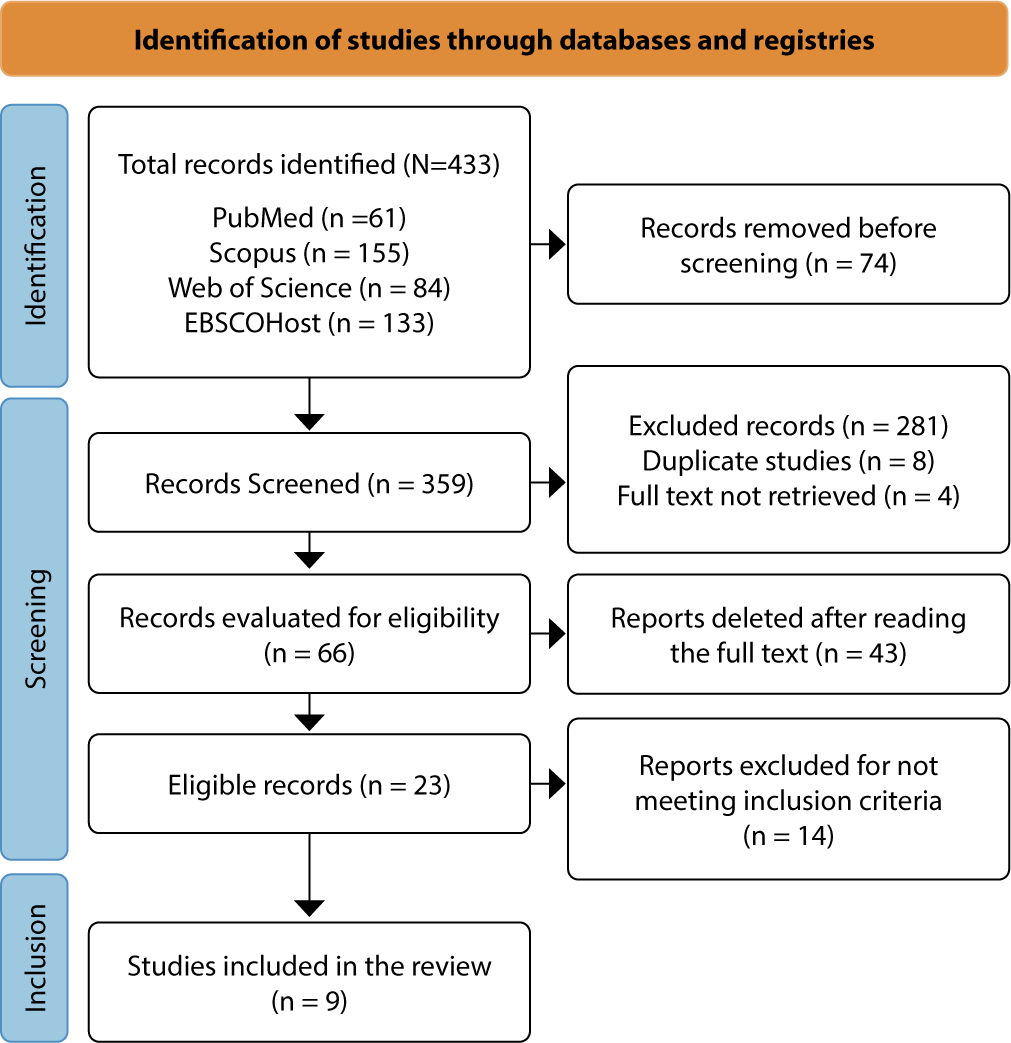
Of the total of 433 records identified, nine scientific articles were selected for the synthesis of information (Figure 1).

Study selection flow diagram based on the Preferred Reporting Items for Systematic Reviews and Meta-Analyses extension for Scoping Reviews PRISMA-ScR, Lima, Peru, 2025
The studies reviewed were predominantly from the United States (77.7%). In terms of design, they were mainly quantitative (55.5%), followed by qualitative (22.2%); in terms of participants, in general, their samples consisted of NS in their final years at religiously affiliated universities. The objectives and conclusions of these reviewed studies are detailed in Chart 1.
Educational interventions on spirituality identified
Chart 2 details the characteristics, results, and level achieved in four interventions identified according to Kirkpatrick’s model. Specifically, an interactive workshop on the use of a spiritual assessment tool was identified, in which participation and dialogue were encouraged through personal reflection on one’s own spiritual journey before using the tool with a patient. This was followed by spiritual assessment exercises with real patients in a clinical setting. It concluded with feedback on performance during spiritual assessments. Similarly, an educational video was identified, which, in its pre-production phase, included the development of a script based on literature and expert input, as well as the creation of a storyboard. The production phase involved rehearsing scenes with actors, filming, narration, and developing images and animations. Finally, in the post-production phase, the focus was on editing the educational video and its evaluation by experts and NS.
Instructional design, results, and level assessment according to Kirkpatrick’s model of the educational interventions analyzed, Lima, Peru, 2025
In addition, there is an experimental design study with an educational intervention(26), which employed multimodal teaching strategies and considered a four-month follow-up period to assess the impact using the Spirituality and Spiritual Care Rating Scale (SSCRS). A simulation exercise on spiritual care was also identified, which employed standardized patients(21), beginning with a lecture, simulation activities in pairs, assuming the roles of nurse and observer, and finally a debriefing session. After the simulation, students were asked to complete a spiritual assessment of a patient during their clinical rotation using the FICA (Faith, Importance and Influence, Community, and Address) spiritual history tool.
Educational programs on spirituality identified
Chart 3 details the characteristics, results, and level achieved according to Kirkpatrick’s model in five identified educational programs. One of them was SCREP(19) (Spiritual Care Educational and Reflective Program), conducted in two retreats; in the first, they developed the theoretical content through didactic group sessions and small group exercises; then, they implemented an online discussion forum (Wiki), where they shared their clinical experiences in groups of 4 to 5 NSs and received feedback from researchers, which included an evaluation of these experiences in terms of recognizing a patient’s sign and providing spiritual interventions. Similarly, they encouraged reflective practices using the examination of conscience, which allowed them to inquire into their feelings and reactions in their daily experience. At the end, they held another retreat that included a group discussion about the spiritual encounters experienced in their clinical practice and the impact of online interactions. They concluded with reflective practices on how to incorporate spirituality into their future professional performance. The SCERP theoretical model was based on Burkhart/Hogan’s theory of Spiritual Care in Nursing Practice(19), which describes spiritual care as an interactive process between the patient and the nurse, aimed at promoting the patient’s spirituality.
Instructional design, results, and level assessment according to Kirkpatrick’s model of the programs analyzed, Lima, Peru, 2025
The second was a pilot program(23), which began with a half-day lecture on the theory of spirituality in nursing, given by a specialist. This was followed by weekly clinical conferences to deepen theoretical content and analyze spiritual interventions implemented according to the theoretical model with residents of the long-term care center. In addition, NPs were encouraged to write about their experiences in reflective journals and to develop care plans with nursing diagnoses related to spirituality. This pilot program was based on the model by Callister et al.(27), which proposes integrating spirituality into nursing education through “fundamental elements” based on the competencies of the American Association of Colleges of Nursing (AACN). This model suggests that interventions that influence spirituality are: connection with oneself (reminiscence, presence, and inspirational reading), connection with something higher (prayer, visits to the chapel, and musical meditation), and connection with nature (walking outdoors and inspirational reading).
The third program, which was experiential learning-based, was carried out during a community rotation(20), in which NS were encouraged to reflect on their relationship with the transcendent and to keep a journal during clinical practice in order to explore thoughts and feelings about their own spirituality and that of their patients. In addition, they encouraged research and discussion on health-related spirituality to promote greater understanding and dispel fears about addressing patients’ spiritual needs. This was accompanied by home visits to patients referred by the parish to participate in the spiritual dimension of holistic nursing care. Before and after the visits, discussions were held to share their experiences, feelings, and prejudices. At the end of the intervention, they held a conference with the participation of health professionals and priests to summarize their learning and reflect on their growth in spiritual sensitivity.
The fourth program was experiential learning-based, promoting the participation of nursing students in a variety of activities at a religious-based community crisis center for homeless people and those living in poverty. It included patient care, observation of spirituality, analysis of nursing practice, and participation in post-clinical seminar discussions.
The fifth program was the only one in which spiritual care was integrated into various courses in a curriculum(25), through methodological strategies such as supporting students’ spiritual well-being, combining various teaching methods (theoretical and practical) with an emphasis on reflection, as well as clinical experiences and assessment of learning in spiritual care.
DISCUSSION
This review showed that, in the Region of the Americas, there are few educational initiatives aimed at strengthening spirituality in healthcare settings, among which structured educational programs(19,22), simulations(21), educational videos(4), and guided clinical experiences(24) stand out. These initiatives were implemented to strengthen confidence, competence, and spiritual sensitivity.
As for the characteristics of the studies reviewed, most were conducted in the United States; this may be due to the fact that this country was a pioneer in integrating spirituality into healthcare, reflecting an institutionalized interest in the holistic training of nursing professionals(19,25); in addition, most studies considered students in their final years as their sample. This shows that students begin their curriculum with general courses and then progressively become involved in immersive learning experiences in career courses linked to the biological, psychological, and social dimensions of the people they care for; therefore, the final year would be a relevant setting for addressing the spiritual dimension.
The finding that most of the programs identified were implemented by religiously affiliated universities suggests that these institutions consider the spiritual dimension an essential component of their mission and the holistic care they seek to instill(20,24). However, this predominance also raises questions about possible gaps in the training offered by secular institutions and the need to ensure that the teaching of spirituality is inclusive and respectful of diversity of beliefs, which opens up opportunities for all institutions to explore how to effectively integrate the spiritual dimension into the training of nurses in order to provide humanized care.
The reviewed studies highlight that reflective strategies based on personal experiences(23), the use of journals(20,25), or clinical experience(19) fostered the development of awareness about the relevance of spirituality in nursing care, suggesting that introspection and critical analysis of practice can be considered valuable methods for internalizing the importance of this aspect. In addition, the simulation strategy with standardized patients(21) emphasizes that experiential learning in a safe environment strengthens hope, confidence, and attitudes favorable to the provision of spiritual care; which shows that guided practice and exposure to realistic scenarios are crucial for translating theoretical understanding into skills for providing spiritual care and a favorable disposition toward comprehensive patient care.
On the other hand, the implementation of interactive workshops and conferences(22,26) is another useful strategy for increasing knowledge about religiosity and spirituality; in addition, it fosters a positive perception and self-confidence to assess patients’ spiritual needs; However, their impact on promoting spiritual care attitudes and practices is significantly amplified when combined with more experiential and reflective methodologies, such as reflective practices, retreats, and online discussion(19,23). This suggests that, although the transmission of theoretical knowledge is an important first step, the internalization and effective application of spirituality in care requires a more comprehensive pedagogical approach that involves personal reflection, experiential immersion, and active exchange of ideas; this allows HCWs to transcend conceptual understanding and develop genuine sensitivity and skills to address the spiritual needs of their patients.
The analysis of educational initiatives on spirituality in NS, using Kirkpatrick’s model, reveals that brief interventions(4,21,22,26) focused mainly on raising awareness and conceptual clarification; they achieved level 2 by improving NS’s understanding and self-confidence; however, medium- and long-term training programs(19,20,23-25), which reached levels 2, 3, or 4 by integrating a variety of experiential and reflective strategies, such as retreats, clinical practices, and simulations, demonstrated a significantly greater impact by facilitating changes in student behavior; in some cases, they generated a positive impact on patients’ perception of care.
This difference underscores that, although short interventions are useful for the initial acquisition of knowledge, the transformation of professional practice and tangible improvement in spiritual care require more immersive and sustained programs that allow for internalization, practical application, and development of the “nursing presence” in holistic care of the person(23).
Study limitations
This review faced some limitations. First, the inclusion of only nine primary studies significantly restricts the generalizability of the findings. Second, the fact that the studies came mainly from the United States raises questions about the transferability of the results to other cultural and educational contexts in Latin America. Third, having analyzed mainly educational interventions implemented in religiously affiliated universities may have influenced the valuation and focus on spirituality in nursing practice, limiting the applicability of the findings to secular environments. Finally, as this is a scoping review, in which no assessment of the methodological quality or evidence of the included studies was performed, caution is required when interpreting the implications of the results for nursing education.
Contributions to nursing, healthcare, or public health
The findings of this review have implications for nursing education, highlighting the need to formally integrate the teaching of spirituality, identifying spiritual needs, competence, and spiritual intelligence(28) into curricula for a comprehensive approach to people, an essential component of holistic care. The effectiveness of active and experiential educational strategies underscores the importance of innovating teaching methodologies that promote spiritual sensitivity and confidence in future nurses.
Based on the findings of this review, it is recommended that interventions aimed at strengthening spirituality in nursing education in the Americas require the design of strategies that promote spiritual self-awareness among students, recognizing the spiritual dimension as an intrinsic component of their well-being and professional development. Subsequently, strategies should be implemented that foster the skills to assess needs and provide spiritual care. Finally, nursing teachers should not focus solely on theoretical training on spirituality, but also on practical training in spiritual care(29).
CONCLUSIONS
This review highlights a limited number of educational initiatives on spirituality in NS in the Americas, with a slight predominance of structured programs over brief interventions; this contrasts with the academic consensus on the importance of integrating spirituality into nursing education. Nevertheless, the studies analyzed demonstrate the feasibility of training sensitive professionals who are prepared to offer holistic care that incorporates the spiritual dimension through reflective and experiential pedagogical strategies, ranging from concise workshops to experiential programs that promote reflection.
The concentration of these initiatives in specific contexts, particularly religious universities and countries such as the United States, underscores the need to expand and adapt these training experiences to a wider range of educational environments. As actors in nursing education, we face the challenge of integrating spirituality in a systematic and experiential way into the curriculum, transcending the mere transmission of content to cultivate a deep understanding of the wholeness of the human being in health care.
ACKNOWLEDGEMENT
To librarian Manuel Santa Cruz Zúñiga for his support in constructing the search equations. Likewise, to Father Mateo Bautista García, religious priest of the Order of St. Camillus, for his contribution in reviewing aspects related to spirituality.
AVAILABILITY OF DATA AND MATERIAL
The research data are available only upon request.
REFERENCES
-
1 Bush RS, Baliko B, Raynor P. Building spiritual care competency in undergraduate psychiatric mental health nursing students: a quality improvement project. J Holist Nurs. 2022;41(3):256-64. https://doi.org/10.1177/08980101221103104
» https://doi.org/10.1177/08980101221103104 -
2 Jenkinson AK, Hartman N. Interprofessional end-of-life simulation in nursing education. Clin Simul Nurs. 2021;51:14-18. https://doi.org/10.1016/j.ecns.2020.12.001
» https://doi.org/10.1016/j.ecns.2020.12.001 -
3 Khalajinia Z, Tehran HA, Heidari A. Explaining the perception of spiritual care from the perspective of health personnel: a qualitative study. J Educ Health Promot. 2021;10(1):53. https://doi.org/10.4103/jehp.jehp_599_20
» https://doi.org/10.4103/jehp.jehp_599_20 -
4 Rodrigues JC, Miranda TPS, Fulquini FL, Guilherme C, Caldeira S, Campos E. Construction and evaluation of an educational video: nursing assessment and intervention of patients’ spiritual needs. Religiones. 2020;11(9):460. https://doi.org/10.3390/rel11090460
» https://doi.org/10.3390/rel11090460 -
5 Castillo Mancera F, Domínguez García JF, Rodríguez Rodríguez MG, Luna Gómez YA, Guerrero Castañeda RF. Significado del cuidado espiritual de enfermería en pacientes en cuidados paliativos. Gaceta Méd Boliv. 2023;46(2):13-19. https://doi.org/10.47993/gmb.v46i2.654
» https://doi.org/10.47993/gmb.v46i2.654 -
6 Morales Contreras BN, Palencia Sierra JJ. Dimensión espiritual en el cuidado enfermero. Enferm Investig. 2021;6(2):51-9. https://doi.org/10.31243/ei.uta.v6i2.1073.2021
» https://doi.org/10.31243/ei.uta.v6i2.1073.2021 -
7 Martínez Rodríguez L. Humanización desde la evidencia científica: el reto de las competencias espirituales y su formación. Paraninfo Dig[Internet]. 2023[cited 2025 May 20];(23):foroIEc1. https://ciberindex.com/c/pd/foroIEc1
» https://ciberindex.com/c/pd/foroIEc1 -
8 Aponte-Franco SM, Guerrero-Castañeda RF, Cervantes ER, Jiménez González DJ. Intervención educativa sobre cuidado espiritual para estudiantes de licenciatura en enfermería y obstetricia. Rev Cult Cuid Enferm[Internet]. 2022[cited 2025 May 20];19(2):101-115. Available from: https://dialnet.unirioja.es/servlet/articulo?codigo=8897660
» https://dialnet.unirioja.es/servlet/articulo?codigo=8897660 -
9 American Nurses Association (ANA). Nursing: scope and standards of practice [Internet]. Washington, DC: American Nurses Association. 2004[cited 2025 May 20]. https://www.nursingworld.org/practice-policy/scope-of-practice/
» https://www.nursingworld.org/practice-policy/scope-of-practice/ -
10 American Association of Colleges of Nurses (AACN). Essentials of Baccalaureate Education for Professional Nursing Practice [Internet]. Washington, DC: (AACN); 2008[cited 2025 May 20]. https://www.aacnnursing.org/Portals/0/PDFs/Publications/BaccEssentials08.pdf
» https://www.aacnnursing.org/Portals/0/PDFs/Publications/BaccEssentials08.pdf -
11 Cho HJ, Kang K y Park KY. Spiritual nursing education programme for nursing students in Korea: a systematic review and meta-analysis. BMC Nurs. 2024;23(1):310. https://doi.org/10.1186/s12912-024-01961-6
» https://doi.org/10.1186/s12912-024-01961-6 -
12 Kaiyue W, Xinsheng W, Linbo S, Jiayi F, Changping S. Nurse competency in providing spiritual care and associated influencing factors: a systematic review and meta‐analysis. Nurs Open. 2025;12(4):e70192. https://doi.org/10.1002/nop2.70192
» https://doi.org/10.1002/nop2.70192 -
13 Torres-Contreras CC, Vargas-Escobar LM, Triana-Rodríguez JY. Cuidado espiritual en estudiantes de enfermería: estudio cualitativo. MedUNAB. 2022;25(3):419-40. https://doi.org/10.29375/01237047.4330
» https://doi.org/10.29375/01237047.4330 -
14 Torres Contreras CC, Vargas Escobar LM, Triana Rodríguez JY, Cañon-Montañez W. Competencia en cuidado espiritual en enfermería: revisión integrativa de literatura. Rev Cuidarte. 2023;14(2). https://doi.org/10.15649/cuidarte.2635
» https://doi.org/10.15649/cuidarte.2635 -
15 Intriago GC, Alvarado CC, Panchana EL y Coffre AF. El cuidado espiritual como problema profesional y educativo de enfermería: preguntas complejas, respuestas simples. Polo del Conoc [Internet]. 2023[cited 2025 May 20];8(11):98-111. https://www.polodelconocimiento.com/ojs/index.php/es/article/view/6195
» https://www.polodelconocimiento.com/ojs/index.php/es/article/view/6195 -
16 Peters MDJ, Godfrey C, McInerney P, Munn Z, Tricco AC, Khalil H. Chapter 11. Scoping Reviews In: (2020). Aromataris E, Munn Z. JBI Manual for Evidence Synthesis, JBI [Internet]. 2020 [cited 2023 Jul 18]. Available from: https://synthesismanual.jbi.global
» https://synthesismanual.jbi.global -
17 Tricco AC, Lillie E, Zarin W, O’Brien KK, Colquhoun H, Levac D, et al. PRISMA Extension for Scoping Reviews (PRISMA-ScR): checklist and explanation. Ann Intern Med. 2018;169(7):467–73. https://doi.org/10.7326/M18-0850
» https://doi.org/10.7326/M18-0850 -
18 Miranda MD, Santos VD, Kristman VL, Mininel VA. Uso de la metodología de Kirkpatrick para evaluar la formación de los profesionales de enfermería: una revisión integradora. Rev Latino-Am Enfermagem. 2025;33:e4431. https://doi.org/10.1590/1518-8345.7250.4430
» https://doi.org/10.1590/1518-8345.7250.4430 -
19 Burkhart L, Schmidt W. Measuring effectiveness of a spiritual care pedagogy in nursing education. Rev Enferm Prof. 2012;28(5):315-21. https://doi.org/10.1016/j.profnurs.2012.03.003
» https://doi.org/10.1016/j.profnurs.2012.03.003 -
20 Catanzaro AM, McMullen KA. Increasing nursing students’ spiritual sensitivity. Nurse Educ. 2001;26(5):221-6. https://doi.org/10.1097/00006223-200109000-00011
» https://doi.org/10.1097/00006223-200109000-00011 -
21 Galloway S, Hand MW. Spiritual immersion: developing and evaluating a simulation exercise to teach spiritual care to undergraduate nursing students. Nurse Educ. 2017:42(4):199-203. https://doi.org/10.1097/NNE.0000000000000347
» https://doi.org/10.1097/NNE.0000000000000347 -
22 Hoffert D, Henshaw C, Mvududu N. Enhancing the ability of nursing students to perform a spiritual assessment. Nurse Educ. 2007;32(2):66-72. https://doi.org/10.1097/01.NNE.0000264327.17921.b7
» https://doi.org/10.1097/01.NNE.0000264327.17921.b7 -
23 Lovanio K, Wallace M. Promoting spiritual knowledge and attitudes: a student nurse education project. Holist Nurs Pract. 2007;21(1):42-47. https://doi.org/10.1097/00004650-200701000-00008
» https://doi.org/10.1097/00004650-200701000-00008 -
24 Rankin EA y DeLashmutt MB. Finding spirituality and nursing presence: the student’s challenge. Rev Enferm Holíst. 2006;24(4):282-8. https://doi.org/10.1177/0898010106294423
» https://doi.org/10.1177/0898010106294423 -
25 Taylor EJ, Testerman N, Hart D. Teaching spiritual care to nursing students: an integrated model. JCN. 2014;31(2):94-9. https://doi.org/10.1097/cnj.0000000000000058
» https://doi.org/10.1097/cnj.0000000000000058 -
26 Vargas LM, Guarnizo M. Effect of an educational intervention delivered to senior nursing students to strengthen spiritual care for people with chronic illness. Int J Nurs Educ Scholarsh. 2020;17(1):20190049. https://doi.org/10.1515/ijnes-2019-0049
» https://doi.org/10.1515/ijnes-2019-0049 -
27 Callister LC, Bond AE, Matsumura G, Mangum S. Threading spirituality throughout nursing education. Holist Nurs Pract. 2004;18(3):160-6. https://doi.org/10.1097/00004650-200405000-00008
» https://doi.org/10.1097/00004650-200405000-00008 -
28 Zeladita-Huaman JA, Cuba-Sancho JM, Martina-Chavez MB, Zegarra-Chapoñan R y Castillo-Parra H. Religión y experiencia profesional: ¿serán predictores de la inteligencia espiritual de los enfermeros? estudio transversal. Rev Bras Enferm. 2024;77(6):e20240217. https://doi.org/10.1590/0034-7167-2024-0217es
» https://doi.org/10.1590/0034-7167-2024-0217es -
29 Wang W, Yang J, Bai D, Lu X, Gong X, Cai M, et al. Nurses’ perceptions and competencies about spirituality and spiritual care: a systematic review and meta-analysis. Nurse Educ Today. 2024;132:106006. https://doi.org/10.1016/j.nedt.2023.106006
» https://doi.org/10.1016/j.nedt.2023.106006
Edited by
-
EDITOR IN CHIEF
Dulce Barbosa
-
ASSOCIATE EDITOR
Waldemar Brandão Neto