 A systematic review of the literature on semantic networks of concept maps: study supported by a specialized bibliometric process
ABSTRACT
Introduction: The current context of information manipulation advocates computational data processing for the generation of detailed and precise information in the academic field.
Objective: Present a Systematic Literature Review (SLR) supported by bibliometrics on semantic networks of concept maps (RSMC) - networks of meanings in which the nodes are concepts belonging to a collection of concept maps and the edges are semantic relations established between these concepts.
Methodology: The SLR followed Kitchenham's proposal and was implemented in the online tool Parsifal. To provide breadth to the research, bib files from ACM, ScienceDirect and Engineering Village sources were included in the methodological conduction through metadata treatment, which increased the number of documents found and analyzed.
Results: As a result, it was found, in relation to the specialized bibliometric procedure, that the addition of academic bases resulted in an increase in the search breadth by 56.8% and, consequently, in the results of the bibliographic and the bibliometric analysis conducted.
Conclusion: In relation to the documents analyzed, the most relevant conclusions were: a) that the concept of RSMC is not yet formalized in academic literature and b) that there is continued interest in pedagogical practices involving, mainly, conceptual maps and, in addition, semantic networks and lexical semantic relations in the search scope performed. The study presented here can contribute to qualifying the practice of systematic literature review with the adoption of bibliometric procedures supported by technological tools, such as the Bibliometrix package.
KEYWORDS:
Semantic networks; Concept map; Semantic relationships; Semantic networks of concept maps; Bibliometrix
RESUMO
Introdução: O contexto atual de manipulação de informações preconiza tratamento computacional de dados para geração informacional detalhada e precisa no campo acadêmico.
Objetivo: Apresentar uma Revisão Sistemática da Literatura (RSL) apoiada por bibliometria sobre redes semânticas de mapas conceituais (RSMC) - redes de significados nos quais os nodos são conceitos pertencentes a uma coleção de mapas conceituais e as arestas são relações semânticas estabelecidas entre esses conceitos.
Metodologia: A RSL seguiu a proposta de Kitchenham e foi implementada na ferramenta on-line Parsifal. A fim de fornecer amplitude à pesquisa, foram incluídos na condução metodológica, por meio de um tratamento de metadados, arquivos bib das fontes ACM, da ScienceDirect e da Engineering Village, o que aumentou a quantidade de documentos encontrados e analisados.
Resultados: Como resultado verificou-se, em relação ao procedimento bibliométrico especializado, que a adição de bases acadêmicas resultou em um aumento da amplitude da busca em 56,8% e, consequentemente, nos resultados das análises bibliográficas e bibliométricas realizadas.
Conclusão: Em relação aos documentos analisados, as conclusões mais relevantes foram: a) que o conceito de RSMC ainda não está formalizado na literatura acadêmica e b) que existe interesse continuado em práticas pedagógicas envolvendo, principalmente, mapas conceituais e, complementarmente, redes semânticas e relações semânticas lexicais no escopo de busca realizado. O estudo ora apresentado pode contribuir para qualificar a prática da revisão sistemática de literatura com a adoção de procedimentos bibliométricos suportados por ferramentas tecnológicas, como é o caso do pacote Bibliometrix.
PALAVRAS-CHAVE:
Redes semânticas; Mapas conceituais; Relações semânticas; Redes semânticas de mapas conceituais; Bibliometrix
1 INTRODUCTION: SEMANTIC NETWORKS OF CONCEPT MAPS
Educators seek, as a highly relevant pedagogical objective, the cognitive development of its students. Nowadays, it has been challenging to keep the student focused, develop oral and written languages, encourage a good conceptual foundation and deepen the ability to interpret. This is due, in part, to a false illusion of easy knowledge construction due to the massive access to information in digital environments (Wolf 2019; castles, 2005). However, it is always important to emphasize that information is not knowledge. Considering this new digital phase of human education, it is necessary to develop pedagogical tools and practices that can help the development of the aforementioned skills in a computer environment, enabling students to track their own intellectual productions, monitoring their development and becoming, hopefully, more confident and autonomous. Well-founded conceptual learning, formed from in-depth reflections, is a necessity for both young people and adults in the process of building knowledge.
That said, it appears that the use of conceptual maps in pedagogical practices can favor meaningful learning, that is, learning in which knowledge is assimilated in a non-random, reasoned and, therefore, non-arbitrary and non-literal way (Ausubel, 2003, Novak e Musonda, 1991), incorporating itself into cognition. For this to occur, new knowledge needs to be anchored in relevant pre-existing ideas in the learner's cognitive structure, called subsumers (Ausubel, 1962, p. 217). Following the Ausubelian theoretical line, during the knowledge acquisition processes, a concept1 it is subordinate when the learner's cognitive structure has stable elements capable of establishing relationships with that concept, thus being capable of attributing meaning to it.
Another way to reinforce the contextualized understanding of concepts is to explore lexical semantic relationships - in this context, associated with spelling - such as the relationship of identity (the same word in the same context), homography (same word, different context), proximity semantics (synonymy, similarity), semantic separation (antonymy, gradual opposition), hierarchy and classification (hyperonymy and hyponymy), relations of parts to a whole (meronymy and holonymy) and translations (Happiness, 2019; Cruse, 2006; 1986).
A third form, considered classic, is the development of dissertation texts, which enable an in-depth linear chain of reasoning around a topic. Vigotski (2002, p. 177) opposes pedagogical practices in which writing is conceived purely as a motor, mechanical skill. It takes as a central assumption the fact that writing must be relevant to life, have meaning for the child. Only then will writing be developed as a language, and not just as a manual skill.
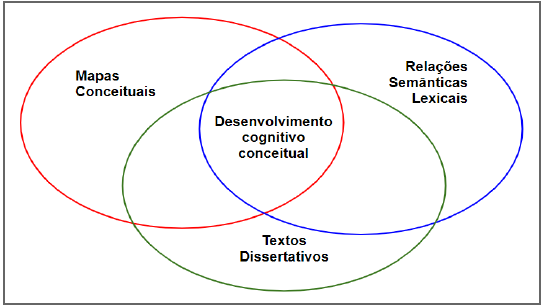
Big et al. (2022) proposed to unify these expressions - conceptual maps, dissertation texts and lexical semantic relations (see representation in Figure 1) - in a knowledge network in which a learner can establish contextualized semantic relationships between concepts belonging to an interrelated collection of conceptual maps. From this unification, the proposed concept of Semantic Concept Map Network (RSMC) emerges.

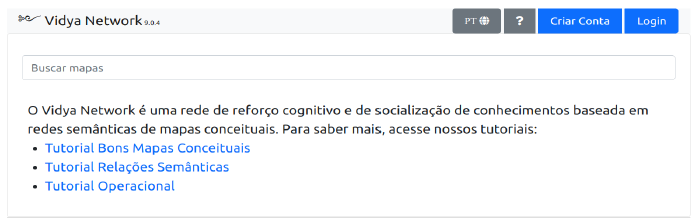
Transporting this conception to a computational environment in which students and teachers can collaborate with each other by sharing knowledge, forming study groups, interacting on materials collected by classes, in a multi-user architecture in which each participant can have their own collection of conceptual maps, in addition to shared instances, a Multi-User RSMC is formed. Based on this concept, the educational tool Vidya Network was developed2, which has the following characteristics:
-
pedagogical architecture structured in a multi-user RSMC;
-
synchronous and asynchronous interactions are provided through chats, discussion forums and simultaneous editing of concept maps, features especially useful in distance education (EAD);
-
debate of theses associated with conceptual maps and semantic relations allow the cooperative construction of knowledge through critical and reasoned debates (snowy et al., 2011) and
-
allows visually impaired people, autistic people and people with fine coordination difficulties to create and understand the maps developed, since its project was guided by accessibility criteria.
-
native multilingual interface, with the currently supported languages being Portuguese, English and Spanish.

In the context of studies on concept maps, this Systematic Literature Review (SLR) was required by research on favoring the meaningful learning of concepts, in the Ausubelian sense (Ausubel, 2003), using the Vidya Network as a proposal for innovation in Conceptual Maps through the formation of Semantic Networks. The presentation of this article was organized as follows:
-
2aSection: Theoretical Foundation: brings together theories that support ongoing research.
-
3aSection: Materials and methods: details the procedures used, instruments and computational resources adopted to carry out the review and bibliometric analyses.
-
4aSection: Details of the Conduct of the Bibliographic Review: details the conduct of the work carried out.
-
5aSection: Results and Discussion: presents the results of the review, focusing on analyzes understood as relevant to the research required.
-
6asection: Conclusions: performs a closing of the review in relation to its methods and objectives.
2 THEORETICAL FOUNDATION
This theoretical foundation brings together the theoretical aspects and concepts related to the demanding research: meaningful learning, conceptual maps, semantic networks, lexical semantic relations and socio-interactionist pedagogical practices.
2.1 Meaningful Learning and its Relationship with Concept Maps
At the heart of his theory, there is the concept of subsumer, which can be understood as a relevant pre-existing idea in the learner's cognitive structure. Activated during the construction or reinforcement of knowledge, subsumers serve as a cognitive anchor that reinforces learning by inserting it into its network of meanings, expanding retention and reflection capacity.
In this context, concept maps were developed based on the Ausubelian principle that the most important factor that influences learning is what the learner already knows. Due to the ability to deepen the understanding of concepts and relationships between them, the conceptual maps proposed by Novak and Cañas (2010) are academically recognized as cognitive organizers capable of reinforcing meaningful learning.
2.2 Semantic Networks
Semantic networks are structures defined and used in several areas of knowledge, including semiotics, linguistics, cybernetics and psychology. Within the scope of this document, aimed at cognitive reinforcement of related concepts, the following concepts are used:
-
a) Semantic Network: a directed graph in which the nodes represent concepts and the edges represent relationships between them (Christensen et al., 2018);
-
b) Semantic Network of Concept Maps (RSMC): a particular type of semantic network, in which the nodes are concepts belonging to conceptual maps and the edges are potentially significant relationships established between them and
-
c) RSMC Multiusers: an RSMC semantic network formed by different types of users (in the computational sense): learners, teachers, study groups, classes.
In a Multi-User RSMC, the meaning of each conceptual map is properly contextualized, and it can be said that its meaning is generic or even belongs to a specific context of a certain domain of knowledge. Thus, the learner can establish or search, in a multi-user network - a user being a person, a study group or a class - lexical relationships of homonymy, heteronomy, synonymy, similarity, antonymy or gradual opposition. In a multilingual environment, conceptual translation relationships can also be established. Through an inclusion relationship, concepts belonging to a conceptual map defined in others are also sought.
A semantic network with these characteristics - multi-users, with lexical relationships and inclusion relationships - can form, as soon as each of its members provides collaborations, an evolutionary social network of shared knowledge.
2.3 Lexical Semantic Relations
Cruse (2004) defines lexical semantic relations as relations that are established between words due to their meanings, which need to be properly contextualized to express pertinent knowledge. These relationships can be of different nature, such as:
-
homonym: linguistic phenomenon in which two or more different words have the same form or pronunciation, but have different meanings and, often, different etymological origins.
-
Hyperonymy-hyponymy: relationship between words that have a general meaning and a more specific meaning, respectively.
-
Synonymy: relationship between words that have identical or very similar meanings.
-
Similarity: relationship between words that have similar but not identical forms or meanings.
-
Antonym: relationship between words that have opposite or contrary meanings.
-
Gradual opposition: relationship between words whose meanings are on some kind of opposite scale or spectrum, but are not absolute extremes.
-
Polysemy: relationship between words that have more than one meaning.
Understanding relationships between words is fundamental for effective communication and accurate understanding of language. These relationships help organize vocabulary and allow people to express nuances of meaning, relate concepts and choose the most appropriate words to communicate clearly and efficiently. Among the reasons for developing an understanding of lexical relationships are the expansion of vocabulary, the development of more precise communication, the increase in relevance of discourses in relation to contexts, the correct treatment of ambiguities and the ability to analyze texts . In summary, understanding lexical relationships enriches communication, allows a more precise interpretation of the meaning of words and is essential for the construction and interpretation of written or spoken texts.
2.4 Sociointeractionist Pedagogical Practices
The socio-interactionist pedagogical practices using conceptual maps reported by Novak and Cañas (2010) highlight the Vygotskian idea that language and social dialogue can assist in learning, especially when members of a social group approach Zones of Proximal Development ( ZDP) similar, in the context worked (Vygotsky, 2014). Sociointeractionist pedagogical practices can be classified as collaborative or cooperative. In the scope of this work, collaborative learning is defined as a pedagogical practice in which students work as a team or help each other, but deliver individual work.
On the other hand, in cooperative learning: a) students collectively construct the work carried out; b) there is positive interdependence: the work of others benefits us and our work benefits them; c) each person's performance is evaluated and the results are returned to the group and individuals; d) the promotion of success is mutual; e) the development of social skills is required (leadership, decision-making, trust, communication, conflict management) and f) members discuss how well they are achieving their objectives, maintaining effective working relationships (McInnerney e Roberts, 2009; Johnson e Johnson, 1999).
3 MATERIALS AND METHODS
This subsection presents the methodological procedures, instruments and computational materials used to carry out the RSL and support it with bibliometrics. The methodological basis originates from Kitchenham (2004), whose report aims to guide researchers to evaluate and interpret published work on topics relevant to research using a reliable and auditable methodology. To organize it, the tool on-line Parsifal (2021), in which the following were defined: the objective of the review, its scope (in PICOC format3), the research questions, keywords, search string, sources, inclusion criteria and exclusion criteria.
Bibliometrics, a subfield of information science dedicated to the study of statistical and quantitative aspects of scientific production, helped RSL in two main aspects:
-
facilitating the joining and subsequent export of bibliographic reference files in bib format to Excel format. This joining process automatically removed duplicate references;
-
generation of summaries, graphs, tables and maps of the most varied types, including temporal and spatial analyzes of sources, authors, documents, groupings, conceptual structure, intellectual structure and social structure.
Bibliometric analyzes were based on an adaptation of Rodríguez-Soler's proposal et al. (2020) to use the Bibliometrix package for the R programming language. This package contains the most complete set to support bibliometric analyses, as it has a wide range of tools and functionalities to automate the generation of information and bibliometric graphs. The original proposal by Rodríguez-Soler et al. suggests using the academic databases Scopus and Web of Science (WoS), as they are the only ones natively supported by Bibliometrix for exporting Excel files from bib files (Air, 2021).
You can, however, convert bib files generated by other databases, such as ACM Digital Library, Engineering Village and ScienceDirect, keeping in mind that, when declaring them as files from the Scopus or WoS database, the conversion does not generate dataframes4 the metadata listed in Chart 1, requiring treatment for this problem.
Without the contents of this metadata, several functionalities provided by the Biblioshiny interface - main information, Lotka's Law for authors5, most cited documents globally, most cited documents locally and historiographic6 - would be affected, failing to present respective textual information, graphics, diagrams and maps. However, when executing the procedure described in Chart 2, which adjusts bib files for Scopus metadata, the Excel generated to be read in the Biblioshiny interface is adjusted, normalizing the functioning of these functionalities.
Following these procedures, it was possible to carry out a bibliographic analysis supported by bibliometrics using five knowledge bases in Bibliometrix, three in addition to the two officially supported, which considerably expanded the initial search base (56.8% in the search carried out).
4 DETAILS OF CONDUCTING THE BIBLIOGRAPHIC REVIEW
The RSL carried out aimed to observe themes in the scientific literature related to the following general research question: “How to promote meaningful learning and socio-interactionist learning using an educational tool whose educational resources are structured and made available in the form of an RSMC?” Based on this objective, the scope of the RSL was defined in the PICOC format, as shown in Chart 3.
Having defined the scope, the research questions presented in Chart 4 were established, to be answered by bibliographic and bibliometric analyzes involving the themes of semantic networks, conceptual maps, treatment of ambiguities (for the proper contextualization of lexical semantic relations), the wiki paradigm (for studying collaborations in the construction and evolution of materials in multi-user environments), collaborative learning and cooperative learning.
As explained, for a comprehensive search, it was decided to search for documents in the databases natively supported by Bibliometrix (Scopus and WoS), plus ACM Digital Library, Engineering Village and ScienceDirect, capable of being converted to Scopus format, according to the methodological procedure presented in Chart 2.
To be included in this review, the study needed to be related to some pedagogical practice that involves conceptual maps or semantic networks. It was considered important for the document, regardless of its language of origin, to present its summary in English (abstract). We sought to value research based on primary data and with scientific rigor. Therefore, it was decided to exclude studies based on secondary data or gray literature. In order to analyze the results, publications whose full text is not available in English, Portuguese and Spanish were also excluded. For reasons of scope, exclusion criteria based on date were not included (Chart 5).
In order to focus on articles that contribute to the general question, it was decided to search for the keywords in the search string in the title, abstract and keywords of the publication. Due to the fact that the research is based on a Multi-User RSMC architecture, it was considered important to search for articles containing conceptual maps or semantic networks with the other keywords. Therefore, the default search string was as shown in Chart 6.
In the initial search stage, 377 documents were found in academic databases natively supported by Bibliometrix: 154 in Scopus and 223 in WoS. With the addition of databases, a total of 540 publications were found, representing an increase of 56.8% in the initial total of documents retrieved, 20 from the ACM Direct Library, 25 from ScienceDirect and 118 from Engineering Village. By combining all the files in a program written in R language that allowed the addition of non-native bases, an Excel file in Bibliometrix format was generated, automatically removing 227 duplicate documents (42%), leaving a total of 314 publications to be analyzed. at the selection stage. This information is summarized in Table 1.
In the first phase of exclusion, 227 duplicates were removed, representing 42% of the total documents found. This removal was done programmatically in a script step in R language, using Bibliometrix's duplicate removal and joining options, as we can see in Chart 7.
In this operation, 5 dataframes from bib files were unified: df_scopus (bib da Scopus), df_wos (bib da WoS), df_scopus_acm (bib da ACM), df_scopus_engvill (bib da Engineering Village) e df_scopus_scidir (bib da ScienceDirect), the last three being transformed into Scopus dataframes. After this merger with automatic removal of duplicates, an initial Excel file was generated.
In the next step, exclusion criteria were applied in the initial Excel, starting with CE-1 and CE-2, relating to scientific-pedagogical issues. Finally, discards were made regarding the CE-3 criterion, related to the unavailability of the full texts of the publications. Table 2 summarizes the phase-by-phase exclusion steps, and in the end, 335 studies (65.7%) were excluded, leaving 185 documents (34.3%) of the initial total of 540 publications found.
In the next section, the remaining documents from the initial search are analyzed.
5 RESULTS AND DISCUSSION
As general data, after applying selection, inclusion and exclusion criteria, 185 documents were selected between 1999 and 2023, presenting an average annual publication growth rate of around 2.93%, which indicates academic interest in the topics researched, as per shows Figure 3.
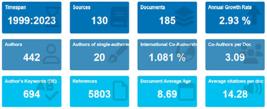
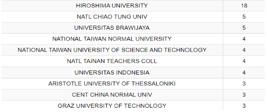
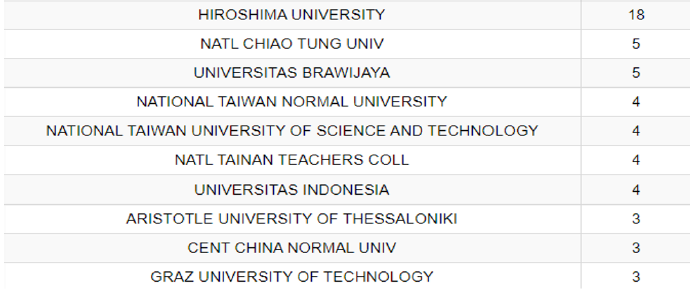
Due to research published on the pedagogical use of the collaborative learning tool Kit-Build Concept Map, whose main objective is to support learning through a process of reading content and subsequent construction of conceptual maps, Hiroshima University has stood out as the main source of references on the researched area, with 18 publications in total, mainly the from 2017 (Hiroshima University, 2021).
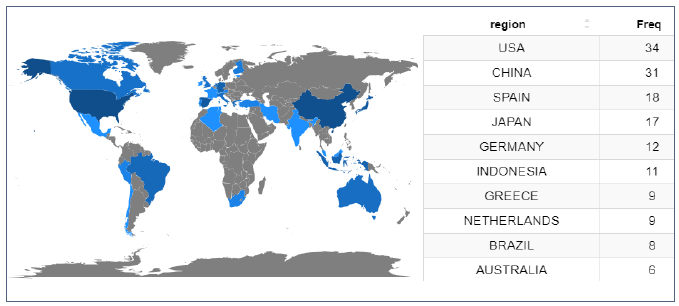
The United States has the largest scientific production, with 34 publications, followed by China, with 31. Brazil appears in 9th place this criterion. In relation to citations, this order is reversed: China is in the lead, with 62 documents, followed by the United States, with 14. In relation to citations, it is noteworthy that Brazil does not appear in the ranking. Below are analyzes relating to research questions Q1 to Q3.
5.1 Evolution of themes associated with the research question (Q1)
This subsection analyzes publications associated with the themes of the research question - semantic networks, concept maps, collaborative learning, cooperative learning and the wiki paradigm. The topic of concept maps leads, tied with collaborative learning, appearing in 74 documents. THE Kit-Build Concept Map is the main tool cited in 19 publications. Semantic themes, which include semantic networks, are referenced 12 times. Cooperation is mentioned in 23 documents, a fraction of 31% in relation to collaboration, demonstrating a greater interest in collaboration than in cooperation or, alternatively, there is no distinction between these two pedagogical practices, since often cooperative practices, in the view by Johnson and Johnson (1999), are reported to be collaborative. In relation to conceptual maps associated with the Wiki paradigm, the work of Lahti (2011) was found, from which we came to a related work, which proposed an educational framework called ConceptMapWiki, from which collections of concept maps in a Wiki environment (Open, 2015). Annex I lists the selected documents related to the topic of concept maps, while Annex II lists the selected documents related to the topic of semantic relations.
5.1.1 Most Frequent Keywords
Among the various information provided by the Biblioshiny interface, one considered relevant for understanding the evolution of research on topics related to the RSL carried out is the number of most frequent keywords (Figure 4). Three words stand out: concept maps, collaborative learning and students. By stemming, we can bring together concept maps, mapping, concept mapping and kit-build concept maps, we noticed a great emphasis on the theme of concept maps, with 98 (48+21+17+12) occurrences. Collaborative learning (collaborative learning) comes in second place, with 42 occurrences. The list of most frequent words is completed by words directly associated with pedagogical practices: students (students), computer-assisted learning (computer-aided instruction), e-learning (e-learning), and teaching (teaching).
The high frequency of keywords around the concept maps demonstrates the strength of this technique in relation to the theme researched in RSL, especially considering collaborative learning, which comes in second place.

5.1.2 Annual Scientific Production
Another question of interest for research is the trends in annual scientific production on topics related to RSL. Considering the 185 documents selected for final analysis, 59 of them were published in the last 5 years (2018 to 2022), which demonstrates the support of related lines of research. However, a drop in publications was noticed in the years 2021 and 2022. We can visualize these trends in the articles/year graph shown in Figure 5.

5.1.3 Most Relevant Institutions
The institution that has stood out most in publishing articles related to RLS themes is the Hiroshima University (Japan), due to his research with the collaborative concept map editor Kit-Build Concept Map. A predominance of research carried out in Asian institutions can be seen: Of the ten most relevant, eight are on that continent, while only two are located in Europe (Figure 6): National Chiao Tung University (Taiwan), University of Brawijaya (Indonesia), National Taiwan University of Science and Technology (Taiwan), National University of Tainan (Taiwan), University of Indonesia (Indonesia), Aristotle University of Thessaloniki (Greece), Central China Normal University (China) and Graz University of Technology (Austria).
5.1.4 Scientific Contribution by Country
From the perspective of scientific contribution by country, the United States stands out (34 publications), followed by China (31), Spain (18), Japan (17) and Germany, rounding out the five most prominent countries. Brazil appears in ninth position, with eight publications (Figure 7).

5.3 Treatments for concept disambiguation in semantic networks (Q2)
Two studies were found that addressed the issue of concept ambiguity in semantic networks. Moshkin et al. (2021) proposed an algorithm that automatically extends the core of an ontology defined in the Web Ontology Language (OWL) through semantic analyzes of an organization's Wiki resources. The proposed algorithm handles ambiguities by comparing sets of contexts of homonymous terms in Wiki pages. They concluded that the accuracy of the generated semantic network was 70%.
In the geography area, Dancer et al. (2013) proposed the use of an algorithm based on co-citation analysis (when two or more documents/authors are cited together in a subsequent search, indicating a thematic, conceptual and/or methodological proximity between those cited) to compute similarities in concepts of a collective sourcing semantic network (crowdsourced) based on data voluntarily provided to OpenStreetMap, an open and collaborative geographic database.
5.3 Concept of semantic network of concept maps (Q3)
After analyzing the selected documents, the concept of a semantic network based on concept map constructs was not identified.
6 CONCLUSION
This article began with two objectives associated with each other: 1) to present a specialized bibliometric process using the Bibliometrix package, including bib files generated by ACM, ScienceDirect and Engineering Village in addition to the originally supported search sources, which are Scopus and WoS and 2) present a systematic literature review, supported by this specialized bibliometric process, on RSMC.
Regarding the first objective, it is concluded that bibliometric techniques helped mainly in the following aspects: 1.1) since coverage was an important criterion of this review, the adaptation process for the inclusion of academic bases, in addition to those natively supported by Bibliometrix, contributed for an initial increase in documents recovered of around 42%, which was considered important for the objective of research breadth; 1.2) with just a few lines of programming, it was possible to join bib files, programmatically eliminating duplicate documents. The gain in time and quality at this stage of the process was significant.
As for academic objectives, it is understood that the most relevant result was not finding in the literature a concept equivalent to the one presented as a semantic network of concept maps. Another highlight was finding the Kit-Build Concept Map (a collaborative concept map editing tool) and ConceptMapWiki (a wiki tool based on concept maps) as related works.
In the quantitative part, works on search topics continue to be published, demonstrating growth of medium interest (around 2.93%), mainly in relation to collaborative pedagogical practices related to concept maps. The presence of innovative approaches is noted, as in the cases of related work. THE Kit-Build Concept Map, for example, took Hiroshima University to a prominent position in collaborative learning of concept maps, mainly from 2017 onwards. At the Brazilian level, the country continues to publish (9the place), but his studies have been little cited by other studies.
Since the RSL aimed to support ongoing research on promoting meaningful learning and socio-interactionist learning using the Vidya Network educational tool, whose educational resources are structured and made available in the form of a Multi-User RSMC, future work is focused in carrying out pedagogical quasi-experiments to validate this general research question, of an interdisciplinary nature, linked to Educational Informatics.
Acknowledgments:
Not applicable.
References
-
ALEGRIA, V. R. dos S. Desenvolvimento lexical no 1º ano de escolaridade: um percurso didático. 2019. Tese (Doutorado) - Instituto Politécnico de Lisboa, Escola Superior de Educação de Lisboa 2019. Disponível em: https://repositorio.ipl.pt/handle/10400.21/10958 Acesso em: 28 ago. 2024.
» https://repositorio.ipl.pt/handle/10400.21/10958 -
ARIA, M. Bibliometrix: data importing and converting. 2021. Disponível em: https://www.bibliometrixorg. Acesso em 28 maio 2023.
» https://www.bibliometrix - AUSUBEL, D. P. Aquisição e retenção de conhecimentos: uma perspectiva cognitiva. Lisboa, 2003.
- AUSUBEL, D. P. A subsumption theory of meaningful verbal learning and retention. The Journal of General Psychology, Philadelphia, PA, v. 66, n. 2, p. 213-224, 1962.
- BALLATORE, A. et al. Geographic knowledge extraction and semantic similarity in OpenStreetMap. Knowledge and Information Systems, London, v. 37, p. 61-81, 2013.
- CASTELLS, Manuel. A sociedade em rede. São Paulo: Paz e terra, 2005.
- CHRISTENSEN, A. P. et al. Remotely close associations: openness to experience and semantic memory structure. European Journal of Personality, London, v. 32, n. 4, p. 480-492, 2018.
- CRUSE, D. A. Glossary of semantics and pragmatics. Edinburgh University Press, 2006.
- CRUSE, D. A. Meaning in language: an introduction to semantics and pragmatics. 2004.
- CRUSE, D. A. Lexical semantics. Cambridge University Press, 1986.
- JOHNSON, D. W.; JOHNSON, R. T. Making cooperative learning work. Theory into Practice, Philadelphia, PA, v. 38, n. 2, p. 67-73, 1999.
- KITCHENHAM, B. Procedures for performing systematic reviews. Jul. 2004. p. 1-26, 2004. (Keele University Technical Report).
- GRANDI, R. H. et al. Rede semântica de mapas conceituais Vidya Network. Manaus, CBIE: Apps@Edu, 2022.
-
HIROSHIMA UNIVERSITY. Kit build concept map quick guide. 2021. Disponível em: https://collab.kit-build.net/documentation/quick-guide.pdf Acesso em: 4 jun. 2023.
» https://collab.kit-build.net/documentation/quick-guide.pdf - LAHTI, L. Computer-Assisted learning based on cumulative vocabularies, conceptual networks and wikipedia linkage. Aalto University, 2015.
- LAHTI, L. ConceptMapWiki - a collaborative framework for agglomerating pedagogical knowledge. In: INTERNATIONAL CONFERENCE ON ADVANCED LEARNING TECHNOLOGIES. 11., IEEE, 2011. [Proceedings of the…]. [S.l.]: IEEE, 2011. p. 163-165.
-
MOSHKIN, V.; YARUSHKINA, N.; ANDREEV, I. The extending the knowledge base of the intelligent cad of a design organization using semantic analysis of Wiki-Resources. In: RADIONOV, A.A.; GASIYAROV, V.R. (ed.). Advances in automation II. Singapore: Springer, 2021. p. 695-703. (Lecture Notes in Electrical Engineering Advances in Automation II; v.729). DOI: https://doi.org/10.1007/978-3-030-71119-1_68
» https://doi.org/10.1007/978-3-030-71119-1_68 - MCINNERNEY, J. M.; ROBERTS, T. S. Collaborative and cooperative learning. In: ENCYCLOPEDIA of Distance Learning, 2. ed. IGI Global, 2009. p. 319-326.
-
NEVADO, R. A. de et al. Debate de teses œ uma arquitetura pedagógica. In: SIMPÓSIO BRASILEIRO DE INFORMÁTICA NA EDUCAÇÃO (SBIE), 22., 2011, Aracaju. Anais do [...]. Aracaju: SBIE, 2011. Disponível em: http://milanesa.ime.usp.br/rbie/index. php/sbie/article/view/1644/1409 Acesso em: 28 ago. 2024.
» http://milanesa.ime.usp.br/rbie/index. php/sbie/article/view/1644/1409 -
NOVAK, J. D.; CAÑAS, A. J. A teoria subjacente aos mapas conceituais e como elaborá-los e usá-los. Práxis Educativa, Ponta Grossa, PR, p. 9-29, 2010. DOI: https://doi.org/10.5212/PraxEduc.v.5i1.009029
» https://doi.org/10.5212/PraxEduc.v.5i1.009029 - NOVAK, J. D.; MUSONDA, D. A twelve-year longitudinal study of science concept learning. American Educational Research Journal, Thousand Oaks, CA, v. 28, n. 1, p. 117-153, 1991.
-
PARSIFAL. About Parsifal. 2021. Disponível em: https://parsif.al/about Acesso em: 05 abr. 2023.
» https://parsif.al/about - RODRÍGUEZ-SOLER, R. et al. Worldwide trends in the scientific production on rural depopulation, a bibliometric analysis using Bibliometrix R-tool. Land Use Policy, Oxford, UK, v. 97, p. 104787, 2020.
- VIGOTSKI, L. S. A formação social da mente. 7 ed. São Paulo: Martins Fontes, 2014.
- VIGOTSKI, L. El desarrollo de los procesos psicológicos superiores. Barcelona: Crítica, 2000.
- WOLF, M. O cérebro no mundo digital: os desafios da leitura na nossa era. Editora Contexto, 2019.


-
1
Ausubel (2003, p. 2) defines concepts as objects, events, situations or properties that have common specific attributes and are designated by the same sign or symbol.
-
2
Home page: http://vidyanet.inf.ufrgs.br
-
3
English acronym for a set of RSL scope parameters: Population, Intervention, Comparison, Outcomes and Context.
-
4
Two-dimensional data structures that store data in rows and columns. Each row in a dataframe represents an observation or record, while each column represents a variable or attribute.
-
5
Lotka's Law, also known as the Inverse Square Law, is an information science law that describes the distribution of productivity among authors. According to the mathematical rule proposed by this law, the number of authors who produce n publications is inversely proportional to the square of n. In other words, a small number of authors produce a large number of publications, while most authors produce a small number of publications.
-
6
A historiographical analysis, in bibliometrics, seeks to identify trends, development patterns and changes in research perspectives over time. This may involve mapping key authors, influential journals, fundamental concepts, and important milestones in the evolution of research on a specific topic. Through this analysis, it is possible to understand how scientific ideas and debates developed, which areas received the most attention at different times and how new approaches or paradigms emerged.
-
7
RStudio online environment home page: https://login.rstudio.cloud .
Not applicable.

 Source: The authors.
 Source: The authors.
 Source: The authors.
 Source: The authors.
 Source: The authors.
 Source: The authors.
 Source: The authors.