 Accounting information and the risk of noncompliance with contracts by companies contracted by the public sector
ABSTRACT
This study aimed to develop the Contractual Noncompliance Risk Index (CNRI) to evaluate the ability of accounting data from suppliers to predict defaults in Brazilian public sector contracts. Despite advances in predictive methodologies in the private sector, there is a lack of studies that adapt these methods to the public sector. Current legislation and the heterogeneity of suppliers underscore the need for instruments that leverage accounting information more effectively. This study contributes to the literature by addressing a theoretical gap in the systematic use of accounting information for the economic and financial evaluation of public-sector suppliers. Additionally, it aligns with regulatory reforms and the 2030 Agenda, reinforcing innovation (SDG 9) and effective institutions (SDG 16) through efficiency and transparency. The CNRI promotes risk-based financial audits, contract oversight, and economic and financial qualifications, thereby enhancing the credibility of accounting records in Brazilian public procurement. We used an exploratory, quantitative approach to analyze data from 311 suppliers that participated in bids or contracts with the Superior Court of Justice (Superior Tribunal de Justiça - STJ) between 2018 and 2023. Inspired by traditional insolvency prediction models, we used logistic regression to model the probability of penalties based on accounting variables, such as indebtedness, liquidity, and ROI, as well as control variables, such as company size and penalty history. Our results showed that higher long-term indebtedness, immobilization of resources, ROI, and current liquidity reduce the risk of contractual noncompliance. Additionally, the CNRI proved effective in identifying low-risk suppliers. Control variables improved the accuracy of the CNRI by accounting for sector-specific characteristics and supplier heterogeneity. This study proposes a practical, replicable, and predictive model that improves risk management, oversight, auditing, and economic and financial qualification in Brazilian public procurement.
Keywords:
public innovation; insolvency prediction; public procurement; accounting information
RESUMO
O objetivo deste estudo foi desenvolver o Índice de Risco de Descumprimento Contratual (IRDC) para avaliar como informações contábeis de fornecedores podem prever inadimplementos em contratos do setor público brasileiro. Apesar dos avanços das metodologias preditivas no setor privado, a literatura carece de estudos que adaptem tais métodos para o setor público. A legislação atual e a heterogeneidade dos fornecedores reforçam a necessidade de instrumentos que empreguem informações contábeis de forma mais assertiva. Este estudo contribui para a literatura ao preencher uma lacuna teórica na utilização sistemática de informações contábeis para a avaliação econômico-financeira de fornecedores públicos. Além disso, ele está alinhado às reformas regulatórias e à Agenda 2030, reforçando a inovação (ODS 9) e instituições eficazes (ODS 16), com eficiência e transparência. O IRDC apoia auditorias financeiras baseadas em riscos, a fiscalização contratual e a qualificação econômico-financeira, contribuindo para a legitimação da informação contábil nas contratações públicas brasileiras. Adotamos uma abordagem exploratória e quantitativa para analisar dados de 311 fornecedores que participaram de licitações ou contratos com o Superior Tribunal de Justiça (STJ) entre 2018 e 2023. Inspirados nos tradicionais modelos de previsão de insolvência, utilizamos regressão logística para modelar a probabilidade de penalização com base em variáveis contábeis, como endividamento, liquidez e ROI, além de variáveis de controle, como porte empresarial e histórico de penalidades. Identificamos que maior endividamento de longo prazo, imobilização de recursos, ROI e liquidez corrente reduzem o risco de descumprimento contratual. Além disso, o IRDC se mostrou eficaz na identificação de fornecedores de baixo risco. Variáveis de controle aprimoraram a assertividade do IRDC, ao contemplarem características setoriais e a heterogeneidade dos fornecedores. Este estudo propõe um modelo prático, replicável e preditivo, que contribui para aprimorar a gestão de riscos, a fiscalização, a auditoria e a habilitação econômico-financeira nas contratações públicas brasileiras.
Palavras-chave:
inovação pública; previsão de insolvência; contratações públicas; informações contábeis
1 INTRODUCTION
The New General Public Procurement Law (Brazil, 2021) exacerbates the challenges of contract management in the Brazilian public sector. The lack of transparency in bidding exemptions during emergencies (Precinotto et al., 2023), technical difficulties in overseeing contracts (Bedin et al., 2020), and administrative leniency in applying penalties (Luiz et al., 2023) underscore the need for enhanced qualification, oversight, and control processes, emphasizing the imperative for novel approaches to managing contractual risks.
This situation is further complicated by restrictions on the use of suppliers' accounting information (Alsharari, 2022; Jorge et al., 2021; Lapsley & Miller, 2019; van Helden et al., 2021). Often, bidding rules do not align with best accounting practices because they restrict the use of minimum profitability, earnings, and revenue indicators as economic and financial qualification criteria (Azevedo & Ribeiro, 2020; Michelin et al., 2012; Ribeiro et al., 2021). Furthermore, the lack of standardization in the use of economic and sectoral indices, which are often disconnected from the diversity of bidder sizes and segments, makes consistent application difficult (Michelin et al., 2012; Ribeiro et al., 2020).
Although accounting information is fundamental to qualifying bidders, there are no predictive tools for applying it to the public sector. Since the 1960s, methods have existed for predicting financial difficulties in private companies (Altman, 1968; Altman et al., 1979; Ohlson, 1980; Shumway, 2001; Zmijewski, 1984). However, their adaptation to the Brazilian public sector is still in its infancy.
These predictive statistical models, based on accounting information from companies, have the potential to promote efficiency, transparency, and risk mitigation in private management (Almaskati et al., 2021; Barboza & Altman, 2024; Bittencourt & Albuquerque, 2020; Ma'in et al., 2022; Nyitrai, 2019; Rezende et al., 2017; Rosa & Gartner, 2018; Salotti & Carvalho, 2024; Zhang & Nielson, 2015). However, we did not find any studies that systematically explore the application of these models in evaluating suppliers that contract with the government, except for the report by Sobreira et al. (2014). They used discriminant analysis to test the qualification hypothesis on 20 contracted companies, 20% of which did not complete their projects.
Thus, we identify a gap in the literature and legislation, which underscores the need for instruments that can leverage accounting information more effectively in evaluating suppliers to Brazilian public entities. These tools could provide alternatives to the technical use of profitability or return indices, going beyond minimum indicators prohibited by law. They could also establish parameters for economic and financial qualification and contractual guarantees. This would expand the legitimate use of suppliers' accounting information for risk mitigation actions such as audits and contractual inspections.
In this context, the research poses the following question: "How can suppliers' accounting information predict the likelihood of contractual noncompliance in the public sector?" The objective is to develop the Contractual Noncompliance Risk Index (CNRI) to anticipate default risks and further the reflections of Bonelli and Cabral (2018) regarding the influence of bidders' financial capabilities on contractual performance.
This topic is relevant because it contributes to both practice and the literature by filling a theoretical gap and using accounting information to systematically assess the economic and financial situation of public suppliers. Furthermore, this study addresses the need for innovation and effective governance in public procurement, aligning with Sustainable Development Goals 9 and 16 (United Nations, 2015). The proposed model aims to foster the creation of resilient and innovative public infrastructure (SDG 9) and strengthen effective and transparent institutions (SDG 16).
2 CHALLENGES OF ACCOUNTING INFORMATION IN PUBLIC PROCUREMENT
In the Brazilian public sector, the acquisition and sale of goods and services occurs through bidding. Only technical and economic requirements essential for fulfilling obligations are permitted (Brazil, 1988). According to Article 61 of the New Procurement Law (Brazil, 2021), qualification is defined as the verification of information and documents that prove the bidder's capacity. This includes legal, technical, fiscal, social, labor, and economic-financial qualifications.
Economic and financial qualification (EFQ) requires bidders to demonstrate the availability of resources through accounting information that guarantees satisfactory contract execution (Di Pietro, 2021). However, bidding rules are not aligned with recommended accounting practices. It is not possible to use profitability, return, or minimum billing amount indicators for EFQ (Azevedo & Ribeiro, 2020; Michelin et al., 2012; Ribeiro et al., 2021).
Research indicates that the government often disregards the rules for presenting financial statements, resulting in the acceptance of inconsistent accounting data that does not adhere to primary accounting standards. This practice may encourage smaller suppliers to disregard the importance of maintaining accurate accounting records (Costa & Guimarães, 2020; Lester et al., 2013; Ribeiro et al., 2021).
Reports indicate a lack of mechanisms to verify commitments made to the private or public sector, as well as a lack of attention to academic training in public procurement issues (Ribeiro et al., 2021). Additionally, the lack of standardization in the use of economic indicators and sector indices, which are often disconnected from the diversity of bidders' sizes and areas of activity, can render them inapplicable (Michelin et al., 2012; Ribeiro et al., 2020). Thus, the literature suggests that, due to the aforementioned barriers, accounting information in public procurement is used ceremonially (Dalescio & Machado, 2024; Ribeiro et al., 2020).
3 INSOLVENCY PREDICTION
Insolvency prediction models aim to predict whether companies will succeed or fail by anticipating financial difficulties. Using past economic and financial indicators, these models predict a company's insolvency. Since Beaver's seminal work in 1966, a substantial body of literature on insolvency prediction has emerged, influencing the commercial sector and the development of predictive models for commercial insolvency (Gissel et al., 2007). Most of these models use a dichotomous dependent variable, assigning "1" to insolvent companies and "0" to solvent ones.
Wu et al. (2010) point out that several key models have been introduced to the insolvency prediction literature by renowned authors. These include Altman's (1968) multiple discriminant analysis (MDA) model, which focuses on accounting variables; Ohlson's (1980) logistic regression model, which uses accounting ratios; Zmijewski's (1984) probabilistic regression model, which uses accounting data; Shumway's (2001) risk model, which combines accounting and market variables; and Hillegeist et al.'s (2004) BSM-Prob model, which uses both accounting and market variables.
In the Brazilian context, Soares et al. (2021) conducted a bibliometric study on insolvency prediction models, referencing studies that used discriminant analysis to evaluate indicators of liquidity, profitability, and indebtedness. Sobreira et al. (2014) used discriminant analysis to evaluate companies' qualifications for public contracts. Prado et al. (2019) identified important economic and financial indicators, including working capital, liquidity, return on equity, net margin, debt ratio, and net equity to assets. They used techniques such as discriminant analysis, logistic regression, and neural networks to make these predictions, finding that neural networks were the most accurate. Machado and Gartner (2018) investigated corporate fraud in Brazilian banking institutions using logit models. Fuhr et al. (2020) emphasized the prevalence of logistic regression and the increasing use of advanced credit techniques.
The relevance of logistic regression is also emphasized in Barboza and Altman's (2024) study, in which they compared the performance of this model with that of random forest (RF) in predicting financial difficulties in Latin American companies. Despite the advantages of RF in dealing with nonlinearities and complex patterns, the authors emphasize that logistic regression remains a widely trusted and used tool.
4 METHODOLOGICAL PROCEDURES
This is an applied study with an exploratory objective and a quantitative approach. We investigated companies involved in bids or contracts with the Superior Court of Justice (Superior Tribunal de Justiça - STJ), the locus of the research. We used secondary data, including contracts, laws, reports, STJ regulations, public tax data, and suppliers' financial statements. We collected this data via Application Programming Interfaces (APIs) or databases of computerized court data. The cross-sectional analysis, covering 2018 to 2023, compares companies that were and were not penalized by the STJ using accounting and control variables.
4.1 Penalties Applied by the STJ: The Dependent Variable
The STJ imposes penalties, including warnings, fines, and temporary suspensions, as provided for in specific legislation. The binary dependent variable used in the logistic regression was defined as a penalized (1) or non-penalized (0) company. Penalized companies received significant sanctions requiring more rigorous administrative processes. Companies that received minor penalties, such as fines up to R$1,000, were considered non-penalized because such penalties do not require complex procedures.
4.2 Population and Sample of Suppliers
According to the STJ's Business Intelligence Panel on Bids, Purchases, and Contracts (2023), the court entered into contracts worth approximately R$984 million with 430 suppliers. Between 2018 and 2023, the court imposed 349 penalties on 171 suppliers. Of those penalties, 192 were imposed on 80 contract performers (18% of the total). The rest refer to violations in acquisitions or improper participation in bids.
The study sample includes 311 suppliers who performed contracts or participated in bids with the STJ. Their contracts total R$708 million, representing 72% of the total contracted during the period. The sample includes data from 2018 to 2023 that is not necessarily continuous and includes 68 penalized suppliers, accounting for approximately 22% of the sample.
4.3 Independent Variables: Suppliers' Accounting Information
We used 15 independent variables, which are detailed in Table 1 and are based on accounting references from the literature on insolvency prediction.
4.4 Control Variables
Control variables isolate the effect of external factors on the relationship between the main variables and the outcome (Hair et al., 2009). In accordance with Bittencourt and Albuquerque (2020), seven legal and economic variables (Table 2) were selected to identify sectors of activity and capture heterogeneity among companies.
The legal variables include the company's legal nature and penalties imposed by other agencies. The legal nature adheres to corporate law guidelines and those of the Brazilian Federal Revenue Service. The number of penalties recorded in Unified Suppliers Registration System (Sistema de Cadastramento Unificado de Fornecedores - SICAF), a database that centralizes Brazilian government supplier qualification documents, serves as an indicator of historical compliance in public procurement (Bonelli & Cabral, 2018; Nepomuceno et al., 2022).
The economic variables include the company's main economic activity, level of diversification, age, and value of contracts with the STJ. According to Bittencourt and Albuquerque (2020), the economic activity, identified by the National Classification of Economic Activities (Classificação Nacional de Atividades Econômicas - CNAE), allows us to assess how different sectors and the scope of operations influence compliance and the risk of penalties.
Several studies (Bonelli & Cabral, 2018; Wu et al., 2010; Zhang & Nielsen, 2015) have shown that the level of diversification, measured by the number of secondary CNAEs, and the age of the company are determining factors. Rodrigues and Torre Junior (2015) note that, due to regulatory restrictions, higher-value contracts can affect the quality of services provided, especially in long-term contracts.
Finally, the control variable "company size" is qualitative and classifies companies according to the Brazilian Accounting Standard ITG 1000 (Brazil, 2022). Companies with gross revenue exceeding R$300 million or assets above R$240 million are considered large. Those with revenue between R$78 million and R$300 million are considered medium-sized. Those with revenue between R$4.8 million and R$78 million are considered small. Those with revenue of up to R$4.8 million are considered micro entities.
4.5 Data Collection, Processing, and Analysis
We use accounting data from suppliers registered in the Accounting Information Registry (CIC). The CIC was institutionalized by the STJ in 2019 and 2022 and implemented in 2018. It enabled the creation of a detailed database in accordance with the court's EFQ rules, which limited the scope of the analysis to data from that year onwards. To generate reports with the necessary financial indicators, the CIC records various analytical accounts from the balance sheet and income statement, attaches financial statements, and verifies compliance with basic formalities. Permanent court employees with training in accounting sciences, who are assigned to the STJ's Accounting Support Commission for Contracts (CACC), perform this task. Information on sanctions, contract values, amendments, deadlines, and suppliers was obtained from the Business Intelligence Panel for Bids, Purchases, and Contracts on the STJ Transparency Portal (2023). The agency authorized the use of this information for research purposes because it is public and not available via APIs.
Control variables related to economic activity, penalties imposed by other agencies, company age, and legal status were collected via public data APIs from the Federal Executive Branch, thereby expanding the set of variables for analysis (Brazil, 2023a, 2023b). We processed the data on the Microsoft Power BI® platform and created a Microsoft Excel® database for statistical analysis in Stata®, with a dynamic connection that updates the data as the BI platform is updated. We generated graphs and reports using the Python language packages "matplotlib" and "numpy."
We adopted the logit (or logistic) model, which is widely used to analyze relationships between binary dependent variables (e.g., yes/no) and categorical or continuous independent variables (Fávero & Belfiore, 2024; Hosmer et al., 2000). We chose this model due to its interpretive clarity and ease of application in the STJ, where decisions require transparent and comprehensible analyses. Although machine learning techniques such as regression trees, random forests, boosting, and neural networks are more effective, they are too complex to be easily interpreted or implemented (Souza & Melo, 2024). Thus, the logit model strikes a balance between statistical robustness and applicability to the context studied.
5 DESCRIPTION AND ANALYSIS OF RESULTS
5.1 Transformation of Variables and Descriptive Statistics
We automated the process of transforming the variables using a Stata® software (version 18) do.file script. The initial dataset included 22 variables (accounting and control) and 834 observations. We generated dummy variables to represent categories such as supplier size, CNAE, and legal nature. The data and script used in the analyses are available in a public repository (Santiago, 2024) to ensure transparency and reproducibility of the results. To address missing values, we replaced the zero value of the "contract value" variable with one and created the variable "log_vlrcontrato," which corresponds to the natural logarithm of the contract value. This normalization facilitates the interpretation of the coefficients in the regression.
For the variables asset turnover, operating and net margin, ROI (Return on Investment), and ROE (Return on Equity), we imputed missing data with the mean. This is a widely used practice in statistical analyses to preserve sample size and minimize bias (Little & Rubin, 2002). This approach assumes that the missing data occur randomly (Missing At Random - MAR). The mean calculations were performed by ignoring the missing values, as shown in Table 3.
Since the averages were calculated by ignoring missing values, the number of valid observations reflects only those in the database. Therefore, the total number of valid observations and imputations for each variable is sometimes less than 834 due to the automatic exclusion of missing observations during the calculation of the average. The "Percentage of Imputations (%)" column represents the ratio of "Number of Imputations" to the total number of observations (834). After transformation, the data were randomly divided into training (80%) and test (20%) sets while maintaining balance in the classes of the binary dependent variable (penalized/non-penalized), as shown in Figure 1.

Using unbalanced data provides a more realistic view of the phenomenon since healthy companies are more common in real-world scenarios. Barboza and Altman (2024) pointed this out when they analyzed the prediction of financial difficulties in Latin American companies by comparing logistic models and random forest.

We performed descriptive statistics on all continuous variables, as shown in Figure 2. Variables such as current liquidity and overall solvency have high mean values and dispersion, indicating that some companies have high liquidity and solvency levels, while others have working capital issues. In contrast, debt composition and operating margin show less dispersion, reflecting greater homogeneity in capital structure and operating profitability. The median age of the companies is 20 years, revealing a mixed sample of new and established companies. The wide range in contract value and the number of penalties imposed by other agencies suggests diversity in financial volume and risk profile. These results highlight the striking differences in the companies' financial profiles.
The distribution of suppliers by size revealed that 11.10% of the companies were large, 16.76% were medium-sized, 11.21% were micro entities, and 60.94% were small. The distribution by CNAE showed several categories with frequencies ranging from 0.11% to 0.77%.
5.2 Logistic Regression Models for Predicting Contractual Noncompliance
We developed three logistic regression models to predict contractual noncompliance. All models had a chi-square test p-value of 0.000, indicating statistical significance greater than the null model (Fávero & Belfiore, 2024; Hair et al., 2009).
The initial model included all accounting and control variables (the CNRIcom model). Additionally, we created stepwise models with 5% (CNRI05) and 10% (CNRI10) significance levels, which simplified the analysis without significantly reducing its effectiveness. Due to the exploratory nature of the research, the diversity of criteria adopted in the studies reviewed, and the absence of a general theory on the choice of explanatory variables for predicting insolvency or financial difficulty, we opted for automated variable selection (Rezende et al., 2017; Tascón-Fernández & Castaño-Gutiérrez, 2012).
We assessed the quality of the model fit using the Hosmer-Lemeshow test, which checks whether the observed probabilities differ significantly from the expected ones. The null hypothesis (H₀) posits that these probabilities are equivalent, indicating an adequate fit. If the p-value is greater than 0.05, the difference is not statistically significant, which validates the model's fit to the data (Fávero & Belfiore, 2024; Hosmer et al., 2000). The results confirmed a good fit for the three models, all of which had p-values greater than 0.05: CNRIcom (p = 0.68), CNRI05 (p = 0.41), and CNRI10 (p = 0.42).
To select the most appropriate model, we applied the likelihood ratio test (LRT), which compares the quality of fit between nested models. The LRT uses the chi-square statistic (Chi²), which is based on the difference between the likelihoods of the models. The degrees of freedom correspond to the difference in the number of parameters. The LRT assesses whether the more complex model fits significantly better than the simpler one. If the p-value is less than 0.05, then H₀ is rejected, indicating that the more complex model fits significantly better (Fávero & Belfiore, 2024; Hosmer et al., 2000).
According to Table 4, the LRT results showed that the complete model (CNRIcom) significantly outperforms the CNRI05 model (p = 0.0031, p < 0.05) and that the CNRI10 model significantly outperforms the CNRI05 model (p = 0.0002, p < 0.05). However, the p-value of 0.3423 (p > 0.05) when comparing CNRI10 with CNRIcom does not allow us to reject the null hypothesis, indicating that CNRIcom is not statistically superior to CNRI10.
Based on the LRT results, the CNRI10 model fit was comparable to that of the complete model, but it was simpler. Thus, we adopted the CNRI10 model as the final model for the Supplier Contractual Noncompliance Risk Index because it balances parsimony and statistical robustness.
5.3 Final Model of the Supplier Contractual Noncompliance Risk Index
Figure 3 shows the results of the final logistic regression model of the Contractual Noncompliance Risk Index (CNRI). The CNRI model equation is based on formula (1) and the information in Figure 3, as shown below.
in which: constant: ; accounting variables: ; control variables: .

Of the accounting variables, the composition of indebtedness has a negative and significant effect (coefficient = -3.845117), indicating that companies with a higher proportion of long-term debt are at lower risk of penalty. This finding aligns with those reported by Prado et al. (2019), Soares et al. (2021), and Ma'in et al. (2022), who assert that long-term financing promotes financial stability and contract fulfillment.
On the other hand, ROI (coefficient = -1.716815) reveals that a high return on investment reduces the probability of penalties. This suggests that companies focused on internal investments are better prepared to honor contracts with the court (Marion, 2019). However, the lack of significance of ROE indicates that returns on equity are indifferent to contractual performance. This may be due to practices that prioritize shareholder interests over investment in operations, as suggested by Kanitz (1978) and Prado et al. (2019).
Current liquidity (coefficient = -0.3159842) and overall liquidity (coefficient = 1.07931) have opposing effects. While current liquidity positively reflects the ability to meet short-term obligations, high overall liquidity may signal excessive resource allocation and indicate a higher risk of penalties. Bonelli and Cabral (2018) argue that companies with good short-term liquidity ratios tend to avoid risky financial practices, maintaining sustainable bids and reducing the risk of default.
Among the control variables, the legal nature of the company is an important factor. Companies categorized as closed corporations are less likely to be penalized, possibly due to the regulatory rigor and transparency practices required of these organizations (coefficient = -3.641822).
The number of secondary CNAEs (coefficient = -0.0313374) suggests that diversified companies are less vulnerable to sectoral risks. This finding aligns with the work of Wu et al. (2010) and Zhang and Nielson (2015), who associated diversification with resilience and compliance.
The number of penalties imposed by other agencies (coefficient = 0.1240055) positively correlates with the probability of penalties imposed by the STJ, reflecting potential structural or behavioral issues impacting compliance. Studies by Nepomuceno et al. (2022) and Jiménez-Triana and Pérez-Arango (2018) suggest that a history of penalties may indicate recurring failures in quality and compliance practices.
The contract value (coefficient = 0.1530698) is associated with a higher probability of penalties. This may be due to greater scrutiny of high-value contracts, as suggested by Rodrigues and Torre Junior (2015). According to the literature, long-term, high-value contracts tend to attract greater monitoring and regulation, which can affect supplier compliance.
Large and medium-sized companies are less likely to be penalized due to their more robust governance practices, while micro-entities are more susceptible to sanctions because their processes are less formalized. Wu et al. (2010) and Barbosa (2006) point out that larger companies have easier access to government information, which favors compliance. In contrast, smaller companies face greater financial and operational vulnerability, as discussed by Crisóstomo et al. (2012).
Finally, sector characteristics captured through the CNAE showed that contracts involving companies that provide outsourced labor (CNAE 78.302-00) and information and communication technology services (CNAE 4751-2-01, 61.10-8-03, and 62.09-1-00) present a higher risk of noncompliance. Similarly, companies in the building construction sector - often associated not only with construction and maintenance, but also labor outsourcing due to tax benefits - also exhibit a higher risk. These findings corroborate those of Bittencourt and Albuquerque (2020), who emphasize the importance of considering heterogeneity among companies when improving insolvency prediction models based on sectoral and economic characteristics.
5.4 Predictive Power of the CNRI: Sensitivity and Specificity
Sensitivity and specificity are measures of the accuracy of predictive models. Sensitivity correctly identifies positive cases (penalized suppliers), while specificity correctly identifies negative cases (non-penalized) (Fávero & Belfiore, 2024; Hair et al., 2009; Hosmer et al., 2000; Menard, 2002). Despite the differences between the samples, the performance of the CNRI10 model on the training and test data confirms its good predictive ability.
In the training set, the model had a sensitivity of 69.92%, correctly identifying approximately 70% of penalized companies. Its specificity was 85.51%, correctly classifying approximately 86% of non-penalized companies. The correct classification rate was 79.54%, and the area under the ROC curve (AUC) was 0.8869, indicating the model's high ability to distinguish between penalized and non-penalized companies.
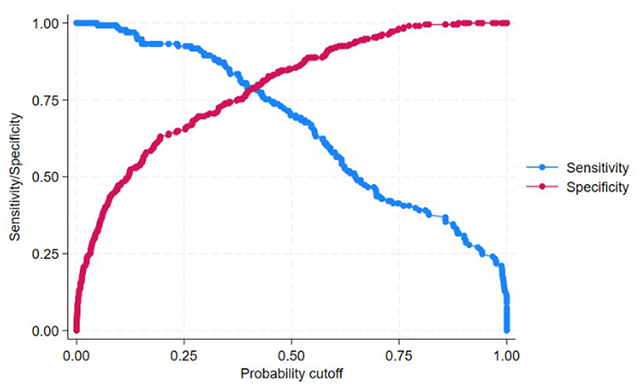
In the test set, analysis using the standard cutoff of 0.5 revealed a sensitivity of 42.00% and a specificity of 87.93%, resulting in a correct classification rate of 74.10%. Compared to the training set, the model's ability to detect penalized companies decreased, though its accuracy in classifying non-penalized companies remained high.

After analyzing the graph generated by Stata's lsens command (Figure 4), we adjusted the cutoff to 0.42 (CNRI = 42%) in the test set according to the intersection of the sensitivity and specificity curves. With this modification, sensitivity increased to 46.00%, while specificity decreased to 77.59%. The correct classification rate decreased slightly to 68.07%, reflecting the trade-off between increased sensitivity and a slight reduction in specificity.
The results suggest that the CNRI model performs well with high specificity in both samples analyzed. It should be noted that sensitivity is affected by the natural imbalance between penalized and non-penalized companies. This is consistent with literature highlighting the lower recurrence of companies in financial difficulty compared to solvent companies (Barboza & Altman, 2024; Bittencourt & Albuquerque, 2020; Rezende et al., 2017; Rosa & Gartner, 2018).
Thus, the lower sensitivity observed should not be interpreted as a significant limitation of the CNRI model, but rather as an inherent characteristic of the context analyzed. This aspect reinforces the model's potential as an effective tool for identifying companies with a high probability of satisfactory contract execution. The interpretation is corroborated by an AUC of 0.70 in the test set, which demonstrates adequate overall predictive capacity. This strengthens the practical applicability of the CNRI, as discussed in Section 5.6.
5.5 Assessment of Multicollinearity and Impact on the CNRI model
The model's independent variables revealed multicollinearity in the correlation matrix, especially between current liquidity and overall liquidity, as well as between these and financial independence (Figure 5). We performed tests to combine and exclude these correlated variables but found that doing so resulted in a significant loss of predictive power. However, given this study's objective to replicate the model for contractual risk management rather than analyze the determining factors for contractual noncompliance in detail, we kept the variables in the model to maximize predictive accuracy.
According to the findings of Souza and Melo (2024) on how some statistical techniques impose difficulties on both interpretation and practical implementation, additional statistical techniques, such as factor analysis and principal component analysis, could reduce multicollinearity but would compromise the practical applicability of the model due to the complexity of interpretation and the difficulty of generalization to new observations.

Future research should investigate ways to address multicollinearity and improve the robustness of the CNRI model without compromising practical replication. This can be achieved by applying approaches that refine variable selection and improve the interpretation of coefficients.
5.6 Practical Implications for the Predictive Model
The CNRI innovates economic and financial assessment in public procurement by complementing usual indicators and providing additional support in uncertain scenarios. Presented on a scale from 0% to 100%, the CNRI facilitates interpretation for non-specialist civil servants. It is recommended that it be applied when there is uncertainty about the supplier's financial soundness, serving as a trigger for risk-based audits.
Although Law 14,133/2021 permits the use of financial indices for qualification if justified in the public notice, as explained in Section 2, bidding rules and case law do not always reflect the best accounting practices in practice. This discrepancy limits the full use of profitability, return, and revenue indicators, underscoring the need for more comprehensive tools. In this sense, despite its technical accounting relevance, the CNRI may face questions from a formalistic legal perspective for including indices such as return on investment (ROI). However, a more appropriate legal and accounting interpretation should acknowledge that, while the legislation prohibits requiring minimum profitability or return indices for qualification, it does not prohibit using these indices as variables in predictive models to evaluate contractual default risk. Additionally, the CNRI does not establish minimum thresholds for these indicators because their results depend on the mathematical weighting of the regression coefficients used. Thus, a low or negative ROI may not significantly impact the CNRI result.
Due to the statistical complexity and the amount of data required, it is recommended that preparation be centralized within higher-level bodies, such as the Ministry of Management and Innovation in Public Services, in partnership with the Federal Revenue Service. Integrating structured government databases (the Digital Accounting Bookkeeping of the Brazilian Federal Revenue Service's Public Digital Bookkeeping System and SICAF) and creating specific governance would enable coordination of the necessary institutional, technological, and procedural dimensions. Furthermore, it is essential to train civil servants responsible for accounting analysis with the support of the CNRI. This training would entail establishing sectoral centers within decentralized public agencies. These centers would be composed of accountants who support areas of procurement, bidding, and contracts. This would overcome the barriers identified in Section 2 of this study. Thus, the index will extend beyond mere formal adoption, effectively improving economic governance.
In addition, the CNRI can be useful for managing risks during contract execution, as outlined in Article 169 of Law No. 14,133/2021. Inspired by Sobreira et al.'s (2014) model, the index would encourage good practices and increase oversight rigor when necessary. For example, the bonus would be applied to companies with a CNRI below the 42% cutoff, which is classified as low risk. These companies could receive benefits, such as a reduction in the minimum contractual guarantee, due to the lower risk of penalties.
Conversely, the concept of malus applies to suppliers with a high CNRI (above 42% or 50%), indicating a higher risk level. For these companies, contractual clauses should require a more robust guarantee and strict monitoring, especially in areas such as compliance with labor and social security funds. In labor outsourcing contracts, this could entail expanding the scope of sampling to verify these payments beyond what would be necessary under lower-risk conditions.
6 CONCLUSIONS
This study demonstrated how accounting information can predict the risk of contractual noncompliance in the Brazilian public sector by developing the Contractual Noncompliance Risk Index (CNRI). We applied a logistic regression model to data from the Superior Court of Justice (STJ). The results revealed that accounting variables such as debt composition, immobilization of net equity, financial independence, current liquidity, and return on investment (ROI) significantly predict the probability of supplier penalties.
Suppliers with a higher proportion of long-term debt, greater immobilization of resources, greater financial independence, and a higher ROI were found to have a lower risk of contractual noncompliance. Conversely, the lower the current liquidity, the greater the likelihood of supplier penalties. Additionally, using control variables related to CNAE, company size, and legal nature, we found evidence supporting the consideration of sectoral differences due to company heterogeneity.
This study contributes to the literature by proposing an innovative, predictive index for managing contractual risk based on suppliers' accounting data. The CNRI fills a technical and regulatory gap by suggesting an alternative use of accounting information in public procurement governed by Law 14,133/2021, thereby strengthening decision-making and governance in the public sector.
However, the study has methodological limitations. For example, multicollinearity was identified between some of the independent variables, as discussed in Section 5.5. Additionally, the CNRI was calibrated specifically for the STJ context, using historical data from that institution. Therefore, direct replication in other agencies is not recommended, as risk profiles and analysis criteria may vary, which influences the performance and relevance of the variables used. Thus, recalibrating the model for other contexts and adapting it to the specific data and characteristics of each institution is recommended to ensure the accuracy of forecasts and decisions based on the CNRI.
Future research should investigate ways to address multicollinearity in order to improve the robustness of the CNRI model without compromising practical replication. This can be achieved by applying approaches that refine variable selection and improve the interpretation of coefficients. For theoretical purposes, exploring additional statistical techniques such as factor analysis or principal component analysis to address multicollinearity and refine variable selection is suggested. Another interesting approach would be to compare the accuracy of logit models with machine learning models, such as random forest (RF), as Barboza and Altman (2024) did in the case of financial distress.
The practical implications of this study are significant for contractual risk management in the public sector. The CNRI can complement traditional EFQ indices, assist in contract enforcement, and support audits. It provides a more robust, preventive assessment of noncompliance risk.
The findings of this study also contribute to the implementation of the 2030 Agenda, particularly SDGs 9 and 16 (United Nations, 2015). By proposing an innovative predictive tool for contractual risk management, the study helps align public tenders with the goals of promoting resilient infrastructure and innovation (SDG 9) and strengthening effective, transparent institutions (SDG 16).
REFERENCES
-
Almaskati, N., Bird, R., Yeung, D., & Lu, Y. (2021). A horse race of models and estimation methods for predicting bankruptcy. Advances in Accounting, 52, 100513. https://doi.org/10.1016/j.adiac.2021.100513
» https://doi.org/10.1016/j.adiac.2021.100513 -
Alsharari, N. M. (2022). Institutionalization of results-based budgeting in the public sector: political and economic pressures. Asian Review of Accounting, 30(3), 352-377. https://doi.org/10.1108/ARA-02-2022-0037
» https://doi.org/10.1108/ARA-02-2022-0037 -
Altman, E. (1968). Financial ratios, discriminant analysis and the prediction of corporate bankruptcy. The Journal of Finance, 23(4), 589-609. https://doi.org/10.1111/j.1540-6261.1968.tb00843.x
» https://doi.org/10.1111/j.1540-6261.1968.tb00843.x -
Altman, E., Baidya, T. K. N., & Dias, L. M. R. (1979). Previsão de problemas financeiros em empresas [Prediction of financial distress in firms]. Revista de Administração de Empresas [Journal of Business Administration], 19(1), 17-28. https://doi.org/10.1590/S0034-75901979000100002
» https://doi.org/10.1590/S0034-75901979000100002 -
Azevedo, R. R. de, & Ribeiro, R. B. (2020). A relevância (des)percebida da informação contábil [The (un)perceived relevance of accounting information]. Revista Mineira de Contabilidade [Minas Gerais Accounting Review], 21(2), 4-9. https://revista.crcmg.org.br/rmc/article/view/1295
» https://revista.crcmg.org.br/rmc/article/view/1295 -
Barbosa, R. R. (2006). Uso de fontes de informação para a inteligência competitiva: um estudo da influência do porte das empresas sobre o comportamento informacional [Use of information sources for competitive intelligence: A study on the influence of company size on informational behavior]. Encontros Bibli: Revista Eletrônica de Biblioteconomia e Ciência da Informação [Electronic Journal of Librarianship and Information Science], 11(1), 91-102. https://doi.org/10.5007/1518-2924.2006v11nesp1p91
» https://doi.org/10.5007/1518-2924.2006v11nesp1p91 -
Barboza, F., & Altman, E. (2024). Predicting financial distress in Latin American companies: A comparative analysis of logistic regression and random forest models. The North American Journal of Economics and Finance, 72, 102158. https://doi.org/10.1016/j.najef.2024.102158
» https://doi.org/10.1016/j.najef.2024.102158 -
Beaver, W. H. (1966). Financial ratios as predictors of failure. Journal of Accounting Research, 4, 71-111. https://doi.org/10.2307/2490171
» https://doi.org/10.2307/2490171 -
Bedin, É. P., Fontes, A. R. M., & Braatz, D. (2020). Discrepancy between prescribed and real work: the case of outsourced service contract supervisors at federal universities in the state of São Paulo. Revista Brasileira de Gestão de Negócios [Brazilian Journal of Business Management], 22(2), 232-249. https://doi.org/10.7819/rbgn.v22i2.4055
» https://doi.org/10.7819/rbgn.v22i2.4055 -
Bittencourt, W. R., & Albuquerque, P. H. M. (2020). Evaluating company bankruptcies using causal forests. Accounting & Finance Review, 31(84), 542-559. https://doi.org/10.1590/1808-057X202010360
» https://doi.org/10.1590/1808-057X202010360 -
Bonelli, F., & Cabral, S. (2018). Efeitos das competências no desempenho de contratos de serviços no setor público [Effects of competences on the performance of public service contracts]. Revista de Administração Contemporânea [Journal of Contemporary Administration], 22(4), 487-509. https://doi.org/10.1590/1982-7849rac2018170152
» https://doi.org/10.1590/1982-7849rac2018170152 -
Brazil. (1988). Constituição da República Federativa do Brasil de 1988 [Constitution of the Federative Republic of Brazil, 1988]. Presidência da República. https://www.planalto.gov.br/ccivil_03/constituicao/constituicao.htm
» https://www.planalto.gov.br/ccivil_03/constituicao/constituicao.htm -
Brazil. (2021). Lei nº 14.133, de 1º de abril de 2021 [Public Procurement Law No. 14,133/2021]. Presidência da República. https://www.planalto.gov.br/ccivil_03/_ato2019-2022/2021/lei/l14133.htm
» https://www.planalto.gov.br/ccivil_03/_ato2019-2022/2021/lei/l14133.htm -
Brazil. (2022). Norma Brasileira de Contabilidade, ITG 1000, de 15 de dezembro de 2022 [Brazilian Accounting Standard ITG 1000, December 15, 2022]. Conselho Federal de Contabilidade. https://cfc.org.br/wp-content/uploads/2023/01/ITG-1000.pdf
» https://cfc.org.br/wp-content/uploads/2023/01/ITG-1000.pdf -
Brazil. (2023a). Dados Abertos do Sistema Integrado de Administração e Serviços Gerais - SIASG [Open Data from the Integrated System of Administration and General Services]. https://dados.gov.br/dados/conjuntos-dados/compras-publicas-do-governo-federal
» https://dados.gov.br/dados/conjuntos-dados/compras-publicas-do-governo-federal -
Brazil. (2023b). Portal de Dados Abertos - Cadastro Nacional da Pessoa Jurídica [Open Data Portal - National Registry of Legal Entities]. https://dados.gov.br/dados/conjuntos-dados/cadastro-nacional-da-pessoa-juridica---cnpj
» https://dados.gov.br/dados/conjuntos-dados/cadastro-nacional-da-pessoa-juridica---cnpj -
Costa, E. G. da, & Guimarães, F. M. P. (2020). A utilização de índices econômico-financeiros em licitações [The use of financial ratios in public procurement]. Revista do Tribunal de Contas do Estado de Minas Gerais [Journal of the Court of Accounts of Minas Gerais State], 38(1), 44-60. https://revista.tce.mg.gov.br/pagina/article/view/13/2020-38-01-005
» https://revista.tce.mg.gov.br/pagina/article/view/13/2020-38-01-005 - Crisóstomo, V. L., López-Iturriaga, J., & Vallelado, E. (2012). Firm size matters for financial constraints: evidence from Brazil. Sistemas & Gestão [Systems & Management], 7(3), 490-501.
-
Dalescio, S. T. M. de R., & Machado, L. de S. (2024). Revisão da literatura sobre habilitação econômico-financeira com ênfase em concessões dos serviços públicos de saneamento básico [Review of literature on economic-financial qualification with emphasis on concessions for public basic sanitation services]. Revista de Auditoria Governança e Contabilidade [Journal of Governmental Auditing and Accounting], 16, 32-49. https://www.revistas.fucamp.edu.br/index.php/ragc/article/view/3497
» https://www.revistas.fucamp.edu.br/index.php/ragc/article/view/3497 - Di Pietro, M. S. Z. (2021). Licitação [Bidding]. In: Direito Administrativo (34th ed., pp. 423-438). Forense.
- Fávero, L. P., & Belfiore, P. (2024). Manual de análise de dados: estatística e machine learning com Excel, SPSS, Stata e Python [Manual of data analysis: statistics and machine learning with Excel, SPSS, Stata and Python]. In: Manual de análise de dados: estatística e modelagem multivariada com Excel, SPSS e Stata (2nd ed., pp. 641-723). LTC.
-
Fuhr, F., Lima, J. D. de, & Donizetti, F. J. A. S. Qj. (2020). Uma revisão sistemática da literatura sobre Credit Scoring [A systematic literature review on Credit Scoring]. Brazilian Journal of Development, 6(3), 9679-9695. https://doi.org/10.34117/bjdv6n3-009
» https://doi.org/10.34117/bjdv6n3-009 -
Gissel, J., Giacomino, D., & Akers, M. (2007). A review of bankruptcy prediction studies: 1930-present. Journal of Financial Education, 33-34(5), 1-42. https://epublications.marquette.edu/account_fac/25
» https://epublications.marquette.edu/account_fac/25 - Hair, J. F., Babin, B. J., Black, W. C., Anderson, R. E., & Tathan, R. L. (2009). Análise discriminante múltipla e regressão logística [Multiple discriminant analysis and logistic regression]. In: Análise Multivariada de Dados (6ª ed., pp. 217-298). Bookman.
-
Hillegeist, S. A., Keating, E. K., Cram, D. P., & Lundstedt, K. G. (2004). Assessing the probability of bankruptcy. Review of Accounting Studies, 9(1), 5-34. https://doi.org/10.1023/B:RAST.0000013627.90884.b7
» https://doi.org/10.1023/B:RAST.0000013627.90884.b7 - Hosmer, D. W., Lemeshow, S., & Sturdivant, R. X. (2000). Applied logistic regression (2nd ed.). John Wiley & Sons, Inc.
-
Jiménez-Triana, J. C., & Pérez-Arango, D. (2018). De la violación del principio non bis in idem en la aplicación de multas en supuestos donde hay cláusulas de descuento por indicadores de calidad en los contratos estatales [Violation of the non bis in idem principle in the application of penalties in cases with quality discount clauses in public contracts]. Revista Digital de Derecho Administrativo [Digital Journal of Administrative Law], 20(20), 241-265. https://doi.org/10.18601/21452946.n20.10
» https://doi.org/10.18601/21452946.n20.10 -
Jorge, S., Nogueira, S. P., & Ribeiro, N. (2021). The institutionalization of public sector accounting reforms: the role of pilot entities. Journal of Public Budgeting, Accounting and Financial Management, 33(2), 114-137. https://doi.org/10.1108/jpbafm-08-2019-0125
» https://doi.org/10.1108/jpbafm-08-2019-0125 - Kanitz, S. C. (1978). Como prever falências [How to predict bankruptcies]. McGraw-Hill do Brasil.
-
Lapsley, I., & Miller, P. (2019). Transforming the public sector: 1998-2018. Accounting, Auditing and Accountability Journal, 32(8), 2211-2252. https://doi.org/10.1108/AAAJ-06-2018-3511
» https://doi.org/10.1108/AAAJ-06-2018-3511 -
Lester, P., Alonso Borba, J., & Dal-Ri Murcia, F. (2013). Transparência e governança na área pública: uma análise da qualificação econômica e financeira das empresas licitantes do estado de Santa Catarina [Transparency and governance in the public sector: An analysis of the economic and financial qualification of bidding firms in the state of Santa Catarina]. Revista Eletrônica de Administração [The Electronic Journal of Administration], 15(3), 759-782. https://seer.ufrgs.br/index.php/read/article/view/39037
» https://seer.ufrgs.br/index.php/read/article/view/39037 - Little, R. J. A., & Rubin, D. B. (2002). Statistical analysis with missing data. Wiley-Interscience.
-
Luiz, E. L. C., Abib, G., & Oliveira, V. G. de. (2023). The (in)tolerance in application of penalties in the Brazilian public administration. Journal of Contemporary Administration], 27(6), e230005. https://doi.org/10.1590/1982-7849rac2023230005.por
» https://doi.org/10.1590/1982-7849rac2023230005.por -
Machado, M. R. R., & Gartner, I. R. (2018). The Cressey hypothesis (1953) and an investigation into the occurrence of corporate fraud: an empirical analysis conducted in Brazilian banking institutions. Accounting & Finance Review, 29(76), 60-81. https://doi.org/10.1590/1808-057X201803270
» https://doi.org/10.1590/1808-057X201803270 -
Ma’in, M., Junos, S., Tamizi, N. H. M., Iskanda, N. F. A., & Mohd Hanif, N. J. S. (2022). How financial ratio can predict the corporate bankruptcy in Japan. International Journal of Academic Research in Business and Social Sciences, 12(10). https://doi.org/10.6007/ijarbss/v12-i10/15455
» https://doi.org/10.6007/ijarbss/v12-i10/15455 - Marion, J. C. (2019). Análise das demonstrações contábeis [Financial statement analysis]. Atlas.
- Menard, S. (2002). Applied logistic regression analysis. SAGE.
-
Michelin, F. P., Weise, A. D., Medeiros, F. S. B., & Sheffer, D. (2012). Os índices de designação econômico-financeira nos processos licitatórios: o caso de uma prefeitura municipal-RS [Economic-financial designation indices in public bidding processes: The case of a municipal government in Rio Grande do Sul]. Ciências Sociais Aplicadas em Revista [Applied Social Sciences Review], 12(23), 185-198. https://e-revista.unioeste.br/index.php/csaemrevista/article/view/8855
» https://e-revista.unioeste.br/index.php/csaemrevista/article/view/8855 -
Nepomuceno, T. C. C., Nepomuceno, K. T. C., Poleto, T., Carvalho, V. D. H. de, & Costa, A. P. C. S. (2022). When penalty fails: Modeling contractual misincentives with evidence from Portugal ITO agreements. SAGE Open, 12(4), 1-14. https://doi.org/10.1177/21582440221141850
» https://doi.org/10.1177/21582440221141850 -
Nyitrai, T. (2019). Dynamization of bankruptcy models via indicator variables. Benchmarking, 26(1), 317-332. https://doi.org/10.1108/bij-03-2017-0052
» https://doi.org/10.1108/bij-03-2017-0052 -
Ohlson, J. A. (1980). Financial ratios and the probabilistic prediction of bankruptcy. Journal of Accounting Research, 18(1), 109-131. https://doi.org/10.2307/2490395
» https://doi.org/10.2307/2490395 -
Prado, J. W. do, Carvalho, F. de M., Benedicto, G. C. de, & Lima, A. L. R. (2019). Analysis of credit risk faced by public companies in Brazil: an approach based on discriminant analysis, logistic regression and artificial neural networks. Estudios Gerenciales, 35, 347-360. https://doi.org/10.18046/j.estger.2019.153.3151
» https://doi.org/10.18046/j.estger.2019.153.3151 -
Precinotto, A., Dias, L. N. da S., & Aquino, A. C. B. de. (2023). Transparency in tender waivers in local governments during emergency situations. Accounting & Finance Review , 34(93), e1716. https://doi.org/10.1590/1808-057X20231716.en
» https://doi.org/10.1590/1808-057X20231716.en -
Rezende, F. F., Montezano, R. M. da S., Oliveira, F. N. de, & Lameira, V. de J. (2017). Predicting financial distress in publicly-traded companies. Accounting & Finance Review , 28(75), 390-406. https://doi.org/10.1590/1808-057X201704460
» https://doi.org/10.1590/1808-057X201704460 -
Ribeiro, R. B., Miranda, G. J., & Azevedo, R. R. de. (2020). The low legitimacy of economic and financial qualification (QEF) perceived by stakeholders in public bids. Advances in Scientific and Applied Accounting, 1(1), 185-205. https://doi.org/10.14392/asaa.2020130310
» https://doi.org/10.14392/asaa.2020130310 -
Ribeiro, R. B., Miranda, G. J., & Azevedo, R. R. de. (2021). (De)legitimization of accounting information in public procurement processes in Brazil Revista Contemporânea de Contabilidade [Contemporary Journal of Accounting], 18(48), 72-88. https://doi.org/10.5007/2175-8069.2021.e75806
» https://doi.org/10.5007/2175-8069.2021.e75806 -
Rodrigues, G. L., & Torres Junior, N. (2015). Dimensions of quality perceived in B2B relationships: a case study in the public sector. Revista Produção Online [Online Production Journal], 15(4), 1426-1456. https://doi.org/10.14488/1676-1901.v15i4.1975
» https://doi.org/10.14488/1676-1901.v15i4.1975 -
Rosa, P. S., & Gartner, I. R. (2018). Financial distress in Brazilian banks: an early warning model. Accounting & Finance Review , 29(77), 312-331. https://doi.org/10.1590/1808-057X201803910
» https://doi.org/10.1590/1808-057X201803910 -
Salotti, B. M., & Carvalho, J. V. de F. (2024). On the edge: the impacts of cash flow at risk on the shareholders’ equity of public companies in Brazil. Accounting & Finance Review , 35(94), e1907. https://doi.org/10.1590/1808-057X20231907.en
» https://doi.org/10.1590/1808-057X20231907.en -
Santiago, M. S. (2024). Script do Índice de Risco de Descumprimento Contratual (IRDC) [Script of the Contractual Non-Compliance Risk Index (IRDC)]. Zenodo. https://doi.org/10.5281/zenodo.14567484
» https://doi.org/10.5281/zenodo.14567484 -
Sheng, D., Meng, Q., & Li, Z. C. (2021). Optimal quality incentive scheme design in contracting out public bus services. Transportation Research Part C: Emerging Technologies, 133, 103427. https://doi.org/10.1016/j.trc.2021.103427
» https://doi.org/10.1016/j.trc.2021.103427 -
Shumway, T. (2001). Forecasting bankruptcy more accurately: A simple hazard model. Journal of Business, 74(1), 101-124. https://doi.org/10.1086/209665
» https://doi.org/10.1086/209665 -
Soares, C. S., Marin, L. O., & Santos, E. A. dos. (2021). Características das pesquisas com aplicação de modelos de previsão de insolvência: um estudo bibliométrico no contexto brasileiro [Characteristics of research with application of insolvency prediction models: a bibliometric study in the Brazilian context]. Revista Brasileira de Contabilidade e Gestão [Brazilian Journal of Accounting and Management], 10(18), 61-80. https://doi.org/10.5965/2316419010152021061
» https://doi.org/10.5965/2316419010152021061 - Sobreira, A. E., Nascimento, J. C. H. B. do, Reis, J. da S., & Sousa, W. D. de. (2014). Avaliação econômico-financeira por índices contábeis em processos licitatórios: aplicação de modelo de análise discriminante [Economic-financial evaluation through accounting ratios in bidding processes: Application of a discriminant analysis model]. Revista Brasileira de Contabilidade [Brazilian Journal of Accounting], 209, 32-43.
- Souza, L. de M., & Melo, E. F. L. de. (2024). Actuarial learning e GLM: comparação de ajustes para seguros residenciais [Actuarial learning and GLM: Comparison of fitting methods for home insurance]. Revista Brasileira de Risco e Seguro [Brazilian Journal of Risk and Insurance], 18(31), 3-32.
-
Superior Tribunal de Justiça [Brazilian Superior Court of Justice]. (2019). Instrução Normativa STJ/GDG n. 23 de 21 de novembro de 2019 [Internal Regulation STJ/GDG No. 23, November 21, 2019]. https://bdjur.stj.jus.br/server/api/core/bitstreams/23aae647-1439-4677-a3fc-1570e4adcc55/content
» https://bdjur.stj.jus.br/server/api/core/bitstreams/23aae647-1439-4677-a3fc-1570e4adcc55/content -
Superior Tribunal de Justiça [Brazilian Superior Court of Justice]. (2022). Instrução Normativa STJ/GDG n. 30 de 9 de dezembro de 2022 [Internal Regulation STJ/GDG No. 30, December 9, 2022]. https://bdjur.stj.jus.br/server/api/core/bitstreams/570f4841-1287-4c14-8a9d-e4df54ac71d3/content
» https://bdjur.stj.jus.br/server/api/core/bitstreams/570f4841-1287-4c14-8a9d-e4df54ac71d3/content -
Superior Tribunal de Justiça [Brazilian Superior Court of Justice]. (2023, dezembro 6). Painel de informações de compras, licitações e contratos. https://app.powerbi.com/view?r=eyJrIjoiNDA5MmI5YmUtNTUyYi00NWZlLWE3N2MtNWVlNDlmZDI5OGJhIiwidCI6ImRlMjNkNWYwLWNjYWMtNGM4NC04MWQ2LTI4OTJhOGMwNTVhYSJ9
» https://app.powerbi.com/view?r=eyJrIjoiNDA5MmI5YmUtNTUyYi00NWZlLWE3N2MtNWVlNDlmZDI5OGJhIiwidCI6ImRlMjNkNWYwLWNjYWMtNGM4NC04MWQ2LTI4OTJhOGMwNTVhYSJ9 -
Tascón Fernández, M. T., & Castaño Gutiérrez, F. J. (2012). Variables y modelos para la identificación y predicción del fracaso empresarial: revisión de la investigación empírica reciente [Variables and models for the identification and prediction of business failure: A review of recent empirical research]. Revista de Contabilidad [Spanish Accounting Review], 15(1), 7-58. https://doi.org/10.1016/s1138-4891(12)70037-7
» https://doi.org/10.1016/s1138-4891(12)70037-7 -
United Nations. (2015). Transformando nosso mundo: a agenda 2030 para o desenvolvimento sustentável. Ministério das Relações Exteriores do Brasil [Transforming our world: The 2030 agenda for sustainable development]. https://www.mds.gov.br/webarquivos/publicacao/brasil_amigo_pesso_idosa/agenda2030.pdf
» https://www.mds.gov.br/webarquivos/publicacao/brasil_amigo_pesso_idosa/agenda2030.pdf -
van Helden, J., Adhikari, P., & Kuruppu, C. (2021). Public sector accounting in emerging economies: a review of the papers published in the first decade of Journal of Accounting in Emerging Economies. Journal of Accounting in Emerging Economies, 11(5), 776-798. https://doi.org/10.1108/JAEE-02-2020-0038
» https://doi.org/10.1108/JAEE-02-2020-0038 -
Wu, Y., Gaunt, C., & Gray, S. (2010). A comparison of alternative bankruptcy prediction models. Journal of Contemporary Accounting & Economics, 6(1), 34-45. https://doi.org/10.1016/j.jcae.2010.04.002
» https://doi.org/10.1016/j.jcae.2010.04.002 -
Zhang, L., & Nielson, N. (2015). Solvency analysis and prediction in property-casualty insurance: incorporating economic and market predictors. Journal of Risk and Insurance, 82(1), 97-124. https://doi.org/10.1111/j.1539-6975.2013.12012.x
» https://doi.org/10.1111/j.1539-6975.2013.12012.x -
Zmijewski, M. E. (1984). Methodological issues related to the estimation of financial distress prediction models. Journal of Accounting Research, 22, 59-82. https://doi.org/10.2307/2490859
» https://doi.org/10.2307/2490859
-
This is a bilingual text. This article was originally written in Portuguese and published under the DOI https://doi.org/10.1590/1808-057x20252241.pt.
-
This article stems from a master's dissertation defended by the author, Moreno Souto Santiago, in 2024.
-
Study presented at the 24th USP International Conference on Accounting, São Paulo, SP, Brazil, July 2024.
-
DATA AVAILABILITY STATEMENT
Datasets related to this article are available at: https://doi.org/10.5281/zenodo.14567484
Datasets related to this article are available at: https://doi.org/10.5281/zenodo.14567484

 Source: Prepared by the authors.
 Source: Prepared by the authors.
 Source: Prepared by the authors.
 Source: Prepared by the authors.
 Source: Prepared by the authors.