 Emergence and initial growth of sesame under variations in irrigation water quality and proportion of plant ash
ABSTRACT
Under saline conditions, the seed germination process is often impaired. Thus, the use of organic residues may represent an alternative to mitigate salt stress in plants. This study aimed to investigate sesame seed germination and early growth, considering the influence of irrigation water quality and the proportion of plant ash in the substrate. Conducted at the Federal Rural University of Pernambuco, the experiment tested different proportions of sugarcane bagasse ash [0%, 13%, 26%, 40%, 54%] and irrigation water qualities (0.3, 1.8, and 4.1 dS m-1). The ashes did not mitigate the effects of irrigation water salinity, and their increase had negative effects on emergence percentage. However, an ash proportion of up to 13.7% increased the emergence speed index when non-saline water (0.3 dS m-1, control) was used, but under saline water conditions, it caused detrimental effects. Average emergence time and average emergence speed showed positive results with ash proportions up to 21% when non-saline water was used. Plant height, stem diameter, and root length were negatively affected by higher ash proportions in the substrate, especially under irrigation with saline water.
Keywords
Sesamum indicum L.; salt stress; organic fertilizer; sustainable agriculture
INTRODUCTION
Sesame (Sesamum indicum L.), known for its versatility and nutritional value, plays an important role in global agriculture, particularly among small and medium-sized producers, both for its socioeconomic benefits and its ease of cultivation. However, successful crop production is directly associated with efficient irrigation management, especially in semiarid regions.(1)
According to Mesquita et al.,(2) irrigation techniques contribute to increasing productivity and stabilizing agricultural production by ensuring that crops receive the necessary amount of water during critical periods, thereby reducing the effects of water scarcity. Nevertheless, it is essential to consider not only the quantity but also the quality of the irrigation water, since the use of lower-quality water may impair plant growth and limit the expected outcomes of irrigation.
Although sesame is a crop tolerant to water deficit, its yield is affected by abiotic factors such as salinity. In semiarid regions, such as Northeastern Brazil, the availability of fresh water for irrigation is limited due to the climatic characteristics of the region, leading to the use of brackish and saline water in several situations to maintain productive activities. However, when used, such waters may have negative impacts on the early growth of plants, affecting water and nutrient absorption.(3)
In many cultivated species, seed germination and early seedling development are particularly sensitive stages to salt stress. This stress compromises water absorption through specific ion effects, osmotic gradients, and oxidative effects. The presence of Na⁺ and Cl⁻ may reduce embryo viability and hinder reserve mobilization, while salt accumulation promotes excessive reactive oxygen species (ROS) and redox imbalance. As a result, delays in germination, reduced uniformity, and impaired seedling growth are observed, ultimately limiting crop productivity.(4-6) Therefore, it is necessary to adopt strategies to minimize these effects.
In this context, the application of organic residues, such as plant ash, may represent an alternative to increase nutrient availability, improve the soil’s physical, chemical, and biological properties, and mitigate salt stress in plants. Plant ash, a byproduct of burning organic material, is rich in calcium, potassium, phosphorus, and magnesium, which neutralize aluminum (Al³⁺) toxicity, reduce acidity, increase nutrient availability in the soil solution, and enhance cation exchange capacity.(7,8)
Therefore, the aim of this study was to investigate sesame seed germination and early growth, considering the influence of irrigation water quality and the proportion of plant ash in the planting substrate.
MATERIALS AND METHODS
Location
The study was conducted in a greenhouse at the Federal Rural University of Pernambuco, Academic Unit of Serra Talhada (UFRPE/UAST), located in the northern portion of the Pajeú Valley microregion.
The climate of the region is classified as BSh, semiarid, hot, and dry, according to Köppen. The area is characterized by irregular spatiotemporal rainfall distribution, with annual precipitation ranging from 250 to 750 mm and an average annual temperature of 27 ºC.(9,10)
Experimental design
The experiment was arranged in a completely randomized design (CRD), with four replications of 25 seeds, in a 5 × 3 factorial scheme. The factors consisted of five different ash-to-soil proportions, based on the volume of tray cells [0% (soil only), 13%, 26%, 40%, and 54% ash], and three irrigation water qualities (0.3, 1.8, and 4.1 dS m-1).
Materials used
Polystyrene trays with 200 cells, each with a volume of 15 cm³, were used. Each cell received one seed, sown at a depth of 2 cm, of the sesame cultivar BRS Seda.
The sugarcane bagasse ash used in the study was obtained from the furnaces of Engenho Santa Luzia, in the municipality of Triunfo, Pernambuco, where sugarcane bagasse is used as fuel for rapadura production. The soil used in the substrate mixture, classified as Eutrophic Haplic Cambisol,(11) with sandy loam texture, was collected near the experimental site (greenhouse). Both ash and soil were chemically analyzed (Tables 1 and 2), following the methodologies of Teixeira et al(12) and Malavolta,(13) respectively.
The sugarcane bagasse ash used in this experiment presented high electrical conductivity (20.2 dS m-1) and alkaline pH (10.4), according to prior laboratory analysis. These characteristics indicate a potential risk of inducing salt stress in plants, especially in soils already sensitive to salinization. However, the ash was applied under the hypothesis that its benefits as a soil conditioner could outweigh possible adverse effects related to salinity.
Propagation material quality
To evaluate the quality of the propagation material, the seeds were characterized (Table 3) by determining the weight of one thousand seeds, moisture content, and germination rate, according to the guidelines established by the Ministry of Agriculture, Livestock, and Supply.(14) The results obtained for the seeds used in this study are similar to those reported by Silva et al.(15) and Lima et al.(16) indicating that they meet the recommended standards for sowing.
Methodology and evaluated variables
For irrigation, non-saline water (control) with electrical conductivity of 0.3 dS m-1, supplied by the public distribution system, and water from an artesian well, which presented an electrical conductivity of 1.8 dS m-1 at the time of the study, were used.
According to Silva et al.,(17) waters from the Brazilian Northeast are predominantly classified as sodium chloride type, with the following ionic predominance: Cl- > Na+ > Ca2+ > Mg2+. In the present study, this composition was not exactly reproduced. The saline solution was prepared from artesian well water by adding NaCl and CaCl2 in a 1:1 molar ratio, as adopted by Morais et al.(18) and Lira et al.(19) This formulation aimed to prevent substrate sodification, with the presence of Ca2+ being essential to balance osmotic effects and reduce the specific toxicity of Na+. The final concentration was adjusted to achieve an electrical conductivity of 4.1 dS m-1, calculated according to the methodology described by Richards.(20)
Where:
Qs – salt quantity (mg L-1);
ECw – desired electrical conductivity of the water (dS m-1).
Irrigation was carried out manually on a daily schedule until drainage began at the bottom of the trays.
To evaluate the effects of the treatments on emergence, daily counts were performed. In this process, four variables were analyzed, as described below.
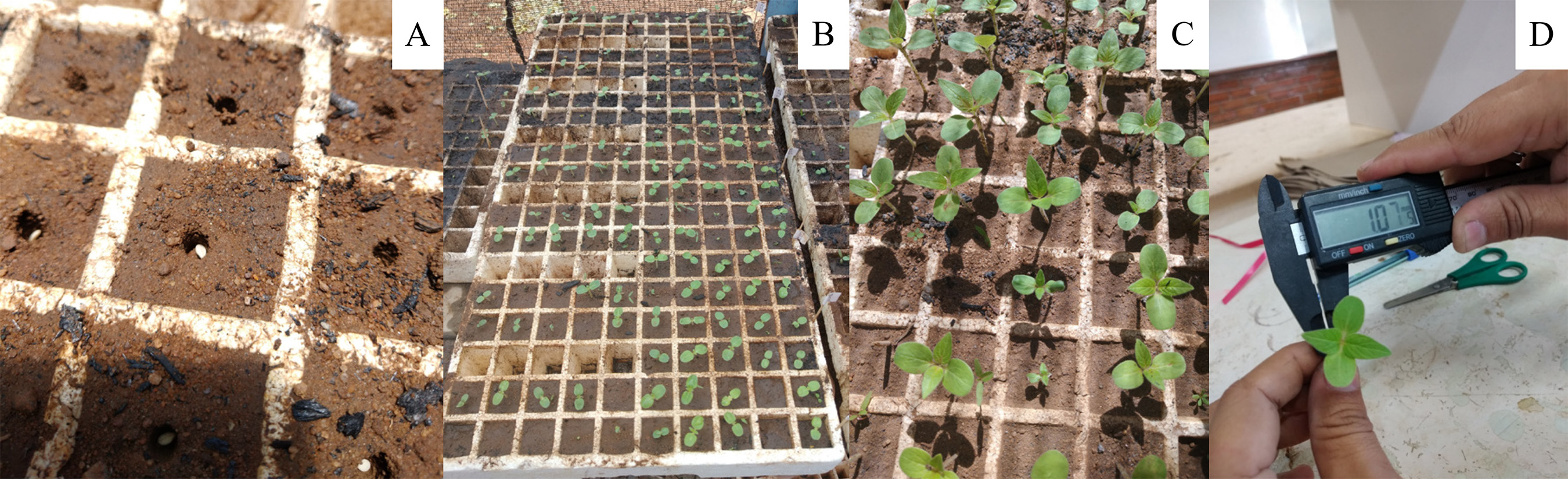
The emergence percentage (EP) was calculated considering only normal seedlings, following the methodology of Labouriau and Valadares.(21) The emergence speed index (ESI) was determined from the daily counts of seedlings, according to the recommendation of Maguire.(22) The average emergence time (AET) was obtained based on the daily seed counts, following the methodology proposed by Labouriau,(23) with results expressed in days. Finally, the average emergence speed (AES) was calculated according to the methodology described by Carvalho and Carvalho,(24) also with results expressed in days-1. Figure 1 illustrates general aspects of the experiment.

1A: Sowing of sesame seeds; 1B: Initial stages of seedling germination; 1C: Final stages of seedlings for biometric analysis; 1D: Biometric analysis 17 days after sowing.
At 17 days after sowing (DAS), four seedlings per treatment were collected, and the following variables were analyzed: plant height (PH) and root length (RL), using a graduated ruler, and stem diameter (SD), measured with a digital caliper.
Statistical analyses
After verifying the normality of the data, they were subjected to analysis of variance using the F-test at 1% and 5% probability levels, utilizing the R Software version 4.2.1.(25)
The proportions of ashes and the interaction between the factors were analyzed through polynomial regression, selecting the regression model based on the highest value of the determination coefficient, significance of the equation parameters, non-significant effect of regression deviation, and biological explanation for the phenomena.
RESULTS AND DISCUSSION
According to the analysis of variance (Table 4), the interaction between the factors water quality for irrigation and ash proportions in the substrate was observed for all variables, except for the percentage of emergence (EP), for which a significant difference was found only for the ash proportion factor.
Analysis of variance of emergence percentage (EP), emergence speed index (ESI), average emergence time (AET), average emergence speed (AES), plant height (PH), stem diameter (SD), and root length (RL) of sesame seedlings
For emergence percentage (Figure 2A), it was observed that the increase in ash proportion in the substrate had a deleterious effect on this variable, resulting in a progressive reduction in germination as the amount of ash increased. According to the Ministry of Agriculture, Livestock, and Supply (MAPA) Normative Instruction No. 45/2013,(26) standardized sesame seeds must present at least 70% germination. This percentage was achieved under conditions of exclusive soil use or with up to 16.67% ash in the substrate. Higher proportions resulted in marked decreases in germination rate.

Emergence percentage (EP) of sesame seedlings under different proportions of sugarcane ash (A); emergence speed index (ESI) of sesame seedlings under different irrigation water qualities and sugarcane ash proportions (B).
This behavior can be attributed to the high sodium content, which resulted in elevated electrical conductivity of the ash (20.2 dS m-1), along with the high pH of the sugarcane bagasse ash (Table 2), reflecting its strong corrective capacity. Increased pH in the substrate can exert a potentially detrimental effect on the seed germination process, possibly inducing dormancy. Evidence also indicates that the presence of plant ash may clog soil pores, reducing aeration and oxygen availability, leading to surface sealing and significantly impairing seed germination, as reported by Rezende et al.(27)
Another relevant aspect is the high iron (Fe) and manganese (Mn) content in the ash, 3660 and 717 mg kg-1, respectively (Table 2), which may have contributed to the reduction in germination and seedling growth as ash proportion in the substrate increased. However, additional analyses would be required to confirm this response in the present study.
Although essential in small amounts, even favoring dormancy breaking, iron at concentrations above the optimal range becomes phytotoxic. Excess Fe compromises germination and plant development by interfering with water transport and absorption during seed imbibition, causing permanent damage to the embryo. In addition, it induces the formation of reactive oxygen species (ROS), which cause damage to membranes, DNA, and proteins.(28,29)
Similarly, manganese plays an essential role in germination, as its deficiency impairs seed emergence. It is a micronutrient fundamental to physiological processes related to the maintenance of cellular metabolic activity and enzyme activation. On the other hand, excess Mn can cause toxicity by inducing the production of reactive oxygen species, inhibiting growth, impairing the selective permeability of the membrane, and accelerating the degradation of seed reserves, which hinders water and nutrient uptake.(30-32)
In Figure 2B, the interaction between water quality and ash percentage for ESI is evident. When water with electrical conductivity of 0.3 dS m-1 was used, it was observed that the initial increase in ash percentage in the substrate resulted in an increase in ESI, reaching a maximum value of 3.04 at the dose of 13.7% ash. This behavior can be attributed to the improvement of the physical conditions of the substrate, such as greater moisture retention during the pre-emergence phase.
For the other two water sources (1.8 and 4.1 dS m-1), a decreasing linear response was observed for ESI, with the minimum value recorded at 54% ash in the substrate. This demonstrates that the electrical conductivity of the water, combined with the ability of sugarcane ash to alter the pH of the solution, resulted in a lower emergence speed of the plants.
Although the R² values for some models were relatively low (0.56 - 0.60), reflecting the high biological variability inherent to germination and early growth under salinity stress, the models were retained because they adequately captured the overall response trend and were consistent with the underlying physiological mechanisms. Thus, despite the statistical limitation, these models provide useful and biologically consistent insights for interpreting seedling responses
According to Dias et al.,(33) emergence speed is a determining factor for the rapid establishment of seedlings under field conditions. Seedlings with higher emergence speed indicate a more vigorous seed lot, which directly translates into the development of plants more resistant to stress.
Rezende et al.(27) also reported negative effects of ash on germination percentage and germination speed index of pepper seedlings; however, these impacts were evident only at ash proportions above 20% in the substrate used. This divergence in relation to the results obtained in the present study can be attributed to physiological differences between species (pepper and sesame) regarding osmotic sensitivity and tolerance to compounds present in the ash, in addition to possible variations in the type of ash used, environmental conditions, and experimental management.
This result is particularly relevant for sesame, as it demonstrates that the use of up to 13.7% ash is suitable, promoting a favorable Emergence Speed Index (ESI) for germination and early plant growth when water of 0.3 dS m-1 (control treatment) is used.
Dias et al.(34) and Cordão et al.(35) also reported that increased salinity reduced emergence and germination percentages, as well as the emergence and germination speed indices of sesame seeds. The authors attribute the observed reduction in these variables to the lower rate of water absorption by the seeds, resulting from the increase in soluble salt concentration in the substrate and the consequent reduction in osmotic potential, which limits water availability. In addition, they emphasize that the excessive absorption of ions can induce toxicity both to the embryo and to the endosperm membrane cells, compromising the metabolism and development of the embryonic tissue. High concentrations of sodium (Na⁺) and chloride (Cl⁻) ions can negatively affect cell division and differentiation processes, enzymatic activity, as well as the absorption and translocation of essential nutrients, leading to delays in seedling emergence and in the mobilization of reserves.
Although no data on temperature and light were recorded variables that directly influence germination and the emergence speed index it is recommended that future studies include them to deepen the analysis of the observed effects. Nevertheless, this limitation does not compromise the relevance of the findings, which contribute to the understanding of the effects of ash and salinity on sesame seedling emergence.
In Figure 3A, it is evident that the average emergence time (AET) was affected by the increase in ash proportions in the substrate. When water with EC of 0.3 dS m-1 was used, the lowest average emergence time was obtained with 21.4% ash, with an AET of 6.56 days. This value increased with the addition of higher ash percentages in the substrate. The same behavior was observed for water with EC of 4.1 dS m-1, with a AET of 7.31 days at 17.5% ash. However, when water with EC of 1.8 dS m-1 was used, the increase in AET was linear and continuous up to the highest percentage of ash added.

Average emergence time (A) and average emergence speed (B) of sesame seedlings under different irrigation water qualities and proportions of sugarcane ashes.
For the average emergence speed (AES) (Figure 3B), a quadratic behavior was observed, in which the use of water with EC of 0.3 dS m-1 showed a maximum point at 21.2% ash, with 0.15 days-1 of AES. For irrigation water with EC of 4.1 dS m-1, the behavior was similar to the previous treatment, although less pronounced. In contrast, with the use of water with EC of 1.8 dS m-1, a decreasing linear behavior of AES was observed with the increase in ash proportion in the substrate.
This behavior may result from highly negative osmotic potentials promoted by the high electrical conductivity of the irrigation water and the addition of plant ash, which may have caused restricted water availability and reduced minimum moisture levels required by the seed, therefore leading to longer germination time and lower germination speed of sesame seeds.
Guerra et al.(36) reported adverse effects of irrigation salinity on average emergence time in beet crops. Although this crop shows greater tolerance to salinity compared to others, salts still exert significant impacts on the performance of different cultivars.
For plant height (PH) (Figure 4A), no significant differences were observed when water with EC of 4.1 dS m-1 was used, with a mean PH of 2.2 cm, indicating growth limitation. This effect can be attributed to osmotic stress induced by high salinity, which hinders water absorption by roots. Although no statistical differences were observed, salinity may have compromised plant development, limiting growth due to difficulty in maintaining water balance, which impairs early growth.

Plant height (A), stem diameter (B), and root length (C) of sesame seedlings under different qualities of irrigation water and proportions of sugarcane ash in the substrate.
The use of water with EC of 1.8 dS m-1 promoted a decreasing linear response with increasing ash proportion in the substrate. For water with EC of 0.3 dS m-1, the quadratic model best represented the behavior of the variable, with a maximum point at 15.5% ash, corresponding to 3.03 cm of PH.
The progressive increase in ash proportions and the use of irrigation water with an electrical conductivity (EC) of 0.3 dS m-1 did not result in significant changes in stem diameter (SD) of sesame seedlings (Figure 4B), which maintained an average of 0.98 mm. However, when water with an EC of 1.8 dS m-1 was used, a decreasing linear trend was observed as the proportion of ash in the substrate increased. This suggests that ash may have raised substrate pH and, combined with irrigation water, increased EC, thus exerting significant effects in reducing stem diameter.
For water with EC of 4.1 dS m-1, an increasing linear response of SD was obtained with higher ash proportions in the substrate. Pimenta et al.(37) reported similar results using biofertilizers and found that irrigation with saline water provided superior outcomes compared to irrigation with unrestricted water for sesame stem diameter.
According to Flowers and Yeo,(38) the increase in stem diameter under saline irrigation, and in the present study, associated with higher ash proportions in the substrate, can be explained by the regulation of ion concentration in the shoot, which can be accommodated by an increase in either cell size or number.
For root length (RL) (Figure 4C), irrigation with water at EC of 4.1 dS m-1 was not statistically significant, with an average RL of 3.4 cm. In the treatment with irrigation water at EC of 0.3 dS m-1, a quadratic trend was observed, with a maximum RL of 5.02 cm at 8.6% ash in the substrate, followed by a decline as ash proportions increased. When water with EC of 1.8 dS m-1 was applied, a linear decline in RL was observed, indicating a negative impact of increasing ash levels in the substrate.
Data on plant height (PH) and RL diverged from results obtained by Castellanos et al.(39) with wheat. According to that study, plant height was not significantly influenced by rice husk ash dosage when irrigated with saline water up to 8 mM NaCl. However, when NaCl concentration reached 16 mM, the study revealed that shoot length increased with higher rice husk ash levels in the substrate, but decreased significantly at the maximum ash dose, a pattern also observed for RL.
Although irrigation water salinity is a common challenge that impairs crop growth, previous studies have shown that agricultural practices involving organic inputs can substantially mitigate or alleviate these adverse effects. For instance, Pimenta et al.(37) observed a positive effect of biofertilizer on early sesame growth, while Sousa et al.(40) reported that although salinity negatively affected watermelon growth variables, the impact was significantly reduced when the substrate was enriched with biochar.
The results of this study did not demonstrate the effectiveness of ash in mitigating salinity effects under the experimental conditions established. Nevertheless, in practical field conditions, applying ash at adequate proportions may contribute to early sesame development, especially when irrigation water does not present salinity constraints. This hypothesis underscores the need for further studies assessing the interaction between ash proportions and salinity levels in different management scenarios and crop species.
CONCLUSION
Ash was not effective in mitigating or reducing the effects of saline irrigation water, and its incorporation into the substrate generated negative impacts on sesame seedling germination rate.
An ash proportion of up to 13.7% in the substrate increased the emergence speed index of sesame seedlings when irrigated with water at EC of 0.3 dS m-1. However, when saline water was used, the effects were detrimental. Average emergence time and average emergence speed showed positive results with ash proportions of up to 21% in the substrate when non-saline irrigation water was applied.
Plant height, stem diameter, and root length were negatively affected by increasing ash proportions in the substrate, particularly under saline irrigation treatments.
The high alkalinity (pH) and electrical conductivity of ash may have intensified salt stress in seedlings, reducing its potential as a mitigating agent. This highlights the need to characterize residues prior to agricultural use. Considering that ashes from different materials exhibit variable compositions, future research should evaluate other sources under field conditions, monitoring substrate dynamics over time, with emphasis on pH, solution electrical conductivity, water retention, and the capacity to mitigate salt stress.
ACKNOWLEDGEMENTS, FINANCIAL SUPPORT, AND FULL DISCLOSURE
This study has significant contributions from all authors, who agree with its publication and state that there are no conflicts of interest.
DATA AVAILABILITY STATEMENT
The entire dataset supporting the findings of this study is available on SciELO Data and can be accessed at https://doi.org/10.48331/SCIELODATA.DOX6IW
REFERENCES
-
1 Dias AS, Lima GS, Silva SS, Soares LA, Chaves LH, Gheyi HR, et al. Gas exchange, photosynthetic pigments, and photochemical efficiency of sesame under salt stress and phosphate fertilization. Semina Ciênc Agrár [Internet]. 2022 [cited 2023 Jun 10];43(3):1237-56. Available from: https://ojs.uel.br/revistas/uel/index.php/semagrarias/article/view/43703
» https://ojs.uel.br/revistas/uel/index.php/semagrarias/article/view/43703 -
2 Mesquita JB, Azevedo BM, Sousa GG, Araújo VT, Silva SJ, Goes GF. Desempenho agronômico do milho cultivado no litoral cearense sob lâminas de irrigação. Irriga [Internet]. 2023 [cited 2023 Aug 15];28(2):286-97. Available from: https://revistas.fca.unesp.br/index.php/irriga/article/view/4640
» https://revistas.fca.unesp.br/index.php/irriga/article/view/4640 -
3 Guimarães DG, Amaral CL, Oliveira LM, Guedes MO. Efeito da salinidade na água de irrigação em cultivares de feijão-caupi. Rev Agronegócio Meio Ambient [Internet]. 2023 [cited 2023 Aug 25];16(1):1-18. Available from: https://periodicos.unicesumar.edu.br/index.php/rama/article/view/10052
» https://periodicos.unicesumar.edu.br/index.php/rama/article/view/10052 -
4 Sghayar S, Debez A, Lucchini G, Abruzzese A, Zorrig W, Negrini N, et al. Seed priming mitigates high salinity impact on germination of bread wheat (Triticum aestivum L.) by improving carbohydrate and protein mobilization. Plant Direct [Internet]. 2023 [cited 2024 Jan 20];7(6):e497. Available from: https://onlinelibrary.wiley.com/doi/full/10.1002/pld3.497
» https://onlinelibrary.wiley.com/doi/full/10.1002/pld3.497 -
5 Debez A, Sid IB, Bousselmi S, Atia A, Farhat N, El Kahoui S, et al. Comparative analysis of salt impact on sea barley from semi-arid habitats in Tunisia and cultivated barley with special emphasis on reserve mobilization and stress recovery aptitude. Plant Biosyst [Internet]. 2020 [cited 2023 May 08];154(4):544-52. Available from: https://www.tandfonline.com/doi/abs/10.1080/11263504.2019.1651777
» https://www.tandfonline.com/doi/abs/10.1080/11263504.2019.1651777 -
6 Dutra TR, Massad MD, Moreira PR, Ribeiro ED. Efeito da salinidade na germinação e crescimento inicial de plântulas de três espécies arbóreas florestais. Pesqui Florest Bras [Internet]. 2017 [cited 2023 Oct 18];37(91):323-30. Available from: https://pfb.sede.embrapa.br/pfb/article/view/1447
» https://pfb.sede.embrapa.br/pfb/article/view/1447 -
7 Reis RV, Bonfim-Silva EM, Meneghetti LA, Oliveira JR, Silva TJ. Potential of wood ash on the production characteristics of peanuts and mitigation of water deficit. Rev Caatinga [Internet]. 2025 [cited 2025 Jun 24];38:e12362. Available from: https://www.scielo.br/j/rcaat/a/jTrWN9TJHTfDgM7nsrbJkXt/?format=html⟨=en
» https://www.scielo.br/j/rcaat/a/jTrWN9TJHTfDgM7nsrbJkXt/?format=html⟨=en -
8 Santos FS, Bonfim-Silva EM, Silva SA, Ferreira PA, Meneghetti LA, Dias-Arieira CR, et al. Plant ash associated with liming can help the management of Pratylenchus brachyurus in Phaseolus vulgaris Trop Plant Pathol [Internet]. 2025 [cited 2025 Oct 10];50(1):60. Available from: https://link.springer.com/article/10.1007/s40858-025-00750-z
» https://link.springer.com/article/10.1007/s40858-025-00750-z -
9 Soares GA, Bandim CG, Silveira NT, Barros JP, Silva JN, Galvíncio JD. Análise do balanço hídrico da bacia hidrográfica do Riacho Cachoeira, Serra Talhada, Pernambuco. Rev Bras Sens Remoto [Internet]. 2024 [cited 2024 Dec 18];5(2):18-30. Available from: https://rbsr.com.br/index.php/RBSR/article/view/133
» https://rbsr.com.br/index.php/RBSR/article/view/133 -
10 Empresa Brasileira de Pesquisa Agropecuária (EMBRAPA). Clima [Internet]. 2025 [cited 2025 Feb 07]. Available from: https://www.cnpf.embrapa.br/pesquisa/efb/clima.htm
» https://www.cnpf.embrapa.br/pesquisa/efb/clima.htm -
11 Sousa Martins LD, Martim MB, Guerra TM, Brito FA, Mello NR Júnior, Santos WM, et al. Physiological and anatomical mechanisms induced by water deficit on the longevity and post-harvest quality of amaryllis stems. Sci Hortic [Internet]. 2024 [cited 2025 Feb 10];330:113082. Available from: https://www.sciencedirect.com/science/article/abs/pii/S0304423824002413
» https://www.sciencedirect.com/science/article/abs/pii/S0304423824002413 - 12 Teixeira PC, Donagemma GK, Fontana A, Teixeira WG. Manual de métodos de análise de solos. 3. ed. rev. e ampl. Brasília (DF): Embrapa; 2017. 573 p.
- 13 Malavolta E, Vitti GC, Oliveira SA. Avaliação do estado nutricional das plantas: princípios e aplicações. Piracicaba: Potafos; 1989. 201 p.
- 14 Brasil. Ministério da Agricultura, Pecuária e Abastecimento. Regras para análise de sementes. Brasília (DF): MAPA; 2009. 395 p.
-
15 Silva E, Oliveira HM, Araújo LN, Guilherme FD. Caracterização morfológica e qualidade fisiológica de cultivares de sementes de gergelim. Rev Verde Agroecol Desenv Sustent [Internet]. 2014 [cited 2023 Sep 28];9(3):149-56. Available from: https://www.gvaa.com.br/revista/index.php/RVADS/article/view/2921
» https://www.gvaa.com.br/revista/index.php/RVADS/article/view/2921 -
16 Lima BF, Almeida TT, Oliveira AS, Machado GL. Qualidade fisiológica de sementes de gergelim em função do equilíbrio higroscópico em diferentes sais. Agropec Cient Semiárido [Internet]. 2021 [cited 2024 Jan 14];17(1):18-22. Available from: https://acsa.revistas.ufcg.edu.br/acsa/index.php/ACSA/article/view/1231
» https://acsa.revistas.ufcg.edu.br/acsa/index.php/ACSA/article/view/1231 -
17 Silva LG, Gheyi HR, Medeiros JF. Composição química de águas do cristalino do Nordeste brasileiro. Rev Bras Eng Agric Ambient [Internet]. 1999 [cited 2025 Sep 05];3(1):11-17. Available from: https://www.scielo.br/j/rbeaa/a/6Z33C5v9pKmBXMbDRFCTXwL/?lang=pt
» https://www.scielo.br/j/rbeaa/a/6Z33C5v9pKmBXMbDRFCTXwL/?lang=pt -
18 Morais JE, Silva EF, Godoi AH Neto, Lima CB, Lira RM, Berto CS, et al. Sugarcane (Saccharum officinarum L.) under saline stress: growth, productivity, technological quality, and industrial yield. Ind Crops Prod [Internet]. 2022 [cited 2025 Sep 12];188:115642. Available from: https://www.sciencedirect.com/science/article/abs/pii/S0926669022011256
» https://www.sciencedirect.com/science/article/abs/pii/S0926669022011256 -
19 Lira RM, Gordin LC, Silva EF, Silva GF, Dantas DD, Morais JE. Leaching of cations in soil cultivated with sugarcane subjected to saline irrigation and leaching fractions. Rev Bras Eng Agric Ambient [Internet]. 2018 [cited 2025 Sep 12];22(9):616-21. Available from: https://www.scielo.br/j/rbeaa/a/nKyTzmrGmmqqVkFSfWWbgdK/?lang=en
» https://www.scielo.br/j/rbeaa/a/nKyTzmrGmmqqVkFSfWWbgdK/?lang=en -
20 Richards LA, editor. Diagnosis and improvement of saline and alkali soils. Washington (DC): US Government Printing Office; 1954. 60 p. Available from: https://www.ars.usda.gov/ARSUserFiles/20360500/hb60_pdf/hb60complete.pdf
» https://www.ars.usda.gov/ARSUserFiles/20360500/hb60_pdf/hb60complete.pdf - 21 Labouriau LG, Valadares MB. On the physiology of seed of Calotropis procera An Acad Bras Cienc. 1976; 42:235-64.
-
22 Maguire JD. Speed of germination—Aids in selection and evaluation for seedling emergence and vigor. Crop Sci [Internet]. 1962 [cited 2023 May 08]; 2:176–7. Available from: https://acsess.onlinelibrary.wiley.com/doi/10.2135/cropsci1962.0011183X000200020033x
» https://acsess.onlinelibrary.wiley.com/doi/10.2135/cropsci1962.0011183X000200020033x - 23 Labouriau LG. A germinação das sementes. Washington (DC): Secretaria Geral da OEA; 1983. 147 p.
-
24 Carvalho DB, Carvalho RI. Qualidade fisiológica de sementes de guanxuma sob influência do envelhecimento acelerado e da luz. Acta Sci Agron [Internet]. 2009 [cited 2023 May 08];31(3):489–94. Available from: https://www.scielo.br/j/asagr/a/pPVF4XkbctPDLKJspdpkFZS/?format=html⟨=pt
» https://www.scielo.br/j/asagr/a/pPVF4XkbctPDLKJspdpkFZS/?format=html⟨=pt -
25 R Development Core Team. R: A language and environment for statistical computing [Internet]. Vienna (AT): R Foundation for Statistical Computing; 2022 [cited 2023 Aug 05]. Available from: https://www.r-project.org/
» https://www.r-project.org/ -
26 Brasil. Ministério da Agricultura, Pecuária e Abastecimento. Instrução Normativa nº 45, de 17 de setembro de 2013. Diário Oficial da União [Internet]. 2013 Sep 18 [cited 2025 Apr 12]. Available from: https://www.gov.br/agricultura/pt-br/assuntos/insumos-agropecuarios/insumos-agricolas/sementes-e-mudas/publicacoes-sementes-e-mudas/copy_of_INN45de17desetembrode2013.pdf
» https://www.gov.br/agricultura/pt-br/assuntos/insumos-agropecuarios/insumos-agricolas/sementes-e-mudas/publicacoes-sementes-e-mudas/copy_of_INN45de17desetembrode2013.pdf -
27 Rezende JS, Carvalho AC, Moura GA, Santos JR, Sousa RD, Sousa DP, et al. Uso da cinza vegetal na germinação e produção de mudas de pimentão. Rev Cienc Agric [Internet]. 2021 [cited 2024 Jul 22];19(2):85–93. Available from: https://seer.ufal.br/index.php/revistacienciaagricola/article/view/11786
» https://seer.ufal.br/index.php/revistacienciaagricola/article/view/11786 -
28 El Rasafi T, Nouri M, Bouda S, Haddioui A. The effect of Cd, Zn and Fe on seed germination and early seedling growth of wheat and bean. Ekológia (Bratislava) [Internet]. 2016 [cited 2025 May 25];35(3):213–23. Available from: https://reference-global.com/article/10.1515/eko-2016-0017
» https://reference-global.com/article/10.1515/eko-2016-0017 -
29 Rodrigues JF, Corte VB, Perin IT, Silva RW, Reis C. Iron toxicity on germination and early growth of Cecropia hololeuca Miq. Ens Ciênc Ciênc Biol Agrár Saúde [Internet]. 2020 [cited 2025 May 24];24(5):584–92. Available from: https://ensaioseciencia.pgsscogna.com.br/ensaioeciencia/article/view/7907
» https://ensaioseciencia.pgsscogna.com.br/ensaioeciencia/article/view/7907 -
30 Bhupendra B, Kiran K, Gazala R. Effect of arsenic, manganese and chromium on in vitro seed germination of black gram (Vigna mungo L.) and green gram (Vigna radiata L.). J Chem Pharm Res [Internet]. 2014 [cited 2025 May 24];6(5):1072–5. Available from: https://www.jocpr.com/articles/effect-of-arsenic-manganese-and-chromium-on-in-vitro-seed-germination-of-black-gram-vigna-mungo-l-and-green-gram-vigna-r.pdf
» https://www.jocpr.com/articles/effect-of-arsenic-manganese-and-chromium-on-in-vitro-seed-germination-of-black-gram-vigna-mungo-l-and-green-gram-vigna-r.pdf -
31 Wang Y, Li J, Pan Y, Chen J, Liu Y. Metabolic responses to manganese toxicity in soybean roots and leaves. Plants [Internet]. 2023 [cited 2025 Jun 22];12(20):3615. Available from: https://www.mdpi.com/2223-7747/12/20/3615
» https://www.mdpi.com/2223-7747/12/20/3615 -
32 Nasir Y, Umar ZD. Assessing the toxicity of heavy metals and potential tolerance of common bean (Phaseolus vulgaris) while monitoring the population dynamics of the associated Rhizobia. UMYU J Microbiol Res [Internet]. 2024 [cited 2025 Feb 06];9(1):93–101. Available from: https://www.researchgate.net/publication/382531400_Assessing_the_Toxicity_of_Heavy_Metals_and_Potential_Tolerance_of_Common_Bean_Phaseolus_vulgaris_while_Monitoring_the_Population_Dynamics_of_the_Associated_Rhizobia
» https://www.researchgate.net/publication/382531400_Assessing_the_Toxicity_of_Heavy_Metals_and_Potential_Tolerance_of_Common_Bean_Phaseolus_vulgaris_while_Monitoring_the_Population_Dynamics_of_the_Associated_Rhizobia -
33 Dias LR, Rodrigues AA, Cavalcante RI, Correa LA, Oliveira LJ, Silva EK, et al. Comparative study of the physiological and health quality of traditional and biofortified cowpea seeds. Braz J Biol [Internet]. 2023 [cited 2024 Feb 23];83:e277489. Available from: https://www.scielo.br/j/bjb/a/wR355n5TRGcHpJdnpm8bbzF/?lang=en
» https://www.scielo.br/j/bjb/a/wR355n5TRGcHpJdnpm8bbzF/?lang=en -
34 Dias AS, Lima GS, Gheyi HR, Nobre RG, Santos JB. Emergence, growth and production of sesame under salt stress and proportions of nitrate and ammonium. Rev Caatinga [Internet]. 2017 [cited 2024 Feb 23];30(2):458–67. Available from: https://www.scielo.br/j/rcaat/a/BGSJyfwCpYM7w3n3YJwR39B/?format=html⟨=en
» https://www.scielo.br/j/rcaat/a/BGSJyfwCpYM7w3n3YJwR39B/?format=html⟨=en -
35 Cordão MA, Sobrinho TG, Brito KQ, Tavares AJ, Nascimento R. Plântulas de gergelim cv. BRS Seda sob aplicação de água salinizada. Rev Verde Agroecol Desenvolv Sustent [Internet]. 2020 [cited 2024 Dec 11];15(3):319–24. Available from: https://www.gvaa.com.br/revista/index.php/RVADS/article/view/7667
» https://www.gvaa.com.br/revista/index.php/RVADS/article/view/7667 -
36 Guerra AM, Machado LC. Germinação de sementes e crescimento de plântulas cultivares de beterraba submetidas ao estresse salino. Res Soc Dev [Internet]. 2022 [cited 2024 Nov 15];11(7):e9411729686. Available from: https://rsdjournal.org/index.php/rsd/article/view/29686
» https://rsdjournal.org/index.php/rsd/article/view/29686 -
37 Pimenta RM, Cocozza FM, Paz CD, Varjão AE, Bitencourt MS, Nascimento Almeida JV. Biofertilizante líquido anaeróbico como atenuador do estresse salino no crescimento inicial do gergelim. Observ Econ Latinoam [Internet]. 2024 [cited 2025 Oct 20];22(12):1–14. Available from: https://ojs.observatoriolatinoamericano.com/ojs/index.php/olel/article/view/8041
» https://ojs.observatoriolatinoamericano.com/ojs/index.php/olel/article/view/8041 -
38 Flowers TS, Yeo AR. Effects of salinity on plant growth and crop yields. In: Environmental stress in plants: biochemical and physiological mechanisms [Internet]. Berlin (DE): Springer; 1989 [cited 2024 Apr 12]. p. 101–19. Available from: https://link.springer.com/chapter/10.1007/978-3-642-73163-1_11
» https://link.springer.com/chapter/10.1007/978-3-642-73163-1_11 -
39 Castellanos CI, Rosa MP, Deuner C, Bohn A, Barros AC, Meneghello GE. Aplicação ao solo de cinza de casca de arroz como fonte de silício: efeito na qualidade de sementes de trigo produzidas sob estresse salino. Rev Cienc Agrar [Internet]. 2016 [cited 2024 May 05];39(1):95–104. Available from: https://revistas.rcaap.pt/rca/article/view/16358
» https://revistas.rcaap.pt/rca/article/view/16358 -
40 Sousa GG, Sousa HC, Lessa CI, Goes GF, Freire MH, Souza MV. Production of watermelon seedlings in different substrates under salt stress. Rev Bras Eng Agric Ambient [Internet]. 2023 [cited 2024 Jul 15];27(5):343–51. Available from: https://www.scielo.br/j/rbeaa/a/fj6GJFsBKVJNb7btP68Cnzw/?format=html⟨=en
» https://www.scielo.br/j/rbeaa/a/fj6GJFsBKVJNb7btP68Cnzw/?format=html⟨=en