 Physicochemical Properties of Monguba Seeds (Malvaceae fruit) at Different Ripening Stages
ABSTRACT
Pachira aquatica Aubl., popularly known in Brazil as Monguba, is an unconventional food plant (UFP) found in tropical regions of Central and South America. In the Amazon region, its seeds are traditionally consumed boiled, roasted, or fried and may also be incorporated into cakes and sweets. Despite this cultural use and the nutritional potential of its seeds, commercial exploitation remains limited. This study aims to assess physicochemical disparities between ripe and unripe Monguba seeds. In the physical characterization, the main differences were in the seeds: unripe seeds exhibited a higher mucilage content (1.3 g) and denser pericarp (4.5 g), while ripe seeds presented more pulp (12.9 g) and darker coloration. Chemically, ripe and unripe seeds contained high lipid and protein levels (35.6–32.5% and 13.0–12.7%, respectively). Ripe seeds showed an increase in carbohydrates (45.8%) and minerals, like calcium (82.3 mg.100 g-1), magnesium (65.2 mg.100 g-1), manganese (1.4 mg.100 g-1), and zinc (2.1 mg.100 g-1), while unripe seeds showed higher acidity (23.9%) and lower °Brix (12.8). FTIR spectra revealed differences in polysaccharide hydrolysis and cell wall lignification during ripening. These findings emphasize the importance of exploring the various stages of plant development.
Keywords
Pachira aquatica Aubl.; unconventional food plants; oilseed; alternative protein; oil; Fourier Transform Infrared Spectroscopy
INTRODUCTION
In recent years, the search for alternative and little-explored food sources has grown due to the concern and search for a more sustainable diet that values local biodiversity. In this scenario, fruits native to tropical regions have attracted attention for their nutritional and health-promoting benefits. One of them is Pachira aquatica Aubl., popularly known as Monguba, which stands out for being highly adapted to the local climate, with fruits that produce seeds rich in nutrients, with emphasis on lipid and protein composition, in addition to bioactive compounds that exert antioxidant activity. Native to Central and South America, its fruits are found in many countries, such as Guatemala, Guyana, and Panama, and its seeds have always been consumed in various ways, like cooked, fried, or roasted, mainly by the population of the Amazon region. Its fruit has a high potential for use in the food sector, such as cakes, cookies, and sweets, although they are still underutilized.(1)
Although there are recent studies, such as those by Rezende et al.,(2) Silva et al.,(3) Rodrigues et al.,(4) and Becker et al.,(5) which address the composition of the Monguba fruit, focus mainly on the ripe fruit. However, it is essential to recognize the importance of investigating the different stages of a fruit's maturation, as each stage can reveal valuable information about its nutritional properties and bioactive compounds.(6)
Understanding the mechanisms of the fruit ripening process is instrumental to improving their sensory and nutritional qualities and reducing postharvest losses.(7) This becomes even more crucial in the case of Monguba, a climacteric fruit whose final stage of maturation is confirmed by the spontaneous opening of the fruit.(1) This process occurs on the tree or after harvesting, which, like other fruits, can reflect in a number of significant biochemical and physiological changes in its profile.(6)
Therefore, the objective of this study was to evaluate the difference in physicochemical composition between ripe and unripe Monguba seeds.
MATERIALS AND METHODS
Fruits samples
The Monguba fruits were collected during the months of January and April 2023 in the municipality of Camaçari, state of Bahia, on coordinates -12.851161828325086, -38.28364324552152. After the collection, all the fruits were washed and sanitized. The fruits were separated into two groups: The unripe fruits, characterized 24 hours after harvesting, and the ripe fruits, which were characterized at the first sign of fruit opening, demarcating their total ripening. A total of 10 unripe fruits and 10 ripe fruits were collected, obtained from at least three independent trees, ensuring biological representativeness.
Fruit ripening stage
To determine the stage of fruit maturation between unripe and ripe, multiple criteria were used to define the samples. Initially, fruit opening was monitored both spontaneously and manually since spontaneous opening is an indication of complete ripening. Furthermore, the maturation stage was determined using the ºBrix/acidity ratio and fruit color as the seed shells darken during ripening.
Physical characterization analyses
First, the whole fruit mass was determined, and its height and length were measured using a caliper (It Blue, LE-1997, Brazil). For the Monguba seeds characterization, the unripe fruits were forcibly opened and manually separated into pericarp, mucilage, and Monguba seeds. For the ripe samples, the collection of the Monguba seeds was carried out manually after their spontaneous opening. All Monguba seeds and mucilages were counted, weighed, and measured in height and length. The determination of color variables (L, a*, b*, C*, H*) by the CIELAB system was performed on the Monguba seeds using a CR-400 colorimeter (Konica Minolta, Tokyo). From each of the 10 fruits per stage, 3 seeds were selected (total of 30 seeds per stage) and used as biological replicates for seed characterization, while pericarp and mucilage were only subjected to physical characterization.
Fruits treatment
After the physical characterization, the 30 seeds from each maturation stage were separately processed in a home juicer (Philips Walita, Ri 7632, Brazil) and frozen in an ultra-freezer at - 80º C. After 24 hours, the samples were freeze-dried (Terroni, LS3000, Brazil) for 48 hours. At the end of the treatment, the resulting sample was stored in a conventional freezer at -18 ºC inside hermetically sealed containers, protected from light, until further analysis.
Chemical composition analyses
The chemical composition were determinated following the official methods of analysis of AOAC International:(8) moisture (method n° 925.26), ashes (n° 940.26), crude fat (n° 933.05), crude protein (n° 920.87), total titratable acidity (TTA) (method n° 942.15), pH (method n° 970.21) and the total soluble solids (TSS) (method n° 932.12). Total carbohydrates were performed using the phenol-sulfuric acid methodology according to Nielsen.(9) The water activity (Aw) was evaluated manually using a water activity analyzer (OEM, Model: HD-6, China). The hemicellulose, cellulose, and lignin fractions were analyzed according to Van Soest et al.,(10) carried out using the reagents and filter Ankom filter bag system bags (Ankom, Technol. Corp., USA). The total energy value was estimated by considering the conversion factors of 4 kcal.g-1 for protein and carbohydrate and 9 kcal.g-1 for lipids.
Determination of minerals
For the determination of Zn, Fe, Cu, and Mg, the digestion of the samples was carried out according to Doner & Age,(11) with some modifications. Freeze-dried Monguba ripe and unripe Monguba seeds (2 g each) were accurately measured, subjected to smoke removal, and then placed into a preheated muffle furnace, heated up to 550 ºC, and kept at this temperature for 4 hours. After this time, 1 mL of nitric acid was added, and the samples were placed on a hotplate until complete evaporation, returning to the muffle for another 4 hours. This process was repeated until a total white ash was obtained. The residue was dissolved in 5 mL of 1% nitric acid, transferred, and swelled in a 10 mL flask. For Ca and Mn, at the end of the digestion, 1 mL of the sample, together with 1 mL of lanthanum oxide, was increased in a 10 mL flask.(12) Digested and diluted samples were stored in test tubes, under refrigeration, until reading. All the minerals were determined using a flame atomic absorption spectrometer (FAAS) (Varian, model AA 240 Fast Sequential, USA) and expressed in mg.100 g-1.
Fourier Transform Infrared Spectroscopy (FTIR)
The ripe and unripe fruits were analyzed by Fourier transform infrared spectroscopy (FTIR) spectra. The samples were mixed with KBr (spectroscopy grade) and then pressing the mixture into a 3 mm pellet. FTIR spectrum was recorded (16 scans) in the transparent mode from 4000 to 400 cm-1 using a Spectrum 400 spectrometer (Perkin-Elmer, Ink., MA, USA).
Statistical analyzes
Analyses were carried out in triplicate, and the data are reported as the mean values ± standard deviation. These triplicates refer to technical replicates performed on the homogenized sample obtained from 30 seeds per maturation stage, and thus do not correspond to independent biological replicates. Biological replicates were represented by the 10 fruits collected per stage, from which the seeds were obtained. The Student’s t-test was applied between the results of the unripe and ripe samples to evaluate a significant difference between the maturation stages. A 5% significance level and the Microsoft Excel program (USA) were used.
RESULTS AND DISCUSSION
Physical characteristics
The physical characterization of a species is widely used as the first step in a study due to its easy and fast application. This type of analysis is important to detect the specific traits of the plant and to avoid duplication when identifying an accession, with the objective of increasing the efficiency of collection efforts and improving the organization of populations for the conservation of Monguba at both ripe and unripe stages.(13)
In Brazil, the trees of Monguba are found all over the country, from the Amazon region to the southern states.(13) The height of the tree varies from 6 to 20 meters,(14) while the trunk diameter can reach up to 40 cm,(15) with a dense alternating treetop and usually five or six leaves per branch, in dark green color (Fig. 1d). The flowers have an exotic shape, characterized by elongated petals that radiate from the center in a star-shaped arrangement, displaying yellow, brown, and red hues, and occurring always solitarily (Fig. 1c), and they bloom mainly in September to November.(16)

a) Fruit; b) Unripe fruit open; c) Flower; d) Tree leaf; e) Monguba ripe seed; f) Monguba unripe seed; g) Ripe fruit open; h) Monguba ripe seed; i) Monguba unripe seed open. Source: authors' personal collection.
The Monguba fruits have a large and rounded shape, with an average length of 252.0 mm and a diameter of 104.1 mm and a pericarp brown and velvet, similar to cocoa (Fig. 1a). The fruit pericarp didn’t present much difference in size or color between the ripe and unripe samples (Table 1), as also observed by Azizah et al.(13) The unripe fruit presented 258.3 mm of length, while the ripe one showed a very similar value (252.0 mm), with 104.1 mm and 117.7 mm in diameter, respectively. These values show fruits bigger than those found by Silva et al.(3) and Camacho et al.,(17) which measured approximately 195.0 to 211.0 mm in length and 78.16 mm in diameter. Consequently, the fruits also presented a bigger mass, with 789.9 g for unripe and 779.7 g for ripe fruits, while Silva et al.(3) registered 578 g, Camacho et al.(17) observed 781.9 g, and Azizah et al.(13) found 289 g in its heaviest fruit.
Physical characterization of Pachira aquatica Aubl. fruits and seeds and colorimetric variables
The pericarp of the Monguba fruit accounts for most of its total mass, with 531.4 g for the unripe fruit and 516.0 g for the ripe fruit, representing 67.3 % and 66.2 %, respectively. Because of this, some authors carried out studies and proposed possible uses beyond seeds. This part has demonstrated pharmacological properties, which are being used to treat diseases, such as earache, cholesterol, and conjunctivitis.(16)
Furthermore, the pericarp has lignocellulosic biomass with the potential for application in thermochemical energy due to its low moisture, ash, volatile matter, and density content.(18) In a study carried out by Nascimento et al.,(19) its pericarp was applied to produce charcoal, demonstrating an efficient material for biosorption of metallic ions in effluents, such as Fe3+, Ni2+, and Cd2+. Fruit shells produce large quantities of organic waste, representing an ecological and financial burden for the process industry. Therefore, finding solutions for its use is necessary in the food industry.(1)
According to Silva et al.(3) and Camacho et al.(17), the seeds range from 34 to 28% of the fruit mass, with almonds that represent 199 g per fruit. Despite the unripe (254.9 g) and ripe fruit (263.7 g) presenting higher values for seed mass, the percentages per fruit were very similar to those found by the authors, being 32.3 % for unripe and 33.8 % for ripe fruit. The unripe and ripe fruits had an average of 19.7 and 19.3 units, while the authors found an average of 21 to 40 units per fruit.
As can be seen in Figures 1b and 1g, the main difference between unripe and ripe fruits is in the seed. While the seeds of unripe fruits are mostly white, as the fruit matures, its seeds will have a brownish skin. The interior of unripe seeds is mainly filled with colorless mucilage (Fig. 1i), and the mature ones (Fig. 1h) have a solid interior with a minimal film of mucilage that keeps the seed attached to the skin.
The unripe seeds presented a denser and heavier pericarp, with 4.5 g compared to 2.0 g of the pericarp of ripe seeds. Regarding the pulp, the unripe seeds presented a much higher amount of mucilage than that present in the ripe seeds, with 1.3 g and 0.1 g of mass, respectively. On the other hand, ripe seeds had a greater amount of pulp, with 12.9 g, compared to 6.7 g of unripe seeds.
According to the values described by Silva et al.,(3) almonds range from 34 mm in length to 23 mm in diameter and mass of 6.36 g. The values found for the height of unripe and ripe fruits were 38 mm and, 39 mm, and 28 mm in diameter for both samples. Despite being very similar values to those found by Silva et al.,(3) the total mass of seeds in the two stages of ripening was much higher than that found by the author, with 12.5 g for unripe and 14.9 g for ripe ones.
Color parameters
After the Monguba seeds undergo the initial process for the analyses, their color change highly noticeable. Its pulp changes from a very light beige color, almost white (Fig. 1i and 1h), to a brownish tone. As seen in Table 1, the L* values were very similar between the unripe and ripe samples, both much smaller than those found for the fresh samples of Silva et al.(3), of 90.16. This demonstrates a large difference between the untreated fruits and the studied samples. The color analysis of the fruits after the treatment is important to evaluate the impact of processing on the visual characteristics of the seeds.(20) In the studied samples, as well as other seeds, presented a significant negative correlation with the L variable, that is, lower L* corresponds to darker samples.(21)
This change in hue can be attributed to the enzymatic browning caused by the oxidative reactions of polyphenol oxidase, an enzyme present in most plant-based foods. Through mechanical damage, such as the processing of Monguba seeds, browning gradually becomes more intense due to the exposure of the inner part of the fruit to oxygen. Although this reaction is undesirable in some cases, such as for fresh fruits and flours,(22) in other products, such as during chocolate processing, this reaction becomes a quality parameter.(23)
For the intensity of green and red (a*), the samples tended slightly towards red, mainly the ripe fruit. The unripe fruit, being closer to 0, indicated a little more neutrality in relation to these colors than the ripe fruit. Despite this, the value of fresh fruit found by Silva et al.(3) indicates that there is almost no green or yellow pigment in the Monguba seeds (0.12). On the other hand, the value of the roasted Monguba seeds, probably due to the Maillard reaction, tended a little more towards a red color, from 8.89(24) to 10.81.(3)
Regarding the b* variable, which analyzes the intensity of blue and yellow, both fruits showed values slightly more inclined towards yellow, especially the ripe fruit. When compared to samples from other authors, the Monguba almonds showed significantly reduced values, with 21.66 for fresh samples(3) and 24.41 - 34.86 for roasted samples.(3,24)
The chroma values of both samples did not show high differences due to their maturation time, and the ripe samples obtained a slightly more intense color than the unripe samples. Despite this, fresh samples showed a higher color intensity (24.30), with values for roasted Monguba almonds being even higher (38.84).(3)
The variable that obtained the greatest variation between the unripe and ripe samples was the Hue angle (H), with a difference of 12 % between the samples. With regard to fresh fruit, this was the variable that came closest to the value found by Silva et al.,(3) of 89.39, and with a higher value for the unripe samples than that found for the roasted fruit (71.98). This demonstrates that, even with treatment variations, the Hue angle continues to tend toward a reddish color.
Chemical characteristics
To our knowledge, there are no reports on the basic chemical composition of unripe Monguba seeds. However, the chemical characteristics in ripe Monguba seeds were previously analyzed by other authors.
For the purpose of this study, the Monguba seeds were lyophilized. Both the unripe and ripe seeds presented very similar moisture values after lyophilization, of 5.0% and 4.8%, respectively (Table 2). These reduced values are the result of the sample pre-treatment process. Very similar humidity values could be observed in studies by Rodrigues et al.(4), 5.3%, in which the ripe Monguba seeds were also freeze-dried. Lara Lopez et al.(25) determined even lower values, of 3.2%, with Monguba seeds that also went through a drying process to carry out the analyses. Rezende et al.,(2) even applying a drying process at 40ºC, slightly higher humidity values were obtained, at 11.4%.
Proximal composition and chemical characteristics of Pachira aquatica Aubl. ripe and unripe seed (DW)
Due to the chosen pre-treatment method, the water activity (aw) of the Monguba seeds also gave very low values (0.30). Despite having presented higher humidity values, the aw measured by Rezende et al.(2) gave a similar value (0.41). This similarity indicates that the water present in these fruits is not easily available for chemical reactions or the growth of microorganisms, which can contribute to the stability and commercial life of these food products. Therefore, although moisture differs between fruits, the similar water activity suggests that both are relatively dry and stable foods in terms of spoilage and food safety.(26)
Regarding acidity variable, the pH value of Monguba ripe almonds was slightly higher (6.1) when compared to Monguba unripe almonds (5.1). Similar values (6.69) were found by Rodrigues et al.(4)
Titratable acidity (TTA) and pH are two interrelated concepts in the analysis of foods that deal with acidity, where TTA is inversely proportional to the pH value. In other words, if the pH value decreases, the total titratable acidity will increase, exactly as observed in Monguba seeds. Although both variables work with acidity, each provides its own insights into food quality.
When compared to other studies values for TTA of Monguba seeds, authors such as Rezende et al.,(2) Rodrigues et al.,(4) and Lara Lopez et al.(25) found values of 1.3%, 0.9%, and 4.3%, respectively. Contrary to the values obtained for pH, TTA tended to decrease with fruit ripening, going from 23.9% to 11.5%. During the ripening process of a fruit, acidity tends to decrease due to several biochemical changes that occur as the fruit ripens. In the early stages of ripening, unripe fruits contain high levels of organic acids like citric, malic, and tartaric acids, which are gradually broken down by natural enzymes into sugars such as sucrose and glucose as the fruit matures.(27)
Consequently, ºBrix tends to be a better variable for predicting the ripeness of a fruit, as it tends to increase over time, something observed with Monguba seeds. Similar ºBrix values were found for ripe Monguba almonds by Rodrigues et al.(4) and Silva et al.(3), of 24º and 21.3ºBrix. Total soluble solids (TSS) offer a partial view of the ripeness level of a fruit, as they indicate the amount of sugars present in it.(28)
The increase in the ºBrix acidity index is mainly due to the increase in the total soluble solids of the fruit over time,(29) but in the case of Monguba almonds, both the acidity decreased, and the ºBrix increased between the unripe and ripe samples, varying from 0. 5 to 2.2. This higher variation indicates a greater proportion of total soluble solids in relation to acidity, and when it comes to fruits or agricultural products, this is an indication of greater maturity and sweetness of the sample.(30)
Macronutrients
Monguba seeds, as well as other oilseeds, have been shown to be a possible source of vegetable protein, where the stage of fruit maturation has not been shown to impact the total concentration of this macronutrient. The values found in the study (12.7% - 13.0%) were similar to those of Brazil nuts (Bertholletia excelsa H.B.K), 14.5% and walnuts (Carya illinoinensis (Wangenh.) K. Koch.), 14%.(31) Rezende et al.(2) determined 11.68% protein for Monguba seeds, while Rodrigues et al.(4) and Lara Lopes et al.(25) found 12.0% and 11.74%, respectively.
The concentration of proteins in Monguba seeds allows them to add nutritional and technological value to the fruit. Nowadays, new food possibilities are being evaluated by scientists and industry for partial replacement of protein from animal sources with vegetable sources, contributing to improving the pro-health values of meat products and corresponding to the need of many scientists, activists, and governments who aims to reduce meat production for ethical and environmental reasons.(32)
The primary essential amino acids found in other studies were leucine, valine, and lysine, corresponding to 7.97, 7.16, and 5.17 g per 100 g of protein, respectively.(33) These leucine values were similar to those found for cashew kernels (Anacardium occidentale L.) (7.33 g/100g) and higher for lysine (6.09 g.100g-1) and valine (3.63 g.100g-1) (Olatidoye et al., 2020). This class of amino acids is not synthesized by the body, and among those found in Monguba, leucine, and valine are known to have branched chains (BCAAs), representing, together with isoleucine, 40% of the body's total amino acid needs.
Among the primary non-essential amino acids, glutamic acid and aspartic acid represented 17.11 g and 12.70 g,(33) similar to those found by Olatidoye et al.,(34) 15.27g.100g-1 and 12.20g.100g-1, respectively. These amino acids are crucial in tumor metabolism, regulating redox status, antioxidant systems, and serving as precursors for macromolecule biosynthesis, post-translational, and epigenetic modifications.(35)
In addition to the presence of protein, Monguba seeds also presented considerable amounts of oil, with values of 35.6% and 32.5% for unripe and ripe samples. These results are similar to the study by Silva et al.,(3) which recorded a content of 31.35%, and that of Rezende et al.(2), with 38.9%. However, there is a difference in relation to the studies by Rodrigues et al.(4) with 43.4% and Lara Lopes et al.(25) with 52.7%, which recorded higher levels.
Compared to other nuts and seeds, Monguba presented lower concentration than those found for almonds (Prunus dulcis (Mill.) D.A. Webb), cashews (Anacardium occidentale L.), and coconuts (Cocos nucifera L.), which range between 42.0% and 47.3%.(31) However, safflower (Carthamus tinctorius L.) presented a similar value (32.0%), while seeds such as cotton (Gossypium spp.), corn (Zea mays L.), wheat germ (Triticum aestivum L.), and olive (Olea europaea L.) presented lower concentrations (10.3 - 27%), sources traditionally used for oil extraction.(36)
The main fatty acids found in its oil include palmitic acid (49.3 - 82.1%), linoleic acid (6.3 - 11.2%), and oleic acid (5.5 - 18.7%), being mostly saturated (62.7 - 85.6%), which justifies its melting point and high thermal stability.(1) It can also be observed in studies such as that by Lara Lopes et al.,(25) the presence of y-tocopherol, stigmasterol, and β-sitosterol, bioactive compounds with potential for protection against lipid oxidation.(37)
Fruits have always been used as important sources of energy due to their carbohydrate levels, including the presence of starch, soluble sugars, and dietary fiber.(38) The concentration found for both the unripe (42.89%) and ripe fruit (40.71%) were very similar, indicating that the ripening period had no impact on the concentration of total carbohydrates. These concentrations were higher than those found by Rodrigues et al.(4) (35.03%), Lara Lopez et al.(25) (27.99%), and Rezende et al.(2) (31.76%), which can be justified by a greater presence of lipids in the authors' samples.
When compared to other nuts and seeds, the Monguba fruit presents similar oil concentration to linseed (Linum usitatissimum L.) (43.3%) and pine nuts (Pinus spp.) (43.9%), being higher than almonds (Prunus dulcis (Mill.) D.A. Webb) (29.5%) and cashew nuts (Carya illinoinensis (Wangenh.) K. Koch.) (29.1%).(31)
Ripe Monguba almonds presented greater content than those found for Monguba unripe total fiber almonds, with 18.3%. Compared to the daily fiber intake needs, 100g of ripe Monguba almonds (DW) meets 47% and 72% of adult men's and women's needs, respectively.(39) As with total carbohydrates, this concentration was also higher than that found by Rezende et al.(2) and Silva et al.(3), 12.2% and 17.7%. When compared to other oilseeds and seeds, ripe Monguba almonds had higher total fiber content than Brazil nuts (Bertholletia excelsa H.B.K) (7.9%), coconut (Cocos nucifera L.) (5.4%), sesame (Sesamum indicum L.) (2.9%), walnut (Juglans regia L.) (2.1%) and linseed (Linum usitatissimum L.) (3.7%).(31)
In Monguba fruit, ripe and unripe almonds had a very similar hemicellulose content, of 1.2% and 1.4%, respectively. In addition to the health benefits that dietary fiber can provide, the use of hemicellulose as a renewable material has gained attention in recent years and is now used in many sustainable bio-based processes. This demonstrates the versatility of this fiber and the importance of investigating different sources containing this nutrient.
In relation to cellulose, ripe Monguba almonds have a very high content (15.4%) when compared to unripe Monguba almonds (5.4%). During the ripening process, a biochemical transformation may occur in the fruits, which leads to a greater proportion of cellulose in the cell walls. This process, added to the fruit's tendency to reduce hemicellulose levels, means that the fruit tends to change its firmness during maturation. This entire process is associated with changes in the composition of the cell wall as a result of changes in the structure and composition of carbohydrates, such as hemicellulose and cellulose.(40) Both ripe and unripe samples of Monguba almonds showed lignin content, being higher in mature samples (1.7%). This increase in lignin is a natural process during fruit maturation, as lignification strengthens cell walls and provides mechanical protection to the seeds.(41)
As can be seen, the ripe Monguba almonds had a value of 526.5 kcal.100g-1, with the unripe Monguba almonds obtaining a slightly higher value of 541.2 kcal.100g-1. This difference can be explained by the lower concentration of lipids, followed by the concentration of proteins, mainly in the Monguba unripe seeds. Very close calorie values can be found in almonds (581 kcal.100g-1), cashew nuts (570 kcal.100g-1), and linseed (495 kcal.100g-1).(31) This high caloric density can be beneficial when it comes to high-calorie diets, such as for hospitalized patients or those undergoing hypertrophy.(42)
Micronutrients
As can be seen in Table 2, the ash content did not vary between the unripe and ripe samples. This content corresponds to that found in the literature, which ranges between 4.1 and 8.4%.(2-4, 25) This variable represents the total amount of minerals present in a food sample,(43) and although its concentrations does not demonstrate an influence on the maturation time, the specific analysis of the minerals demonstrated a significant difference between ripe and unripe samples.
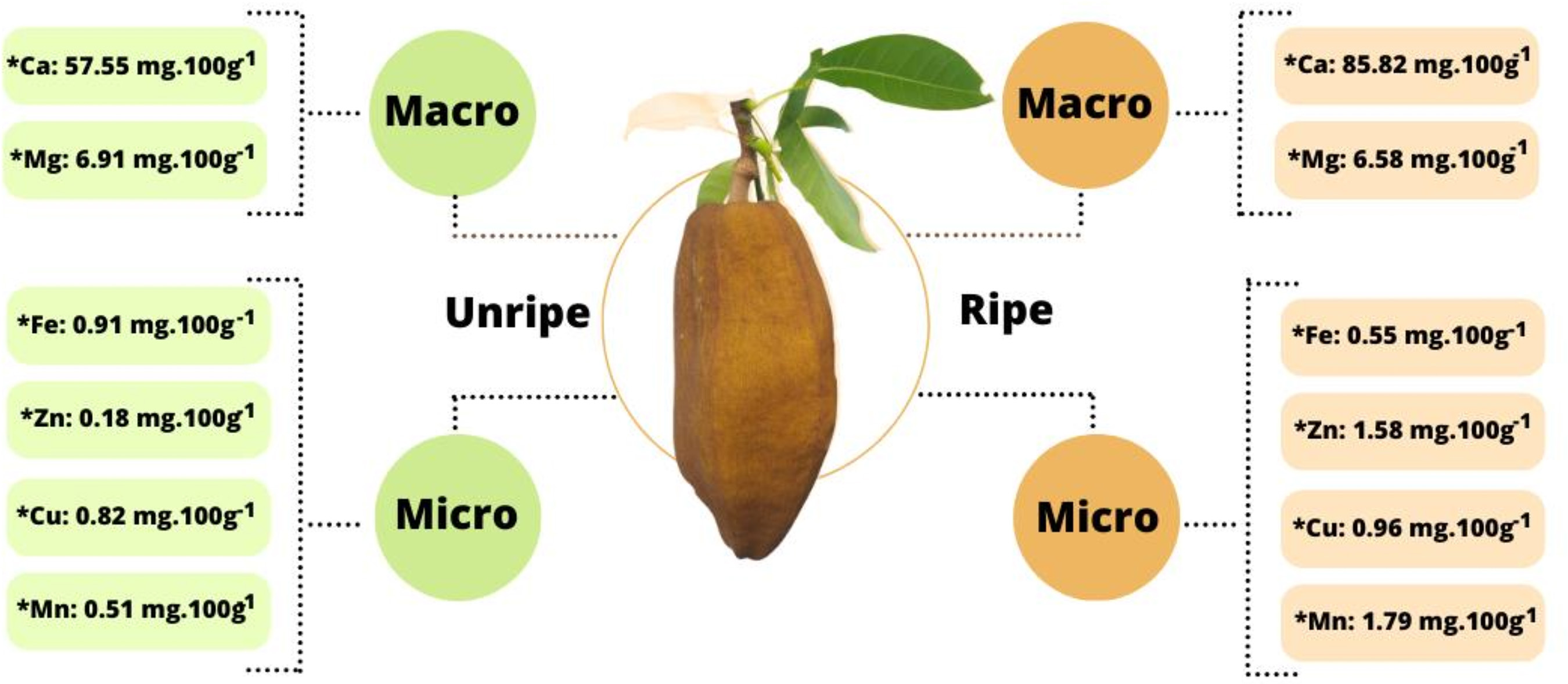
The main macrominerals found in Monguba almonds were calcium and magnesium (Figure 2). 100g of ripe Monguba almonds supply 8.5% of the daily calcium needs for adult human beings, while magnesium supplies 2.01% for women.(39) These minerals were also the main ones determined in the study by Rodrigues et al.,(4) although the authors found higher concentrations for calcium and magnesium, of 158.2 mg.100g-1 and 303.9 mg.100g-1, respectively. A similar concentration to that of unripe Monguba seeds was found for calcium by Becker et al.,(5) of 55.9 mg.100g-1, although the authors also found higher content for magnesium (87.5 mg.100g-1).

Macro and micromineral content of Monguba (Pachira aquatica Aubl.) ripe and unripe seeds (mg.100-1 g DW). Ca: Calcium; Mg: Magnesium; Fe: Iron; Zn: Zinc; Cu: Copper; Mn: Manganese. Asterisks denote significant differences between ripe and unripe samples according to Student’s t-test: *P-value < 0.05. Source: authors' personal collection.
Regarding microminerals, the main ones found in the study were manganese and zinc, with concentration similar to those found by Rodrigues et al.,(4) of 1.01 mg.100g-1 and 2.58 mg.100g-1, respectively. When compared to the microminerals analyzed by Becker et al.,(5) the values found in their study were lower for manganese, zinc, copper, and iron, at 0.20, 0.99, 0.75, and 0.44 mg.100g-1, respectively. The differences observed among other authors may be related to the form of cultivation, genetic factors, ecological conditions, different maturation periods, and harvest time.(44)
The content of manganese and zinc found in the study are equivalent to 98% and 19.7%, respectively, for adult women and 77.8% and 14.6% for men's daily needs, per 100g of seeds.(39) When compared to other oilseeds, the Monguba almond presented values higher than Brazil nuts (Bertholletia excelsa H.B.K) and coconut (Cocos nucifera L.) in manganese (1.0 - 1.1 mg/100g) and also higher than coconut in zinc (0.9 mg.100g-1). Almonds (Prunus dulcis (Mill.) D.A. Webb) and linseed (Linum usitatissimum L.) presented copper values similar to those found in the study for Monguba, 0.93 mg.100g-1 and 1.09 mg.100g-1.(31)
As can be seen in Figure 2, there was an increase in the concentration of calcium, manganese, copper, and zinc as the fruit matured, whereas only iron showed the opposite behavior. During the ripening period, a considerable accumulation of micronutrients occurs, varying during the initial development of the fruit and remaining until harvest,(45) which could justify an increase in the concentration of most micronutrients.
Fourier Transform Infrared Spectroscopy (FTIR)
As can be seen in Figure 3, the FTIR spectrum of the ripe and unripe Monguba seed is quite complex and contains several bands resulting from the contribution of different functional groups belonging to lipids, proteins, carbohydrates, among others.

Fourier Transform Infrared Spectroscopy (FTIR) spectra of Monguba seeds at ripe and unripe stages. The main absorption bands observed include O–H stretching (~3300 cm⁻¹), C–H stretching (~2920 and 2850 cm⁻¹), C=O stretching (~1740 cm⁻¹), and C–O stretching (~1050–1150 cm⁻¹), corresponding to functional groups typically associated with lipids, proteins, and carbohydrates.
Typically, in the FTIR spectra, the broad bands in the 3400 cm-1 regions are due to OH stretching vibrations, arising from hydrogen bonding, attributed to water and hydroxyl groups.(46) As it can be observed this band is more pronounced in the unripe Monguba seed, since, during the fruit ripens, there is a hydrolysis of polysaccharide chains to synthesis of simple sugars, like sucrose, with many hydroxyl groups. This fact could also explain why the °Brix measurement nearly doubles in the ripe Monguba seed. In the same way, the region of 2918 and 2850 cm-1 contains two vibrations, attributed to the asymmetric and symmetric stretching of CH2, respectively.(47) Vibration intensities decrease in the FTIR spectrum of the ripe seed, which can be attributed to the loss of specific primary wall components, such as pectin, during the fruit maturation process, followed by the predominance of cellulose in the secondary wall, which justifies the higher concentration of cellulose found in the ripe seed.(48)
In both spectra, the sharp and narrow band observed at 1743 cm-1 can be attributed to the C=O stretching vibration of ester groups in triacylglycerol or phospholipid, and the bands at 1465 cm-1 are due to the CH absorption bending vibration of CH2 groups, which is correlated with the content of fatty acid chains,(49) justifying the high lipid content of the samples. In the same region, the spectral peaks located at 1637 and 1546 cm-1 correspond to the vibrations of amides I and I in structural proteins, respectively. The absorption peak of amide I mainly indicates the stretching movements of the carbonyl group (C=O) within the amide bonds of the protein. Meanwhile, the amide II absorption peak originates from the combination of amide N-H group vibrations coupled with C-N stretching vibrations within the polypeptide and protein structure. In addition, the different peaks at the region around 1200 to 00 cm-1 can represents the fingerprint of carbohydrates.(50)
CONCLUSIONS
Although the size and mass variables did not demonstrate significant changes between the maturation stages, there was a greater presence of mucilage in unripe Monguba seeds and a higher percentage of pulp in ripe seeds. These differences may influence the possible nutritional and technological applications of Monguba. As for chemical composition, despite the differences between the maturation stages, Monguba seeds maintained their moisture, water activity, and protein variables, which suggests that the maturation process does not influence these components. Monguba almonds are an excellent source of oil, which, due to its constitution, provides good thermal stability, with similar amounts between samples. The main difference observed between the maturation stages was the minerals, with the majority of those analyzed growing in ripe Monguba seeds.
5. ACKNOWLEDGMENTS, FINANCIAL SUPPORT, AND FULL DISCLOSURE
The authors declare that they have no known competing financial interests or personal relationships that could have appeared to influence the work reported in this paper.
This study was financed by the Foundation for the Support of Research in the State of Bahia (Fapesb) and National Council for Scientific and Technological Development (CNPq) and Coordination for the Training and Improvement of Higher Education Personnel (Capes).
6. DATA AVAILABILITY STATEMENT
All data are included in this article.
8. REFERENCES
- 1 Costa LD, Trindade RP, Cardoso PS, Colauto NB, Linde GA, Otero DM. Pachira aquatica (Malvaceae): an unconventional food plant with food, technological, and nutritional potential to be explored. Food Res Int. 2023;162:112354.
- 2 Rezende YRRS, Nogueira JP, Silva TOM, Barros RGC, Oliveira CS, Cunha GC, et al. Enzymatic and ultrasonic-assisted pretreatment in the extraction of bioactive compounds from monguba (Pachira aquatica Aubl.) leaf, bark and seed. Food Res Int. 2021;140:109869.
- 3 Silva SMT, Morais RA, Costa DM, Teles JS, Rodrigues RM, Santos CCA, et al. Physical-chemical characterization, bioactive compounds and antioxidant activity of Pachira aquatica Aublet almonds. Res Soc Dev. 2020;9(7):e535974391.
- 4 Rodrigues AP, Pereira GA, Tomé PHF, Arruda HS, Eberlin MN, Pastore GM. Chemical composition and antioxidant activity of monguba (Pachira aquatica) seeds. Food Res Int. 2019;121:880-7.
- 5 Becker MM, Mandaji CM, Catanante G, Marty JL, Nunes GS. Mineral and bromatological assessment and determination of the antioxidant capacity and bioactive compounds in native Amazon fruits. Braz J Food Technol. 2018;21:e20180218.
- 6 Kapoor L, Simkin AJ, Doss CGP, Siva R. Fruit ripening: dynamics and integrated analysis of carotenoids and anthocyanins. BMC Plant Biol. 2022;22(1):1-22.
- 7 Liu Y, Tang M, Liu M, Su D, Chen J, Gao Y, et al. The molecular regulation of ethylene in fruit ripening. Small Methods. 2020;4(8):1900485.
- 8 Horwitz W, Latimer GW, editors. Official methods of analysis of AOAC International. 19th ed. Gaithersburg: AOAC International; 2012.
- 9 Nielsen SS. Phenol-sulfuric acid method for total carbohydrates. In: Food analysis laboratory manual. 2nd ed. New York: Springer; 2010. p. 47-53.
- 10 Van Soest PJ, Robertson JB, Lewis BA. Methods for dietary fiber, neutral detergent fiber, and nonstarch polysaccharides in relation to animal nutrition. J Dairy Sci. 1991;74(10):3583-97.
- 11 Doner G, Ege A. Evaluation of digestion procedures for the determination of iron and zinc in biscuits by flame atomic absorption spectrometry. Anal Chim Acta. 2004;520(1–2):217-22.
-
12 Ministério da Agricultura, Pecuária e Abastecimento (BR). Manual de métodos analíticos oficiais para fertilizantes e corretivos [Internet]. Brasília: MAPA; 2017 [cited 2023 Apr 7]. Available from: https://www.gov.br/agricultura
» https://www.gov.br/agricultura - 13 Azizah AN, Yuniastuti E, Putri IIS. Morphological characterization of pachira (Pachira aquatica Aubl.). IOP Conf Ser Earth Environ Sci. 2021;905:012044.
-
14 Flora do Brasil. Jardim Botânico do Rio de Janeiro [Internet]. Rio de Janeiro: JBRJ; 2020 [cited 2023 Jan 17]. Available from: http://floradobrasil.jbrj.gov.br/
» http://floradobrasil.jbrj.gov.br/ - 15 Souto PC, Gonçalves EP, Viana JS, Ferreira DTRG, Ralph LN, Silva JCA. Characterization of fruits, seeds and physiological quality of munguba seeds submitted to drying. Magistra. 2018;29(2):182-91.
- 16 Polmann G, Badia V, Danielski R, Ferreira SRS, Block JM. Nonconventional nuts: an overview of reported composition and bioactivity and new approaches for its consumption and valorization of co-products. Future Foods. 2021;4:100099.
- 17 Camacho ME, Tatis HA, Ayala CC. Correlations and path analysis between fruit characteristics and seeds of Pachira aquatica Aubl. Rev Fac Nac Agron Medellín. 2018;71(1):8387-94.
- 18 Correia LAS, Silva JE, Calixto GQ, Melo DMA, Braga RM. Pachira aquatica fruit shells valorization: renewables phenolics through analytical pyrolysis study (Py-GC/MS). Cienc Rural. 2021;52:e20210068.
- 19 Nascimento TLS, Oliveira DDJ, Araújo Melo D, Braga RM. Study of influencing factors in the process of biosorption in batches of Fe3+, Ni2+ and Cd2+ using bioadsorbent derived from Pachira aquatica Aubl. Res Soc Dev. 2021;10(12):e155101220321.
- 20 Subhashree SN. Quantification of browning in apples using colour and textural features by image analysis. Food Qual Saf. 2017;1(3):221–6.
- 21 Abtahi M, Mirlohi A, Sharif-Moghaddam N, Ataii E. Revealing seed color variation and their possible association with yield and quality traits in a diversity panel of flax (Linum usitatissimum L.). Front Plant Sci. 2022;13:1038079.
- 22 Alvarenga TC, Neto HFS, Ogossavara FO, Arantes FC, Marques MO, Frigieri MC. Polyphenoloxidase: an intriguing enzyme. Sci Technol FATEC-JB. 2011;3(1):83-93.
- 23 Efraim P, Pezoa-García NH, Jardim DCP, Nishikawa A, Haddad R, Eberlin MN. Influence of cocoa beans fermentation and drying on the polyphenol content and sensory acceptance. Food Sci Technol. 2010;30:142-50.
-
24 Lopes NL, Jaski JM, Barão CD, Filho LC. Characterization of monguba seeds [Internet]. In: Encontro Nacional de Produção Científica (EPCC); 2017; Paraná, Brazil. Paraná: EPCC; 2017 [cited 2023 Jan 24]. Available from: https://www.epcc.uem.br/
» https://www.epcc.uem.br/ - 25 Lopes NL, Almeida-Couto JMF, Silva C, Pereira MB, Pimentel TC, Barão CE. Evaluation of the effects of pressurized solvents and extraction process parameters on seed oil extraction in Pachira aquatica. J Supercrit Fluids. 2020;161:104823.
- 26 Labuza TP, Altunakar B. Water activity prediction and moisture sorption isotherms. In: Water activity in foods: fundamentals and applications. 2nd ed. Ames: Blackwell Publishing; 2020. p. 161-205.
- 27 Batista-Silva W, Nascimento VL, Medeiros DB, Nunes-Nesi A, Ribeiro DM, et al. Modifications in organic acid profiles during fruit development and ripening: correlation or causation? Front Plant Sci. 2018;9:1689.
- 28 Sousa SF, Silva FB, Araújo AC, Gomes JP. Determination of physical and physicochemical properties of peaches cultivar Rubimel. Rev Bras Tecnol Agroindustr. 2018;12(2):e20181202.
- 29 Adi DD, Oduro IN, Tortoe C. Physicochemical changes in plantain during normal storage ripening. Sci Afr. 2019;6:e00164.
- 30 Viana ES, Jesus JL, Reis RC, Fonseca M, Sacramento CK. Physicochemical and sensorial characterization of papaya jelly with araçá-boi. Rev Bras Frutic. 2012;34(4):1154-64.
-
31 Núcleo de Estudos e Pesquisas em Alimentação (NEPA). Tabela brasileira de composição de alimentos [Internet]. 4th ed. Campinas: NEPA/Unicamp; 2011 [cited 2023 Jan 17]. Available from: https://www.cfn.org.br/wp-content/uploads/2017/03/taco_4_edicao_ampliada_e_revisada.pdf
» https://www.cfn.org.br/wp-content/uploads/2017/03/taco_4_edicao_ampliada_e_revisada.pdf - 32 Kotecka-Majchrzak K, Sumara A, Fornal E, Montowska M. Oilseed proteins: properties and application as a food ingredient. Trends Food Sci Technol. 2020;106:160-70.
- 33 Rodrigues AP, Pastore GM. A review of the nutritional composition and current applications of monguba (Pachira aquatica Aubl.) plant. J Food Compos Anal. 2021;100:103878.
- 34 Olatidoye OP, Akinnymi S, Taofik TA, Olusegun A, Akin AES. Nutritional profile, protein quality, and biological value of raw and roasted cashew kernels (Anacardium occidentale) grown in southwest Nigeria. Croat J Food Sci Technol. 2020;12(1):11-9.
- 35 Choi BH, Coloff JL. The diverse roles of non-essential amino acids in cancer. Cancers (Basel). 2019;11(5):675.
- 36 Erol AS, Er F. Composition and characteristics of some seed oils. Asian J Chem. 2011;23(4):1851-5.
-
37 Machado AF, Antoniassi R, Guedes A, Wilhelm A. Method of analysis of tocopherols in olive oil by reverse phase high performance liquid chromatography [Internet]. Rio de Janeiro: Embrapa; 2018 [cited 2023 Apr 10]. Available from: https://www.infoteca.cnptia.embrapa.br/
» https://www.infoteca.cnptia.embrapa.br/ - 38 Rinaldo D. Carbohydrate and bioactive compounds composition of starchy tropical fruits and tubers in relation to pre- and postharvest conditions: a review. J Food Sci. 2020;85(2):249-59.
- 39 Padovani RM, Amaya-Farfán J, Colugnati FAB, Domene SMA. Dietary reference intakes: application of tables in nutritional studies. Rev Nutr. 2006;19(6):741-9.
- 40 Gonçalves CAA, Lima LCO, Lopes PSN, Prado MET. Physical, chemico-physical, enzymatic and cell wall characterization during the different development stages of the fig tree fruits. Food Sci Technol. 2006;26(1):220-9.
- 41 Sharma P, Kumar R, Sandhir R, et al. Lignification and plant development: roles in structural integrity and defense. Front Plant Sci. 2021;12:631524.
- 42 Crippa C, Matteucci S, Pastore M, Morenghi E, Starace E, et al. A comparative evaluation of the caloric intake and economic efficiency of two types of homogenized diets in a hospital setting. Nutrients. 2023;15(22):4731.
- 43 Marshall MR. Ash analysis. In: Nielsen SS, editor. Food analysis. 5th ed. New York: Springer; 2010. p. 105-15.
- 44 Özcan MM, Viktar L. The effect of harvest times on mineral contents of almond and walnut kernels. Erwerbs-Obstbau. 2020;62(4):455-8.
- 45 Mirdehghan SH, Rahemi M. Seasonal changes of mineral nutrients and phenolics in pomegranate (Punica granatum L.) fruit. Sci Hortic. 2007;111(2):120-7.
- 46 Ojstršek A, Gorgieva S. Cellulose nanofibrils-reinforced pectin membranes for the adsorption of cationic dyes from a model solution. Polymers (Basel). 2024;16(6):724.
- 47 Nelson ML, Mares T. Accessibility and lateral order distribution of the cellulose in the developing cotton fiber. Text Res J. 1965;35(7):592-603.
- 48 Abidi N, Cabrales L, Haigler CH. Changes in the cell wall and cellulose content of developing cotton fibers investigated by FTIR spectroscopy. Carbohydr Polym. 2014;100:9-16.
- 49 Dogan A, Severcan M, Severcan F. Dose-dependent differentiation of gamma-irradiated hazelnut samples by mid-infrared spectroscopy coupled with chemometrics. J Spectrosc. 2020;2020:8859104.
- 50 Bansal K, Bajpai M. Isolation and analysis of Phanera variegata mucilage by various analytical techniques. Indian J Pharm Educ Res. 2024;58(2):642-50.
Edited by
-
Editors:
Ricardo MarencoDanielle Fabíola Pereira da silva