
 Spraying of phytosanitary products with different equipment and flow rates in soybean crop
ABSTRACT
The use of spraying drones in agricultural crops has become a recurring practice on rural properties. In this context, this study aimed to evaluate the influence of different spraying equipment and flow rates on the agronomic performance of second-season soybean crop. The experiment was conducted in the experimental area of the Polytechnic College, Federal University of Santa Maria, under the experimental design of randomized blocks, in a 3×2 factorial, with three spraying equipment (DJI T16 drone, DJI T40 drone and MF 8225 self-propelled sprayer) and two flow rates for each equipment (10 and 15 L ha-1 for drones and 50 and 100 L ha-1 for self-propelled sprayer). For drones, application rates of 10 and 15 L ha-1 were classified as low and high, respectively, whereas for the self-propelled sprayer, application rates of 50 and 100 L ha⁻¹ were classified as low and high, respectively. The evaluated variables were number of pods per plant, number of grains per plant, thousand-grain weight, and grain yield. ANOVA indicated no significant interaction between application rates × equipment, with no significant main effects observed. It was concluded that both drones and the self-propelled sprayer, regardless of the application rate, ensured similar soybean crop performance.
Keywords
agronomic performance; self-propelled sprayer; spraying drones
INTRODUCTION
Soybean is a commodity with major global importance, due to its bromatological quality, which is extremely important for human and animal diet.(1) In Brazil, soybean production in the 2023/24 harvest was 147.3 million tonnes, 4.7% lower than that obtained in the 2022/23 harvest, the highest ever harvested in the country.(2) In this scenario, Brazilian agriculture is recognized for its high competitiveness and enormous job creation potential in the agricultural sector.(3)
Due to the advancement of management techniques and technological increase, Precision and Digital Agriculture has promoted improvements in agricultural production systems, optimizing resources and mitigating effects and impacts on the environment.(4) Among the technologies driven by modern agriculture is the use of Remotely Piloted Aircraft (RPAs), or drones, for the phytosanitary control of agricultural crops, which has shown significant growth.(5,6)
There is a lack of studies that consistently validate the efficiency of using remotely piloted aircraft in soybean cultivation.(7) Furthermore, there is insufficient information to support the selection of specific operational parameters under different working conditions.(8,9) Environmental factors strongly influence the spraying quality of remotely piloted aircraft, potentially significantly reducing equipment efficiency in the field and consequently increasing the risk of environmental contamination.(10,11)
There is a tendency for spraying drones to be increasingly present in agriculture; however, as they have been recently introduced in the national market, studies on their technical efficiency and economic feasibility are needed. In this context, this study aimed to evaluate the influence of different spraying equipment and flow rates on the agronomic performance of second-season soybean crop.
MATERIAL AND METHODS
Study area and experimental design
A field experiment was conducted during the 2023/2024 crop season at the experimental area of the Polytechnic College of the Federal University of Santa Maria, in the city of Santa Maria, southern Brazil, at the geographic coordinates 29°43′44.396″ S and 53°45′25.826″ W, with an altitude of 105 m above mean sea level. According to the Köppen climate classification, the region has a Cfa climate, humid subtropical, characterized by hot summers.(12) The soil at the site is classified as Argissolo Bruno Acinzentado (Ultisol), due to the presence of a textural change and low clay activity,(13) with its chemical characteristics shown in Table 1.
The experimental design was randomized complete block in a 3×2 factorial arrangement, with three spraying equipment (drones and self-propelled sprayer) and two flow rates (low and high), with three replicates. The equipment used consisted of DJI drones, AGRAS T16 and AGRAS T40 models, and a Massey Ferguson self-propelled sprayer, MF 8225 model. The flow rates applied were 10 L ha-1 (low) and 15 L ha-1 (high) for the drones, and 50 L ha-1 (low) and 100 L ha-1 (high) for the self-propelled sprayer.
The definition of the application rates and their classification as “low” or “high” were based on the operational conditions encountered in the field for each piece of equipment. Due to the limited autonomy of drones in terms of tank capacity and flight time per battery, as well as the characteristics of the atomization technology employed, the application rates used with these devices for insecticide and fungicide spraying are lower than those adopted for self-propelled sprayers, generally ranging from 10 to 15 L ha⁻¹, which are the most commonly reported.(14-17)
The operational parameters used by the drones, AGRAS T16 and AGRAS T40, during the applications consisted of a flight height of 4 m above the ground surface, application swath width of 5 m, and working speed of 20 km h⁻¹. The AGRAS T16 and AGRAS T40 produced fine droplets at both low and high spray volumes. The self-propelled sprayer operated at a working speed of 8 km h⁻¹ and working pressure of 4.5 bar, producing fine droplets at both low and high spray volumes.
Crop management
Soybean sowing was carried out on February 1, 2024 (off-season), with a row spacing of 0.45 m and a plant density of 377,800 seeds per hectare. The soybean cultivar used was HO Paraguaçu I2X, characterized by an indeterminate growth habit, medium plant size, maturity group 6.4, and good adaptability to the regional climate. Fertilization was performed following the recommendations of the Manual de Calagem e Adubação for the states of Rio Grande do Sul and Santa Catarina, based on soil analysis results (Table 1), using 300 kg ha⁻¹ of NPK fertilizer (2-23-23).(18) Weed management and phytosanitary control were carried out according to the Technical Recommendations for Soybean Cultivation .(19) Harvest was carried out on May 20, 2024.
During the experimental period, three applications of insecticides and fungicides were conducted on March 26, 2024, April 9, 2024, and April 23, 2024, according to control needs based on the monitoring of neotropical brown stink bug (Euschistus heros) and red-banded stink bug (Piezodorus guildinii), as well as the Asian soybean rust (Phakopsora pachyrhizi) and downy mildew (Peronospora manshurica). These applications were performed using a fan-type nozzle, XR11001 model, in the AGRAS T16 drone, and an atomizing nozzle, LX8060SZ model, in the AGRAS T40 drone. In the self-propelled sprayer, hollow cone nozzles were used: 30HCX4 for low flow rate and 30HCX8 for high flow rate.
The response variables measured were the number of pods per plant (NPP), the number of grains per plant (NGP), thousand-grain weight (TGW), and grain yield. NPP and NGP were determined by counting the number of structures present in six representative plants collected from each experimental unit (EU). To measure TGW and grain yield, plants were manually harvested in a 4.05 m² area in each EU. Subsequently, the samples were threshed, cleaned, and weighed on a precision scale, with grain moisture content corrected to 13%.
Weather conditions
Air temperature (minimum, average, and maximum) and accumulated rainfall data were obtained from the automatic meteorological station of the National Institute of Meteorology (INMET), affiliated with the Federal University of Santa Maria, located approximately 1,000 m from the experimental area. During the soybean growing season, the average air temperature was 22.07 °C, ranging from 4.40 °C to 37.20 °C, with accumulated rainfall of 1,160.60 mm (Figure 1). In addition, during the spraying operations, wind speed and relative air humidity were measured (Table 2) using a thermo-hygro-anemometer.
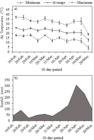
Air temperature (minimum, average, and maximum) (a) and accumulated rainfall (b) during the soybean growing season (February to May).
Statistical analysis
The data obtained were initially analyzed for adherence of the residuals to normal distribution and homogeneity of residual variances using the Shapiro-Wilk (p < 0.05) and Bartlett (p < 0.05) tests, respectively..(20,21) Subsequently, the data were subjected to Analysis of Variance (ANOVA) to determine the possible effects of treatment and interaction. When a significant effect was verified by the F test (p < 0.05), the appropriate complementary analyses were carried out. All analyses were performed with the aid of R software (R Core Team, 2024).
RESULTS AND DISCUSSION
The 2023/24 growing season was marked by the occurrence of the El Niño phenomenon, which is characterized by high rainfall volumes in southern Brazil. During the study period, as previously mentioned, an average air temperature of 22.04 °C was observed, and total cumulative rainfall reached 1,160.6 mm, approximately 106% above the regional climatological normal.(22) Soybean requires temperatures between 0 °C and 45 °C, with an optimum temperature of approximately 30 °C, and accumulated precipitation of around 800 mm.(23) However, in addition to the total amount of available water, a regular distribution of rainfall throughout the crop cycle is essential, particularly during the grain-filling stage.(24) In the present study, the excess water observed, especially after the grain-filling stage and close to the harvest period, had a marked negative impact on the yield obtained.
According to the ANOVA, there was no significant interaction between flow rates × spraying equipment for the variables evaluated (Table 3). When analyzing the main effects, no significant effects of the studied factors were observed. The overall means were 68.103 pods per plant, 134.294 grains per plant, a thousand-grain weight of 117.507 g, and a grain yield of 1,529.635 kg ha⁻¹.
Summary of the analysis of variance and significance of the mean square error for the sources of variation and coefficient of variation (CV) for number of pods per plant (NPP), number of grains per plant (NGP), thousand-grain weight (TGW), and grain yield of soybean grown under pest and disease management using two spray application rates and different spraying equipment
The fact that no significant difference was observed for the variables number of pods per plant, number of grains per plant, and thousand-grain weight (Figure 2a, 2b, and 2c) shows the potential that spraying drones have, when used correctly. Due to the high relative humidity and, consequently, highly favorable conditions for the occurrence of diseases in the soybean crop, it can be stated that, indirectly, the drone promoted an environment of protection against pathogens similar to that promoted by the terrestrial application.

Number of pods per plant (a), number of grains per plant (b), thousand-grain weight (c), and grain yield (d) of soybeans cultivated using different equipment and flow rates for the application of phytosanitary products.
A similar result was observed for soybean grain yield as a function of the factors studied (Figure 2d), which can be considered a positive result for the use of spraying drones, as it indicates that their performance was similar to that of the self-propelled sprayer, a technology already consolidated in agriculture. Nevertheless, considering the productive potential of soybean, the grain yield obtained in this study is considered low, which is possibly related to the sowing time.
In the region where the study was conducted, soybean sowings carried out in February are considered late (off-season) and commonly result in lower grain yields due to the imposed environmental conditions.(23) Among these conditions, shorter photoperiods and lower solar radiation are noteworthy, factors that shorten crop cycle and tend to decrease the number of nodes, pods, and grains.(25) In addition, during the period in which the study was conducted, cumulative rainfall exceeded the requirements of the soybean crop, causing excessive soil waterlogging and favoring the occurrence of diseases and pests.
With the use of agricultural spraying drones, other benefits specifically associated with the phytosanitary management operation were also observed, such as the optimization of operational work and greater protection of the workers involved, as the application is carried out at a distance. Similar results were observed in other studies, confirming that drones have the potential to perform the work efficiently and with associated beneficial effects.(26)
During the operation with spraying drones carried out in the present study, this tool proved to be an alternative for spraying areas of difficult access, where ground sprayers and aircraft cannot perform their function efficiently, a characteristic also observed by Barbizan and Cavichioli.(27) In addition, the use of drones had the potential to perform functionalities within Agriculture 4.0 with greater precision and efficiency, an aspect already described by Alarcão Júnior and Nuñez.(5)
CONCLUSIONS
The use of spraying drones in second-season soybean crop has the potential to deliver agronomic performance results similar to those obtained with self-propelled sprayers, regardless of the use of low flow rate (10 L ha-1) or high flow rate (15 L ha-1). Further studies are recommended across different growing seasons to evaluate spray quality using self-propelled sprayers and drones at different application rates, as well as the agronomic response of the crops.
ACKNOWLEDGEMENTS, FINANCIAL SUPPORT AND FULL DISCLOSURE
The authors would like to thank the Federal University of Santa Maria – Polytechnic College for its financial support. They also thank Massey Ferguson for providing the MF8225 self-propelled sprayer (loan agreement 000088/2021) and Allianza: Plant Energy for providing the T40 drone used in this research. We have no conflict of interest to declare. The authors contributed equally to the conception and writing of the manuscript.
DATA AVAILABILITY STATEMENT
All datasets supporting the findings of this study are included in this article.
REFERENCES
- 1 Guarienti VF, Pavão LFS, Maldaner IC, Follmann DN, Pes LZ, Farias MS, et al. Desempenho agronômico, teores de proteína e óleo de cultivares de soja em ambiente de terras baixas com ocorrência de La Niña. Obs de La Econ Latinoam. 2024;22(02):14974-96.
-
2 Companhia Nacional de Abastecimento. Acompanhamento da safra brasileira de grãos: safra 2023/24 - 10° levantamento [Internet]. Brasília (DF): CONAB; 2024 [cited 2025 May 19]. Available from: https://www.conab.gov.br/info-agro/safras/graos/boletim-da-safra-de-graos
» https://www.conab.gov.br/info-agro/safras/graos/boletim-da-safra-de-graos - 3 Moraes LR, Araújo Neto LT, Garcia LHA, Mendonça MAB, Santos RR, Neto OC. Benefícios, desafios e legislações para utilização de drones na produção agrícola: uma revisão da literatura. Rev Multidiscip do Nordeste Mineiro. 2024;3(1):1–13.
- 4 Oliveira AJ, Silva GF, Silva GR, Santos AAC, Caldeira DSA, Vilarinho MKC, et al. Potencialidades da utilização de drones na agricultura de precisão. Braz J Dev. 2020;6(10):64140–9.
- 5 Alarcão Júnior JC, Nuñez DNC. O uso de drones na agricultura 4.0. Brazilian Journal of Science. 2024;3(1):1-13.
- 6 Ribeiro MEA, Ribeiro LFO, Santos TG, Nunes JGP, Vitória EL. Análise bibliométrica da produção científica sobre uso de aeronave remotamente pilotada na pulverização agrícola. Braz J Prod Eng. 2024;10(1):94–104.
- 7 Silva MRA. Deposição de calda aplicada com aeronave remotamente pilotada nas culturas de milho e soja [dissertação]. Uberlândia: Universidade Federal de Uberlândia; 2022. 50 p.
- 8 Lopes LL, Cunha JPAR, Nomelini QSS. Use of unmanned aerial vehicle for pesticide application in soybean crop. AgriEngineering. 2023;5(4):2049-2063.
- 9 Liu Y, Ru L, Duan L, Qu R. Model and design of real-time control system for aerial variable spray. PLoS One. 2020;15(7):1-16.
- 10 García-Munguía A, Guerra-Ávila PL, Islas-Ojeda E, Flores-Sánchez JL, Vázquez-Martínez O, García-Munguía AM, et al. A review of drone technology and operation processes in agricultural crop spraying. Drones. 2024;8(11):674.
- 11 Thomson SJ, Huang Y. Comparison of weather data acquisition periods influencing an aerial pesticide drift statistical model. Agronomy. 2023;13(1):213.
- 12 Alvares CA, Stape JL, Sentelhas PC, de Moraes GJL, Sparovek G. Köppen’s climate classification map for Brazil. Meteorol Z. 2013;22(6):711–728.
- 13 dos Santos HG, Jacomine PKT, Anjos LHC, Oliveira VA, Lumbreras JF, Coelho MR, et al. Sistema brasileiro de classificação de solos. 5th ed. Brasília (DF): Embrapa; 2018. 356 p.
- 14 Chen P, Ouyang F, Wang G, Qi H, Xu W, Yang W, et al. Droplet distributions in cotton harvest aid applications vary with the interactions among the unmanned aerial vehicle spraying parameters. Ind Crops Prod. 2021;163:113324.
- 15 Cunha JP, Silva MR. Spray deposition from a remotely piloted aircraft on the corn crop. Rev Ciênc Agron. 2023;54:e20217862.
- 16 Lou Z, Xin F, Han X, Lan Y, Duan T, Fu W. Effect of Unmanned Aerial Vehicle Flight Height on Droplet Distribution, Drift and Control of Cotton Aphids and Spider Mites. Agronomy. 2018;8(9):187.
- 17 Woldt W, Martin D, Latheef M, Kruger G, Wright R, McMechan J, et al. Field Evaluation of Commercially Available Small Unmanned Aircraft Crop Spray Systems. Transactions of the ASABE. 2018;61(2):603-614.
- 18 Comissão de Química e Fertilidade do Solo - RS/SC. Manual de calagem e adubação para os estados do Rio Grande do Sul e de Santa Catarina. 11th ed. Frederico Westphalen: Sociedade Brasileira de Ciência do Solo - Núcleo Regional Sul; 2016. 376 p.
- 19 Martin TN, Rugeri AP, Beutler AN, Conceição GM, Fipke GM, Pires JM, et al. Indicações técnicas para a cultura da soja no Rio Grande do Sul e em Santa Catarina e no Paraná 2020/2021. Passo Fundo: Embrapa Trigo; 2020. 272 p.
- 20 Shapiro SS, Wilk MB. An analysis of variance test for normality (complete samples). Biometrika. 1965;52(3-4):591–611.
- 21 Steel RGD, Torrie JH, Dickey DA. Principles and procedures of statistics: a biometrical approach. New York (NY): McGraw-Hill; 1997. 666 p.
-
22 Instituto Nacional de Meteorologia. Banco de Dados Meteorológicos [Internet]. Brasília (DF): INMET; c2022 [cited 2025 May 4]. Available from: https://portal.inmet.gov.br/
» https://portal.inmet.gov.br/ - 23 Wink JE, Tagliapietra EL, Porta FS, Tura EF, Nora MD, Alves AF, et al. Ecofisiologia da soja visando altas produtividades. 3rd ed. Santa Maria: Editora GR; 2025. 686 p.
- 24 Zanon AJ, Streck NA, Grassini P. Climate and management factors influence soybean yield potential in a subtropical environment. Agron J. 2016;108(4):1447-1454.
- 25 Nico M, Miralles DJ, Kantolic AG. Natural post-flowering photoperiod and photoperiod sensitivity: Roles in yield-determining processes in soybean. Field Crops Res. 2019;231:141-152.
-
26 Canal Rural. Drones: conheça vantagens da utilização desse equipamento nas lavouras [Internet]. São Paulo: Canal Rural; c2021 [cited 2025 May 20]. Available from: https://www.canalrural.com.br/programas/direto-ao-ponto/drones-saiba-vantagens-da-utilizacao-desse-equipamento-nas-lavouras/
» https://www.canalrural.com.br/programas/direto-ao-ponto/drones-saiba-vantagens-da-utilizacao-desse-equipamento-nas-lavouras/ - 27 Barbizan RZ, Cavichioli FA. Uso de drones na pulverização da agricultura 4.0. INFA. 2022;19(2):584-96.
Edited by
-
Editors:
Fernando CunhaMarihus Altoé Baldotto


