| First |
Sensory-social play and everyday activities |
D. spilled soda on the table, and M. looked for a cloth to dry it. Since he couldn't find it, he used his sleeve. D. kisses and hugs M. and encourages him by clapping when he understands his parents' requests. M. has started smiling more and seems to understand what's being said. The best interactions happen at mealtimes. They're dancing. |
Establish eye contact and synchronize the child's play with the adult's speech, especially eye contact. Engage in more sensory-social and physical activities rather than more structured tabletop activities. Parents should realize that, despite being twins, they have different tastes and abilities, as they are attuned to M.'s language support but very directive with D. Explain age-appropriate books and how to read. |
| Second |
Activities of daily living |
Parents asked for toy ideas. They said their boys were having a birthday soon, and the family wanted to give them toys. |
Discussion about play styles, how to align speech with play. General explanation of each person's play style. |
| Third |
M. and D's favorite games, alone and with their father. |
D. is saying vowels while watching "Galinha Pintadinha", saying "woof woof" for "dog", and "grandma." He has become interested in household chores. M. uses the "give" word functionally and has started pointing. "We couldn't get close to him before; he didn't like kisses and hugs; he lived in corners, and now he doesn't. His grandmother comes home, and he shows the books or whatever else he wants”. M. has started hugging D. and looking for him to play with. |
Presentation of toys suitable for both children and for each one, explaining where each child is in their development, with ideas for variations. Attentional and calming sensory games for both children aim to explore bidirectionality, increase eye contact, understand verbal commands, and develop motor skills. Also, simple action-reaction and disassembly games, and a simple functional presentation-matching game. For D, games and toys that refer to the pre-symbolic. Guidance on choosing books. Discussion about avoiding inappropriate behavior by anticipating routines for him. Empowerment and encouragement for the father to appear in the videos and play with them more. |
| Fourth |
Discussing in-person care with family. No videos to watch this week. |
M. is saying "didi" for "godfather" and "potato." They've stopped spinning the wheels on toys, objects, and their bodies. They're playing more functionally; D. always liked toy cars, and now M. likes them too. M. likes tearing leaves into ever smaller pieces. On a Children's Day outing, they loved playing on the trampoline, where only D. jumped and M. sat. D. tried to say "chicken." |
Stimulate speech based on the environment and action, and continue encouraging motor play and motor imitation through dance. With D: use concrete objects and narrate them to improve pre-symbolic development; it's still very much in their body and that of others. With M., expand tactile exploration of objects. For example, M. can use play-dough to squeeze and make balls. D. can pretend to make food. Encourage them to choose games and participate in them. The child's motivation is essential to improving auditory memory and speech. Introduce functional words like yes and no, anchored in gestures, as it's necessary to understand the concept of the word in everyday life to use it. |
| Fifth |
In-person observation of interactions with parents and modeling. |
Questions about how to vary games and introduce two-way play |
They received a gift from the therapist, an alligator with a toothache, encouraging two-way play and the functional use of some words. With M., more sensory-social games, and with D., more toy car games with variations. |
| Sixth |
Next videos collage with a mosaic of M.'s shredded papers, and with D. with his parents playing and using different cars. |
They learned to take turns playing with their parents, playing the alligator with a toothache game. Their mother says she has difficulty connecting with M. during games and prefers cuddling to interact with him. They began responding when called by name. They began solving problems like picking up a cup from the sink. Both also learned to blow bubbles and smell flowers. M. is understanding his parents' speech related to everyday needs. |
D. really enjoys drawing, with an adequate attention span. His father was able to vary his toy car games and build towers well. M. likes to play by taking toys in and out of a jar, and we encourage variation by providing role-playing examples. It's important to learn to play both separately and together.
Guidance on how to approach a child to play together. D. has cognitive rigidity, not accepting exchanges of games, unlike M., who exchanges with slight effort. D. has started to refuse to share toys with M. and has increased screaming and crying behaviors. Guidance on regulation and co-regulation is provided. |
| Seventh |
Free videos of play with parents and each other |
M. engages well with any toy or interaction with others, unlike D., who needs affection and fun. After moving house and city, M. is having more fits. M. engages well and prefers to play with others. They're already understanding small commands like "get the pacifier for mommy." M. is saying "dada" to daddy and "mama" to mommy, and D. can say "one" and "two"; understands colors and tries to name them. They played with a child of the same age, also with ASD, and shared toys and shared small moments together, such as throwing the toy car back and forth. This two-way play emerged in the game of one throwing the ball and the other dropping it, and then switching roles in the game. They're able to cut their nails without getting out of control. The parents recognized and understood each child's profile and became confident. |
D. and M. use the pacifier a lot - guidelines to try to reduce it; wait 3 seconds for a response after asking a question, if it doesn't come, then say the expected answer.
Actively participate in play, always using action verbs and objective sentences. M. needs to improve stacking and nesting skills instead of always asking an adult for support without even trying, and D. needs to play more together and make more eye contact; in addition to expanding play into pre-symbolic play. |

 Telecare for parents of children with autism spectrum disorder: A case report of a proposal for assisted waiting from DIR-Floortime
 Thumbnail
 Thumbnail
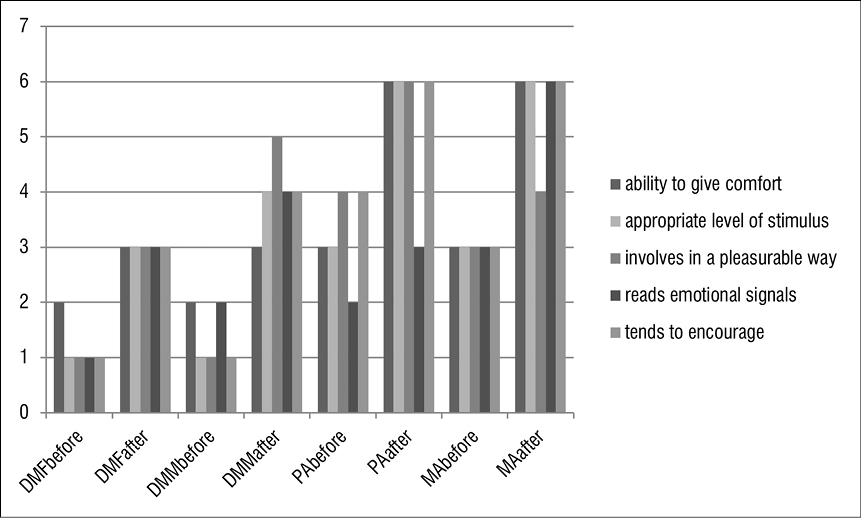 Captions: F=father, M=mother, D, M, A=children; 0=did not achieve, 1=beginning of skill, 2=islands of development, 3=moderate presence, 4=becoming consistent,m5=effective except when stressed, 6=very effective
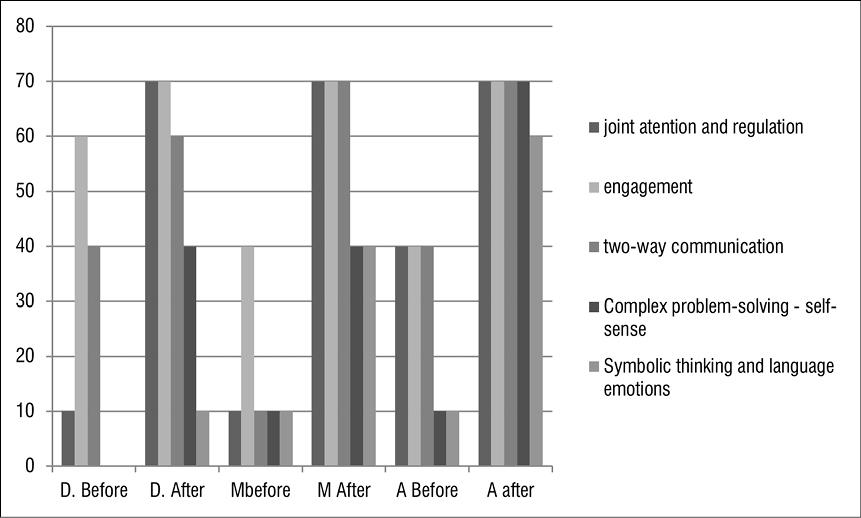 Captions: D, M and A = children