
 Telecare for parents of children with autism spectrum disorder: A case report of a proposal for assisted waiting from DIR-Floortime
ABSTRACT
This case report is on the effects of teleparental care on the evolution of the profile of parents and children with autism spectrum disorder (ASD), as a process of assisted waiting, in a study of three cases of children who were on the waiting list of the speech-language pathology school clinic and who, in the initial evaluation with the Labyrinth Scale, showed evidence of ASD. They were evaluated based on the levels of emotional functional development of the DIR-Floortime, the evolution of play and communication, before and after the intervention. Seven online intervention sessions were held with the parents, in which their demands regarding the development of their children were heard and guidance was given on how to provide adequate support for the evolution of children in play, social interactions, body control, reduction of restricted behaviors, communication and language, based on principles of the DIR-Floortime, enunciative principles and play. Progress was evidenced in both the profiles of the parents and the children. The children improved their playing and language skills, especially understanding. The approach was effective as a form of assisted waiting.
Keywords:
Autism Spectrum Disorder; Therapeutics; Language; Telemedicine; Growth and Development
RESUMO
Este relato de caso descreve os efeitos do teleatendimento parental na evolução do perfil de pais e filhos com transtorno do espectro autista (TEA), como um processo de espera assistida, em um estudo com três casos de crianças que estavam na lista de espera de clínica- escolaa de fonoaudiologia e que, na avaliação inicial com a Escala do Labirinto, apresentaram indícios de TEA. Elas foram avaliadas com base nos níveis de desenvolvimento funcional emocional do DIR-Floortime, na evolução do brincar e da comunicação, antes e depois da intervenção. Foram realizadas sete sessões de intervenção online com os pais, nas quais suas demandas em relação ao desenvolvimento de seus filhos foram ouvidas e eles receberam orientações sobre como oferecer suporte adequado para a evolução das crianças no brincar, nas interações sociais, no controle corporal, na redução de comportamentos restritos, na comunicação e na linguagem, com base nos princípios do DIR-Floortime, nos princípios enunciativos e do brincar. Observou-se progresso tanto nos perfis dos pais quanto nos das crianças. As crianças melhoraram suas habilidades de brincar e de linguagem, especialmente a compreensão. A abordagem mostrou-se eficaz como uma forma de espera assistida.
Descritores:
Transtorno do Espectro Autista; Terapêutica; Idioma; Telemedicina; Crescimento e Desenvolvimento
INTRODUCTION
A study1 analyzed the narratives of parents of children with autism spectrum disorder (ASD) about the protagonism and barriers to their children's care. It noted that several family members actively participated in the fight for their children's rights, but they highlighted the need to expand psychosocial care for their children, complaining of difficulties related to access, including transportation, service hours, frequency of appointments, lack of maintenance, and precarious physical space. This reality observed in Brazilian Psychosocial Care Centers for Children and Youth (CAPSi) is no different from that found in speech-language-hearing teaching clinics, where these children remain on long waiting lists and, when called, often experience the same difficulties accessing the service and having low-intensity care.
Treatment intensity is an important aspect in ASD cases, considering the characteristics that comprise the diagnostic criteria for these children, as described in the Diagnostic and Statistical Manual of Mental Disorders (DSM-5)2. These include persistent deficits in social communication and social interaction across multiple contexts, such as socioemotional reciprocity (e.g., difficulty initiating, responding to, or maintaining social interactions and/or conversations), nonverbal communicative behaviors used for social interaction (e.g., limited or absent eye contact and difficulty understanding and using gestures), and difficulties developing, maintaining, and understanding relationships (e.g., difficulty sharing simple to complex symbolic play and partial or absent interest in children their own age group). They also have restricted and repetitive patterns of behavior, interests, or activities. The diagnosis also considers their hyperreactivity, hyporeactivity, and severity levels, which can range from little support (level 1) to a lot of support (level 3)2.
The diagnosis is generally made by a physician based on a physical examination and additional tests3. Decree No. 55,995/2021 establishes the Identification Card for Persons with ASD (Ciptea) within the State of Rio Grande do Sul. By law, the diagnosis must be certified by a physician using the International Statistical Classification of Diseases and Related Health Problems (ICD-10), code F.84.0. This ensures families have the right to prompt care and priority access to public and private services, especially in the areas of health, education, and social assistance.
The Rio Grande do Sul Foundation for Supporting People with Disabilities4 recorded 4,358 requests from June 18, 2021, to February 2022. Among these, 80.12% of those who requested Ciptea are male; 51.06% do not have private insurance; 31.30% have a per capita income of half a minimum wage to one minimum wage; and 94.50% are receiving specialized clinical care. Another important finding is that the vast majority were diagnosed between 2 and 3 years of age, which establishes the prevalence of early diagnosis5. This term "early" could be questioned, considering that the risk of progression to ASD can already be detected in the first year of life6,7. Many of the children without a diagnosis are on waiting lists at teaching clinics, complaining of delayed language acquisition, as was the situation in the three cases in this study.
It is known that the social consequences of ASD can create a series of challenges for family care, as children have difficulty with routine changes, food selectivity, adverse reactions to sounds, and lack of response to interaction8. This calls into question a series of interventions for this phase between 2 and 3 years old. The intervention chosen for this study was DIR/Floortime9,10, which is a non-intensive in-person care tool available in teaching clinics, suitable for interventions with parents, taking, at most, two weekly sessions.
DIR/Floortime considers family relationships a key factor in the development of children with ASD. It approaches the functional levels of emotional development (D), the individual profile of each child and their family (I), and their relationships with family members and other people in their lives (R), giving play and interaction a fundamental role in building social interaction and communication (floor time). This approach seeks to develop functional skills, the acquisition of affective-emotional competencies, the integration of children into social interactions, the development of sensory skills, psychomotor planning, and symbolic development, which includes language acquisition. This process is based on working with parents in sessions with a therapist and/or analyzing family videos and providing specific guidance.
This approach is compatible with language perspectives that prioritize drive and intersubjectivity, such as the enunciative perspective11, which supports a place of enunciation for children with language disorders while simultaneously offering prompts that support language appropriation. Therefore, this study used the DIR/Floortime intervention method9,10,12,13 combined with speech-language-hearing enunciative principles11,14 due to the importance they give to the child's relationship with their caregivers.
The enunciative principles proposed by Souza11 include the parents’ support of a place of enunciation for the child by fostering the assumption/recognition of the subject and the assumption/recognition of the speaker of the language, using strategies that enable the child's engagement and communicational expression in playful activities of interest. This principle strengthens the child-family conjunction and disjunction relationships. The aim is also to facilitate the relationships of form and meaning across linguistic levels through requests that meet principles of lexical, morphosyntactic, phonological, and praxis processing. Thus, prosodic strategies can be used to focus on aspects of form and meaning in language associated with the emphasis on the speech continuum. The DIR/Floortime rule for language requests is to be at most one step ahead of the child's expression - i.e., if the child produces a word, they use statements of at most two words and always with obvious gestural and visual support.
DIR/Floortime establishes principles for developing functional levels based on the child's individual leadership and profile, and their relationship with family members. Thus, through playful activities, the intention for this age group is to develop the first five levels of emotional development: shared attention and self-regulation, engagement, bidirectional communication and complex problem-solving, and a sense of self, laying the foundation for the transition from the sensorimotor period to symbolism and language. What stands out at this level is language functioning appropriate for developing the ability to refer in language (second enunciative mechanism) and to initiate the process of establishing the subject in discourse (third enunciative mechanism)11,15.
The DIR/Floortime method analyzes nine levels of a child's emotional and functional development. The first five levels were developed concurrently with suggestions for the expected ages of manifestation and consolidation in typical children, as follows:
Level 1: Regulation and Joint Attention (0-3 months) - Establishing eye contact, smiling, and vocalizing demonstrates interest in social interaction, as well as the ability to remain calm, alert, and attentive. The child regulates their body and multiple sensory and emotional stimuli.
Level 2: Mutual Engagement (2-5 months) - Develops interest and trust in others, enabling them to overcome emotional problems with their support.
Level 3: Intentional Two-Way Communication (4-10 months) - Perceiving responses to gestures/speech and demonstrating emotions such as joy and anger, enabling engagement in communication with others.
Level 4: Complex Problem Solving and Sense of Self (10-18 months) - Able to solve motor problems and acquire greater control over their body, representing actions and being able to anticipate them in the interaction process.
Level 4: Complex Problem Solving and Sense of Self (10-18 months) - Able to solve motor problems and acquire greater control over their body, representing actions and being able to anticipate them in interaction.
Level 5: Symbolic Thinking, Language and Emotions (18-30 months) - The child can understand the intention of others and respond through language, using gestures, verbalizing, or simply moving to communicate their ideas and desires.
According to a study11, children with ASD experience significant obstacles in the first four levels, particularly physical ones, which impede the adequate and robust development of engagement, shared attention, and two-way communication. Therefore, although they can produce speech, they are not always able to address their productions to others and engage in a casual dialogue. This highlights the importance of combining this approach with the enunciative view of language, as it allows for the analysis of obstacles in the first three levels and promotes family-child synchrony. If synchrony is established, it can fuel the assumption/recognition of subject and speaker, providing compensation so that the child can master bodily spaces and create the cognitive conditions necessary to represent action and language.
The COVID-19 pandemic called attention to telecare, not only for already trained speech-language-hearing pathologists but also as an aspect to be developed in the training of future ones. A study on telecare16 highlights its potential in speech-language-hearing therapy in teaching clinics. Some studies have already been conducted specifically in cases of ASD17,18, demonstrating that, despite limitations in some developments, parents can make progress in their interactions with their children through an approach that considers family videos and guidelines that conceptualize the profiles of both children and parents. In the first study17, although 60% of parents had difficulty completing the tasks, there was improvement in social interaction after 6 weeks of intervention. Another study18 states that intervention with parents can include observational learning, didactic workshops, and passive coaching. The authors researched the evolution of parents and children in terms of communicative intention and socio-communicative performance after 10 weekly telecare sessions.
Considering the positive results of telecare and the impossibility of accessing in-person care for some children, this case study aimed to analyze the effects of parental telecare as assisted waiting on the evolution of the profiles of parents and children presented with ASD.
CASE REPORT
This research is part of the project “The relationship between language acquisition delay and history of mental distress in children aged 2 to 4 years”, approved by the Research Ethics Committee of the Federal University of Santa Maria, RS, Brazil, under protocol number 5.057.051 and CAEE 52044121.6.0000.5346. The parents read and signed an informed consent form after understanding the research objectives, benefits, and risks. They also received the researcher's confidentiality agreement. The study also followed the human research guidelines and regulatory standards as determined by the Brazilian National Health Council in its resolutions no. 466/12 and no. 510/16.
This section is divided into three subsections: the materials and methods used in the case studies, case history and initial assessments, and intervention results.
Materials and methods
Three children with ASD and their parents participated in this qualitative case study. Two 3-year-old twin brothers, identified as M. and D., and their parents (M; P); and a 3-year-old girl, A., and her parents (Ma, Pa). They were on a speech-language-hearing clinic’s waiting list.
The inclusion criteria were children diagnosed with ASD based on the core symptoms proposed in DSM-52, aged 2 to 4 years, on a waiting list for treatment at the teaching clinic, and whose parents/guardians agreed to participate in the study. Children with syndromic conditions, other comorbidities such as epilepsy, sensory or physical disabilities, and whose parents/guardians declined to participate were excluded.
The instruments used in the assessment were the Dimensional Inventory for Child Development Assessment (IDADI)19 and the Labyrinth Scale20, described below.
1 - The IDADI was developed and validated by Silva, Mendonça, and Bandeira19 for the Brazilian population. It consists of a comprehensive assessment of child development covering seven domains: cognitive, socioemotional, receptive and expressive communication and language, gross and fine motor skills, and adaptive behavior. The instrument, validated for the Brazilian population, collects retrospective information on child development through parental reports, offering a time-efficient, cost-effective approach to assessing the relational and communicative aspects of child development. The inventory includes items describing expected behaviors and skills for each age group and can be completed by parents, either self-administered or in an interview with the examiner. This assessment was administered before the online interventions.
2 - Labyrinth Scale
The Labyrinth Scale assessment consists of a structured medical history survey (attached) and videotaping of planned play activities with toys to assess core autism symptoms and comorbidities20. The counselor provided training on the scale and administered it to the three research subjects during the initial assessment. The average application time is 30 minutes and consists of free play with toys to assess motor planning and execution, symbolism, intersubjective interactions with aspects such as shared attention and closeness to others, verbal and nonverbal communication, as well as the presence of rigid, repetitive, and stereotyped behaviors. It also identifies aspects related to sensory modulation, intelligence, and other developmental aspects. After the scale was administered, it was submitted to the Labyrinth team for its psychiatrists to review the score and issue a diagnostic report, which confirmed ASD in all three cases.
The Labyrinth Scale filming also allowed us to verify aspects related to the DIR/Floortime checklist items described below.
3 - DIR/Floortime checklists
The DIR/Floortime12,13 checklist for assessing children's functional emotional development includes a gradual progression at each level, based on observation of the child's behavior. It was applied during the filming of the Labyrinth Scale assessment and observed during the online videos and in-person sessions to analyze the children's progress. The results description includes the attributions for the first and last filming.
The functional capacities assessed were:
I- Self-regulation and attention
II- Engagement and relationships
III- Use of affect and two-way communication
IV- Organization of behavior and problem regulation
V- Creation and elaboration with symbols.
The following gradations were assessed at each of these levels: 1. The child did not reach it; 2. They practically did not reach it; it is very intermittent, even with support; 3. They had points (“islands”) of this capacity (40% present) with persistent and/or predictable support; 4. They reached it with structure and support, through high affect (60% present); 5. Level not expected for age, immature - fragmented, possibly cyclical, but returns to higher levels (70% present); 6. Level appropriate for age, but vulnerable to stress and/or with a restricted range of affects (80% present); 7. Level appropriate for age with a full range of affective states (90-100% present).
The DIR/Floortime checklist for assessing the functional emotional development of parents aims to identify parental capacity and attitudes toward their children. It covers five aspects:
1. Ability to provide comfort and ease them, staying regulated and helping the child regulate when they become dysregulated.
2. Finding the appropriate level of stimulation or request that the child needs based on their developmental level.
3. Engaging the child in a pleasant way.
4. Reading the child's emotional cues.
5. Tendency to encourage the child when faced with challenges.
Parental capacity was assessed at each level as being absent at the beginning, having islands of behavior, being moderate, becoming consistent, effective except under stress, or very effective. Levels were recorded before and after the intervention.
This is, therefore, a qualitative observational assessment applied during interactions with children and family members in session. However, family videos of routine situations were also used to verify the process at home.
The online intervention consisted of weekly meetings lasting approximately one hour via Google Meet, links to which were sent to parents via WhatsApp. There were seven intervention sessions in total, six online and one in-person. Parents received guidance during four online sessions, one in-person session, and three online sessions.
Before the weekly meetings, parents were instructed to record family videos of free interaction and/or interaction with the therapist. At least two videos a week, each lasting no more than 10 minutes, were requested. The therapist and research supervisor could view these parent-child interactions via WhatsApp.
After viewing, they analyzed play conditions, verbal and nonverbal communication, and emotional functioning levels. Based on this analysis, they established guidance objectives and materials with pictures of toys, for example, to guide parents in their weekly Google Meet sessions.
The structure of the online sessions generally involved listening to parents about the previous week, during which the therapist would sometimes answer questions and request guidance. Following this, comments were made on the videos watched, always praising the positive aspects and encouraging parents to improve those aspects that required greater support in the interactions. During these sessions, suggestions for actions, toys, and ways to request and support language were made, particularly regarding the complexity of children's speech and the type of vocabulary most present in the proximal zone of acquisition.
The guidelines on play took into consideration the stages outlined in the Jasper methodology21, which consider indiscriminate, discriminate, and cause-and-effect exploratory play; combined play, pre-symbolic play, which encompasses functional use based on experience and the sequence in which actions from a single scheme are extended to different figures; and symbolic play, which encompasses make-believe with the substitution of objects present and absent, dolls that come to life, sociodramatic play, and fantasy role-playing.
The principles of DIR/Floortime encompass aspects such as following the child's natural emotional interests and creating heightened states of pleasure in playful interactions, which aligns with Couvert's drive clinic20. It also provides for adapting interactions to the child's unique motor profile and sensory processing. Some of the strategies used are described in Table 1.
Enunciative principles11 supported a place of enunciation and favored the appropriation of forms and meanings.
1) Supporting a place of enunciation for the subject with ASD
Because these children don't speak, it's common for people to think that imitation will help them learn to speak. However, the question is how they will communicate, based on what they want to express. Thus, following DIR/Floortime, the goal isn't to teach children to repeat words, but rather to progressively express themselves through levels 1, 2, and 3 of emotional development. If they possess two-way communication, they will develop the ability to converse, first nonverbally and later verbally, as all children do. Thus, the sensory routines that occur at the initial levels (especially 1 and 2) will lay the foundation for intentional communication at level 3. Then, symbolic skills will begin to emerge at level 5, which may take a long time to develop. Speech-language-hearing pathologists play a key role in providing access to verbal communication.
In any case, the first step is to provide a space for the subject to express themselves by:
- Following the child's lead - we provide a place for enunciation by letting them choose the activity and tuning in to it.
- Validating their feelings and all nonverbal expressions (gestures, gaze, vocalizations) as a form of participation in language to align the therapist's speech or comments with what they are feeling, seeing, and observing. This avoids imposing what one wants to teach, which the subject may not want to learn.
Sensorimotor play can be a powerful start in creating this space for enunciation in which there is joint attention, engagement, and a two-way street.
2) Construction of language knowledge through integration with non-verbal manifestations.
In this construction, nonverbal expressions such as gestures, symbols, filler gestures, and jargon can be combined with the production of the first words. It is important, however, to consider some principles:
a) Understanding comes before production. Therefore, if the subject does not understand what you say, they can't converse with you.
b) Nonverbal expressions must be in the order of two-way communication so that verbal expression can be developed through dialogue.
c) The expressive ability to speak will occur during dialogue, and this must be attuned to the child's attention, expanding what they express in a way that is highly synchronized with their focus and respecting certain lexical, syntactic, and phonological rules across the board. In other words, a specific level is not required, as all levels occur together in the dialogue, even if the child only expresses words. Care should be taken not to overtalk and always offer "speech" by opening a level proximal to the child's current development - i.e., expanding their speech to something that is close in terms of language acquisition. Thus, if the child says a word, another one can be said that adds something to that word, respecting lexical, phonological, syntactic, and morphological strategies. Hence, pure, meaningless repetition, lacking communicative connection, is not effective in teaching children to express themselves verbally in dialogue. At most, they are training to repeat speech that they may not even understand.
Maintaining dialogue allows children to build language knowledge through practice, improving their grammatical skills, as they strive to make themselves understood by their addressee.
Table 2 summarizes principles and strategies for appropriating relationships of form and meaning.
With these frameworks in mind, they were translated as objectively as possible into conversations with parents about the scenes they submitted. During the in-person session, we attempted to demonstrate some play situations to provide a model for parents, particularly regarding aspects that proved more difficult to address in the online session or for which behavior modification was more difficult.
The analyses presented in the results were based on the session recordings and a field diary kept by the researcher.
Case history and initial assessments
M. and D. are identical twin boys born on November 1, 2019, who were evaluated when they were 2 years and 8 months old. After the boys' in-person evaluation, their father lost his job, and in-person care became unfeasible, which suggested their inclusion in this research.
The boys' mother reported an unplanned pregnancy and rejection, suspecting that her diagnosis of depression was the cause. She blames herself for the children's language delays caused by this condition.
The twins were born at 34 weeks by cesarean section. D. weighed 2,540 kg, had a 45 cm head circumference, and had a 1-minute Apgar score of 6 and a 5-minute Apgar score of 8. M.’s Apgar scores were 5 and 8, respectively, requiring resuscitation.
Both were admitted to the ICU for 20 days due to lung immaturity and were switched to formula instead of breastfeeding. The feeding transition went well at 6 months, and the only restriction now is that they do not eat vegetables.
Both boys slept well in their own room and wore diapers.
Regarding sensory aspects, M. and D. rotated around the axis. The boy M. liked to spin toy wheels, chop leaves into small pieces, and flap. D., on the other hand, had crying fits and screamed for no apparent reason or when upset.
D.'s main complaint was delayed language acquisition and inappropriate behaviors. M. also had delayed language acquisition and language regression, as well as inattention and lack of social interaction.
Both M. and D. were assessed using the Labyrinth Scale, and the results were consistent with ASD (see Table 3). M. and D.'s parents also completed the IDADI online.
Girl A., aged 2 years and 10 months, and her parents joined the research in the same year as D. and M., while they were waiting for in-person appointments.
The initial interview revealed that A.'s pregnancy was unplanned but accepted, and prenatal care began in the 11th week of pregnancy. A. was born at 39 weeks, weighing 3.290 kg, with a head circumference of 36 cm, and 1-minute and 5-minute Apgar scores of 9. She was breastfed immediately after birth and was exclusively breastfed until 6 months, when other foods were introduced. A. ate well, accepting foods from all nutritional groups.
The parents' main complaint was delayed language acquisition, although A. was already producing some words. The parents observed difficulties in social interaction, such as a preference for playing alone and a lack of initiative in seeking out other children, although she was receptive to others approaching. The mother also reported that all of A.'s games were repetitive, although she did not resent the change in routine. Sometimes, A. would get angry and throw tantrums when her demands, such as going somewhere or obtaining the desired object, were not met.
Regarding toilet training, A. still wore diapers when out of the home, but she preferred urinating at home, when she could be changed more frequently.
A. slept well, in her own bed, although some days she would wake up and go to his parents' bed to fall asleep again.
Regarding sensory aspects, A. would often spin around, shake her head from side to side when happy, squint her eyes, and occasionally walk on her tiptoes.
After completing the interview, A. was personally assessed using the Labyrinth Scale, whose results were consistent with ASD, as seen in Table 1. The Labyrinth Scale assessments were conducted by certified speech-language-hearing pathologists and were analyzed in the Labyrinth group, with the participation of a child psychiatrist, who confirmed the diagnosis of ASD for all three children. A.'s parents also completed the IDADI online (see Table 4).
From a psychomotor standpoint, A. presented proprioceptive, balance, and visual-manual coordination failures, especially in fitting games and in assessing the distance from her body to objects, as she often stepped on them while walking, lost her balance when changing surfaces on the ground (mat to floor), and was unable to plan and execute changes in her body position to achieve motor objectives such as getting up to reach the top of a tower to fit another piece.
She would also sit in a W-shape, and sometimes her left hand rested on the floor while extending the right to maintain balance. She had difficulty articulating the two sides of her body and automatically maintaining postures. If the child turned too quickly, she could fall and lose her balance. These qualitative changes did not manifest in the mastery of major fine (typical) and gross (delay warning) motor skills on the IDADI (see Table 2).
No hypersensitivity was observed. She had tactile hyposensitivity, trying to explore objects with her hands and feet, and sometimes putting them in her mouth.
Regarding communication, A. presented vocalizations, which were mostly not addressed to parents or therapists, but rather for self-stimulation and self-regulation. Although A.'s parents reported that she could utter words such as "hi, hello, bye, mommy, mama, daddy, water, woof, meow, bear, jump," these were not observed in the initial assessments. A. requested actions on objects through gestures, such as asking for more bubbles, using iconic gestures (rounding the mouth), or handing over the jar of bubbles without eye contact.
Her focus was on the action on the object. She also didn't use smiling or eye contact as a form of social interaction. Therefore, she didn't open or close communication circles. She only engaged in the bubble activity and had difficulty maintaining attention in other activities with greater psychomotor demands, especially when faced with fine motor obstacles, quickly giving up on the toy.
She couldn't perceive actions in the environment, as she was always focused on the objects she was exploring.
A.'s parents provided excellent stimulation for her, but their greatest difficulty was in synchronizing their stimulation with what she could understand and produce. Often, her parents' speech was too complex, their suggestions were less suited to what A. could accomplish, or they still didn't understand what she wanted. Sometimes, she would express herself, her expression drifting, and her parents couldn't interpret or recognize what she was saying, leading A. to scream to be heard.
Table 3 shows the Labyrinth Scale data for the three children.
The IDADI results of the three children are in Table 4.
The initial plan was for 10 guidance sessions, considering the parameter found in a study18. However, for operational reasons, the study had to be completed with seven sessions.
RESULTS
Seven online follow-up sessions were conducted between the initial and final assessments. The sessions consisted of listening to the parents first and then discussing situations observed in the videos and reported by them.
Tables 5 and 6 describe the interventions implemented, considering the instructions provided for video production, the parents' comments on the past week, and aspects developed in the session based on guidance provided by the speech-language-hearing pathologist.
Table 5. Summary of intervention sessions with D. and M.’s parents
Table 5 shows that both boys progressed from the three initial levels, and that guidance focused on play, strategies for synchronizing speech and gesture, the introduction of bidirectionality, and psychomotor challenges, with some introduction of problem-solving. Co-regulation and engagement were also expanded at times, particularly after moving house. All sessions cross-sectionally differed in each boy's profile.
Table 6 presents A.'s intervention sessions, which generally took place with her parents.
The interventions indicate a change in the profile of parents and children (A, D, and M), as seen in Figures 1 and 2.
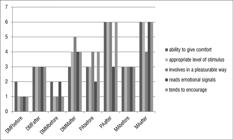
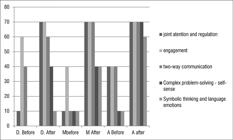
In addition to the noticeable developments in their profiles, it's worth highlighting the observations made by D. and M.'s parents: "We arrived there desperate for them to talk, and through the sessions, we realized through their progress that they don't need to speak to communicate. Today, they are both happy."
This statement is confirmed in a scene sent by the mother in which M. and D. playfully hit each other's heads with a pillow. One brother hits, and the other waits, then simulates a fall, and both laugh, watching and sharing the scene with their parents. This scene highlights several aspects of the boys' development, such as their beginning to play together, their sense of self, as there is simulation and appropriate use of the body, and, most importantly, the pleasure in play mentioned by the mother.
Moreover, A.'s parents became more attuned to her needs and synchronized their speech with their daughter's actions. The parents noticed that she had significantly improved her social interactions. One report was of a visit to a gathering with friends during the World Cup games, where A. interacted more with people, explored the area, wanted to see the pool, and was able to communicate better. In A.'s case, there was no direct approach to the ASD diagnosis with her parents, but rather a focus on the girl's potential, considering that her parents rarely asked her about the topic.
DISCUSSION
Despite the positive results in this research, the fact that it is a case study does not allow for greater generalization for the population with ASD and establishes interpretative limits to be investigated in research with a larger number of subjects.
Another limitation to be highlighted is that this approach requires a lot of time to prepare the guidelines, in terms of watching the videos and analyzing the materials to be offered and discussed with the parents, which needs to be anticipated in professional services.
Significant progress was observed in the three children, considering the first three levels of DIR/Floortime. They became more robust in their possibilities of mindfulness, regulation, engagement, and bidirectional exchange with others12,13. This confirms what the literature states about the relevance of DIR/Floortime for intervention in this age group9,10.
All evolved in problem-solving and sense of self, although D. and A. evolved a little more. This is possibly because M. was less evolved at all levels of functional emotional development than D. and A. at the beginning of the intervention.
Only A. progressed in creation and elaboration with symbols, but with support. M. began his development, and D. advanced one level further than his brother. This slower progress at this level seems to be explained by the fact that development at previous levels did not reach expected levels for their age, although the children advanced at all levels. It is also explained by the fact that A.'s play was more advanced at the beginning of therapy, as she had moments of pre-symbolic play, as classified in the Jasper methodology21.
Overall, the program was noticeably effective for both couples to find more productive and appropriate ways to play21 and provide enunciative support for their children15. This was reflected in the progress of fathers and mothers in relation to the items on the parents' checklist.
D. and M.'s parents started at levels that reached a maximum of 40% before the intervention and developed to moderate capabilities. A.'s parents, on the other hand, went from moderate capabilities to highly effective in most of the items assessed. These differences highlight the importance of individually assessing parents' profiles, ensuring progress at home based on the support each family needs.
It is believed that the DIR/Floortime approach9,10 can bring important contributions to work with parents and children precisely because it does not focus on skills, but on integrative forces of development based on the relationship between the child and their family members12,13.
This work suggests telecare’s potential for parental work, as already conducted in other studies17,18 based on the reality imposed by the pandemic. It can have important effects on the training of future speech-language-hearing pathologists16 and approaches compatible with the current conditions offered by the Brazilian Unified Health System (SUS). Telecare can constitute a hybrid approach, alongside in-person care, to enhance the progress of children who sometimes have limited access to diagnosis and treatment with the necessary intensity1-4.
Another important aspect to highlight in this approach is that DIR/Floortime is compatible with an active subject perspective, as advocated by the enunciative approach. In the latter, the dialogue attuned to the child15, following their lead in play21, evolved the conditions for the emergence of a place of enunciation11 in D. and M.'s play, vocalizations, and communicative gestures. A., on the other hand, moved from a displayed reference to a spoken reference15, evidenced by the production of the first words.
Finally, this work highlights the process of mourning and re-idealization22 that was possible with D. and M.'s parents, who began to better understand what it means to have children with ASD, identify their children's potential, and value their overall development, seeing beauty, competence, and a future for their boys. More aware than A.'s parents of their children's ASD, they were able to speak more openly about the challenges their children's condition imposed on the whole family. A.'s parents, however, had not yet addressed the topic, although the research supervisor had confirmed the presence of ASD traits in A.'s first assessment. They seemed uninterested in a diagnosis. They preferred to focus on what A. needed to develop. This highlights each family's unique journey and the need to consider this in therapeutic approaches, whether general developmental, such as DIR/Floortime, or specific to speech-language-hearing therapy, such as the enunciative standpoint.
FINAL CONSIDERATIONS
Telecare for parents was effective as a form of assisted waiting and can be a good practice, both for children on waiting lists and for those who cannot attend in-person care more than once a week, due to family socioeconomic conditions. This can be crucial for situations like those encountered in the Unified Health System (SUS), as was the case with the twins who initially motivated this study because they could not afford to commute to the teaching clinic. This approach, based on DIR/Floortime and associated with principles of play and an enunciative view of language, was also effective in assisted waiting for all three cases.
The results suggest that online guidance with parents, based on viewing family videos, can be an effective strategy in conjunction with in-person care when children begin treatment at teaching clinics. This combination can enhance children's progress. Overall, the study highlights the importance of including parents in the therapy of their children presented with ASD.
REFERENCES
-
1 Lima RC, Couto MCV, Andrada BC, Corrêa PH, Cardoso ACA. Narrativas de familiares de autistas de capsi da região metropolitana do Rio de Janeiro: participação, protagonismo e barreiras ao cuidado. Saúde debate | Rio de janeiro. 2020;44(especial3):144-55. https://doi.org/10.1590/0103-11042020e313
» https://doi.org/10.1590/0103-11042020e313 - 2 American Psychiatric Association - APA. Manual diagnóstico e estatístico de transtornos mentais: DSM-5. Porto Alegre: Artmed, 2014.
- 3 Kalil Neto F, Azambuja LS. Transtorno do espectro autista (TEA): o que pais e cuidadores precisam saber sobre o TEA? 1ª edição. Editora Bestiário, Ebook Kindle, Porto Alegre, 2022.
-
4 Governo do Estado do Rio Grande do Sul [webpage on the internet]. FADERS Características da população com carteira de identificação do transtorno do espectro autista no estado do Rio Grande do Sul - CIPTEA, Porto Alegre, 2022 [accessed on 2023 mar] Available at: https://www.estado.rs.gov.br/faders-divulga-pesquisa-sobre-autismo-no-estado#:~:text=A%20partir%20das%20informa%C3%A7%C3%B5es%20que,os%20atos%20da%20vida%20civil
» https://www.estado.rs.gov.br/faders-divulga-pesquisa-sobre-autismo-no-estado#:~:text=A%20partir%20das%20informa%C3%A7%C3%B5es%20que,os%20atos%20da%20vida%20civil -
5 Anagnostou E, Zwaigenbaum L, Szartmari P, Fombonne E, Fernandez BA, Woodbury-Smith M et al. Autism spectrum disorder: Advances in evidence - based practice. CMAJ. 2014;186(7):509-19. https://doi.org/10.1503/cmaj.121756 PMID: 24418986.
» https://doi.org/10.1503/cmaj.121756 - 6 Laznik MC. A hora e a vez do bebê. São Paulo, Instituto Langage, 2013.
-
7 Olliac B, Crespin G, Laznik MC, El Ganouni OCI, Sarradet JL, Bauby C et al. Infant and dyadic assessment in early-community based screening for autism spectrum disorder with the preaut grid. Plos One. 2017;12(12):1-22. https://doi.org/10.1371/journal.Pone.0188831 PMID: 29216234.
» https://doi.org/10.1371/journal.Pone.0188831 -
8 Zanon RB, Backes B, Bosa CA. Identificação dos primeiros sintomas do autismo pelos pais. Psic.: Teor. e Pesq. 2014;30(1):25-33. https://doi.org/10.1590/S0102-37722014000100004
» https://doi.org/10.1590/S0102-37722014000100004 -
9 Pajareya K, Nopmaneejumruslers K. A pilot randomized controlled trial of dir/floortime TM parente training intervention for pre-school children with autistic spectrum disorders. Autism. 2011;15(5):553-77. https://doi.org/10.1177/1362361310386502 PMID:21690083.
» https://doi.org/10.1177/1362361310386502 -
10 Pajareya K, Nopmaneejumruslers K. A one-year prospective follow-up study of a dir/floor time parent training intervention for preschool children with autistic spectrum disorders. J Med Assoc Thai. 2012;95(9):1184. https://pubmed.ncbi.nlm.nih.gov/23140036 PMID: 23140036.
» https://pubmed.ncbi.nlm.nih.gov/23140036 -
11 Souza APR. Clínica fonoaudiológica de linguagem com crianças pequenas e seus familiares [book on the internet]. Editora UFSM, Santa Maria, 2022 [accessed on 2023 mar]. Available at: https://editoraufsm.com.br/clinica-fonoaudiologica-ebook.html
» https://editoraufsm.com.br/clinica-fonoaudiologica-ebook.html - 12 Greenspan SI, Wieder S. The developmental individual-difference, relationship based (dir-floortime) model approach to autism spectrum disorders. In: Hollander E, Anagnostou E, editors. Clinical manual for the treatment of autism. American psychiatric publishing. 2007. p. 179-209.
-
13 Wieder S. The power of symbolic play in emotional development through the DIR lens. Top lang disorders. 2017;37(3):259-81. https://doi.org/10.1097/TLD.0000000000000126
» https://doi.org/10.1097/TLD.0000000000000126 -
14 Cardoso JL. Princípios de análise enunciativa na clínica dos distúrbios de linguagem [thesis]. Porto Alegre (RS): Programa de pós-graduação em letras, estudos da linguagem, Instituto de letras, Universidade Federal do Rio Grande do Sul; 2010. Available at: http://hdl.handle.net/10183/26464
» http://hdl.handle.net/10183/26464 - 15 Silva CLC. A criança na linguagem: enunciação e aquisição. Campinas: Pontes, 2009.
-
16 Fernandes FDM, Lopes-Herrera SA, Perissinoto J, Molini-Avejonas DR, Higuera-Amato CA, Tamanaha AC et al. Use of telehealth by undergraduated students in speech therapy: Possibilities and perspectives during COVID-19 pandemic. CoDAS. 2020;32(4):e20210264. https://doi.org/10.1590/2317-1782/20192020190 PMID:32696814.
» https://doi.org/10.1590/2317-1782/20192020190 -
17 Barbosa MRP, Fernandes FDM. Remote follow-up to speech-language intervention for children with autism spectrum disorders (asd): Parents' feedback regarding structured activities. CoDAS. 2017;29(2):e20160119. https://doi.org/10.1590/2317-1782/20162016119 PMID: 27177061.
» https://doi.org/10.1590/2317-1782/20162016119 -
18 Sun Yi, Varanda CA, Fernandes FDM. Stimulation of executive functions as part of the language intervention process in children with autism spectrum disorder. Folia phoniatr logop. 2017;69(1-2):78-83. https://doi.org/10.1159/000479586
» https://doi.org/10.1159/000479586 -
19 Silva MA, Mendonça Filho J, Bandeira DR. Development of the dimensional inventory of child development assessment (IDADI). Psico-usf. 2019;24(1):11-26. http://dx.doi.org/10.1590/1413-82712019240102
» http://dx.doi.org/10.1590/1413-82712019240102 -
20 Pondé MP, Wanderley DB, Menees ID, Gomes FL, Siquara GM. A validation study of labirinto scale for avaliation of autism spectrum disorder in children age 2 to 4 years. Trends Psychiatry Psychother. 2021;43(4):320-8. http://dx.doi.org/10.47626/2237-6089-2020-0141 PMID:34139117.
» http://dx.doi.org/10.47626/2237-6089-2020-0141 - 21 Kasari C, Gulsrud AC, Shire SY, Strawbridge C. The Jasper model for children with autism: Promoting joint attention, symbolic play, engagement, and regulation. Guilford publications, New York, 2021.
-
22 Franco VD. Tornar-se pai/mãe de uma criança com transtornos graves do desenvolvimento. Educar em revista. 2016;(59):35-48. http://dx.doi.org/10.1590/0104-4060.44689
» http://dx.doi.org/10.1590/0104-4060.44689
-
A study conducted at the Federal University of Rio Grande do Sul in cooperation with a project approved at the Federal University of Santa Maria, Porto Alegre, RS, Brazil.
-
Financial support
Nothing to declare
-
Data sharing statement
The research data are in a video format, as they were virtual parenting sessions recorded on Google Meet. They are not available to third parties due to participant confidentiality. All data were transcribed, and a session log was created, which is summarized in the article.
The research data are in a video format, as they were virtual parenting sessions recorded on Google Meet. They are not available to third parties due to participant confidentiality. All data were transcribed, and a session log was created, which is summarized in the article.

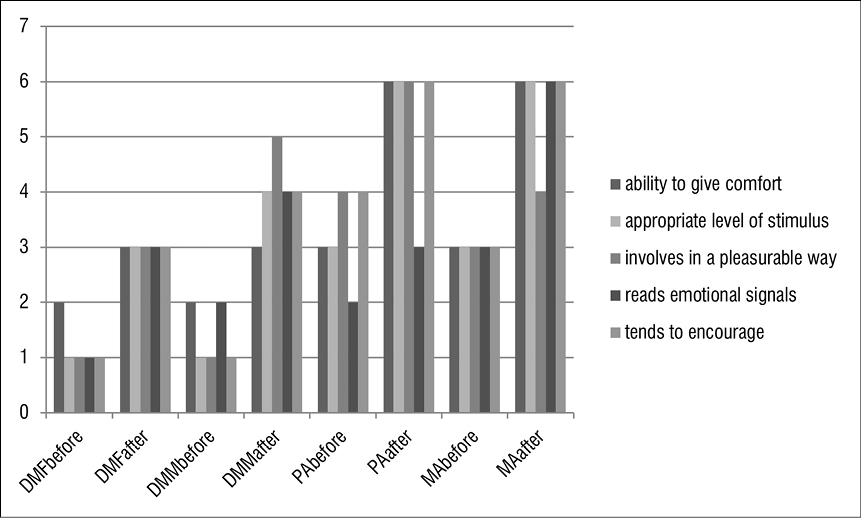 Captions: F=father, M=mother, D, M, A=children; 0=did not achieve, 1=beginning of skill, 2=islands of development, 3=moderate presence, 4=becoming consistent,m5=effective except when stressed, 6=very effective
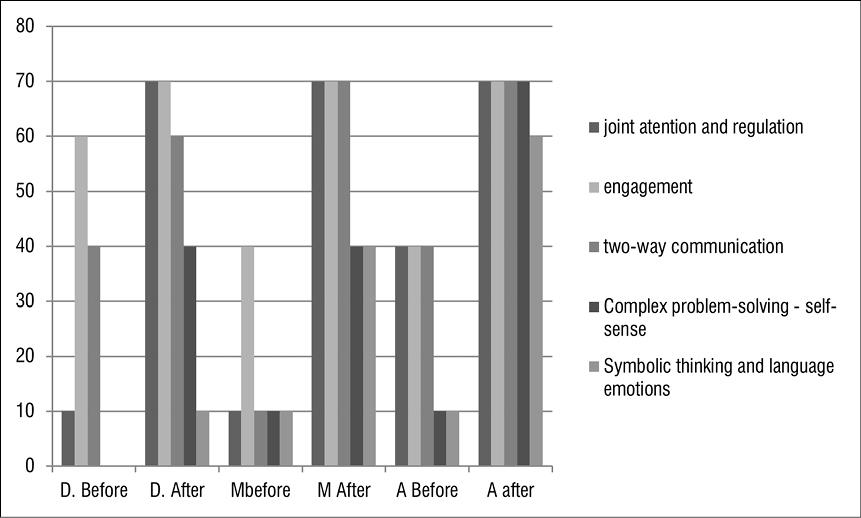 Captions: D, M and A = children