Initial vegetative vigor of Coffea canephora genotypes grown in the western amazon
Understanding the vegetative vigor of clonal genotypes under nursery conditions is essential for efficient seedling production and the development of new cultivars. This study aimed to evaluate the initial vegetative vigor of Coffea canephora genotypes cultivated in the Western Amazon. Twenty-one genotypes from the Embrapa Germplasm Bank, four registered cultivars, and three publicly available clones were assessed in a completely randomized design with four replicates and six plants per plot. Vegetative traits were evaluated 128 days after planting the cuttings and included: shoot length (SL), shoot diameter (SD), number of roots (NR), root volume (RV), shoot dry mass (SDM), root dry mass (RDM), total dry mass (TDM), leaf area (LA), the SDM/RDM ratio, and the Dickson Quality Index (DQI). Genotype performance and experimental accuracy were analyzed using genetic parameter estimates and genotype divergence. All commercial genotypes, except GJ25 and AS2, exhibited superior vegetative vigor during the seedling stage. Genotype BAG15 was initially the most vigorous. Genotypes BAG30, BAG31, BAG21, BAG29, BAG19, BAG26, BAG24, BAG28, BAG39, BAG41, BAG33, BAG38, BAG43, BAG23, BAG34, and BAG32 were considered promising due to their high RDM/SDM ratio and/or proximity to ideotype III, which was characterized by greater root development a trait likely to enhance survival following transplanting in the field.
Keywords:
Conilon; Robusta; Coffee seedlings; Vegetative growth; Genetic divergence.
 Thumbnail
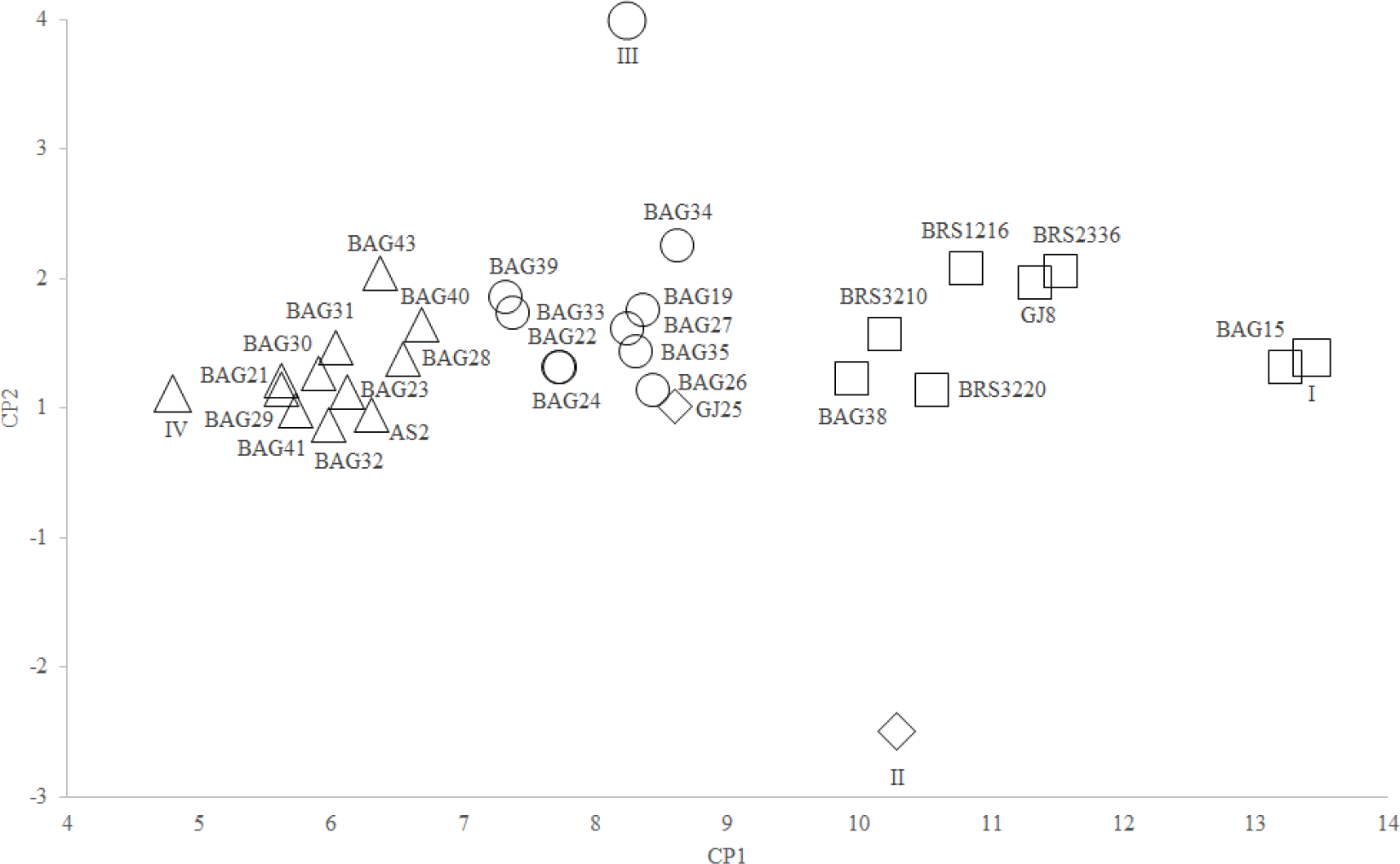 Points I, II, III, and IV represent ideal reference values, where point I corresponds to the maximum estimated values for both shoot and root traits, and point IV to the minimum values. Point II represents a genotype with a maximum shoot and minimum root system, while point III represents the inverse minimum shoot and maximum root development.