Toxicity and synergism of Piper aduncum L. essential oil on insect pests of stored products
ABSTRACT
The Amazon Rainforest concentrates a large biodiversity with potential for research on botanical insecticides. Therefore, the management of stored grain pests can benefit, since control is predominantly carried out by synthetic insecticides, which makes it essential to search for alternative methods. Thus, the objective of this study was to evaluate the toxicity of Piper aduncum L. essential oil (PAEO) and its synergistic effect in mixtures with deltamethrin on Sitophilus zeamais Motschulsky, Oryzaephilus surinamensis (L.), Cryptolestes ferrugineus (Stephens) and Tribolium castaneum (H.). For this purpose, contact toxicity bioassays were performed on contaminated surfaces to generate concentration-mortality curves and establish lethal concentrations for 50 and 95% of the insects (LC50 and LC95). Subsequently, binary mixtures between PAEO and the insecticide were tested to determine the synergistic factor. There was variation in response among the four weevil species, both for PAEO and deltamethrin, with T. castaneum showing greater tolerance to both. PAEO potentiated the toxicity of deltamethrin for the four species, with synergism factors ranging from 1.42 to 6.30. It was concluded that the toxicity of PAEO varied among the four weevil species evaluated, with T. castaneum showing greater tolerance. Additionally, PAEO showed a synergistic effect in mixtures with deltamethrin.
Keywords:
Botanical insecticides; Piperaceae; Beetles; Post-harvest losses.
RESUMO
A Floresta Amazônica concentra grande biodiversidade com potencial para investigações acerca de inseticidas botânicos. De modo que o manejo de pragas de grãos armazenados possa se beneficiar, uma vez que o controle é predominantemente realizado por inseticidas sintéticos, o que torna imprescindível a busca por métodos alternativos. Deste modo, o objetivo do trabalho foi avaliar a toxicidade do óleo essencial de Piper aduncum L. (OEPA) e seu efeito sinérgico em misturas com deltametrina sobre Sitophilus zeamais Motschulsky, Oryzaephilus surinamensis (L.), Cryptolestes ferrugineus (Stephens) e Tribolium castaneum (H.). Inicialmente, foram realizados bioensaios de toxicidade por contato em superfície contaminada, para gerar as curvas de concentração-mortalidade e estabelecer as concentrações letais para 50 e 95% dos insetos (CL50 e CL95). Posteriormente, misturas binárias entre o OEPA e o inseticida foram testadas para determinar o fator de sinergismo. Constatou-se variação de resposta entre as quatro espécies de carunchos, tanto para o OEPA quanto para a deltametrina, sendo que o T. castaneum apresentou maior tolerância para ambos. O OEPA potencializou a toxicidade da deltametrina para as quatro espécies, com fatores de sinergismo variando de 1.42 a 6.30. Conclui-se que a toxicidade do OEPA variou entre as quatro espécies de carunchos avaliadas, sendo que o T. castaneum apresentou maior tolerância. Adicionalmente, o OEPA apresentou efeito sinérgico em misturas com deltametrina.
Palavras-chave:
Inseticidas botânicos; Piperaceae; Carunchos; Perdas pós-colheita.
INTRODUCTION
Post-harvest losses caused by insect pests in stored grains are significant and should not be underestimated, as they directly affect the market-ready product. In the storage environment, there is an infestation of primary and secondary pests that simultaneously affect the grains, causing direct damage, such as the reduction of mass, and indirect damage, such as the promotion of the development of undesirable microorganisms and the reduction of quality (SOUZA et al., 2018; NIKOLAOU et al., 2021).
Among the primary pests, Sitophilus zeamais Motschulsky (Coleoptera: Curculionidae) stands out, which attacks from the field to storage, where larvae and adults feed on whole, healthy grains. On the other hand, secondary pests, such as Oryzaephilus surinamensis L. (Coleoptera: Silvanidae), Cryptolestes ferrugineus (Stephens, 1831) (Coleoptera: Laemophloeidae) and Tribolium castaneum (H.) (Coleoptera: Tenebrionidae), attack grains broken, cracked or damaged by primary pests (LORINI et al., 2018).
The control of insect pests in stored products has been carried out through the application of preventive insecticides, belonging to the group of pyrethroids and organophosphates, and through fumigation with phosphine (PH3) (SOUSA et al., 2008; PIMENTEL et al., 2012). However, continuous and indiscriminate use of the same active ingredients has led to the emergence of resistant populations (MOTA-SANCHEZ; WISE, 2024).
A promising alternative to synthetic insecticides is the use of essential oils extracted from plants, which stand out for being biodegradable products, with ample insecticidal activity for different insect pests and low toxicity to mammals (WALIA et al., 2017). Extraction of essential oils is carried out by physical methods, such as steam or dry distillation, using various parts of the plants, such as seeds, stems, leaves, and flowers (ALEXANDRE et al., 2018).
The Piper genus, belonging to the Piperaceae family, stands out for its recognized potential in the production of secondary metabolites with bioactive properties, used in several areas. Among the representatives of this genus, the species P. aduncum L., originally from the Amazon Rainforest, has been the subject of study due to the complex composition of its essential oil, composed of terpenoids and phenylpropanoids, such as dillapiole, identified as the major component (DUROFIL et al., 2021).
P. aduncum essential oil (PAEO) has insecticidal activity for several species of pest insects, such as Spodoptera frugiperda (Lepidoptera: Noctuidae) (FAZOLIN et al., 2022), S. zeamais, Sitophilus oryzae (Coleoptera: Curculionidae) and C. ferrugineus (NASCIMENTO et al., 2023; MENDONÇA et al., 2024), T. castaneum (JARAMILLO-COLORADO; DUARTE-RESTREPO; PINO-BENÍTEZ, 2015) and Callosobruchus maculatus (F.) (Chrysomelidae: Bruchinae) (OLIVEIRA et al., 2017).
The synergistic activity of PAEO has also been documented in research involving S. frugiperda, which is associated with the presence of lignans common to the methylenedioxyphenyl group. These substances inhibit detoxifying enzymes involved in the mechanism of insecticide resistance (BELZILE et al., 2000), particularly pyrethroids (FAZOLIN et al., 2016). Therefore, PAEO has been suggested as an alternative to the commercial synergist piperonyl butoxide (PBO), with the purpose of enhancing the action of synthetic insecticides (OLIVEIRA et al., 2023).
In this context, the objective of this study is to evaluate the toxicity of PAEO and deltamethrin when applied alone, as well as the synergistic effect of binary combinations (PAEO + deltamethrin), on weevils of the species S. zeamais, O. surinamensis, C. ferrugineus and T. castaneum.
MATERIAL AND METHODS
PAEO extraction was carried out at the Natural Products Laboratory of the Acre State Technology Foundation (FUNTAC), and toxicity and synergism bioassays were conducted at the Integrated Pest Management Laboratory of the Federal University of Acre, Rio Branco Campus, both located in Rio Branco, Acre, Brazil.
Farms of S. zeamais, T. castaneum, O. surinamensis and C. ferrugineus were established from insects collected in storage units around Rio Branco. The insects were reared in 1.5 L glass jars, closed with perforated plastic lids and internally lined with organza fabric, to allow gas exchange, under constant conditions of temperature (27±2 ºC), relative humidity (70±5%) and 24 h scotophase. Food substrate consisted of corn grains with a water content of 13% on a wet basis (w.b.), previously purged with phosphine (PH3) and kept refrigerated to avoid reinfestation. Whole grains were used for S. zeamais, and crushed grains were supplied for secondary pests.
The collection of plant material was carried out in P. aduncum plants located on the Campus of the Federal University of Acre, in Rio Branco, Acre, under the geographic coordinates 9° 57’ 34.9” S and 67° 51’ 30.6” W. Collections were carried out in the morning, during August 2021. Initially, the plants were cut from 0.40 m from the ground, followed by the separation of leaves and branches. The collected leaves were partially dried under ambient conditions, then taken to the oven at 45º C and kept until reaching a constant mass.
Identification of the plant material was carried out by Dr. Elsie Franklin Guimarães, from the Herbarium of the Botanical Garden of Rio de Janeiro (Herbário RJ). The exsiccate of P. aduncum was deposited in the UFACPZ Herbarium of the Federal University of Acre, under the registration number: UFACPZ 20.646.
PAEO extraction was carried out using the hydrodistillation extraction method, in a Clevenger apparatus, connected to a refrigeration system and to a 5-L roundbottomed flask, on a ceramic heating blanket. Each extraction was performed using 150 g of dry biomass mixed with 2 L of distilled water in the volumetric flask.
Initially, the heating thermal blanket was turned on and regulated at a boiling temperature of approximately 120 °C, with an average extraction time of 240 minutes. After the boiling and condensation process, PAEO was collected together with the hydrolate in Erlenmeyer® flasks. Then, the essential oil samples were separated by decanting in a separation funnel and dried using anhydrous sodium sulfate (Synth, 99%, Brazil). Finally, each essential oil sample was stored in amber flasks, kept refrigerated in B.O.D. chambers at 4 ºC.
Gas Chromatography-Mass Spectrometry (GC-MS) analysis was performed at the Department of Scientific Technical Police of the Institute of Forensic Analysis (Instituto de Análise Forense - IAF), of the Civil Police of the State of Acre. The GC-MS device used was from Agilent Technologies, model 7890A/5975C. PAEO was diluted to 2% in methanol and injected into an HP-5MS capillary column (30 m x 0.25 mm internal diameter x 0.25-μm-thick film), using helium (He) as the carrier gas, in split mode. The injector temperature was 290 °C, with a gradient starting at 80 °C for 5 minutes, increasing 4 °C.min-1 to 285 °C, kept for 40 minutes. The detector and system interface remained at 290 °C, and the mass detector operated with electron impact ionization at 70 eV. The spectra were recorded by scanning masses from 30 to 600 Dalton. The chemical constituents were identified by comparing the respective mass spectra with those in the equipment’s library, validated by the literature for essential oils (ADAMS, 2007) and the National Institute of Standards and Technology (NIST) database. For this, the Linear Retention Indices (LRI) relative to the n-alkane series (C10 - C40, Fluka Analytical) and the Kovats index (KI) were calculated.
The contact toxicity bioassays on contaminated surfaces, for the four weevil species, were carried out separately, with PAEO and the synthetic insecticide deltamethrin, generating concentration-mortality curves to establish lethal concentrations for 50 and 95% of the insects (LC50 and LC95). The toxicity bioassays with synthetic insecticide were performed using a pyrethroid based on the active ingredient deltamethrin (K-Obiol® 25 EC).
Initially, preliminary tests were carried out to establish the minimum and maximum concentrations, which cause mortality above zero and less than 100%. Based on this information, six concentrations of PAEO were determined for S. zeamais (0.079 to 1.834 μL cm-2), O. surinamensis (0.005 to 0.708 μL cm-2), C. ferrugineus (0.003 to 0.013 μL cm-2) and five for T. castaneum (0.458 to 2.835 μL cm-2). In the deltamethrin toxicity bioassays, six concentrations were established for S. zeamais (0.001 to 0.079 μL cm-2), T. castaneum (0.001 to 0.236 μL cm-2) and C. ferrugineus (0.001 to 0.156 μL cm-2) and five concentrations were established for O. surinamensis (0.003 to 0.079 μL cm-2).
The experimental design was completely randomized, with four replicates of each treatment. The experimental units consisted of Petri dishes of 9 cm in diameter and 1.5 cm in height, with the bottom covered with filter paper moistened with 1000 μL of each concentration of the essential oil or synthetic insecticide. The solution was applied with an automatic pipette, and the dilution to obtain the concentrations was performed in acetone solvent. After total evaporation of the solvent (about 5 minutes), 50 non-sexed adult insects, aged between 1 and 15 days, were placed in each plate. In the control treatment, the insects were placed in Petri dishes, moistened only with acetone. Insect mortality was evaluated after 24 hours of exposure. They were considered dead when they showed no movement after stimulation with a finebristled brush, or when they could not move.
To evaluate the synergistic potential of PAEO, preliminary tests were carried out using the sublethal concentration of PAEO (1/4 of the LC50 of PAEO) obtained for each species (S. zeamais: 0.052 μL cm-2; T. castaneum: 0.796 μL cm-2; O. surinamensis: 0.011 μL cm-2; and C. ferrugineus: 0.004 μL cm-2), combined with deltamethrin concentrations, to estimate the maximum and minimum concentrations of deltamethrin, within the mortality range of 5% to 95%, according to the methodology adapted from Almeida et al. (2017). For each species, six definitive concentrations of the combinations between PAEO and synthetic insecticide were established, defined by means of preliminary tests. Synergism bioassays by contact on a contaminated surface and the evaluation of mortality followed the same methodological procedures previously used.
The concentration-mortality data were subjected to Probit analysis (PROC PROBIT, SAS INSTITUTE, version 9), to generate curves and estimate the LC50 and LC95 of both the binary mixtures and the insecticide deltamethrin and PAEO applied individually. The confidence intervals for toxicity ratios (TR) were calculated according to Robertson and Preisler (1992). To evaluate the synergistic effect, the synergism factor (SF) was calculated according to Guedes et al. (1995), using the following equation: SF = LC50 of the synthetic insecticide/LC50 of the essential oil + synthetic insecticide; SF values above 1 indicate a synergistic effect; those equal to 1, additive effect; and those below 1, an antagonistic response, relative to the pure synthetic insecticide (ABBASSY et al., 2009).
RESULTS AND DISCUSSION
Through the GC-MS analysis, components belonging to the classes of phenylpropanoids and sesquiterpenes were identified in the composition of PAEO. Dillapiole was the major component, accounting for 70.34% of the compounds identified, followed by myristicin (9.57%), viridiflorol (4.68%), (E)-caryophyllene (3.82%), caryophyllene oxide (2.38%) and (+) spathulenol (2.36%) (Table 1).
Chemical composition and relative concentrations of the compounds identified in Piper aduncum essential oil using gas chromatography-mass spectrometry (GC-MS) analysis.
Toxicological variation of PAEO was observed among the four species evaluated, with TR50 ranging from 1.00 to 225.99 times and TR95 ranging from 1.00 to 261.46 times (Table 2). The slopes of the PAEO curves ranged from 1.32 to 4.08, indicating heterogeneity of response for the insects evaluated and risk of resistance evolution, especially for T. castaneum, which had a greater slope (Table 2).
Relative residual toxicity of Piper aduncum L. essential oil (μL cm-2) in adults of Cryptolestes ferrugineus, Oryzaephilus surinamensis, Sitophilus zeamais and Tribolium castaneum, after 24 h of exposure.
It should be pointed out that the secondary pest C. ferrugineus had the lowest lethal concentrations, which qualifies it as the standard species of susceptibility to the botanical insecticide (Table 2). This species showed greater slope of the curve. It is worth noting that curves with greater slopes indicate greater homogeneity of response within the population evaluated. The higher toxicity of PAEO for this species was also corroborated by Nascimento et al. (2023), who obtained an LC50 of 0.0005 μL cm-2, using the same method of contact exposure on a contaminated surface.
The LC50 and LC95 of PAEO for O. surinamensis indicate moderate toxicity of the bioinsecticide, but lower toxicity was observed for S. zeamais. On the other hand, the species T. castaneum showed greater tolerance, with toxicity ratios (TRs of LC50 and LC95) of 225.99 and 261.46 times higher than those of the standard susceptibility species (C. ferrugineus). Thus, in practical terms, toxicity to T. castaneum should be considered as a basis for establishing concentrations of use, since the effective concentrations for this species are also efficient for the other species.
The greater susceptibility of C. ferrugineus and the tolerance of T. castaneum may be related to the size and body mass of these species, since adults of C. ferrugineus are small coleopterans of 1.5-2.5 mm, with long antennae that represent up to 2/3 of their body length, while T. castaneum individuals are larger insects, reaching up to 4 mm in length (PACHECO; PAULA, 1995). This morphological difference can influence the rate of cuticular absorption and the internal distribution of toxic compounds, favoring greater susceptibility in smaller individuals.
Nascimento et al. (2003) observed that C. ferrugineus showed high susceptibility to PAEO, in addition to neutral behavior regarding attractiveness or repellency to the bioinsecticide. This behavioral neutrality can reduce the chances of escape of C. ferrugineus from the toxic effects of PAEO, minimizing the risks of selection and evolution of resistance.
When analyzing the high concentrations of PAEO through the exposure of adult insects to the contaminated surface, intense agitation was observed, followed by loss of mobility and, finally, mortality in a 24-hour period. According to Afshar et al. (2017), the dillapiole present in PAEO acts by inhibiting enzymatic pathways involved in the detoxification of toxic molecules, while terpenes cause neurotoxicity in insects, in addition to assisting in the action of other constituents that penetrate the cuticle due to their lipophilicity.
Regarding the toxicity of deltamethrin (Table 3), there was a lower variation in response compared to PAEO, with TR50 ranging from 1.00 to 4.16 times and TR95 ranging from 1.00 to 16.20 times. The slopes of the curves range from 1.03 to 1.62 (Table 3). In general, lethal concentrations were lower than those obtained for the botanical insecticide. The species S. zeamais had the lowest LC50 and LC95, being considered the standard species of susceptibility to deltamethrin. In the case of O. surinamensis, toxicity ratios were relatively low and, as observed in the PAEO bioassays, the species T. castaneum was shown to be the most tolerant to deltamethrin.
Relative residual toxicity of K-Obiol® 25 EC (deltamethrin) (μL cm-2) in adults of Sitophilus zeamais, Oryzaephilus surinamensis, Cryptolestes ferrugineus, and Tribolium castaneum, after 24 hours of exposure.
It is important to note that, in contrast to what was observed for PAEO, deltamethrin showed lower toxicity for C. ferrugineus compared to the species S. zeamais and O. surinamensis (Table 3). Application of pyrethroid insecticides has been common in the protection of stored grains in recent years (SILVA et al., 2013). However, continuous use of the same products, without proper management, results in the development of resistant populations, as previously reported for C. ferrugineus (MADHUMATHI; SUBBARATNAM, 2007).
The results of the bioassays with the mixture of deltamethrin and PAEO are presented in Table 4. The slopes of the concentration-mortality curves ranged from 0.99 to 1.99, indicating uniformity of response between the curves. In general, the LC50 and LC95 of deltamethrin mixed with PAEO (Table 4) were lower than the LCs of deltamethrin alone (Table 3).
Relative residual toxicity of the combinations of Piper aduncum essential oil + K-Obiol® 25 EC (deltamethrin) (μL cm-2) in adults of Sitophilus zeamais, Cryptolestes ferrugineus, Oryzaephilus surinamensis and Tribolium castaneum, after 24 hours of exposure.
Figure 1 shows the synergism factors of the binary mixtures between the synthetic insecticide and PAEO. Values higher than 1 were observed in all species evaluated, indicating a synergistic effect of PAEO on deltamethrin. The highest synergism factor was observed in the species C. ferrugineus (6.30), followed by T. castaneum (3.04), S. zeamais (2.94) and O. surinamensis (1.42). This suggests that it is possible to increase the toxicity of deltamethrin in mixtures with PAEO, mitigating the risks of evolution of resistance to the pyrethroid.
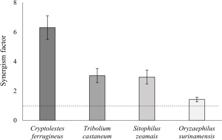
Synergism factors of binary mixtures (Piper aduncum essential oil + K-Obiol® 25 EC) against stored grain pests. Bars represent confidence intervals with 95% probability and the dotted line as SF=1 defines the effect of the combinations as synergistic (SF>1).
Dillapiole, the major compound of Piper aduncum essential oil (PAEO), has an action similar to that of the synergist piperonyl butoxide (PBO), derived from safrole, acting in the inhibition of cytochrome P450-dependent monooxygenase enzymes (BERNARD et al., 1995), as well as esterases (SHANKARGANESH et al., 2009). It is worth noting that PBO has been used in mixtures with deltamethrin in grain storage units (K-Obiol® 25 EC) in a 10:1 ratio, aiming at the management of resistance to deltamethrin (BECKEL; LORINI; LAZZARI, 2006). Considering that, in the present study, the toxicity of deltamethrin was potentiated by the synergistic action of PAEO, it is likely that the bioactive compounds of PAEO (rich in dillapiole) acted by minimizing these detoxifying enzymes of weevils.
These results demonstrate the potential of PAEO as a synergistic agent, with the ability to reduce the amount of insecticide applied and, consequently, the environmental impact, in addition to possibly delaying the development of resistance (GAIRE et al., 2021). Adopting alternative approaches, which include the incorporation of essential oils extracted from plants, is extremely important, particularly for small and medium-sized family producers, as the species Piper aduncum is adapted to different edaphoclimatic conditions and easy to manage.
CONCLUSION
Deltamethrin showed greater toxicity on weevils, with Sitophilus zeamais being the species most susceptible to the synthetic insecticide. The species Cryptolestes ferrugineus stood out for showing greater susceptibility to PAEO when compared to the synthetic insecticide, while the species Tribolium castaneum showed greater tolerance to both deltamethrin and Piper aduncum essential oil.
The essential oil potentiated the toxic effect of deltamethrin for the four species of weevils, indicating potential as a synergist agent in mixtures with commercial insecticides.
The results of the study suggest that Piper aduncum essential oil is a promising alternative for the control of stored grain pests and an additional strategy to insecticide resistance management.
ACKNOWLEDGMENTS
We are grateful for the funding and fellowships provided by the following Brazilian agencies: National Council for Scientific and Technological Development (CNPq) and Coordination for the Improvement of Higher Education Personnel (CAPES).
Data Availability:
The data that support the findings of this study can be made available, upon reasonable request, from the corresponding author.
REFERENCES
- ABBASSY, M. A. et al. Insecticidal and synergistic effects of Majorana hortensis essential oil and some of its major constituents. Entomologia Experimentalis et Applicata, 131: 225-232, 2009.
- ADAMS, R. P. Identification of essential oil components by gas cromatography/mass spectroscopy 4. ed. Carol Stream, IL: Allured publishing corporation, 2007. 804 p.
- AFSHAR, F. H. et al. Comparative toxicity of Helosciadium nodiflorum essential oils and combinations of their main constituents against the cabbage looper, Trichoplusia ni (Lepidoptera). Industrial Crops and Products, 98: 46-52, 2017.
- ALEXANDRE, P. et al. Essential oil of Lippia sidoides and its major compound thymol: Toxicity and walking response of populations of Sitophilus zeamais (Coleoptera: Curculionidae). Crop Protection, 112: 33-38, 2018.
- ALMEIDA, W. A. et al. Potentiation of copaíba oil-resin with synthetic insecticides to control of fall armyworm. Revista Caatinga, 30: 1059-1066, 2017.
- BECKEL, H. S.; LORINI, I.; LAZZARI, S. M. N. Efeito do sinergista butóxido de piperonila na resistência de Oryzaephilus surinamensis (L.) (Coleoptera, Silvanidae) a deltametrina e fenitrotiom. Revista Brasileira de Entomologia, 50: 110-114, 2006.
- BELZILE, A. S. et al. Dillapiol derivatives as synergists: Structure activity relationship analysis. Pesticide Biochemistry and Physiology, 66: 33-40, 2000.
- BERNARD, C. B. et al. Insecticidal defenses of Piperaceae from the neotropics. Journal of Chemical Ecology, 21: 801-814, 1995.
- DUROFIL, A. et al. Piper aduncum essential oil: a promising insecticide, acaricide and antiparasitic. A review. Parasite, 28: 42, 2021.
- FAZOLIN, M. et al. Synergistic potential of dillapiole-rich essential oil with synthetic pyrethroid insecticides against fall armyworm. Ciência Rural, 46: 382-388, 2016.
- FAZOLIN, M. et al. Insecticidal activity of Piper aduncum oil: variation in dillapiole content and chemical and toxicological stability during storage. Acta Amazonica, 52: 179-188, 2022.
- GAIRE, S. et al. Plant essential oil constituents enhance deltamethrin toxicity in a resistant population of bed bugs (Cimex lectularius L.) by inhibiting cytochrome P450 enzymes. Pesticide Biochemistry and Physiology, 175: 104829, 2021.
- GUEDES, R. N. et al. Sinergismo do óleo mineral sobre a toxicicidade de inseticidas para Scrobipalpula absoluta (Lepidoptera: Gelechidae). Pesquisa Agropecuária Brasileira, 30: 313-318, 1995.
- JARAMILLO-COLORADO, B. E.; DUARTE-RESTREPO, E.; PINO-BENÍTEZ, N. Evaluación de la actividad repelente de aceites esenciales de plantas Piperáceas del departamento de Chocó, Colombia. Revista de Toxicología, 32: 112-116, 2015.
- LORINI, I. et al. Descrição, biologia e danos das principais pragas de grãos e sementes armazenadas. In: LORINI, I. et al. (Eds.). Armazenagem de grãos Jundiaí, SP: Instituto Bio Geneziz, 2018. v. 2, cap. 4.1, p. 363-381.
- MADHUMATHI, T.; SUBBARATNAM, G. V. Determinação de resistência cruzada e resistência múltipla em Crypstolestes ferrugineus (Stephens). Pesticide Research Journal, 19: 63-66, 2007.
- MENDONÇA et al. Rendimento, composição e toxicidade de voláteis de piperáceas para insetos-praga. Revista Caatinga, 37: 1-11, 2024.
-
MOTA-SANCHEZ, D.; WISE, J. C. The Arthropod Pesticide Resistance Database. Michigan State University Available at: <http://www.pesticideresistance.org>. Access on: May 30, 2024.
» http://www.pesticideresistance.org - NASCIMENTO, J. M. et al. Bioactivity of Piper aduncum L. essential oil for insect pests of stored products. Pesquisa Agropecuária Tropical, 53: e77482, 2023.
- NIKOLAOU, P. et al. Controlling Stored Products Pests with Plant Secondary Metabolites: A Review. Agriculture, 11: 879, 2021.
- OLIVEIRA, J. V. et al. Fumigation and repellency of essential oils against Callosobruchus maculatus (Coleoptera: Chrysomelidae: Bruchinae) in cowpea. Pesquisa Agropecuária Brasileira, 52: 10-17, 2017.
- OLIVEIRA, R. V. et al. Toxicidade e sinergismo de óleo essencial de Piper aduncum L. em populações de Sitophilus zeamais (Coleoptera: Curculionidae). Pesquisa Agropecuária Tropical, 53: e76287, 2023.
- PACHECO, I. A.; PAULA, D. C. Insetos de grãos armazenados: identificação e biologia Campinas, SP: Fundação Cargil, 1995. 228 p.
- PIMENTEL, M. A. G et al. Phosphine-induced walking response of the lesser grain borer (Rhyzoperta dominica). Pest Management Science, 68: 1368-1373, 2012.
- ROBERTSON, J. L.; PREISLER, H. K. Pesticide bioassays with arthropods Boca Raton, Florida: CRC Press, 1992. 127 p.
- SILVA, L. B. et al. Behavior of maize weevil at doses of permethrin. Comunicata Scientiae, 4: 26-34, 2013.
- SHANKARGANESH, K. et al. Dillapiole mediated esterase inhibition in insecticide resistant Spodoptera litura (Fabricius). Pesticide Research Journal, 21: 143-147, 2009.
- SOUSA, A. H. et al. Ozone as a management alternative against phosphine-resistant insect-pests of stored products. Journal of Stored Products Research, 44: 379-385, 2008.
- SOUZA, L. P. et al. Toxicity and sublethal effects of allyl isothiocyanate to Sitophilus zeamais on population development and walking behavior. Journal of Pest Science, 91: 761-770, 2018.
- WALIA, S. et al. Phytochemical biopesticides: some recent developments. Phytochemistry Reviews, 16: 989-1007, 2017.
Edited by
-
Editor in Chief: Aurélio Paes Barros Júnior
-
Section Editor: Carlos Henrique Brito