Effect of biochar soaked in wood vinegar on cowpea production and root growth
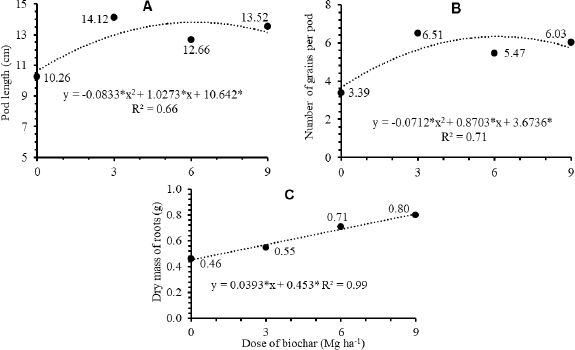
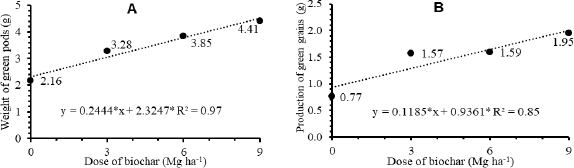
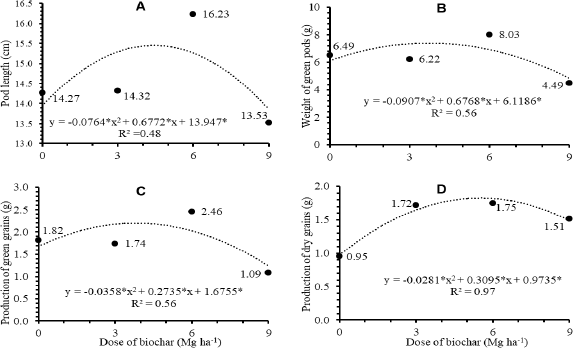
 Pyrolysis of woody biomass produces biochar, whose application aims to promote positive effects on the soil, crops and the environment, and wood vinegar (WV), which is used as growth regulator and pesticide. Cowpea (Vigna unguiculata (L.) Walp) is of great importance worldwide and, in Brazil, it is predominantly produced by family farming in the Northeast region, mainly in soils with low fertility and low productivity. In this context, this study aimed to verify the possibility that the application of biochar, pure or soaked in WV, improves the performance of cowpea crop. To this end, an experiment was conducted in two seasons in a greenhouse, in a completely randomized design, in which doses and types of biochar were tested. Grains were harvested green in four replicates of the treatments and harvested dry in the other four replicates. The determinations made were: number of pods, pod length, number of grains per pod, grain production per pot and root dry mass. The results obtained do not allow us to recommend the application of wood vinegar impregnated in biochar in cowpea. However, biochar application can be recommended at doses between 6.0 and 9.0 Mg ha-1, which can be reduced to 4.0 to 6.0 Mg ha-1 in the presence of mineral fertilization. Studies addressing the joint application of biochar and pyroligneous extract should address different doses, forms of application, raw materials, soil types, and crops.
Keywords:
Pyrolysis products; Soil amendment; Growth regulator; Vigna unguiculata (L.) Walp
 Thumbnail
 Thumbnail
 Thumbnail