Micropropagation as an alternative to vegetative propagation in Anthurium plowmanii Croat
ABSTRACT
In the flower and ornamental plant sector, species of genus Anthurium stand out, particularly Anthurium plowmanii, known for its lush, wavy, bright green leaves, which create an eye-catching and harmonious display, making it ideal for the foliage market. The species is mainly propagated from seeds, a lengthy process, requiring time for the seedling to reach the commercial stage, and resulting in non-uniform plants that differ from the parents. In this respect, tissue culture is seen as an efficient alternative in the large-scale production of uniform plantlets of high genetic and phytosanitary quality. The aim of this study was to evaluate the in-vitro propagation of A. plowmanii from nodal segments in Pierik culture medium with different concentrations of cytokinin. The experimental design was completely randomised, and included six BAP concentrations (0, 1.11, 2.22, 3.33, 4.44 and 5.55 µM) in five replications, each replication comprising 10 test tubes containing one nodal segment. After 60 days of in-vitro culture, the nodal segment explants were evaluated for the number of shoots and roots, height, fresh and dry matter, number of leaves and length of the longest root. The results show that for shoot formation in A. plowmanii, BAP must be added to the culture medium at a concentration of 3.33 µM. Furthermore, increasing the BAP concentration resulted in a greater number of leaves and an increase in the fresh and dry matter of the explant.
Keywords:
Tissue culture; Araceae; Multiplication; Ornamental species.
RESUMO
No setor de flores e plantas ornamentais, as espécies do gênero Anthurium se destacam, especialmente Anthurium plowmanii, conhecida por suas folhas exuberantes, onduladas e de um verde brilhante, que formam um limbo vistoso e harmonioso, sendo ideal para comercialização no segmento de folhagens. A propagação dessa espécie se dá principalmente a partir das sementes, processo que demanda muito tempo para que a muda atinja o estágio de comercialização, além de resultar em plantas desuniformes, diferentes das matrizes. Assim, a cultura de tecidos surge como uma alternativa eficiente para a produção em larga escala de mudas uniformes, com alta qualidade genética e fitossanitária. Sendo assim, objetivou-se avaliar a propagação in vitro de A. plowmanii a partir de segmentos nodais, em diferentes concentrações de citocinina no meio de cultivo Pierik. O delineamento experimental foi o inteiramente casualizado, com seis concentrações de BAP: 0; 1,11; 2,22; 3,33; 4,44 e 5,55 µM, em cinco repetições, sendo cada repetição constituída por 10 tubos de ensaio, contendo um segmento nodal. Aos 60 dias de cultivo in vitro, os explantes de segmentos nodais foram avaliados quanto ao número de brotos e raízes, altura e massas fresca e seca, número de folhas e comprimento da maior raiz. Os resultados indicam que para formação de brotações em A. plowmanii é necessária a adição de BAP ao meio de cultivo sob a concentração de 3,33 µM. Além disso, o aumento da concentração de BAP resultou também no maior número de folhas e de massas fresca e seca do explante.
Palavras-chave:
Cultura de tecidos; Araceae; Multiplicação; Espécies ornamentais.
INTRODUCTION
Anthuriums of genus Anthurium Schott, are among the most marketed species of flowers and ornamental plants in Brazil (IBRAFLOR, 2022), and are divided into two groups depending on their predominant ornamental characteristic, either attractive inflorescences or foliage; since foliage is its main attraction, A. plowmanii stands out in the latter group.
A. plowmanii is native to Brazil, where it is found in the north and central-west of the country (COELHO et al., 2020; CAMELO et al., 2023a). It also occurs in other countries, such as Bolivia, Paraguay and Argentina (CAMELO et al., 2023b). It is marketed for its ornamental characteristics, both as cut foliage and in pots (MORAIS et al., 2017; GUIMARÃES et al., 2019), due to the high post-harvest durability of the leaves (MORAIS et al., 2017) and the marked undulation present on the edges of the leaf blade (WARNITA; HERAWATI, 2017, 2018), attributes which afford it high commercial value (ZEIN; HAMAMI; MULYANA, 2022).
Conventional propagation of A. plowmanii is mainly from seeds, although vegetative propagation is also carried out. Propagation from seeds, however, results in non-uniform plants that are different from the parents. In addition, a long juvenile period is required until the plants reach their reproductive phase (YUSNITA, 2015). While vegetative propagation produces uniform plants, it is also a slow process, as the species does not produce tillers (YUSNITA, 2015) and gives rise to a reduced number of propagules (WITJAKSONO, 2012). Micropropagation is therefore seen as the most suitable method, as it is a viable technique for the large-scale production of uniform plants of high phytosanitary quality that are identical to the mother plant (SILVA et al., 2015).
Most studies on the tissue culture of A. plowmanii focus on Indonesia (KHUMAIDA; RIYANTI; SUKMA, 2012; WITJAKSONO, 2012; YUSNITA, 2015; LESTARI; ISLAMI; NIHAYATI, 2017; WULANDARI; MURDIOCO; BARUNAWATI, 2018), a country where the species is of ornamental importance (ZEIN; HAMAMI; MULYANA, 2022). In the literature, only one study is available from Brazil, that of Schiavinato et al. (2008).
In general, in-vitro culture protocols make use of MS culture medium (MURASHIGE; SKOOG, 1962). Although MS is the most widely used medium for the micropropagation of Anthurium (SILVA et al., 2015), various studies state that using Pierik medium (PIERIK, 1976) with Anthurium results in higher multiplication rates and reduced costs (CAMPOS et al., 2018; SERAFIM et al., 2018; LIMA; CAMPOS; CARVALHO, 2020). The main difference between the MS and Pierik culture media is their macronutrient concentration.
The most efficient cytokinin for inducing shoots in A. plowmanii is 6-benzylaminopurine (BAP), either alone or combined with NAA in concentrations ranging from 0.44 µM (WITJAKSONO, 2012) to 44.39 µM (LESTARI; ISLAMI; NIHAYATI, 2017).
The multiplication rates recorded in shoot explants of A. plowmanii range from 10.4 (KHUMAIDA; RIYANTI; SUKMA, 2012) to 8.75 (WULANDARI; MURDIOCO; BARUNAWATI, 2018). In general, this variation is due to the species and genotype, the type and concentration of growth regulator added to the culture medium, and to the in-vitro culture conditions (MALABADI; CHALANNAVAR; KOLKAR, 2025).
Considering the advantages of micropropagation over conventional propagation, and the great potential for ornamental use, the aim of this study was to evaluate the in-vitro propagation of A. plowmanii from nodal segments in Pierik medium with different concentrations of cytokinin.
MATERIAL AND METHODS
Plants of Anthurium plowmanii (Figure 1) from the Tropical Flower Active Germplasm Bank (AGB) of Embrapa Agroindústria Tropical (CNPAT) (3°44’ S, 38°33’ W, 19.5 m above sea level) were used to obtain the seeds, which were collected from the ripe fruits. The seeds were germinated in vitro, and the plantlets used to obtain the nodal segment explants (Figure 2A).

Plant (A), leaf (B) and inflorescence (C) of Anthurium plowmanii, propagated via seeds after three years seedbed cultivation.

Anthurium plowmanii plant resulting from the in-vitro germination of seeds (A) from the Tropical Flower Active Germplasm Bank (AGB) of Embrapa Agroindústria Tropical (CNPAT) and used to obtain nodal segment explants, approximately 1.0 cm long, containing one bud (axillary meristem), highlighted by the circle (B).
Under aseptic conditions, the plants established in vitro had their roots removed, leaves excised and stem sectioned into nodal segments approximately 1.0 cm in length containing one bud (axillary meristem). The nodal segment explants (Figure 2B), were placed vertically in test tubes (150 mm x 25 mm) containing 10 mL of Pierik culture medium (1976), supplemented with 20 g L-1 sucrose and 6-benzylaminopurine (BAP) at the different concentrations under test, solidified with 1.8 g of Gelrite®. The pH was adjusted to 5.8, followed by autoclaving at 121°C for 15 minutes at 1 atm.
The experimental design was completely randomised (CRD), comprising six BAP concentrations (0.0, 1.11, 2.22, 3.33, 4.44 and 5.55 µM) with five replications. Each replication consisted of 10 test tubes containing one explant (one nodal segment/tube).
The cultures were kept in a growth chamber at 24 ± 1°C, under a photoperiod of 16 hours at a light intensity of 30 µmol m-2 s-1. After 60 days of in-vitro culture, the nodal segment explants were evaluated for the number of shoots and roots, height (cm), fresh and dry matter (mg), number of leaves and length of the longest root (cm). The dry matter was obtained by placing the explant and any shoots that were formed in a forced-air drying oven at 60°C for 72 hours.
The data were submitted to analysis of variance by F-test at a significance level of 5% using the SISVAR® statistical software (FERREIRA, 2019). When significant, regression analysis was applied due to the number of BAP concentrations and their quantitative nature, using the TableCurve® v 5.01 software. The Sigmaplot® v 12.5 software was used to represent the results graphically.
RESULTS AND DISCUSSION
Each of the analysed variables was significantly affected by the concentration of the BAP growth regulator added to the culture medium (Table 1).
Analysis of variance (ANOVA) for height (HGT), number of roots (NR), length of the longest root (LLR), number of shoots (NSE), fresh matter (FM), dry matter (DM) and number of leaves (NLE) per explant, as a function of the applied treatments, in nodal segments of Anthurium plowmanii after 60 days of in-vitro culture.
In the culture medium with no added growth regulators, the nodal segments developed only shoots and roots, forming on average one shoot (Figure 4A) with a recorded value close to 1.0 (Figure 3A). Similar results were obtained by Lestari, Islami and Nihayati (2017) in the same species (1.00 shoot/explant), by Campos et al. (2018) in A. maricense (1.13), and by Serafim et al. (2018) in A. maricense (1.06) and A. bonplandii (1.46). It was found that for shoot formation in A. plowmanii, cytokinin must be added to the culture medium, with BAP being the most recommended cytokinin for the micropropagation of species of genus Anthurium (SILVA et al., 2015). The time the explant remains in vitro in the culture medium without the addition of BAP also affects the number of shoots. Khumaida, Riyanti and Sukma (2012) report that after 90 days of in-vitro culture in the absence of BAP, A. plowmanii produced 2.9 shoots. Therefore, the limited number of shoots recorded in the present study may also be related to the in vitro period of only 60 days. It is evident that the type and concentration of growth regulator added to the culture medium, as well as the length of time the explants remain in vitro, are determining factors for shoot formation in flowering and ornamental plant species (MEHBUB et al., 2022).

Number of shoots (A) and number of leaves (B) in nodal segment explants of Anthurium plowmanii, as a function of different BAP concentrations, after 60 days of in-vitro culture.

Nodal segment explant of Anthurium plowmanii in culture medium with no added growth regulators (A), and supplemented with 3.33 µM BAP (B), after 60 days of in-vitro culture.
Shoot formation occurred at all the BAP concentrations under test (Figure 3A). Morphogenetic responses are influenced by both endogenous concentrations of growth regulator, those already present in the explant (CAMPOS et al., 2018), and those added to the culture media. As a result, the responses vary depending on the species, genotype and type of explant used for in-vitro cultivation (MEHBUB et al., 2022).
The multiplication rate was adjusted to the exponential model as a function of the increasing BAP concentration. In other words, the number of shoots formed per explant increased as the BAP concentration added to the culture medium increased. This behaviour is similar to that recorded by Serafim et al. (2018) and Campos et al. (2018) in A. maricense and A. bonplandii, confirming the effect of the concentration of this cytokinin on shoot formation in these species.
The number of shoots regenerated per nodal segment increased with the increase in BAP concentration, reaching a plateau at ~3.0 µM. The highest average occurred at 5.55 µM BAP (≈4.7 shoots/explant), with no significant differences in relation to the doses of 2.22 to 4.44 µM (Figure 3A). The stimulating effect of cytokinin on organogenesis can be seen in Figure 4B, with intense shoot emission in an explant cultivated in medium supplemented with 3.33 µM BAP, in contrast to the absence of this growth regulator (Figure 4A). Khumaida, Riyanti and Sukma (2012) found that, for the species used in the present research, the number of shoots formed in MS culture medium supplemented with 2.22 µM and 6.66 µM of BAP was 3.3 and 5.8, respectively, while Wulandari, Murdioco and Barunawati (2018), using a BAP concentration of 8.88 µM, recorded 4.1 shoots. In the literature, the BAP concentrations tested in A. plowmanii vary considerably, from 0.44 µM (WITJAKSONO, 2012) to 44.39 µM (LESTARI; ISLAMI; NIHAYATI, 2017). However, Khumaida, Riyanti and Sukma (2012) state that the ideal concentration during the multiplication phase for the ‘Wave of Love’ cultivar is between 6.66 µM and 13.2 µM, reporting 5.1 and 5.8 shoots, respectively.
As the BAP concentration added to the culture medium increased, so did the number of leaves per explant (Figure 3B). The highest number of leaves per explant (10.1) was obtained at a BAP concentration of 5.55 µM. In earlier studies, Lestari, Islami and Nihayati (2017) recorded 4.33 leaves at a BAP concentration of 11.1 µM, while Wulandari, Murdioco and Barunawati (2018) recorded 4.08 leaves in a culture medium containing 8.88 µM of added BAP. However, the latter authors found that the number of leaves increased to 5.25 in a culture medium containing 11.1 µM BAP supplemented with 1.34 µM NAA. Wulandari, Murdioco and Barunawati (2018) state that the number of leaves is directly related to the in-vitro multiplication rate, since as the number of nodal segments (shoots) increases, so does the number of leaves and axillary buds, and consequently, the number of plantlets. Khumaida, Riyanti and Sukma (2012) also found that the increase in the number of leaves is directly related to the increased in the number of shoots.
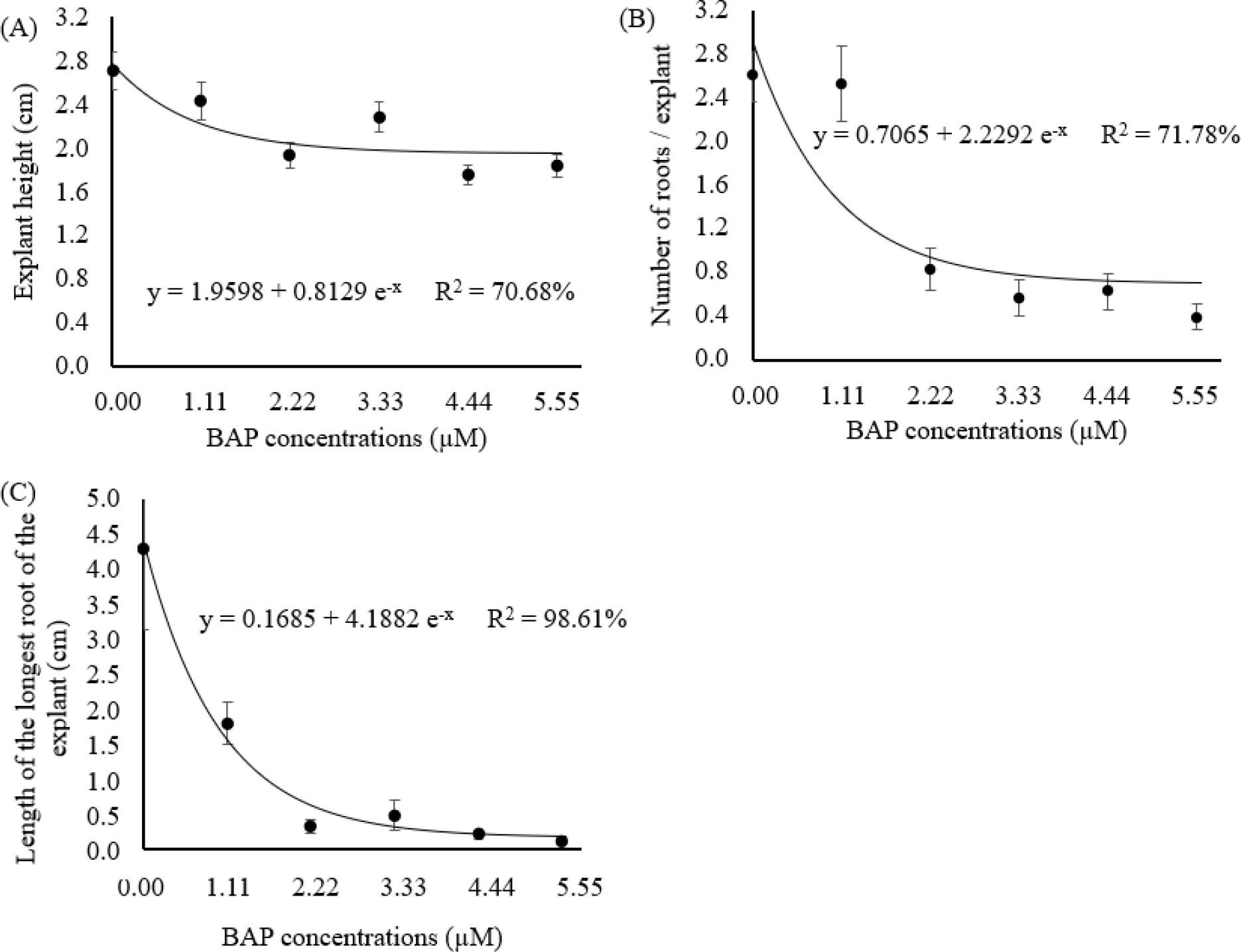
The variables explant height (Figure 5A), number of roots (Figure 5B) and length of the longest root (Figure 5C) showed an inverse relationship, i.e. the higher the BAP concentration added to the culture medium, the lower the values recorded for these variables. Thus, the highest values for shoot height were found in the treatment with no added BAP (2.8 cm), reducing as the concentration of the cytokinin increased (Figure 5A). These results corroborate those of Khumaida, Riyanti and Sukma (2012) where, with no added BAP, the shoots reached an average height of 3.1 cm, while the higher the BAP concentration, the smaller the shoots. These authors add that the reduction in height is probably due to the BAP, since cytokinins inhibit the process of shoot elongation. On the other hand, Lestari, Islami and Nihayati (2017) found no reduction in shoot height from the addition of BAP to the culture medium, with values remaining similar at around 2.0 cm.

Height (A), number of roots (B) and length of the longest root (C) in nodal segment explants of Anthurium plowmanii, as a function of different BAP concentrations, after 60 days of in-vitro culture.
Despite the addition of BAP to the culture medium affording a greater number of shoots, these shoots are shorter, meaning that treatments with lower BAP concentrations are the most suitable due to the greater ease of separating each shoot during the multiplication phase.
The increase in BAP concentration in the culture medium also had a negative effect on the number and length of the roots. The highest number of roots (Figure 5B) and the greatest length (Figure 5C) were achieved in nodal segments developed in culture medium with no cytokinin, producing an average of 2.6 roots and a maximum length of 4.3 cm. Root formation, even in the absence of added growth regulators, shows that the explants have endogenous concentrations of auxins, which, albeit low, are sufficient to induce rooting of the nodal segment (LESTARI; ISLAMI; NIHAYATI, 2017). Using the same culture medium, Lestari, Islami and Nihayati (2017) obtained only one root with a length of 8.17 cm. At BAP concentrations greater than 2.22 µM, the reduction was even more pronounced, resulting in only one root of approximately 0.5 cm. Wulandari, Murdioco and Barunawati (2018) also found lower average values for the root (0.71) in media containing 0.88 µM to 26.63 µM BAP. Witjaksono (2012) found that increasing the BAP concentration significantly reduced the number of roots, with no roots being formed at a concentration of 8.88 µM. Similar results were found by Lestari, Islami and Nihayati (2017), with no root formation in explants grown in culture media with added BAP. The inhibitory effect on rooting was also seen in A. andraeanum 'Rubi’ by Campos et al. (2019), who found a lack of root formation when using 6.66 µM BAP.
The inhibitory effect that BAP has on rooting can be understood from the way cytokinins modulate root organogenesis. An excess of these hormones tends to inhibit both root elongation and the formation of lateral roots, since they alter the normal patterns of cell division in the pericycle. For example, in Arabidopsis thaliana, high levels of cytokinin have been shown to disrupt the expression of PIN genes, which are fundamental for polar auxin transport, thereby preventing the formation of the gradients necessary to initiate root primordia (LAPLAZE et al., 2007). In addition to this direct action, BAP also stimulates the production of ethylene, another regulator that acts negatively on root growth, leading to shortening and, in some cases, abnormal thickening of the tips. Recent studies with the same species further detail this mechanism, showing that cytokinin can activate specific stages of ethylene biosynthesis through the spatial regulation of ACS and ACO genes, and that the interaction between the ARR2 and EIN2-C regulators is directly involved in inducing ACO4, the gene responsible for the observed root shortening (YAMOUNE et al., 2024).
The maximum values for fresh (Figure 6A) and dry (Figure 6B) matter, 262.48 mg and 26.64 mg respectively, were recorded in the culture medium supplemented with 3.33 µM BAP, although there were no significant differences between the doses of 2.22 to 5.55 µM BAP. This was probably due to the larger number of shoots (Figure 3A) and leaves per explant (Figure 3B) that were formed using this culture medium.

Fresh (A) and dry (B) matter from nodal segment explants of Anthurium plowmanii, as a function of different BAP concentrations, after 60 days of in-vitro culture.
Based on the results, the addition of BAP to Pierik medium had significant effects on the morphogenetic responses of the nodal segments for the number of shoots and leaves formed, and for fresh and dry matter. This cytokinin has an effect both on overcoming apical dormancy and on inducing the proliferation of axillary buds, and is widely used in the micropropagation of genus Anthurium (CAMPOS et al., 2018; SERAFIM et al. 2018). However, the recommended concentrations of the cytokinin vary according to the species, variety/cultivar, type of explant and methodology, underlining the need to develop specific protocols for each genotype.
The technique of micropropagation can therefore be used as a biotechnological tool, and optimised for the mass propagation of A. plowmanii, a species with great ornamental potential.
CONCLUSION
Shoot formation in A. plowmanii requires the addition of BAP to the culture medium, with a concentration of 3.33 µM being recommended to achieve higher multiplication rates. Furthermore, increasing the BAP concentration results in a greater number of leaves and an increase in the fresh and dry matter of the explant.
Data Availability:
The data that support the findings of this study can be made available, upon reasonable request, from the corresponding author.
REFERENCES
- CAMELO, M. C. et al. Fruit morphology in Anthurium sect. Pachyneurium from Brazil (Araceae) and its taxonomic implications. Flora, 309: 152406, 2023a.
- CAMELO, M. C. et al. Taxonomic updates in Anthurium sect. Pachyneurium (Araceae) from the Brazillian Atlantic Forest. Phytotaxa, 599: 109-125, 2023b.
- CAMPOS, A. S. et al. Micropropagação por organogênese direta de duas espécies de antúrio para folhagem. Ciência Rural, 48: 1-4, 2018.
- CAMPOS, A. S. et al. Micropropagação de antúrio 'Rubi' estiolamento e regeneração de brotações Fortaleza, CE: CNPAT, 2019. 21 p. (Boletim de pesquisa e desenvolvimento, 185).
-
COELHO, M. A. N. et al. Anthurium in Flora do Brasil 2020 2020. Jardim Botânico do Rio de Janeiro. Available at: https://floradobrasil2020.jbrj.gov.br/FB605558 Access on: Abr. 21, 2025.
» https://floradobrasil2020.jbrj.gov.br/FB605558 - FERREIRA, D. F. Sisvar: Computer analysis to fixed effects split plot type designs. Revista Brasileira de Biometria, 37: 529-535, 2019.
- GUIMARÃES, A. L. A. et al. Toxicological and anatomical study of vegetative organs of Anthurium maricense Nadruz and Mayo (Araceae). Revista Agrogeoambiental, 11: 87-106, 2019.
-
IBRAFLOR - Instituto Brasileiro de Floricultura. O mercado de flores no Brasil Informe 01/2022. Por Kees Schoenmaker. 2022. Available at: https://www.ibraflor.com.br/_files/ugd/b3d028_2ca7dd85f28f4add9c4eda570adc369f.pdf Access on: Abr. 25, 2025.
» https://www.ibraflor.com.br/_files/ugd/b3d028_2ca7dd85f28f4add9c4eda570adc369f.pdf - KHUMAIDA, N.; RIYANTI, C. H. S.; SUKMA, D. Induksi organogenesis anthurium Wave of Love (Anthurium plowmanii) secara in vitro [Organogenesis induction of anthurium Wave of Love (Anthurium plowmanii) in vitro]. Jurnal Hortikultura Indonesia, 3: 1-9, 2012.
- LAPLAZE, L. et al. Cytokinins act directly on lateral root founder cells to inhibit root initiation in Arabidopsis thaliana The Plant Cell, 19: 3889-3900, 2007.
- LESTARI, A. T.; ISLAMI, T.; NIHAYATI, E. Pengaruh konsentrasi NAA (naphthaleneacetic acid) dan BAP (6-benzyl amino purine) pada pembentukan planlet anthurium gelombang cinta (Anthurium plowmanii) secara in vitro [Effect of NAA (naphthalene acetic acid) and BAP (6-benzyl amino purine) concentration on the formation of bird’s nest anthurium plantlet (Anthurium plowmanii) in vitro]. Jurnal Produksi Tanaman, 5: 2047-2052, 2017.
- LIMA, I. M. B.; CAMPOS, A. S.; CARVALHO, A. C. P. P. The in vitro multiplication of Anthurium cv. Eidibel. Revista Agro@mbiente On-line, 14: 1-12, 2020.
- MALABADI, R. B.; CHALANNAVAR, R. K.; KOLKAR, K. P. Plant cell totipotency: Plant tissue culture applications-an updated review. World Journal of Advanced Engineering Technology and Sciences, 16: 112-135, 2025.
- MEHBUB, H. et al. Tissue culture in ornamentals: cultivation factors, propagation techniques, and its application. Plants, 11: 1-33, 2022.
- MURASHIGE, T.; SKOOG F. A revised medium for rapid growth and bio-assays with tabacco tissues cultures. Journal Plant Physiology, 15: 473-497, 1962.
- MORAIS, E. B. et al. Evaluation of potential use of native Anthurium foliage. Ornamental Horticulture, 23: 7-14, 2017.
- PIERIK, R. L. M. Anthurium andraeanum Lind. plantlets produced from callus tissues cultivated in vitro Physiologia Plantarum, 37: 80-82, 1976.
- SCHIAVINATO, Y. O. et al. Micropropagação de Anthurium plowmanii Croat. Plant Cell Culture & Micropropagation, 4: 15-20, 2008.
- SERAFIM, C. M. et al. Types and concentrations of cytokinins in the micropropagation of Anthurium maricense Revista Agroambiente On-line, 12: 117-123, 2018.
- SILVA, J. A. T. et al. Anthurium in vitro: a review. Scientia Horticulturae, 186: 266-298, 2015.
- WARNITA, W; HERAWATI, N. Pengaruh konsentrasi naphthalene acetic acid (NAA) dan pupuk daun terhadap pertumbuhan tanaman hias anthurium ‘Gelombang Cinta’ (Anthurium plowmanii). Prosiding Seminar Nasional Masyarakat Biodiversitas, 3: 69-74, 2017.
- WARNITA, W.; HERAWATI, N. Respons pertumbuhan tanaman hias anthurium ‘Gelombang Cinta’ (Anthurium plowmanii) pada beberapa konsentrasi bap dan frekuensi pemberian pupuk daun. Jurnal Agroekotek, 10: 10-18, 2018.
- WITJAKSONO, W. Perbanyakan massal anthurium daun (Anthurium sp) asal biji dengan teknologi in vitro Jurnal Biologi Indonesia, 8: 367-379, 2012.
- WULANDARI, C.; MURDIOCO, W. E.; BARUNAWATI, N. Pengaruh konsentrasi sitokinin dan auksin terhadap pertumbuhan planlet Anthurium plowmanii Croat. (Effect concentration of cytokinin and auxin on growth Anthurium plowmanii Croat plantlet). Jurnal Produksi Tanaman, 6: 2531-2538, 2018.
- YAMOUNE, A. et al. Cytokinins regulate spatially specific ethylene production to control root growth in Arabidopsis. Plant Communications, 5: 101013, 2024.
- YUSNITA, Y. Perbanyakan klonal in vitro Anthurium plowmanii. In: YUSNITA, Y. (Ed.) Kultur Jaringan Tanaman Lampung: Universitas Lampung, 2015. v. 1, cap. 3.3, p. 25-26.
- ZEIN, D. R.; HAMAMI, F.; MULYANA, T. Pengembangan system penyiramen otomatis tanaman Anthurium Berbasis Iot. Journal of Information System Research, 4: 103-110, 2022.
Edited by
-
Editor in Chief:
Aurélio Paes Barros Júnior
-
Section Editor:
Salvador Barros Torres