Influence of sewage sludge biochar and Priestia sp. on soil fertility
ABSTRACT
This study aimed to evaluate, after the period of soil incubation with biochar, the influence of the interaction between sewage sludge biochar and Priestia sp. on soil fertility. The experiment was carried out in Campina Grande, PB, Brazil, using 4 doses of biochar (0, 5, 10 and 15 t ha-1) and 4 doses of Priestia sp. (0,1.5 × 106, 1.5 × 10⁷, 1.5 × 10⁸ CFU mL-1), in a completely randomized design with 3 replicates, totaling 48 experimental units, containing 350 grams of soil. After 104 days of soil incubation with the treatments mentioned above, biochar x Priestia sp. (after mineralization), soil samples were collected from the experimental units and chemically analyzed. Biochar significantly influenced all chemical variables evaluated. Priestia sp. affected most variables, except for electrical conductivity, sodium and calcium. The interaction between biochar and Priestia sp. influenced phosphorus, pH, magnesium and hydrogen + aluminum contents. In general, the single effects of biochar and Priestia sp. promoted increases in carbon and calcium contents in the soil. The interaction between the factors favored the increase in available phosphorus and variations in pH, keeping it within a range suitable for nutrient availability, evidencing the potential of the combination for improving soil fertility.
Keywords:
Microorganism; Pyrolysis; Soil properties.
RESUMO
Objetivou-se com este estudo avaliar, após o período de incubação do solo com biocarvão, a influência da interação entre biocarvão de lodo de esgoto e Priestia sp. na fertilidade do solo. A pesquisa foi realizada em Campina Grande-PB, utilizando 4 doses de biocarvão (0, 5, 10 e 15 t ha-1) e 4 doses de Priestia sp. (0, 1.5 × 10⁶, 1.5 × 10⁷, 1.5 × 10⁸ UFC mL-1), no delineamento inteiramente casualizado com 3 repetições, totalizando 48 unidades experimentais. Após 104 dias de incubação do solo com os tratamentos acima citados, biocarvão x Priestia sp. foram coletadas amostras do solo das unidades experimentais e analisadas quimicamente. O biocarvão influenciou significativamente todas as variáveis químicas avaliadas. Priestia sp. afetou a maioria das variáveis, com exceção da condutividade elétrica, sódio e cálcio. A interação entre biocarvão e Priestia sp. influenciou os teores de fósforo, pH, magnésio e hidrogênio + alumínio. De forma geral, os efeitos isolados do biocarvão e da Priestia sp. promoveram aumentos nos teores de carbono e cálcio no solo. A interação entre os fatores favoreceu o aumento do fósforo disponível e variações no pH, mantendo-o em faixa adequada para a disponibilidade de nutrientes, evidenciando o potencial da combinação na melhoria da fertilidade do solo.
Palavras-chave:
Microrganismo; Pirólise; Propriedades de solo.
INTRODUCTION
The growing volume of sewage sludge generated in wastewater treatment plants has become an environmental concern around the world. Although its generation is the result of an essential process for the recovery of water quality, inadequate disposal of this waste can lead to serious risks to the environment, especially due to the potential presence of heavy metals and pathogenic agents (TYTŁA; WIDZIEWICZ-RZOŃCA, 2023). At the same time, sewage sludge is a material with a high content of organic matter and essential nutrients for plants, which arouses interest in its agricultural use (HAO et al., 2024). However, direct application to the soil is still limited, due to the need for technologies that make this residue safe and efficient for agronomic use.
In this context, the conversion of sewage sludge into biochar through pyrolysis has stood out as a promising alternative (GUSIATIN, 2024). Biochar is a stable carbonaceous material, obtained from the thermal decomposition of biomass in an environment with little or no oxygen. This technology not only reduces the volume and hazardousness of the sludge, but also generates an input with the potential to improve the chemical and physical properties of the soil (DAYOUB et al., 2024). Studies have indicated that the application of biochar can favor water retention, raise pH, increase nutrient availability, promote carbon sequestration, and stimulate microbial activity (TITO et al., 2021). Nevertheless, the agricultural use of biochar produced from sewage sludge needs further investigation as to its safety, efficiency and impacts on the soil.
At the same time, the use of plant growth-promoting microorganisms (PGPMs) has been consolidated as a promising strategy for sustainable agriculture, especially in view of the negative impacts associated with the intensive use of chemical fertilizers and pesticides (CHEN et al., 2023). Among these microorganisms, bacteria of the genus Priestia stand out, whose action in the rhizosphere includes promoting plant growth, phosphate solubilization (increasing the availability of phosphorus in the soil), and improving nutrient absorption.
Despite evidence of the benefits promoted individually by biochar and PGPMs, there are still limited studies investigating the effects of the joint application of sewage sludge biochar and Priestia sp. However, recent research shows that biochar exerts positive effects on soil microbial communities, including beneficial microorganisms such as Bacillus and Sphingomonas (WANG et al., 2024). In addition, biochar stimulates the activity of nitrogen-fixing bacteria and promotes an increase in the total abundance of nitrogen-fixing bacteria naturally present in the soil (CASTEJÓN-DEL PINO et al., 2024). These findings suggest that biochar has the potential to favor the establishment and activity of inoculated strains of Priestia, thus contributing to the improvement of soil biological quality and fertility.
In this context, the combined use of biochar and PGPMs can contribute to reducing the use of chemical fertilizers, improving soil fertility, and promoting additional benefits, such as increased organic matter, improved soil aggregation, and increased microbial activity (HUSSAIN et al., 2019).
According to the above, as it symbolizes a new option for reusing the large amounts of waste generated in sewage treatment plants, it is necessary to carry out new studies that can bring new products to farmers as soon as possible, especially in relation to the use of sewage sludge biochar and Priestia sp. as fertilizers and as a conditioner in soils.
The objective of this study was to evaluate, after a period of soil incubation with biochar, the influence of the interaction between sewage sludge biochar and Priestia sp. on soil fertility.
MATERIAL AND METHODS
The experiment was carried out at the Laboratory of Irrigation and Salinity (LIS) of the Federal University of Campina Grande (UFCG), located in Campina Grande, PB, Brazil.
The study was carried out at the Irrigation and Salinity Laboratory of the Department of Agricultural Engineering of the Federal University of Campina Grande in Campina Grande, PB, Brazil, using a soil classified as Argissolo (Ultisol), collected in the State of Paraíba, Brazil, at 0-20 cm depth, whose chemical characterization was carried out according to Teixeira et al. (2017) (Table 1).
Chemical characterization of the soil used in the experiment and chemical composition of the sewage sludge biochar produced in a muffle furnace.
The sewage sludge used for the production of biochar was obtained from the PROSAB Sewage Treatment Plant, located in the municipality of Campina Grande, PB, after the stage of removal of solids and organic matter from domestic sewage. According to data from CAGEPA (2019), the raw sewage treated by this station has on average a pH of 7.9, electrical conductivity of 1.38 dS m-1 and, in mg L-1: Biochemical Oxygen Demand (BOD) of 44.3, Chemical Oxygen Demand (COD) of 54.5, dissolved oxygen of 3.9, ammonia (NH3) of 41.7, phosphorus (P) of 7.3, and total dissolved solids of 752.7.
The sewage sludge biochar was produced through a slow pyrolysis process at a carbonization temperature of 550 ºC in a muffle furnace. Subsequently, this material was chemically characterized following the Manual of Official Analytical Methods for Fertilizers and Correctives (BRASIL, 2017) (Table 1). The microorganism used in the study was the bacterium Priestia sp., belonging to the Microbiology Laboratory - State University of Paraíba.
The experimental design was completely randomized, in a 4 x 4 factorial scheme, corresponding to 4 doses of biochar (0, 5, 10 and 15 t ha-1) (BIO) and 4 doses of Priestia sp. (0, 1.5 × 10⁶, 1.5 × 10⁷, 1.5 × 10⁸ CFU mL-1) (MICRO) with three replicates, totaling 48 experimental units. Each experimental unit corresponded to a plastic pot with a capacity of 1.0 L, hermetically sealed, with matte black color, in order to avoid the presence of lichens, containing 350 grams of soil mixed with the respective treatments (doses of microorganism and biochar). These mixtures, incubated for 104 days, were moistened with distilled water whenever necessary to increase water content in the soil by 60% of the field capacity. After this period, soil samples were collected from the experimental units and chemically analyzed, that is, pH, calcium, magnesium, sodium, potassium, hydrogen, aluminum, phosphorus, organic carbon and electrical conductivity, according to Teixeira et al. (2017).
Once the ANOVA assumptions (normality of residuals and homogeneity of variances) were met, the data were subjected to analysis of variance using the F test (p ≤ 0.01 and p ≤ 0.05). When a significant effect was verified, polynomial regression analysis was performed for the individual effect of the factors biochar doses and Priestia sp. using the statistical software SISVAR (FERREIRA, 2011). As the potassium content did not meet the ANOVA assumptions, the data were subjected to the non-parametric Kruskal-Wallis test. The response surface plots were used to describe the response of the interaction between the factors, using the statistical software SigmaPlot 14.5.
RESULTS AND DISCUSSION
Exchangeable potassium contents in the soil did not show normal distribution, even after the application of statistical transformations, and there were no significant differences between the treatments according to the Kruskal- Wallis test, with an overall mean of 0.103 cmolc dm-3. The low concentration of potassium in the biochar used (0.46%) may have been insufficient to promote increases in its available contents in the soil and may have limited the solubilizing action of Priestia sp. These results do not corroborate Balkrishna, Chauhan and Kaushik (2024), who reported an 8-fold increase in the available potassium content in the soil compared to the control set with the application of sewage sludge.
The soil variables phosphorus (P), pH, magnesium (Mg) and hydrogen + aluminum (H+Al) were significantly influenced by the interaction between the factors biochar doses (BIO) and Priestia sp. doses (MICRO). Regarding electrical conductivity (EC), sodium (Na) and calcium (Ca), only the BIO factor had a significant effect and, for organic carbon (OC), there was individual influence of both factors (BIO and MICRO) (Table 2).
Analysis of variance of soil chemical characterization as a function of the interaction of increasing doses of sewage sludge biochar with
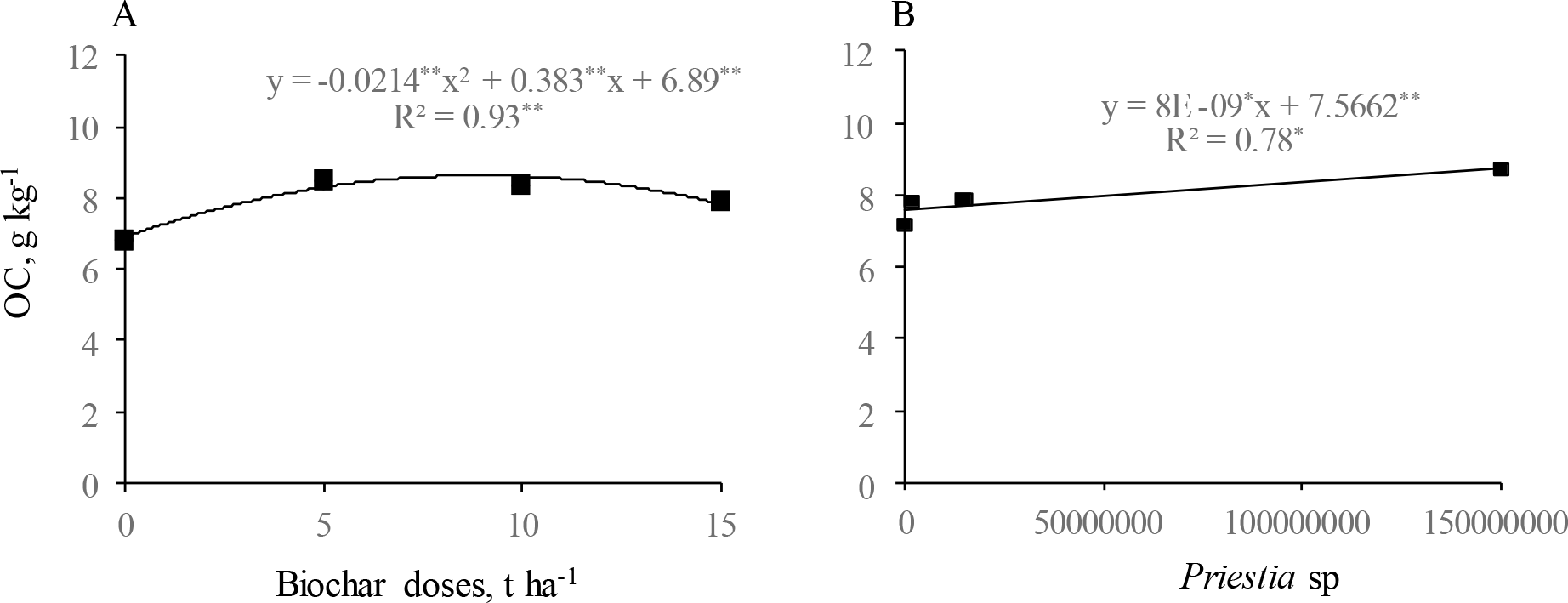
Organic carbon (OC) is an important indicator of soil fertility, and is added through organic fertilization, root exudates, among others. In the present study, an accumulation of OC in the soil was observed with the application of sewage sludge biochar, with the highest carbon content estimated at 8.6 g kg-1 at a dose of 8.9 t ha-1 (Figure 1A). This result is important since organic carbon helps to improve and conserve soil fertility in the long term. Likewise, it is known in the literature that biochar application to the soil increases the total organic carbon content, as it is a material with a high carbon content, which corroborates Velli, Manolikaki, and Diamadopoulos (2021). These authors found that the total organic carbon content in the soil increased significantly by 67 to 85% with the application of sewage sludge biochar compared to the control treatment.
Organic carbon (OC) contents as a function of the individual effects of biochar (A) and Priestia sp. (B).
Biochar application results in increases in soil organic carbon content. Several studies have demonstrated this effect in various types of soil and under different experimental conditions, with increments ranging from 15.8% to 82.2% compared to untreated soil (SHI et al., 2020). This increase is attributed to the recalcitrance of biochar against microbial degradation, which makes it very stable in the soil compared to other organic matter additions. Incorporating biochar into the soil can modify the decomposition rates of organic matter, although these effects are influenced by multiple factors and are highly complex. Scientific evidence indicates that biochar contributes to increasing the organic carbon content of the soil and to improving its physical-chemical properties. The application of wheat straw biochar, for example, significantly increased soil organic carbon content by up to 59% compared to the control (AON et al., 2023). Similar results were observed by Abbas et al. (2024), with a 69% increase in organic matter and a 70% increase in the carbon reserve index in low-fertility soils.
Also based on Figure 1A, it was observed that the application of biochar at doses higher than 8.9 t ha-1 resulted in a significant reduction in the organic carbon contents present in the soil, and this decrease was estimated at 9.07% at the highest dose applied. This effect of reduction in soil organic carbon may be associated with the presence of volatile compounds generated during the pyrolysis process, such as polycyclic aromatic hydrocarbons, classified as persistent organic pollutants. These compounds are capable of negatively interfering with soil enzymatic activity and organic matter availability (SUMATHI; MANIAN, 2023). According to the same authors, contamination by these substances represents a considerable obstacle to long-term microbial growth and development, due to their mutagenic, carcinogenic and toxic properties. In addition, Chen et al. (2024) reported that high doses of biochar (above 20 t ha-1) caused reduction of carbon fractions subject to mineralization and the more labile portions of organic carbon. These findings indicate that, although the total carbon content in the soil has increased, the fraction of easy decomposition decreased, which may contribute to increasing the stability of the incorporated organic matter (CHEN et al., 2024).
Organic carbon content showed a linear increase in response to inoculationwithPriestiasp.,reaching 8.766 g kg-1 at a dose of 1.5 × 10⁸ CFU mL-1, which represents an increase of 16% compared to the control treatment (Figure 1B). This result highlights the biostimulant potential of the bacterium in the carbon dynamics in the soil. Soil microorganisms, including bacteria and fungi, play an essential role in the carbon cycle by favoring the influx of organic matter through the promotion of plant growth, stimulation of beneficial associations (such as mycorrhization) and increase in the stability of soil aggregates, factors that favor the incorporation and physical protection of organic matter in the micropores of the aggregates (AZEVEDO et al., 2024). In addition, these microorganisms can modulate native microbial activity, positively influencing humification and carbon retention processes. Although they also participate in carbon efflux via respiration and mineralization, the observed effect suggests that the balance favored the accumulation of carbon, possibly due to the improvement in biological conditions promoted by the action of Priestia sp. (AZEVEDO et al., 2024).
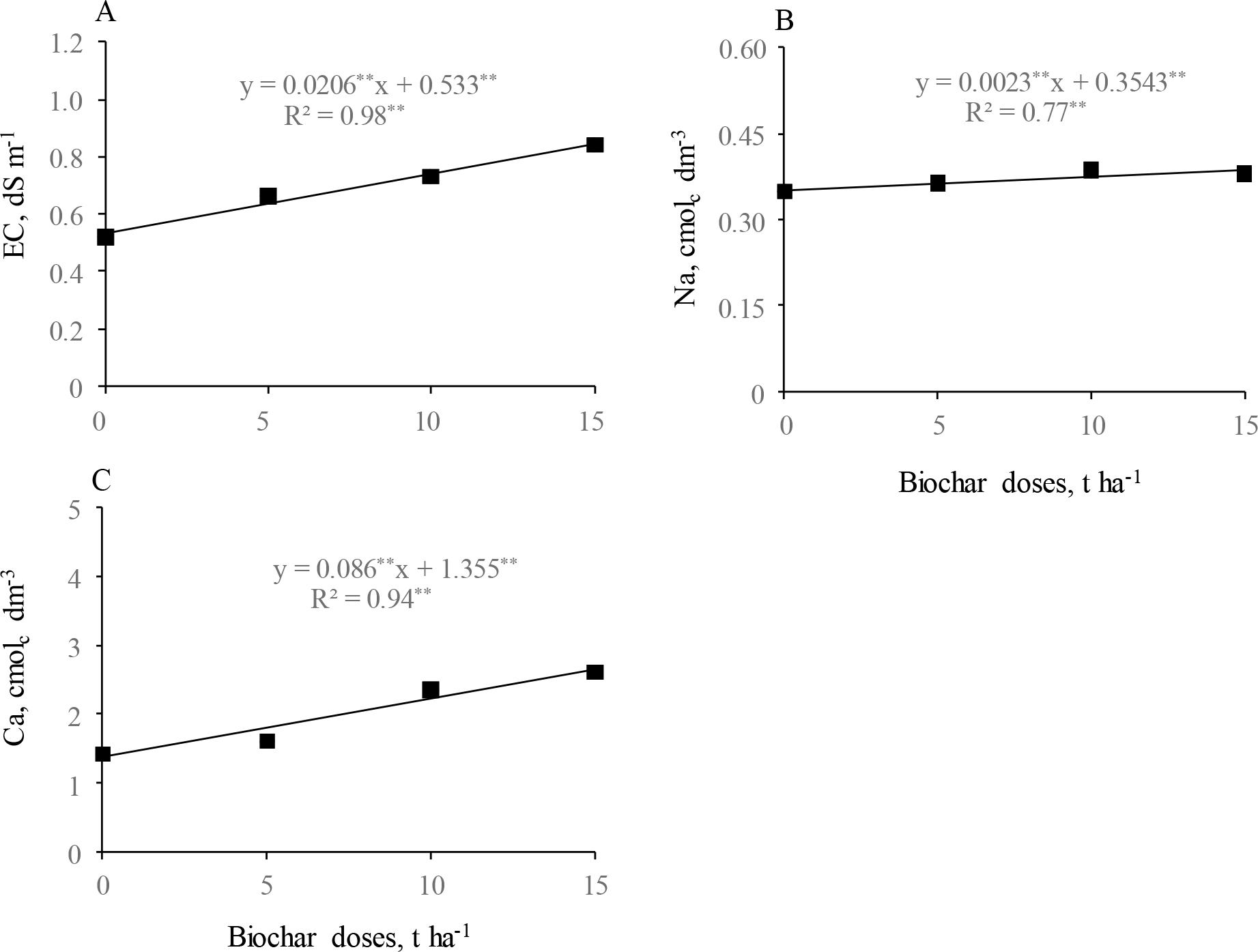
Regarding electrical conductivity, a linear increase of 58% was observed compared to the control, reaching a value of 0.842 dS m-1 with the dose of 15 t ha-1 (Figure 2A). Corroborating this study, Hossain et al. (2010) evaluated the agronomic potential of sewage sludge biochar and its impact on soil quality and observed that biochar increased the electrical conductivity to a value of 0.29 dS m-1, while the control was 0.05 dS m-1.
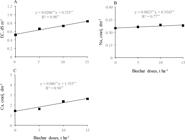
Electrical conductivity (A), sodium (B) and calcium (C) as a function of the application of doses of sewage sludge biochar.
The electrical conductivity (EC) of the soil is influenced by the presence of free ions in solution, which result, in large part, from the decomposition or release of substances present in the applied inputs, such as biochar. In this context, the EC can reflect the amount of soluble nutrients available in the system. Biochar, in turn, has variable levels of ash depending on the raw material and pyrolysis temperature, and the ash content is directly associated with the concentration of residual minerals. Thus, materials with higher ash content tend to release more soluble ions, which contributes to increasing the electrical conductivity of the soil after its application. According to Figure 2B, the highest sodium concentration (Na) of 0.38 cmolc dm-3 was obtained with the highest dose of biochar (15 t ha-1); therefore, there was an increase of around 10% compared to the control, which can be attributed to the concentration of soluble salts present in this residue. Na⁺ accumulation can negatively affect soil fertility, favoring the dispersion of clays and reduction of porosity and water infiltration. In addition, at high concentrations, sodium can cause direct toxicity to plants and compete with essential nutrients, such as Ca2+, Mg2+, and K+, compromising their uptake. However, the effects of sodium are dependent on the dose, exposure time, type of soil, and tolerance of the cultivated species. At moderate levels and under well-structured soil conditions, Na⁺ may not cause immediate phytotoxic effects, but its progressive accumulation should be closely monitored, especially in agricultural systems with continuous use of organic inputs containing soluble salts, such as sewage sludge biochar.
A linear increase in soil calcium contents was observed in response to increasing doses of sewage sludge biochar, with an estimated increase of 0.086 cmolc dm⁻3 per t ha-1 applied (Figure 2C). This pattern can be attributed to the mineral composition of the biochar, resulting from the concentration of nutrients in the ash fraction after the pyrolysis process. During this thermal process, there is volatilization of organic elements such as C, H, O and N, which favors the enrichment of the residue in cations, such as Ca2+ (SINGH; SINGH; COWIE, 2010). Similar results were found by Sousa and Figueiredo (2016), who reported gradual increments in calcium contents as the doses of sludge biochar increased, highlighting the potential of this waste as an alternative source of nutrients. In addition to the nutritional supply, the increase of Ca2⁺ in the soil can favor its physical structure by promoting particle flocculation and aggregate stability, which is particularly important in weathered tropical soils (WANG; WANG, 2024).
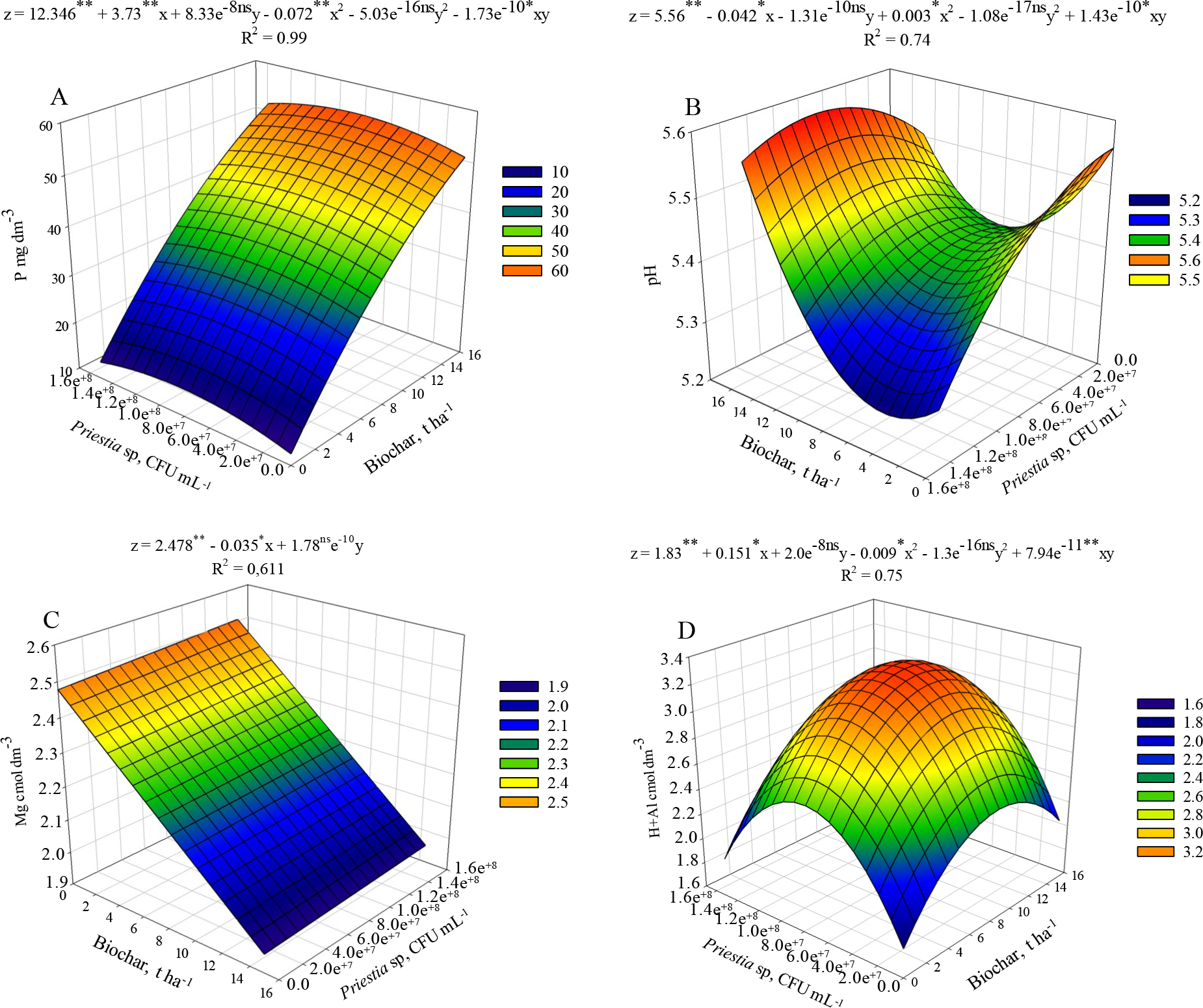
The interactions between the doses of sewage sludge biochar and Priestia sp. significantly influenced several soil chemical attributes, as evidenced by the response surfaces (Figure 3). The available phosphorus content (Figure 3A) showed a significant increase, with a maximum estimated value of 55.329 mg dm3 dm-3 in the combination of 15 t ha-1 of biochar and 8.02e+7 CFU mL-1 of Priestia sp., resulting in an increase of 418% compared to the control. This effect may be associated with both the presence of phosphorus in the inorganic fraction of biochar and the bacterium’s role in solubilizing phosphates. Studies indicate that plant growthpromoting rhizobacteria (PGPR), such as Priestia sp., contribute to phosphorus solubilization mainly by excreting low-molecular-weight organic acids, releasing phosphatase enzymes, and acidifying the rhizosphere microenvironment (MENGESHA; LEGESSE, 2024). These acids, including citric, maleic, and gluconic acids, help convert soil aluminumbonded P and organic P into forms available for plant uptake.
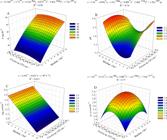
Response surface for phosphorus (A), pH (B), magnesium (C) and H+Al (D) as a function of sewage sludge biochar and Priestia sp.
In relation to pH (Figure 3B), a significant increase was observed with increasing doses of biochar, although the final values still remain below the neutral level.
The pH ranged from 5.24 (6.9 t ha-1 and 1.5e+8 CFU mL⁻1) to 5.56 (0 t ha-1 and 14997802.78 CFU mL-1), which represents an increase of 6.11%. This behavior is in line with the slightly alkaline nature of the sludge biochar, whose mineral composition includes basic oxides that act as acidity correctives. However, the presence of Priestia sp. may have partially attenuated this effect, possibly due to the release of organic acids during phosphorus solubilization, which promotes some localized acidification in the soil solution.
Figure 3C shows that the magnesium content in the soil was negatively influenced by the increasing doses of biochar, while the microbial inoculant (Priestia sp.) and the interaction between the factors did not caused statistically significant effects. The fitted model reveals a decreasing linear trend of Mg2+ with the increase of biochar, which can be attributed to the physicochemical adsorption of magnesium by biochar (ZHU et al., 2023). The carbonaceous material used, produced from sewage sludge, tends to have a large surface area, a large number of functional groups, and cation exchange capacity (CEC), and may retain cations such as Mg2+ in its pores or active surfaces, reducing the soluble fraction readily available in the soil (MAYILSWAMY et al., 2023).
Inoculation with Priestia sp., in turn, did not significantly alter magnesium contents, which suggests that this bacterium, despite being a potential growth promoter, does not directly interfere in the processes of solubilization or availability of Mg2+ in the short term, at least under the
Regarding potential acidity (H+ + Al) (Figure 3D), the results also indicated a significant effect of the interactions between the treatments, with values ranging from 1.6 cmolc dm-3 (0 t ha-1 and 164752513.72 CFU mL-1) to 2.94 cmolc dm-3 (8.97 t ha-1 and 131743495.01 CFU mL-1), the latter being obtained with the application of 9 t ha⁻1 of biochar associated with 7.9 × 10⁷ CFU mL-1 of Priestia sp. The increase in H+ + Al, in some treatments, may be a consequence of microbial action on organic matter, releasing protons and acidic organic compounds (HUANG et al., 2023). Although biochar has the potential to reduce soil acidity, its interaction with solubilizing microorganisms can temporarily alter this balance, especially in soils with low buffer capacity (SRIVASTAVA et al., 2023).
CONCLUSIONS
Application of sewage sludge biochar and inoculation with Priestia sp. promoted an increase in soil carbon content due to individual effects of both treatments;
Sewage sludge biochar increased soil calcium contents, indicating potential for short-term improvement in chemical fertility;
Soil pH showed a slight variation between 5.24 and 5.56, remaining within a slightly acidic range, adequate for the availability of most nutrients;
The interaction between biochar and Priestia sp. significantly influenced phosphorus, indicating that this combination may be strategic to increase the availability of this nutrient in the soil.
Data Availability:
The data that support the findings of this study can be made available, upon reasonable request, from the corresponding author.
REFERENCES
- ABBAS, A. et al. The efficacy of organic amendments on maize productivity, soil properties and active fractions of soil carbon in organic-matter deficient soil. Spanish Journal of Soil Science, 14: 12814, 2024.
- AON, M. et al. Wheat straw biochar produced at a low temperature enhanced maize growth and yield by influencing soil properties of Typic calciargid. Sustainability, 15: 9488, 2023.
- AZEVEDO, L. C. B. et al. Microbial contribution to the carbon flux in the soil: a literature review. Revista Brasileira de Ciência do Solo, 48: e20230065, 2024.
- BALKRISHNA, A.; CHAUHAN, D.; KAUSHIK, I. et al. Reuse of Sewage Sludge as Organic Agricultural Products: An Efficient Technology-Based Initiative. Applied and Environmental Soil Science, 2024: 1-16, 2024.
- BRASIL. Ministério da Agricultura, Pecuária e Abastecimento. Manual de métodos analíticos oficiais para fertilizantes e corretivos/Ministério da Agricultura, Pecuária e Abastecimento Secretaria de Defesa Agropecuária. Brasília, DF:MAPA, 2017.240p.
-
CAGEPA - Companhia de Água e Esgotos da Paraíba. Relatório da Administração e da Sustentabilidade 2019 2019. Available at: https://www.cagepa.pb.gov.br/wp-content/uploads/2020/05/Relat%C3%B3rio-daAdministra%C3%A7%C3%A3o-e-de-Sustentabilidade-e-Balan%C3%A7o-2019.pdf Access on: Fev. 09, 2024.
» https://www.cagepa.pb.gov.br/wp-content/uploads/2020/05/Relat%C3%B3rio-daAdministra%C3%A7%C3%A3o-e-de-Sustentabilidade-e-Balan%C3%A7o-2019.pdf - CASTEJÓN-DEL PINO, R. et al. Field assessment of biochar interactions with chemical and biological N fertilization in pointed white cabbage. GCB Bioenergy, 16: e70006, 2024.
- CHEN, M. et al. Effect of biochar types and rates on SOC and its active fractions in tropical farmlands of China. Agronomy, 14: 676, 2024.
- CHEN, W. et al. Biochar combined with Bacillus subtilis SL- 44 as an eco-friendly strategy to improve soil fertility, reduce Fusarium wilt, and promote radish growth. Ecotoxicology And Environmental Safety, 251: 114509, 2023.
- DAYOUB, E. B. et al. Chemical and physical properties of selected biochar types and a few application methods in agriculture. Agronomy, 14: 2540, 2024.
- FERREIRA, D. F. Sisvar: a computer statistical analysis system. Ciência e Agrotecnologia, 35: 1039-1042, 2011.
- GUSIATIN, M. Z. Advantages of co-pyrolysis of sewage sludge with agricultural and forestry waste. Energies, 17: 5736, 2024.
- HAO, J. et al. Double advantages of nutrients and biostimulants derived from sewage sludge by alkaline thermal hydrolysis process for agricultural use: Quality promotion of soil and crop. Advanced Science, 11: 2307793, 2024.
- HOSSAIN, M. K. et al. Agronomic properties of wastewater sludge biochar and bioavailability of metals in production of cherry tomato (Lycopersicon esculentum). Chemosphere, 78: 1167-1171, 2010.
- HUANG, K. et al. Soil acidification and salinity: the importance of biochar application to agricultural soils. Frontiers in Plant Science, 14: 1206820, 2023.
- HUSSAIN, A. et al. Impact of integrated use of enriched compost, biochar, humic acid and Alcaligenes sp. AZ9 on maize productivity and soil biological attributes in natural field condition. Italian Journal of Agronomy, 14: 101-107, 2019.
- MAYILSWAMY, N. et al. Sludge-derived biochar: Physicochemical characteristics for environmental remediation. Applied Physics Reviews, 10: 031308, 2023.
- MENGESHA, A. S.; LEGESSE, N. H. Isolation and characterization of phosphate solubilizing bacteria from the rhizosphere of lentil (Lens culinaris M.) collected from Hagere Mariam district, Central Ethiopia. PLoS One, 19: e0308915, 2024.
- SHI, S. et al. Soil organic and inorganic carbon sequestration by consecutive biochar application: Results from a decade field experiment. Soil Use and Management, 37: 95-103, 2020.
- SINGH, B.; SINGH, B. P.; COWIE, A. L. Characterisation and evaluation of biochars for their application as a soil amendment. Soil Research, 48: 516-525, 2010.
- SUMATHI, K.; MANIAN, R. Bioremediation of polycyclic aromatic hydrocarbons contaminated soils: recent progress, perspectives and challenges. Environmental Monitoring and Assessment, 195: 1441, 2023.
- SOUSA, A. A. T. C.; FIGUEIREDO, C. C. Sewage sludge biochar: effects on soil fertility and growth of radish. Biological Agriculture & Horticulture 32: 127-138, 2016.
- SRIVASTAVA, P. et al. Biochar’s influence on soil microorganisms: understanding the impacts and mechanisms. International Journal of Plant & Soil Science, 35: 455-464, 2023.
- TEIXEIRA, P. C. et al. Manual de métodos de análise de solo 3. ed. rev. e ampl. Brasília, DF: Embrapa, 2017. 573 p.
- TITO, G. A. et al. Organic carbon mineralization of the biochar and organic compost of poultry litter in an Argisol. Semina: Ciências Agrárias, 42: 3167-3184, 2021.
- TYTŁA, M.; WIDZIEWICZ-RZOŃCA, K. Ecological and human health risk assessment of heavy metals in sewage sludge produced in Silesian Voivodeship, Poland: a case study. Environmental Monitoring and Assessment, 195: 1373, 2023.
- VELLI, P.; MANOLIKAKI, I.; DIAMADOPOULOS, E. Effect of biochar produced from sewage sludge on tomato (Solanum lycopersicum L.) growth, soil chemical properties and heavy metal concentrations. Journal of Environmental Management, 297: 113325, 2021.
- WANG, S. et al. The win-win effects of an invasive plant biochar on a soil-crop system: controlling a bacterial soilborne disease and stabilizing the soil microbial community network. Microorganisms, 12: 447, 2024.
- WANG, T.; WANG, Y. Mechanical and microstructural changes in expansive soils treated with lime and lignin fiber from paper industry. Applied Sciences, 14: 3393, 2024.
- ZHU, C. et al. Effect of MgCl2 Loading on the Yield and Performance of Cabbage-Based Biochar. Bioengineering, 10: 836, 2023.
Edited by
-
Editor in Chief:
Aurélio Paes Barros Júnior
-
Section Editor:
Alexandre Tavares da Rocha