Yield and post-harvest quality of tomato hybrids under agricultural ambience and salt stress
ABSTRACT
The agricultural environment can mitigate salt stress in plants. Therefore, this study aimed to evaluate the yield and post-harvest quality of tomato hybrids brackish water irrigated in different growing environments. The study was conducted in Aratuba, Ceará, Brazil. The design was a randomized complete block design, in split-split plots, with the plots having two environments (E1 = agricultural greenhouse and E2 = full sun), the subplots having five levels of irrigation water electrical conductivity (ECw) (1.0, 1.7, 2.4, 3.1, and 3.8 dS m-1), and the sub-subplots having two tomato hybrids (Itaipava and BS DI0014), with five replicates and two plants per plot. The following variables were evaluated: total number of fruits, average total fruit mass, marketable fruit yield, non-marketable fruit yield, and total fruit yield; soluble solids content, hydrogen potential, fruit length and diameter, and pulp thickness. The Itaipava hybrid grown in an agricultural greenhouse was superior to the BS DI0014 hybrid in terms of production and post-harvest performance. Salinity favors an increase in soluble solids content, but with greater intensity in the agricultural greenhouse. The agricultural greenhouse environment partially mitigated the effects of salinity up to 1.86 dS m-1 on production variables, resulting in a lower percentage of non-marketable fruits and higher total fruit yield compared to full-sun cultivation. The agricultural greenhouse promotes greater production performance and fruit quality for tomato plants under irrigation with water of both lower and higher salinity compared to the full-sun environment.
Keywords:
Solanum lycopersicum L
; Salinity; agricultural greenhouse
RESUMO
A ambiência agrícola pode mitigar o estresse salino em plantas. Neste sentido, objetivou-se avaliar a produtividade e pós-colheita de híbridos de tomateiro irrigados com água salobra, em diferentes ambientes de cultivo. O estudo foi desenvolvido em Aratuba, Ceará, Brasil. O delineamento foi em blocos ao acaso, em parcelas subsubdivididas, sendo as parcelas dois ambientes (A1= estufa agrícola e A2= pleno sol), as subparcelas cinco níveis de condutividade elétrica da água de irrigação (CEa) (1,0; 1,7; 2,4; 3,1 e 3,8 dS m-1) e as subsubparcelas dois híbridos de tomate (Itaipava e BS DI0014), com cinco repetições e duas plantas por parcela. Foram avaliadas as seguintes variáveis: número de frutos totais, massa média de frutos totais e a produtividade de frutos comerciais, não comerciais e a total, teor de sólidos solúveis, potencial hidrogeniônico, comprimento e diêmetro do fruto e a espessura da polpa. O híbrido Itaipava cultivada em estufa agrícola, mostrou superioridade para os aspectos produtivos e pós-colheita, em relação ao híbrido BS DI0014. A salinidade favorece o aumento no teor de sólidos solúveis, porém com maior intensidade em estufa agrícola. O ambiente do tipo estufa agrícola mitigou parcialmente os efeitos da salinidade até 1,86 dS m-1 nas variáveis de produção, resultando em menor percentual de frutos não comerciais e maior produtividade total de frutos em relação ao cultivo em pleno sol. A estufa agrícola proporciona maior desempenho produtivo e de qualidade de frutos do tomateiro sob irrigação com água de menor e maior salinidade em relação ao ambiente pleno sol.
Palavras-chave:
Solanum lycopersicum L.
; Salinidade; Cultivo protegido
INTRODUCTION
Tomato (Solanum lycopersicum L.) has great relevance in the economic sphere, being one of the most produced and consumed vegetables in the world, with food functions for fresh consumption or processed in the form of sauce, offering several benefits to human nutrition (AGIUS; TUCHER; ROZHON, 2022; ALENAZI; KHANDAKER, 2024). Tomato fruits are known to perform nutritional functions, in addition to having an abundance of phenolic compounds and carotenoids (LI et al., 2022a), being the second most important vegetable in terms of production and cultivated area in Brazil, with an average yield of 70,880 kg per hectare (IBGE, 2023).
In the Brazilian Northeast region, the characteristic climate is semi-arid, with poor distribution of rainfall and long periods of drought. In this context, the use of irrigation is the only way to guarantee agricultural production (FERNANDES et al., 2016). However, this region has water with a high salt content, which causes an increase in the osmotic potential of the soil, triggering nutritional imbalance, as well as physiological and biochemical changes, consequently affecting crop growth and yield (CEDEÑO et al. 2023; LESSA et al., 2023).
An alternative to deal with high levels of salts in irrigation water is the use of agricultural greenhouses, whose purpose is to control environmental variables and establish conditions conducive to plant development, providing greater efficiency in the use of water and fertilizers, and to the yield of agricultural crops (ZHANG et al., 2023; SILVA et al., 2024), in addition to minimizing the harmful effects caused by salts on plants (LESSA et al., 2023). Studies describing the effect of the interaction between salinity and protected environment are on the rise in the scientific community. Souza et al. (2019), when studying the tomato crop, Persimmon hybrid, in a protected environment with a 50% shade net under salt stress, recorded an attenuating effect on shoot and root biomass. Similarly, Roque et al. (2022) researched the effect of salt stress on tomato crop under greenhouse conditions and found that salt stress favored the increase in soluble solids content.
Therefore, our hypothesis is that the agricultural greenhouse attenuates salt stress effects on the yield and fruit quality of tomato hybrids. In this context, the objective of this study was to evaluate the initial growth and yield of tomato hybrids subjected to irrigation with brackish water and grown in different environments.
MATERIAL AND METHODS
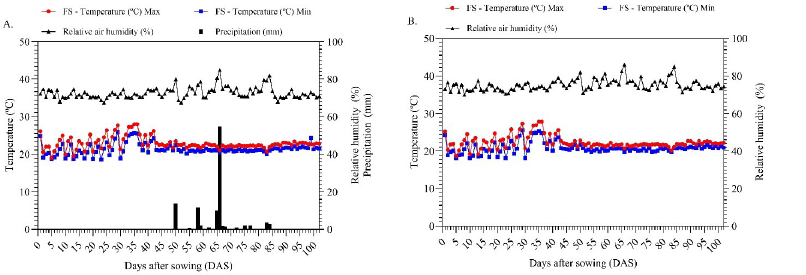
The study was carried out from August to December 2022, at Sítio Flexeiras, Aratuba (4º07'48.6"S; 38º49'30.6"W; 830 m), located in the region of the Baturité Massif, Ceará, Brazil. The climate of the region, according to Köppen's classification, is of the Aw type, classified as tropical with a dry season in winter (ALVARES et al., 2013), average temperatures of 24 ºC to 26 ºC and average relative humidity of approximately 75% (IPECE, 2017). Meteorological data were obtained with a thermo-hygrometer and are presented in Figure 1.

The experiment was conducted in a randomized block design, in split-split plots, with the plots formed by two environments (E1 = agricultural greenhouse and E2 = full sun), the subplots formed by five levels of electrical conductivity of the irrigation water (ECw) (1.0, 1.7, 2.4, 3.1 and 3.8 dS m-1), and the sub-plots formed by the two tomato hybrids (Itaipava and BS DI0014), with 5 replicates.
Sowing was carried out in a polypropylene tray with 200 cells with volume of 40 cm3, by planting one seed at 2 cm depth in each cell. Transplanting was carried out at 25 days after sowing (DAS) to pots with a capacity of 49 L for the chapel-type agricultural greenhouse, with dimensions of 12x6 meters in length and width, respectively, covered by a 150-µm-thick transparent low-density polyethylene (LDPE) plastic film with anti-UV protection and 85% transmissivity, sides closed with 50-mesh anti-aphid screens and advective window, and for the environment in full sun.
The substrate was obtained from the mixture of soil + goat manure + washed sand in the proportion of 3:1:1, respectively, whose physical and chemical analysis was carried out in the Soil, Water and Plant Laboratory, belonging to the Federal University of Ceará (UFC), according to the methodology of Teixeira et al. (2017), and the results are presented in Table 1.
Tomato fertilization was carried out according to the recommendation of Trani et al. (2015), which corresponds to 40 kg ha-1 of N, 200 kg ha-1 of P2O5 and 60 kg ha-1 of K2O, following the chemical analysis of the substrate (Table 1). For the pot conditions, the spacing used was 1 m x 0.5 m between rows and plants, respectively, corresponding to a population of 20,000 plants ha-1. The maximum dose per plant in the cycle was 2.0 g N, 10 g P2O5 and 3.0 g K2O, using urea (45% N), single superphosphate (18% P2O5) and potassium chloride (60% K2O) as sources of N, P and K, respectively, with N applied entirely in basal fertilization, and P and K applied 50% in basal fertilization and 50% in top-dressing (20 and 40 DAT).
The water with the lowest electrical conductivity applied came from a well used in the experimental area, whereas the others were obtained through preparation using the salts NaCl, CaCl2.2H2O, MgCl2.6H2O in order to obtain the desired ECw in the proportion of 7:2:1, according to the ratio between ECw and their respective concentration (mmolc L-1 = EC x 10) (RHOADES; KANDIAH; MASHALI, 2000). The chemical characteristics of the water from the artisanal well are described in Table 2.
Irrigation was carried out at a daily frequency calculated according to the drainage lysimeter principle (BERNARDO et al., 2019), applying a leaching fraction of 15%. Irrigation was performed using drippers with a flow rate of 8 L h-1, and the irrigation time was quantified according to the volume to be applied in each irrigation event, determined using Equation 1:
Where: VI - Volume of water to be applied in irrigation (mL); Vp - Volume of water applied in the previous irrigation (mL); Vd - Volume of water drained (mL); and LF - Leaching fraction of 0.15.
Irrigation with brackish water started at 15 days after transplanting (DAT). The fruits of each treatment were harvested according to full maturation - characterized by totally red and firm fruits, starting at 85 DAT and ending at 100 DAT. At the end of this period, the following variables were evaluated: total number of fruits (TNF), obtained by directly counting the fruits harvested per plant; average total fruit mass (ATFM, in grams); marketable fruit yield (MFY, g pot-1), non-marketable fruit yield (NMFY, g pot-1) and total fruit yield (TFY, g pot-1), with all masses measured on a semi-analytical precision scale.
For the post-harvest analyses, only fruits that showed commercial standard were considered. The variables evaluated were: soluble solids content (SS, in ºBrix), analyzed in the pulp after processing, using an analog refractometer; hydrogen potential (pH), measured with a benchtop pH meter; fruit length (FL, in millimeters); fruit diameter (FD, in millimeters); and pulp thickness (PT, in millimeters), determined with a digital caliper.
The variables were analyzed using the Kolmogorov- Smirnov test with a 0.05 probability level, to check for data normality. Subsequently, analyses of variance were applied using the F test (p < 0.05). In cases of statistical significance, the mean values of the quantitative data were compared by Tukey test (p < 0.05), while the quantitative data were subjected to regression analysis using the Assistat 7.7 Beta program.
RESULTS AND DISCUSSION
According to the summary of the analysis of variance (Table 3), only the variables total number of fruits (TNF) and average total fruit mass (ATFM) were significantly affected by the interaction between the factors cultivation environment (E), salinity (S) and tomato hybrids (H) (p < 0.05 and p < 0.01). In turn, the variables marketable fruit yield (MFY) and total fruit yield (TFY) were significantly influenced by the interaction between the factors salinity (S) and tomato hybrids (H) (p < 0.05). Effect of the interaction between salinity (S) and cultivation environment (E) (p < 0.05) was also observed for total fruit yield (TFY).
Summary of the analysis of variance for total number of fruits (TNF), average total fruit mass (ATFM, g), marketable fruit yield (MFY), non-marketable fruit yield (NMFY) and total fruit yield (TFY) in tomato hybrids under different growing environments and levels of electrical conductivity of irrigation water.
The total number of fruits was negatively influenced by the increase in the concentration of salts in irrigation water, both under greenhouse conditions (Figure 2A) and in full sun (Figure 2B). In the agricultural greenhouse, the reductions between the highest and lowest salinity levels were 35.48 and 26.9%, respectively, for the hybrids Itaipava and BS DI0014. For full sun, these reductions were 25 and 26.08%, respectively, and in this environment the hybrid Itaipava performed better than in the greenhouse. Such behavior may be related to an adaptation to salt stress under pot conditions and to the local climatic conditions. When evaluating the effects of irrigation water salinity on tomato, Li et al. (2022a) found a reduction in the number of fruits when associated with the treatment of highest electrical conductivity (4.8 dS m-1), while the water with the lowest salinity (1.6 dS m-1) led to a higher number of fruits, corroborating the present study.
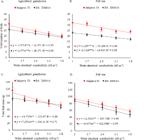
Total number of fruits (A and B) and average total fruit mass (C and D) of tomato hybrids, (

 Itaipava) and (♦ BS DI0014), irrigated with brackish water in an agricultural greenhouse and in full sun.
Fruit mass was reduced with the increase in the electrical conductivity of irrigation water in the greenhouse (Figure 2C) and in full sun (Figure 2D), with total reductions of 26.33% and 21.33% for the hybrids Itaipava and BS DI0014, respectively. This effect indicates that salinity causes a decrease in soil water absorption by the roots, which is inhibited due to osmotic effects, forcing stomatal closure, compromising transpiration and consequently the process of solute translocation, hindering the gain of mass by the fruit. Results similar to those observed in the present study were obtained by Li et al. (2022b) when irrigating the tomato crop with brackish water (6.2 dS m-1). These authors recorded a reduction in tomato fruit mass under salt stress.
The increase in the electrical conductivity of water caused deleterious effects on marketable fruit yield, which was reduced by 35.14% from the lowest to the highest salinity level (Figure 3A), regardless of the type of environment and the hybrids tested. Possibly, the salt stress caused by high concentrations of Na+ and Cl- ions in the soil solution triggered a toxic effect on plants, reducing the uptake of nitrogen, phosphorus and potassium, thus affecting yield.

Marketable fruit yield (A) of tomato as a function of the electrical conductivity of water, non-marketable fruit yield (B) and total fruit yield (C) of tomato irrigated with brackish water in an agricultural greenhouse (■) and in full sun (

 ).
).
The negative effect of salt stress on marketable fruit yield observed in this study was also found by Wu et al. (2022) when investigating the use of brackish water (6.2 dS m-1) in the irrigation of tomato crop under greenhouse conditions. Similarly, Li et al. (2022a) also observed a decrease in the marketable fruit yield of tomato plants grown under field conditions and irrigated with increasingly saline water.
The non-marketable fruit yield obtained under greenhouse conditions (Figure 3B) showed an increasing response to the different electrical conductivities of the water in the full-sun environment, increasing by 41.36% from the lowest to the highest salinity. In the agricultural greenhouse, the maximum non-marketable fruit yield was 4.569 kg per plant for an ECw of 2.28 dS m-1.
The superiority of non-marketable fruit yield in the full-sun environment may be related to greater transpiration and consequently greater absorption of toxic ions such as Na+, that is, increasing their translocation to the phloem, causing an antagonistic effect with potassium and calcium and, consequently, fruits that are smaller and more susceptible to pest and disease attacks. A similar trend was also observed by Li et al. (2022b) in tomato crop grown in full sun and under salt stress.
For total fruit yield (Figure 3C), plants grown in the full-sun environment showed a decrease with increasing salinity. This reduction was 35.14% from the lowest to the highest salinity level. For plants cultivated in the agricultural greenhouse, a maximum yield of 2.30 kg per plant was obtained under irrigation using water with electrical conductivity of 1.86 dS m-1.
The better yield in the agricultural greenhouse may be associated with a reduction in energy expenditure by plants, providing less variation in evapotranspiration, promoting greater maintenance of photosynthetic mechanisms, CO2 assimilation and transpiration, mitigating the harmful effects caused by salts on plants (CEDEÑO et al. 2023) and consequently higher production performance (WU et al., 2022). Similarly, El-Mogy, Garchery and Stevens (2018) evaluated the effect of salt stress on tomato crop grown under greenhouse conditions and also found a reduction in marketable fruit yield with an increase in the concentration of salts in irrigation water.
The Itaipava hybrid outperformed the BS DI0014 hybrid by 20.88% in terms of total fruit yield (Table 3). This result may be associated with the adaptation of this hybrid to high temperatures that are common in tropical regions, being factors that compromise the yield of crops such as tomato (LI et al., 2018). The same performance among tomato hybrids was reported by Trento et al. (2021), who found that the cultivar 'Fascínio' had higher total yield compared to the hybrids 'Santa Adélia' and 'Hy Color'.
According to the analysis of variance (Table 4), there was an effect of the interaction between the factors studied, cultivation environment (E), salinity (S) and tomato hybrids (H), on hydrogen potential (p < 0.01). There were also effects of the interactions between salinity (S) and cultivation environment (E) on the soluble solids content (SS) (p < 0.01), between cultivation environment (E) and tomato hybrids (H) on fruit diameter (FD) and SS (p < 0.05), and between salinity (S) and tomato hybrids (H) on pulp thickness (p < 0.01). Single effects were observed on fruit length, caused by tomato hybrids (H), and on pulp thickness, caused by the cultivation environment (p < 0.01).
Summary of the analysis of variance for the post-harvest quality variables of tomato crop irrigated with brackish water in different growing environments.
The mean values of fruit length as a function of the studied environments are presented in Table 4, and the highest fruit length was obtained in the agricultural greenhouse, with an increase of 4.6%. This effect may be linked to less variation in solar radiation, wind speed and nutrient losses, thus favoring greater performance in fruit length. This result is similar to those described by Seabra Junior et al. (2022). These same authors, when evaluating the tomato cultivar 'Fascínio' under protected cultivation conditions similar to those of the present study, also found greater fruit length.
According to the data presented in Table 4, the hybrid Itaipava obtained a larger fruit diameter when grown in the agricultural greenhouse, being statistically higher than those obtained under full sun, with a gain of 5.47%. This effect may be associated with genetic factors that directly influence sensory properties, physical characteristics, as well as the susceptibility of crops to the environmental conditions to which they are exposed, resulting in more adapted varieties of the same species (HOPPU et al., 2020). Similar to the present study, Alenazi and Khandaker (2024) evaluated the tomato hybrids 'Luanova' 'Savarona' and 'Tessera' under protected cultivation and also found stem diameters ranging from 60 to 65 mm.
The increase in the electrical conductivity of irrigation water increased the soluble solids content, but with higher mean values in the agricultural greenhouse, with increments of 13.04% and 23.33% at the lowest and highest salinity levels, respectively, compared to full sun (Figure 4). This superior effect in the agricultural greenhouse may be related to greater accumulation of carbohydrates in plant tissues to adjust the osmotic potential and ensure water absorption and consequently greater concentration of sugar (RIBEIRO et al., 2024).

Soluble solids content of fruits of tomato hybrids irrigated with brackish water in an agricultural greenhouse (■) and in full sun (
).
Similarly, Wu et al. (2022) also found that salt stress with 2.0 dS m-1 increased the soluble solids content in tomato crop grown in an agricultural greenhouse. These same authors emphasize that this effect can be attributed to the fact that salt stress could increase metabolites that are osmotically effective to decrease water potential, facilitating water absorption. Studies describing the positive effect of salt stress on soluble solids in tomato crop grown in a protected environment were reported by Lu et al. (2024).
Tomato fruit pulp thickness also varied as a function of the cultivation environment (Table 4), and in the agricultural greenhouse, the mean values were statistically higher than those obtained in the full-sun cultivation, with an increase of 9.25%. The superiority for the agricultural greenhouse may be associated with lower luminosity, highlighting greater thermal amplitude; consequently, plants tend to have a better development of their fruits, that is, greater allocation of photoassimilates and pulp thickness (WU et al., 2022). A trend similar to the data presented here was reported by Vendruscolo et al. (2018). These authors found that melon plants grown in a protected environment have greater fruit pulp thickness compared to those grown in full sun.
Salt stress negatively affected pulp thickness for the two tomato hybrids, but with greater intensity for BS DI0014 (Figure 5). For Itaipava, the maximum pulp thickness (7.49 mm) was obtained at ECw of 2.02 dS m-1. For BS DI0014, the maximum pulp thickness obtained was 5.84 mm, at ECw of 1.42 dS m-1, revealing a superiority of Itaipava over BS DI0014.

Pulp thickness in fruits of tomato hybrids Itaipava (
) and BS DI0014 (♦), irrigated with brackish water.
The result presented in this study describes the negative effect of salts, especially sodium, which can cause reduction and/or inhibition in the absorption of water and nutrients important for adequate formation and translocation of photoassimilates, such as potassium and calcium for strengthening fruit thickness (SILVA JUNIOR et al., 2020). Wu et al. (2022) described reduction of peel thickness in tomato under salt stress in a study carried out in a protected environment.
According to the data presented in Figure 6, it is possible to observe the effects of cultivation environments and electrical conductivities of irrigation water on the pH of the hybrids used. In the agricultural greenhouse (Figure 6A), the hybrid Itaipava showed an increase of 9.09% and a reduction of 5.12% in fruit pH at the lowest and highest salinity levels compared to the hybrid BS DI0014, respectively. In the full- sun environment (Figure 6B), the hybrid BS DI0014 obtained higher pH at all salinity levels, with increments of 6.97% at the lowest and 2.5% at the highest salinity level, respectively.

Hydrogen potential in fruits of tomato hybrids (Itaipava
) and (BS DI0014 ♦), irrigated with brackish water in an agricultural greenhouse (A) and in full sun (B).
This result indicates that salt stress may have accelerated the maturation process, inhibiting the use of organic acids in the Krebs cycle (TAIZ et al., 2017), causing the pH to remain acidic with increasing electrical conductivity of irrigation water and in the full-sun environment. The present result contrasts with those reported by Paiva et al. (2018), who found no changes in the pH of tomato fruits grown in a protected environment under salt stress.
CONCLUSIONS
The hybrid Itaipava cultivated in agricultural greenhouse was superior to BS DI0014 in terms of production and post-harvest aspects.
Salinity favors the increase in soluble solids content, but with greater intensity in agricultural greenhouse.
The agricultural greenhouse environment mitigated the effects of salinity up to 1.86 dS m-1 on the production variables, resulting in a lower percentage of non-marketable fruits and higher total fruit yield compared to the cultivation in full sun.
The agricultural greenhouse promotes greater production performance and quality of tomato fruits under irrigation with water of lower and higher salinity compared to the full-sun environment.
Data Availability:
The data that support the findings of this study can be made available, upon reasonable request, from the corresponding author.
ACKNOWLEDGMENTS
To the ‘Cientista-Chefe em Agricultura’ program of the Government of the Ceará State (agreement 14/2022 SDE/ ADECE/FUNCAP and FUNCAP process 08126425/2020) and to the National Council for Scientific and Technological Development - CNPq for the financial support granted for this study and the scholarships. The authors also thank the owner of Sítio Flexeiras, agronomist Ricardo José da Costa Silva, for the infrastructure support to carry out the study
REFERENCES
- AGIUS, C.; TUCHER, S. V.; ROZHON, W. The effect of salinity on fruit quality and yield of cherry tomatoes. Horticulturae, 8: 1-18, 2022.
- ALENAZI, M. M.; KHANDAKER, M. M. Responses of tomato hybrid cultivars to soil application of humic acid under greenhouse conditions. Brazilian Journal of Biology, 84: e252573, 2024.
- ALVARES, C. A. et al. Köppen's climate classification map for Brazil. Meteorologische Zeitschrift, 22: 711-728, 2013.
- BERNARDO, S. et al. Manual de irrigação 9. ed. Viçosa, MG: Ed. UFV, 2019. 625 p.
- CEDEÑO, J. et al. Reducing nutrient loss in drainage from tomato grown in free-draining substrate in greenhouses using dynamic nutrient management. Agricultural Water Management, 287: 108418, 2023.
- EL-MOGY, M. M.; GARCHERY, C.; STEVENS, R. Irrigation with salt water affects growth, yield, fruit quality, storability and marker-gene expression in cherry tomato. Acta Agriculturae Scandinavica, 68: 727-737, 2018.
- FERNANDES, P. D. et al. Halofitismo e agricultura biossalina. In: GHEYI, H. R. et al. (Eds.). Manejo da salinidade na agricultura: Estudos básicos e aplicados Fortaleza, CE: Instituto Nacional de Ciência e Tecnologia em Salinidade, cap.15, 35-50, 2016.
- HOPPU, U. et al. Factors related to sensory properties and consumer acceptance of vegetables. Critical Reviews in Food Science and Nutrition, 61: 8398, 2020.
-
IBGE - Instituto Brasileiro de Geografia e Estatística. Produção Agropécuaria - Tomate Rio de Janeiro: IBGE, 2023. Available at: <https://www.ibge.gov.br/explica/producao-agropecuaria/tomate/br>. Access on: Jan. 13, 2023.
» https://www.ibge.gov.br/explica/producao-agropecuaria/tomate/br -
IPECE - Instituto de Pesquisa e Estratégia Econômica do Ceará. Perfil Básico Municipal de Aratuba, 2017 Available at: <https://acervo.fortaleza.ce.gov.br/download-file/documentById?id=14202a1f-9b73-444c-940e-68ec2148202c>. Access on: Jul. 15, 2025.
» https://acervo.fortaleza.ce.gov.br/download-file/documentById?id=14202a1f-9b73-444c-940e-68ec2148202c - LESSA, C. I. N. et al. Potential of Brackish Groundwater for Different Biosaline Agriculture Systems in the Brazilian Semi-Arid Region. Agriculture, 13: e550, 2023.
- LI, D. et al. Effect of water-salt regulation drip irrigation with saline water on tomato quality in an arid region. Agricultural Water Management, 261: e107347, 2022b.
- LI, J. et al. The optimal irrigation water salinity and salt component for high-yield and good-quality of tomato in Ningxia. Agricultural Water Management, 274: 1-42, 2022a.
- LI, X. et al. Exploring stress tolerance mechanism of evolved freshwater strain Chlorella sp. S30 under 30 g/L salt. Bioresource Technology, 250: 495-504, 2018.
- LU, J. et al. The role of hydraulic lift in tomato yield and fruit quality under diferente water and salt stresses. Agricultural Water Management, 299: 108899, 2024.
- PAIVA, F. I. G. et al. Qualidade de tomate em função da salinidade da água de irrigação e relações k/ca via fertirrigação. Irriga, 23: 168-193, 2018.
- RHOADES, J. P.; KANDIAH, A.; MASHALI, A. M. The use saline waters for crop production Campina Grande, PB: UFPB. Tradução de Gheyi, H. R.; Sousa, J. R.; Queiroz, J. E., 2000. 117 p.
- RIBEIRO, R. M. B. et al. The impact of saline and water stress on the agronomic performance of beet crops. Brazilian Journal of Biology, 84: 276278, 2024.
- ROQUE, I. A. et al. Biomass, gas exchange and production of cherry tomato cultivated under saline water and nitrogen fertilization. Revista Caatinga, 35: 686-696, 2022.
- SEABRA JUNIOR, S. et al. Selection of thermotolerant Italian tomato cultivars with high fruit yield and nutritional quality for the consumer taste grown under protected cultivation. Scientia Horticulturae, 291: 110559, 2022.
- SILVA JUNIOR, F. B. et al. Salt stress and ambience on the production of watermelon seedlings. Revista Caatinga, 33: 518-528, 2020.
- SILVA, C. J. et al. Gas exchange and yield of industrial tomato under different types of irrigation and non-woven fabric plant cover. Revista Brasileira de Engenharia Agrícola e Ambiental, 28: e271470, 2024.
- SOUZA, M. V. P. et al. Estresse salino e uso de biofertilizante bovino na cultura do tomate. Revista Brasileira de Agricultura Irrigada, 13: 3524-3532, 2019.
- TAIZ, L. et al. Fisiologia e desenvolvimento vegetal 6. ed. Porto alegre, RS: Artmed, 2017. 888 p.
- TEIXEIRA, P. C. et al. Manual de métodos de análise de solo 3.ed. Brasília, DF: Embrapa, 2017. 573 p.
- TRANI. P. E. et al. Calagem e adubação do tomate de mesa Campinas, SP: IAC, 2015. 35 p. (Boletim Técnico IAC, 215).
- TRENTO, D. A. et al. Desempenho de cultivares de tomate italiano de crescimento determinado em cultivo protegido sob altas temperaturas. Nativa, 9: 359-366, 2021.
- VENDRUSCOLO, E. P. et al. Desenvolvimento e produção de melão Cantaloupe em função do espaçamento e ambientes de cultivo no Cerrado brasileiro. Revista Colombiana de Ciencias Hortícolas, 12: 397-404, 2018.
- WU, Z. et al. Response of yield and quality of greenhouse tomatoes to water and salt stresses and biochar addition in Northwest China. Agricultural Water Management, 270: 107736, 2022.
- ZHANG, R. et al. Dynamics of shaded areas in a typical-shaped solar greenhouse and their effects on tomato growth- A case study in winter. Scientia Horticulturae, 312: 111882, 2023.
Edited by
-
Editor in Chief:
Aurélio Paes Barros Júnior
-
Section Editor:
João Everthon da Silva Ribeiro