 Residual phosphate fertiliser and Azospirillum brasilense inoculation on soil quality and soybean productivity
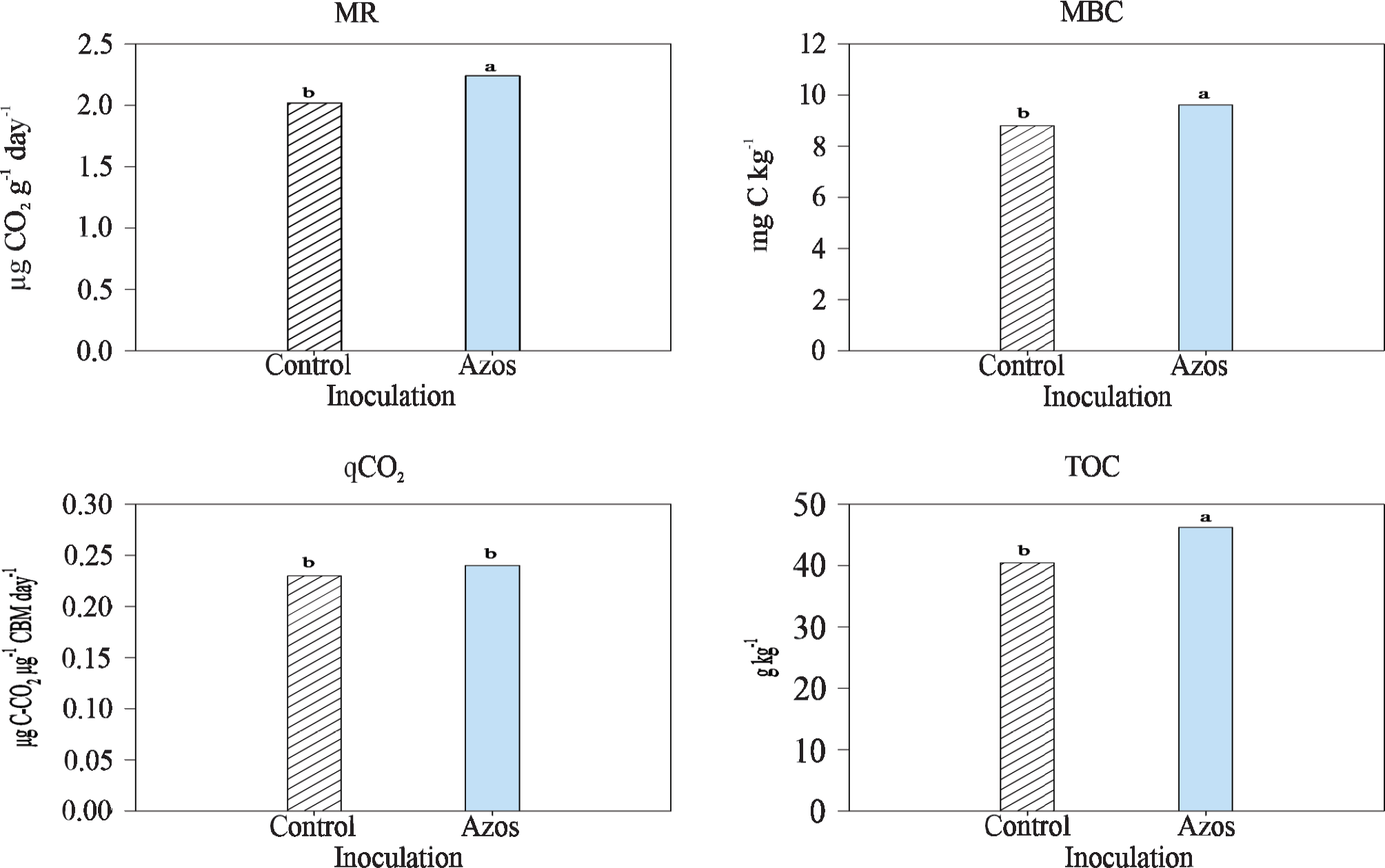
Maintaining adequate levels of labile phosphorus (P) in weathered soils is challenging due to its constant fixation. Mineral fertilisation is therefore often employed to ensure adequate nutrient levels in the soil. Such techniques as the use of phosphate-solubilising bacteria, are gaining recognition for minimising production costs. Genus Azospirillum brasilense demonstrates this ability, increasing nutrient availability and reducing the amount of P applied through mineral fertilisation. The aim of this study was to evaluate the residual effect of phosphate fertiliser in soil under a no-till system, verifying whether inoculating the preceding crop with A. brasilense increased soybean production and productivity, and the bioindicators of soil quality. The experiment was conducted in a typical clayey dystrophic Red Latosol, employing a randomised block design with four replications, in a 5 x 2 factorial scheme, comprising five doses of P₂O₅ in the form of MAP applied during 2013 and 2020, with and without inoculating the grasses preceding the soybean with A. brasilense. There was a positive effect on the soybean population during the 2019/20 crop season due to the inoculation of the preceding crop, as well as responses in microbiological activity, such as total carbon, microbial respiration, biomass carbon, total organic carbon, acid phosphatase, arylsulfatase and β-glucosidase. The results show that cropping systems which maintain adequate soil health, together with the inoculation of grasses with A. brasilense, can be a low-cost management option for sustaining crops and contributing to system maintenance.
Keywords:
System fertilisation; Enzyme activity; Diazotrophic bacteria; Residual effect; Soil health.
 Thumbnail
 Thumbnail
 Thumbnail
 Thumbnail
 Note: Data collected at the weather station of the Irrigation and Drainage Laboratory of the Faculty of Engineering at Ilha Solteira, São Paulo, Brazil