 Residual phosphate fertiliser and Azospirillum brasilense inoculation on soil quality and soybean productivity
ABSTRACT
Maintaining adequate levels of labile phosphorus (P) in weathered soils is challenging due to its constant fixation. Mineral fertilisation is therefore often employed to ensure adequate nutrient levels in the soil. Such techniques as the use of phosphate-solubilising bacteria, are gaining recognition for minimising production costs. Genus Azospirillum brasilense demonstrates this ability, increasing nutrient availability and reducing the amount of P applied through mineral fertilisation. The aim of this study was to evaluate the residual effect of phosphate fertiliser in soil under a no-till system, verifying whether inoculating the preceding crop with A. brasilense increased soybean production and productivity, and the bioindicators of soil quality. The experiment was conducted in a typical clayey dystrophic Red Latosol, employing a randomised block design with four replications, in a 5 x 2 factorial scheme, comprising five doses of P₂O₅ in the form of MAP applied during 2013 and 2020, with and without inoculating the grasses preceding the soybean with A. brasilense. There was a positive effect on the soybean population during the 2019/20 crop season due to the inoculation of the preceding crop, as well as responses in microbiological activity, such as total carbon, microbial respiration, biomass carbon, total organic carbon, acid phosphatase, arylsulfatase and β-glucosidase. The results show that cropping systems which maintain adequate soil health, together with the inoculation of grasses with A. brasilense, can be a low-cost management option for sustaining crops and contributing to system maintenance.
Keywords:
System fertilisation; Enzyme activity; Diazotrophic bacteria; Residual effect; Soil health.
INTRODUCTION
The world population has now surpassed 8.2 billion inhabitants (United Nations, 2024), requiring greater agricultural food production. However, soils of low fertility and with advanced levels of erosion lead to losses in crop productivity and increased soil acidity, with a consequent reduction in nutrient levels and restrictions on total food production (Legaz et al., 2017). The adoption of no-till systems in tropical countries is an indispensable technique for improving soil conditions and maintaining soil health, benefiting microbiological activity, minimising erosion, supplying nutrients through the decomposition of crop residue, favouring the equilibrium and self-regulation of the environment, and promoting improvements in the genetic performance of crops, which reflects in greater productivity (Hernani, 2021; Ribeiro et al., 2025).
Soils in areas of tropical climate exhibit a high degree of weathering, with a predominantly acidic pH, aluminium (Al) and manganese (Mn) toxicity, low cation exchange capacity (CEC), low base saturation (V%), nutrient deficiency-especially phosphorus (P), and aerobic bacteria that are highly active in terms of humus degradation. No-till systems are therefore essential, as the increase in organic matter (OM) content can benefit the thermal regulation of the environment and aid in soil production and conservation (Martins et al. 2023; Ren et al., 2023). At the same time, monitoring soil fertility, together with an understanding and knowledge of the microbiological factors, is essential to assess the health and quality of the soil (Ribeiro et al., 2025).
Phosphorus (P) is an essential nutrient for plant dynamics and metabolism (Taiz et al., 2017); however, in tropical soils, P may become unavailable to plants due to reacting with the Fe and Al ions that are present in high concentrations (Braos et al., 2020). One option for improving the management of phosphate fertilisation is the use of phosphate-solubilising bacteria that are able to convert the insoluble P adsorbed to Fe and Al oxyhydroxides, thereby breaking the strong bond and making the P available to plants (Kour et al., 2021).
The bacterium, Azospirillum brasilense, acts to solubilise soil phosphorus (Pereira et al., 2020; Sun et al., 2022). Furthermore, it promotes greater root development, improving exploitation of the soil profile, which can increase phosphorus absorption and enzyme activity due to the increase in the microbial community stimulated by the long-term no-till system (Cassán; Vanderleyden; Spaepen, 2014; Spaepen et al., 2014). Another benefit attributed to the use of A. brasilense is the production of phytohormones, such as indole-3-acetic acid (IAA), that aid in the development of lateral roots, bud production and increased root hairs (Cohen et al., 2014; Ucea-Herrera; Quiroz-Velasquez; Hernandez-Mendoza, 2020). A. brasilense demonstrates this ability, increasing phosphorus availability, which can considerably reduce the amount required through mineral fertilisation in long-term no-till systems and promote improvements in the microbiology of the soil. This effect can be prolonged in grasses that precede the soybean crop, affording increased grain yield.
The aim of this study was to evaluate the residual effect of phosphate fertilisation in soil under long-term no-till management, verifying any interaction between productivity and the inoculation of crops preceding the soybean with the bacterium A. brasilense to increase production, and its effect on the bioindicators of soil quality.
MATERIALS AND METHODS
Location, Characterisation and Installation of the Experiment
The research was conducted under field conditions in the district of Selvíria, Mato Grosso do Sul (20°20’ S and 51°24’ W, altitude 335 m). The relief in the area is characterised as moderately flat. According to the Köppen classification (1928), the climate is described as Aw, humid tropical with a rainy season during the summer and dry season during the winter. Monthly data on the average, maximum and minimum air temperature and rainfall were collected throughout the experiment (Figure 1).

Climate data on average, maximum, and minimum temperature and rainfall, in the district of Selvíria, Mato Grosso do Sul, during the experimental period
The soil in the experimental area was classified as a typical clayey dystrophic Red Latosol (52% clay) (Santos et al., 2018). The experimental area had a history of cultivation with annual crops under a no-till system for 18 years up to the time of the study. Prior to the experiment, there had been a succession of crops in the area to provide mulch for the system and improve the physical, chemical and biological aspects of the soil (Figure 2).

History of the experimental area under long-term no-till management in the district of Selvíria, Mato Grosso do Sul, crop seasons 2013/14 to 2020/21
When setting up the experiment (14 April 2013), an initial chemical characterisation of the soil was carried out (Raij et al., 2001) for the 0.00 - 0.20 m layer (Table 1), with a further chemical characterisation during the 2019/20 season. Based on the results of the chemical analysis, and in order to raise the base saturation to 70%, surface liming with dolomitic limestone (PRNT of 87%) was carried out at a dose of 1.7 t ha-1 with no incorporation.
Chemical characterisation of the soil in the 0.00 - 0.20 m layer for the long-term no-till experiment, for the 2013/14 and 2019/20 crop seasons, respectively. Selvíria, Mato Grosso do Sul, Brazil
The experimental design was of randomised blocks with four replications in a 5 x 2 factorial scheme (five doses of P2O5 and two treatments, with and without inoculation), giving a total of 40 experimental units. Each experimental unit (plot) was 4.4 m in width and 10 m in length, for a total area of 44 m2. All the crops were grown in the same area, which including a working border with a length and width of 1 m, totalling 1 m2.
The doses of P₂O₅ were based on Mascarenhas and Tanaka (1997) and applied as monoammonium phosphate - MAP (0, 30, 60, 120 and 240 kg ha-1 P₂O₅), broadcast at the time of sowing the black oats (cv. IAPAR 61) in 2013. For the second treatment factor (with or without seed inoculation with Azospirillum brasilense), the Ab-V5 and Ab-V6 strains (guaranteed 2x10⁸ CFU/mL) were inoculated into the rotated grasses from 2013-2020. A liquid inoculant was used at a dose of 100 mL per 25 kg of seeds. Inoculation was carried out in the shade immediately before sowing.
In 2013, the initial levels of P in the soil were average (Raij et al., 1996). It was therefore decided to broadcast the phosphate fertiliser with no incorporation. One day before sowing the black oats, the doses of P₂O₅ were applied in each experimental plot using monoammonium phosphate (MAP) as the source (52% P₂O₅ and 12% N). At the time of sowing, the nitrogen (N) equivalent was also applied based on the doses studied in the research; this was supplied by the MAP containing 12% N and complemented by the application of 115 kg ha-1 urea for the 30 kg ha-1 dose of P₂O₅, 100 kg ha-1 urea for the 60 kg ha-1 dose, 60 kg ha-1 urea for the 120 kg ha-1 dose and 10 kg ha-1 urea for the 240 kg ha-1 dose. Topdressing was applied at the start of grass tillering, on 7 March 2013, with the application of 60 kg ha-1 K2O using potassium chloride (KCl) as the source, and 60 kg ha-1 N (urea), as per the recommendations for black oats (Cantarella; Raij; Camargo, 1997).
From the soil analysis carried out each cycle (first and second crops), phosphate fertiliser was not necessary until 2019. From 2013 to 2019, only the residual effect of the P applied in 2013 was evaluated, applying only N and/or KCl as topdressing, according to each rotated crop. After the soybean harvest in the 2019/20 season, a chemical soil analysis was carried out (Table 1) at 20 different points within each plot at depths of 0.00 - 0.20 m. After air-drying, the samples were homogenised, ground, passed through a 100-mesh sieve and analysed as per the methodology proposed by Raij. et al. (2001).
Soil microbial respiration (MR), microbial biomass carbon (MBC), metabolic quotient (qCO2) and total organic carbon (TOC) in the 0.00-0.10 m layer following soybean cultivation, as a function of the residual effect of P2O5 doses (2020/21). Selvíria, Mato Grosso do Sul, Brazil
After the 2020 analysis, P levels were found to be low (Table 1), so it was decided to reapply the P. MAP was used to apply the doses (0, 30, 60, 120 and 240 kg ha-1 P2O5) which were broadcast when sowing the black oats (cv. EMBRAPA 29). Nitrogen fertilisation was carried out using 115 kg ha-1 urea for the 30 kg ha-1 dose of P2O5, 100 kg ha-1 urea for the 60 kg ha-1 dose, 60 kg ha-1 urea for the 120 kg ha-1 dose and 10 kg ha-1 urea for the 240 kg ha-1 dose, in addition to the MAP.
To form the mulch for the no-till system, the plants in the area were desiccated with 4 L ha-1 Glyphosate. Three experiments (crops) were carried out: soybean (November/2019), black oats (May/2020) and soybean (November/2020), when the production components and productivity of the soybean crop were evaluated.
The soybean (cv. TMG 7063 IPRO) were sown on 5 November 2019 and 5 November 2020 using a seed and fertiliser drill with a shank type (knife) furrow opener for no-till farming, at a spacing of 0.45 metres between rows and approximately 14.9 seeds per metre of furrow. The seeds were treated with a product based on strobilurin, benzimidazole and pyrazole (2 mL kg-1 seeds) and inoculated with Bradyrhizobium. japonicum (100 g of commercial product per 40 kg of seeds) in a peat-based solid formulation. Inoculation was carried out using a concrete mixer shortly before sowing. For both years, the base fertiliser used for the soybean was 136 kg ha-1 KCl, with no additional fertilisation. Cropping practices were carried out for the preventative control of pests and diseases, including the application of herbicide for weeds in the early stages, until the spaces between the rows had completely closed.
Microbiological and enzymatic evaluations of the soil
For the microbial biomass and enzyme analyses, soil samples were collected from the 0.00 - 0.10 m layer of each plot at the end of both soybean crop cycles (2020/21), with an average of 15 subsamples per plot. The samples were passed through a 2-mm mesh sieve and stored in a refrigerator for later microbial analysis. Microbial respiration (MR) was measured as per Rezende, Assis and Nahas (2004), using two controls with no soil for better standardisation. Microbial biomass carbon (MBC) was determined based on the methodology of Jenkinson and Ladd (1976), modified by Oliveira, Mendes and Vivaldi (2001). Soil microbial biomass carbon (MBC) was determined as the difference between the CO2 released from the F (fumigated) and NF (non-fumigated) samples over a 10-day period following fumigation, using a correction factor (Kc) of 0.41 (Anderson; Domsch, 1978).
The metabolic quotient (qCO2) was estimated from the ratio between microbial respiration (MR) and the soil microbial biomass carbon. Total organic carbon (TOC) was determined following the methodology proposed by Walkley and Black (1934), with final titration of the excess dichromate using ferrous ammonium sulphate. A substrate of 0.05 M p-nitrophenyl-β-Dglucopyranoside (PNG 0.05 M) was used in the reaction to determine the activity of the enzymes β-glycosidase and acid phosphatase, while for arylsulfatase, the substrate was 0.05 M p-nitrophenyl (PN 0.05 M).
Evaluation of the production and productivity components of the soybean
Soybean production and productivity were evaluated one day before the harvest. The plant population (POP) was determined by counting the plants in 4 m of the four central rows of each plot, the final value was then extrapolated to the number of plants per hectare. Plant height (PH) was measured in the working area of each plot using ten consecutive plants per row, that were measured from the ground to the top of the plant, with the values expressed in metres (m). The height of the first pod insertion (PIH) was measured on the same plants used for measuring height, from the ground to the first pod. The number of pods per plant (NPP) was determined as the average of 10 plants. The number of grains per plant (NGP) was obtained from the average number of grains on 10 plants per plot. The 100-grain weight (W100) was determined by separating four grain samples, which were sent to the laboratory to be counted on an electronic counter, these were then weighed using a precision balance (0.01 g) with the grain moisture corrected to 13% (wet basis). Grain productivity (PROD) was measured in the central plants of each plot (4 m from 4 rows). Following manual collection, the material was threshed and the grains weighed to obtain the productivity per plot, with the moisture corrected to 13% and values expressed in kg ha-1.
Statistical analysis
The normality of the data was assessed using the Shapiro-Wilk test. The results underwent analysis of variance by F-test (P < 0.05). The mean values for the effect of inoculation or non-inoculation with A. brasilense were compared using Student’s t-test (P < 0.05). The residual effect of the phosphate fertiliser was evaluated by regression analysis, adopting the equation with the highest coefficient of determination (R2) whenever the models were significant (P < 0.05). All the statistical analyses were carried out using the SISVAR® software (Ferreira, 2011), while the SIGMAPLOT v15.0 software (Systat Software Inc., 2023) was used to produce the graphs.
RESULTS AND DISCUSSION
Microbiological and enzymatic evaluations of the soil
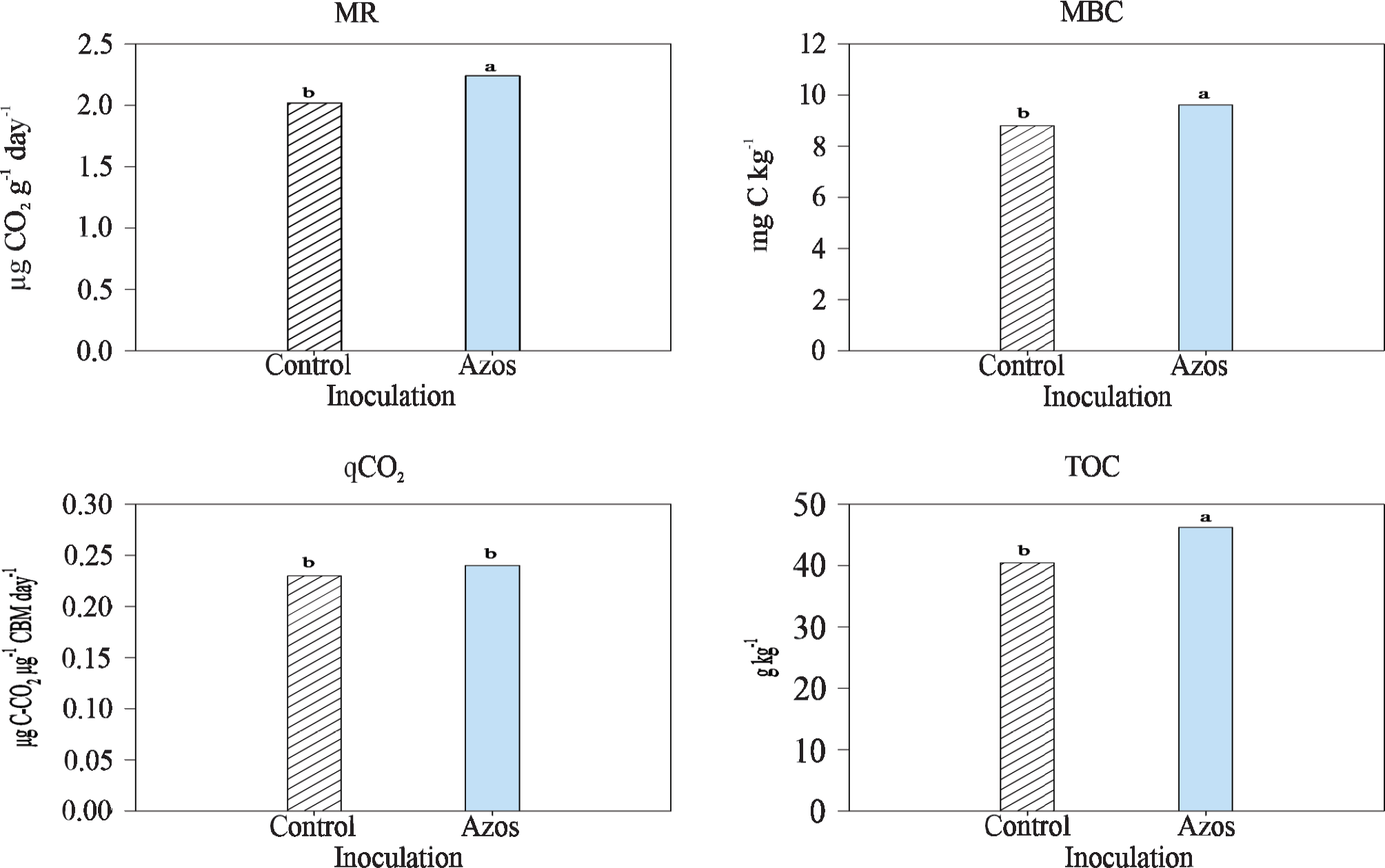
The results for MR, MBC, and TOC showed significant mean values for inoculation with A. brasilense (P ≤ 0.05) (Figure 3). The plant/microorganism interactions give rise to differing responses, and may contribute significantly to enzyme activity, improving the environmental conditions (Cassán; Díaz- Zorita, 2016; Di Salvo et al., 2018; Silva et al., 2024).

Soil microbial respiration (MR), microbial biomass carbon (MBC), metabolic quotient (qCO2) and total organic carbon (TOC) in the 0.00-0.10 m layer following soybean cultivation, as a function of inoculation with A. brasilense (2020/21). Selvíria, Mato Grosso do Sul, Brazil. Control: control treatment (with no inoculation); Azos: Azospirillum brasilense. Mean values followed by the same letter do not differ statistically by Student’s t-test (P ≤ 0.05)
The higher MR rate with inoculation shows that the metabolism of the microorganisms was accelerated, favouring residue degradation and nutrient cycling. Bacterial inoculation increased the microbiological activity indices of the colony, which, in turn, started to release higher rates of CO2. However, MBC and TOC also showed significant mean values (P ≤ 0.05), proving that even with the increase in microbial metabolism, inoculation aided the processes of CO2 fixation and nutrient cycling, given the greater incorporation of organic matter. The results indicate low values for the release of C-CO2 regardless of whether the area was inoculated with A. brasilense or not (Table 2). The greater MBC in the inoculated areas resulted in a higher TOC content, suggesting a reduction in emissions.
The area being under a no-till system for several years is also one of the important factors contributing to the results. No significant differences were seen for qCO2, which is a direct indicator of CO2 use efficiency in the soil, showing that the years under a no-till system have resulted in a balanced soil, since high qCO2 values typically represent areas that are more stressed (Santos et al., 2018).
A large amount of mulch, irrigation and crop rotation can favour microbial biomass and allow for greater equilibrium of the soil/microorganism system. Mulch acts as a barrier to high temperatures and favours the maintenance of soil moisture, crucial for the microbial colony in tropical soils (Li; Li; Pan, 2020; Salomão et al., 2020). The values in question (Figure 3) represent the historical data for the area where black oats, inoculated with Azospirillum, were grown during the 2019/20 winter crop season (Figure 2). Later, when the soybean were sown, they were inoculated with Bradyrhizobium and, since the area already had a history of inoculation and/or co-inoculation over the years, presented an increase in all the indices under study.
The residual effect of the P₂O₅ doses was significant for MR and qCO₂ (P ≤ 0.05) (Table 2). The microbial colony showed higher MR rates as the P dose increased, with an optimum value of 290 kg ha-1 P₂O₅. For qCO₂, the values decreased with the increasing P doses, reaching an optimum value at 94 kg ha-1 P₂O₅. The 94 kg ha-1 dose of P₂O₅ was able to nourish the microbiota, which depend on P to carry out their vital functions, resulting in lower qCO₂ values and helping to balance the soil system.
In terms of inoculating the rotated grasses with A. brasilense, there were significant differences between the enzymes β-glucosidase, acid phosphatase and arylsulfatase by t-test (P ≤ 0.05), with higher enzyme values following inoculation (Figure 4). In the case of β-glucosidase, which is a direct bioindicator of cellulose degradation, soil organic matter (SOM) formation and microorganism activity, inoculation was found to increase enzyme activity, showing that inoculation is effective and able to maintain efficiency during the first/second crop cycle. The bacteria of genus A. brasilense are described as capable of producing phytohormones, which can stimulate the development of plant roots (Cássan; Vanderleyden; Spaepen, 2014; Spaepen et al., 2014). Furthermore, the genus can act as a phosphate solubiliser, aiding P availability in tropical environments, as well as improving biological N fixation (Freitas et al., 2019; Pereira et al., 2020; Sun et al., 2022).

Soil enzyme activity in the 0.00-0.10 m layer following soybean cultivation, as a function of residual phosphate fertilisation and inoculation with A. brasilense (2020/21). Selvíria, Mato Grosso do Sul, Brazil. Control: control treatment (with no inoculation); Azos: Azospirillum brasilense. Mean values followed by the same letter do not differ statistically by Student’s t-test (P ≤ 0.05)
Inoculating these bacteria into rotated crops can significantly increase the levels of MR, MBC and TOC, showing that periodic inoculation is essential for increasing the availability/activity of the microorganisms in the soil, thereby favouring both their presence and multiplication, especially in soils under long-term no-till systems that include the accumulation of plant material that tends to maintain the equilibrium between fungal hyphae and bacterial colonies in the soil due to maintaining the temperature and humid environment (Bettiol et al., 2023; Köberl et al., 2020).
In tropical soils, thermal fluctuations, the occurrence of dry spells and highly weathered soils are factors that can have a negative effect on the presence and maintenance of organic matter and microorganisms in the soil. Such microorganisms are fundamental, and act as bioindicators of soil quality (Dubey et al., 2019; Jansson; Hofmockel, 2020).
Agricultural management is essential for maintaining and/or increasing soil health. In this study, several years under a no-till system led to good results for RM, MBC and TOC, even with no inoculation. This suggests that soils managed using the appropriate agricultural practices can help mitigate the effects of CO2 in the atmosphere. The low qCO2 values indicate good system management during this period, leaving a balanced system that acts as a mitigator of greenhouse gases and maintains the quality and fertility of the soil, and a suitable environment for the microbial colony to develop (Alves et al., 2011).
The mean levels observed for arylsulfatase and acid phosphatase can be explained by the intrinsic characteristics of the biology of the microorganisms, since A. brasilense is able to help solubilise non-labile P in addition to producing phytohormones, helping N fixation and improving the water balance and exploitation of the soil by the roots (Hungria; Rondina; Nunes, 2021). This helps to increase the activity of these enzymes, since under a no-till system and the inoculation of rotation crops, there is an increase in beneficial microorganisms, which allows for better biosynthesis (Prando et al., 2022).
In terms of the P₂O₅ doses, significant mean values (P ≤ 0.05) were seen for the enzymes arylsulfatase and β-glucosidase (Table 3). For arylsulfatase, the optimal dose was 190 kg P₂O₅ ha-1, affording better nutrition for the soil microbiota, which contributed to the increased enzyme activity. For β-glucosidase, the optimal dose was 125 kg ha-1, since with the supply of P, microorganisms can focus their metabolism on the quality of cellulose degradation. However, it is important to note the reduction in acid phosphatase, which was due to greater P availability in the environment from the use of fertilisers and the reduced need for the mulch to degrade for the microbiota to obtain phosphorus.
Soil enzyme activity in the 0.00-0.10 m layer following soybean cultivation, as a function of residual phosphate fertilisation and inoculation with A. brasilense (2020/21). Selvíria, Mato Grosso do Sul, Brazil
The zero-dose presented high levels of both enzymes, showing that soil managed under a no-till system is healthy and metabolically balanced (Table 3). Acid phosphatase activity decreased with the increasing P doses, with the zero-dose showing the highest average. With the lower P availability, the microbiota work harder for their nutrition, solubilising P from organic matter and non-labile P. Once again, the proper management of the area under the no-till system is evident, where the use of bacteria on the rotation plants is sufficient to increase enzyme activity without the need for phosphate fertiliser, provided there is an adequate supply of good-quality mulch.
The enzyme β-glucosidase is used as a measure of soil quality as it is able to evaluate the final stage of cellulose degradation and the release of glucose for microbiological activity. The enzyme detects the degradation of organic matter, identifying the effects of the management and nutrients from the glucose, an essential source of carbon for microorganisms (Mendes; Sousa; Reis, 2021). Higher values of this enzyme therefore indicate more organic matter being metabolised by the microorganisms, which may lead to a considerable increase in arylsulfatase and acid phosphatase levels.
Inoculating the rotation grasses with A. brasilense increased enzyme activity. This is possible, as soil bacteria are free-living, meaning their efficiency can be affected by fluctuations in the system, such as temperature, a lack of water, the quality of the inoculated root tissue, the intrinsic genetic factors of the inoculated plant (which can affect bacterial multiplication), the presence of mulch in the area, the type of soil, and the local climate conditions (Domeignoz-Horta et al., 2020; Silva-Sánchez; Soares; Rousk, 2019), conditions which differed from those in the study area, where there was a large amount of mulch on the ground, which may have favoured high humidity and milder temperatures.
The increased enzyme activity seen in the inoculated areas can be attributed to the increased number of individuals in the colony, and allowed the larger bacterial population to be metabolically active, acting specifically to improve the environmental conditions and solubilise P. Inoculating the black oat seeds increased dry matter production, improved soil fertility by adding high-quality mulch, and resulted in an increase in the production of the main crop (Correa Filho et al., 2017; Ribeiro et al., 2025). There are reports of a 15% increase in the levels of N, 26% in the levels of K and 10% in those of P, as well as increases in Ca and Mg, in addition to contributing to increased micronutrient levels in plants inoculated with A. brasilense (Brum et al., 2021; Carmo et al., 2023). P levels in inoculated plants increased, due to the ability of the bacteria to solubilise P and improve the activity of the soil microbiota, favouring the cycling of organic and non-labile P (Cassán; Vanderleyden; Spaepen, 2014; Spaepen et al., 2014).
In general, microorganisms require phosphorous for their metabolism to carry out their vital functions; however, increasing the supply of P in the system by fertilisation can affect the metabolism of the microbiota, reducing the solubilisation of non-labile P and the degradation of mulch (Carmo et al., 2023).
The doses of phosphate fertiliser contributed to an increase in arylsulfatase and β-glucosidase activity, with increases also seen in qCO2 and MBC, albeit with a reduction in acid phosphatase activity (Table 3). The recommended doses for the phosphate fertiliser should therefore follow not only soil fertility parameters, but also include microbiological characteristics to balance the system and favour nutrient cycling and biodiversity in the soil. Areas under long-term no-till management tend to have a greater supply of P from the mineralisation of mulch, which can reach 60% of all the available P in the soil (Guilbeaut-Mayers; Turner; Laliberté, 2020). As the years go by and the no-till system consolidates, it tends to balance itself, with organic P playing an essential role, as the biological processes carried out by soil microorganisms tend to become key players in making P available to plants and to other soil organisms (Li; Hallama; Romanyà, 2024; Torres et al., 2023).
Evaluation of the production and productivity components of the soybean
Plant height (PH) and plant population (POP) in the soybean during the 2019/20 crop season differed significantly by t-test (P ≤ 0.05) for inoculation (Table 4). Without inoculation, PH was greater than in the treatment with inoculation, a fact explained by the isolated action of Bradyrhizobium, with no competition from A. brasilense. Inoculation with A. brasilense resulted in an 11% increase in POP compared to the treatment with no inoculation (Table 3). According to the regression test, there were significant differences in the mean values for the residual effect of the phosphate fertiliser from the first application of P2O5, carried out in 2013.
Average plant height (PH), height of the first pod insertion (PIH) and plant population (POP) in the soybean, as a function of the inoculation of preceding crops with Azospirillum brasilense and residual phosphate fertilisation during the 2019/20 and 2020/21 crop seasons. Selvíria, Mato Grosso do Sul, Brazil
In the 2020/21 crop season, there was a linear adjustment of residual phosphate fertilisation for plant height (PH) (Table 4): as the P doses increased, so did growth, from 1.13 m with no phosphate fertiliser to 1.19 m with the dose of 240 kg ha-1. In general, the POP was only affected during the first year of soybean cultivation (2019/20) (Table 4), when the stand in the inoculated area was higher. However, as the cultivar is of indeterminate growth, there were more pods (Table 5) and a greater number of grains in the uninoculated area, even with fewer plants.
Average number of pods per plant (NPP), number of grains per plant (NGP), 100-grain weight (W100), and grain productivity (GP) in the soybean, as a function of the inoculation of preceding crops with Azospirillum brasilense and residual phosphate fertilisation during the 2019/20 and 2020/21 crop seasons. Selvíria. Mato Grosso do Sul, Brazil
The results for inoculation and the residual effect of the phosphate fertiliser in the rotation crops showed no significant average values for PH, PIH or POP (Table 4) in soybean sown in succession during the 2020/21 crop season. Soils in consolidated no-till systems tend to reach equilibrium over the years, where most nutrients are made available by the mineralisation of organic matter and later by nutrient cycling in the organic matter. In the present case, the effect of inoculation is more pronounced in these soils due to the metabolic influence of microorganisms on the soil dynamics (Hernani, 2021).
During the 2019/20 crop season, the number of pods per plant (NPP) and the number of grains per plant (NGP) differed significantly in response to the treatments (P ≤ 0.05). In the treatment with no inoculation, NPP and NGP values were higher than in the treatment with inoculation. Once again, the fact the soil was under no-till management for a long period meant it was able to sustain soybean development. The lower values for the treatment with inoculation can also be explained by the heat waves that occurred from mid-November to January (Figure 1) and which are common in the study area, in addition to the period of drought. This high fluctuation in temperature may have impaired the efficiency of the inoculation. There was a quadratic fit between W100 and the P doses during the 2019/20 crop season, albeit with no increase in grain productivity (GP).
There were no significant differences in production parameters during the 2020/21 crop season in terms of inoculation (Table 5); however, there was an obvious increase in GP from one crop season to the other, once again explained by the temperature and rainfall indices (Figure 1) that were responsible for the increase in average value seen each year. In 2020/21, the temperatures from mid-November to January were milder and the rainfall was constant, which favoured grain production in the soybean. In relation to the residual effect of the phosphate fertiliser, there were no significant differences in either 2019/20, with the residual effect of the 2013 fertilisation, or in 2020/21, with the effect of the 2020 fertilisation (Table 5). Once again, the differences in average GP for each season can be attributed to fluctuations in temperature, drought and the soil being under no-till management for years, together with a good supply of mulch and a high level of nutrient cycling (Figures 1 and 2).
Regarding inoculation with A. brasilense and its effects on soybean production and productivity, the uninoculated areas showed significant average values for PH, NPP, and NGP. Under high-mulch conditions, organic matter (OM) is crucial for agricultural development in tropical soils since, due to temperature, rainfall and the characteristics of the clayey soils, plant material is quickly mineralised. In addition to helping replenish nutrients, the OM can retain high volumes of water, assisting crops during periods of water deficit and improving the density of the soil, which favours soil exploitation by the plant roots (Bettiol et al., 2023; Hungria; Rondina; Nunes, 2021).
In terms of phosphorus application, increasing the dose significantly increased the productive parameters of brachiaria and maize, respectively (Cabral et al., 2020; Oliveira et al., 2019). There were positive responses in W100 for the soybean as a function of increasing phosphorus doses in soils of the Cerrado (Silva et al., 2015); however, it should be noted that this does not include the 18-year history under no-till management evaluated in the present study. In areas of consolidated no-till management, organic matter is primarily responsible for soil fertility and, consequently, plant nutrition (Hernani, 2021). Soils with a long history of no-till management tend to be balanced in terms of fertility and microbiology, and heavy fertilisation often fails to achieve good results, potentially resulting in microbiological imbalance without any visible response in plant production to fertilisation (Li; Li; Pan, 2020). For soils in tropical climates, maintaining mulch on the ground and effective management of the no-till system are essential, as they allow for improvements in the condition of the soil, good yields and lower costs in relation to the use of mineral fertilisers.
CONCLUSIONS
-
1. The areas inoculated with Azospirillum brasilense showed increased microbial and enzyme activity in the soil, and played a fundamental role in nutrient cycling and carbon sequestration. In general, under the soil and climate conditions of this study, the no-till system, together with A. brasilense inoculation, has proved to be an advantageous management practice that offers improvements in microbial respiration (MR), microbial biomass carbon (MBC), total organic carbon (TOC), and the enzymes acid phosphatase, arylsulfatase and β-glucosidase. In consolidated no-till systems, the highest concentrations of P are supplied by the soil organic matter (OM), where mineral fertilisation with P2O5 can reduce acid phosphatase activity. Therefore, when opting for mineral fertilisation, the fertility of the soil, number of years under a no-till system and the soil microbiology should all be taken into account;
-
2. In terms of grain productivity, the history of long-term no-till management was found to have contributed to the high average productivity of the area, including the P2O5 doses and co-inoculation with A. brasilense. This demonstrates that the soybean responds well to soil management, especially to a no-till system. The use of plant growth-promoting bacteria (PGPB) is a viable option for production; however, in long-term no-till systems, there are no significant effects on the average production components or on soybean productivity, as the soil tends to become balanced, favouring nutrient availability and nutrient dynamics in the system. It is therefore clear that over the years the no-till system of soil management, together with a high input of mulch, led to the zero-dose of phosphorus (control) producing the same amount of phosphorus as the highest dose, a result of the soil fertility in this system being in equilibrium over the years, which helps to reduce the use of mineral fertiliser.
1
ACKNOWLEDGEMENTS
This study was funded by the Coordenação de Aperfeiçoamento de Pessoal de Nível Superior - CAPES , with a masters study grant (no 88887.646022/2021-00) awarded to the lead author, and by CNPq, with a research productivity grant (no 309307/2023-6) awarded to the last corresponding author.
DATA AVAILABILITY STATEMENT
The research data is available in the repository (http://hdl.handle.net/11449/235708).
REFERENCES
- ALVES, T. S. et al Biomassa e atividade microbiana de solo sob vegetação nativa e diferentes sistemas de manejos. Acta Scientiarum Agronomy, v. 33, n. 2, p. 341-347, 2011.
- ANDERSON, J. P. E.; DOMSCH, K. H. A physiological method for the quantitative measurement of microbial biomass in soils. Soil Biology and Biochemistry, v. 10, n. 3, p. 215-221, 1978.
-
BETTIOL, W. et al Entendendo a matéria orgânica do solo em ambientes tropical e subtropical [S. l.]: Embrapa Meio Ambiente, 2023. Disponível em: http://cadernos.abaagroecologia.org.br/cadernos/article/view/3739 Acesso em: 27 mar. 2023.
» http://cadernos.abaagroecologia.org.br/cadernos/article/view/3739 -
BRAOS, L. B. et al Dynamics of phosphorus fractions in soils treated with dairy manure. Soil Research, v. 58, n. 3, p. 289, 2020. DOI: http://dx.doi.org/10.1071/sr18325
» http://dx.doi.org/10.1071/sr18325 -
BRUM, M. S. et al Black oat and ryegrass inoculated with Azospirillum brasilense in crop-livestock system. Revista Caatinga, v. 34, n. 2, p. 276-286, jun. 2021. DOI: http://dx.doi.org/10.1590/1983-21252021v34n204rc
» http://dx.doi.org/10.1590/1983-21252021v34n204rc - CABRAL, F. L. et al Levels of mineral and organomineral phosphorus fertilization in corn culture. Brasilian Journal of Development, v. 6, n. 6, p. 36414-36426, 2020.
- CANTARELLA, H.; RAIJ, B. VAN, CAMARGO, C. E. O. Cereais. In: RAIJ, B. VAN et al (ed.) Recomendações de calagem e adubação para o estado de São Paulo Campinas: Instituto Agronômico de Campinas, 1997. p. 45-71.
-
CARMO, G. O. et al Utilização da aveia preta como planta de cobertura eficiente para aumentar a qualidade do solo. Agricultura, Mudanças Climáticas e Segurança Alimentar - Anais do VI Simpósio Abc (Argentina-Brasil-Cuba), p. 125-131, 17 out. 2023. DOI: http://dx.doi.org/10.22533/ at.ed.57023171020
» http://dx.doi.org/10.22533/ at.ed.57023171020 -
CASSÁN, F.; DIAZ-ZORITA, M. Azospirillum sp. in current agriculture: from the laboratory to the field. Soil Biology and Biochemistry, v. 103, p. 117-130, dez. 2016. DOI: http://dx.doi.org/10.1016/j.soilbio.2016.08.020
» http://dx.doi.org/10.1016/j.soilbio.2016.08.020 -
CASSÁN, F.; VANDERLEYDEN, J.; SPAEPEN, S. Physiological and agronomical aspects of phytohormone production by model plant-growth-promoting rhizobacteria (PGPR) belonging to the genus Azospirillum Journal of Plant Growth Regulation, v. 33, p. 440-459, 2014. DOI: http://dx.doi.org/10.1007/s00344-013-9362-4
» http://dx.doi.org/10.1007/s00344-013-9362-4 -
COHEN, A. C. et al. Azospirillum brasilense ameliorates the response of Arabidopsis thaliana to drought mainly via enhancement of ABA levels. Physiologia Plantarum, 2014. DOI: https://doi.org/10.1111/ppl.12221
» https://doi.org/10.1111/ppl.12221 - CORREA FILHO, D. V. B. et al Crescimento e desenvolvimento de aveia preta em resposta à inoculação com Azospirillum brasilense e adubação nitrogenada. Colloquium Agrariae, v. 13, n. 2, p. 1-8, 2017.
-
DI SALVO, L. P. et al Microorganisms reveal what plants do not: wheat growth and rhizosphere microbial communities after Azospirillum brasilense inoculation and nitrogen fertilization under field conditions. Plant And Soil, v. 424, n. 1/2, p. 405-417, 2 jan. 2018. DOI: http://dx.doi.org/10.1007/s11104-017-3548-7
» http://dx.doi.org/10.1007/s11104-017-3548-7 -
DOMEIGNOZ-HORTA, L. A. et al Microbial diversity drives carbon use efficiency in a model soil. Nature Communications, v. 11, p. 3684, 2020. DOI: https://doi.org/10.1038/s41467-020-17502-z
» https://doi.org/10.1038/s41467-020-17502-z -
DUBEY, A. et al Soil microbiome: a key player for conservation of soil health under changing climate. Biodiversity and Conservation, v. 28, n. 8/9, p. 2405-2429, 4 abr. 2019. DOI: http://dx.doi.org/10.1007/s10531-019-01760-5
» http://dx.doi.org/10.1007/s10531-019-01760-5 - FERREIRA, D. F. Sisvar: a computer statistical analysis system. Ciência e Agrotecnologia, v. 35, n. 6, p. 1039-1042, nov./dez., 2011.
-
FREITAS, P. V. D. X. et al Produção de gramíneas forrageiras inoculadas com Azospirillum brasilense associada à adubação nitrogenada. Revista Científica Rural, v. 21, 2019. DOI: 10.30945/rcr-v21i2.2707
» https://doi.org/10.30945/rcr-v21i2.2707 -
GUILBEAULT-MAYERS, X.; TURNER, B. L.; LALIBERTÉ, E. Greater root phosphatase activity of tropical trees at low phosphorus despite strong variation among species. Ecology, v. 101, n. 8, e03090, 2020. DOI: https://doi.org/10.1002/ecy.3090
» https://doi.org/10.1002/ecy.3090 -
HERNANI, L. C. Sistema plantio direto [S. l.]: Empresa Brasileira de Pesquisa Agropecuária, 2021. Disponível em: https://www.embrapa.br/agencia-de-informacaotecnologica/tematicas/sistema-plantio-direto/fundamentos/benefícios Acesso em: 24 set. 2024.
» https://www.embrapa.br/agencia-de-informacaotecnologica/tematicas/sistema-plantio-direto/fundamentos/benefícios -
HUNGRIA, M. et al Correction to: Seed and leaf-spray inoculation of PGPR in brachiarias (Urochloa spp.) as an economic and environmental opportunity to improve plant growth, forage yield and nutrient status. Plant and Soil, v. 466, p. 675, 2021. DOI: https://doi.org/10.1007/s11104-021-04908-x
» https://doi.org/10.1007/s11104-021-04908-x -
JANSSON, J. K.; HOFMOCKEL, K. S. Soil microbiomes and climate change. Nature Reviews Microbiology, v. 18, n. 1, p. 35-46, 4 out. 2020. DOI: http://dx.doi.org/10.1038/s41579-019-0265-7
» http://dx.doi.org/10.1038/s41579-019-0265-7 - JENKINSON, D. S.; LADD, J. N. Microbial biomass in soil: measurement and turnover. In: PAUL, E. A.; LADD, J. N. (ed.). Soil biology and biochemistry v. 5, p. 415-471, 1976.
-
KÖBERL, M. et al Unraveling the complexity of soil microbiomes in a large-scale study subjected to different agricultural management in Styria. Frontiers In Microbiology, v. 11, p. 1-11, 25 maio 2020. DOI: http://dx.doi.org/10.3389/fmicb.2020.01052
» http://dx.doi.org/10.3389/fmicb.2020.01052 - KÖPPEN, W.; GEIGER, R. Klimate der Erde Gotha: Verlag Justus Perthes, 1928.
-
KOUR. D. et al Biodiversity, current developments and potential biotechnological applications of phosphorus-solubilizing and -mobilizing microbes: a review. Pedosphere, v. 31, p. 43-75, 2021. DOI: https://doi.org/10.1016/S1002-0160(20)60057-1
» https://doi.org/10.1016/S1002-0160(20)60057-1 - LEGAZ, B. V. et al Soil quality, properties, and functions in life cycle a assessment: an evaluation of models. Journal of Cleaner Production, v. 140, p. 502-515, 2017.
-
LI, R.; LI, Q.; PAN, L. Review of organic mulching effects on soil and water loss. Archives of Agronomy and Soil Science, v. 67, n. 1, p. 136-151, 2020. DOI: https://doi.org/10.1080/03650340.2020.1718111
» https://doi.org/10.1080/03650340.2020.1718111 -
LI, X.; HALLAMA, M.; ROMANYÀ, J. Crops use inorganic and labile organic phosphorus from both highand low-availability layers in no-till compost-amended soils. Soil Use and Management, v. 40, n. 1, 2024. DOI: https://doi.org/10.1111/sum.13027
» https://doi.org/10.1111/sum.13027 -
MARTINS, G. L. et al The role of land use, management, and microbial diversity depletion on glyphosate biodegradation in tropical soils. SSRN, 2023. DOI: https://dx.doi.org/10.2139/ssrn.4385942
» https://dx.doi.org/10.2139/ssrn.4385942 - MASCARENHAS, H. A. A.; TANAKA, R. T. Seção de leguminosas - IAC. In: RAIJ, B. VAN et al (org.). Recomendações de adubação e calagem para o Estado de São Paulo 2. ed. rev. atual. Campinas: Instituto Agronômico/Fundação IAC, 1997.
- MENDES, I.; SOUSA, D. M. G.; REIS, F. B. J. Tecnologia BioAS: uma maneira simples e eficiente de avaliar a saúde do solo. Planaltina, DF: Embrapa Cerrados, 2021.
-
OLIVEIRA, J. R. A.; MENDES, I. de C.; VIVALDI, L. J. Carbono da biomassa microbiana em solos de cerrado: comparação dos métodos fumigação-incubação e fumigação-extração. Planaltina: Embrapa Cerrados, 2001. Disponível em: https://www.embrapa.br/busca-de-publicacoes/-/publicacao/567076/carbono-dabiomassa-microbiana-em-solos-de-cerrado-comparacao-dosmetodos-fumigacao-incubacao-e-fumigacao-extracao Acesso em: 24 set. 2024.
» https://www.embrapa.br/busca-de-publicacoes/-/publicacao/567076/carbono-dabiomassa-microbiana-em-solos-de-cerrado-comparacao-dosmetodos-fumigacao-incubacao-e-fumigacao-extracao -
OLIVEIRA, S. M. de et al. Contribution of corn intercropped with Brachiaria species to nutrient cycling. Pesquisa Agropecuária Tropical, v. 49, e55018, 2019. DOI: http://dx.doi.org/10.1590/198340632019v4955018
» http://dx.doi.org/10.1590/198340632019v4955018 -
ORGANIZAÇÃO DAS NAÇÕES UNIDAS (org.). The population project. 2024. Disponível em: https://thepopulationproject.org/?mtm_campaign=2023%20All%20in%20One%20%20USA&mtm_cid=20498872233&mtm_ group=671901059688&keyword=World%20population&gad_ wjY64BhCaARIsAIfc7YajUc0RhIS2BxOFrjLmMTAdkVn8V5_ KBq37uwFQNfm2FBWKfJwkMEMaAnW8EALw_wcB . Acesso em: 24 set. 2024.
» https://thepopulationproject.org/?mtm_campaign=2023%20All%20in%20One%20%20USA&mtm_cid=20498872233&mtm_ group=671901059688&keyword=World%20population&gad_ wjY64BhCaARIsAIfc7YajUc0RhIS2BxOFrjLmMTAdkVn8V5_ KBq37uwFQNfm2FBWKfJwkMEMaAnW8EALw_wcB -
PEREIRA, N. C. M. et al Corn yield and phosphorus use efficiency response to phosphorus rates associated with plant growth promoting bacteria. Frontiers in Environmental Science, v. 8, p. 1-12, 7 abr. 2020. DOI: http://dx.doi.org/10.3389/fenvs.2020.00040
» http://dx.doi.org/10.3389/fenvs.2020.00040 - PRANDO, A. M. et al Coinoculação da soja com Bradyrhizobium e Azospirillum na safra 2020/2021 no Paraná. Londrina: Embrapa, 2022. 24 p.
- RAIJ, B. VAN et al Análise química para avaliação da fertilidade de solos tropicais. Campinas: Instituto Agronômico, 2001. 284 p.
- RAIJ, B. VAN. et al Recomendações de adubação e calagem para o estado de São Paulo. 2. ed. Campinas: Instituto Agronômico de Campinas, 1996. 285 p.
-
REN, X. et al Soil properties affect crop yield changes under conservation agriculture: a systematic analysis. European Journal of Soil Science, v. 74, n. 5, 2023. DOI: https://doi.org/10.1111/ejss.13413
» https://doi.org/10.1111/ejss.13413 -
REZENDE, L. A.; ASSIS, L. C.; NAHAS, E. Carbon, nitrogen and phosphorus mineralization in two soils amended with distillery yeast. Bioresource Technology, v. 94, p. 159-167, 2004. DOI: http://dx.doi.org/10.1016/j.biortech.2003.12.004
» http://dx.doi.org/10.1016/j.biortech.2003.12.004 -
RIBEIRO, N. A. A. et al Soil bioindicators and crop productivity affected by legacy phosphate fertilization and Azospirillum brasilense inoculation in no-till systems. Applied Sciences, v. 15, e7146, 2025. DOI: https://doi.org/10.3390/app15137146
» https://doi.org/10.3390/app15137146 -
SALOMÃO, P. E. A. et al A importância do sistema de plantio direto na palha para reestruturação do solo e restauração da matéria orgânica. Research, Society and Development, v. 9, n. 1, p. 1-21, 1 jan. 2020. DOI: http://dx.doi.org/10.33448/rsd-v9i1.1870
» http://dx.doi.org/10.33448/rsd-v9i1.1870 - SANTOS, H. G. et al Sistema brasileiro de classificação de solos. 5. ed. Brasília, DF: Embrapa Solos, 2018. 355 p.
-
SANTOS, T. E. B. et al Comportamento da comunidade microbiana no sistema silviagrícola na região de cerrado. Revista Agrotecnologia - Agrotec, v. 9, n. 2, p. 18, 24 set. 2018. DOI: http://dx.doi.org/10.12971/2179-5959/agrotecnologia.v9n2p18-27
» http://dx.doi.org/10.12971/2179-5959/agrotecnologia.v9n2p18-27 -
SILVA, P. S. T. et al. Azospirillum brasilense inoculation in a maize-Urochloa-rice cropping system promotes soil chemical and biological changes and increases productivity. Crops, v. 4, p. 211-226, 2024. DOI: https://doi.org/10.3390/crops4020016
» https://doi.org/10.3390/crops4020016 - SILVA, R. R. et al Eficiência de fertilizante fosfatado na cultura da soja no cerrado baiano. Agropecuária Científica no Semiárido, v. 11, p. 13-22, 2015.
-
SILVA-SÁNCHEZ, A.; SOARES, M.; ROUSK, J. Testing the dependence of microbial growth and carbon use efficiency on nitrogen availability, pH, and organic matter quality. Soil Biology and Biochemistry, v. 134, p. 25-35, 2019. DOI: http://dx.doi.org/10.1016/j.soilbio.2019.03.008
» http://dx.doi.org/10.1016/j.soilbio.2019.03.008 -
SPAEPEN, S. et al Phenotypical and molecular responses of Arabidopsis thaliana roots as a result of inoculation with the auxin-producing bacterium Azospirillum brasilense. New Phytologist, v. 201, p. 850-861, 2014. DOI: http://dx.doi.org/10.1111/nph.12590
» http://dx.doi.org/10.1111/nph.12590 -
SUN, N. et al Beneficial bacterium Azospirillum brasilense induces morphological, physiological and molecular adaptation to phosphorus deficiency in Arabidopsis. Plant and Cell Physiology, v. 63, n. 9, p. 1273-1284, set. 2022. DOI: https://doi.org/10.1093/pcp/pcac101
» https://doi.org/10.1093/pcp/pcac101 - SYSTAT SOFTWARE INCORPORATION. Scientific Graphing, Software. Versão 15.0. San Jose, Califórnia, EUA, 2023.
- TAIZ, L. et al Fisiologia e desenvolvimento vegetal 6. ed. Porto Alegre: Artmed, 2017. 888 p.
-
TORRES, J. L. R. et al Phosphorus fractionations and availability in areas under different management systems in the Cerrado. Agronomy, v. 13, p. 966, 2023. DOI: https://doi.org/10.3390/agronomy13040966
» https://doi.org/10.3390/agronomy13040966 -
UCEA-HERRERA, J. I.; QUIROZ-VELASQUEZ, J. Di C.; HERNANDEZ-MENDOZA, J. L. Impacto de Azospirillum brasilense, una rizobacteria que estimula la producción del ácido indol-3-acético como el mecanismo de mejora del crecimiento de las plantas en los cultivos agrícolas. Revista Boliviana de Química, v. 37, n. 1, p. 34-39, 2020. DOI: http://dx.doi.org/10.34098/2078-3949.37.1.5
» http://dx.doi.org/10.34098/2078-3949.37.1.5 - WALKLEY, A.; BLACK, I. A. An examination of Degtjareff method for determining soil organic matter, and proposed modification of the chromic acid tritation method. Soil Science, v. 37, p. 29-38, 1934.

 Note: Data collected at the weather station of the Irrigation and Drainage Laboratory of the Faculty of Engineering at Ilha Solteira, São Paulo, Brazil