
 Iodine test to detect physical damage in chickpea seeds
ABSTRACT
The chickpea (Cicer arietinum L.) is the third most cultivated legume in the world and the second most consumed. One of the main problems in producing seed of this species is the mechanical damage generated when harvesting or during post-harvest. With the aim of developing a protocol for rapid iodine testing, the aim of this study was to determine the most suitable exposure time for chickpea seeds in iodine solution, and the most appropriate concentration for staining naturally or artificially damaged seeds. Concentrations of 5%, 10% and 15% (commercial product containing 2% iodine) were tested on both intact and artificially damaged seeds for an immersion time of 2.5, 5.0, 10.0, 15.0 and 20.0 minutes. The correlation between the colour and the physical and physiological properties of ten seed batches exposed to 10% iodine for 10 and 15 minutes was also evaluated. The data were submitted to univariate and multivariate analysis. The iodine test, at a concentration of 10% of the commercial product (iodine concentration of 2%) for 15 minutes, is effective in evaluating the level of mechanical damage in chickpea seeds, due to the negative correlation between the colour of the seeds in the test and the physical and physiological qualities of the seeds.
Key words:
Cicer arietinum L; Mechanical damage; Multivariate analysis; Physical quality; Physiological quality
INTRODUCTION
The chickpea (Cicer arietinum L.), native to India, is the second most consumed legume in the world (Nascimento et al., 2016; Pang et al., 2017). Its grains, which are rich in fibre, minerals and vitamins (Merga; Haji, 2019), are nowadays largely used, in addition to food, in medicinal preparations, nutraceuticals, and the cosmetics industry (Pandey; Chakraborty, 2023). Consumption and production have been on the increase due to its nutritional characteristics and versatility.
The crop shows great potential in Brazil, especially in the savannah where, due to its soil and climate requirements, it can be grown either as a second crop or during the winter (Nascimento et al., 2016). As a result, the demand for high quality seeds has also been increasing (Araújo et al., 2022).
Chickpea seeds are highly susceptible to mechanical damage due to such characteristics as the highly exposed hypocotyl-radicle axis (Nascimento et al., 2016), the thinness and poor resistance of the seed coat, and the low natural protection of the cotyledon tissue. This sensitivity leads to a loss of quality during harvesting, processing and handling of the seeds (Dias et al., 2021).
Mechanical damage is one of the main causes of reduced quality in chickpea seeds (Delfan; Shanbazi; Esvand, 2023), not only reducing the nutritional quality, but also the storage potential of the grains. Rapid tests to assess mechanical damage have various uses, such as in the selection and adjustment of harvesting and seed-processing equipment. These tests, including the sodium hypochlorite test for soybean seeds (Albaneze et al., 2018), the iodine test for maize (Carvalho et al., 2011), and the tetrazolium test for chickpea seeds (Paraíso et al., 2019), need to be accurate in detecting damage, in addition to giving quick results. This last test, although accurate, requires at least 24 hours for interpretation, which makes it impractical when adjusting harvesting equipment, as the ideal setting varies with the changing moisture content of the seeds throughout the day. In addition, the test is relatively expensive and requires specialised labour (Brasil, 2009).
Preliminary results have not shown the effectiveness of the sodium hypochlorite test in assessing mechanical damage in chickpea seeds (unpublished data). The iodine test, on the other hand, has been used as a viable and practical alternative for detecting mechanical damage in maize seeds, as it can be used to determine the location and level of the damage (Carvalho et al., 2011).
Due to the high starch content of the chickpea, the iodine test can be a viable alternative for detecting mechanical damage in the species. The aim of the present study was to evaluate the effect of the length of time the seeds were exposed to the iodine solution, and its concentration in staining the structures of artificially or naturally damaged seeds; and also, to evaluate the correlation between the degree of staining in this test and the physical and physiological quality of the seeds.
MATERIAL AND METHODS
Eleven batches of chickpea seeds of the BRS Aleppo cultivar were harvested in 2019 and 2020, at the Fazenda AgroGarbanzo Farm, located in Cristalina, Goiás. The experimental area is located at 16°10'23.503" S and 47°25'53.747" W, at an altitude of 884 m. A number of seed batches were harvested and threshed manually, while for the others, a 9770 STS John Deere self-propelled combine harvester with axial threshing was used at different humidities and settings. The seed batches harvested in 2019 were stored for one year in Kraft paper bags at 5 ºC and a moisture content of around 10% (wet basis); those harvested in 2020 were stored for four months under the same conditions, prior to the tests.
Concentration of the iodine solution and immersion time
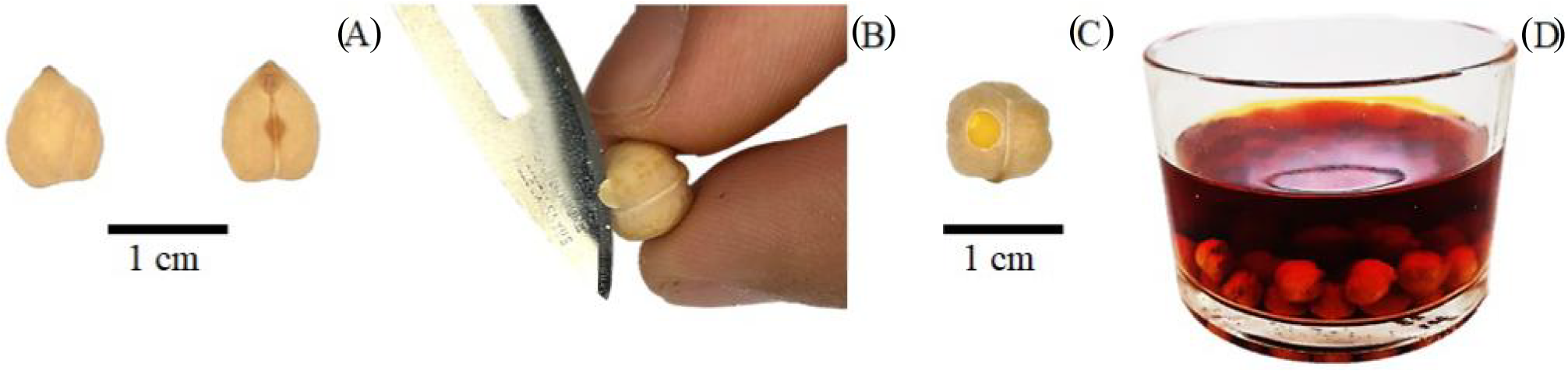
Initially, the iodine concentrations and seed immersion times were tested in one seed batch using only visually intact seeds (Figure 1A) and discarding any broken seeds and those with a damaged seedcoat or attacked by insects. A portion of the intact seeds was damaged by cutting with a scalpel blade at the opposite end to the root protuberance, producing circular damage of around 2-3 mm in diameter (Figures 1B and 1C).

Damage and the staining process in chickpea seeds: intact seeds (A); artificial damage (B); damaged seed (C); immersion in iodine solution (D)
Four replications of 50 intact or artificially damaged seeds were immersed in commercial 2% iodine solution at concentrations of 5%, 10% and 15% in water, in a transparent glass, and kept in a natural environment in the laboratory for 2.5, 5.0, 10.0, 15.0 and 20.0 minutes (Figure 1D). The seeds were then washed in running water and placed on a wet paper towel for evaluation. Seeds with at least one dark (stained) spot as a result of the iodine reaction were considered damaged. The results were expressed as a percentage of stained and unstained seeds.
Correlation between staining and the physical and physiological qualities of the seeds
During the second stage, the percentage of stained seeds in the iodine test of 10 seed batches harvested manually or mechanically under different rotor settings (Table 1) was correlated with the physical and physiological qualities of the seeds and evaluated. Prior to the tests, the moisture content of the seeds was determined on a wet basis using the oven method at 105 ± 3 ºC for 24 hours, in four subsamples of 10 seeds per batch (Brasil, 2009).
Batches of chickpea seeds used to evaluate the correlation between staining in the iodine test and the physical and physiological qualities of the seeds
The iodine test was carried out at a concentration of 10% iodine for 10 and 15 minutes. The solution was then drained, and the seeds visually classified as damaged (stained) or undamaged (unstained).
As in the iodine test, the physiological quality was assessed in four replications of 50 seeds per batch using the following tests:
Germination test - in a roll of paper towels moistened with distilled water at twice the weight of the paper, packed in transparent plastic bags at 25 ºC under light (Brasil, 2009).
First germination count - the percentage of normal seedlings was determined on the fifth day after setting up the experiment (Brasil, 2009).
Seedling length - the length of normal seedlings (cm seedling-1), evaluated at the end of the germination test.
Seedling dry weight - after discarding the cotyledons, the normal seedlings from the germination test were dried in Kraft paper bags at 65 °C for 72 hours and weighed (Krzyzanowski et al., 2020).
Tetrazolium test of viability and vigour - the seeds were pre-soaked in a roll of paper towels moistened with distilled water at twice the weight of the paper and placed in transparent plastic bags at 41 ºC for four hours. The seeds were then immersed in a 0.1% solution of 2,3,5-triphenyl tetrazolium chloride, placed in the dark at 30 ºC for six hours. The seeds were washed in running water and the seed coat removed with a scalpel. For the purposes of evaluation, the seeds were cut transversely and classified according to their viability and vigour into the following classes (Paraíso et al., 2019): 1 - viable and vigorous (with no lesions); 2 - viable and vigorous (with superficial lesions); 3 - viable and non-vigorous (with deep lesions); 4 - non-viable.
The physical quality of the seed batches was evaluated using the following tests:
Damaged seeds (percentage by weight) - four replications of 100 grams from each batch were visually assessed and the following seed fractions were separated and weighed: intact (undamaged) (Figure 1A), ruptured seed coat (Figure 2A), damage to more than 50% of the original size (Figure 2B), and damaged by insects (Figure 2C).

Physical damage in chickpea seeds: ruptured seed coat (A); damaged (B) and insect damage (C)
Damaged seeds (percentage by number) - four replications of 50 seeds from each batch were separated based on the fractions described in the previous test.
The experiments were conducted in a completely randomised experimental design. Regression analysis was used to select the appropriate immersion time and iodine concentration.
To assess the quality of the seed batches and validate the iodine methodology, the data were submitted to ANOVA and to the Scott-Knot test (p ≤ 0.05). For the purpose of analysis, the percentage data relating to the number of dead seeds, those attacked by insects, and those with a ruptured seed coat were previously transformed by the formula √(x + 0.5) due to a lack of data normality.
The multivariate analysis was carried out after standardising the variables, where each variable had a mean of 0 and a variance of 1. The hierarchical method was based on the Euclidean distance between the seed batches for the set of variables, using Ward’s method. As such, the initial set of variables was first characterised by two new latent variables (PCA 1 and PCA 2), which made it possible to locate them on a biplot graph. The validity of this analysis can be verified by the total amount of information of the original variables retained by the principal components with an eigenvalue greater than one. The multivariate analysis was carried out using the STATISTICA version 7.0 software, and the Pearson correlation using the Past version 4.0 software.
RESULTS AND DISCUSSION
Concentration of the iodine solution and immersion time
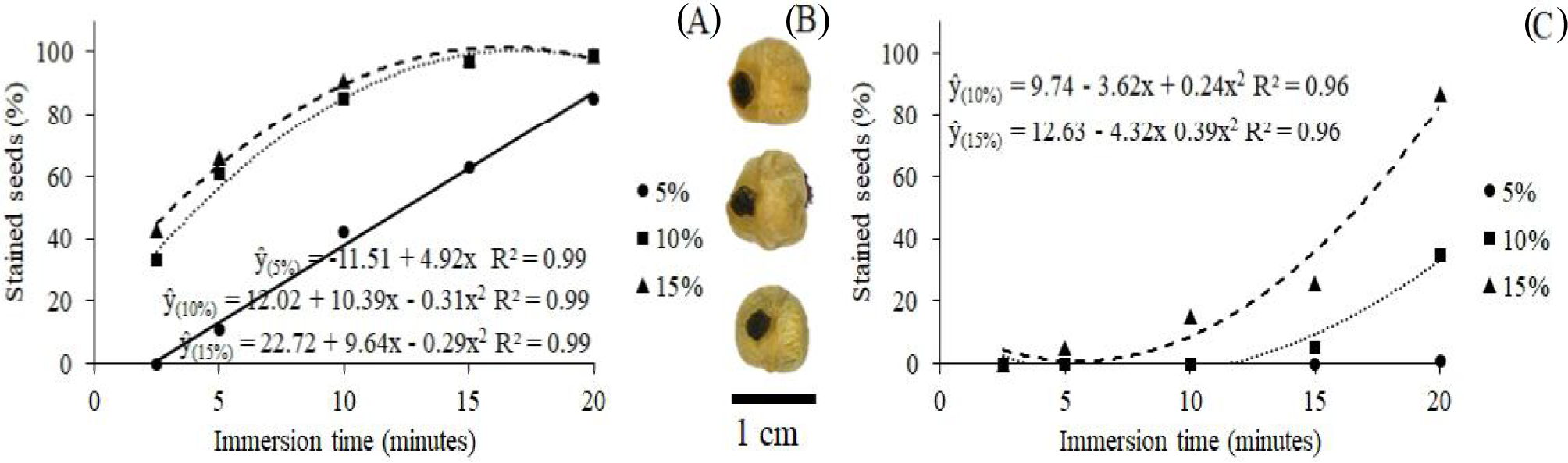
The seed batch under test had a water content of 13.2%. Iodine was effective in staining the damaged chickpea seeds (Figure 3B). The aqueous solution is brown in colour (Santos; Afonso, 2013) and when in contact with starch produces a reaction that changes the colour to dark blue due to occlusion of the iodine in the linear chains of amylose (Denardin; Silva, 2009; Liu et al., 2013; Zhao et al., 2018).

Staining of chickpea seeds as a function of time and iodine concentration in artificially damaged (A and B) and intact (C) seeds
The immersion time and concentration of the iodine solution affected the percentage of stained seeds (Figures 3A and 3C). Considering the optimal conditions for carrying out the iodine test to be the concentration x time relationship that gives the maximum staining of damaged seeds and the minimum staining of intact seeds, the concentration of 10%, together with an exposure time of 10 to 15 minutes, led to the staining of 90% to 100% of the damaged seeds and 0% to 5% of the intact seeds (Figure 3). These conditions were therefore considered the most suitable for the iodine test in chickpea seeds. The iodine test can also be used to detect mechanical damage in maize seeds (Parizotto et al., 2022), albeit a 5% concentration of iodine solution for 5 minutes is recommended for this species (Carvalho et al., 2011).
Correlation between staining and the physical and physiological qualities of the seeds
The average water content in the ten seed batches under evaluation was 10.0%. Based on the results of the germination and tetrazolium tests, Batches 1, 7 and 8 showed the highest physiological quality, while Batches 9 and 10 showed the lowest (Table 2). In general, there was a positive correlation between the results of the germination and viability tests for the ten batches of chickpeas.
Germination, viability and vigour in 10 batches of chickpea seeds used to correlate seed quality with the results of the iodine test. FGC = first germination count (%); G = germination (%); AS = abnormal seedlings (%); DS = dead seeds (%); RL = radicle length (cm); SL = shoot length (cm); SDW = seedling dry weight (g); VIA = viability (%); VIG = vigour (%); MD = mechanical damage (%); OM = overall mean
The dry weight of the seedlings also showed a positive correlation with germination and viability in tetrazolium; however the length of the radicle and shoot did not consistently correlate with germination or viability (Table 2).
The seed batches harvested in 2020 generally showed higher physiological quality than those harvested in 2019, while the worst seed quality was seen at the highest rotor speed (800 RPM), probably due to the mechanical damage caused by this component of the mechanical harvester (Pacheco et al., 2015). Nascimento et al. (2016) suggested the use of mechanical harvesters with an axial cylinder or double beater to minimise mechanical damage and preserve seed or grain quality. However, Batch 7, whose physiological quality was higher, was harvested manually, showing that this method of harvesting affords a low rate of damage.
The amount of physical damage to the seeds, tested by seed weight and seed number, differed between batches (Table 3). Batch 8, mechanically harvested in 2020 at a rotor speed of 600 RPM, showed the lowest rates for damaged seeds. On the other hand, Batch 9, mechanically harvested in 2020 at a rotor speed of 800 RPM, showed the highest rate of damage. These results confirm the importance of correctly adjusting the harvester threshing mechanism for chickpea seeds. Mechanical damage, especially to the embryonic axis, can affect germination, resulting in abnormal seedlings or dead seeds (Gomes-Junior et al., 2019).
Percentage of damaged seeds by weight and number in 10 batches of chickpea seeds. ID = insect damage; RC = ruptured seed coat; B = broken seeds; DW = total damage by seed weight; DN = total damage by number of seeds; OM = overall mean
In general, batches harvested at a threshing-cylinder speed of 600 RPM showed the lowest number of broken seeds; this speed, however, generated a high number of ruptured seed coats, as seen in Batch 3. Batches 4 and 7, which were harvested manually, had the lowest number of stained (damaged) seeds in the iodine test after 10 and 15 minutes, showing that this method of harvesting exerts a minimum of mechanical damage compared to mechanised harvesting (Table 4). On the other hand, the highest rate of mechanical damage detected by this test was seen in Batch 9 for both immersion times, when the rotor speed was at maximum (800 RPM). Mechanised harvesting is one of the main sources of mechanical damage to seeds (Holtz; Reis, 2013). These results underline the effectiveness of the iodine test in assessing mechanical damage in chickpea seeds.
Percentage of stained and unstained seeds in ten batches of chickpea seeds after immersion in 10% iodine solution for 10 and 15 minutes
The results (Table 4) show staining of the exposed internal structures of the seeds (Figure 4). This damage is due to insects (Figure 4A), seed coat rupture (Figure 4B) or seed breakage (Figure 4C). The iodine test is used to detect external mechanical damage to seeds, but does not show whether the internal structures are affected (Cicero; Banzatto-Junior, 2003).

Damage in chickpea seeds shown by iodine staining, due to: insects (A), seed coat rupture (B) and breakage (C); undamaged seed (D)
Given the high number of variables under study, multivariate analysis was carried out to highlight the effect of any physiological and physical qualities on seed staining by the iodine test. This analysis helps to minimise the influence of unrepresentative factors, resulting in greater applicability of the most relevant variables and the grouping of batches with similar qualitative characteristics.
The following variables were selected for the multivariate analysis based on representation and importance: a) physiological quality: first germination count, germination, abnormal seedlings, dead seeds, viability, and vigour by the tetrazolium test; b) physical quality: damaged by weight and by number; c) iodine test: seeds stained after 10 and 15 minutes (Figure 5).

Representation of the marked variation in Euclidean distance between the variables under consideration that allowed the formation of groups (A); dendrogram resulting from the analysis of hierarchical clustering using Ward's method based on the Euclidean distance (B); and characterisation of the groups by the K-means non-hierarchical method (C), obtained from the evaluation of nine parameters related to the physiological and physical qualities of the batches, and from the iodine test in 10 batches of chickpea seeds (L). FGC = first germination count; G = germination; AS = abnormal seedlings; DS = dead seeds; VIA = viability; VIG = vigour; DW = total damage by seed weight; DN = total damage by number of seeds; I10 = stained chickpea seeds after immersion in 10% iodine solution for 10 minutes; I15 = for 15 minutes
A significant variation in the Euclidean distance, which represents the linkage distance between the batches based on their characteristics, as shown by the variables used, makes it possible to determine the ideal cutoff point to obtain groups of batches with similar characteristics, albeit with significant differences from the batches in the other groups (Freddi; Ferraudo; Centurion et al., 2008). The range where groups most differed, marked by the largest vertical line, was between distances 6 and 11 (Figure 5A). Therefore, the cutoff point within this range was set to an intermediate value of 10 (Figure 5A), resulting in five groups of seed batches, shown by the dashed line.
Each group is made up of similar seed batches in terms of their physiological and physical qualities and iodine test results (Figure 5B and 5C). According to the dendrogram resulting from Ward's hierarchical grouping analysis based on the Euclidean distance, and in forming groups by the K-means non-hierarchical method, Batches 1 and 3 were allocated in Group 1 while Batches 4, 5 and 6 in Group 2. These groups corresponded to the batches with intermediate physiological and physical qualities (Figures 5B and 5C). Group 2 had the lowest values for first germination count, seed damage by number, and damage index by the iodine test after 10 minutes (Figure 5C). Group 3, with the best physiological and physical qualities, consisted of batches 7 and 8 (Figure 5B).
Group 4, comprising Batches 10 and 2 (Figure 5B), presented low physiological quality, with a high number of abnormal seedlings and dead seeds, and intermediate physical damage evaluated by seed number, seed weight and the iodine test (10 and 15 minutes) (Figure 5C). Finally, Group 5, corresponding to Batch 9 (Figure 5B), had the poorest physiological and physical qualities and high levels of damage, as assessed by the above variables (Figure 5C). In the case of maize seeds, there is a correlation between an increase in the percentage of mechanical damage and a reduction in seed vigour (Gu et al., 2019).
With the aim of analysing the selected variables as a whole, principal component analysis was carried out in an attempt to reduce the number of variables through correlation. The number of components is determined by the correlation between the variables, and has to be sufficient to express the importance of each of the variables. Therefore, if one of the selected variables shows a higher correlation with one component than with another, that with the highest correlation should be used in the evaluation. The correlation study of the multivariate analysis generated two principal components, improving interpretation of the variability of the described variables, and representing an accumulated variance of 82.80%: Principal Component 1 (63.84% of the variance) and Principal Component 2 (18.96% of the variance) (Table 5). When the sum of the two principal components is greater than 80%, the PCA results are considered effective in explaining the total variability of the data (Josllife; Cadima, 2016).
Correlation of the variables with each of the principal components (PCA 1 and PCA 2), and variability of the data for the physiological and physical characteristics and the iodine test for 10 batches of chickpea seeds
Two principal components, with accumulated variances of 59% and 68%, were sufficient to express the relevant variables in other studies, with no significant loss of information (Hongyu; Sandanielo; Oliveira-Junior, 2016; Tobar-Tosse et al., 2015). As such, the rate of variance seen in the present study was considered highly significant and representative (Table 5).
The most representative values for each principal component were identified based on the correlation analysis. Values greater than 0.6, whether positive or negative, were considered discriminatory; this was taken into account in the relationships between quality measurements in batches of rice seeds (Lorentz; Nunes, 2013). In this respect, only the first germination count showed a strong negative correlation with Principal Component 2 (Table 5). The other variables showed a higher correlation with Principal Component 1. Germination, viability and vigour showed a positive correlation with Principal Component 1, while the other variables showed a negative correlation with this component (Table 5).
There was a difference between Group 5 and the other groups (Figure 6), since this group is distant from the variables that add quality to the seeds, and close to the arrows for damage by weight and by number, and seeds that were stained after 10 and 15 minutes of exposure to the iodine solution. The greater the distance between the batch and the eigenvector of the variable (arrow in the biplot), the poorer the performance of the batch for that variable (Araújo et al., 2021).

Biplot showing the dispersion of the first two principal components obtained from the evaluation of nine variables related to the physiological and physical qualities of 10 batches of chickpea seeds (L). FGC = first germination count; G = germination; AS = abnormal seedlings; DS = dead seeds; VIA = viability; VIG = vigour; DM = total damage by seed weight; DN = total damage by number of seeds; I10 = stained chickpea seeds after immersion in 10% iodine solution for 10 minutes; I15 = for 15 minutes
The size of the arrows indicates how representative they are in relation to the principal components. The variables abnormal seedlings, vigour (TZ), viability (TZ), germination, damage by weight, damage by number, and stained seeds by the iodine test (10 and 15 minutes), are more related to Principal Component 1 (Figure 6 and Table 7).
In general, the batches in groups 1, 2 and 3 are positioned towards the centre in relation to almost all the variables of physiological quality, showing them to be of intermediate quality (Figure 6). Group 4 is positioned close to the variables, abnormal seedlings and dead seeds, albeit positioned on the opposite side of the variables, germination, vigour and viability, since non-germinated or non-viable seeds were either dead or produced abnormal seedlings.
The Pearson correlation coefficients were determined between the nine highlighted variables and the damage indices by the iodine test after 10 and 15 minutes (Figure 7). The coloured ellipses represent the same numerical results graphically, where the darker the shade of blue and the larger the ellipse, the greater the positive correlation coefficient between the variables. The larger the ellipse and the more intense the red colour, the greater the negative correlation.

Pearson correlation coefficients (r) between qualitative variables of 10 batches of chickpea seeds. FGC = first germination count; G = germination; AS = abnormal seedlings; DS = dead seeds; VIA = viability; VIG = vigour; DW = total damage by seed weight; DN = total damage by number of seeds; I10 = stained chickpea seeds after immersion in 10% iodine solution for 10 minutes; I15 = for 15 minutes
There was a positive and discriminatory correlation between the iodine test after 10 and 15 minutes and the occurrence of abnormal seedlings, damage by weight, and damage by number (Figure 7). However, the highest correlation between the iodine test and the physical quality of the seeds was seen after 15 minutes immersion. On the other hand, there was a negative correlation between staining in the iodine test and germination, seed viability and vigour.
These results show a correlation between the iodine test and the physical and physiological qualities of chickpea seeds; however, this correlation is higher for the physical qualities. It is important to emphasise that physiological seed quality is affected not only by mechanical damage, but also by deterioration. Considering that the main purpose of the iodine test is the rapid detection of mechanical damage in chickpea seeds, this test is recommended at a concentration of 10% commercial iodine for 15 minutes, and can be used in several situations, including adjusting harvesting and processing equipment to minimise seed loss due to mechanical damage (Rybiński et al., 2015, 2019), receiving seeds at the processing units, as well as for marketing in general.
CONCLUSION
The iodine test, using a concentration of 10% of the commercial product (iodine concentration of 2%) for 15 minutes, is effective in evaluating the level of mechanical damage in chickpea seeds, due to the negative correlation between the level of staining of the seeds in the test and the physical and physiological qualities of the seeds.
ACKNOWLEDGMENTS
The authors would like to thank the Coordenação de Aperfeiçoamento de Pessoal de Nível Superior - Brasil (CAPES) - Finance Code 001, for their financial support. Thanks also go to the Fazenda AgroGarbanzo for their support and for providing the seeds used in the study.
REFERENCES
-
ALBANEZE, R. et al Mechanical damage caused by the use of grain carts for transport during soybean seed harvest. Journal of Seed Science, v. 40, n. 4, p. 422-427, 2018. DOI: https://doi.org/10.1590/2317-1545v40n4174101
» https://doi.org/10.1590/2317-1545v40n4174101 -
ARAÚJO, J. O. et al Accelerated aging test and antioxidant enzyme activity to assess chickpea seed vigour. Journal of Seed Science, v. 43, n. 1, e202143038, 2021. DOI: https://doi.org/10.1590/2317-1545v43253934
» https://doi.org/10.1590/2317-1545v43253934 -
ARAÚJO, J. O. et al Adjustment of the electrical conductivity test to evaluate the seed vigour of chickpea (Cicer arietinum L.). Journal of Seed Science, v. 44, n. 1, e202244003, 2022. DOI: https://doi.org/10.1590/2317-1545v44258666
» https://doi.org/10.1590/2317-1545v44258666 - BRASIL. Ministério da Agricultura, Pecuária e Abastecimento. Regras para análise de sementes Brasília, DF: Secretaria Nacional de Defesa Agropecuária, 2009. 398 p.
-
CARVALHO, D. C. et al Avaliação da resistência mecânica de grãos de milho via teste de impacto. Revista Brasileira de Engenharia Agrícola e Ambiental, v. 15, n. 7, p. 724-730, 2011. DOI: https://doi.org/10.1590/S1415-43662011000700011
» https://doi.org/10.1590/S1415-43662011000700011 -
CICERO, S. M.; BANZATTO-JUNIOR, H. L. Avaliação do relacionamento entre danos mecânicos e vigour, em sementes de milho, por meio da análise de imagens. Revista Brasileira de Sementes, v. 25, n. 1, p. 29-36, 2003. DOI: https://doi.org/10.1590/S010131222003000100006
» https://doi.org/10.1590/S010131222003000100006 -
DELFAN, F.; SHANBAZI, F.; ESVAND, H. R. Impact damage to chickpea seeds during free fall. International Agrphysics, v. 37, n. 1, p. 41-49, 2023. DOI: https://doi.org/10.31545/intagr/156049
» https://doi.org/10.31545/intagr/156049 -
DENARDIN, C. C.; SILVA, L. P. Estrutura dos grânulos de amido e sua relação com propriedades físico-químicas. Ciência Rural, v. 39, n. 3, p. 945-954, 2009. DOI: https://doi.org/10.1590/S0103-84782009005000003
» https://doi.org/10.1590/S0103-84782009005000003 -
DIAS, L. B. X. et al Physiological quality of mechanically harvested chickpea seeds. Engenharia na Agricultura, v. 29, n. 1, p. 28-35, 2021. DOI: https://doi.org/10.13083/reveng.v29i1.10907
» https://doi.org/10.13083/reveng.v29i1.10907 -
FREDDI, O. S.; FERRAUDO, A. S.; CENTURION, J. F. Análise multivariada na compactação de um latossolo vermelho cultivado com milho. Revista Brasileira de Ciências do Solo, v. 32, n. 3, p. 953-961, 2008. DOI: https://doi.org/10.1590/S0100-06832008000300005
» https://doi.org/10.1590/S0100-06832008000300005 -
GOMES-JUNIOR, F. G. et al X-ray microtomography in comparison to radiographic analysis of mechanically damaged maize seeds and its effect on seed germination. Acta Scientiarum. Agronomy, v. 41, n. 1, e42608, 2019. DOI: https://doi.org/10.4025/actasciagron.v41i1.42608
» https://doi.org/10.4025/actasciagron.v41i1.42608 -
GU, R. et al Effect of mechanical threshing on damage and vigour of maize seed threshed at different moisture contents. Journal of Integrative Agriculture, v. 18, n. 7, p. 1571-1578, 2019. DOI: https://doi.org/10.1016/S2095-3119(18)62026-X
» https://doi.org/10.1016/S2095-3119(18)62026-X -
HOLTZ, V.; REIS, E. F. Perdas na colheita mecanizada de soja: uma análise quantitativa e qualitativa. Revista Ceres, v. 60, n. 3, p. 347-353, 2013. DOI: https://doi.org/10.1590/S0034-737X2
» https://doi.org/10.1590/S0034-737X2 -
HONGYU, K.; SANDANIELO, V. L. M.; OLIVEIRA-JUNIOR, G. J. Análise de componentes principais: resumo teórico, aplicação e interpretação. E&S - Engineering and Science, v. 5, n. 1, p. 83-90, 2016. DOI: https://doi.org/10.18607/ES20165053
» https://doi.org/10.18607/ES20165053 -
JOSLLIFE, I.; CADIMA, J. Principal component analysis: a review and recent developments. Philosophical Transactions The Royal Society, v. 374, n. 1, p. 1-16, 2016. DOI: https://doi.org/10.1098/rsta.2015.0202
» https://doi.org/10.1098/rsta.2015.0202 - KRZYZANOWSKI, F. C. Vigor de sementes: conceitos e testes. Londrina, PR: ABRATES, 2020. 601 p.
-
LIU, D. et al Structural variability between starch granules in wild type and in ae high-amylose mutant maize kernels. Carbohydr Polym, v. 97, n. 2, p. 458-468, 2013. DOI: https://doi.org/10.1016/j.carbpol.2013.05.013
» https://doi.org/10.1016/j.carbpol.2013.05.013 -
LORENTZ, L. H.; NUNES, U. R. Relações entre medidas de qualidade de lotes de sementes de arroz. Revista Ciência Agronômica, v. 44, n. 4, p. 798-804, 2013. DOI: https://doi.org/10.1590/S1806-66902013000400017
» https://doi.org/10.1590/S1806-66902013000400017 -
MERGA, B.; HAJI, J. Economic importance of chickpea: production, value, and world trade. Cogent Food and Agriculture, v. 5, n. 1, p. 1-12, 2019. DOI: https://doi.org/10.1080/23311932.2019.1615718
» https://doi.org/10.1080/23311932.2019.1615718 - NASCIMENTO, W. M. et al Hortaliças Leguminosas Brasília, DF: Embrapa Hortaliças, 2016. 216 p.
-
PACHECO, F. P. et al Physiological quality of soybean seeds under mechanical injuries caused by combines. Revista Caatinga, v. 28, n. 4, p. 190-201, 2015. DOI: https://doi.org/10.1590/1983-21252015v28n421rc
» https://doi.org/10.1590/1983-21252015v28n421rc -
PANDEY, S.; CHAKRABORTY, D. Salicylic acid increases tolerance of Vigna mungo cv. T9 to short-term drought stress. Acta Physiologiae Plantarum, v. 45, n. 25, p. 1-11, 2023. DOI: https://doi.org/10.1007/s11738-022-03492-6
» https://doi.org/10.1007/s11738-022-03492-6 -
PANG, J. et al Response of chickpea (Cicer arietinum L.) to terminal drought: leaf stomatal conductance, pod abscisic acid concentration, and seed set. Journal of Experimental Botany, v. 68, n. 8, p. 1973-1985, 2017. DOI: https://doi.org/10.1093/jxb/erw153
» https://doi.org/10.1093/jxb/erw153 -
PARAÍSO, H. A. et al Adjustments in the tetrazolium test methodology for assessing the physiological quality of chickpea seeds. Journal Seed Science, v. 41, n. 1, p. 7-12, 2019. DOI: https://doi.org/10.1590/2317-1545v41n1187777
» https://doi.org/10.1590/2317-1545v41n1187777 -
PARIZOTTO, N. F. et al Can dosing mechanisms affect the physical quality of corn seeds at different seeding speeds? Revista de Agricultura Neotropical, v. 9, n. 3, e6823, 2022. DOI: https://doi.org/10.32404/rean.v9i3.6823
» https://doi.org/10.32404/rean.v9i3.6823 -
RYBIŃSKI, W. et al Estimation of mechanical properties of seeds of common vetch accessions (Vicia sativa L.). Genetic Resources and Crop Evolution, v. 62, n. 1, p. 361-375, 2015. DOI: https://doi.org/10.1007/s10722-014-0157-7
» https://doi.org/10.1007/s10722-014-0157-7 -
RYBIŃSKI, W. et al Estimation of the physicochemical variation of chickpea seeds (Cicer arietinum L.). International Agrophysics, v. 33, n. 1, p. 67-80, 2019. DOI: https://doi.org/10.31545/intagr/103889
» https://doi.org/10.31545/intagr/103889 - SANTOS, V. M.; AFONSO, J. C. Elemento químico: Iodo. Química Nova Escola, v. 35, n. 4, p. 297-298, 2013.
-
TOBAR-TOSSE, D. E. et al Caracterização de genótipos de soja-hortaliça por análise de componentes principais. Ciência Rural, v. 45, n. 7, p. 1214-1219, 2015. DOI: https://doi.org/10.1590/0103-8478cr20140597
» https://doi.org/10.1590/0103-8478cr20140597 -
ZHAO, L. et al A simple and rapid method for preparing the whole section of starchy seed to investigate the morphology and distribution of starch in different regions of seed. Plant Methods, v. 14, n. 16, p. 1-11, 2018. DOI: https://doi.org/10.1186/s13007-018-0283-x
» https://doi.org/10.1186/s13007-018-0283-x
-
Editor-in-Chief: Prof. Salvador Barros Torres - sbtorres@ufersa.edu.br



 ** Significant (p ≤ 0.01); * significant (p ≤ 0.05); nsnot significant by F-test.

 ** Significant (p ≤ 0.01); * significant (p ≤ 0.05); nsnot significant by F-test. A Pearson correlation coefficient greater than 0.6 or less than -0.6 were considered discriminatory (