 Estimation of the reproductive and population parameters of Diaphorina citri (Hemiptera: Liviidae)
ABSTRACT
Diaphorina citri (Hemiptera: Liviidae) is a primary citrus pest associated with the transmission of pathogens that cause huanglongbing disease (HLB). Parameter estimation is a crucial step in the process of predicting and modelling biological systems. The reproductive and population parameters of D. citri in Citrus sinensis var. Valencia/Citrumelo, and the growth rate and load capacity of the shoots were determined from experimental data employing a logistic function. The sex ratio of D. citri was estimated at 0.49, with a standard deviation of 0.14. The number of immature and adult individuals per shoot per day was estimated at 24.7 eggs shoot−1, 19.2 NI shoot−1 and 13.6 adults shoot−1, with a standard deviation of 3.6, 2.3 and 2.3, respectively. During the nymphal stages NII, NIII, NIV and NV this value reached 15.1 nymphs shoot−1, with a standard deviation of 2.85. Longevity for the adult stage was 37.9, with a deviation of 7.2 days. The lifetime and effective oviposition rate per female were estimated at 7.36 and 10.97 eggs day−1, with a respective standard deviation of 1.99 and 2.5. Egg fertility was estimated at 70.6%, with a standard deviation of 9.4. The growth rate of the shoots was 0.12, with a standard deviation of 0.02. The values of these parameters are fundamental for adapting and correctly applying mathematical models when analysing biological systems and defining strategies of pest control.
Keywords:
Citrus
; Biological systems; Mathematical models
INTRODUCTION
Diaphorina citri (Hemiptera: Liviidae) is a primary pest associated with the transmission of Candidatus Liberibacter asiaticus and Ca. L. americanus, phloem-restricted bacteria that cause huanglongbing disease (HLB), one of the most destructive of citrus diseases (Bové, 2006). The biological cycle of D. citri consists of three stages: egg, nymph and adult. The nymphs develop through five instars. Females preferably lay their eggs on young shoots during the emergence and development phases, which are the most suitable for oviposition, nymph survival and adult emergence. Egg-laying gradually decreases as the shoots mature (Cifuentes-Arenas et al., 2018; García et al., 2016), and temporarily ceases in the absence of suitable leaf tissue (Tsai; Liu, 2000).
The life cycle of D. citri occurs on a wide range of host species, most of which belong to family Rutaceae. The ornamental plant, Murraya paniculata (L.) Jack, is a preferential host (Laranjeira et al., 2020) that is widely used in studies on the biology of the insect (Alves; Diniz; Parra, 2014; Liu; Tsai, 2000; Nava et al., 2007; Pérez-Artiles et al., 2011). The host plant and scion-rootstock combination influence the reproductive parameters of D. citri (Pérez-Artiles et al., 2017). The biology and incidence of D. citri are strongly influenced by temperature (Liu; Tsai, 2000; Nava et al., 2007), which is why various studies use or generate experimental data on the life cycle of the insect under controlled temperatures.
Mathematical models that incorporate life cycle parameters of a species and its populations, as well as interactions with the host and natural enemies, albeit simplifying certain elements of the agroecosystem, are useful for simulating such interactions as population dynamics based on the species of pest and the host parameters (Miranda et al., 2008). As tools for monitoring and control, these models allow a qualitative and quantitative analysis of the development of the insect population and make it easier to understand the population dynamics.
Adapting mathematical models to the specific characteristics of the region under study is essential if they are to become truly useful tools. This is achieved by estimating or determining specific values for each model parameter (Arias et al., 2018). Parameter estimation is a crucial and essential step in the prediction process for biological systems (Lillacci; Khammash, 2010; León et al., 2021; Mesa et al., 2021; Schmiester et al., 2021). The simulation model for the HLB-D citri pathosystem by Chiyaka et al. (2012) was developed from differential equations using estimated parameters taken from a number of studies.
The aim of this study was to estimate the reproductive and population parameters of D. citri on different hosts based on experimental data of D. citri biology under controlled conditions and to compare these findings with published data from various scientific studies on the subject.
MATERIAL AND METHODS
Experimental data. The data used in this study for parameter estimation were recorded during other experimental studies on the development of D. citri on different hosts:
Host: Sweet orange ‘Valencia.’ When collecting experimental data for a doctoral thesis on the bioecological aspects of D. citri funded by the Coordenação de Aperfeiçoamento de Pessoal de Nivel Superior (CAPES), data were also collected for a study of D. citri biology on the host sweet orange ‘Valencia’ (Citrus sinensis (L.) Osbeck) grafted onto Swingle citrumelo (Citrus paradisi Macfad. ‘Duncan’, 1830 x Poncirus trifoliata (L.) Raf., 1838).
Initially, an experiment was set up under laboratory conditions using 10 plants, each with one shoot at the emergence stage (≤ 5 mm). The individual plants were isolated, and two pairs of 15-day-old D. citri adults were released onto each plant. After 24 hours, the insects were removed and the eggs deposited on each shoot were monitored until the adults emerged. The number of eggs (NE), the number of nymphs at each stage: nymph I (NI), nymph II (NII), nymph III (NIII), nymph IV (NIV) and nymph V (NV), as well as the number of adults (A) categorised by sex (♀, ♂) were recorded for each plant. The data were used to calculate the proportion of females (f) (Table 1).
Developmental stages of Diaphorina citri on Citrus sinensis var. Valencia/Citrumelo CPB4475 under controlled conditions of temperature (27 °C) and relative humidity (60%)
The average time and standard deviation (SD) required by individuals to transition from one stage to the next (Pday: E-NI, NI-NII, NII-NIII, NIII-NIV, NIV-NV and NV-A) and for the complete cycle (Pday E-A) were also recorded for each plant (Table 2).
In another experiment, 20 plants were separated, isolated and infested with a pair of D. citri adults, aged 8 to 12 hours post-emergence. The vitality of the adults was checked every 24 hours. If eggs were present, the date oviposition began was recorded and the pair of D. citri was transferred to a new plant containing shoots; this was repeated until the death of the female. If the male died, it was replaced with another young adult. The plants were inspected every three days from the start of oviposition (υ), recording the number of eggs per female until the nymphs emerged (NI). Based on this data, lifetime oviposition (θ), effective oviposition (ε) and egg fertility (FE) were calculated (Table 3).
Oviposition parameters, adult longevity, lifetime oviposition rate (θ) and effective oviposition rate (ε) estimated for Diaphorina citri on Citrus sinensis var. Valencia/Citrumelo
The collected data on the pre-oviposition period (PPO), oviposition period (PO) and longevity of the females (LO♀) and males (LO♂) were recorded for each pair, as per the methods described by Rabinovich (1980) and Begon, Harper and Colin (1988). (Table 3).
Every three days, the number of eggs (E) (Table 4) and hatched nymphs (NI) per female on each shoot was recorded (Table 5). The experiments were conducted in climate-controlled chambers at a temperature of 27 ± 1 °C, a relative humidity (RH) of 60 ± 10% and a photoperiod of 14:10 hours light:dark.
Oviposition of 20 Diaphorina citri females on Citrus sinensis var. Valencia/Citrumelo, evaluated every three days
Number of first-instar nymphs (NI) per 20 female Diaphorina citri on Citrus sinensis var. Valencia/Citrumelo, evaluated every three days
Host: Tahiti acid lime (Citrus lati/olia Tanaka). A study on the population fluctuation of Diaphorina citri was carried out at the Caribia Research Centre (CI) of Agrosavia, as per project 2798: ‘Recommendations for the use of rootstocks for Persian lime in different regions of the country’, funded by the Ministerio de Agricultura y Desarrollo Rural (MADR).
Plants of the Tahiti lime were grafted onto six rootstocks: Citrange Carrizo (Citrus sinensis Osb. × Poncirus trifoliata (L.) Raf.), Cleopatra mandarin (Citrus reshni Hort. Ex Tanaka), CPB 4475 (Poncirus trifoliata (L.) Raf. × Citrusparadisi Macf.), Kryder 15-3 (Poncirus trifoliata (L.) Raf.), Sunki x English (Citrus sunki Hort. Ex Tan. × Poncirus trifoliata (L.) Raf.), and Volkamer lime (Citrus volkameriana Ten. & Pasq.). The plot of Tahiti lime was set up in a randomised block design with four replications of six plants per rootstock in an area located in Zona Bananera, Magdalena (Colombia), characterised by an average temperature of 27 ± 1 °C, relative humidity of 87 ± 8.3% and precipitation of 1,945 ± 15.1 mm.
One Tahiti lime plant from each rootstock was established as the experimental unit per replication, giving a sample of four plants per rootstock and a total of 24 study plants. The number of vegetative shoots (less than 8 cm) on each plant was recorded every 15 days. The data collected from February to December 2017, recording values equal to or less than three shoots per plant, were organised so that the first value represented the absence of any shoots (0) (Table 6). The data were used to fit curves representing the number of shoots per plant as a function of time.
RESULTS AND DISCUSSION
Estimation of the Reproductive and Population Parameters of Diaphorina citri
Proportion of Females of Diaphorina citri (f).
Based on the data (Table 1), the sex ratio of D. citri (f) on the host C. sinensis var. Valencia/Citrumelo was determined for each plant as the proportion of females among the total emerged adults per plant (Equation 1). This parameter was then estimated as the average sex ratio for the cohort under evaluation.
The average sex ratio of D. citri on C. sinensis var. Valencia/Citrumelo was 0.49, with a standard deviation of 0.14 (Table 1). Cifuentes-Arenas et al. (2018) provided complementary information on C. sinensis grafted onto Citrumelo ‘Swingle’ that is relevant to this study, reporting the adult emergence of D. citri under screenhouse conditions.
This study estimated the female proportion of D. citri to be 0.54, with a standard deviation of 0.10. Whereas, Nava et al. (2007), under controlled environmental conditions (average 25 ± 1 °C and RH 70 ± 20%), estimated a sex ratio of 0.50, 0.50, and 0.47, with a standard deviation of 0.05, 0,06, and 0.07 for Citrus limonia, M. paniculata, and Citrus sunki, respectively, and found no significant differences between the hosts.
However, Alves, Diniz, and Parra (2014), under controlled environmental conditions (average 25 ± 2 °C and RH 60 ± 10%), determined the sex ratio on M. paniculata (0.74), and on plants grafted onto Rangpur lime (Citrus limonia) with Citrus reticulata var. Ponkan (0.58), and on C. sinensis of the Valencia (0.62), Hamlin (0.77), Natal (0.67) and Pera (0.77) varieties. These results determined the high prevalence of female D. citri across various hosts. However, no significant differences or host preferences regarding development were found.
Egg fertility (FE) and survival (S) between the stages of Diaphorina citri
Based on the data shown in Tables 1, 3, egg fertility (FE) was determined as the ratio between the total number of eggs (E) and the total number of first-instar nymphs (NI) that emerged from those eggs (Equation 2).
For C. sinensis var. Valencia/Citrumelo under controlled conditions, the FE parameter was estimated as the average fertility of the eggs from the cohort under evaluation. Data from the first experiment (Table 1) estimated FE at an average value of 78.1%, with a standard deviation of 5.0% (Table 7), while in the second experiment (Table 3), FE was estimated at 66.9%, with a standard deviation of 10.9%. Considering all the data (Table 1, Table 3), the FE parameter for D. citri on C. sinensis var. Valencia/Citrumelo is estimated at 70.6%, with a standard deviation of 9.4. In Cifuentes-Arenas et al. (2018), the FE parameter was calculated as 83.9 ± 1.6% for shoots at the emergence stage and 76.5 ± 3.3% for shoots at the vegetative stage.
Estimation of egg fertility (FE) and survival (S) between the stages of Diaphorina citri for one cohort (Table 1) on Citrus sinensis var. Valencia/Citrumelo
The survival of D. citri (S) between one stage and another was determined for each plant based on the ratio between the total number of individuals generated during the initial stage and the total number of individuals during the final stage (Equation 3).
Parameter S was estimated as the average survival between two stages of D. citri for the cohort under evaluation. Survival from nymph I to nymph II (NI-NII) was estimated at 78.8%, with a standard deviation of 12.8%, and from nymph V to adult (NV-A) at 90.6%, with a standard deviation of 6.7%. Survival from nymph I to adult (NI-A) reached 70.8%, with a standard deviation of 8.9%; while survival for the entire life cycle, from egg to adult (E-A), was 55.2%, with a standard deviation of 6.6% (Table 7).
In the study by Cifuentes-Arenas et al. (2018), the S parameter for egg-to-adult survival (E-A) was calculated at 66.4 ± 3.4% for shoots at the emergence stage and 65.4 ± 4.0% for shoots at the vegetative stage. The survival rate from nymph I to adult (NI-A) was estimated at 79.1 ± 3.7% and 86.9 ± 2.3%, respectively.
Longevity of Diaphorina citri adults (LO).
Based on the data shown in Table 3, the average longevity for the adult stage of D. citri was estimated at 37.9 days, with a standard deviation of 7.2 days and a maximum of 60 and a minimum of 17 days. Females showed an average longevity of 35.9 days, with a standard deviation of 8.5 days and a minimum of 17 and a maximum of 60 days, while males lived an average of 40.0 days, with a standard deviation of 7.5 days, ranging from a minimum of 25 to a maximum of 60 days (Table 3).
Different studies reported the longevity of female and male D. citri onM. paniculata. For instance, Liu and Tsai (2000) reported a longevity of 39 days regardless of sex, and demonstrated the influence of temperature on the longevity and reproduction of D. citri, where female longevity increased as the temperature decreased (20 – 28 °C). Garcia et al. (2016) reported a longevity of 39 and 23 days for females and males, respectively. However, Chirinos, Chávez, and Castro (2018), in tests conducted at 25.2 °C, found differences in longevity between females (25.0 days) and males (12.8 days), reporting lower values than those of other studies. Nava et al. (2007) reported that in C. limonia, C. sunki, and M. paniculata, female longevity was higher (approximately 30 days) than in males.
Lifetime oviposition rate of Diaphorina citri females (θ). The oviposition rate for a D. citri female during her lifetime is referred to as lifetime oviposition (θ), and was calculated based on oviposition (υ) and female longevity (LOÇ) (Table 3).
The lifetime oviposition rate per D. citri female for the host C. sinensis var. Valencia/Citrumelo was estimated as the average of the lifetime oviposition rates of the 20 females studied at 27 °C, with a value of 7.36 eggs per day and a standard deviation of 1.99 eggs per day (Table 3). Average oviposition data and average longevity from investigations evaluating the development of D. citri on M. paniculata at different temperatures showed that at 28 °C the lifetime oviposition rate is 21.55 eggs per day, while at 30 °C it was estimated at 9.43 eggs per day (Liu; Tsai, 2000). An analysis of the research data from Nava et al. (2007), based on average oviposition and average longevity, determined a respective oviposition rate of 8.56, 5.33 and 10.78 eggs per day for C. limonia, M. paniculata and Citrus sunki, at 25 ± 1 °C.
In our experiment, by estimating lifetime oviposition using the averages of oviposition and longevity, we obtained a value of 7.06 eggs per day. According to the above studies, developing principal or alternate D. citri host crops at 28 °C affords a higher lifetime oviposition rate per female. Both temperature and host influence the lifetime oviposition parameter.
Effective oviposition rate per female of Diaphorina citri (ε). The oviposition rate of a D. citri female during the oviposition period is referred to as effective oviposition (ε), and was determined based on oviposition (υ) and the oviposition period of the female (PO) (Table 3, Equation 5).
The effective oviposition rate per female of D. citri for the host C. sinensis var. Valencia/Citrumelo was estimated as the average effective oviposition rate of 20 females at 27 °C, with an average value of 11.08 eggs per day and a standard deviation of 2.51 (Table 3). When estimating effective oviposition using the averages of oviposition and oviposition period, we obtained a value of 10.74 eggs per day.
The average oviposition period was estimated using the data on pre-oviposition and average longevity from Alves, Diniz, and Parra (2014), which made it possible to determine the effective oviposition rate for M. paniculata (14.76 eggs per day) and C. sinensis var. Hamlin (12.12 eggs per day) at 25 °C. Alves, Diniz, and Parra (2014) reported the influence of the host on the fecundity of D. citri for the variables average number of eggs and average female longevity between the species C. sinensis var. Hamlin and M. paniculata, and C. sinensis var. Valencia, Pera and Natal.
Rates for the immature and adult stages of Diaphorina citri (ψe). To calculate the rate for each of the nymphal stages per female, the rate for the previous immature stage (ψ(e-1)) and the survival of the respective and preceding stages (S(e-1)e) were used (Equation 6).
In the case of stage NI, the rate was calculated from the value of the previously determined lifetime oviposition rate (θ) (Table 3) and the survival rate between E – NI (Table 7). The immature rate of D. citri for the host C. sinensis var. Valencia/Citrumelo was estimated at 5.19, 4.09 and 3.71 for NI, from NII to NV, and for the adult stage, respectively (Table 8).
Lifetime oviposition rate, survival from egg to adult, and immature and adult rates per female of Diaphorina citri on Citrus sinensis var. Valencia/Citrumelo
Survival from egg to NI and from NI to adult was determined using data on C. limonia reported by Nava et al. (2007); in addition, the oviposition rate (θo) was calculated at 8.56. These values allowed the rate for stage NI (ψNI) and the adult stage (ψA) to be determined for D. citri, with values of 8.03 and 5.94, respectively (Table 9).
Oviposition rate, egg-to-adult survival, and immature rate per female of Diaphorina citri on Citrus limonia
Transition rate through the immature stages to adult (η): Based on the data shown in Tables 2, 7, the transition rate from stage i to stage j (ηij) was determined from the survival between stage i and stage j (Table 7, excluding FE) and the time (t), defined as the number of days required for an individual to progress from stage i to stage j (Table 2).
This calculation assumes that transitions follow an exponential distribution (Li; Huang; Li, 2018) (Equation 7).
The transition rate from each immature stage to adult in D. citri for the host C. sinensis var. Valencia/Citrumelo was estimated at 0.32, 0.16, 0.12, 0.10, 0.09 and 0.05, respectively (Table 10).
Survival, transition time and daily transition rate of Diaphorina citri on Citrus sinensis var. Valencia/Citrumelo
Mortality rate for the immature stages (δi). The mortality rate from stage i to stagej (δij) is determined from the survival rate between stage i and stage j and the time (t) given by the number of days it takes for an individual to transition from stage i to stage j, assuming constant daily survival as the complement of the daily mortality rate (Equation 8).
The mortality rate for each immature stage on the host C. sinensis var. Valencia/Citrumelo was estimated at 0.085 for eggs, 0.111 from NI to NII, 0.022 from NV to adult, and 0.039 for the entire life cycle. No mortality was observed between stages NII and NV (Table 11).
Survival, transition time and daily mortality rate for each immature stage of Diaphorina citri on Citrus sinensis var. Valencia/Citrumelo
Mortality rate for the mature stage (δm). The mortality rate for the mature stage (δm) is defined as the inverse of longevity (3) (Equation 9), assuming mortality follows an exponential distribution (Martcheva, 2015).
The mortality rate for the adult stage on the host C. sinensis var. Valencia/Citrumelo was estimated at 0.027. The parameter was slightly higher for males (0.029) than for females (0.026) (Table 12).
Survival, duration in days, and daily mortality rate of adult Diaphorina citri for the Valencia Orange on CPB
Estimation of the Crop Parameters
Evaluation data from a batch of Tahitian lime planted on six rootstocks established at C.I. Caribia were used to determine the crop parameters. A total of 21 samples were grown biweekly. At each sampling, the number of vegetative shoots per plant was counted for the six rootstocks (Table 6).
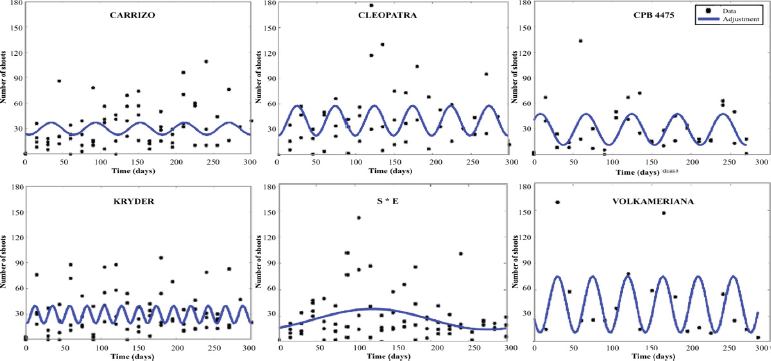
According to the behaviour of the data, the number of shoots on a plant is cyclical and can therefore be modelled using a sinusoidal function. However, in autonomous models that consider short-term work horizons (less than two months), it can be assumed that the number of shoots per plant follows a logistic pattern. An estimation of the parameters for this variable using the above pair of function families is shown below.
Plant shoot growth represented by a sinusoidal function. For the data in Table 5, which reports the number of shoots on a plant over approximately ten months, it was assumed that shoot growth is given by the function (Equation 10):
Where B(t) represents the number of shoots at time t, A the wave amplitude, ω the frequency, φ the phase angle, and C the vertical shift. The results of adjusting the Tahiti acid lime parameters for each rootstock are shown in Table 13 and Figure 1.
Adjustment of the growth parameters of Tahiti acid lime grown on six rootstocks for a period of around ten months, considering sinusoidal behaviour
Adjustment of the growth parameters of Tahiti lime grown on six rootstocks for a period of more than two months: sinusoidal model
The results show different wave amplitudes for the six rootstocks under evaluation, in line with those reported in the literature. It can be seen that the rootstock significantly influences growth and emergence of the canopy (Albrecht et al., 2020; Carvalho et al., 2021; Hayat et al., 2022). Citrus volkameriana Tan & Pasq is an early rootstock, showing high vigour and vegetative growth that promotes greater sprouting and distinguishes it from the other rootstocks (Riaño et al., 2020).
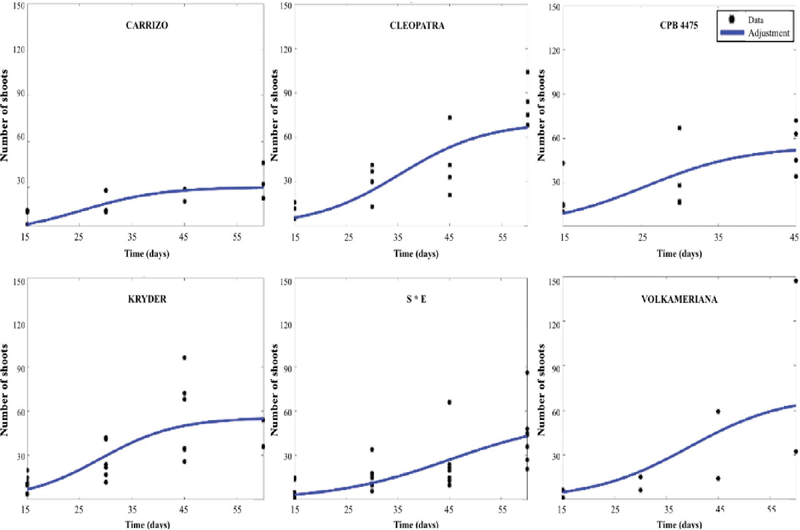
Plant shoot growth represented by a logistic function. To work with an autonomous model, it was assumed that the number of shoots on a plant follows a logistic function. Given a short-term horizon, a period of no more than two months was considered, where the shoots exhibit monotonic growth (Table 6). The data were then adjusted to a logistic function (Equation 11), where Bo represents the initial number of shoots on the plant, K denotes the load capacity of the shoots and p is the intrinsic growth rate of the shoots.
The results obtained for each Tahiti acid lime rootstock (Table 6), considering a period of less than two months, are shown in Table 14 and Figure 2.
Adjustment of the growth parameters for a period of no more than two months, considering logistic behaviour
Adjustment of the growth parameters of Tahiti lime grown on six rootstocks for a period of no more than two months: logistic model
Summary of the Estimated Parameters
The various estimated parameters are shown in Table 15.
CONCLUSIONS
1. In this research, the population parameters of D. citri were estimated to allow the adaptation of mathematical models that incorporate parameters of the life cycle of the species and its populations, as well as interactions with the host. This makes it possible to simulate the population dynamics of the pest and its interactions with the environment in order to determine and evaluate different methods for controlling the HLB vector insect;
2. In addition, two models were proposed for analysing the fluctuation in the number of shoots in citrus species: one using a sinusoidal function for periods of more than two months, given the cyclical behaviour of shoot development in the crop, and another using a logistic function for periods of less than two months to study the initial increase in shoot growth.
ACKNOWLEDGEMENTS
The authors wish to thank the Ministerio de Ciencia, Tecnologia e Innovación - (MinCiencias) for financing the program ‘Models and Mathematical Methods for the Control of Pests and Infectious Diseases’ (Code: 1106-852-6923), under which the project ‘Mathematical Models and Methods for the Control of Diaphorina citri’ (Code: 69528-2019) was developed. The authors wish to thank the Universidad del Valle and the Corporación Colombia de Investigación Agropecuaria (Agrosavia), who were also involved in implementing the project.
RFEERENCES
- ALBRECHT, U. et al. Influence of rootstock propagation method on traits of grafted sweet orange trees. HortScience, v. 55, n. 5, p. 729-737, 2020.
- ALVES, G. R.; DINIZ, A. J. F.; PARRA, J. R. P. Biology of the huanglongbing vector Diaphorina citri (Hemiptera: Liviidae) on different host plants. Journal of Economic Entomology, v. 107, n. 2, p. 691-696, 2014.
- ARIAS, J. H. et al. Estimación de los parâmetros de dos modelos para la dinâmica del dengue y su vector en Cali, Colombia. Ingeniería y Ciencia, v. 14, n. 28, p. 69-92, 2018.
- BEGON, M.; HARPER, J. I.; COLIN, C. R. Ecología: indivíduos, poblaciones y comunidades. Barcelona: Editorial Omega, 1988. 883 p.
- BOVÉ, J. M. Huanglongbing: a destructive, newly-emerging, century-old disease of citrus. Journal of Plant Pathology, v. 88, n. 1, p. 7-37, 2006.
- CHIRINOS, D. T.; CHÁVEZ, Y.; CASTRO, R. Biología y estadísticos poblacionales del psílido de los citricos Diaphorina citri Kuwayama (Hemiptera: liviidae) en dos condiciones de cría sobre Murraya paniculata L. Bioagro, v. 30, n. 3, p. 221-226, 2018.
- CHIYAKA, C. et al. Modeling huanglongbing transmission within a citrus tree. Proceedings of the National Academy of Sciences, v. 109, n. 30, p. 12213-12218, 2012.
- CARVALHO, E. V. et al. Modeling seasonal flushing and shoot growth on different citrus scion-rootstock combinations. Scientia Horticulturae, v. 288, p. 110358, 2021.
- CIFUENTES-ARENAS, J. C. et al. Citrus flush shoot ontogeny modulates biotic potential of Diaphorina citri Plos ONE, v. 13, n. 1, p. 1-17, 2018.
- GARCÍA, Y et al. Biology of Diaphorina citri (Hemiptera: Liviidae) under glass house conditions in Palmira, Colombia. Revista Colombiana de Entomologia, v. 42, n. 1, p. 36-2, 2016.
- HAYAT, F. et al. Influence of citrus rootstocks on scion growth, hormone levels, and metabolites profile of ‘Shatangju’ Mandarin (Citrus reticulata Blanco). Horticulturae, v. 8, n. 7, p. 608, 2022.
- LARANJEIRA, F. et al. Presence and abundance of Diaphorina citri in Murraya paniculata in urban areas free of huanglongbing in Brazil. Entomologia Experimentalis et Applicata, v. 168, n. 9, p. 695-702, 2020.
- LEÓN, G. D. S. et al. Parámetros reproductivos de Tecia solanivora (Povolný, 1973) (Lepidoptera: Gelechiidae) en genotipos de papa (Solanum tuberosum L.). Revista Latinoamericana de la Papa, v. 25, n. 1, p. 71-90, 2021.
- LI, X. Y.; HUANG, H. Z.; LI, Y. F. Reliability analysis of phased mission system with non-exponential and partially repairable components. Reliability Engineering & System Safety, v. 175, p. 119-127, 2018.
- LILLACCI, G.; KHAMMASH, M. Parameter estimation and model selection in computational biology. Plos Computational Biology, v. 6, n. 3, E1000696, 2010.
- LIU, Y. H.; TSAI, J. H. Effects of temperature on biology and life table parameters of the asian citrus psyllid, Diaphorina citri Kuwayama (Homoptera: Psyllidae). Annals of Applied Biology, v. 137, n. 3, p. 201-206, 2000.
- MARTCHEVA, M. An introduction to mathematical epidemiology. Texts in Applied Mathematics. New York: Springer, 2015. 453 p.
- MESA-FÚQUEN, E.; HERNÁNDEZ, J. S.; CAMPEROS, J. E. Uso de modelos lineales generalizados en el conteo de Leptopharsa gibbicarina (Hemiptera: Tingidae) en palma de aceite. Revista Colombiana de Entomología, v. 47, n. 1, p. 2-5, 2021.
- MIRANDA, I. et al. Modelo teórico de la interacción de Diaphorina citri Kuwayana (Hemiptera: Psyllidae) con sus enemigos naturales. Revista Protección Vegetal, v. 23, n. 2, p. 126-130, 2008.
- NAVA, D. E. et al. Biology of Diaphorina citri (Hem., Psyllidae) on different hosts and at different temperatures. Journal of Applied Entomology, v. 131, p. 709-715, 2007.
- PÉREZ-ARTILES, L. et al. Biologia y parâmetros reproductivos de Diaphorina citri (Hemiptera: Liviidae) en diferentes hospederos de rutaceae. Revista Colombiana de Entomología, v. 43, n. 2, p. 141-150, 2017.
- PÉREZ-ARTILES, L. et al. Ciclo de vida de Diaphorina citri Kuw. (Hemiptera: Psyllidae) en Citrus aurantifolia L. y Murraya paniculata (L.) Jack en condiciones de laboratorio. Citrifrut, v. 28, n. 2, p. 12-8, 2011.
- RABINOVICH, J. E. Introducción a la ecología de poblaciones animales. México: Compañía Editorial Continental, 1980. 313 p.
- RIAÑO, N. M. et al. Modelo productivo de lima ácida Tahiti (Citrus×Latifolia Tanaka Ex Q. Jiménez) para Colombia. Mosquera: Agrosavia, 2020. 431 p.
- SCHMIESTER, L. et al. PEtab—Interoperable specification of parameter estimation problems in systems biology. PLoS Computational Biology, v 17, n. 1, e1008646, 2021.
- TSAI, J. H.; LIU, Y. H. Biology of Diaphorina citri (Homoptera: Psyllidae) on four host plants. Journal of Economic Entomology, v. 93, n. 6, p. 1721-1725, 2000.
Edited by
-
Editor-in-Chief:
Agricultural Engineer. Manoel Barbosa Filho manoel.filho@ufc.br