 Oxidative stability of biodiesel in the presence of leaves and fruit extracts
ABSTRACT
This research evaluated the efficiency of ethanolic extracts from yerba mate leaves (Ilex paraguariensis), coffee leaves (coffea arabica), and jambolan pulp (Syzygium cumini Lamarck) through the application of the simplex-centroid mixture design, the super modified simplex optimization algorithm, and the functions of desirability, using the induction period (IP) and the rate constant (k) of the biodiesel oxidation reaction at 110 °C as responses. Antioxidant activity was observed in all extracts, manifesting either by reducing the rate constant or extending the biodiesel induction period in comparison to the control sample. The mathematical models derived from the simplex-centroid design exhibited adjusted determination coefficients of 0.990 for the IP model and 0.960 for the k model. Analysis of variance indicated the significance of both models at the 5% significance level for IP and k, with p1 = 7.382 × 10⁻⁴ and p2 = 1.177 × 10⁻³, respectively. The lack of fit was not significant at the same level with p1 = 0.132 and p2 = 0.653, showing that they can be used for predictive purposes. The analysis of the response surface and optimization using the super modified simplex method revealed that higher proportions of coffee leaves extract in the mixture yielded superior IP values and lower k values.
Keywords:
Induction period; Degradation; Antioxidant; Simplex-Centroid; Modified simplex
INTRODUCTION
Fossil fuels, currently the most widely used energy source, exert a significant impact on the environment by serving as the primary contributors to greenhouse gas emissions. Furthermore, diesel combustion gas emissions contain hundreds of carcinogenic chemical compounds such as carbonyl compounds, aromatic hydrocarbons, among others (Hoang et al., 2021; Turrio-Baldassarri et al., 2004 Tomislav, 2018). In light of this ecological challenge, researchers have been actively engaged in efforts to identify a suitable alternative to fossil fuels. Among the various alternatives, biodiesel, produced from renewable raw materials like vegetable oils and animal fats, emerges as a promising replacement for petroleum diesel. Biodiesel offers a range of advantages, including the potential for local sourcing, emissions reduction of aromatics and sulfur oxides into the atmosphere, mitigation of greenhouse gas emissions, and the potential reuse of glycerin, a product generated during the transesterification process in biodiesel production (Pinto et al., 2005; Rezende et al., 2021).
Despite its significant environmental benefits, biodiesel exhibits reduced oxidative stability in comparison to conventional diesel due to the presence of esters from fatty acids and double bonds within the carbon chain. This attribute could render biodiesel less suitable for utilization in automotive engines, potentially leading to heightened viscosity, increased acidity, and the formation of gum-like substances and solid compounds. In addition, during its production, transportation, and storage phases, biodiesel is susceptible to exposure to moisture and transition metal ions, such as copper and iron. These metals can potentially originate from the equipment involved in its production and the storage tanks, thereby hastening the oxidative process and potentially rendering it unsuitable for certain applications (Borsato et al., 2014; Clemente et al., 2023; Jeyakumar et al., 2022).
According to Chendynski et al. (2019), the oxidation of biofuels is influenced not only by the degree of unsaturation in the ester carbon chain but also by their specific positions within the molecular structure. Consequently, biodiesel is vulnerable to chemical degradation via free radicals. In the initiation phase of the reaction, the hydrogens of the bis-allylic sites within the carbon chains of biodiesel are easily removed, leading to the propagation of oxidation and the subsequent formation of secondary decomposition products that can lead to problems in fuel flow and corrosion in vehicle engines. To reduce this limitation, synthetic antioxidants or natural extracts with antioxidant properties are typically incorporated shortly after the production of biodiesel to delay degradation reactions and increase oxidative stability (Borsato et al., 2014; Chendynski et al., 2019; Clemente et al., 2023).
Therefore, for the appropriate commercialization of biodiesel, antioxidants are used to increase the induction period (IP), reduce the rate constant of oxidation reactions and prolong storage (Borsato et al., 2014; Chendynski et al., 2019; Clemente et al., 2023). The use of synthetic antioxidants is one of the ways to control the biodiesel oxidation process. The most used are butylhydroxyanisole (BHA), butylhydroxytoluene (BHT), and tert-butylhydroquinone (TBHQ) (Borsato et al., 2014; Dunn, 2005; Medeiros et al., 2014).
However, extracts of natural origin, with antioxidant properties, have gained importance due to their ease of obtainment compared to the complex and expensive synthesis of synthetic antioxidants. These natural extracts have become a valuable alternative for retarding oxidation reactions and reducing the overall production cost of biofuel (Borsato et al, 2014; Chendynski et al, 2019; Clemente et al., 2023; Dunn, 2005; Jeyakumar et al., 2022; Kahimbi; Kichonge; Kivevele, 2023; Medeiros et al., 2014).
Research findings concerning the synergistic effects of natural antioxidants reveal that, under specific conditions and within certain temperature parameters, the combined mixture can outperform the effectiveness of individual antioxidants. Coppo et al. (2014), employed the simplex-centroid mixture design coupled with multi-response optimization and demonstrated that a blend consisting of 25% ethanolic extract of rosemary and 75% ethanolic extract of oregano exhibited superior efficacy in retarding the oxidation process of biodiesel derived from soybean oil, compared to their isolated usage. Gregório et al. (2018), observed an increase in the activation energy necessary for biodiesel oxidation in the presence of extracts of sage and coffee leaves, alone or in a mixture According to Clemente et al. (2023), the addition of jabuticaba peel extract increased the biodiesel induction period in relation to the control sample and decreased the rate constants at each evaluated temperature.
The present work aimed to analyze the induction period (IP) and the rate constant (k) from the biodiesel oxidation reaction, applying alcoholic extracts with antioxidant properties, from coffee leaves, jambolan pulp, and yerba mate leaves, using the simplex-centroid mixture design with multiresponse optimization.
MATERIAL AND METHODS
2.1 Biodiesel Production
The triglyceride transesterification reaction was conducted with 50% of palm oil (S.S. Moratto Comércio de Insumos, São Paulo/SP, Batch SE-0518/25672) and 50% of soybean oil (Coamo®, Batch 423058), along with absolute methanol (F. Maia, P.A. 99.8%) and potassium hydroxide (Sigma-Aldrich, 95%) as the reaction catalyst.
For every 100 g of triglycerides, 0.8 g of KOH dissolved in 50 mL of methanol was used. The mixture was heated to 60 °C, refluxed, and agitated for 2 hours. The phases were separated in a separating funnel and, subsequently, the biodiesel underwent a two-step washing process: initially with an aqueous solution of hydrochloric acid (1% w/w) and then, only with water. The washing procedure for the biodiesel involved hydrochloric acid and water at 80 °C and the process was repeated until the pH reached neutrality.
After the water washing procedure, anhydrous sodium sulfate, initially dried in an oven at 140 °C for 2 hours, was used to carry out the biodiesel dehumidification process. The sodium sulfate was then mixed under stirring and left to rest for 1 hour. Then, the biodiesel-sulfate mixture was vacuum filtered to obtain the biodiesel used for the analyses in this study.
2.2 Biodiesel chromatographic analysis (GC-MS)
To evaluate the concentrations of methyl esters present in the biodiesel samples, a mass of 0.0200 g was measured on an analytical balance and placed into Eppendorf tubes. Then, 500 µL of a standard solution of tricosanoic acid methyl ester (C23:0) with a concentration of 1.0 mg mL−1 in heptane (Sigma-Aldrich) was added to each tube.
After stirring, a volume of 2 µL from each sample was injected into a Shimadzu GC2010 Plus chromatograph coupled to a QP2010 Ultra mass detector, using the following conditions: RESTEK-RT2560 fused silica chromatographic column (100 m, 0.25 mm and 0.20 μm i.d., 100% non-alloyed bis cyanopropyl polysiloxane) with a He gas flow rate automatically determined by the device, based on the injection conditions and column properties, with a line pressure of 110 kPa, a He flow rate of 17.1 mL min−1, and a pressure of 0.28 kPa; the column had a linear flow of 11.1 mL min−1. The sample split ratio was set at 1/50, and the injector temperature was maintained at 240 ºC.
The column was initially set at a temperature of 190 °C for 2 minutes. It was subsequently increased to 200 °C at a rate of 2.0 ºC per minute and maintained at this temperature for an additional 2 minutes. Following this, the temperature was once again increased, this time to 230 ºC at a rate of 2.0 ºC per minute and held steady for another 2 minutes. The interface temperature from the gas chromatograph (GC) to the mass spectrometer (MS) was consistently maintained at 240 ºC, while the detector was set at a temperature of 200 ºC. The detector operated in SCAN mode, with mass scanning occurring within a m/z ratio range from 35 to 500. Scanning was initiated 15 minutes after the start of the analysis to optimize detector performance, resulting in a total analysis time of 35 minutes.
Peak areas were calculated using the Post Run Analysis software. Methyl esters identification was established through a comparison of retention times of known fatty acids from soybean oil samples using the Bibliotec software. Quantitative analyses were conducted relative to the internal standard, methyl tricosanoate.
2.3 Physical and Chemical Characterization of Biodiesel
The density (20 ºC) was determined according to the ASTM D4052 (2018) method, the flash point by the ASTM D93 (2020), kinematic viscosity (40 ºC) by the ASTM D445 (2021), iodine value by the EN14111-2023, acid number by the ASTM D664 (2021), water content by the ASTM D6304 (2020), cloud and pour points by the ASTM D2500 (2017).
2.4 Natural Extracts
Alcoholic extracts of yerba mate leaves (Ilex paraguariensis) (SISGEN Registry A957A9), arabica coffee leaves (Coffea Arabica) (SISGEN Registry ABA1234), and jambolan pulp (Syzygium cumini Lamarrk) (SISGEN Registry A45BABD) were prepared. Yerba mate leaves (81®, Lot 113) was purchased from Grupo Muffato supermarket in the city of Londrina/PR/Brazil. The coffee leaves and jambolan pulp were collected at different locations within the State University of Londrina, with the respective geographic coordinates (−23.327877, −51200190) and (−23.328047, −51.197556).
Samples of yerba mate leaves, coffee leaves, and jambolan pulp were dried in an oven at 60 ºC. Subsequently, the dried samples were crushed and vacuum-sealed. For extract preparation, 10 g of dried and crushed samples were carefully weighed and mixed in a beaker containing 250 mL of absolute ethyl alcohol (Anhydrol, 99.8%).
Following the combination of the extracts with absolute ethyl alcohol, the beaker was tightly covered with plastic film, enveloped in aluminum foil, and stored in the darkness for 48 hours.
After the completion of the 48-hour period, each extract was filtered through a glass funnel equipped with quantitative filter paper. Subsequently, the extract was subjected to concentration on a heating plate at 60 °C until its volume was reduced to below 50 mL The final volume of the condensed extract was then transferred to 50 mL volumetric flask, with the volume topped up using absolute ethanol. The flask was covered with aluminum foil and stored in a refrigerator for subsequent use.
2.5 Determination of Phenolic Compounds in Extracts
The quantification of the phenolic compounds present in the prepared natural alcoholic extracts was conducted at the Laboratory of Chemometrics in Natural Sciences (LQCN/UEL) using UV-Vis spectrometry on Thermo Scientific equipment (model: Evolution 60), within the wavelength of 760 nm, following the Folin-Ciocalteu method. The methodology of Kumazawa, Hamasaja and Nakayama (2004) was adapted for the concentrations of the analyzed extracts, the concentration of Folin’s reagent (0.2 N), and for the sodium carbonate solution 7.5% (w/w).
Dilutions of the extracts were performed, and the volumes used were determined based on prior studies to ensure that the dilutions presented absorbance values within the limits of the analytical curve.
The dilutions were prepared by transferring specific volumes of the alcoholic extracts into 50 mL volumetric flasks, then topping up with absolute ethyl alcohol. After thorough homogenization and an hour of incubation in darkness, the samples were centrifuged and supernatant were taken on the equipment. The total phenol content was then calculated and expressed as milligrams of gallic acid equivalents (GAE) per gram of dry matter, as described by Romagnoli et al. (2018).
2.6 Sample preparation
Biodiesel samples were prepared individually by adding 42.80 mg GAE from yerba mate leaves extract, coffee leaves extract and jambolan pulp extracts, all alcohol-free, to 100 g of biodiesel, and kept at rest for 24 hours. These concentrations were determined through prior experimental tests to ensure that each biodiesel sample had the same concentration of GAE with IP equal to or greater than 8 hours, which is the minimum value specified by the EN14214-2020 standard. The alcohol in the extract was removed through evaporation using a heating plate at 60 °C. The binary and ternary mixtures were prepared according to the simplex-centroid design.
2.7 Determination of the induction period (I.P.)
The induction period of biodiesel, with natural antioxidant extract, was analyzed using a Rancimat model 873, Metrohm Instruments equipment according to EN 14112-2003. The data acquired consisted of electrical conductivity values in µScm−1 plotted against time in hours, up to the point on the curve where an inflection occurs, representing the respective Induction Period (IP) of each sample.
2.8 Rate Constant
With the adjusted data of the natural logarithm (ln) of the electrical conductivity vs time, provided by the accelerated oxidative stability assay (EN 14112-2003) at 110 °C, the rate constants (k) were calculated. The calculation followed a first-order reaction kinetics model, according to Eq. (1): where Λ represents the electrical conductivity at time t; Λ0 is the initial conductivity, t and tf correspond to the initial and final time, respectively. The values of the rate constants (k) were determined from the slope of the fitted linear equation (Eq. 1).
2.9 Experimental design
The experimental design applied for this study was the simplex-centroid mixture design with the inclusion of 2q -1 combinations, where q represents the number of components that collectively sum up to 1 or 100%. The design also incorporated two replications at the central point.
2.10 Mathematical model
The function used was of the following type:
Where Y represents the response function of the experimental data (induction period and rate constant); x1, x2, and x3 are the components representing the proportions of alcoholic extracts of yerba mate leaves (x1), coffee leaves (x2) and jambolan pulp (x3) in the mixture; and g represents the estimated parameters.
2.11 Optimization
The values of the response functions IP, k and the components x1, x2, and x3 as well as the values of the desirability function (D), were optimized using the super modified simplex optimization method described by Bona et al. (2000) associated with the desirability functions, initially formulated by Harrington (1965) and later improved by Derringer and Suich (1980), Lancheros, Guedes and Borsato (2023) and Statistica (2018).
2.12 Statistical analysis
The statistical parameters of the models, including the coefficients of determination (R2) and the analysis of variance (ANOVA) were calculated using the Statistica software v. 13.4.0 (Statistica, 2018).
RESULTS AND DISCUSSION
The biodiesel utilized in the study was produced from a transesterification reaction involving a blend of equimolar quantities of soybean and palm oils. This reaction was facilitated by methyl alcohol and potassium hydroxide acting as catalysts.
The chromatographic analysis revealed that the biodiesel used in the present study primarily consisted of methyl esters with compositions ranging from C16 to C22. The proportion of saturated fatty acid methyl esters in the biodiesel sample was 33.86% w/w, whereas the unsaturated ones constituted 62.99% w/w. In addition, the biodiesel showed mean values of the flash point of 176.7 °C and the biodiesel with extract of 185.7 °C, specific mass at 20 °C of 874.2 kg m−3, acid number of 0.059 ± 0.017 mgKOH g−1, cloud point of 5 °C, pour point of 4 °C, iodine value of 97.23 g I2 100g−1, water content of 182.3 mg kg1, and viscosity of 4.31 mm2 s−1. The results carried out are within the specification parameters for biodiesel B100 according to current legislation specified in Resolution 920 (Brasil, 2023).
The alcoholic extracts derived from yerba mate leaves, coffee leaves, and jambolan pulp, used as an additive with antioxidant properties in a mixture with biodiesel, underwent assessment for total phenolic content via the Folin-Ciocalteu method. The quantified values, expressed in mg GAE, were as follows: 25.03 mg GAE g−1 dry mass for yerba mate leaves, 21.89 mg of GAE g−1 dry mass for coffee leaves, and 11.68 mg GAE g−1 dry mass for jambolan pulp. Frizon et al. (2015), used 111 samples of yerba mate leaves from different regions of the State of Paraná, Brazil (Southeast, Center-South, and Metropolitan Region of Curitiba) and the samples analyzed by the Folin-Ciocalteu method showed total phenol content ranging from 23.07 - 168.50 mg g−1. Gregorio et al. (2018) studied the influence of the alcoholic extract of coffee leaves on both the induction period and the thermodynamic parameters of biodiesel derived from soybean oil, with total phenolic content of 12.472 mg of GAE g−1 dry mass, lower value than that determined in the current study, 21.89 mg of GAE g−1 dry mass. Analyzing the phenol content in natura jambolan samples, at different maturation stages, Brandão et al. (2011), obtained values in the range of 208.30 - 338.89 mg 100g−1. Concentrations of phenolic compounds were observed to be higher during the green stage, while tannins predominated in the green/purple stage.
However, such comparisons must be considered with caution. According to Frizon et al. (2015), the phenolic content is influenced by several factors, including the cultivation region, processing methods, agronomic practices, varietal differences, the timing of sample collection, and even the specific procedures employed in the extraction of phenolic compounds.
To carry out the oxidative stability tests using Rancimat and obtain the IP and k, the biodiesel samples were prepared individually by adding 8.55 mL, 9.78 mL, and 18.33 mL of yerba mate leaves extract, coffee leaves extract and jambolan pulp extract, respectively, into 100 g of biodiesel, and kept at rest for 24 hours. Notably, all extracts were free of alcohol. These volumes were determined through prior experimental assessments to ensure a consistent concentration of 42.80 mg GAE per 100 of biodiesel. These volumes were adjusted to warrant an IP equal to or greater than 8 hours, stipulated by the EN14214-2020 standard. The alcohol in the extracts was removed by evaporation, before being added to biodiesel, using a heating plate at 60 °C. The binary and ternary mixtures were prepared following the simplex-centroid design.
The control biodiesel samples and those containing alcohol-free extracts, in line with the simplex-centroid mixture design, were submitted to the accelerated oxidation test, using the Rancimat equipment, to determine the induction period at 110 ºC, according to the EN14112-2003 standard and the oxidation reaction rate constants.
The IPvalues were determined forthe control group and for each specific assay outlined by the mixture design using the Rancimat apparatus. The values of the rate constants (k) of the biodiesel oxidation reaction were calculated according to Eq. 1. The determination coefficients (R2) ranged from 0.9837 to 0.9917, indicating a good fit of the models to the experimental data and validating the choice of the 1st order reaction. Table 1 shows the conducted tests, the values of the induction periods, and the rate constants of the biodiesel oxidation reaction at 110 ºC. We can observe through the results presented in Table 1 that all the tests presented higher IP and lower k when compared with the values observed for the control sample. In addition, test 2 presented the highest IP and the lowest value of k. These data indicate that the alcoholic extract of coffee leaves has a greater potential to reduce the oxidative degradation of biodiesel, thereby enhancing its storage time (Borsato et al., 2014; Chendynski et al., 2019; Clemente et al., 2023; Coppo et al., 2014; Dunn, 2005; Kahimbi; Kichonge; Kivevele, 2023; Medeiros et al., 2014). When applying the t-test for a single sample and using the average of the 9 tests as reference, only tests 2 and 3, which exhibited higher IP values, showed a significant difference with p-values ranging from 2.111 × 10⁻⁴ to 2.602 × 10⁻², respectively. In the same tests, the lowest k values were achieved as intended, and these values also demonstrated significant differences from the mean of the 9 tests, with p-values ranging from 1.139 × 10⁻⁴ to 1.642 × 10⁻³, respectively. It is noteworthy that all conducted tests exhibited an induction period (IP) following the European standard EN14214-2020, which sets a minimum value of 8 hours.
Values of induction periods (110 °C) and rate constants obtained through the simplex-centroid mixture experimental design
Through the application of the simplex-centroid experimental design, mathematical models represented by Eq. 3, 4 were obtained for IP and k, respectively. Non-significant terms at the 5% significance level were excluded from the equations, and the values below the coefficients indicate the corresponding standard errors. The determination coefficients R2 and R2adj, which express the data variance explained by the regression model, were calculated as 0.996 and 0.990 for Eq. 3, and 0.980 and 0.960 for Eq. 4, respectively. According to Maia et al. (2011), the results show that the obtained models are considered acceptable and suitable for optimization procedures as they exhibit determination coefficients equal to or greater than 0.960 and no significant regression deviations (Tables 2, 3).
According to Eq. 3, it becomes evident that the linear terms were the ones that most significantly contributed to the increase in the induction period, while the binary mixtures showed antagonism contributing negatively to the present response. Among the significant terms found in the model (Eq. 3), the lowest p-value of 6.435 x 10⁻⁷ was observed for the linear term representing the biodiesel sample containing coffee leaves extract. The highest value, with p-value of 6.726 × 10⁻³, was attributed to the binary mixture containing extract of coffee and yerba mate leaves.
As in the model that represents the induction period (Eq. 3), in Eq. 4 the linear terms were the ones that most contributed to the increase in the rate constant. Among the significant binary mixtures, the combination carrying coffee leaves extract and jambolan pulp exhibited the most substantial influence on increasing the rate constant. However, for the present mathematical model, the less significant terms were the most desirable, since the smaller the rate constant, the smaller the propagation of the biodiesel oxidation reaction.
Tables 2, 3 summarize the analysis of variance, excluding less significant terms, for the induction period model (mixture x1x2x3) and the rate constant model (binary mixture x1x3 and ternary mixture x1x2x3), respectively. Both models were significant at the 5% level (p1 = 7.382 × 10⁻⁴ and p2 = 1.177 × 10⁻³) and the lack of fit was not significant at the same level (p1 = 0.132 and p2 = 0.653), showing that they can be used for predictive purposes.
The induction period of biodiesel is a crucial factor in estimating its storage duration while maintaining its quality (Borsato et al., 2014). Therefore, identifying the optimal combination of independent variables becomes essential to maximize the induction period. This optimization not only predicts the stability of the biofuel but also evaluates the effectiveness of the extract.
The rate constant k is a proportionality factor that represents the oxidation reaction rate varying with different extract proportions. The lower the rate constant, the longer the induction period of the biodiesel sample. Therefore, the best answer for this dependent variable would be the minimum value obtained (Chendynski et al., 2020; Correia et al., 2020).
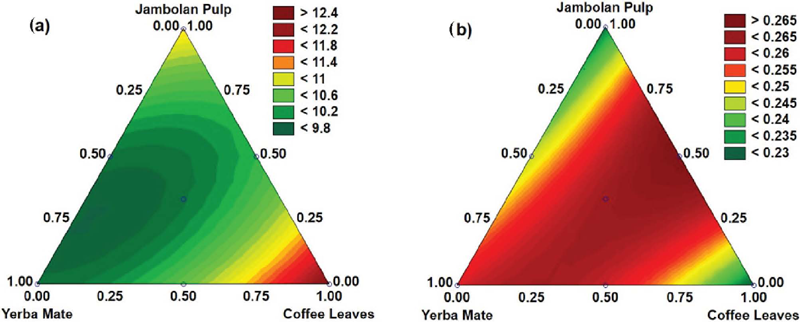
In Figure 1, it is observed that the highest values for the induction period were reached in the highest proportions of coffee leaves extract, which are represented in the reddish regions of the response surface (Figure 1a). On the other hand, it is possible to observe that the response surface for the rate constant exhibited its minimum value in the greenish region (Figure 1b). From Figure 1a, it becomes evident that the most optimal IP is obtained solely through the application of coffee leaves extract. As for k (Figure 1b), the best results were obtained with higher proportions of coffee leaves extract or jambolan pulp, despite the latter having a shorter induction period when compared to coffee leaves extract mixed with biodiesel.

Response surface for the induction periods (a) and rate constant (b) of different proportions of yerba mate, coffee leaves, and jambolan pulp extracts
To evaluate the importance of the combined addition of the three extracts with antioxidant properties, their ratios were optimized to maximize the induction period and minimize the rate constant of the biodiesel oxidation reaction. The chosen approach involved employing the super modified simplex optimization method, known for its suitability in automated processes. This method operates as an iterative procedure, continuously suggesting new experimental sequences through algorithm-driven adjustments based on initial parameter conditions. Thus, the method tends to bring the response to an optimal value through the reflection, expansion, and/or contraction of specific points over a region in the n-dimensional space to avoid undesired responses (Bona et al., 2000; Brandão et al., 2011; Brasil, 2023; Castro et al., 2003; Chendysnki et al., 2020; Correia et al., 2020; Derringer; Suich, 1980; Frizon et al., 2015; Harrington, 1965; Lancheros et al., 2023; Maia et al., 2011; Statistica, 2018).
To perform the joint optimization of both responses, the simplex method was integrated with desirability functions, originally developed by Harrington (1965), and later improved by Derringer and Suich (1980). These functions can evaluate a set of responses simultaneously, allowing the determination of the most desirable set of conditions.
Figure 2 shows the optimization of the proportions of natural extracts of yerba mate leaves (Figure 2a), coffee leaves (Figure 2b), and jambolan pulp (Figure 2c), as well as the behavior of the induction period (Figure 2d), rate constant (Figure 2e) and the desirability function (Figure 2f). Parameter stabilization was only achieved after 21 iterations, that is, in simplex 21. As a stopping criterion, the desirability function D was used (Figure 2f) from the point where it ceased to grow to 1 x 10⁻⁴, in 3 consecutive simplexes.

Figure 2b, based on simplex 21, shows that the highest proportion of coffee leaves extract yielded the highest oxidative stability and the lowest rate constant for biodiesel oxidation, with an IP of 12.41 hours (Figure 2d) and k of 0.2299 h−1 (Figure 2e).
CONCLUSIONS
1. The conformity assays conducted on the biodiesel, with the exception of the induction period, were in accordance with the specification parameters set by current legislation EN 14214 where IP must be equal or greater than 8 hours;
2. Phenolic compounds with antioxidant properties act as antioxidants in biodiesel, donating hydrogen to neutralize free radicals, reducing its oxidation reaction rate. The addition of alcoholic extracts of yerba mate leaves, coffee leaves and jambolan pulp increased the induction period and decreased the rate constant of the biodiesel oxidation reaction in relation to the control sample;
3. The predictive equations derived through the simplex-centroid method, with the application of the super modified simplex optimization method integrated with the desirability functions, proved to be adequate tools that allowed the determination of the best proportion of alcoholic extracts to obtain a higher IP and a lower k for the biodiesel oxidation reaction;
4. Among the extracts used, the alcoholic extract of coffee leaves stood out. This extract notably enhanced the oxidative stability of the biodiesel and resulted in a lower rate constant in comparison to the other extracts. This extract increased the oxidative stability of biodiesel with a PI of 12.42 hours and decreased k to 0.2296 h-1, the lowest compared to the other extracts. The biodiesel containing alcoholic extracts of yerba mate leaves and jambolan pulp had IP values of 9.95 and 11.25 hours, respectively, and rate constants of 0.2573 hours-1 and 0.2310 hours-1. Therefore, for the parameters analyzed in the study, the alcoholic extract of coffee leaves was the most efficient in increasing IP and reducing k.
ACKNOWLEDGMENT
State University of Londrina (UEL), National Council for Scientific and Technological Development (CNPq), Coordination for the Improvement of Higher Education Personnel (CAPES) and Araucaria Foundation to Support Scientific.
REFERENCES
-
ASTM D2500-17a. Standard test method for cloud point of petroleum products and liquid fuels. West Conshohocken, PA: ASTM International, 2017. Disponível em: http://www.astm.org Acesso em: 05 de março de 2025.
» http://www.astm.org -
ASTM D4052. Standard test method for density, relative density, and API gravity of liquids by digital density meter. West Conshohocken, PA: ASTM International, 2018. Disponível em: http://www.astm.org Acesso em: 05 de março de 2025.
» http://www.astm.org -
ASTM D445. Standard test method for kinematic viscosity of transparent and opaque liquids (and calculation of dynamic viscosity). West Conshohocken, PA: ASTM International, 2021. Disponível em: http://www.astm.org Acesso em: 05 de março de 2025.
» http://www.astm.org -
ASTM D6304-20. Standard test method for determination of water in petroleum products, lubricating oils, and additives by coulometric Karl Fischer titration. West Conshohocken, PA: ASTM International, 2020. Disponível em: http://www.astm.org Acesso em: 05 de março de 2025.
» http://www.astm.org -
ASTM D664. Standard test method for acid number of petroleum products by potentiometric titration. West Conshohocken, PA: ASTM International, 2018. Disponível em: http://www.astm.org Acesso em: 05 de março de 2025.
» http://www.astm.org -
ASTM D93. Standard test methods for flash point by Pensky-Martens closed cup tester. West Conshohocken, PA: ASTM International, 2020. Disponível em: http://www.astm.org Acesso em: 05 de março de 2025.
» http://www.astm.org -
BONA, E. et al. Software for optimization using a sequential simplex method. Acta Scientiarum, v. 163, p. 1201-1206, 2000. DOI: https://doi.org/10.4025/actascitechnol.v22i0.3012
» https://doi.org/10.4025/actascitechnol.v22i0.3012. -
BORSATO, D. et al. Kinetic and thermodynamic parameters of biodiesel oxidation with synthetic antioxidants: simplex centroid mixture design. Journal of Brazilian Chemical Society, v. 25, p. 1984-1992, 2014. DOI: https://doi.org/10.5935/0103-5053.20140182
» https://doi.org/10.5935/0103-5053.20140182. -
BORSATO, D. et al. Oxidation kinetics of biodiesel from soybean mixed with synthetic antioxidants BHA, BHT and TBHQ: determination of activation energy. Fuel Processing Technology, v. 127, p. 111-116, 2014. DOI: https://doi.org/10.1016/j.fuproc.2014.05.033
» https://doi.org/10.1016/j.fuproc.2014.05.033. -
BRANDÃO, T. S. O. et al. Changes in enzymes, phenolic compounds, tannins, and vitamin C in various stages of jambolan (Syzygium cumini Lamark) development. Food Science and Technology, v. 31, p. 849-55, 2011. DOI: https://doi.org/10.1590/S0101-20612011000400004
» https://doi.org/10.1590/S0101-20612011000400004. - BRASIL. Ministério de Minas e Energia. Agência Nacional do Petróleo, Gás Natural e Biocombustíveis. Resolução ANP nº. 920, de 4 de abril de 2023. Diário Oficial da União, Brasília, DF, 5 abr. 2023. Seção 1, p. 51.
-
CASTRO, I. A. et al. Simultaneous optimization of response variables in protein mixture formulation: constrained simplex method approach. International Journal of Food Science and Technology, v. 38, p. 103-110, 2003. DOI: https://doi.org/10.1046/j.1365-2621.2003.00650.x
» https://doi.org/10.1046/j.1365-2621.2003.00650.x. -
CHENDYNSKI, L. T. et al. Analysis of the formation of radicals in biodiesel in contact with copper and metallic alloys via electronic paramagnetic resonance (EPR). Fuel, v. 242, p. 316-322, 2019. DOI: https://doi.org/10.1016/j.fuel.2019.01.058
» https://doi.org/10.1016/j.fuel.2019.01.058. -
CHENDYNSKI, L. T. et al. Evaluation and application of extracts of rosemary leaves, araçá pulp and peel of bacuri in the inhibition of the oxidation reaction of biodiesel. Fuel, v. 261, e116379, 2020. DOI: https://doi.org/10.1016/j.fuel.2019.116379
» https://doi.org/10.1016/j.fuel.2019.116379. -
CLEMENTE, M. A. J. et al. Estimation of the storage time of biodiesel at room temperature in mixture with natural antioxidants and metallic ions: a semi-empirical study. Fuel, v. 253, e129276, 2023. DOI: https://doi.org/10.1016/j.fuel.2023.129276
» https://doi.org/10.1016/j.fuel.2023.129276. -
COPPO, R. L. et al. Effect of natural antioxidants on oxidative stability of biodiesel from soybean oil applying simplex-centroid design. Journal of Biobased Materials and Bioenergy, v. 8, p. 545-51, 2014. DOI: 10.1166/jbmb.2014.1468.
» https://doi.org/10.1166/jbmb.2014.1468. -
CORREIA, I. A. S. et al. Inhibition of the biodiesel oxidation by alcoholic extracts of green and black tea leaves and plum pulp: application of the simplex-centroid design. Renewable Energy, v. 160, p. 288 96, 2020. DOI: https://doi.org/10.1016/j. renene.2020.06.118
» https://doi.org/10.1016/j. renene.2020.06.118. -
DERRINGER, G.; SUICH, R. Simultaneous optimization of several response variables. Journal of Quality Technology, v. 12, p. 214-19, 1980. DOI: https://doi.org/10.1080/002240 65.1980.11980968
» https://doi.org/10.1080/002240 65.1980.11980968. -
DUNN, R. O. Effect of antioxidants on the oxidative stability of methyl soyate (biodiesel). Fuel Processing Technology, v. 86, p. 1071-85, 2005. DOI: https://doi.org/10.1016/j. fuproc.2004.11.003
» https://doi.org/10.1016/j. fuproc.2004.11.003. - EN 14111. Fat and oil derivatives. fatty acid methyl esters (fame). determination of iodine value. Brussels: European Committee for Standardization, 2003.
- EN 14112. Fat and oil derivatives. Fatty acid methyl esters (fame). determination of oxidation stability (accelerated oxidation test). Brussels: European Committee for Standardization, 2003.
- EN 14214. Liquid petroleum products. Fatty acid methyl esters (FAME) for use in diesel engines and heating applications. Requirements and test methods. Brussels: European Committee for Standardization, 2020.
-
FRIZON, C. N. T. et al. Determination of total phenolic compounds in yerba mate (Ilex paraguariensis) combining near infrared spectroscopy (NIR) and multivariate analysis. LWT - Food Science and Technology, v. 60, p. 795-801, 2015. DOI: http://dx.doi.org/10.1016/j.lwt.2014.10.030
» https://doi.org/10.1016/j.lwt.2014.10.030 -
GREGÓRIO, A. P. H. et al. Kinetic and thermodynamic parameters in biodiesel oxidation reaction in the presence of coffee leaves and sage extracts. Sustainable Energy Technologies and Assessments, v. 28, p. 60-64, 2018. DOI: https://doi.org/10.1016/j.seta.2018.06.008
» https://doi.org/10.1016/j.seta.2018.06.008. - HARRINGTON, E. C. The desirability function. Industrial Quality Control, v. 21, p. 494-98, 1965.
-
HOANG, A. T. et al. Rice bran oil-based biodiesel as a promising renewable fuel alternative to petrodiesel: a review. Renewable and Sustainable Energy Reviews, v. 135, e110204, 2021. DOI: https://doi.org/10.1016/j.rser.2020.110204
» https://doi.org/10.1016/j.rser.2020.110204. -
JEYAKUMAR, N. et al. Experimental evaluation over the effects of natural antioxidants on oxidation stability of binary biodiesel blend. International Journal of Energy Research, v. 46, 2022. DOI: https://doi.org/10.1002/er.7956
» https://doi.org/10.1002/er.7956. -
KAHIMBI, H.; KICHONGE, B.; KIVEVELE, T. The potential of underutilized plant resources and agricultural wastes for enhancing biodiesel stability: the role of phenolic-rich natural. International Journal of Energy Research, v. 2, p. 1-30, 2023. DOI: https://doi.org/10.1155/2023/9389270
» https://doi.org/10.1155/2023/9389270. -
KUMAZAWA, S.; HAMASAJA, T.; NAKAYAMA, T. Antioxidant activity of propolis of various geographic origins. Food Chemistry v. 84, p. 329-339, 2004. DOI: https://doi.org/10.1016/S0308-8146(03)00216-4
» https://doi.org/10.1016/S0308-8146(03)00216-4. -
LANCHEROS, A.; GUEDES, C.; BORSATO, D. Multiresponse optimization of biodiesel obtained from a mixture of soybean oil, beef tallow, and waste cooking oil. Biofuels, v. 14, n. 8, p. 785-792, 2023. DOI: https://doi.org/10.1080/17597269.2023.2175477
» https://doi.org/10.1080/17597269.2023.2175477. -
MAIA, E. C. R. et al. Study of the biodiesel B100 oxidative stability in mixture with antioxidants. Fuel Processing Technology, v. 92, p. 1750-55, 2011. DOI: https://doi.org/10.1016/j.fuproc.2011.04.028
» https://doi.org/10.1016/j.fuproc.2011.04.028. -
MEDEIROS, M. L. et al. Efficient antioxidant formulations for use in biodiesel. Energy Fuels, v. 28, p. 1074-1080, 2014. DOI: https://doi.org/10.1021/ef402009e
» https://doi.org/10.1021/ef402009e. -
PINTO, A. C. et al. Biodiesel: an overview. Journal of the Brazilian Chemical Society, v. 16, p. 1313-1330, 2005. DOI: https://www.scielo.br› jbchs
» https://www.scielo.br› jbchs -
REZENDE, M. J. C. et al. Biodiesel: an overview II. Journal of the Brazilian Chemical Society, v. 32, p. 1301-1344, 2021. DOI: https://dx.doi.org/10.21577/0103-5053.20210046
» https://doi.org/10.21577/0103-5053.20210046 -
ROMAGNOLI, E. S. et al. Influence of the extracts of senna leaves, blackberries and hibiscus flowers in the oxidation reaction of commercial biodiesel. Biofuels, v. 11, n. 7, p. 839-45, 2018. DOI: https://doi.org/10.1080/17597269.2017.1418569
» https://doi.org/10.1080/17597269.2017.1418569. - STATISTICA software for windows: version 2018/13.4. Tulsa: StatSoft Inc., 2018.
-
TOMISLAV, K. The concept of sustainable development: from its beginning to the contemporary issues. Zagreb International Review of Economics & Business, v. 21. p. 67-94, 2018. DOI: https://doi.org/10.2478/zireb-2018-0005
» https://doi.org/10.2478/zireb-2018-0005. -
TURRIO-BALDASSARRI, L. et al. Emission comparison of urban bus engine fueled with diesel oil and ‘biodiesel’ blend. Science of the Total Environment, v. 327, p. 147-162, 2004. DOI: https://doi.org/10.1016/j.scitotenv.2003.10.033
» https://doi.org/10.1016/j.scitotenv.2003.10.033.
Edited by
-
Editor-in-Chief:
Agricultural Engineer. Manoel Barbosa Filho - manoel.filho@ufc.br