
 Sources and methods of phosphorus application in maize cultivation
ABSTRACT
Despite having a vast area for agricultural production, Brazil is highly dependent on mineral sources for phosphate fertilisers, making their use unsustainable and highly dependent on the international market. The aim of the present study was to evaluate the effect of different sources of phosphate fertiliser and the depth of application on the development and productivity of maize over two crop seasons. A randomised block design was used in a 3 × 4 factorial scheme comprising 12 treatments, with four replications. Three sources of phosphorus were tested: single superphosphate (SSP), Top-Phos® (TOP-PHOS) and reactive natural phosphate (RNP), in addition to four methods of application (broadcast application [0.00 m] and in-furrow application at three depths [0.05 m, 0.08 m and 0.11 m]). The following parameters were evaluated: final plant stand, plant height, stalk diameter, ear insertion height, number of rows per ear, number of grains per row, 1000-grain weight, and grain productivity. The data were submitted to analysis of variance using the F-test at a level of 5%, and to principal component analysis (PCA) with biplot graphical analysis. The use of SSP and Top-Phos® increased productivity and the ear insertion height compared to the use of RNP. Applications made at a depth of 0.11 m were the most efficient. Seasonal variables affected productivity, with Top-Phos® showing a greater correlation with the yield metrics at greater depths.
Keywords:
Fertilisation depth; Natural phosphate; Phosphate fertiliser; Top-Phos; Zea mays L.
INTRODUCTION
Phosphorus (P), one of the primary macronutrients essential for plant growth, can be supplied by various sources of phosphate fertiliser, which differ in solubility and nutrient content. Available sources of phosphorus include natural phosphates (NF), simple superphosphate (SSP) and triple superphosphate (TSP), as well as phosphate fertilisers of animal and synthetic origin, and in some cases, wastewater (Boldrin et al., 2021; Ferreira Junior et al., 2022). Over 90% of the phosphorus used is in the form of highly reactive phosphates such as SSP, TSP and MAP (Monoammonium Phosphate) (Withers et al., 2018). These fertilisers are highly efficient in the short-term supply of phosphorus to the soil; however, their unit cost is high (Johnston et al., 2014).
Although phosphorus is a macronutrient and is required in small quantities by plants, it is the most frequently applied nutrient in agricultural fertilisers in Brazil (Resende et al., 2006; Withers et al., 2018). The scarcity of phosphorus in Brazilian soils is attributed to agricultural intensification, excessive use of other fertilisers, erosion, low natural availability, phosphorus fixation in the soil, nutritional imbalance, and inadequate management practices, which result in a generalised deficiency of the nutrient (Gomes et al., 2019; Oliveira et al., 2021; Muraishi et al., 2011).
Over time, soluble phosphates such as SSP and TSP tend to become less efficient when applied to the soil due to phosphorus fixation (Rajan; Upsdell, 2021; Santos et al., 2021). Natural phosphates, which are less soluble in water, dissolve slowly, gradually increasing the phosphorus availability for plants (Asomaning, 2020; Johan et al., 2021; Oliveira et al., 2019). On the other hand, Top-Phos® is a protected phosphate fertiliser that prevents phosphorus fixation by aluminum (Al), iron (Fe) and calcium (Ca) in the soil, especially in acidic soils, making the nutrient more available and easier to use by plants (Almeida et al., 2016; Timac AGRO, 2018).
In addition to the source, the method and depth of phosphorus application influence crop development by affecting root distribution in the soil. The two most common methods of fertilisation for grain production are broadcasting, in which the fertiliser is applied to the surface and may or may not be incorporated into the soil, either sowing the crop after fertilisation or in the context of corrective practices; and in-furrow, where the fertiliser is applied directly into the furow at the time of planting annual crops (Gotz et al., 2023; Nunes et al., 2011).
In broadcast phosphorus fertilisation, the fertiliser is distributed evenly throughout the area to be cultivated using specific equipment such as fertiliser or limestone spreaders (Shahena et al., 2021). Applying phosphorus to the surface stimulates shallow roots, limiting the ability of the plants to penetrate the soil, making them vulnerable to drought and toppling, and impairing their development and productivity (Nunes et al., 2011; Wang et al., 2021).
In-furrow fertilisation is characterised by the application of fertiliser at a certain depth and distance from where the seed is to be deposited, so that the plant roots have direct access to the nutrients (Teixeira et al., 2018; Valadão et al., 2015). The in-furrow application of fertilisers affords precise control of the dosage and distribution of the fertiliser, promoting initial development and plant vigour, in addition to improving root development (Quinn; Lee; Poffenbarger, 2020; Resende et al., 2006).
Considering that only a relatively small fraction of the applied phosphorus is effectively used by the plants, while the rest remains in the soil in the form of reduced or increased availability for plants, the residual effect becomes a critical component in the agronomic and economic evaluation of phosphate fertiliser (Huang et al., 2024; Oliveira et al., 2021; Quinn; Lee; Poffenbarger, 2020; Resende et al., 2006).
One hypothesis is that applying protected phosphate fertilisers, such as Top-Phos®, at specific depths in the furrow, results in greater phosphorus availability for maize plants, promoting better root development and higher productivity compared to conventional phosphorus sources, such as simple superphosphate and reactive natural phosphate. In this respect it is necessary to check how different sources of phosphorus and methods of application influence its availability in the soil and, consequently, the growth and productivity of maize, particularly in Brazilian soils where phosphorus fixation is high.
The aim of this study was to evaluate development and productivity in maize as a function of different sources and methods of phosphorus application when sowing, during the 2018/2019 and 2019/2020 crop seasons.
MATERIAL AND METHODS
The experiment was conducted in the experimental area of the Dois Vizinhos Campus of the Federal University of Technology - Paraná (UTFPR), in Paraná, Brazil, at 25°41’32” S and 53°05’42” W at an altitude of 526 metres. The soil in the area is a Dystroferric Red Latosol (Typic Hapludox) with a high phosphorus fixation capacity (Muraishi et al., 2011; Soil Survey Staff, 2014), very clayey texture, and the following chemical characteristics at a depth of 0.0 - 0.20 m: organic matter (OM) in g dm-3 = 51.6; pH in CaCl2 = 5.93; P (Mehlich-1) = 18.02 mg dm-3; K, Ca and Mg = 0.77, 8.93 and 2.24 cmolc dm-3, respectively, and percent base saturation (V%) = 78.55%.
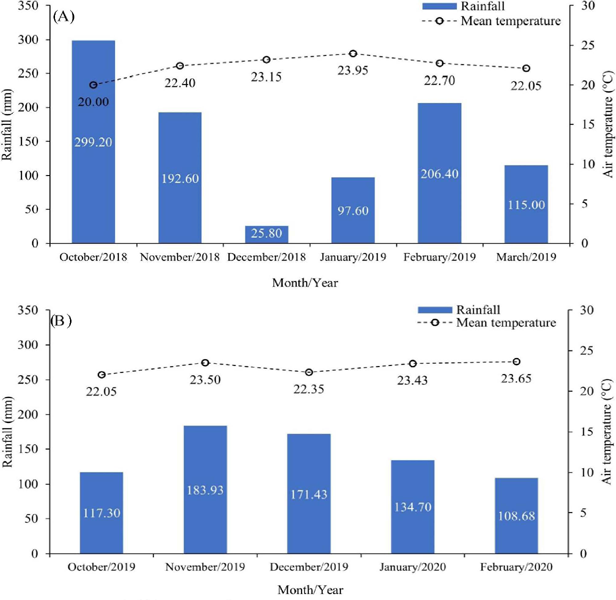
According to the Köppen’s classification, the climate of the region is type Cfa: subtropical, with an average temperature below 18 °C during the coldest month and above 22 °C during the hottest month, hot summers, infrequent frosts, with an average rainfall of 2,025 mm year-1 tending to concentrate during the summer, albeit with no defined dry season (Alvares et al., 2013). The average temperature and rainfall data during the experimental period are shown in Figure 1.

Meteorological data during the experimental period for the 2018/2019 (A) and 2019/2020 (B) crop seasons
The experimental area has been cultivated for over 15 years under a no-tillage system (NTS) with soya beans (Glycine max (L.) Merr.) and maize (Zea mays L.) during the summer and black oats (Avena strigosa Schreb) or ryegrass (Lolium multiflorum L.) during the winter.
A randomised block design (RBD) was used in a factorial scheme comprising 12 treatments, each with four replications, giving a total of 48 experimental units. The treatments consisted of combinations of three sources of phosphorus: 1) simple superphosphate (SSP) with 19% P2O5; 2) Top-Phos® (Timac Agro, Brazil) (TOP-PHOS) with 28% P2O5, including 6% slow-release P (Timac AGRO, 2018); and 3) reactive natural phosphate (RNP) with 30% P2O5. In addition, four methods of application at different depths were evaluated: I) surface broadcast (0.00 m); II) in the furrow at a depth of 0.05 m; III) in the furrow at a depth of 0.08 m; and IV) in the furrow at a depth of 0.11 m.
The plots consisted of five rows, 12 metres in length, spaced 0.45 m apart, with a plant spacing of 0.3 m. The working area of each plot was 8.1 m2, including the three central rows, disregarding 3.0 m of border at each end.
Black oats (Avena strigosa Schreb) were used for cover during the winter, at a seed rate of 80 kg ha-1 with no base fertiliser. The experiment was conducted over two years (2018/2019 and 2019/2020 crop seasons). For the first year of the experiment, the maize was sown on 17 October 2018, and for the second year, on 8 October 2019. The Pioneer 30F53VHR R3® hybrid was used, with a stand of 70,000 plants ha-1, or 3.15 plants per linear metre. A precision direct-planting seeder-fertiliser was used (Vence Tudo®, model SA 14600), with a mechanical seed dispenser, giving five planting rows spaced 0.45 metres apart at a speed of 5.0 km h-1.
The amount of each source of phosphorus was calculated when setting up the experiment considering the total P2O5 content of the fertilisers and the history of the experimental area. The following fertilisers were applied at sowing: 421 kg ha-1 SSP (19% P2O5), 288 kg ha-1 TOP-PHOS (28% P2O5) and 266 kg ha-1 RNP (30% P2O5). Urea was used as the source of nitrogen (N), with a N content of 45%, applying 150 kg N ha-1. Potassium chloride (KCL), with a total K content of 60%, was used as potassium fertiliser at a rate of 120 kg ha-1, which was broadcast as top dressing.
The following characteristics were assessed during the period of physiological maturity of the maize: final plant stand (FPS), plant height (PH, in m), stalk diameter (SD, in mm), and ear insertion height (EIH, in m). The final plant stand was determined by counting the plants in six linear metres of each of the three central rows of each experimental unit (working area); this result was later extrapolated to the total number of plants per hectare. Plant height, stalk diameter and ear insertion height were measured in 10 plants in the working area of each experimental unit.
The yield components of the maize crop were evaluated in 10 ears collected at random from each experimental unit. The number of grains per row (NGR) and number of rows per ear (NRE) were determined; the ears were then threshed by hand to determine the 1000-grain weight (W1000, in g), calculated from the average of eight subsamples, each containing 100 randomly selected grains from each plot. These subsamples were weighed, and the moisture content corrected to 13%. Grain productivity (PROD, in kg ha-1) was calculated by harvesting all the ears in the working area of each experimental unit; the data were then extrapolated to an area of one hectare.
The data were submitted to tests of normality (Shapiro-Wilk) and homogeneity (Oneill-Mathews) and then to analysis of variance. Whenever there was a significant difference (p ≤ 0.05), the mean values of the qualitative effects (sources of P) were compared by Tukey’s test at 5% probability, while for the quantitative effects (methods and depths of P application), polynomial regression analysis were carried out. The models were selected based on the highest R2 and the significance (p ≤ 0.05) of the equation parameters, using the GENES® software (Cruz, 2013).
To obtain an integrated evaluation of the sources of phosphate fertiliser in relation to the methods (depths) of phosphorus application, the data were submitted to principal component analysis (PCA), selecting two PCAs considering each of the variables, using biplot graphical analysis. The multivariate analysis was carried out using the OriginPro® 2021 software (Originlab Corporation, 2022).
RESULTS AND DISCUSSION
Agronomic characteristics of the maize at physiological maturity
The final plant stand (FPS) showed no significant differences between the sources of phosphorus and the methods (depths) of phosphorus application in either of the two crop seasons (Table 1). The average value was 71,527.77 plants ha-1 for the 2018/2019 season and 71,656.37 plants ha-1 for the 2019/2020 season, considered satisfactory since the desired average population in the experiment was 70,000 plants ha-1.
Summary of the analysis of variance represented by the mean squares for the agronomic characteristics of the maize crop, evaluated for three sources of phosphorus (single superphosphate - SSP, Top-Phos® - TOP-PHOS and reactive natural phosphate - RNP) and four methods (depths) of phosphorus application (I: surface broadcast, II: applied in the furrow at 0.05 m, III: applied in the furrow at 0.08 m, and IV: applied in the furrow at 0.11 m). Dois Vizinhos, Paraná, Brazil
A sufficient population and uniform distribution of the maize plants are extremely important when seeking high productivity (Storck et al., 2015). In addition, the application of phosphate fertilisers at the right dose and time significantly improves grain yield, but only when combined with the ideal plant density (Oliveira et al., 2021; Quinn; Lee; Poffenbarger, 2020; Resende et al., 2006).
The results are related to the optimal climate conditions at the start of development in the maize crop, with no water deficit (Figure 1), which allowed the plants to make the most of the resources available in the soil.
According to the quadratic model (Table 1), there was a significant response for plant height (PH) during the 2018/2019 season, reaching the greatest height (2.45 m) when the TOP-PHOS source of phosphorus was applied at a depth of 0.07 m (Figure 2A). SSP did not present a mathematical model that fit the data, maintaining an average height of approximately 2.44 m (Figure 2A). On the other hand, RNP showed a linear increase in plant height with increasing depth. It should be noted that among the sources used, RNP resulted in the lowest values for final plant height (Figure 2A).

Height of the maize plants (m) during the 2018/2019 (A) and 2019/2020 (B) crop seasons as a function of the different methods (depths) of phosphate fertilisation and sources of phosphorus. **significant at a level of 1%; *significant at a level of 5% and (ns) not significant at a level of 5%
In the 2019/2020 crop season, with phosphate fertiliser applied at a depth of 0.11 m, there was a linear increase in plant height for RNP and TOP-PHOS. For TOP-PHOS and SSP, plant height was approximately 2.85 m. For RNP, the final height was 2.83 m (Figure 2B).
In terms of the source of phosphate fertiliser, the lowest technical efficiency was seen with SSP at a depth of 0.03 m (Figure 2B), with a plant height of 2.81 m. For the 2018/2019 crop season, the greatest plant height compared to the other sources was seen with TOP-PHOS applied on the surface. However, during the 2019/2020 season, virtually none of the sources stood out.
Recent studies show that the use of SSP and RNP can provide plants with better nutrition, as they reduce the effects of soil-plant competition by reducing phosphorus fixation in the soil, improving the soil-plant interaction and increasing fertiliser use efficiency, thereby optimising efficient use of the phosphorus (Hellal et al., 2019; Oliveira et al., 2019; Rajan; Upsdell, 2021; Santos et al., 2021). The use of very soluble sources of phosphorus, such as single or triple superphosphate, can lead to problems with plant nutrition, since these sources have a higher rate of nutrient release, which increases their interaction with colloids in the soil. On the other hand, the use of reactive natural phosphate (RNP) is an interesting alternative, as it is more sustainable and less aggressive to the environment due to the gradual release of phosphorus into the soil, which can minimise P fixation in addition to reducing the cost of fertilisation (Ferreira Junior et al., 2022).
Boldrin et al. (2021) investigated the effect of different sources and times of phosphorus application on maize nutrition and found that triple superphosphate, for example, should be used in soils with corrected acidity, while natural phosphate performs better when used in acidic soils, with RNP promoting still greater phosphorus availability for plants without the application of limestone.
The better performance of natural phosphate in acidic soils is due to the interaction with iron and aluminium oxides in the soil, which solubilise phosphate rock, improving its availability for plants (Asomaning, 2020; Johan et al., 2021). Furthermore, the activity of phosphorus-solubilising microorganisms in acidic environments, which produce organic acids, and modification of the chemical properties of the soil by such materials as charcoal and wood ash that reduce the toxicity of aluminium and iron, increase nutrient use efficiency (Johan et al., 2021; Sharma et al., 2013).
Several studies have shown that, despite being less soluble than other sources, RNP can be a viable option in soils with a higher pH (Ferreira Junior et al., 2022). Furthermore, Oliveira et al. (2019) found that the application of RNP improved phosphorus availability and maize productivity, and was more efficient than soluble triple superphosphate. These results underline the importance of choosing the appropriate source of phosphorus for maize, and the relevance of ongoing studies into plant nutrition and soil fertility.
In the 2018/2019 crop season, there were no significant differences between the sources of fertiliser for stalk diameter (SD), with a linear increase for the different methods (depths) of application (Table 1 and Figure 3A). Several factors may have contributed to this lack of results among the sources of phosphate fertiliser, one of which is the high phosphorus content of the soil used in this study (18.02 mg dm-3), considered very high for the soil, which is very clayey (> 60% clay) (Pauletti; Motta, 2019).

Average values for stalk diameter (mm) during the 2018/2019 (A) and 2019/2020 (B) crop seasons as a function of the different methods (depths) of phosphate fertilisation and sources of phosphorus. ** significant at a level of 1%; *significant at a level of 5% and (ns) not significant at a level of 5%
During the 2019/2020 season, the crop response to phosphate fertilisation using different methods (depths) of application (Table 1) showed that the stalk diameter adjusted to the quadratic model, the results demonstrating that when applied at a depth of 0.07 m, the fertiliser resulted in a smaller diameter (average of 21.64 mm). However, the treatments that received broadcast phosphate fertiliser showed a better response, with a stalk diameter of 23.07 mm (Figure 3B).
Applying fertiliser in the layer most influenced by the roots reduces the loss of phosphorus to soil colloids, since, by placing the nutrient closer to the roots, it is quickly absorbed by the plants before it can bind to the colloids (Huang et al., 2024; Mollier; Pellerin, 1999). At the same time, this favours the availability of the nutrient, stimulating vegetative development and leading to greater expansion of the shoots (Teixeira et al., 2018). Maintaining the diameter of the stalk is crucial for regulating the flow of carbohydrates, as the organ uses stored reserves to meet the demand during the grain filling stage (Zucareli et al., 2019). Under stress conditions, such as those often seen during the second crop season, maintaining or increasing the stalk diameter is even more important, especially where there is intense intraspecific competition (Zucareli et al., 2019). In this respect, choosing the best source of phosphorus and depth of application when sowing the maize are key factors for increasing the productivity of the crop.
There were significant differences in terms of plant height (PH) and ear insertion height (EIH) in relation to the sources of phosphate fertiliser during the 2018/2019 crop season, and in stalk diameter (SD) during the 2019/2020 season (Table 2).
Plant height (PH), stalk diameter (SD) and ear insertion height (EIH) in maize as a function of the different sources of phosphate fertiliser applied when sowing, during the 2018/2019 and 2019/2020 crop seasons
When analysing the height of the maize plants, it was found that the treatment receiving TOP-PHOS as the source of phosphate fertiliser had the greatest average height (2.44 m) and was not statistically different from the treatment that received the simple superphosphate (SSP) (Table 2). On the other hand, reactive natural phosphorus (RNP) had the lowest average height at 2.38 metres. This variation in plant height can be attributed to several factors, of which the source of phosphate fertiliser is among the most important; for example, RNP may have resulted in taller plants due to its specific composition and the way it provides nutrients essential for plant growth.
The treatments that received TOP-PHOS as a source of phosphate fertiliser had the largest stalk diameter (22.41 mm) and did not differ from those that received RNP (22.20 mm). The smallest stalk diameter was found for simple superphosphate, with 21.85 mm, which statistically, also did not differ from RNP.
The stalk is a basic structure, ensuring adequate support for the maize plant, in addition to being an important organ for storing photoassimilates (Cunha; Jesus; Buso, 2017; Souza et al., 2018). The diameter of the stalk is an important variable in genetic improvement programs, as it is directly related to the resistance of a plant to water deficit and lodging. During the grain filling stage of the maize, some compounds found in the stalk, such as sucrose, are mobilised towards the ears, helping to increase the 1000-grain weight; a correlation can therefore be established between a larger stalk diameter and high productivity, since the compounds stored in this part of the plant can be remobilised for grain filling (Souza et al., 2018).
Maize plants with smaller stalk diameters can compromise both productivity and harvest efficiency, given that there is an increased risk of plant lodging (Souza et al., 2018). Some authors maintain that a larger stalk diameter can be considered an undesirable characteristic, since the plant would direct its reserves to vegetative growth, impairing grain filling and, consequently, productivity (Cunha; Jesus; Buso, 2017). From this point of view, it should be said that different sources of phosphorus applied when sowing the maize (RNP and TOP-PHOS) favour a larger stalk diameter, which may later result in higher crop productivity.
Regarding the influence of the source of phosphate fertiliser on the ear insertion height (EIH), the best result was obtained with the SSP and TOP-PHOS fertilisers. For these sources, the average insertion height was 1.32 m and 1.31 m, respectively (Table 2). The lowest insertion height was seen with RNP (1.29 m) during the 2019/2020 crop season. According to Kopper et al. (2017), plants with higher ear insertions tend to produce more grain. In addition, maize plants with an ear insertion greater than 1.0 m allow the crop to be harvested with no loss of productivity (Gerlach; Silva; Arf, 2019).
In the 2018/2019 season, the ear insertion height adjusted to quadratic equations in response to the different methods (depths) of fertilisation and sources of phosphorus (Table 1 and Figure 4). The lowest technical efficiency for the EIH (1.30 m) was seen at a depth of 0.02 m (Figure 4A); however, the best responses (1.32 m) were for phosphate fertiliser applied at a depth of 0.11 m, with no statistical difference in relation to the source. These results show that applying phosphate fertiliser at greater depths affords greater development of the ear insertion.
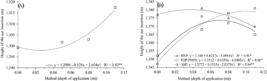
Average values for ear insertion height (m) in maize during the 2018/2019 (A) and 2019/2020 (B) crop seasons as a function of the methods (depths) of phosphate fertilisation and sources of phosphorus. **significant at a level of 1%; *significant at a level of 5% and (ns) not significant at a level of 5%
For the 2019/2020 season, RNP presented the greatest insertion height (1.38 m) when this phosphate fertiliser was applied at a depth of 0.10 m (Table 1 and Figure 4B). For TOP-PHOS, the greatest technical efficiency was seen when applied at a depth of 0.06 m, with an insertion height of 1.37 m. When evaluating the technical efficiency of the simple superphosphate (SSP) fertiliser, the greatest ear insertion height occurred at an application depth of 0.04 m, with an EIH of 1.38 m (Figure 4B).
The EIH shows a significant positive correlation with maize productivity, standing out as the variable with the highest correlation, and is considered an important agronomic parameter in high-yield hybrids (Kopper et al., 2017). However, a lower ear insertion height can promote better vertical balance for the plant, resulting in a lower incidence of stalk breakage and plant toppling, especially in crops with higher plant densities (Quinn; Lee; Poffenbarger, 2020).
Yield components of the maize crop
During the 2018/2019 crop season, the number of rows per ear (NRE) showed no significant differences between the sources of phosphate fertiliser, with an average value of 17.15 rows per ear of maize (Tables 3 and 4). During the 2019/2020 season, the use of RNP showed a higher NRE compared to the other sources of phosphate fertiliser, with an average value of 18.13. These results are possibly related to the phosphorus accumulating in the plants and soil regardless of the reactivity of the source of phosphate or the method of application (Oliveira et al., 2021).
Summary of the analysis of variance represented by the mean squares for the yield components of the maize crop evaluated in three sources of phosphorus (single superphosphate - SSP, Top-Phos® - TOP-PHOS and reactive natural phosphate - RNP) and four methods (depths) of phosphorus application (I: surface broadcast, II: applied in the furrow at 0.05 m, III: applied in the furrow at 0.08 m, and IV: applied in the furrow at 0.11 m). Dois Vizinhos, Paraná, Brazil
Number of rows per ear (NRE), number of grains per row (NGR) and grain productivity (PROD) as a function of the sources of phosphate fertiliser, during the 2018/2019 and 2019/2020 crop seasons
During the 2018/2019 crop season, applying TOP-PHOS resulted in the highest number of grains per row (NGR), with an average of 35.50 grains (Tables 3 and 4). The other sources of phosphate fertiliser showed no significant differences, with 32.06 and 33.63 grains per row, for RNP and SSP, respectively. During the 2019/2020 crop season, there were no significant differences for NGR, with an average value of 36.06 grains per row.
The number of grains per row is related to the average length of the ears, this relationship being influenced by the genetic potential of the hybrid and the conditions of the soil and climate (Quinn; Lee; Poffenbarger, 2020). It can also be seen that correctly selecting the source of phosphate fertiliser can have a positive impact on the number of grains per row, as shown by the application of TOP-PHOS, which had a positive effect on increased productivity in the maize.
The lack of a significant response during the 2019/2020 crop season can be attributed to the history of phosphate fertilisation in the study area, where the P content is considered very high (18.02 mg dm-3) for the very clayey soil in the area (> 60% clay) (Pauletti; Motta, 2019). Given that the area has been fertilised with phosphorus for approximately fifteen years under a no-tillage system used for growing soybeans and maize, it is expected that a large part of the most reactive sites in the soil are already saturated with this element, which would reduce its loss through adsorption onto the soil colloids. Furthermore, it should be noted that the soils in the region are kaolinitic, stratified with 2:1 minerals interlaid with hydroxide, meaning that adsorption is not as marked as in oxidic soils, for example (Santos et al., 2023). Kaolinitic soils have a lower cation exchange capacity compared to soils with 2:1 minerals, such as vermiculite and smectite, which results in fewer nutrients and chemical elements retained in the soil (Kumari; Mohan, 2021).
Under the conditions of this experiment, October saw 299.20 mm of rainfall, with an average temperature of 22 °C (Figure 1). These conditions favoured the p la n t -m i cr oorgani sm interaction, as well as fertiliser usage, which helped determine these production components.
In relation to grain productivity, it was found that during the 2018/2019 crop season the treatments that received an application of SSP had an average production of 10,361.43 kg ha-1, while the other sources did not differ from one another, with averages of 9,629.03 kg ha-1 and 9,400.50 kg ha-1, for TOP-PHOS and RNP, respectively (Table 4). There were no significant differences between the sources of phosphate fertiliser during the 2019/2020 crop season, with an average value of 10,664.70 kg ha-1. The average productivity for both crop seasons was higher than the average productivity of the state of Paraná, which was 6,394 kg ha-1 for the 2018/2019 crop season and 5,684 kg ha-1 for 2019/2020 (CONAB, 2020).
Maize productivity in the treatments with RNP applied during the 2018/2019 season is related to its solubility in the soil. Sources with low solubility require more time to release their phosphorus into the soil solution so that it can then be absorbed by the plants (Ferreira Junior et al., 2022; Resende et al., 2006). It is also important to remember that when a fertiliser is less soluble, it is released gradually, giving the plant access to the phosphorus over a longer period. On the other hand, when the fertiliser is highly soluble and the entire dose is quickly released into the solution, a large part of the molecules can be lost due to adsorption onto soil colloids (Han; White; Cheng, 2022; Wang et al., 2021).
Given the dynamics of phosphorus in the soil, the results of this study can, to some extent, be attributed to occupation of the soil colloids, a result of the fertilisation history. This result is evidently due to the similar response of the crop to different phosphate management strategies (Huang et al., 2024; Resende et al., 2006). It is also important to assess the local soil and climate conditions and the specific characteristics of each source of phosphate fertiliser in order to optimise the effects of the fertiliser management on crop productivity.
During the 2018/2019 crop season, there were no significant differences between the sources of phosphate fertiliser in relation to the number of grains per row (NGR); however, there were significant differences between the various application depths (Figure 5A). During the 2019/2020 crop season, RNP was less efficient at a depth of 0.04 m, with an average of 35.56 grains per row. In the case of the TOP-PHOS fertiliser, there was a linear increase, whereas SSP adjusted to quadratic equations in response to the different application depths, with the best responses at a depth of 0.11 m (Figure 5B).

Average values for the number of grains per row during the 2018/2019 (A) and 2019/2020 (B) crop seasons as a function of the methods (depths) of phosphate fertilisation and sources of phosphorus. ** significant at a level of 1%; * significant at a level of 5% and (ns) not significant at a level of 5%
The probable explanation for the higher number of grains per row observed in the treatment at a fertilisation depth of 0.11 m may be related to the low mobility of phosphorus in the soil, which, when applied at greater depth, favours ion-root contact via diffusion and root interception (Han; White; Cheng, 2022; Huang et al., 2024). In addition, at this depth the absorption mechanisms, both passive and active, are optimised by the roots of the plants (Wang et al., 2021). The association with mycorrhizae can also increase the efficiency of phosphorus absorption, resulting in better development of the maize ears and, consequently, in a greater quantity of grains per row (Lu et al., 2023).
As it moves in the soil by diffusion, P tends to accumulate close to where it’s applied, especially in the 0.05 to 0.10 m range of the soil profile (Nunes et al., 2020). The lack of tillage can lead to less solubilisation of the fertiliser or even prevent its adsorption. It is important to note that direct contact between the fertiliser and the mineral phase of the soil may increase the adsorption processes of labile phosphorus in non-labile forms, which may significantly affect the availability of the nutrient for the crops (Asomaning, 2020; Oliveira et al., 2021). Choosing the most appropriate fertiliser management strategy for each production system must therefore take into account the interaction between the characteristics of the soil and the characteristics of the fertilisers.
During the 2018/2019 crop season, the greatest technical efficiency in relation to the 1000-grain weight was obtained when the phosphate fertiliser was deposited in the soil at a depth of 0.05 m, with an average 1000-grain weight of 342.00 g (Figure 6). During the 2019/2020 season, there were no significant differences between the sources of phosphate fertiliser and depths of application, with a mean 1000-grain weight of 342.15 g.

Average values for 1000-grain weight (W1000, g) as a function of the methods (depths) of phosphate fertilisation and sources of phosphorus during the 2018/2019 crop season. ** significant at a level of 1%; * significant at a level of 5% and (ns) not significant at a level of 5%
Productivity is improved when fertilisation is carried out in the furrow, since in addition to ensuring distribution of the fertiliser at depth in the root system of the maize, the practice can minimise the negative effects of the physical constraints of the soil, especially in situations of water stress (Valadão et al., 2015). This favours the supply of nutrients throughout the soil profile, which can result in greater root development and, consequently, greater absorption of water and nutrients. It can be said that fertiliser applied in the furrow at a depth of 0.05 m resulted in greater uptake by the roots thereby increasing the 1000-grain weight.
Phosphorus availability in the soil can be influenced by such factors as the pH, the organic matter content, texture and mineralogy, which affect the adsorption and mineralisation of the nutrient (Asomaning, 2020; Resende et al., 2006). Understanding the dynamics of phosphorus in the soil is therefore essential when adopting appropriate management practices with the aim of increasing fertiliser use efficiency and ensuring crop productivity.
Principal Component Analysis (PCA)
The Principal Component Analysis (PCA) shows that the SFS treatments were located in the positive portion of PC1 and in the negative portion of PC2, unlike the TOPPHOS treatments, which were located in the positive portion of PC1 (except for the unincorporated treatment) and in the positive portion of PC2 (Figure 7A). In turn, the RNP treatment was located in the negative portion of PC1, differing from almost all the other treatments (the only exception being the treatment with unincorporated TOP-PHOS) and around the dividing line of PC2.

Two-dimensional projection of the principal components (PC1 and PC2) for the variables under analysis (final plant stand (FPS), plant height (PH), stalk diameter (SD), ear insertion height (EIH), number of rows per ear (NRE), number of grains per row (NGR), 1000-grain weight (W1000) and grain yield (PROD)) in maize as a function of the different methods of phosphorus application (application depth, surface broadcasting (Surface), and application in the furrow at three different depths (0.05, 0.08 and 0.11 m)) and sources of phosphorus (reactive natural phosphate (RNP), Top-Phos® (TOP-PHOS) and simple superphosphate (SSP)) for the 2018/2019 (A) and 2019/2020 (B) crop seasons
Considering the 2018/2019 crop season, it can be seen that the yield components SD, NGR and PH showed a greater correlation with the treatments where TOP-PHOS was incorporated into the soil. On the other hand, the components PROD and W1000 were more pronounced in the SSP treatments (Table 5 and Figure 7A). In the treatments with RNP on the surface and at a depth of 0.05 m, the variable with the greatest correlation was FPS. At greater depths, 0.08 m and 0.11 m, the yield component with the greatest correlation was NRE.
Eigenvectors extracted from the variables analysed in the maize crop as a function of the different methods (depths) of phosphorus application (application depths) and sources of phosphorus during the 2018/2019 and 2019/2020 crop seasons. PC1 = first principal component; PC2 = second principal component
For the 2019/2020 crop season, the treatment with TOP-PHOS at 0.08 m was located at the end of PC2, proving to be highly significant. However, the other treatments were close to the zero point on the dividing line of PC2, indicating that this component did not really explain the variance of the data for these treatments. For PC1, the TOP-PHOS treatment at 0.11 m stood out the most, being located in the positive portion of the PC2 axis; furthermore, W1000 and NRE showed a strong relationship with this fertiliser (PC2) (Table 5 and Figure 7B).
In terms of the SSP treatments, the most significant was the unincorporated application, followed by the incorporated application at 0.05 m. The other treatments were located around the dividing line of PC2, showing that they were not as significant.
In relation to the RNP treatments, the most significant for PC2 were those with applications on the surface or at a depth of 0.05 m. The other treatments were positioned close to the intersection of the two lines representing PC1 and PC2. It is important to note that, in relation to the previous crop season, the 2019/2020 season had a good supply of rainfall, meaning the treatments were masked by the excellent weather conditions.
CONCLUSIONS
-
The application of simple superphosphate (SSP) and Top-Phos® proved to be effective in promoting greater ear insertion height compared to reactive natural phosphate (RNP);
-
SSP was the most efficient source in terms of maize productivity during the 2018/2019 crop season. However, during the 2019/2020 season, there were no significant differences between the sources of phosphorus under test, indicating the influence of seasonal variables;
-
The depth of phosphorus application had a significant impact on maize growth and productivity. Applications at a depth of 0.11 m afforded the best development, resulting in greater plant height, ear insertion height and stalk diameter;
-
The depth of 0.05 m afforded lower technical efficiency, especially for SSP, which performed less well under this condition;
-
The multivariate analysis showed that Top-Phos® had a higher correlation with such yield variables as stalk diameter and number of grains per row when applied at depths of 0.08 and 0.11 m;
-
In soils with high phosphorus fixation, such as the soil in this study, protected phosphate fertilisers such as Top-Phos®, when applied at the correct depth, increase phosphorus use efficiency and improve productivity.
ACKNOWLEDGMENTS
This study was carried out with the support of the Coordenação de Aperfeiçoamento de Pessoal de Nível Superior – Brazil (CAPES) – Finance Code 001. The authors wish to thank the Federal University of Technology – Paraná (UTFPR) for their support in developing the experiment.
REFERENCES
- ALMEIDA, T. et al Efficiency of protected phosphate fertilizer in corn crop. Scientia Agraria, v. 17, n. 1, p. 29-35, 2016.
- ALVARES, C. A. et al Koppen’s climate classification map for Brazil. Meteorologische Zeitschrift, v. 22, n. 6, p. 711-728, 2013.
- ASOMANING, S. K. Processes and factors affecting phosphorus sorption in soils. In: KYZAS G.; LAZARIDIS, N. (ed. ). Sorption in 2020s London, UK: IntechOpen, 2020.
- BOLDRIN, P. F. et al Soil phosphorus and corn development under application of phosphate sources. Journal of Agricultural Science, v. 13, n. 9, p. 61-72, 2021.
-
COMPANHIA NACIONAL DE ABASTECIMENTO (BRASIL). Safra 2019/20: décimo segundo levantamento. Acompanhamento da Safra Brasileira de Grãos, v. 7, n. 12, p. 1-68, 2020. Disponível em: https://www.conab.gov.br/info-agro/safras/graos/boletim-da-safra-de-graos Acesso em: 15 out. 2023.
» https://www.conab.gov.br/info-agro/safras/graos/boletim-da-safra-de-graos - CRUZ, C. D. GENES: a software package for analysis in experimental statistics and quantitative genetics. Acta Scientiarum. Agronomy, v. 35, n. 3, p. 271-276, 2013.
- CUNHA, A. de S. S.; JESUS, J. M. I. de; BUSO, W. H. D. Performance of creole corn and hybrids under the application of nitrogen doses in covering in the Cerrado. Tecnologia & Ciência Agropecuária, v. 11, n. 1, p. 45-51, 2017.
- FERREIRA JUNIOR, O. J. et al Agronomic response of rice crop under effect of rock phosphate doses. Agri-Environmental Sciences, v. 8, n. 2, e022011, 2022.
- GERLACH, G. A. X.; SILVA, J. C. da; ARF, O. Response of corn in a consortium with green manure in the no-till system. Acta Iguazu, v. 8, n. 2, p. 134-146, 2019.
- GOMES, L. et al Agricultural expansion in the Brazilian Cerrado: increased soil and nutrient losses and decreased agricultural productivity. Land, v. 8, n. 1, p. 1-26, 2019.
- GOTZ, L. F. et al Phosphate management for high soybean and maize yields in expansion areas of Brazilian Cerrado. Agronomy, v. 13, n. 1, p. 158, 2023.
- HAN, Y.; WHITE, P. J.; CHENG, L. Mechanisms for improving phosphorus utilization efficiency in plants. Annals of Botany, v. 129, n. 3, p. 247-258, 2022.
- HELLAL, F. et al Importance of phosphate pock application for sustaining agricultural production in Egypt. Bulletin of the National Research Centre, v. 43, n. 11, p. 1-11, 2019.
- HUANG, H. et al Influence of the depth of nitrogen-phosphorus fertilizer placement in soil on maize yielding and carbon footprint in the Loess Plateau of China. Agronomy, v. 14, n. 4, p. 805, 2024.
- JOHAN, P. D. et al Phosphorus transformation in soils following co-application of charcoal and wood ash. Agronomy, v. 11, n. 10, p. 2010, 2021.
- JOHNSTON, A. E. et al Phosphorus: its efficient use in agriculture. Advances in Agronomy, v. 123, p. 177-228, 2014.
- KOPPER, C. V. et al Second season maize yield based on sowing speed and plant population density. Pesquisa Agropecuária Pernambucana, v. 22, n. 1, e201701, 2017.
- KUMARI, N.; MOHAN, C. Basics of clay minerals and their characteristic properties. Clay Clay Miner, v. 24, n. 1, p. 1-29, 2021.
- LU, Y. et al Arbuscular mycorrhizal fungi enhance phosphate uptake and alter bacterial communities in maize rhizosphere soil. Frontiers in Plant Science, v. 14, e1206870, 2023.
- MOLLIER, A.; PELLERIN, S. Maize root system growth and development as influenced by phosphorus deficiency. Journal of Experimental Botany, v. 50, n. 333, p. 487-497, 1999.
- MURAISHI, C. T. et al Chemical attributes of a savannah Typic Hapludox soil under management systems. Acta Scientiarum. Agronomy, v. 33, n. 3, p. 551-557, 2011.
- NUNES, R. de S. et al Distribution of soil phosphorus fractions as a function of long-term soil tillage and phosphate fertilization management. Frontiers in Earth Science, v. 8, n. 350, p. 1-12, 2020.
- NUNES, R. de S. et al Phosphorus distribution in soil as affected by cropping systems and phosphate fertilization management. Revista Brasileira de Ciência do Solo, v. 35, n. 3, p. 877-888, 2011.
- OLIVEIRA, L. C. A. de et al Phosphorus fractions as a function of the use of phosphate fertilizers in different soil classes. Revista em Agronegócio e Meio Ambiente, v. 14, n. 4, e8921, 2021.
- OLIVEIRA, L. E. Z. de et al Response of maize to different soil residual phosphorus conditions. Agronomy Journal, v. 111, n. 6, p. 3291-3300, 2019.
-
ORIGINLAB CORPORATION. OriginPro® 2021 Free trial. Northampton, MA, USA: OriginLab Corporation, 2022. Disponível em: https://www.originlab.com/. Acesso em: 5 nov. 2022.
» https://www.originlab.com/ - PAULETTI, V.; MOTTA, A. C. V. Manual de adubação e calagem para o Estado do Paraná 2. ed. Curitiba: SBCS/NEPAR, 2019.
- QUINN, D. J.; LEE, C. D.; POFFENBARGER, H. J. Corn yield response to sub-surface banded starter fertilizer in the US: a meta-analysis. Field Crops Research, v. 254, p. 107834, 2020.
- RAJAN, S. S. S.; UPSDELL, M. P. Environmentally friendly agronomically superior alternatives to chemically processed phosphate fertilizers: Phosphate rock/sulfur/Acidithiobacillus sp. combinations. Advances in Agronomy, v. 167, p. 183-245, 2021.
- RESENDE, A. V. de et al Phosphorus sources and application methods for maize in soil of the Cerrado region. Revista Brasileira de Ciência do Solo, v. 30, n. 3, p. 453-466, 2006.
- SANTOS, H. G. et al Proposta de atualização da 5ª edição do Sistema Brasileiro de Classificação de Solos: ano 2023. 1. ed. Rio de Janeiro: Embrapa Solos, 2023.
- SANTOS, W. F. dos et al Efficiency and response to phosphorus use of corn cultivars in the tropical climate. International Journal of Plant & Soil Science, v. 33, n. 4, p. 41-48, 2021.
- SHAHENA, S. et al Conventional methods of fertilizer release. In: LEWU, F. B. et al (ed.). Controlled Release Fertilizers for Sustainable Agriculture Amsterdã, NL: Elsevier, 2021.
- SHARMA, S. B. et al Phosphate solubilizing microbes: sustainable approach for managing phosphorus deficiency in agricultural soils. SpringerPlus, v. 2, n. 587, p. 1-14, 2013.
- SOIL SURVEY STAFF. Keys to soil taxonomy 12 th ed. Washington, D. C.: USDA-Natural Resources Conservation Service, 2014.
- SOUZA, D. R. de et al Second corn crop response to phosphate fertilization on a yellow Latosol in cerrado region. Revista de Ciências Agro-ambientais, v. 16, n. 1, p. 14-24, 2018.
- STORCK, L. et al Measures of the regularity of spacing of maize plants under different management systems. Revista Brasileira de Engenharia Agrícola e Ambiental, v. 19, n. 1, p. 39-44, 2015.
- TEIXEIRA, H. R. S. et al Effect of the depth of fertilization and sowing in corn culture. Cultura Agronômica, v. 27, n. 1, p. 91-100, 2018.
-
TIMAC AGRO. Timac Agro - Indústria e Comércio de Fertilizantes Ltda. TOP-PHOS® 2018. Disponível em: https://www.timacagro.com.br/tecnologia/top-phos/ Acesso em 5 jun. 2018.
» https://www.timacagro.com.br/tecnologia/top-phos/ - VALADÃO, F. C. de A. et al Phosphorus fertilization and soil compaction: soybean and maize root system and soil physical properties. Revista Brasileira de Ciência do Solo, v. 39, n. 1, p. 243-255, 2015.
- WANG, Y. et al Phosphate uptake and transport in plants: an elaborate regulatory system. Plant and Cell Physiology, v. 62, n. 4, p. 564-572, 2021.
- WITHERS, P. J. A. et al Transitions to sustainable management of phosphorus in Brazilian agriculture. Scientific Reports, v. 8, n. 1, p. 1-13, 2018.
- ZUCARELI, C. et al Plant density and topdressing nitrogen fertilization on development and productive performance of maize. Brazilian Journal of Maize and Sorghum, v. 18, n. 2, p. 178-191, 2019.
Edited by
-
Editor-in-Chief:
Profa. Mirian Cristina Gomes Costa - mirian.costa@ufc.br

 Source: INMET - UTFPR, Dois Vizinhos, Paraná, Brazil (2021)


