
 Delivery frequency of loose mineral mixtures for grazing cattle: Physicochemical changes of the supplement and animal responses
ABSTRACT
The objective was to evaluate the effect of delivery frequency of loose mineral mixtures (LMM) offered to grazing steers on the physicochemical characteristics of the mixture and animal performance. Two experiments were carried out both during the wet-to-dry transition period (March 2021 to June 2021) and during the rainy season (November 2021 to March 2022). Brangus steers (n = 120, distributed in 24 paddocks) were used in experiment 1 and Nellore steers (n = 96, distributed in 20 paddocks) in experiment 2. The LMM contained 8% phosphorus and was delivered at two different frequencies: weekly (DF7d) and every 21 days (DF21d). The paddock was considered the experimental unit, with 12 experimental units in experiment 1 and 10 experimental units in experiment 2. The LMM disappearance was assessed as the difference between LMM delivered mass and orts. Assessments included the chemical characteristics of the LMM orts, the rainfall drained water mineral content and its electrical conductivity, fecal and plasma mineral content, and animal performance. Data were analyzed for outliers and subjected to analyses of maximum restricted likelihood. In experiment 1, drained rainfall water was higher for DF21d. There were differences in plasma and fecal mineral concentrations due to homeostatic balance. There were no significant differences in average daily weight gain (ADG) between treatments during the wet-to-dry transition period (P>0.05); however, the ADG of animals supplemented weekly was 60 g higher than ADG of animals in the DF21d treatment (P<0.04). During the rainy season, there was a greater demand for force to penetrate the mass of the mixture for the DF21d treatment (2.14 vs. 1.63 kg/cm2; P = 0.01). The delivery frequency of loose mineral mixtures changes the physicochemical patterns of the supplement, affecting animal performance, which is more evident during the rainy season.
beef; Brachiaria; feeder; performance; rainfall; salt
1. Introduction
In the tropics, where grasses are the main feed source, cattle are rarely able to obtain all the essential minerals needed to reach their productive potential via forage alone (Suttle, 2010; Marino and Medeiros, 2015; Costa e Silva et al., 2016). In this scenario, providing loose mineral mixtures (LMM) can promote a positive mineral balance, with effects on their performance, health, and immunity (Costa e Silva et al., 2016; Oliveira et al., 2021).
Parallel to the advancement of beef cattle farming, there is a technological demand for tools that facilitate the performance of tasks and the optimization of labor. Studies of future trends point to the possibility of a reduction in the availability of labor in the field, which raises concerns about the ability to perform routine livestock production tasks (Malafaia et al., 2021). In this scenario, reducing the delivery frequency of LMM is, therefore, an alternative that makes it possible to leverage the existing workforce on the property and reduce production costs with daily transportation of food, as already demonstrated for energy supplements (Assad et al., 2015; Al-Marashdeh et al., 2020; Oliveira et al., 2021).
Studies are available in the literature that evaluate the consequences of reducing the frequency of providing protein supplements (Assad et al., 2015; Moriel et al., 2016; Al-Marashdeh et al., 2020; Oliveira et al., 2021) on the productive and reproductive performance of cattle. There are also studies that evaluated the types and forms of supply of mineral supplements (Silva et al., 2023) or different sources of minerals (Arthington et al., 2021). However, to our knowledge, there are no studies available that evaluate different delivery frequencies of LMM.
A common practice in beef cattle farming is to provide the animals with mineral supplements on a weekly basis. The supplements are provided in uncovered troughs, leaving the mixture susceptible to wind and rain (Souza et al., 2024). Based on this premise, it is essential to understand the chemical and physical changes that occur in the supplement during the time it is exposed to the animals and whether this exposure time can be extended. These changes can compromise adequate intake of the mixture, either due to an imbalance in the proportion of minerals or the effect of the mass hardening in the trough (McDowell, 1996). By knowing how changes occur in the mixture, the producer can look for strategies to guarantee adequate mineral nutrition for the animals, as well as to serve as a basis for the supplement industry to develop products capable of being more stable when exposed to the animals.
The objective was to evaluate the effect of the delivery frequency of LMM on its physicochemical characteristics and the performance of grazing beef cattle.
2. Material and methods
The study was carried out at Embrapa Beef Cattle in Campo Grande, Brazil (20°27' S and 54°37' W, at 530 m above sea level). The climate, according to the Köppen climate classification (Alvares et al., 2013), is AW type (rainy tropical savanna), with a defined dry season from May to September. The mean annual temperature and precipitation are 23.4 °C and 1449 mm, respectively. All experimental procedures employed in the study were approved by the Ethics Committee on Animal Use and Care of Embrapa Beef Cattle (CEUA/CNPGC #05/2015 and 01/2020). Two experiments were carried out from March 2021 to June 2021 (experiment 1) and November 2021 to March 2022 (experiment 2).
2.1. Cattle, experimental periods, and areas
In experiment 1, the experimental period was from March to June 2021, comprising 105 days of evaluation during the wet-to-dry transition period. The experimental period was divided into five subperiods of 21 days. Brangus steers (n = 120), with an initial body weight (BW) and age of 250 ± 14 kg and 8 ± 1 months, respectively, were used; they were kept in an experimental area of 96 ha, divided into 24 paddocks of 4 ha each, with Urochloa brizantha cv. Marandu. The paddocks were managed through continuous grazing and a fixed stocking rate of five animals per paddock.
In experiment 2, the experimental period was from November 2021 to March 2022, comprising 126 days of evaluation during the rainy season. The experimental period was divided into six subperiods of 21 days. Nellore steers (n = 96), with 194 ± 31 kg initial BW and 10 ± 1 months of age, were used; they were kept in an experimental area of 80 ha, divided into 20 paddocks of 4 ha each, with Urochloa brizantha cv. Marandu. The paddocks were managed through continuous grazing and a fixed stocking rate of four to five animals per paddock.
When the cattle were registered in the experiment, they were dewormed (Levamisol chloridate 7.5%, Ripercol L, Zoetis, Brazil), individually identified with ear tags, and subjected to ectoparasite control (Cyperclor Plus Pour On, Ceva Saúde Animal, Brazil). All paddocks had feed troughs for supplementation and water fountains, with free access to mineral supplements and fresh water.
2.2. Treatments and supplementation procedures
The experimental area was divided into two blocks (1 and 2), and treatments were distributed considering a randomized block design. The paddock was considered an experimental unit, containing 12 experimental units per treatment in experiment 1 and 10 experimental units per treatment in experiment 2. Two LMM delivery frequencies were tested, the first with a seven-day supply interval (DF7d) and the second with a 21-day supply interval (DF21d).
Supplements employed in all trials were formulated to guarantee similar micro- and macromineral levels and were fabricated according to Normative Instruction #12/2004 from the Brazilian Ministry of Agriculture, Livestock, and Food Supply (MAPA), which is technically based on requirements reported by NRC (1996) and NRC (2001). Fabrication was carried out by an animal nutrition industry legally licensed by MAPA. The LMM were fabricated with dicalcium phosphate, lime, sodium chloride, elemental sulfur, cobalt sulfate, zinc oxide, magnesium oxide, manganese sulfate, sodium selenite, and calcium iodate.
The LMM samples were obtained before each subperiod and analyzed for Ca, Na, P, Mg, Zn, Cu, and Mn contents. Mean, minimum, maximum, and standard deviation values are shown in Table 1.
Loose mineral mixtures were supplied in plastic feeders, uncovered, measuring 0.86 × 0.56 m and 0.29 m deep, suspended from the ground at 0.5 m via a wooden support. To drain and recover the water accumulated in the feeder, a drain was used in the ventral part, which was connected to a plastic reservoir installed underneath the feeder. The amount of LMM provided, 200 g/animal/day, was sufficient to ensure that there was ad libitum intake and recovery of leftovers at the end of the subperiod. For DF7d, 7 kg of LMM were delivered on day 1, 7 kg on day 7, and 7 kg on day 14. On days 7 and 14, the remaining LMM was manually revolved before the delivery and mixture of fresh LMM. For DF21d, 21 kg was completely delivered on day 1. The LMM orts were completely removed from the feeder on day 21 for the beginning of a new subperiod.
2.3. Sampling and evaluations
The LMM disappearance was calculated by the difference between the sum of the delivered LMM mass and the orts on day 21, divided by the number of animals in the paddock and the period length (21 d). The orts were weighed and sampled for later analyses. The LMM disapperance was further calculated in grams per kilogram of BW and adjusted for dry basis. The LMM orts were oven dried (65 °C for 72 h and 105 °C for 24 h).
The force for penetrating the LMM mass was measured on days 7, 14, and 21, using a digital dinanometer (DD-200, Instrutherm Instrumentos de Medição Ltda., São Paulo, Brazil) with a flat endpoint probe. Measurements were taken three times in different feeder spots by inserting the probe down 1 cm into the LMM mass. Individual values were registered and averaged.
A plastic tube was installed so that the feeder drain was linked to a 50-L plastic container, which stored the leached water. At the end of each subperiod, water volume was measured and sampled for subsequent laboratory analysis. Samples of leached water were subjected to analysis for absolute conductivity, total solved salt, and salinity using a callibrated condutivimeter (Edge®, Hanna Instruments Inc., Woonsocket, Rhode Island, USA).
Pasture evaluation was carried out throughout the experimental period (Table 2), using the method described by Haydock and Shaw (1975). Random 1-m2 forage samples were obtained per paddock and cut at the soil level. In all experiments, fresh mass weight was registered, and the sample was divided into two subsamples for dry forage mass determination (dried at 65 °C for 72 h) and morphological composition (leaf, stem, and dead material). Leaves were oven-dried (55 °C for 72 h), weighed, and ground to pass 1-mm sieves for chemical analyses. Forage chemical composition was estimated by near-infrared reflectance spectroscopy (NIRS), according to Marten et al. (1985), using NIRFlex NJ-500 and NIRWare SW 1.6 software (Buchi, Switzerland). The equipment was previously calibrated for forage samples from Brachiaria and Panicum genera for crude protein (R2 calibration = 0.847, R2 validation = 0.836, standard deviation (SD) calibration = 1.510, SD validation = 1.483), neutral detergent fiber (R2 calibration = 0.667, R2 validation = 0.698, SD calibration = 8.738, SD validation = 8.123), acid detergent fiber (R2 calibration = 0.825, R2 validation = 0.730, SD calibration = 4.520, SD validation = 5.427), and in vitro organic matter digestibility (R2 calibration = 0.874, R2 validation = 0.878, SD calibration = 4.080, SD validation = 4.113).
In experiment 1, fecal and blood samples were collected at the beginning and end of the experimental period of two animals per paddock, totaling 24 animals per treatment. In experiment 2, only feces were collected from 18 animals per treatment. Fecal samples were collected by rectal palpation, placed in plastic bags, and frozen at −20 °C. After thawing, samples were dried in a forced ventilation oven at 65 °C for 72 h, ground in a food grinder knives Willey mill with a 1-mm sieve, and then sent for laboratory analysis to determine the concentrations of Ca, P, Na, Mg, Cu, Zn, and Mn. Blood samples were collected into 6-mL vacum tubes with lithium heparin (Vacutainer - Becton Dickinson Ind. Cirúrgicas Ltda).
The mineral content of the offered supplement, supplement remaining, feces, and forage samples were determined using inductively coupled plasma-optical emission spectrometry (ICP-OES, Agilent 4100 MP-AES, Agilent Technologies). Samples were homogenized, mashed, and subjected to acid digestion in a nitric and hydrochloridric acid (1:1) solution. The extract was filtered (grammage 80 g/m2) and read in triplicate. The elements determined were Ca, P, Na, Mg, Zn, Cu, and Mn. Plasma Ca, P, and Mg content were determined using analytical kits (Ref. 42, 50, 90, Labtest Diagnóstica S. A., Lagoa Santa, MG, Brazil) by colorimetric methods (BEL SPECTRO S-2000, Bel Engineering®, Italy).
Cattle were weighed at the beginning and end of the experimental period, following feed fasting for 16 h. The average daily gain (ADG) was calculated by dividing the BW gain by the experimental length.
In all experiments, rain gauges were allocated at different points in the experiments (n = 4). The precipitations per period were summed, and the averages of the meters were taken, generating, therefore, precipitation information per period of each experiment. Rainy days were calculated in the period, according to the concept and methodology described by Honer (1993), for the region of Campo Grande, MS, Brazil, whereby days with precipitation greater than or equal to 5 mm are considered rainy days (Table 3).
2.4. Statistical procedures
Data were analyzed for outliers (± 3 standard deviations) and subjected to analyses of maximum restricted likelihood. For BW, ADG, LMM disappearance in g kg BW−1, and feces and plasma mineral content, the following model was employed:
in which Yij = observed value of block j and treatment i, μ = mean general effect, Bj = effect of block j (j = experimental area), Ti = effect of treatment i (i = delivery frequencies 7 and 21 d), and eij = error associated with treatment i in block j.
To evaluate LMM disappearance in g animal−1, leached water volume and LMM orts DM content, repeated measures were used in the following statistical model:
in which Yij = observed value of block j and treatment i, μ = mean general effect, Bj = effect of block j (j = experimental area), Ti = effect of treatment i (i = delivery frequencies 7 and 21 d), αij = effect of random error of plot, Pk = effect of subperiod k (k = 1, 2, 3, ...), (T×P)ik = effect of interaction between treatment and subperiod, and βijk = random effect assigned to subplot.
To analyze the force for penetrating the supplement mass, the model used was:
in which Yijk = observed value for treatment i, block j, period k; µ = mean general effect; Bj = effect of block j (j = experimental area); Ti = effect of treatment i (i = delivery frequencies 7 and 21 d); αij = effect of random errors assigned to main plot; Pk = effect of period k (k = 1, 2, 3, ...); (T×P)ik = effect of interaction between treatment and subperiod; (P×D)ix = effect of interaction of day nested on subplot; and βijk = random error assigned to subplot. The type of (co)variance structure matrix on repeated measures analyses was chosen according to the Akaike Information Criterion (AIC).
Statistical significance was declared at a level of 5%, and the least square means were presented throughout. Analyses were conducted using the mixed procedure of SAS (Statistical Analysis System, version 9.4).
3. Results
3.1. Experiment 1
There was no significant difference (P>0.05) for LMM DF on initial and final BW, ADG, LMM disappearance (g/kg BW and g/d), conductivity, total solids, and NaCl content (Table 4). However, there was a significant effect (P<0.05) on leached water volume, presenting a volume of 3.46 L for DF7d and 6.10 L for DF21d.
There was a treatment effect (P<0.05) for the DM content in the LMM orts, with a difference of 2.75% between treatments (Table 5). There was no treatment effect (P>0.05) for the concentration of Na, Ca, P, Mg, Zn, Cu, and Mn in the LMM orts.
In experiment 1, there was no interaction between delivery frequency and collection date (P>0.05) on fecal and plasma mineral concentration, as well as for the effect of delivery frequency (Table 6). However, there was a significant difference (P<0.05) in the content of some minerals present in feces, with the elements P, Mg, Zn, and Cu found with a reduction of 1.57 g/kg, 1.11 g/kg, 16.13 mg/kg, and 11.13 mg/kg, respectively, in the final collection in relation to the initial collection, while the Mn element showed an increase in its concentration in the final collection of 25.76 mg/kg. There was a tendency (P = 0.08) for an increase of 0.63 g/kg of Ca in feces during the experimental period. A significant difference (P<0.05) was also identified for the concentration of P in blood plasma, showing a reduction of 1.86 mL/dL during the experimental period, although in accordance with the parameters for the species (4.3 – 7.8 mL/dL) (Table 6).
There was a significant treatment × time interaction (P<0.05) for the force needed to penetrate the LMM mass (Figure 1). In the first evaluation carried out on day 7 of each subperiod, there was no treatment effect (P>0.05); however, a tendency was observed towards a higher force to penetrate the LMM mass for DF7d in the evaluation carried out on day 14 of each subperiod (P = 0.07) and a higher value for the DF7d treatment on day 21 (P<0.0001).
3.2. Experiment 2
There was no difference (P>0.05) for initial BW, LMM disappearance, volume of drained water, total solids, conductivity, and sodium chloride content in drained water (Table 7) between delivery frequencies. However, there was a significant difference (P<0.05) for ADG, in which DF7d showed greater weight gain than DF21d, which may have led to a greater final BW (P = 0.09). Delivery frequency did not affect (P>0.05) the LMM contents of DM, Ca, P, Mg, Zn, Cu, and Mn (Table 8). A tendency (P = 0.06) was observed for greater Na content in DF21d.
No effect of interaction between delivery frequency and subperiod day was observed for the force to penetrate LMM mass in experiment 2 (Figure 2, P>0.05). There was a difference (P<0.05) between DF7d and DF21d (1.63 vs. 2.14 kg/cm2, respectively) among the assessment days. In addition, D7 (1.50 kg/cm2) did not differ from D14 (1.56 kg/cm2), but both differed from D21 (2.59 kg/cm2).

There was no interaction between delivery frequency and subperiod day, as well as the effect of delivery frequency (P>0.05) on mineral concentration in fecal samples in experiment 2 (Table 9). However, an increase in the concentration of Ca and Mg in feces was observed at the end of the experiment (P<0.05), as well as a tendency towards an increase in the Mn content (P = 0.0786).
4. Discussion
The absence of a significant effect on animal performance in the rainy to dry transition period (experiment 1) and the plasma concentrations of minerals within the ideal range (NASEM, 2016) suggest that reducing the delivery frequency of LMM to beef cattle may be considered a strategy to minimize labor costs for periods of lower precipitation without compromising productivity. Although the literature has reported that changes in dietary management may cause variation in supplement intake (Yelich et al., 2019; Palomares, 2022), this effect was not observed in experiment 1. In this experiment, a lower variation in supplement composition was observed throughout the experimental period compared with experiment 2, which was conducted during the rainy season.
To our knowledge, there are no results available in the literature from studies that evaluated different delivery frequencies for mineral supplements. However, studies that evaluated the reduction of the frequency of supplying protein and energy supplements agree with the possibility of reducing the frequency of supply without compromising animal performance (Paula et al., 2010; Assad et al., 2015; Oliveira et al., 2021). According to those studies, there were no differences between daily deliveries and three-times-a-week delivery for average daily gain. The main advantage of reducing the frequency of supplementation is the reduction in production costs and optimization of labor (Oliveira et al., 2021) without compromising animal performance.
In a review study carried out by Al-Marashdeh et al. (2020), the authors concluded that the reduction in supplementation frequency is related to some factors, including type of supplement, physiological stage and breed of animals, feeding rate, and forage quality. According to Manzano et al. (2012), the intake of mineral supplements by grazing cattle is influenced by the season of the year, since the authors found a higher intake in the summer than in autumn, which agrees with the results found in this study. The structure available to offer the supplement can also impact intake by animals, since supplements offered during the rainy season in troughs without cover can vary in composition due to the action of rain (Arthington et al., 2021; Silva et al., 2023).
Supplement disappearance was not influenced by delivery frequency. However, when comparing the disappearance of supplements from the two experiments, the greatest average disappearance was observed in experiment 2, supporting the hypothesis that the greater precipitation favored the leaching of mineral elements. Furthermore, the greater disappearance recorded in experiment 2 may be associated with greater ingestion of the mixture, mainly due to the reduction in Na content. As demonstrated by Cockwill et al. (2000) and Yelich et al. (2019), mineral supplement intake is higher in supplements with Na concentrations below the ideal range (30 to 35%). Previous studies have evaluated the effect of the physical form of the supplement on its disappearance (Silva et al., 2023) or the preference of cattle for supplements with different sources of minerals (Arthington et al., 2021); however, no studies were found that evaluated the frequency of supply.
The greater volume of water drained at the supply frequency of 21 days, in experiment 1, may be related to the lower dry matter content of the supplement mass and also to the greater hardening of the supplement mass. This behavior may be explained by the lack of manual disaggregation of the supplement mass and by longer intervals without rain, which possibly leads to the formation of a higher density surface layer that, at the same time, reduces the infiltration of rainwater, which leads to greater drainage and reduces the evaporation of water from the supplement mass, keeping it moist. As observed by Silva et al. (2023), manually disaggregating the supplement mass reduces the force required for penetration, which is also influenced by the type of feeder and physical form of the mineral supplement (Suttle, 2010; Arthington and Ranches, 2021; Swecker Jr., 2023). In experiment 2, the lower values for dry matter percentage and penetration force can be justified by the greater precipitation in that period.
According to Ribeiro et al. (2005), electrical conductivity increases with increasing ionic concentration. The values of electrical conductivity, total solids, and NaCl percentage found in experiments 1 and 2 indicate that the loss of soluble anionic elements in rainwater presents the same pattern regardless of the LMM delivery frequency for periods of low precipitation. However, it is noteworthy that the NaCl percentage in experiment 2 was greater than that found in experiment 1, which could be explained by the higher rainfall in the former.
The concentration of minerals in the residual supplement obtained in experiment 1 showed little variation compared with the initial composition. This result reinforces the thesis that in periods of low rainfall, it is possible to reduce the frequency of supply. However, for periods of high rainfall (experiment 2), there was a greater reduction in the concentration of Na and Ca, which are the elements with the greatest participation in the supplement. In this study, the amount of total solids and NaCl dissolved in the drained water was also higher, indicating that the longer the supplement exposure time, the greater the losses and variation in the composition of the supplement. Because Na is an element with high solubility and the main vehicle for ingesting other minerals (McDowell, 1996; Suttle, 2010; Swecker Jr., 2023), high losses of this element may not meet nutritional requirements or lead to antagonism problems (Suttle, 2010; McDonald et al., 2011) and increased production costs.
The absence of a significant interaction between the frequency of supplementation and the time of collection for mineral concentration in feces indicates that mineral excretion is not influenced by the LMM delivery frequency. The higher concentrations of Ca and Mg in feces in the second collection of experiment 2 may be related to the greater disappearance of the supplement. According to NASEM (2016) recommendations, plasma concentrations of Ca, P, and Mg are within the recommended limits for the animal category. It is also possible that differences in collection periods are related to the availability and intake of forage, as well as the bioavailability of its elements. On the other hand, the similarities between treatments in fecal mineral concentration may support the hypothesis that there was no difference in supplement intake between treatments, thus supporting the possibility of increasing the time span between LMM deliveries.
The hardening of the supplement mass had similar behavior between treatments; however, it differed between experiments 1 and 2. The lower force to penetrate the LMM mass observed in experiment 2 compared with experiment 1 may be related to greater precipitation, which caused greater humidity in the supplement mass. Although some authors advocate that the physical form of the supplement may affect intake (Peixoto et al., 2005; Suttle, 2010; Arthington and Ranches, 2021), no differences were found in the disappearance data that could support this hypothesis. According to Malafaia et al. (2014), the NaCl present in the mineral mixture has a high hygroscopic capacity, and its contact with moisture results in its hardening. Ortolani (1999) identified greater variation in animal intake as the supplement was more hardened. It is likely that in our studies, the degree of hardening was not sufficient to affect the intake of animals. Ortolani (1999) and Malafaia et al. (2014) highlighted the need for a weekly disaggregation of the LMM mass, partially corroborating the results found in this study, in which treatments with weekly supply were less compacted but without negatively affecting the disappearance of supplement.
5. Conclusions
The delivery frequency of loose mineral mixtures to grazing cattle influences their chemical composition, which is more evident during the rainy season. In this case, weekly deliveries may be recommended. Conversely, reducing the delivery frequency of loose mineral mixtures can be adopted in periods of low rainfall, as it does not compromise animal performance.
Acknowledgments
The authors are thankful to Connan Animal Nutrition (Boituva, SP, Brazil), the Conselho Nacional de Desenvolvimento Científico e Tecnológico (CNPq – Brazil), and the Coordenação de Aperfeiçoamento de Pessoal de Nível Superior (CAPES - Brazil).
References
-
Al-Marashdeh, O.; Edwards, G. R. and Gregorini, P. 2020. Infrequent dietary supplementation feeding in beef cattle: animal responses and factors affecting its success. CABI Reviews 15:34. https://doi.org/10.1079/PAVSNNR202015034
» https://doi.org/10.1079/PAVSNNR202015034 -
Alvares, C. A.; Stape, J. L.; Sentelhas, P. C.; Gonçalves, J. L. M. and Sparovek, G. 2013. Köppen's climate classification map for Brazil. Meteorologische Zeitschrift 22:711-728. https://doi.org/10.1127/0941-2948/2013/0507
» https://doi.org/10.1127/0941-2948/2013/0507 -
Arthington, J. D. and Ranches, J. 2021. Trace mineral nutrition of grazing beef cattle. Animals 11:2767. https://doi.org/10.3390/ani11102767
» https://doi.org/10.3390/ani11102767 -
Arthington, J. D.; Silveira, M. L.; Caramalac, L. S.; Fernandes, H. J.; Heldt, J. S. and Ranches, J. 2021. Effects of varying sources of Cu, Zn, and Mn on mineral status and preferential intake of salt-based supplements by beef cows and calves and rainfall-induced metal loss. Translational Animal Science 5:txab046. https://doi.org/10.1093/tas/txab046
» https://doi.org/10.1093/tas/txab046 -
Assad, L. V. F.; Zervoudakis, J. T.; Cabral, L. S.; Hatamoto-Zervoudakis, L. K.; Paulino, P. V. R.; Moraes, E. H. B. K.; Silva-Marques, R. P. and Koscheck, J. F. W. 2015. Proteína degradável no rúmen e frequência de suplementação para novilhos Nelore em pastejo: Desempenho produtivo e análise econômica. Semina: Ciências Agrárias 36:2105-2117. https://doi.org/10.5433/1679-0359.2015v36n3Supl1p2105
» https://doi.org/10.5433/1679-0359.2015v36n3Supl1p2105 -
Cockwill, C. L.; McAllister, T. A.; Olson, M. E.; Milligan, D. N.; Ralston, B. J.; Huisma, C. and Hand, R. K. 2000. Individual intake of mineral and molasses supplements by cows, heifers and calves. Canadian Journal of Animal Science 80:681-690. https://doi.org/10.4141/A99-120
» https://doi.org/10.4141/A99-120 -
Costa e Silva, L. F.; Valadares Filho, S. C.; Rotta, P. P.; Marcondes, M. I.; Zanetti, D.; Gionbelli, M. P.; Engle, T. E. and Paulino, M. F. 2016. Exigências de minerais para bovinos de corte. p.221-258. In: Exigências nutricionais de zebuínos puros e cruzados. 3.ed. Valadares Filho, S. C.; Costa e Silva, L. F.; Gionbelli, M. P.; Rotta, P. P.; Marcondes, M. I.; Chizzotti, M. L. and Prados, L. F., eds. UFV/DZO, Viçosa, MG. https://doi.org/10.5935/978-85-8179-111-1 2016B001
» https://doi.org/10.5935/978-85-8179-111-1 -
Haydock, K. P. and Shaw, N. H. 1975. The comparative yield method for estimating dry matter yield of pasture. Australian Journal of Agriculture and Animal Husbandry 15:663-670. https://doi.org/10.1071/EA9750663
» https://doi.org/10.1071/EA9750663 - Honer, M. R. 1993. Precipitação pluviométrica na região de Campo Grande, MS: uma análise do período 1970 a 1991. Documentos, 53. EMBRAPA-CNPGC, Campo Grande.
-
Malafaia, G. C.; Mores, G. V.; Casagranda, Y. G.; Barcellos, J. O. J. and Costa, F. P. 2021. The Brazilian beef cattle supply chain in the next decades. Livestock Science 253:104704. https://doi.org/10.1016/j.livsci.2021.104704
» https://doi.org/10.1016/j.livsci.2021.104704 -
Malafaia, P.; Costa, R. M.; Brito, M. F.; Peixoto, P. V.; Barbosa, J. D.; Tokarnia, C. H. and Döbereiner, J. 2014. Equívocos arraigados no meio pecuário sobre deficiências e suplementação minerais em bovinos no Brasil. Pesquisa Veterinária Brasileira 34:244-249. https://doi.org/10.1590/S0100-736X2014000300008
» https://doi.org/10.1590/S0100-736X2014000300008 -
Manzano, R. P.; Paterson, J.; Harbac, M. M. and Lima Filho, R. O. 2012. The effect of season on supplemental mineral intake and behavior by grazing steers. The Professional Animal Scientist 28:73-81. https://doi.org/10.15232/S1080-7446 (15)30317-X
» https://doi.org/10.15232/S1080-7446 (15)30317-X - Marino, C. T. and Medeiros, S. R. 2015. Minerais e vitaminas na nutrição de bovinos de corte. p.77-94. In: Nutrição de bovinos de corte: fundamentos e aplicações. Medeiros, S. R.; Gomes, R. C. and Bungenstab, D. J., eds. Embrapa, Brasília.
- Marten, G. C.; Shenk, J. S. and Barton, F. E. 1985. Near infrared reflectance spectroscopy (NIRS): analysis of forage quality. Agriculture Handbook No. 643. ARS-USDA, Washington, D.C.
- McDonald, P.; Edwards, R. A.; Greenhalgh, J. F. D.; Morgan, C. A.; Sinclair, L. A. and Wilkinson, R. G. 2011. Animal Nutrition. 7th ed. Pearson, United Kingdom.
-
McDowell, L. R. 1996. Feeding minerals to cattle on pasture. Animal Feed Science and Technology 60:247-271. https://doi.org/10.1016/0377-8401 (96)00983-2
» https://doi.org/10.1016/0377-8401 (96)00983-2 -
Moriel, P.; Piccolo, M. B.; Artioli, L. F. A.; Poore, M. H.; Marques, R. S. and Cooke, R. F. 2016. Decreasing the frequency and rate of wet brewers grains supplementation did not impact growth but reduced humoral immune response of preconditioning beef heifers. Journal of Animal Science 94:3030-3041. https://doi.org/10.2527/jas.2015-0250
» https://doi.org/10.2527/jas.2015-0250 - NASEM - National Academies of Sciences, Engineering, and Medicine. 2016. Nutrient requirements of beef cattle. 8th revised ed. The National Academies Press, Washington, DC.
- NRC - National Research Council. 2001. Nutrient requirements of dairy cattle. 7th ed. The National Academies Press, Washington, D.C.
- NRC - National Research Council. 1996. Nutrient requirements of beef cattle. 7th ed. National Academies Press, Washington, D.C.
-
Oliveira, H.; Vendramini, J.; Moriel, P.; Gomes, V.; Silva, H. and Palmer, E. A. 2021. Concentrate supplementation frequency effects on early-weaned beef calves grazing annual ryegrass. Journal of Animal Science 99(Supplement_2):20-21. https://doi.org/10.1093/jas/skab096.035
» https://doi.org/10.1093/jas/skab096.035 -
Ortolani, E. L. 1999. The mineral consumption and weight gain of grazing steers fed mineral supplements with different sodium contents and physical forms. Ciência Rural 29:711-716. https://doi.org/10.1590/S0103-84781999000400023
» https://doi.org/10.1590/S0103-84781999000400023 -
Palomares, R. A. 2022. Trace minerals supplementation with great impact on beef cattle immunity and health. Animals 12:2839. https://doi.org/10.3390/ani12202839
» https://doi.org/10.3390/ani12202839 -
Paula, N. F.; Zervoudakis, J. T.; Cabral, L. S.; Carvalho, D. M. G.; Hatamoto-Zervoudakis, L. K.; Moraes, E. H. B. K. and Oliveira, A. A. 2010. Frequência de suplementação e fontes de proteína para recria de bovinos em pastejo no período seco: desempenho produtivo e econômico. Revista Brasileira de Zootecnia 39:873-882. https://doi.org/10.1590/S1516-35982010000400024
» https://doi.org/10.1590/S1516-35982010000400024 -
Peixoto, P. V.; Malafaia, P.; Barbosa, J. D. and Tokarnia, C. H. 2005. Princípios de suplementação mineral em ruminantes. Pesquisa Veterinária Brasileira 25:195-200. https://doi.org/10.1590/S0100-736X2005000300011
» https://doi.org/10.1590/S0100-736X2005000300011 -
Ribeiro, G. M.; Maia, C. E. and Medeiros, J. F. 2005. Uso da regressão linear para estimativa da relação entre a condutividade elétrica e a composição iônica da água de irrigação. Revista Brasileira de Engenharia Agrícola e Ambiental 9:15-22. https://doi.org/10.1590/S1415-43662005000100003
» https://doi.org/10.1590/S1415-43662005000100003 -
Silva, M. G. P.; Neves, A. P.; Montagner, D. B.; Ítavo, L. C. V.; Bonin, M. N.; Marson, B. and Gomes, R. C. 2023. Powder and agglomerated free-choice minerals for grazing cattle: animal responses and chemical and physical alterations of the mineral mixture. Archives of Animal Nutrition 77:403-419. https://doi.org/10.1080/1745039X.2023.2281809
» https://doi.org/10.1080/1745039X.2023.2281809 -
Souza, Z. W. G.; Silva, M. G. P.; Neves, A. P.; Araújo, T. L. A. C.; Siqueira, N. M. C.; Amaral, W. A.; Montagner, D. B.; Ítavo, L. C. V.; Bumbieris Júnior, V.; Marson, B.; Bonin, M. N. and Gomes, R. C. 2024. Association of rainfall pattern with the disappearance of mineral mixtures fed cattle managed on tropical pastures. Tropical Animal Health and Production 56:69. https://doi.org/10.1007/s11250-024-03919-x
» https://doi.org/10.1007/s11250-024-03919-x - Suttle, N. F. 2010. Mineral nutrition of livestock. 4th ed. CABI, London.
-
Swecker Jr., W. S. 2023. Trace mineral feeding and assessment. Veterinary Clinics of North America: Food Animal Practice 39:385-397. https://doi.org/10.1016/j.cvfa.2023.05.001
» https://doi.org/10.1016/j.cvfa.2023.05.001 -
Yelich, J. V.; Ellison, M. J.; Hall, J. B. and McGee, M. 2019. Intake behaviors of yearling steers grazing irrigated pasture and receiving either a free-choice salt-based mineral or a low-moisture molasses-based tub mineral. Translational Animal Science 3:749-760. https://doi.org/10.1093/tas/txz077
» https://doi.org/10.1093/tas/txz077
-
Financial support:
The study was funded by a technical and financial cooperation between Connan Animal Nutrition (Boituva, SP, Brazil) and Embrapa (SEG #30.19.90.016.00.00). The Conselho Nacional de Desenvolvimento Científico e Tecnológico (CNPq – Brazil) and Coordenação de Aperfeiçoamento de Pessoal de Nível Superior (CAPES – Brazil) provided scholarships for undergraduate (PIBIC/CNPq) and graduate students and CAPES also funded the publication fee (PROEX/CAPES #1700/2023).
-
Data availability
The data is not publicly available because it may be used by Embrapa in the development of technologies with exclusive intellectual properties.
Edited by
-
Editors:
Marcio de Souza DuarteAna Clara Baião Menezes
The data is not publicly available because it may be used by Embrapa in the development of technologies with exclusive intellectual properties.

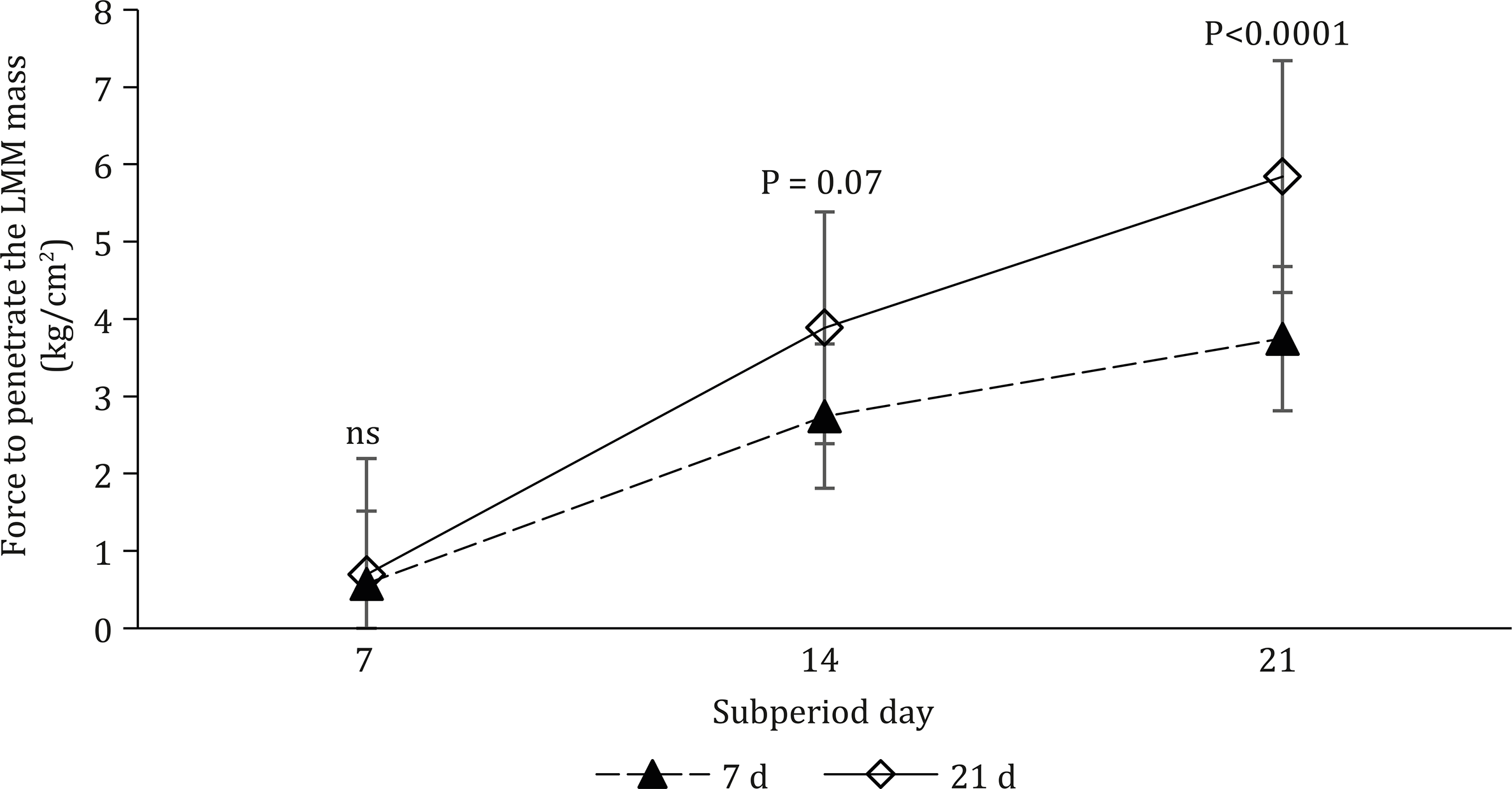 LMM - loose mineral mixture.Effects = delivery frequency: P<0.0001; subperiod day: P<0.0001; interaction: P = 0.0034; ns = P>0.05.
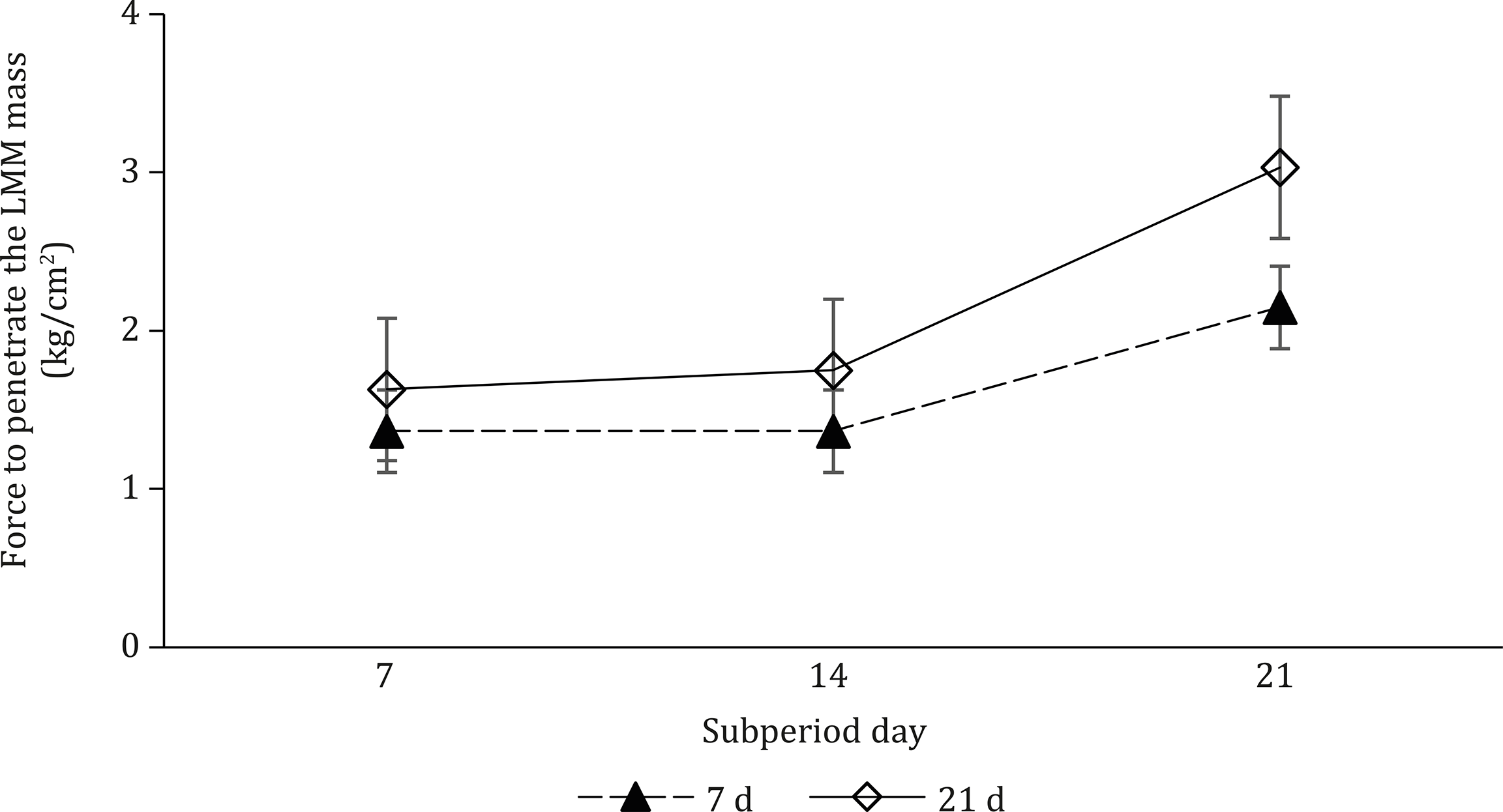 LMM - loose mineral mixture.Effects = delivery frequency (DF): P = 0.0114 (1.63 vs. 2.14 kg/cm2 for 7 and 21 d, respectively); subperiod day (D): P<0.0001 (1.50a vs. 1.56a vs. 2.59b kg/cm2 for 7, 14, and 21 d, respectively); DF × D: P = 0.3955.