 Financial analysis of a dairy farm in the state of Rio Grande do Sul in 2022
ABSTRACT
The objective of this study was to perform a financial analysis of a dairy farm located in the southern region of Rio Grande do Sul, comprising 500 hectares and a herd of 380 lactating Holstein cows, with an average daily milk production of 12,000 liters, during the year 2022. Based on the collected data, the total revenue (TR), fixed and variable costs and expenses were analyzed monthly and for the entire period. Additionally, operating profit (OP), contribution margin (CM), percentage contribution margin (CM%), break-even point (BEP), and break-even point output (BEP output) were calculated. A vertical analysis was conducted to determine the cost share in producing one liter of milk. The average revenue, costs and expenses, and gross profit per liter of milk were US$ 0.47 (R$ 2.41), US$ 0.40 (R$ 2.05), and US$ 0.07 (R$ 0.36), respectively. The CM and CM% were equal to US$ 815,036.08 and 39.84%, respectively. The BEP was equal to US$ 1,248,297.34, and the BEP output was 2,660,396.5 liters of milk. The most significant production costs were related to feed, accounting for 63.12% of the total cost. Labor and machinery maintenance ranked the second and third largest cost components, representing 10.01% and 9.10%, respectively. Except for the month of March, revenues exceeded costs and expenses throughout the year 2022 on the studied farm. The financial analysis of the property supports the adoption of strategies aimed at increasing profitability.
Keywords:
agribusiness; dairy production cost; farm management
1. Introduction
Dairy farming is a prominent economic activity in Brazil, which generates income and employment (Bassotto et al., 2022a; Labiak and Stroparo, 2023). The state of Rio Grande do Sul (RS) has historically been a major milk producer, ranking as the third-largest producer in Brazil. Its production accounts for 12.4% of the Brazilian total, behind Minas Gerais and Paraná only (EMBRAPA, 2022). Since 1990, when milk prices ceased to be regulated, milk production has grown significantly, placing Brazil in the third position among the world’s largest producers (Vilela et al., 2017; Martins et al., 2023). Much of this growth has resulted from increased productivity, although there is still a substantial gap compared to countries with higher production efficiency (Rocha et al., 2020).
Milk production is an economic activity that demands substantial investments in land, infrastructure, equipment, and animals, resulting in a high volume of tied-up capital and slow returns (Bassotto et al., 2022c). Moreover, in recent years, the activity has become even more challenging, due to increasing production costs and the reduced purchasing power of farmers in relation to key inputs, which has led to a drastic reduction in the number of producers, with a 50% decline in the state of RS alone (EMATER/RS-Ascar, 2021; Martins, 2023; Rentero, 2023; Silva, 2023).
Thus, in an increasingly demanding scenario, dairy producers should implement management strategies such as cost control and financial analysis to enhance business sustainability and profitability (Bassotto et al., 2024). In this context, accounting techniques can assist dairy farmers in making more accurate managerial decisions (Fernandes et al., 2022). The analysis of production costs in dairy farming can be challenging, as it encompasses various components, such as feed, fuel, equipment maintenance, labor, reproduction inputs, electricity, medicines, milking management supplies, fertilizers, among others (Lopes et al., 2017). However, cost analysis enables farm managers to identify the main cost drivers of the activity and implement strategies aimed at cost reduction, thereby improving the profitability of the operation (Santos and Veiga, 2016; Kruger et al., 2017). In addition, the analysis of financial indicators, such as profit, contribution margin, and break-even point, enables a diagnosis of the farm’s current performance, as well as the planning of future investments (Simionatto et al., 2018).
Most producers, however, lack adequate control over their revenue and costs (Paixão et al., 2017). Therefore, since there are few studies published in scientific literature about this subject, the objective of the present study was to conduct a financial analysis of a dairy farm located in the Southern region of RS, aiming to identify the production costs with the greatest impact on milk production and key performance indicators related to the financial health of the operation.
2. Material and methods
The present research consists of a descriptive case study with a qualitative approach, based on the collection and analysis of financial data from a dairy farm located in the Southern region of Rio Grande do Sul, Brazil.
2.1. Property characterization
The studied farm comprised an area of 500 hectares dedicated to dairy farming, including corn cultivation for silage production and forage crops such as ryegrass and oats. The herd consisted of approximately 380 Holstein lactating cows with an average production of 12,000 L/day. Lactating animals were housed in a compost-bedded pack barn and milked three times a day using a mechanical milking system. The calves were housed in collective barn and had access to an automatic feeding system, being weaned at 75 days of age. Post-weaning animals were managed in pasture and received concentrate supplementation.
The diet was provided in the form of a total mixed ration (TMR), calculated to supply the appropriate nutritional levels according to NASEM (2021). Animals were grouped based on the production phase. The pre-calving diet (starting 21 days before the expected calving date) consisted of concentrate, corn silage, and ryegrass hay. Lactating cows received concentrate, corn silage, and oat haylage. Finally, cows in the dry period were fed wheat hay, corn silage, and ryegrass haylage.
The farm employed recombinant bovine somatotropin (rbST) starting in the second third of lactation to enhance milk production in the herd. Individual analyses of milk composition (protein, fat, and lactose content) and somatic cell count (SCC) were conducted on a monthly basis.
Additionally, the farm carried out periodic herd health management practices, including vaccination and footbaths with copper sulfate. The dry-off protocol involved the use of internal teat sealants and intramammary antimicrobials, administered 60 days prior to the projected calving date. The farm adopted a selective dry cow therapy strategy for clinical mastitis. To support this approach, milk samples from cows diagnosed with clinical mastitis were collected and cultured on chromogenic media to identify the mastitis-causing pathogen.
Furthermore, neck collars equipped with sensors were used to monitor cow behavior, including rumination, activity, and idle time. The system transmitted data to the management software, which generated alerts to assist in the identification of animals facing health challenges or displaying behavior associated with reproductive events, such as estrus or parturition.
The operation maintained a team of 20 employees assigned to dairy operations. Among them, six were responsible for milking routines, two managed calf care, one was assigned to reproductive management, in addition to one veterinarian and one farm manager, while the remaining personnel were responsible for general farm tasks.
Financial management of the farm’s dairy sector was conducted through the use of electronic spreadsheets, where data were collected, and key performance indicators were systematically calculated and monitored. The farm manager was responsible for keeping aal records up to date.
2.2. Data collection
The information was extracted from the farm’s databases for the year 2022. Financial data, including costs associated with feed (roughage and concentrate), replacement (calves and heifers), labor (permanent and temporary), electricity, fuel, machinery maintenance, milking system maintenance, animal health (disinfectants, medicines, and vaccines), reproduction (artificial insemination services), and other items (acids, detergents, and paper towels) were collected. Additionally, data related to administrative expenses (office supplies and services) were obtained.
The milk price used for calculations was based on the average price established by the Conselho Conjunto dos Produtores/Indústrias de Leite do Rio Grande do Sul (CONSELEITE-RS) for the entire study period, with monthly values of US$ 0.40, US$ 0.42, US$ 0.46, US$ 0.48, US$ 0.51, US$ 0.55, US$ 0.64, US$ 0.50, US$ 0.42, US$ 0.43, US$ 0.42, and US$ 0.42 (R$ 2.15, R$ 2.17, R$ 2.16, R$ 2.38, R$ 2.39, R$ 2.86, R$ 3.30, R$ 2.59, R$ 2.27, R$ 2.25, R$ 2.22, and R$ 2.19) from January to December, respectively, resulting in an average price of US$ 0.47 (R$ 2.41) for the entire period. The exchange rate was considered for each month.
2.3. Financial analysis
Costs were defined as expenditures directly related to milk production, while expenses, were defined as non-production-related expenditures (Oliveira, 2015). Furthermore, costs and expenses were classified as fixed, those which do not change when the milk production changes, and variable, those which change when milk production changes. Total revenue (TR) included only the revenue from milk sales, calculated by multiplying the quantity of milk sold by the milk price. Costs, expenses, and revenues were obtained monthly and totaled for the year 2022. Additionally, a vertical analysis was conducted to determine the percentage participation of each item in the costs for producing one liter of milk.
The financial indicators used in this study were operating profit (OP), contribution margin (CM), percentage contribution margin (CM%), break-even point (BEP), and the break-even point output (BEP output), which was calculated using the average milk price during the period and represents the necessary volume of milk sold to reach the BEP. All equations for the financial indicators are shown in Table 1 (Iudícibus and Marion, 2008; Oliveira, 2015; Lopes, 2018; Chiavenato, 2022).
3. Results
Financial indicator results are presented in Table 2. It is possible to verify that variable costs and expenses totaled US$ 1,230,931.15 (R$ 6,324,544.74), representing 60% of the revenue, while fixed costs and expenses amounted to US$ 497,282.31 (R$ 2,555,004.78), representing 24% of the revenue. Additionally, the OP was positive in 2022, since TR exceeded the sum of costs and expenses (US$ 1,728,205.67; R$ 8,879,549.52). The CM% was equal to 39.84%, and the BEP output was equal to 2,660,396.5 L of milk. The farm studied achieved a CM% of 39.98% and a BEP equal to US$ 1,248,297.34 (R$ 6,413,772.56) in 2022.
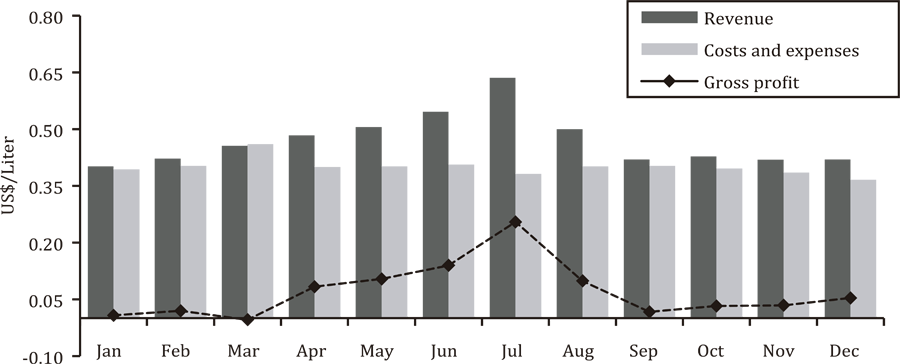
The average revenue, costs and expenses, and gross profit per liter of milk were US$ 0.47 (R$ 2.41), US$ 0.40 (R$ 2.05), and US$ 0.07 (R$ 0.36), respectively. The revenues, costs and expenses, and gross profit per liter of milk throughout 2022 are shown in Figure 1. It can be observed that margins were compressed between January and February, reaching the lowest point in March, when the margin became negative. From April to July, there was an increase in revenues and a stabilization of costs and expenses, resulting in a higher gross profit, which peaked in July. From August to December, a reduction in revenues was observed, leading to a decrease in gross profits, which remained positive despite the reduction.
Revenues, costs and expenses, and gross profit per liter of milk, throughout the year of 2022 on a dairy farm located in Southern RS.
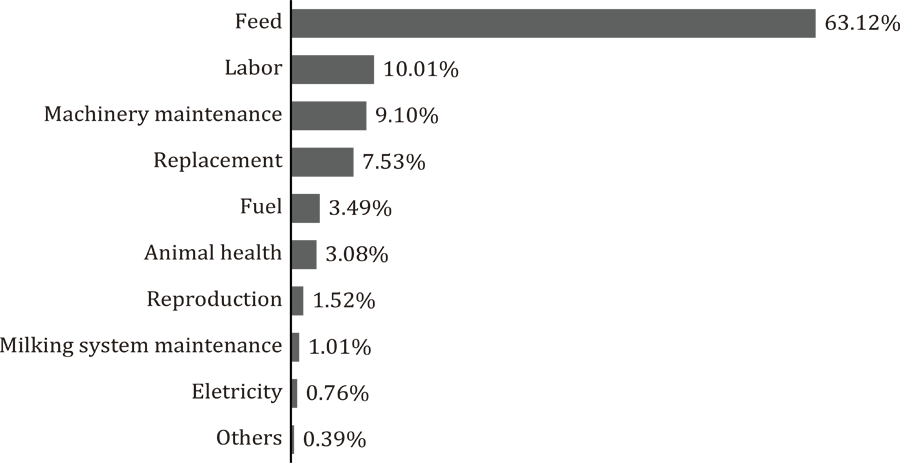
The average cost of producing one liter of milk was US$ 0.40 (R$ 2.05). From the vertical analysis of production costs, it was possible to observe that feed was the most important item, representing 63.12% of the total cost (Figure 2).
Contribution of different costs in the production of one liter of milk throughout the year of 2022 on a dairy farm located in Southern RS.
4. Discussion
From the vertical analysis, it was possible to observe that the largest cost was related to feed, representing 63.12% of the total cost. This result is consistent with previous studies conducted by Lopes et al. (2004), in which feed represented 59.95% of the production costs, and by Hemme et al. (2014) who performed a benchmarking analysis of milk production cost in 46 countries, representing 87% of global production, including Brazil and other major milk producers, and identified that feed cost was equal to or greater than 50% of the total production cost in 62% of the farms analyzed.
Dairy farms using intensive systems become increasingly dependent on the inclusion of concentrate mainly composed of grains like soy and corn in the animal’s diet. Diets rich in grains provide greater energy and protein levels, allowing increased milk production and milk components (NASEM, 2021). The rise in grains prices in the international market is related to their increasing use for biofuel production (Hemme et al., 2014). Therefore, although these diets generate higher revenue by promoting increased milk yield, they also lead to higher production costs, associated with crop fertilization, agrochemicals, and, in some cases, irrigation. Thus, it is essential for producers to find the best combination of ingredients according to their prices, which may vary depending on availability in each region and seasonality. Additionally, the adoption of practices such as correct formulation, use of quality ingredients, storage control, proper mixing, and adequate supply is essential to increase the efficiency of input utilization (Bassotto et al., 2024).
The second most representative item in operating costs was labor, contributing 10.1% of the total (Figure 2). According to Resende et al. (2016), labor is a determining factor for the profitability of dairy farms, and for greater efficiency, periodic training, appropriate hiring, and the implementation of effective people management techniques are necessary (Bassotto et al., 2024). Labor costs have been strongly impacted by the constant rural exodus, leading to a shortage of labor and a consequent increase in worker salaries (Paiva et al., 2016). The mechanization of production systems emerges as a solution to the shortage of professionals in the dairy market, but also generates costs such as maintenance and depreciation, which ranked third among the most relevant costs in this study.
Replacement costs were the fourth most significant, ranking immediately after machinery maintenance. The costs related to raising replacement heifers are highly representative in dairy farms, which can account for 15 to 20% of the total operating costs (Masello et al., 2021). In a study conducted by Boulton et al. (2017), it was observed that approximately one and a half lactations are required for the farmer to recover all expenses associated with rearing a heifer from birth to first calving, therefore age at first calving is one of the main factors influencing this cost. If replacement costs were not considered, given that calves and heifers do not directly contribute to milk production and, consequently, do not generate revenue, the share of feed, labor, and machinery maintenance costs would increase to 68.26%, 10.82%, and 9.84% of total production cost, respectively.
The BEP analysis enables business planning by determining the necessary revenue to cover all costs and expenses, at which the business makes neither a profit nor a loss (Oliveira, 2015; Cittadin et al., 2021; Chiavenato, 2022). Moreover, it is possible to determinate the minimum output necessary to reach BEP, a fundamental factor for the management of a dairy farm. The farm studied achieved a CM% of 39.98% and a BEP equal to US$ 1,248,297.34 (R$ 6,413,772.56) in 2022. Based on these indicators, dairy farm managers can develop strategies aiming for greater profitability. As in the present study, Kruger et al. (2017), when investigating the economic viability of a dairy farm, also observed a positive operational result, although on a smaller scale. Thus, this study supports the idea that dairy farming can be a profitable activity, provided that effective financial management is in place (Simionatto et al., 2018). However, the present study used market prices paid to producers rather than the actual prices received by the specific farm analyzed, which may have led to differences in the indicators obtained.
The year 2022 was extremely challenging for the milk production market, which was influenced by the national and international macroeconomic situation, marked by the consequences of the 2020 health crisis and the conflict in Eastern Europe, as well as adverse climatic conditions associated with the La Niña (FAO, 2022; Lana et al., 2023; Rentero, 2023). There was a 9.4% decrease in the price paid to producers and an 18.67% increase in production costs in 2021, making the dairy industry less attractive, which led to a reduction in investments and the exit of many producers from the industry (CEPEA, 2022a). As a result, there was a decline in production, according to the Índice de Captação de Leite do CEPEA (ICAP-L), and an increase in milk and dairy product prices for consumers. Additionally, in 2022, there was an increase in the international price of oil, resulting in higher costs for mechanical operations and shipping. The La Niña climate pattern influenced pasture and silage availability and quality due to increased rainfall in the Southeast and drought in the Southern regions. Thus, feed costs were the most significant cost category in dairy production, which reduced the purchasing power of farmers (Lana et al., 2023).
The studied property showed a positive Operating Profit in 2022, mainly due to the rise in farmgate milk prices during the offseason (March to September). The month of March was an exception, presenting a negative gross profit, driven by the consequences of the conflict between Russia and Ukraine that began in February 2022. Both countries involved in the conflict are major exporters of agricultural and livestock inputs, such as grains, oil, and fertilizers, especially potassium, phosphate, and urea, leading to an increase in their prices in the international market (Ben Hassen and El Bilali, 2022; Jagtap et al., 2022; Silva, 2023). Additionally, there was an increase in grain prices, especially corn, with a 2.9% increase in March, leading to a 4.07% increase in production costs in the first quarter of 2022 compared to the same period in 2021. There was also an increase in the competitiveness of imported products due to limited supply in Brazil, coupled with revaluation of the Brazilian Real, resulting in a 15% increase in importation (CEPEA, 2022b; CEPEA, 2022d).
In June and July, record prices paid to producers were observed since 2004, reaching US$ 0.55 (R$ 2.86) and US$ 0.64 (R$ 3.30), respectively, according to CONSELEITE-RS and US$ 0.61 (R$ 3.19) and US$ 0.69 (R$ 3.57) in the CEPEA Média Brasil (CEPEA, 2022c). The rise in prices paid to farmers was due to a lower supply of raw milk, with a 5% reduction (1 billion liters) compared to 2021, increasing competition among dairy industries (Rentero, 2023; Silva, 2023). During the winter months (from June 21st to September 22nd), Brazilian dairy production decreases in most states due to the drought, which contributes to the rise in prices. However, in the Southern Region of Brazil, the climate is predominantly subtropical, and rainfall is well distributed throughout the year, therefore there is more pasture available, and the milk production increases during the winter season compared with the rest of the county (Nogara et al., 2022; USDA, 2023). The lower result obtained in August compared to July on the studied dairy farm may be related to higher production costs and an increased milk supply in the Southern Region of Brazil in August. Additionally, August was marked by adverse weather conditions, with heavy rainfall in the region, leading to the early replacement of the bed material in the barn, consisting of rice husk and sawdust.
From September onwards, the bullish trend reversed when the milk price paid to producers experienced a 14.4% drop in the Brazil average and 0.73% in RS (CEPEA, 2022c). This devaluation occurred due to an increase in supply, combining domestic production and importation, and a constraining demand for dairy products, mainly driven by milk and dairy product inflation which reached 22.1% coupled with lower household income in 2022 (Silva, 2023). As a result, milk consumption dropped to 162 L per capita per year, returning to levels observed a decade ago. The increased supply can be explained by the reduction in production costs and the strong imports mainly from Argentina and Uruguay, evidenced by the largest trade deficit since 2000 (Rentero, 2023). These factors influenced the studied property with compressed margins observed from September to December.
Accounting and financial analysis can assist producers in making more assertive decisions regarding the reduction of production costs and the planning of new investments (Fernandes et al., 2022; Labiak and Stroparo, 2023). In the studied farm, it was observed that expenses related to herd nutrition accounted for more than 60% of the total costs. Based on this finding, the farm manager could develop strategies to reduce feed costs while maintaining nutritional quality and digestibility, such as incorporating by-products from local food industries, like soybean hulls and olive cake, as partial substitutes for more expensive ingredients. This approach would enable the farm to operate with higher profit margins and achieve greater profitability.
Dairy farming, like other activities in the agricultural sector, involves several risks for producers, associated with production, market dynamics, environmental factors, and business operations (Bassotto et al., 2022b). In this increasingly challenging scenario, marked by rising production costs, shrinking profit margins, and heightened competition due to growing imports, efficient farm management is necessary to enhance the sustainability and profitability of the business. As highlighted by Zanin et al. (2024), investment in technology and the use of data are essential for increasing the economic efficiency of dairy farms, integrating them into the context of Agribusiness 4.0.
5. Conclusions
The studied property showed a positive financial result in 2022, primarily due to the upward movement in the milk prices paid to producers for most of the year. However, monthly margins were compressed due to the increase in production costs. From the cost analysis to produce one liter of milk, it was possible to identify that feed and labor were the most significant cost components. The economic and financial management of dairy farms can assist producers in making strategic and operational decisions aimed at improving the profitability of the business, thereby contributing to the growth of the dairy industry in the country.
Acknowledgments
The authors are thankful for the support provided by the Coordenação de Aperfeiçoamento de Pessoal de Nível Superior (CAPES, Brasília, Brazil), Conselho Nacional de Desenvolvimento Científico e Tecnológico (CNPq, Brasília, Brazil), and Fundação de Amparo à Pesquisa do Estado do Rio Grande do Sul (FAPERGS, Porto Alegre, Brazil).
References
-
Bassotto, L. C.; Benedicto, G. C.; Lima, A. L. R.; Lopes, M. A. and Merlo, F. A. 2024. Eficiência técnica em propriedades leiteiras familiares no Estado de Minas Gerais em 2021. Revista de Economia e Sociologia Rural 62:e261483. https://doi.org/10.1590/1806-9479.2022.261483
» https://doi.org/10.1590/1806-9479.2022.261483 - Bassotto, L. C.; Benedicto, G. C. and Putti, F. F. 2022a. Estratégias de gestão em propriedades leiteiras de Minas Gerais. Revista Eletrônica de Estratégia e Negócios 15:59-84.
-
Bassotto, L. C.; Lopes, M. A.; Brito, M. J. and Benedicto, G. C. 2022b. Eficiência produtiva e riscos para propriedades leiteiras: uma revisão integrativa. Revista de Economia e Sociologia Rural 60:e245277. https://doi.org/10.1590/1806-9479.2021.245277
» https://doi.org/10.1590/1806-9479.2021.245277 -
Bassotto, L. C.; Lopes, M. A.; Almeida Júnior, G. A. and Prado, J. W. 2022c. Projeção econômica e dos custos em propriedades leiteiras familiares. Desenvolvimento em Questão 20:e12055. https://doi.org/10.21527/2237-6453.2022.58.12055
» https://doi.org/10.21527/2237-6453.2022.58.12055 -
Ben Hassen, T. and El Bilali, H. 2022. Impacts of the Russia-Ukraine war on global food security: Towards more sustainable and resilient food systems? Foods 11:2301. https://doi.org/10.3390/foods11152301
» https://doi.org/10.3390/foods11152301 -
Boulton, A. C.; Rushton, J. and Wathes, D. C. 2017. An empirical analysis of the cost of rearing dairy heifers from birth to first calving and the time taken to repay these costs. Animal 11:1372-1380. https://doi.org/10.1017/S1751731117000064
» https://doi.org/10.1017/S1751731117000064 - CEPEA - Centro de Estudos Avançados em Economia Aplicada. 2022a. Boletim do Leite - Janeiro de 2022, Ano 28, N° ???. CEPEA - Esalq/USP, Piracicaba.
- CEPEA - Centro de Estudos Avançados em Economia Aplicada. 2022b. Custos Leite - Março de 2022. CEPEA - Esalq/USP, Piracicaba.
- CEPEA - Centro de Estudos Avançados em Economia Aplicada. 2022c. Boletim do Leite - Março de 2022. CEPEA - Esalq/USP, Piracicaba.
- CEPEA - Centro de Estudos Avançados em Economia Aplicada. 2022d. Boletim do Leite - Setembro de 2022, Ano 28, N° ?27. CEPEA - Esalq/USP, Piracicaba.
- Chiavenato, I. 2022. Gestão financeira: Uma abordagem introdutória. 4.ed. Atlas, Barueri.
- Cittadin, A.; Monteiro, J. J. and Studzinski, T. M. 2021. Gestão de custos na produção de leite em uma propriedade de agricultura familiar. In: XVIII Congresso Brasileiro de Custos.
- EMATER/RS-Ascar. 2021. Relatório socioeconômico da cadeia produtiva do leite no Rio Grande do Sul: 2021. Emater/RS-Ascar, Porto Alegre.
- EMBRAPA - Empresa Brasileira de Pesquisa Agropecuária. 2022. Anuário Leite 2022 - Pecuária leiteira de precisão. Embrapa Gado de Leite, Juiz de Fora.
- FAO - Food and Agriculture Organization of the United Nations. 2022. Dairy market review: Emerging trends and outlook 2022. FAO, Rome.
- Fernandes, I. F.; Kruger, S. D.; Gollo, V. and Juttel, E. 2022. Viabilidade econômico-financeira da atividade leiteira. Custos e @gronegócio 18:289-310.
-
Hemme, T.; Uddin, M. M. and Ndambi, O. A. 2014. Benchmarking cost of milk production in 46 countries. Journal of Reviews on Global Economics 3:254-270. https://doi.org/10.6000/1929-7092.2014.03.20
» https://doi.org/10.6000/1929-7092.2014.03.20 - Iudícibus, S. and Marion, J. C. 2008. Curso de contabilidade para não contadores. 5.ed. Editora Atlas, São Paulo.
-
Jagtap, S.; Trollman, H.; Trollman, F.; Garcia-Garcia, G.; Parra-López, C.; Duong, L.; Martindale, W.; Munekata, P. E. S.; Lorenzo, J. M.; Hdaifeh, A.; Hassoun, A.; Salonitis, K. and Afy-Shararah, M. 2022. The Russia-Ukraine conflict: its implications for the global food supply chains. Foods 11:2098. https://doi.org/10.3390/foods11142098
» https://doi.org/10.3390/foods11142098 - Kruger, S. D.; Ceccatto, L.; Mazzioni, S.; Domenico, D. D. and Petri, S. M. 2017. Análise comparativa da viabilidade econômica e financeira das atividades avícola e leiteira. Revista Ambiente Contábil 9:37-55.
-
Labiak, G. and Stroparo, T. R. 2023. Análise de custos e rentabilidade da atividade leiteira em uma propriedade familiar. Revista Ibero-Americana de Humanidades, Ciências e Educação 9:1657-1673. https://doi.org/10.51891/rease.v9i7.10767
» https://doi.org/10.51891/rease.v9i7.10767 - Lana, M. S.; Oliveira, S. J. M.; Martins, P. C. and Carneiro, A. V. 2023. O poder de compra do leite em 2022. Texto Comunicação Corporativa.
-
Lopes, M. A.; Lima, A. L. R.; Carvalho, F. M.; Reis, R. P.; Santos, C. and Saraiva, F. H. 2004. Controle gerencial e estudo da rentabilidade de sistemas de produção de leite na região de Lavras (MG). Ciência e Agrotecnologia 28:883-892. https://doi.org/10.1590/S1413-70542004000400022
» https://doi.org/10.1590/S1413-70542004000400022 - Lopes, M. M.; Soares, E. P.; Souza, D. R; Neves, F. R. and Amaral, R. S. 2017. Custos de produção da pecuária leiteira: Estudo em uma instituição federal. Revista de Auditoria, Governança e Contabilidade 5:33-44.
- Lopes, W. 2018. Contabilidade e gestão financeira. Editora Senac, São Paulo.
- Martins, P. C. 2023. A revolução silenciosa. p.53. In: Anuário Leite 2023 - Leite baixo carbono. Embrapa Gado de Leite, Juiz de Fora.
- Martins, P. C.; Carneiro, A. V.; Oliveira, S. J. M. and Lana, M. S. 2023. O comportamento das margens financeiras na cadeia produtiva do leite. p.16-18. In: Anuário Leite 2023 - Leite baixo carbono. Embrapa Gado de Leite, Juiz de Fora.
-
Masello, M.; Perez, M. M.; Granados, G. E.; Stangaferro, M. L.; Ceglowski, B.; Thomas, M. J. and Giordano, J. O. 2021. Effect of reproductive management programs for first service on replacement dairy heifer economics. Journal of Dairy Science 104:471-485. https://doi.org/10.3168/jds.2020-18588
» https://doi.org/10.3168/jds.2020-18588 - NASEM - National Academies of Sciences, Engineering, and Medicine. 2021. Nutrient requirements of dairy cattle. 8th ed. National Academies Press, Washington, DC.
-
Nogara, K. F.; Kaelle, G. C. B.; Tavares, Q. G.; Marcon, T. R.; Gopinger, E.; Zopollatto, M. and Debortoli, E. C. 2022. Influence of the seasons on the quality and composition of milk from dairy farms in the northern region of Rio Grande do Sul, Brazil. Ciência Animal Brasileira 23:e-72795E. https://doi.org/10.1590/1809-6891v23e-72795e
» https://doi.org/10.1590/1809-6891v23e-72795e - Oliveira, A. J. 2015. Gestão financeira aplicada a micro e pequenas empresas. Belo Horizonte.
- Paiva, C. A. V.; Juntolli, F. V.; Carvalho, L. F. R.; Bernardi, A. C. C.; Tomich, T. R. and Pereira, L. G. R. 2016. Pecuária leiteira de precisão. p.307-323. In: EMBRAPA. Pecuária de leite no Brasil: cenários e avanços tecnológicos. Embrapa, Brasília.
-
Paixão, M. G.; Lopes, M. A.; Costa, G. M.; Souza, G. N.; Abreu, L. R. and Pinto, S. M. 2017. Milk quality and financial management at different scales of production on dairy farms located in the south of Minas Gerais state, Brazil. Revista Ceres 64:213-221. https://doi.org/10.1590/0034-737X201764030001
» https://doi.org/10.1590/0034-737X201764030001 - Rentero, N. 2023. Projeção de tendências para o leite aqui e lá fora. p.22-25. In: Anuário Leite 2023 - Leite baixo carbono. Embrapa Gado de Leite, Juiz de Fora.
-
Resende, J. C.; Freitas, A. F.; Pereira, R. A. M.; Silva, H. C. M. and Pereira, M. N. 2016. Determinantes de lucratividade em fazendas leiteiras de Minas Gerais. Arquivo Brasileiro de Medicina Veterinária e Zootecnia 68:1053-1061. https://doi.org/10.1590/1678-4162-8220
» https://doi.org/10.1590/1678-4162-8220 - Rocha, D. T.; Carvalho, G. R. and Resende, J. C. 2020. Cadeia produtiva do leite no Brasil: produção primária. Circular Técnica 123. Embrapa Gado de Leite, Juiz de Fora.
- Santos, F. A. and Veiga, W. E. 2016. Contabilidade de custos - Gestão em serviços, comércio e indústria. Gen Atlas, Barueri.
- Simionatto, F. J.; Kruger, S. D.; Mazzioni, S. and Petri, S. M. 2018. Indicadores econômico-financeiros da produção leiteira em propriedades rurais familiares. Custos e @gronegócio 14:260-282.
- Silva, R. O. P. 2023. Panorama do mercado de leite em 2023. Análises e Indicadores do Agronegócio 18:1-7.
- USDA - United States Department of Agriculture. 2023. Dairy and products annual - Brazil.
- Vilela, D.; Resende, J. C.; Leite, J. B. and Alves, E. 2017. A evolução do leite no Brasil em cinco décadas. Revista de Política Agrícola 26:5-24.
- Zanin, A.; Kruger, S. D.; Gonzaga J. F.; Padgett, R. C. M. L. and Lizot, M. 2024. Agribusiness 4.0: methodology for choosing robotic milking systems. Revista de Economia e Sociologia Rural 62.
-
Data availability:
Data will be available upon request.
Edited by
-
Editors:
Marcos Inácio Marcondes Eduardo Marostegan de Paula
Data will be available upon request.