
 Tourism and Madeira Wine heritage: regeneration through UNESCO recognition
Abstract
This study examines the intersection between regenerative tourism and Madeira wine heritage, focusing on the strategic potential of securing UNESCO Intangible Cultural Heritage of Humanity recognition for Madeira wine traditions. Framed within the concepts of sustainable and regenerative tourism, the research addresses a critical gap in the literature on heritage-led regeneration strategies in island destinations. The data were collected through a semi-structured interview survey (recorded) involving all Madeira wine producing organizations and analyzed through content analysis supported by descriptive statistics. The applied script included questions related to Madeira wine traditions and the UN sustainable development goals, as well as those specific to the Representative List, and varying according to the profile of the interlocutor. The findings reveal a strong consensus on the potential of UNESCO recognition to strengthen Madeira wine cultural heritage.
Keywords
Madeira Wine Traditions; Cultural Heritage; Regenerative Tourism; Sustainable Tourism
Resumo
Este estudo avalia a interseção entre turismo regenerativo e o Património do vinho Madeira, com foco no potencial estratégico da obtenção do reconhecimento pela UNESCO das Tradições do Vinho Madeira como Património Cultural Imaterial da Humanidade. Enquadrada nos conceitos de turismo sustentável e regenerativo, a pesquisa aborda uma lacuna na literatura sobre estratégias de regeneração impulsionadas pelo Património em destinos insulares. Os dados foram recolhidos através de inquérito por entrevista semi-estruturada (gravada), envolvendo todas as organizações produtoras de vinho da Madeira, e analisados por análise de conteúdo apoiada em estatísticas descritivas. O guião aplicado incluía questões relacionadas com as tradições vinícolas da Madeira e os objetivos de desenvolvimento sustentável da ONU, bem como específicas da Lista Representativa. Os resultados revelam um forte consenso sobre o potencial do reconhecimento da UNESCO para fortalecer a identidade cultural, preservar práticas agrícolas tradicionais e aumentar a resiliência do destino. No entanto, os desafios na mudança do uso do solo induzida pelo turismo, descontinuidade geracional e riscos de mercantilização destacam a necessidade de políticas integradas. O estudo sustenta a ideia de que modelos de turismo regenerativo e sustentável podem ser ferramentas complementares para a resiliência de destinos com base no Património em contextos insulares.
Palavras-chave
Tradições do Vinho Madeira; Património Cultural; Turismo Regenerativo; Turismo Sustentável
Resumen
La investigación aborda una laguna en literatura sobre estrategias de regeneración basadas en patrimonio de destinos insulares. Los datos se recopilaron mediante encuesta semiestructurada (grabada), con todas las organizaciones productoras de vino de Madeira, y analizados mediante análisis de contenido respaldados por estadísticas descriptivas. El guion aplicado incluía preguntas relacionadas con las tradiciones vinícolas de Madeira y los objetivos de desarrollo sostenible de la ONU, así como aquellas específicas de la Lista Representativa. Los resultados revelan un fuerte consenso sobre el potencial del reconocimiento de la UNESCO para fortalecer la identidad cultural, preservar prácticas agrícolas tradicionales y incrementar la resiliencia del destino. Sin embargo, los desafíos del cambio del uso del suelo inducido por turismo, discontinuidad generacional y riesgos de mercantilización subrayan la necesidad de políticas integradas. El estudio apoya la idea de que modelos de turismo regenerativo y sostenible pueden ser herramientas complementarias para la resiliencia de destinos basados en el patrimonio en contextos insulares.
Palabras clave
Tradiciones vitivinícolas de Madeira; Patrimonio cultural; Turismo regenerativo; Turismo sostenible
1 INTRODUCTION
Tourism plays a crucial role in the socio-economic development of island regions, particularly those with limited industrial capacity and fragile ecosystems, such as the case of Madeira region (RAM). Madeira’s tourism industry has flourished due to its natural beauty, cultural richness and temperate climate that attract millions of visitors each year. While the sector has been a key driver of economic growth, it has also introduced sustainability challenges, including land-use conflicts, demographic shifts in the agricultural workforce, and pressures on local traditions. For this reason, the main principles that guide sustainable and regenerative tourism models, especially in destinations that rely heavily on tourism – as islands territories, will be discussed. Among Madeira’s most emblematic cultural assets is Madeira wine, a globally recognized product with centuries of history, holding Protected Designation of Origin (PDO) status and deeply embedded in the island’s identity.
In this context, the purpose of this article is to advance the theoretical debate on regenerative tourism and heritage-based development in island destinations, by examining how UNESCO Intangible Cultural Heritage recognition can operate as a strategic instrument for territorial governance and socio-ecological regeneration. Specifically, the study explores how stakeholders’ perceptions regarding UNESCO recognition intersect with key theoretical dimensions such as sustainability transitions, cultural continuity, and tourism transformation, using the Madeira wine traditions nomination process as an empirical lens. By doing so, the article seeks to advance conceptual understanding of how heritage-based strategies may foster regenerative pathways in tourism development, particularly in territorially constrained and tourism-dependent island contexts. Therefore, section 5 presents the empirical context and methodological approach, detailing how the Madeira wine traditions nomination process is used to operationalize the study’s theoretical framework. In this regard, the article focuses specifically on the perceptions of management positions within Madeira wine-producing organizations regarding the potential impacts of UNESCO recognition on tourism regeneration and heritage sustainability (section 6). The main conclusions, weaknesses and suggestions for future studies will also be addressed (section 7).
2 TOURISM STRATEGIC ROLE IN MADEIRA WINE PRODUCTION AND THE REGIONAL ECONOMY
This section establishes the territorial, economic, and productive system within which the theoretical constructions of regenerative tourism and heritage-based development are later mobilized. From the geographical point of view, the Region of Madeira has an area of about 800 km2, is in the Atlantic Ocean, 978 km southwest of Lisbon and about 700 km west of the African coast (Regional Government, 2022). It consists of Madeira Island, Porto Santo Island, Desertas Islands (3 islands) and Selvagens Islands (2 islands and several islets). Of the seven islands, only the two largest, Madeira and Porto Santo, are inhabited (Regional Government, 2022). According to the provisional results of the last Census (2021), about 251 thousand people lived in the archipelago. Tourism represents one of the main pillars of the economy of RAM, acting as a driving force for economic development and job creation (see, for example, Majdack et al., 2022). Madeira has a high dependency on the tourism sector, supported by factors such as its strategic geographic location in the Atlantic, its mild year-round climate, stunning landscapes, and rich cultural and gastronomic offerings (Majdack et al., 2022). According to Madeira “Tourism Satellite Accounts” (Regional Statistical Office, 2019), tourism in Madeira contributes 28.8% to the region’s Gross Domestic Product (GDP), reflecting a greater significance than the national average in Portugal that does not exceed 15.3%.
In addition to its direct impact on the hospitality and restaurant sectors, tourism in Madeira also positively influences other sectors such as transport, agriculture, and services (Almeida, 2023). Although seasonality is present (Majdack et al., 2022), it is also mitigated by a policy of year-round events and festivals – such as the Arraiais, New Year’s Eve, Flower Festival, Atlantic Festival, Madeira wine Festival, Carnival Festivities, Madeira Rally, and the Columbus Festival, among others – which attract visitors at various times of the year (see Almeida & Garrot, 2021; Garrot & Almeida, 2023). The diversification of the tourism offer has also been significant. Madeira has invested in niche segments such as ecotourism, agrotourism, health and wellness tourism in combination with other traditional experiences staged around nature, aiming to strengthen its resilience in the face of external shocks, as demonstrated during the COVID-19 pandemic (Majdack & Almeida, 2022).
Sustainable tourism in Madeira region is gaining prominence, with public policies focused on environmental preservation and the appreciation of local heritage, creating synergies with endogenous products such as Madeira wine (Majdack & Almeida, 2023; Regional Government, 2022; Santos et al., 2025). Madeira wine stands as an icon of the region’s culture and economy, with a history dating back to the second half of the 18th century (Silva, 2023a; Silva, 2023b; Vieira, 1993; Vieira, 2003). This product holds a Protected Designation of Origin (PDO) and enjoys a well-established international reputation, being consumed and recognized for its quality and longevity (Vieira, 2003). According to data from the Madeira Institute of Wine, Embroidery and Handicrafts (IVBAM, 2024), exports of Madeira wine in 2024 amounted to €20,825,157.91, corresponding to 2,109,905.40 liters sold. The main destination markets, by order of importance, were France, the United States of America, Japan, and the United Kingdom (see Figure 1). The distribution reveals a predominance of European markets (particularly France, Germany, and Belgium), with significant importance also attributed to Asian and American markets. This geographical dispersion of exports is strategic for mitigating currency and political risks (IVBAM, 2024). The export value in 2024 reinforces the importance of Madeira wine as a premium export product, with an impact on the regional economy not only through direct production but also through its added value in the region’s tourism and promotional context.

Wine tourism and export activities are complementary, as many tourists meet the product at its source and go on to become ambassadors in their countries of origin (Albuquerque et al., in press; IVBAM’S, 2024). Evidence of this is also provided by IVBAM’s (2024) recent data on the annual total of Madeira wine exports. Within this context, one of the main export markets is, notably, Madeira’s own tourism sector (23.53%) (see figure 1). Beyond its economic value, Madeira wine plays a leading role in the region’s wine tourism offering. Visits to wine cellars, wine tastings, and festivals dedicated to viticulture have become valuable tourist experiences among both national and international visitors (Abreu et al., 2019). This integration between tourism and wine contributes to more balanced rural development and to the appreciation of the territory and its cultural identity (Alonso et al., 2022; Carvalho et al., 2021).
Despite the significant and strategic importance of tourism in the economy and culture of RAM – where Madeira wine traditions heritage also plays a nuclear role –, the practice of viticulture is in clear decline (Albuquerque et al., in press; Pinheiro de Carvalho et al., 2022; Santos et al., 2025; Vinetur, 2024). The viticulture legacy of Madeira faces mounting challenges stemming from land-use changes, demographic shifts, and climate dynamics. In this regard, land conversion and tourism-induced pressure are contributing to rapid expansion in tourism infrastructure and real estate development and mitigating traditional vineyard zones (Lousada et al., 2025; Majdack et al, 2022).
Vinetur is an international leading publication that offers up-to-date content on the wine sector. According to it, in 2023 Madeira recorded over 10.9 million tourist nights – a 13.6% increase from 2022 –, while hillside vineyard land is increasingly sold for housing and hotels, diminishing viticultural areas and displacing indigenous grape varieties like Tinta Negra Mole. The region has witnessed a steep reduction in vintners, falling from approximately 1,900 in 2000 to just 1,147 in 2023 (Vinetur, 2024). Another reason is related to the aging growers and generational turnover difficulties (Albuquerque et al., in press). With the average grower aged 55-60 and limited interest among younger generations – dissuaded by low perceived prestige and challenging terrain –, the risk of losing viticultural expertise and continuity is also a threatening reality (Vinetur, 2024).
Additionally, competition from other crops and economic pressures – as is especially the case of banana cultivation –, now surpasses Madeira wine in economic returns (€21.2 each in 2022), as viticulture struggles with higher production costs and low profitability (Vinetur, 2024). Therefore, financial appeal of alternative crops in the island's fragmented minifúndio structure undermines vineyard viability. Climate change and environmental stressors are also affecting and diminishing viticultural areas (Pinheiro de Carvalho et al., 2022; Wunderlich et al., 2023). Although Madeira benefits from high rainfall and canal-based irrigation, rising winter temperatures and increased disease pressure necessitate greater chemical use in vineyards (Vinetur, 2024; GuildSomm, 2023). In this scope, broader trends in Portugal indicate rising temperatures, erratic droughts, and extreme weather events will increasingly threaten grape production, affecting phenology, yields, and wine quality (Fraga et al., 2017; Fonseca et al., 2023; Pinheiro de Carvalho et al., 2022). Terrain constraints and mechanization limits are also induced factors, since the steep volcanic soils and terraced poios make mechanization impractical, rendering production labor-intensive and costly (GuildSomm, 2023). Without technological adaptation, vineyards remain economically marginal.
It is based on those challenges that the trend towards a continuous decrease, around vineyards and winegrowers, has triggered regional initiatives to strengthen and improve policies to support wine activities, with a strong focus on the principles established in the United Nations Sustainable Development Goals (Brito et al., 2024; Trigo et al., 2022) – as is the case of the Sustainable Politic of Madeira Destination (Regional Government, 2022). The regional concern to uphold the historical and cultural accuracy of intangible heritage, as a means of safeguarding its identity integrity, is also reflected in the official Strategy for the Tourism Sector in Madeira region for the period 2022–2027 (Regional Government, 2021), as one of the strategic pillars identified for the long-term success of regional tourism activity. However, despite measures have been taken to encourage producers to remain in activity, there is a lack of a structuring and mobilizing project capable of uniting all those who want to keep this heritage alive. We will return to this topic in the following section.
3 REGENERATIVE AND SUSTAINABLE TOURISM IN ISLANDS DESTINATIONS
Due to their geographical isolation, unique and fragile ecosystems – where communities often rely heavily on tourism – island’s face significant pressures related with resource overuse, habitat degradation, and cultural commodification (Gössling et al., 2009; Sharpley, 2009; Scheyvens & Momsen, 2008). For this reason, the concept of sustainable tourism has long been central to discourse on island development, emphasizing the need to balance economic benefits with environmental conservation and socio-cultural integrity (Sharpley, 2009; UNEP & UNWTO, 2025). Therefore, sustainable tourism in islands contexts is guided by the notion of minimizing negative environmental impacts while enhancing local livelihoods and protecting cultural heritage. It involves planning and management strategies that ensure tourism does not exceed the ecological or social carrying capacities of these delicate territories (Carter et al., 2015). Community-based tourism and carrying capacity assessments are practical applications of these principles (see for example Butler, 2020; Jones, 2005; Lusby & Eow, 2015; Stronza & Gordillo, 2008; Wall, 2020; Faiz & Komalasari, 2020).
However, recent critiques argue that sustainable tourism, while reducing harm, may not sufficiently address the deeper systemic issues underlying ecological degradation and social inequality (Higgins-Desbiolles, 2018). This has led to the emergence of regenerative tourism, a concept that goes beyond sustainability by seeking to restore, renew, and revitalize ecosystems and communities (Bellato & Pollock, 2025). Regenerative tourism has gained global attention as a transformative approach that aims not only to minimize the negative impacts of tourism but also to actively contribute to the renewal of ecological and social systems. While sustainable tourism offers essential guidelines for minimizing harm, regenerative tourism provides a forward-looking model aimed at renewing and enriching both natural environments and local communities (Bellato & Pollock, 2025; Bellato, 2024; Raymond & Kenter, 2016).
Regenerative tourism is built on principles such as systems thinking, community empowerment, and deep ecological engagement (Bellato et al., 2022; Bellato, 2024; Tham & Sharma, 2023). In this regard, islands provide ideal laboratories for implementing regenerative tourism, given their contained ecosystems and distinct cultural identities (Dredge et al., 2024; Baixinho et al., 2023; Bode et al., 2024). It involves co-creating tourism experiences with local communities, restoring ecosystems through visitor participation, and embedding tourism activities within broader sustainability transitions (Bellato et al., 2022; Sousa et al., 2025; Tham & Sharma, 2023). These initiatives are not only environmentally beneficial but also support social resilience by involving local communities in governance and value creation (Sousa et al., 2025; Tham & Sharma, 2023). Moreover, regenerative tourism frameworks emphasize the co-creation of value among stakeholders, which is essential for the long-term resilience of island destinations facing climate change and tourism saturation (Luthe et al., 2012). Unlike sustainable tourism, which often focuses on damage control, regenerative tourism adopts a holistic systems-thinking approach aimed at creating net-positive impacts (Benur & Bramwell, 2015). This shift from sustaining to regenerating is particularly relevant in the face of mounting global pressures that disproportionately affect island systems (Iddawala & Lee, 2025).
Several international examples illustrate how regenerative tourism principles are being implemented to promote sustainability, resilience, and community well-being. For example, in the Azores – a Portuguese archipelago in the North Atlantic –, regenerative tourism has been advanced through community engagement, ecosystem restoration, and participatory planning. Baixinho et al. (2023) describe co-creation processes involving local stakeholders to develop nature-based tourism products that align with ecosystem conservation and cultural values. These initiatives include reforestation projects, local food promotion, and immersive visitor experiences. Another leading example comes from the Galápagos Islands in Ecuador, where strict regulations and visitor caps have historically been used to limit the environmental footprint of tourism. Recent shifts towards regenerative practices include integrating tourists into conservation activities and supporting local entrepreneurship (Epler, 2007; Mestanza-Ramón et al., 2020; Vega-Mariño et al., 2024).
In the South Pacific, the island nation of Palau has pioneered a global example of regenerative tourism through its “Palau Pledge”. This initiative requires all visitors to sign an environmental pledge upon entry, committing to respect local customs and ecosystems (Medel, 2020). The pledge, combined with a conservation fee, supports environmental education and community projects, effectively embedding regenerative values into the tourism experience (Medel, 2020). In New Zealand regenerative tourism has focused on ecological restoration and cultural revitalization. Fusté-Forné and Hussain (2022) note how indigenous Maori values are integrated into visitor experiences, contributing to both cultural preservation and environmental recovery. Tourism operators collaborate with conservation authorities to restore native vegetation and reduce the ecological footprint of tourism infrastructure.
These international examples highlight that regenerative tourism in islands is most effective when grounded in local contexts, involving stakeholders across governance levels, and guided by ecological and cultural regeneration. Table 1 summarizes the above cited conceptual differences of sustainable and regenerative tourism models in island’s destinations. Therefore, while sustainable tourism remains a valuable framework, the transition toward regenerative tourism in island contexts offers a more transformative pathway for ensuring ecological and community health. Integrating both concepts may provide a comprehensive strategy to navigate the complexities of tourism in island environments. In this regard, there is the recognition of the need for a project capable of uniting all those who want to keep Madeira wine traditions alive (as argued in section 2). The University of Madeira, with the support of the Regional Government and many other Madeiran entities inside and outside the island, has launched an application process for its safeguard by its inscription on the UNESCO Intangible Cultural Heritage List in 2024 (Silva et al., 2025a). The perceptions of Madeira wine-producing organizations about this application and its impact on the regeneration of Madeira destination will be analyzed in section 6.
4 UNESCO HERITAGE RECOGNITION AND POTENTIAL IMPACT ON ISLAND DESTINATIONS
UNESCO recognition – particularly inscription on the World Heritage (WH) List – has become a powerful instrument for island destinations seeking to leverage cultural heritage for sustainable tourism outcomes. A broad empirical literature finds that WH inscription tends to increase visibility and tourist demand, which can catalyze local conservation, finance and governance reforms when adequately managed (Yang et al., 2010; Patuelli, Mussoni & Candela, 2013; Buckley, 2004). However, the magnitude and sustainability of benefits depend on site-specific management capacity, community engagement, and the alignment of tourism with conservation objectives (Hitchcock, 2002; Okech, 2010). Stone Town, Zanzibar (United Republic of Tanzania) – inscribed in 2000 – illustrates how WH recognition can strengthen destination branding for cultural heritage and support policies that protect historic urban landscapes while enabling tourism-based livelihoods. Studies of Zanzibar and comparable Swahili coast heritage towns report that listing provided international visibility, new funding streams and planning guidance, but also created pressures related to commercialization, congestion, and gentrification that require careful management to preserve Outstanding Universal Value and community well‑being (Hitchcock, 2002; Okech, 2010). Where participatory planning, conservation standards, and small‑enterprise support were instituted, benefits accrued in local employment, craft revitalization and adaptive reuse of historic buildings tied to visitor experiences (Okech, 2010; Hitchcock, 2002).
On Gorée Island (Senegal), a WH site renowned for its slave trade heritage, UNESCO status has underpinned investments in conservation, interpretation and museum infrastructure that enable sensitive, education‑oriented tourism. Peer‑reviewed analysis shows how collaborative curation and improved visitor interpretation strengthened authenticity and ethical storytelling, which in turn enhanced both visitors learning outcomes and local professional opportunities in heritage management (Thiaw & Wait, 2018). These shifts demonstrate pathways by which recognition can deliver cultural and social benefits alongside tourism revenue when guided by inclusive governance and heritage ethics (Thiaw & Wait, 2018). Beyond single cases, quasi‑experimental and spatial interaction studies corroborate a positive average effect of WH listing on tourism flows, which can expand local fiscal space for conservation and heritage‑based entrepreneurship if capture mechanisms (fees, destination taxes, public‑private partnerships) are in place (Yang et al., 2010; Patuelli et al., 2013).
Yet scholars warn that unmanaged growth can undermine heritage values and community benefits, especially in small islands with limited infrastructure and fragile social‑ecological systems – strengthening the case for integrated site management plans, visitor caps where appropriate, and community‑benefit agreements (Buckley, 2004; Hitchcock, 2002). Although UNESCO Intangible Cultural Heritage and World Heritage lists have different eligibility criteria and objectives, the cases presented in this section tend to assume both as a kind of label of excellence attributed by UNESCO (see for example Silva, 2018). Taken together, international evidence indicates that UNESCO recognition of island cultural heritage offers a reputational and governance platform that can: (i) attract and rebalance visitor demand toward cultural and educational experiences; (ii) mobilize conservation funding and technical assistance; and (iii) legitimize participatory planning that aligns tourism with heritage safeguarding. Realizing these benefits is contingent on embedding UNESCO inscription within destination‑specific sustainable tourism strategies that prioritize authenticity, equitable benefit sharing, and capacity‑constrained visitor management (Hitchcock, 2002; Thiaw & Wait, 2018). Therefore, based on empirical evidence, international examples illustrate how UNESCO Cultural Heritage recognition can benefit tourism and sustainable development in island destinations.
5 METHODOLOGY
This study is embedded within a broader research project developed in the context of the ongoing UNESCO nomination process. However, the present article focuses exclusively on a specific analytical dimension of this project, namely the perceptions of management positions within Madeira wine-producing organizations regarding the potential impacts of UNESCO recognition on tourism regeneration and heritage sustainability. Therefore, data selected for this study is only part of this project. Based on it, we were able to perceive current concerns and suggestions of Madeira wine-producing organization regarding the application and its impact on regional sustainable development according to the 17 United Nations Sustainable Development Goals. As a UN organization, meeting the SDGs is one of the criteria for registration on the Intangible Cultural Heritage Representative List. Nevertheless, we also interviewed winegrowers (see Silva et al., 2025b), employees without a management position and importers of Madeira wine in China and the USA (73 interviews in total), which allowed us to contrast the views of managers with other sources of information, although we chose not to compare them within the framework of this article.
Therefore, to this study, only relevant data has been considered to the analysis of the perceptions of Madeira wine-producing organizations regarding the potential of the UNESCO application on the regeneration and sustainable development of tourism in Madeira destination. The universe of Madeira wine-producing organizations operating in Madeira region is composed of eight companies (the majority are small and medium size). In Madeira region, only authorized companies by the Institute of Wine, Embroidery and Crafts (IVBAM) can operate in Madeira wine-producing sector, namely: H. M. Borges, Henriques & Henriques, J. Faria & Filhos, Justino’s, Madeira Vintners, Madeira Wine Company, Pereira D'Oliveira, Vinhos Barbeito. In this scope, all of them have the designation PDO that guarantees that Madeira wine is authentic and comes from a specific geographic region, following strict production rules to preserve the characteristics of its land of origin.
The organizational design of the eight companies is diversified and presents, regarding its departmentalization, a mixed structure. Therefore, quite often the tourism department appears under the control of the same management of other functional departments within the company. The same happens with other departments, such as marketing, oenology or quality. For this reason, the focus of the study consists in evaluating the perceptions of all management positions of functional departments within each company, including the Funchal Agrarian Cooperative (brand Madeira Vintners). In this regard, all management positions of each organization were interviewed, which means that the sample conceived in this study is the same as its population, since for its purpose it would not be justified to interview positions below the decision-making levels. Despite the small volume of data, it is important to note that this is not a sample, but rather the entire universe of Madeira wine producers.
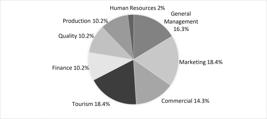
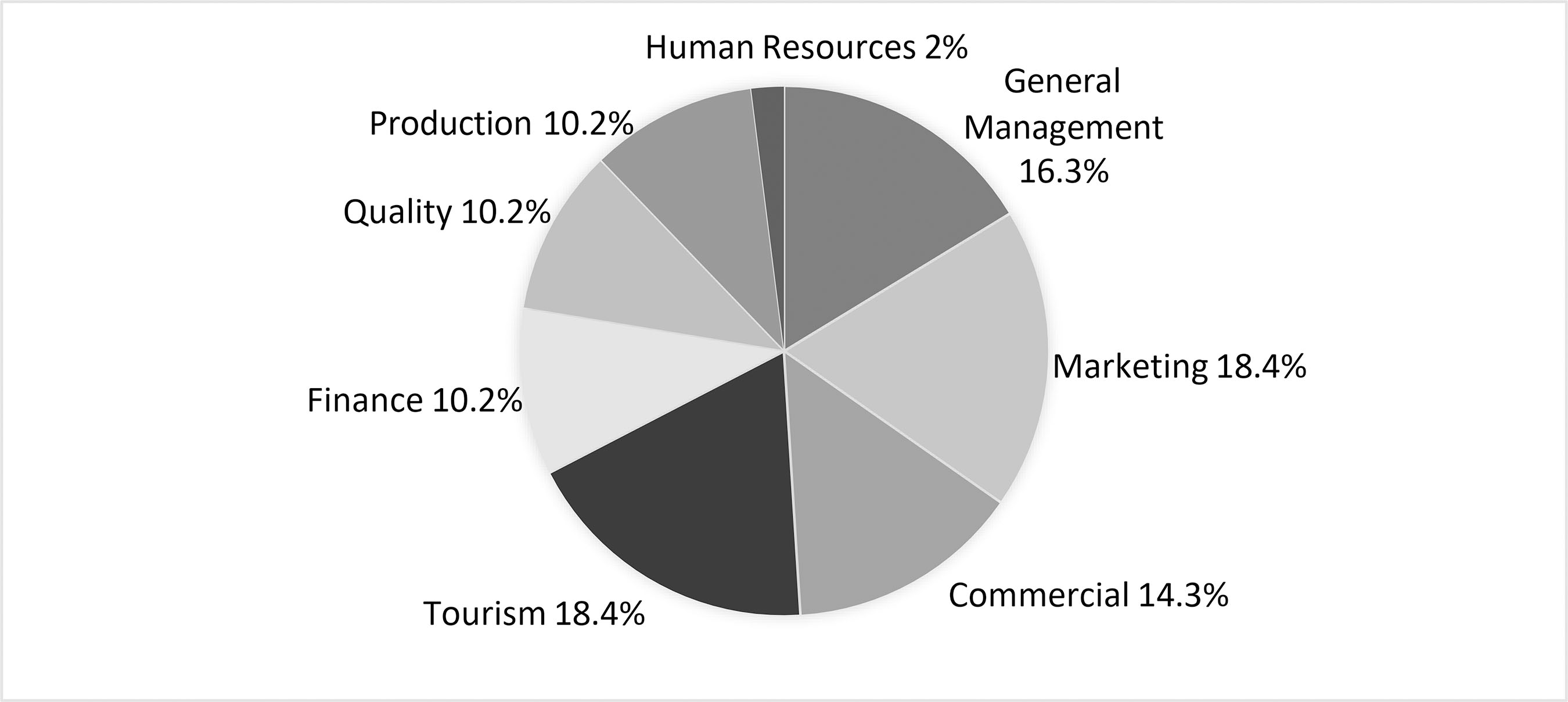
To increase the acceptance rate, a meeting with all Madeira wine-producing companies represented in the Association of Trade and Industry (ACIF), telephone and e-mail contact were previously used to present the project, specify the purpose of the interview and request acceptance from the targets to participate. There was no refusal among all management positions of the different departments within each organization of Madeira wine-producing, and all of them were interviewed. Figure 2 represents the professional roles of all respondents across the universe of Madeira wine-producing organizations. Percentages reflect the proportion of total management positions’ appearances. In this scope, the following management positions were interviewed: Tourism (18.4%), Marketing (18.4%), General Manager (16.3%), Commercial (14.3%), Production (10.2%), Quality (10.2%), Finance (10.2%) and Human Resources (2%). It is also important to note that, in all situations, the winemaker’s role is under the responsibility of production or general management positions, or even the general manager is itself the winemaker.
We have always started the semi-structured interviews by explaining to all those who agree to talk to us that the interview would serve to prepare an application for the Representative List, as well as the motivations for this initiative. This was because the respective dossier must include as many statements as possible attesting to free, prior and informed consent, issued by public and private organizations committed to making the intangible asset that motivated the application for registration viable. Therefore, letters of consent that fulfil this effect were asked at the end of the interview. Semi-structured interviews were conducted by the coordinator of the application of Madeira wine traditions to the UNESCO Representative List of Intangible Cultural Heritage (A.J.M.S.), with the help of a member of the team project of UNESCO application (R.A.N.S.) responsible for scheduling and recording the interviews. The applied script always included questions related to the relationship between Madeira wine traditions and the UN sustainable development goals, as well as those specific to the Representative List, the questions varying according to the profile of the interlocutor. In this way, an attempt was made to fulfil the need to gather testimonies to be submitted as an attachment to the request for registration on the Representative List. At the end, each respondent was asked if they gave their consent to carry out the application and why.
Given the specific aim of the UNESCO application, data collection was purposefully focused on professional insights, organizational perspectives, and thematic content related to cultural heritage and sustainability. The semi-structured interviews were conducted in Portuguese language, and only basic professional data identification was collected from it, namely their name, academic background, and current role within the company. Other personal demographic data (such as age) were not requested, as they were not deemed relevant to the scope or analytical objectives of the research. In this regard, the interview and data collection protocol of University of Madeira stands out since it was previously approved by its Ethics Committee and Data Protection Office, and follows the rules established by UNESCO regarding the preparation of this type of application. This approach aligns with the principles of data minimization and relevance in qualitative research (Silverman, 2017), ensuring that some participants’ privacy is respected while focusing exclusively on their institutional position and experiential knowledge relevant to the study's core themes.
The transcripts of the interviews and content analysis were carried out to evaluate the perceptions of all management positions within Madeira wine-producing organizations regarding UNESCO application potential on regional tourism regeneration and tourism challenges on the sustainability of Madeira wine traditions. Complementary statistical descriptive analysis was carried out to organize, summarize and present data to describe the total set of management positions in Madeira wine-producing organizations that were interviewed, as well as frequency analysis regarding their perceived benefits of Madeira wine traditions application to UNESCO and perceived challenges of tourism to Madeira wine traditions sustainability. To ensure replicability, the interview guide covered core themes such as: (i) perceived cultural significance of Madeira wine; (ii) potential tourism benefits of UNESCO recognition; (iii) threats from tourism to viticultural heritage; and (iv) policy priorities for heritage preservation. The next section will present and discuss the results obtained from key management’ responses regarding the two hypotheses raised in the current study.
6 RESULTS AND DISCUSSION
6.1 Perceived benefits of the UNESCO application to the regeneration of tourism in Madeira
Across the universe of Madeira wine-producing organizations in the RAM, participants emphasize that UNESCO recognition could reposition Madeira wine as a living cultural heritage, transcending its status as a mere commercial product. Figure 3 summarizes the most frequently mentioned perceived benefits of all management positions in Madeira wine-producing organizations. They especially highlight the potential of UNESCO application of Madeira wine traditions to strengthen Madeira’s cultural identity and reinforce authenticity as a core tourism value (100%); also serving as a tool to preserve traditions through revitalization of threatened agricultural and viticultural practices (100%). In this regard, follow some of the participants’ arguments:

-
“I think that this application can bring transmission to people of what is still possible to do in Madeira wine. Or even recover history. We have a long history. (...) and if we look at it, the practices, that is, the difficulties in working the vineyards today, are not that different from what they were 200 and 300 years ago. This is true. And this is something that I think people usually call heroic viticulture” (Ricardo de Freitas – administrator/ general manager and winemaker of Vinhos Barbeito company);
-
“I think that the application is undoubtedly one of the most important tools for making people truly aware of the value of wine and creating a cultural and emotional bond with it” (Francisco de Albuquerque – production manager and winemaker of Madeira Wine Company);
-
“I think that Madeira wine is, without a doubt, world heritage. (…) I think it will only benefit, not only us as Madeira wine company –, but the history and extend our entire history for the next generations in the four corners of the world” (Ana Soares – Lodges Museum and guides manager of Madeira wine Company);
-
“Yes, of course. It is also important because of our interpreters, of the whole process involved, and it is good to give knowledge of the whole process that is done” (André Miranda - production manager and winemaker of Henriques & Henriques company);
-
“I support 100%, because as I said... that helps to promote wine and everything that is around wine. (...) It's not just alcoholic beverage, it's all history that will still come with the wine (...) there are several centuries of history that, if we don't value, in the future we will only value the past” (Melissa de Castro – commercial and tourism manager of H. M. Borges company);
-
“(...) I think that this application is legitimate to be presented, because Madeira wine has been produced since the seventeenth century, eighteenth century, and therefore it is an intrinsic part of this island” (Luís D’Oliveira – administrator/ general manager, marketing and tourism manager of Pereira D'Oliveira company).
-
“So, yes, I think that these types of initiatives are very, very important and that ensuring that they come to fruition is even better. (...) So, I think that we are at a turning point and that we must do everything we can now so that the next generation can continue to be proud and maintain the land and the planting. (…) It's what we sell later in exports, which is tourism, what the economy thrives on. So, this image must be preserved, one way or another, because otherwise we're killing ourselves, aren't we?” (Joana Lomelino – marketing manager of Madeira Wine Company).
Additionally, the most commonly cited benefits of seeking UNESCO recognition for Madeira wine traditions are: educate tourists by deepening their connection with the territory and its traditions (88%); boosts tourism quality (75%); promote local pride (75%); act as a catalyst for public policy (62%); and even for community engagement, and economic revitalization (50%). Some examples of the related relevant comments among the participants are the following:
-
“I think so. But I'll tell you very honestly. The Portuguese are the ones who will benefit most from this. (…) In my reality, they know Madeira wine better than we Madeirans, we Portuguese. It's a fact” (Graça Gouveia – commercial manager of Henriques & Henriques company);
-
“This application not only honors the past, but it’s a strategic path to build the future of wine and tourism in the region” (Mariana Pinto – commercial and marketing manager of Vinhos Barbeito company);
-
“There must be a working team, both between the various wine producers and with the Regional Government, so that we can work together in a concerted effort for the good of farmers and also Madeira wine” (Susana Pedro – financial manager of Funchal Agrarian Cooperative – brand Madeira Vintners);
-
“Honestly, I think the initiative is commendable, without a doubt (...) And I think this is a lesson for all of us, for us, for those who live here to really know and realize this and not forget something that was unique – a toast that was made at the independence of the United States so many centuries ago –, it is really gratifying to take Madeira abroad and essentially Madeira wine – the sweat –, what starts with a little bit of land that a person has and the will to overcome all obstacles (...)” (Gabriela Afonso – commercial manager of Funchal Agrarian Cooperative – brand Madeira Vintners);
-
“(…) I did specific work on the economy and society around wine, around Madeira wine. Mainly during the “Pombaline period”. And I came to this conclusion, which few people mention today, Madeira wine was the main source of income for the economy” (Ricardo de Freitas – administrator/ general manager and winemaker of Vinhos Barbeito company).
Among all respondents, it is realized that the perception of the application transcends symbolic prestige. They see it as a living cultural heritage, strengthening cultural identity and preserving traditional viticultural practices. Beyond symbolic prestige, respondents foresee tangible benefits such as deepening tourist engagement, improving tourism quality, enhancing local pride, catalyzing public policy, fostering community involvement, and stimulating economic revitalization. From a theoretical standpoint, these findings strongly resonate with the principles of regenerative tourism discussed in section 3. The emphasis placed by respondents on cultural revitalization, educational value, community pride, and public policy catalysis aligns with the regenerative paradigm, which advocates tourism as a driver of socio-ecological renewal rather than merely impact mitigation (Bellato & Pollock, 2025; Bellato, 2024; Tham & Sharma, 2023).
In line with systems thinking approaches (Raymond & Kenter, 2016; Luthe et al., 2012), UNESCO recognition emerges not only as a branding mechanism, but as a governance and mobilization tool capable of activating multiple subsystems of the destination, including agriculture, tourism, education, and territorial planning. This integrative perspective reflects the co-creation and stakeholder engagement processes highlighted in regenerative tourism literature, particularly in island contexts, where contained socio-ecological systems allow for more direct feedback loops and transformative interventions (Dredge et al., 2024; Baixinho et al., 2023). Moreover, the perceived educational role of UNESCO inscription – by deepening tourists’ understanding of Madeira wine traditions and their cultural embeddedness – corresponds with the shift from experience consumption to experiential learning emphasized in regenerative tourism frameworks (Bellato et al., 2022). This transition contributes to enhancing tourism quality, reinforcing authenticity, and fostering meaningful encounters between visitors and host communities, which are critical for building long-term destination resilience (Sousa et al., 2025; Fusté-Forné & Hussain, 2022).
From the perspective of island sustainability, these results also echo the literature stressing the strategic relevance of heritage-based tourism as a pathway for diversification and resilience in highly tourism-dependent economies (Sharpley, 2009; Gössling et al., 2009). UNESCO recognition, therefore, may function as a regenerative lever capable of repositioning Madeira’s tourism model from volume-oriented growth towards value-driven, culturally embedded and territorially regenerative development. The shared vision between respondents suggests that the potential impact of UNESCO recognition is multidimensional, combining symbolic, economic, educational, and political effects, all converging towards a more resilient and authentic tourism model for Madeira. However, significant challenges are also recognized. Regarding this point, the following section will be revealing about participant’s tourism major concerns in Madeira destination.
6.2 Perceived challenges of tourism to the sustainability of Madeira wine traditions heritage
Despite the overall positive outlook related to Madeira wine traditions application to UNESCO, respondents also expressed concern about how uncontrolled tourism growth may undermine the very cultural heritage it seeks to promote. In this scope, figure 4 summarizes the main challenges mentioned by all respondents.

While tourism is seen as a vital economic drive, the interviews also reveal significant challenges it poses to the sustainability of Madeira’s wine traditions. The most recurrent concerns mainly include the loss of agricultural land (100%) due to the expansion of tourism-related real estate, particularly in key viticultural areas. This trend compromises not only grape production but also the cultural landscape that underpins the wine's authenticity. It must be admitted that the approximately 20 million euros earned by companies producing Madeira wine are a drop in the ocean compared to the more than 500 million euros generated by tourism annually (see Silva et al., 2025b). The strength of this sector, in turn, makes the destination very attractive for those looking to invest in real estate projects. As one of the participants warns:
“Farmlands are being sold for construction. If this continues, we lose not only vineyards but the soul of the landscape. (…) The land is becoming more valuable for hotels than for grapes. That is the real threat”
(Luis Faria – administrator/ general manager of J. Faria & Filhos company).
There is also widespread worry about the generational discontinuity and labor shortage, due to the aging of the workforce (88%) and a lack of interest from younger generations in viticulture (75%). This challenge is compounded by tourism promoting urban and service-sector lifestyles that are perceived as more attractive. With this respect, one of the respondents commented:
“Most viticulturists are over 60, and the youth sees no future in agriculture”
(Juan Teixeira – administrator/ general manager, production and tourism manager of Justino’s company).
Moreover, the respondents also highlighted a disconnect between tourists’ consumption behaviors and the real value of wine production (75%). As noted by some of them:
“There's that customer... Oh I just want to see a little bit of the space, the building. I just want to see half a dozen barrels, take the picture, taste two wines, that is ‘been there, done that”
(Ana Soares – Lodges Museum and guides manager of Madeira Wine Company);
“The price of Madeira wine must be fair for the farmer and for the companies, because it is a unique product, grown by the sea, on a cliff, and which obviously produces a unique product. (…) It must be a price that does justice to everyone, from the grape producer to the company that produces the wine itself
(Susana Pedro – financial manager of Funchal Agrarian Cooperative – brand Madeira Vintners).
In this context, the threat of mass tourism has been equally detached by respondents (62%), considering that it often reduces Madeira wine to a superficial tasting experience, without understanding the labor, tradition, and identity it embodies. The growing demand for “experiences” without cultural depth may trivialize the wine's heritage, turning it into a souvenir rather than a heritage symbol. This can erode its status and weaken efforts at long-term preservation, as noted:
“Many tourists only see the wine as a tasting – without understanding what’s behind it.
That’s not sustainable. (…) If we allow the wine to become just another souvenir, we’re destroying its cultural significance”
(Gabriela Afonso – commercial manager of Funchal Agrarian Cooperative – brand Madeira Vintners).
Several managers also point out the economic unsustainability of traditional viticulture, due to high production costs, exacerbated by Madeira’s rugged terrain, and a tourism market that demands low prices. This economic mismatch threatens the viability of high-quality wine production and may lead to substitution with less traditional products. Therefore, the low economic returns on agriculture in Madeira have also been noted (62%):
“In relation to the winegrowers and the grapes, it is a very good quality work, because I can go to the winegrower, I can go to the field, I can see the difficulties that each winegrower has... (...) because the Madeira Wine Institute always pay a little less than the companies.”
(Rosa Vares – quality manager of Henriques & Henriques company).
Even being least mentioned, tourism dependency also was a concern being noted by respondents (50%):
“(…) We must not forget that if we become like any other island in the Mediterranean, we will lose our identity (...) If we are going to become a tourist island full of tourist resorts, like all the others that exist in the world, we will have no identity at all. We are just another one. And the consumer no longer wants that.”
(Joana Lomelino – marketing manager of Madeira Wine Company).
“(...) Madeira wine is regaining the status it had in the past, but there is not much coming here exclusively because it is a wine tourism region... But it is possible to create this new attention, and, for that, it is necessary to have vineyards, because vineyards really beautify our landscape. Coexistence is possible.”
(Juan Teixeira – administrator/ general manager, production and tourism manager of Justino’s company).
These challenges underline a paradox: while tourism offers visibility and economic opportunities, without careful management, it risks undermining the very cultural structure that makes Madeira wine unique. This juxtaposition of opportunity and risk presents a strategic paradox for the Madeira wine sector. This strategic paradox reflects a central critique identified in the sustainable tourism literature, namely that harm-reduction approaches alone are insufficient to counteract deeper structural drivers of environmental degradation and cultural erosion (Higgins-Desbiolles, 2018). In the context of island destinations, where spatial constraints and economic dependence on tourism intensify land-use conflicts, these challenges are particularly acute (Sharpley, 2009; Gössling et al., 2009; Lousada et al., 2025). The respondents’ concerns regarding vineyard land loss, generational discontinuity, and commodification risks closely mirror the systemic vulnerabilities discussed in regenerative tourism theory. Rather than isolated problems, these challenges form part of a broader socio-ecological imbalance in which tourism-driven real estate expansion and labor market shifts progressively undermine traditional productive systems (Bellato & Pollock, 2025; Iddawala & Lee, 2025).
From a regenerative perspective, UNESCO recognition may function as a countervailing force capable of reorienting governance priorities, legitimizing agricultural land protection policies, and fostering integrated planning between tourism, agriculture, and cultural heritage management. As observed in other island contexts (Baixinho et al., 2023; Medel, 2020; Fusté-Forné & Hussain, 2022), regenerative tourism initiatives grounded in heritage revitalization can contribute to restoring landscape functionality, strengthening intergenerational transmission of knowledge, and embedding tourism within long-term territorial regeneration strategies.
Consequently, the findings suggest that the UNESCO application should not be interpreted solely as a symbolic recognition mechanism, but rather as an institutional catalyst for systemic transformation, enabling Madeira to transition from a predominantly extractive tourism model toward a regenerative development pathway that safeguards its viticultural heritage and reinforces destination resilience. The UNESCO application is widely seen as a regenerative lever, but the current tourism model may undermine this potential. To address this, management positions of Madeira wine-production organizations call for public policies protecting vineyard land, educational initiatives, deeper integration of wine heritage into tourism, and support for sustainable agricultural practices.
7 CONCLUSION
Beyond its empirical contribution to the Madeira wine context, this study offers broader theoretical insights into the role of intangible cultural heritage as a lever for regenerative tourism and sustainable destination governance. The findings are based on the perceptions of management positions within Madeira wine-producing organizations and highlight a dual narrative: on the one hand, Madeira wine traditions emerge as a cornerstone of regional identity and a strategic asset for tourism regeneration; on the other, they face mounting pressures arising from tourism-induced land-use change, generational discontinuity, and economic vulnerability. It is important to emphasize that these conclusions reflect the perspectives of a specific group of key stakeholders and therefore represent a partial, though highly relevant, view of the broader socio-economic and cultural dynamics shaping Madeira’s tourism and heritage system.
The respective results demonstrate broad consensus among wine-producing organizations that UNESCO recognition can act as a regenerative lever, supported by structural measures such as vineyard land protection, intergenerational transfer incentives, and the integration of heritage into tourism planning. From the perspective of these stakeholders, a shift toward a regenerative tourism model – one that not only minimizes harm but actively contributes to socio-ecological renewal – is perceived as increasingly vital for the long-term sustainability of Madeira’s viticultural heritage and tourism development. Such an approach may enable the branding dividend of UNESCO status to be translated into concrete sustainability practices, provided that these perceptions are effectively integrated into public policy, territorial planning, and participatory governance mechanisms.
The research contributes to the literature by framing UNESCO heritage recognition not only as a tool for cultural preservation but also as a strategic lever for regenerative tourism in island destinations. By linking heritage protection to the United Nations Sustainable Development Goals (SDGs), the study advances the academic discourse on how cultural assets can be mobilized to foster resilience in fragile tourism economies. Future studies should incorporate perspectives from winegrowers, public authorities, local communities, as also tourists themselves, and a post-inscription longitudinal analysis to assess actual impacts on tourism patterns and heritage preservation. This is particularly relevant given that the present article focuses on a specific stakeholder group, whose perceptions, while strategic, do not exhaust the complexity of the destination’s socio-cultural and economic dynamics. Despite these limitations, this study offers a valuable contribution to tourism research and provides practical insights for policymakers and heritage managers in island destinations.
AGRADECIMENTOS
Este trabalho foi realizado no âmbito das atividades do projeto UID/00214/2025–DOI: https://doi.org/10.54499/UID/00214/2025. Financiado por fundos nacionais através da FCT – Fundação para a Ciência e a Tecnologia, com a referência do projeto UID/04470/2025–DOI: https://doi.org/10.54499/UID/04470/2025. A contribuição de António Silva foi financiada pelo Contrato-Programa institucional com a UMa, Cláusula 9.ª, 1. a) Custo da implementação das medidas para desenvolver as suas áreas estratégicas e diferenciadoras. Submedida: Turismo.
-
How to cite:
Santos, R. A. N., Silva, A. J. M., & Nunes, N. N. (2026). Turismo e património do Vinho Madeira: regeneração através do reconhecimento da UNESCO. Revista Brasileira de Pesquisa em Turismo, São Paulo, 20, e-3362, 2026. https://doi.org/10.7784/rbtur.v20.33362
-
Revisado em pares.
Data Availability Statement
All relevant data is available in the text.
REFERENCES
- Abreu, C., Gonçalves, A., Jesus, A., Rodrigues, B., Santos, J., Teives, M. & Garcias, J. (2019). Madeira wine contributions for Madeira Island sustainable tourism. Journal of Spatial and Organizational Dynamics, VII (4), 339–350.
- Albuquerque, F., Teixeira, J., Silva, A. & Santos, R. (in press). Madeira: o vinho que nasceu no mar. Terroir, história, características, processos, agentes, degustação e turismo. In CAEC (Ed.), Macaronesia: islas del vino, La Laguna: Cátedra de Agroturismo y Enoturismo de Canarias.
-
Alonso, A., Bressan, A., Kim, O., Kok, S. & Atay, E. (2023). Integrating tradition and innovation within wine tourism and hospitality experience. International Journal of Tourism Research, 25(1), 169–182. https://doi.org/10.1002/jtr.2561
» https://doi.org/10.1002/jtr.2561 -
Almeida, A. & Garrod, B. (2021). Cross-leveraging synergistic benefits from across an event portfolio: Empirical evidence from Madeira. Journal of Destination Marketing & Management, 21, 100630. http://dx.doi.org/10.1016/j.jdmm.2021.100630
» https://doi.org/10.1016/j.jdmm.2021.100630 -
Almeida, A. (2023). Tourism Development and Economic Growth: The Validity of the Tourism-Led Growth Hypothesis for Madeira. Revista Portuguesa de Estudos Regionais, 65, 31–50. https://doi.org/10.59072/rper.vi65.579
» https://doi.org/10.59072/rper.vi65.579 -
Baixinho, A., Santos, C., Couto, G., de Albergaria, I., da Silva, L., Damião Medeiros, P. & Simas, R. (2023). Sustainable Creative Tourism on Islands and the Pandemic: The Creatour Azores Project. Island Studies Journal, 18(2). https://doi.org/10.24043/isj.416
» https://doi.org/10.24043/isj.416 -
Bellato, L., Frantzeskaki, N., & Nygaard, C. (2022). Regenerative tourism: a conceptual framework leveraging theory and practice. Tourism Geographies, 25(4), 1026–1046. https://doi.org/10.1080/14616688.2022.2044376
» https://doi.org/10.1080/14616688.2022.2044376 -
Bellato, L. (2024). Regenerative development approaches involving tourism: Insights derived from place. Tourism Planning & Development, 1–21. https://doi.org/10.1080/21568316.2024.2415119
» https://doi.org/10.1080/21568316.2024.2415119 -
Bellato, L., & Pollock, A. (2025). Regenerative tourism: a state-of-the-art review. Tourism Geographies, 27(3–4), 558–567. https://doi.org/10.1080/14616688.2023.2294366
» https://doi.org/10.1080/14616688.2023.2294366 -
Benur, A., & Bramwell, B. (2015). Tourism product development and product diversification in destinations. Tourism Management, 50, 213–224. https://doi.org/10.1016/j.tourman.2015.02.005
» https://doi.org/10.1016/j.tourman.2015.02.005 -
Bode, C., Hindley, C., & Legrand, W. (2024). The Impact of Regenerative Tourism Practices on Environmental Resilience in Island Destinations: A Multi-Stakeholder Analysis of New Zealand. In Chen, J. (Ed.) Advances in Hospitality and Leisure, vol. 20, Leeds: Emerald Publishing Limited, 159–178. https://doi.org/10.1108/S1745-354220240000020009
» https://doi.org/10.1108/S1745-354220240000020009 -
Brito, C., Pereira, S., Martins, S., Monteiro, A., Moutinho-Pereira, J., & Dinis, L. (2024). Strategies for achieving sustainable development goals across the wine chain: a review. Front. Sustain. Food Syst. 8, 1437872. https://doi.org/10.3389/fsufs.2024.1437872
» https://doi.org/10.3389/fsufs.2024.1437872 -
Butler, R. (2020). Tourism carrying capacity research: a perspective article. Tourism Review, 75(1), 207–211. https://doi.org/10.1108/TR-05-2019-0194
» https://doi.org/10.1108/TR-05-2019-0194 -
Buckley, R. (2004). The Effects of World Heritage Listing on Tourism to Australian National Parks. Journal of Sustainable Tourism, 12(1), 70–84. https://doi.org/10.1080/09669580408667225
» https://doi.org/10.1080/09669580408667225 -
Carvalho, M., Kastenholz, E., & Carneiro, M. (2021). Interaction as a Central Element of Co-Creative Wine Tourism Experiences - Evidence from Bairrada, a Portuguese Wine- Producing Region. Sustainability, 13(16), 9374. https://doi.org/10.3390/su13169374
» https://doi.org/10.3390/su13169374 -
Carter, R., Thok, S., O’Rourke, V., & Pearce, T. (2015). Sustainable tourism and its use as a development strategy in Cambodia: a systematic literature review. Journal of Sustainable Tourism, 23(5), 797–818. https://doi.org/10.1080/09669582.2014.978787
» https://doi.org/10.1080/09669582.2014.978787 - Dredge, D., Lebski, S., Gowthorp, S., & Monnone, J. (2024). Regenerative tourism on Flinders Island: Insights from practice. In Duxbury, N., Rahim, S., Silva, S., & de Castro, T. (Eds.). Creative Tourism, Regenerative Development, and Destination Resilience: Insights and Reflections. CREATOUR Observatory on Culture and Tourism for Local Development, Coimbra: Centre for Social Studies, University of Coimbra, 30–44.
- Epler, B. (2007). Tourism, the economy, population growth, and conservation in Galapagos. Equador: Charles Darwin Foundation.
-
Faiz, S., & Komalasari, R. (2020). The assessment of tourism carrying capacity in Lombok Island. IOP Conference Series: Earth and Environmental Science, 592(1), 012002. https://doi.org/10.1088/17755-1315/592/1/012002
» https://doi.org/10.1088/17755-1315/592/1/012002 -
Fonseca, A., Fraga, H., & Santos, J. (2023). Exposure of Portuguese viticulture to weather extremes under climate change. Climate Services, 30. https://doi.org/10.1016/j.cliser.2023.100357
» https://doi.org/10.1016/j.cliser.2023.100357 - Fusté-Forné, F., & Hussain, A. (2022). Regenerative tourism futures: a case study of Aotearoa New Zealand. Journal of Tourism Futures, 8(3), 346–351.
-
Fraga, H., García de Cortázar Atauri, I., Malheiro, A., Moutinho-Pereira, J., & Santos, J. (2017). Viticulture in Portugal: A review of recent trends and climate change projections. OENO One, 51(2), 61–69. https://doi.org/10.20870/oeno-one.2017.51.2.1621
» https://doi.org/10.20870/oeno-one.2017.51.2.1621 -
Garrot, B., & Almeida, A. (2023). On the strategic management of an events portfolio to extend tourists’ length of stay: a LASSO approach. Current Issues in Tourism, 26(2), 1–18. https://doi.org/10.1080/13683500.2021.2010673
» https://doi.org/10.1080/13683500.2021.2010673 - Gössling, S., Hall, M., & Weaver, D. (2009). Sustainable tourism futures: Perspectives on systems, restructuring and innovations. London: Routledge.
-
GuildSomm. (2023). Madeira: Seeking a Place in the Modern Age. https://www.guildsomm.com/public_content/features/articles/b/miquel_hudin/posts/madeiraseeking-a-place-in-the-modern-age (Accessed on 03.08.2025).
» https://www.guildsomm.com/public_content/features/articles/b/miquel_hudin/posts/madeiraseeking-a-place-in-the-modern-age -
Higgins-Desbiolles, F. (2018). Sustainable tourism: Sustaining tourism or something more? Tourism Management Perspectives, 25, 157–160. https://doi.org/10.1016/j.tmp.2017.11.017
» https://doi.org/10.1016/j.tmp.2017.11.017 -
Hitchcock, M. (2002). Zanzibar Stone Town Joins the Imagined Community of World Heritage Sites. International Journal of Heritage Studies, 8(2), 153–166. https://doi.org/10.1080/13527250220143931
» https://doi.org/10.1080/13527250220143931 -
Iddawala, J., & Lee, D. (2025). Regenerative Tourism: Context and Conceptualizations. Tourism Planning &Development, 1–31. https://doi.org/10.1080/21568316.2025.2527614
» https://doi.org/10.1080/21568316.2025.2527614 - IVBAM – Instituto do Vinho, Bordado e do Artesanato da Madeira (2024). Mapa Acumulado de Comercialização do Vinho Generoso da Madeira – dezembro. Funchal: IVBAM.
-
Jones, S. (2005). Community-Based Ecotourism: The Significance of Social Capital. Annals of Tourism Research, 32(2), 303–324. https://doi.org/10.1016/j.annals.2004.06.007
» https://doi.org/10.1016/j.annals.2004.06.007 -
Lousada, S., Gómez, J., Jankauskienė, D., & Pukite, V. (2025). Land-Use Changes in an Island Urban Setting: A Retrospective Study of Funchal, Madeira (1990–2018). Journal of Sustainability Research, 7, 1–34. https://doi.org/10.20900/jsr20250029
» https://doi.org/10.20900/jsr20250029 -
Lusby, C., & Eow, K. (2015). Tourism Development in a New Democracy: Residents’ Perception of Community-based Tourism in Mawlamyine, Myanmar. Journal of Tourism and Recreation, 2(1), 23–40. https://doi.org/10.12735/jotr.v2i1p23
» https://doi.org/10.12735/jotr.v2i1p23 -
Luthe, T., Wyss, R., & Schuckert, M. (2012). Network governance and regional resilience to climate change: empirical evidence from mountain tourism communities in the Swiss Gotthard region. Regional Environmental Change. 12(4), 839–854. https://doi.org/10.1007/s10113-012-0294-5
» https://doi.org/10.1007/s10113-012-0294-5 -
Majdak, P., & Almeida, A. (2022). Pre-Emptively Managing Overtourism by Promoting Rural Tourism in Low-Density Areas: Lessons from Madeira. Sustainability, 14, 01–20. https://doi.org/10.3390/su14020757
» https://doi.org/10.3390/su14020757 -
Majdak, P., Mosz, J., & Almeida, A. (2022). Overtourism: The Impact of Tourism on Madeira’s Social and Economic Environment. Studia Ecologiae Et Bioethicae, 20(2), 79–88. https://doi.org/10.21697/seb.2022.09
» https://doi.org/10.21697/seb.2022.09 -
Majdak, P., & Almeida, A. (2023). UN Sustainable Development Goals in the European Periphery via Rural Tourism: Madeira. In Leal, W., Dinis, M., Moggi, S., Price, E., & Hope, A. (Eds.) SDGs in the European Region. Implementing the UN Sustainable Development Goals – Regional Perspectives. Cham: Springer, 1475–1495. https://doi.org/10.1007/978-3-030-91261-1_47-1
» https://doi.org/10.1007/978-3-030-91261-1_47-1 -
Mestanza-Ramón, C., Chica-Ruiz, J., Anfuso, G., Mooser, A., Botero, C. and Pranzini, E. (2020). Tourism in Continental Ecuador and the Galapagos Islands: An Integrated Coastal Zone Management (ICZM) Perspective. Water, 12(6), 1647. https://doi.org/10.3390/w12061647
» https://doi.org/10.3390/w12061647 -
Okech, R. N. (2010). Socio-cultural Impacts of Tourism on World Heritage Sites: Communities’ Perspective of Lamu (Kenya) and Zanzibar Islands. Asia Pacific Journal of Tourism Research, 15(3), 339–351. https://doi.org/10.1080/10941665.2010.503624
» https://doi.org/10.1080/10941665.2010.503624 -
Patuelli, R., Mussoni, M., & Candela, G. (2013). The effects of World Heritage Sites on domestic tourism: a spatial interaction model for Italy. Journal of Geographical Systems, 15, 369–402. https://doi.org/10.1007/s10109-013-0184-5
» https://doi.org/10.1007/s10109-013-0184-5 -
Pinheiro de Carvalho, M., Ragonezi, C., Oliveira, M., Reis, F., Macedo, F., Freitas, J. G. R., Nóbrega, H. and Ganança, J. (2022). Anticipating the Climate Change Impacts on Madeira’s Agriculture: The Characterization and Monitoring of a Vine Agrosystem. Agronomy, 12(9), 2201. https://doi.org/10.3390/agronomy12092201
» https://doi.org/10.3390/agronomy12092201 -
Raymond, C., & Kenter, J. (2016). Transcendental values and the valuation and management of ecosystem services. Ecosystem Services, 21, 241–257. https://doi.org/10.1016/j.ecoser.2016.07.018
» https://doi.org/10.1016/j.ecoser.2016.07.018 - Regional Government (2021). Estratégia para o Turismo da Região Autónoma da Madeira no Período 2022-2027, IPDT – Turismo.
- Regional Government (2022). Política de Gestão da Sustentabilidade do Turismo na Madeira, Funchal: SRTC.
- Regional Statistical Office (2019). Conta Satélite do Turismo – Em Foco, Funchal: Portal de Estatísticas Oficiais.
-
Santos, R., Silva, A., & Nunes, N. (2025). Wine Tourism and Sustainability in Island Destinations: The Case of Madeira Island. In B. Sousa (Ed.). Cross-Border Regions Cooperation and Implications for Organizations. IGI Global Scientific Publishing, 367–388. https://doi.org/10.4018/979-8-3373-1912-4.ch013
» https://doi.org/10.4018/979-8-3373-1912-4.ch013 -
Scheyvens, R., & Momsen, J. (2008). Tourism and poverty reduction: Issues for small island states. Tourism Geographies, 10(1), 22–41. https://doi.org/10.1080/14616680701825115
» https://doi.org/10.1080/14616680701825115 - Sharpley, R. (2009). Tourism development and the environment: Beyond sustainability? London: Routledge. ISBN 9781844077335
- Silva, A. (2018). From the Mediterranean Diet to the Diaita: The Epistemic Making of a Food Label. International Journal of Cultural Property, 25(4), 573–595.
-
Silva, A. (2023a). From the glass to the plate: Reframing the storytelling about the Madeira wine’s leaping into gastronomy. Herança, 6(2), 117–146. https://doi.org/10.52152/heranca.v6i2.668
» https://doi.org/10.52152/heranca.v6i2.668 -
Silva, A. (2023b). Once upon a time: The old Madeira Wine Company’s Wine Lodge – property management and business strategies in Madeira (1811–1855). Herança, 6(2), 14–29. https://doi.org/10.52152/heranca.v6i2.656
» https://doi.org/10.52152/heranca.v6i2.656 - Silva, A., Nunes, N., & Santos, R. (2025a). Dos princípios à prática: candidatura das tradições do vinho Madeira a património cultural imaterial da Humanidade. In Fraga, H., Cardoso, C., Quevedo, É. et al. (Org.) Experimentações do Património (Série Experimentações: v. 5): interfaces e conexões Atlânticas, Porto Alegre: Evangraf, 360–390. ISBN 978-65-5699-403-1.
- Silva, A., Nunes, N., & Santos, R. (2025b). As tradições do Vinho Madeira – Testemunhos de viticultores. Évora: Cátedra UNESCO em Património Imaterial e Saber-Fazer Tradicional: Ligando Patrimónios / Universidade de Évora. ISSN 2184-6340.
- Silverman, D. (2017). Doing qualitative research. California: SAGE Publications Ltd.
-
Sousa, B., Arantes, L., & Bhartiya, S. (2025). Regenerative Tourism for Social Development. USA: IGI Global. https://doi.org/10.4018/979-8-3373-0235-5
» https://doi.org/10.4018/979-8-3373-0235-5 -
Stronza, A., & Gordillo, J. (2008). Community Views of Ecotourism. Annals of Tourism Research, 35(2), 448–468. https://doi.org/10.1016/j.annals.2008.01.002
» https://doi.org/10.1016/j.annals.2008.01.002 -
Tham, A., & Sharma, B. (2023). Regenerative tourism: Opportunities and challenges. Journal of Responsible Tourism Management, 3(1), 15–23. https://doi.org/10.47263/JRTM.03-01-02
» https://doi.org/10.47263/JRTM.03-01-02 -
Thiaw I, & Wait G. (2018). Presenting Archaeology and Heritage at a UNESCO World Heritage Site: Gorée Island, Senegal. Advances in Archaeological Practice. 6(3), 238–247. https://doi.org/10.1017/aap.2018.19
» https://doi.org/10.1017/aap.2018.19 -
Trigo, A., Fragoso R., & Marta-Costa, A. (2022). Sustainability awareness in the Portuguese wine industry: a grounded theory approach. International. Journal of Agricultural Sustainability, 20(7), 1437–1453. https://doi.org/10.1017/aap.2018.19
» https://doi.org/10.1017/aap.2018.19 -
UNEP & UNWTO (2025). Making Tourism More Sustainable – A Guide for Policy Makers. United Nations Environment Programme and World Tourism Organization. https://www.e-unwto.org/doi/book/10.18111/9789284408214
» https://www.e-unwto.org/doi/book/10.18111/9789284408214 -
Vega-Mariño, A., Jimenez, A., Villacres, T., & Houck, L. (2024). Review of One Health in the Galápagos Islands (Part 2): climate change, anthropogenic activities, and socioeconomic sustainability. Frontiers in Conservation Science Sec. – Human-Wildlife Interactions, 5(17), 01–25. https://doi.org/10.3389/fcosc.2024.1351716
» https://doi.org/10.3389/fcosc.2024.1351716 - Vieira, A. (1993). História do vinho Madeira. Documentos e Textos. Funchal: Centro de Estudos da História do Atlântico.
- Vieira, A. (2003). A vinha e o vinho na História da Madeira: séculos XV-XX, 1ª Edição, Funchal: Centro de Estudos de História do Atlântico.
-
Vinetur – Terroirs du Monde (2024). Madeira wine under threat. Vinetur. https://www.vinetur.com/en/2024071980852/madeira-wine-under-threat.html (Accessed on 03.08.2025).
» https://www.vinetur.com/en/2024071980852/madeira-wine-under-threat.html -
Wall, G. (2020). From carrying capacity to overtourism: a perspective article. Tourism Review, 75(1), 212–215. https://doi.org/10.1108/TR-08-2019-0356
» https://doi.org/10.1108/TR-08-2019-0356 -
Wunderlich, R., Lin, Y., & Ansari, A. (2023). Regional Climate Change Effects on the Viticulture in Portugal. Environments, 10(1), 5. https://doi.org/10.3390/environments10010005
» https://doi.org/10.3390/environments10010005 -
Yang, C.-H., Lin, H.-L., & Han, C.-C. (2010). Analysis of international tourist arrivals in China: The role of World Heritage Sites. Tourism Management, 31(6), 827–837. https://doi.org/10.1016/j.tourman.2009.08.008
» https://doi.org/10.1016/j.tourman.2009.08.008
Edited by
-
Editora
Verônica Feder Mayer.

 Source: Institute of Wine, Embroidery and Handicrafts of Madeira (2024).
 Source: Authors.
 Source: Authors.
 Source: Authors.