 First record of Ixodes luciae (Acari: Ixodidae) parasitizing Marmosops noctivagus (Didelphimorphia: Didelphidae) in South America
Abstract
This study reports the first record of parasitism of Ixodes luciae Sénevet, on the marsupial Marmosops noctivagus (Tschudi), in Brazil and in South America. The tick I. luciae, previously recorded in Brazil in the Amazonas state, was collected from the marsupial using a flight intercept trap suspended 28 meters above ground, at the canopy level, in an area located 60 km north from Manaus, Amazonas, Brazil. It is the first time this marsupial has been collected with this type of trap, representing a bycatch collection. Both records highlight significant contributions to better understanding host-parasite interactions and the biodiversity of the Amazonian ecosystem. Both 18S rRNA and 16S rRNA sequences showed 100% identity with previously available I. luciae sequences. Molecular analysis did not indicate the presence of Rickettsiales agents in I. luciae.
Keywords:
Ectoparasites; marsupials; parasitism; Amazon; host-parasite interaction
Resumo
Este estudo relata o primeiro registro de parasitismo de Ixodes luciae Sénevet, no marsupial Marmosops noctivagus (Tschudi), representando o primeiro registro dessa associação no Brasil e na América do Sul. O carrapato I. luciae, previamente registrado no Brasil, no estado do Amazonas, foi coletado do marsupial capturado em uma armadilha de interceptação de vôo para insetos suspensa a 28 metros do solo, ao nível da copa das árvores, em uma área localizada a 60 km ao norte de Manaus, Amazonas, Brasil. É também a primeira vez que este marsupial foi coletado com este tipo de armadilha, representando uma coleta acidental. Ambos registros ressaltam contribuições significativas para uma melhor compreensão das interações hospedeiro-parasito e da biodiversidade do ecossistema amazônico. Tanto a sequência de 18S rRNA quanto a de 16S rRNA mostraram 100% de identidade com as sequências prévias disponíveis de I. luciae. A análise molecular não indicou a presença de DNA de agentes Rickettsiales em I. luciae.
Palavras-chave:
Ectoparasitos; marsupiais; parasitismo; Amazônia; interação parasito-hospedeiro
The Ixodidae Koch, 1844 ticks are known as hard ticks due to the presence of a large antero-dorsal sclerite, or shield, in all life stages. They exhibit marked sexual dimorphism, such that males have a posterior edge of the opisthosoma that may display sclerotized dorsal structures called festoons (as seen in Amblyomma species) or ventral plates (as in Rhipicephalus species), which are absent in females (Barros-Battesti et al., 2024).
In Brazil, this family is represented by 53 species, of which 34 belong to Amblyomma Koch, 1844, 12 to Ixodes Latreille, 1795 and seven to other genera: Dermacentor Koch, 1844, Haemaphysalis Koch, 1844 and Rhipicephalus Koch, 1844. All of these are considered important due to blood-feeding and pathogen transmission (Barros-Battesti et al., 2024). In the Brazilian Amazon region, 37 species occur, with 30 already reported in the Amazonas (Barros-Battesti et al., 2024) state. In this federal state, only a few studies on ectoparasites have been conducted in the municipality of Manaus (Gianizella et al., 2018).
Ixodes consists of 283 described species worldwide, including two fossil species. Of these, 62 occur in the Neotropical region, 12 in Brazil, four in the Brazilian Amazon region, and two in the Amazonas state: Ixodes bocatorensis Apanaskevich and Bermúdez, 2017, and Ixodes luciae Sénevet, 1940 (Barros-Battesti et al., 2024).
Ixodes luciae has been reported from Argentina, Belize, Bolivia, Brazil, Colombia, Costa Rica, Ecuador, Guatemala, French Guiana, Honduras, Mexico, Nicaragua, Panama, Peru, Suriname, Trinidad & Tobago and Venezuela (Díaz et al., 2009; Martins et al., 2024). In Brazil, it occurs in the North region, including Amazonas state (Gianizella et al., 2018), Acre, Pará and Rondônia (Martins et al., 2024) states, as well as in the Northeast region (Maranhão state) (Costa et al., 2020) and Central-Western region (Mato Grosso and Mato Grosso do Sul states) (Labruna et al., 2005; Witter et al., 2016; Martins et al., 2024). Its preferred hosts are marsupials during adult stages and small mammals, mainly rodents, during juvenile stages (Guimarães et al., 2001). However, there are records of marsupials also infested with larvae and nymphs (Autino et al., 2006).
The white-bellied slender mouse opossum, Marmosops noctivagus (Tschudi 1845), is a small mammal in the Didelphidae family (Didelphimorphia). In Brazil, it is found in the northwestern region, in Acre, Amazonas, Mato Grosso and Pará (Gardner, 2005) states. It inhabits mainly primary, secondary and disturbed forests, being nocturnal, insectivorous-omnivorous, solitary and arborial. It uses both the ground and lower vegetation strata to actively move through fallen trees, dense understory clumps and vines (Emmons & Feer, 1997; Vieira & Camargo, 2012).
One of the methods for capturing insects in the upper stratum of the forest canopy is the suspended Malaise trap. This trap creates a microenvironment teeming with insects that can ferment alcohol, making it an attractive food source for predators. Many of these predators are small Didelphidae, which have a varied diet that includes small vertebrates, fruits, leaves, seeds, nectar, plant exudates, fungi and insects (Amador & Giannini, 2020). This study describes the intriguing record of a tick on a marsupial (Marmosops noctivagus) captured in an insect trap set in the forest canopy.
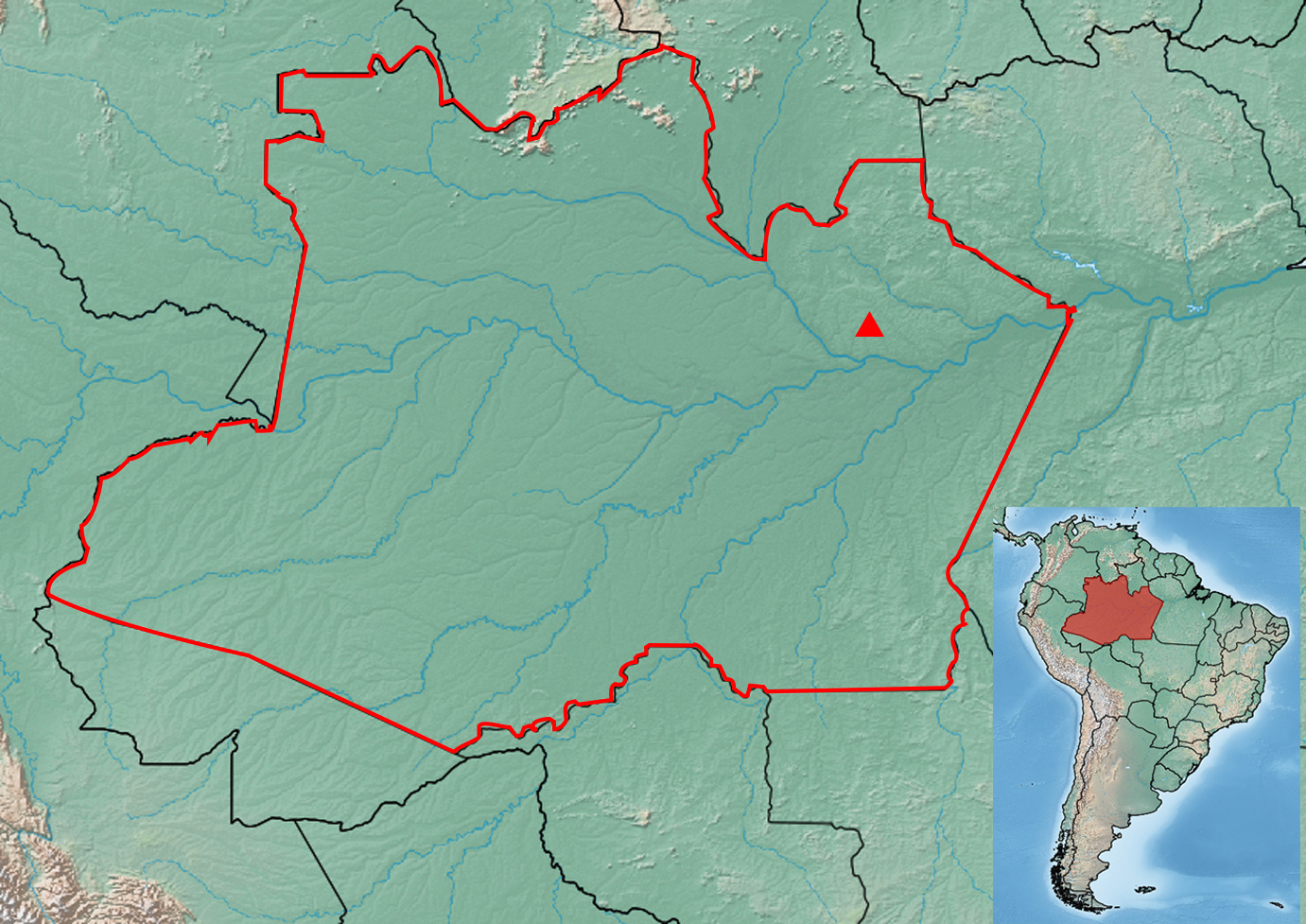
The marsupial M. noctivagus, carrying the tick, was collected in June 2024 using a flight interception trap for insects, placed at a height of 28 m in the forest canopy. The trap was installed in an Amazonian biogeographical component at the Tropical Silviculture Experimental Station which belongs to the National Institute of Amazonian Research (INPA), located on the ZF-2 road (02°35′33′S and 60°06′55′W), 60 km north of Manaus, Amazonas (Figure 1). The specimen was placed in a container with 96% ethyl alcohol and was transported to and analyzed at the Urban and Forensic Systematic Entomology Laboratory (INPA). Its body mass (BM) in grams, length of tail (LT), total length (nose to tail-tip, TL) and head-and-body length (HBL) in millimeters were measured. Its entire external surface, including the fur, was inspected for tick collection, which was performed using entomological tweezers.

Location of the host and ectoparasite collecting site in Manaus municipality, Amazonas State, northern Brazil.
The morphological identification of the tick was performed following specific taxonomic literature (Nava et al., 2017; Onofrio et al., 2010). The main morphological characteristics identified in the studied I. luciae nymph specimen are the basis capituli long, triangular; cornua absent; venter of basis with large lateral extensions homologous to auriculae; scutum elongate with long, distinct lateral carinae, scapulae short and rounded; and mainly external spur on coxa I longer and larger than internal; hypostome pointed.
The voucher material was deposited in the Acarological Collection of the Zoological Collections, Butantan Institute (IBSP). Photographs of the marsupial and tick specimens were taken using a Leica DFC500 digital camera coupled to a Leica M205c microscope, connected to a computer using the Leica Application Suite LAS V3.6 software, which includes an automontage module.
For molecular identification, the entire specimen DNA material was placed in a 1.5 µL Eppendorf® microtube and was extracted using the QIAGEN DNeasy Blood & Tissue kit, following the manufacturer’s protocols. Two molecular markers (18S rRNA and 16S rRNA) were targeted for molecular characterization of this tick species. The following primers and their respectively PCR protocols were used as described in the original articles to target each gene fragment: 18S rRNA using the primers Mite18S-1F (5′-ATATTGGAGGGCAAGTCTGG-3′) and Mite18S-1R (5′-TGGCATCGTTTATGGTTAG-3′); and 16S rRNA using the primers 16S+1 (5′-CTGCTCAATGATTTTTTAAATTGCTGTGG-3′) and 16S–1(5′-CCGGTCTGAACTCAGATCAAGT-3′) (Mangold et al., 1998). The PCR reagent concentration and thermal cycler conditions were as described in the abovementioned studies. A negative control (ultrapure water type I) and a positive control (pool of Tyrophagus sp.) were used for each reaction.
After extraction, the DNA was subjected to additional convective PCRs (cPCRs) in order to detect Anaplasmataceae agents and Rickettsia spp. For this purpose, PCRs targeting 16S rRNA and gltA, respectively, were performed. A negative control (Milli-Q DNA-free water) and a positive control were included in each reaction (Labruna et al., 2004).
The PCR product was purified using ExoSap-IT (GE Healthcare, Pittsburgh, PA, USA). Sanger sequencing was performed at the Human Genome and Stem Cell Research Center of the Biosciences Institute, University of São Paulo, São Paulo, SP, Brazil. The sequence thus obtained was assembled using the Sequencing Analysis 5.3.1 software and was subjected to BLAST analysis (Altschul et al., 1990) to infer similarities with other sequences available in GenBank.
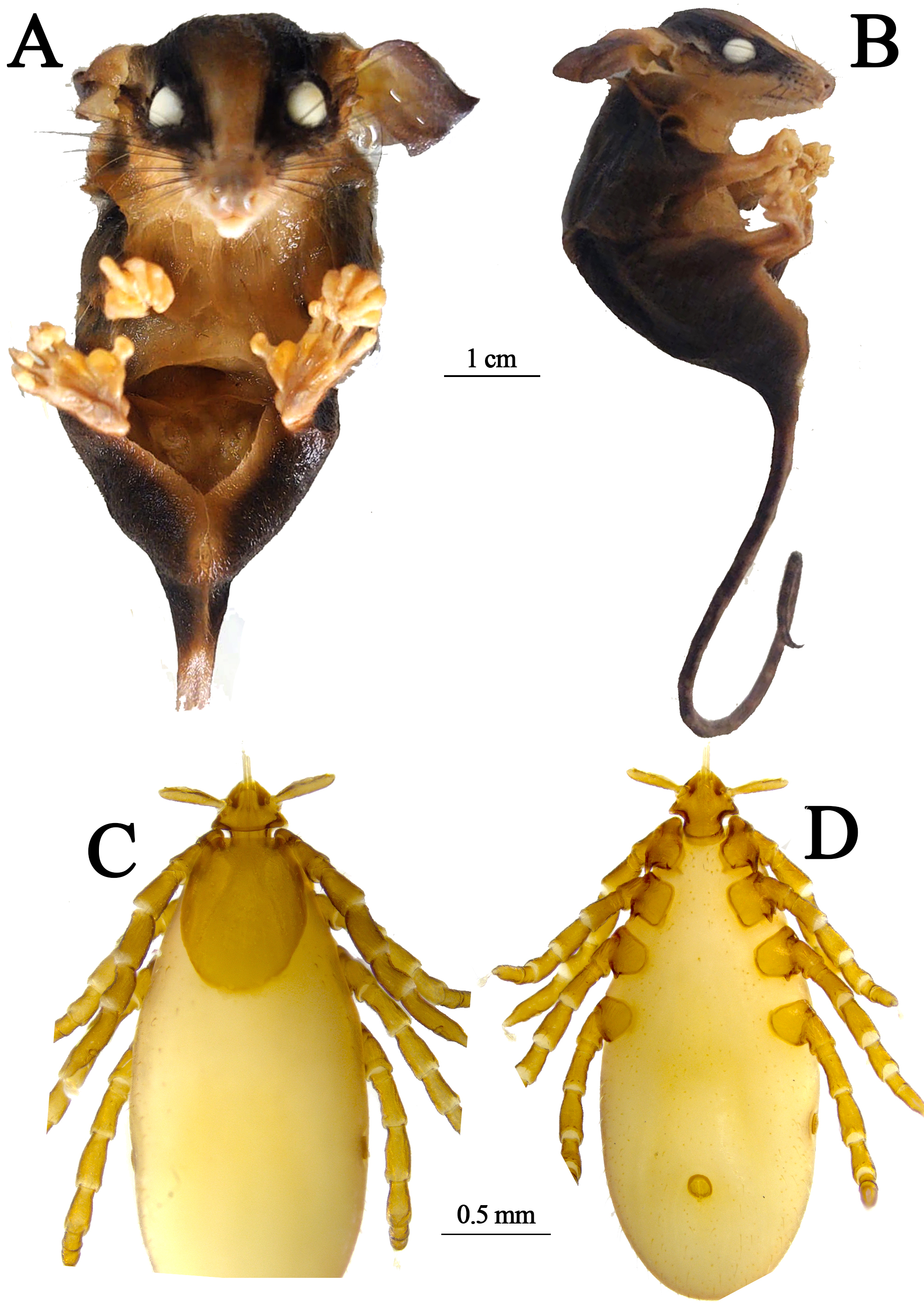
The M. noctivagus (Figure 2A and 2B) specimen possesses the following measurements: BM = 14, TL = 185, LT = 105 and HBL = 85. These values were lower than those reported by Voss et al. (2004), suggesting that the specimen was not an adult. This species has previously been recorded in the Amazon, specifically in the Amazonas (Emmons & Feer, 1997; Vieira & Camargo, 2012) state. In the present report, the specimen was collected in the tree canopy indicating that although M. noctivagus primarily inhabits the understory, this species may expand its vertical exploration range into higher strata when searching for resources such as food. The closely related species of the Atlantic Forest, Marmosops incanus, has also been recorded in upper strata but does not reach the canopy (Cunha & Vieira, 2002).

Marmosops noctivagus subadult, (A) Ventral view; (B) Lateral view (scales in cm); Ixodes luciae nymph; (C) Dorsal view; (D) Ventral view (scales in mm).
A single nymph of the tick I. luciae (Figure 2C and 2D) was found in the dorsal region of the host's neck. In addition to the morphological identification, DNA was successfully extracted from the specimen, and a partial sequence of the genes tested (18S rRNA and 16S rRNA) was obtained. The GenBank accession numbers for these sequences are PV113350 and PV113434, respectively.
Upon comparison with sequences available in the GenBank database, the identification of I. luciae was corroborated. Our 18S rRNA and 16S rRNA sequences showed 100% shared identity (query cover: 100%; e-value: 0) with the I. luciae sequence (GenBank accession number: AF115367 and U95894, respectively).
Regarding parasitism, in Brazil, there are records of I. luciae parasitizing other marsupials, such as Philander opossum in Mato Grosso (Witter et al., 2016), and Mato Grosso do Sul (host not identified) (Onofrio et al., 2010) states in the Central-West region. In the Northeast region, it has been recorded parasitizing Didelphis marsupialis in Maranhão (Costa et al., 2020) state. In the North region, both nymphs and adults have been found in marsupials in Pará (Luz et al., 2013), Rondônia (Labruna et al., 2005) and Acre (D. marsupialis) (Tojal et al., 2021) states. In the Amazonas state, the first record of this tick was obtained from D. marsupialis (Onofrio, 2003) in the municipality of Santa Isabel do Rio Negro, and the second from Micoureus demerarae (Gianizella et al., 2018) in the municipality of Manaus. Therefore, the record in the present study represents the second occurrence of this tick in the city of Manaus, the third to the Amazonas state and the first documented case of I. luciae parasitizing M. noctivagus in Brazil and South America.
There is a significant overlap of the distribution areas of this tick and its host. The distribution of the marsupial (Acre, Amazonas, Pará and Mato Grosso) nearly coincides with the distribution of the tick (Acre, Amazonas, Pará, Rondônia, Maranhão, Mato Grosso and Mato Grosso do Sul), and encompasses both the Brazilian and the Peruvian Amazon regions.
No pathogens were detected in the I. luciae tick collected in the present study. According to Binetruy et al. (2020), the bacterium Rickettsia bellii was identified in I. luciae in French Guiana, a bacterium that is not pathogenic to humans. Additionally, there is a record of a female of this tick parasitizing a human in Argentina (Ivancovich & Luciani, 1992). In Brazil, this tick was tested for the presence of R. bellii in Mato Grosso state, with negative results (Witter et al., 2016). These findings corroborate the results obtained by Díaz et al. (2009), who also found no evidence that I. luciae serves as a possible vector of pathogens to humans.
Understanding the distribution of this species, both in horizontal and vertical strata, is crucial for comprehending ecological mechanisms and for developing more targeted and effective conservation strategies. These new records enhance our understanding of the natural cycle of this tick species and the ecological relationships between this parasite and its host, such as their coexistence within the same area.
Acknowledgements
MC thanks LESUF/INPA for laboratory support and Daniel Lima for the images.
Data availability
Data will be made available on request.
-
How to cite:
Cutrim M, Rafael JA, Jacinavicius FC, Barros-Battesti DM, Bassini-Silva R. First record of Ixodes luciae (Acari: Ixodidae) parasitizing Marmosops noctivagus (Didelphimorphia: Didelphidae) in South America. Rev Bras Parasitol Vet 2025; 34(3): e006325. https://doi.org/10.1590/S1984-29612025039.
-
Financial Support
JAR thanks the Conselho Nacional de Desenvolvimento Científico e Tecnológico (CNPq), by the financial support, research fellow, process 306661/2021-7; PROTAX process 443641/2020-0 and INCT BioDossel, process 406833/2022-2; to Coordenação de Aperfeiçoamento de Nível Superior (CAPES), PROAP program, finance code 001. DMB-B thanks the CNPq for the support and productivity grant (Process: 303.802/2021-9).
-
Ethics declaration
Ethical approval to conduct this study was granted by the Ministry of the Environmental, Chico Mendes Institute for Biodiversity Conservation, under the Biodiversity Authorization and Information System number (91221-1), authentication code: 0912210120231018.
References
-
Altschul SF, Gish W, Miller W, Myers EW, Lipman DJ. Basic local alignment search tool. J Mol Biol 1990; 215(3): 403-410. http://doi.org/10.1016/S0022-2836(05)80360-2 PMid:2231712.
» http://doi.org/10.1016/S0022-2836(05)80360-2 -
Amador LI, Giannini NP. Evolution of diet in extant marsupials: emergent patterns from a broad phylogenetic perspective. Mammal Rev 2020; 51(2): 178-192. http://doi.org/10.1111/mam.12223
» http://doi.org/10.1111/mam.12223 - Autino AG, Nava S, Venzal JM, Mangold AJ, Guglielmone AA. La presencia de Ixodes luciae en el noroeste argentino y nuevos huéspedes de para Ixodes pararicinus y algunas especies de Amblyomma (Acari: ixodidae). Rev Soc Entomol Argent 2006; 65(1-2): 27-32.
- Barros-Battesti DM, Machado RZ, André MR. Ectoparasitofauna brasileira de importância veterinária - volume 3. Acarofauna de importância veterinária: parasitiformes - Ixodida, parte I. Jaboticabal: CBPV; 2024.
-
Binetruy F, Buysse M, Barosi R, Duron O. Novel Rickettsia genotypes in ticks in French Guiana, South America. Sci Rep 2020; 10(1): 2537. http://doi.org/10.1038/s41598-020-59488-0 PMid:32054909.
» http://doi.org/10.1038/s41598-020-59488-0 -
Costa FB, Martins TF, Muñoz-Leal S, Serpa MCA, Ogrzewalska M, Luz HR, et al. Retrospective and new records of ticks (Acari: Argasidae, Ixodidae) from the state of Maranhão, an Amazon-Cerrado transition area of Brazil. Vet Parasitol Reg Stud Rep 2020; 21: 100413. http://doi.org/10.1016/j.vprsr.2020.100413 PMid:32862893.
» http://doi.org/10.1016/j.vprsr.2020.100413 -
Cunha AA, Vieira MV. Support diameter, incline, and vertical movements of four didelphid marsupials in the Atlantic Forest of Brazil. J Zool 2002; 258(4): 419-426. http://doi.org/10.1017/S0952836902001565
» http://doi.org/10.1017/S0952836902001565 -
Díaz MM, Nava S, Guglielmone AA. The parasitism of Ixodes luciae (Acari: Ixodidae) on marsupials and rodents in Peruvian Amazon. Acta Amazon 2009; 39(4): 997-1002. http://doi.org/10.1590/S0044-59672009000400029
» http://doi.org/10.1590/S0044-59672009000400029 - Emmons LH, Feer F. Neotropical rainforest mammals: a field guide Chicago: University of Chicago Press; 1997.
- Gardner AL. Order Didelphimorphia. In: Wilson DE, Reeder DM, editors. Mammal species of the world: a taxonomic and geographic reference. Baltimore: The Johns Hopkins University Press; 2005. p. 3-18. (vol. 1).
-
Gianizella SL, Martins TF, Onofrio VC, Aguiar NO, Gravena W, Nascimento CAR, et al. Ticks (Acari: Ixodidae) of the state of Amazonas, Brazil. Exp Appl Acarol 2018; 74(2): 177-183. http://doi.org/10.1007/s10493-018-0221-7 PMid:29383533.
» http://doi.org/10.1007/s10493-018-0221-7 - Guimarães JH, Tucci EC, Barros-Battesti DM. Ectoparasitos de importância veterinária. São Paulo: Plêiade, FAPESP; 2001.
- Ivancovich JC, Luciani CA. Las garrapatas de Argentina. Buenos Aires: Monografías de la Asociación Argentina de Parasitología Veterinaria; 1992.
-
Labruna MB, Whitworth T, Horta MC, Bouyer DH, McBride JW, Pinter A, et al. Rickettsia species infecting Amblyomma cooperi ticks from an area in the state of São Paulo, Brazil, where Brazilian spotted fever is endemic. J Clin Microbiol 2004; 42(1): 90-98. http://doi.org/10.1128/JCM.42.1.90-98.2004 PMid:14715737.
» http://doi.org/10.1128/JCM.42.1.90-98.2004 - Labruna MB, Camargo LMA, Terrassini FA, Ferreira F, Schumaker TTS, Camargo EP. Ticks (Acari: Ixodidae) from the state of Rondônia, western Amazon, Brazil. Syst Appl Acarol 2005; 10(1): 17-32.
-
Luz HR, Faccini JL, Landulfo GA, Sampaio JS, Costa SF No, Famadas KM, et al. New host records of Ixodes luciae (Acari: Ixodidae) in the State of Pará, Brazil. Rev Bras Parasitol Vet 2013; 22(1): 152-154. http://doi.org/10.1590/S1984-29612013000100028 PMid:24252962.
» http://doi.org/10.1590/S1984-29612013000100028 -
Mangold AJ, Bargues MD, Mas-Coma S. Mitochondrial 16S rDNA sequences and phylogenetic relationships of species of Rhipicephalus and other tick genera among Metastriata (Acari: Ixodidae). Parasitol Res 1998; 84(6): 478-484. http://doi.org/10.1007/s004360050433 PMid:9660138.
» http://doi.org/10.1007/s004360050433 - Martins TF, Onofrio VC, Labruna MB, Guglielmone AA, Barros-Battesti DM. Família Ixodidae da região neotropical: características gerais, distribuição geográfica, hospedeiros e chaves de identificação das espécies que ocorrem no Brasil. In: Barros-Battesti DM, Machado RZ, André MR, editors. Ectoparasitofauna brasileira de importância veterinária, volume 3. Acarofauna de importância veterinária: parasitiformes – Ixodida. Parte I. Jaboticabal: CBPV; 2024. p. 99-240.
- Nava S, Venzal JM, Acuña DG, Martins TF, Guglielmone AA. Ticks of the Southern Cone of America: diagnosis, distribution, and hosts with taxonomy, ecology and sanitary importance. 1st ed. London: Academic Press; 2017.
- Onofrio VC. O gênero Ixodes Latreille, 1795 (Acari: Ixodidae) no Brasil: distribuição geográfica, hospedeiros, taxonomia e chave de identificação para as espécies [dissertation]. Seropédica: Universidade Federal Rural do Rio de Janeiro; 2003.
-
Onofrio VC, Labruna MB, Faccini JLH, Barros-Battesti DM. Description of immature stages and redescription of adults of Ixodes luciae Sénevet (Acari: Ixodidae). Zootaxa 2010; 2495(1): 53-64. http://doi.org/10.11646/zootaxa.2495.1.2
» http://doi.org/10.11646/zootaxa.2495.1.2 -
Tojal SD, Meneguetti DUO, Martins TF, Labruna MB, Aguirre AAR, Siebra EAM, et al. First report of Amblyomma latepunctatum and the second record of Ixodes luciae in the state of Acre, Brazil. Rev Bras Parasitol Vet 2021; 30(3): e007221. http://doi.org/10.1590/s1984-29612021063 PMid:34259742.
» http://doi.org/10.1590/s1984-29612021063 - Vieira EM, Camargo NF. Uso do espaço vertical por marsupiais brasileiros. In: Cáceres NC, editor. Os marsupiais do Brasil: biologia, ecologia e evolução. Campo Grande: UFMS; 2012. p. 345-362.
-
Voss RT, Tarifa T, Yensen E. An Introduction to Marmosops (Marsupialia: Didelphidae), with the description of a new species from Bolivia and notes on the taxonomy and distribution of other Bolivian forms. Am Mus Novit 2004; 3466(1): 1-40. http://doi.org/10.1206/0003-0082(2004)442<0001:OTROMF>2.0.CO;2
» http://doi.org/10.1206/0003-0082(2004)442<0001:OTROMF>2.0.CO;2 -
Witter R, Martins TF, Campos AK, Melo ALT, Corrêa SHR, Morgado TO, et al. Rickettsial infection in ticks (Acari: Ixodidae) of wild animals in Midwestern Brazil. Ticks Tick Borne Dis 2016; 7(3): 415-423. http://doi.org/10.1016/j.ttbdis.2015.12.019 PMid:26775021.
» http://doi.org/10.1016/j.ttbdis.2015.12.019
Edited by
-
Assistant Editor:
Marcelo Bahia Labruna