 When Weak States Win: A Supermodular Game-Theoretic Account of the 2006 Bolivia–Brazil Gas Crisis
Abstract
What if third-party involvement and economic interdependence, often assumed to foster compromise, are precisely what entrench escalation in international negotiations? This paper introduces a supermodular game-theoretic framework to explain how indirect third-party alignment and domestic political constraints can produce strategic complementarities that lock actors into rigid bargaining positions. Drawing on an analytic narrative of the 2006 Bolivia–Brazil gas negotiations, we demonstrate how Venezuela’s political and financial backing emboldened Bolivia to harden its stance, while Brazil’s capacity to respond assertively was neutralized by domestic audience costs, intensified by electoral pressures. The result was not mediation or de-escalation, but a contested equilibrium shaped by positive feedback dynamics. Our findings show that third-party support can strategically reshape payoff structures in ways that incentivize escalation, even under conditions of deep interdependence. This framework advances the study of international negotiations by modelling how escalation can emerge endogenously from the strategic structure of trilateral interactions.
Keywords:
International Negotiations; Crisis Escalation; Strategic Complementarity; Supermodular game theory; Audience Costs
Introduction
The literature on international negotiations has long recognized the varied roles that third parties can assume in shaping bargaining outcomes. Classic distinctions typically categorize third-party involvement as either mediation where an external actor facilitates dialogue without directly influencing the outcome or direct intervention, where the third party becomes an active participant in the bargaining process (Sebenius 1983; Regan 1996). The vast body of literature refers to third parties as mediators, facilitators, or conciliators within the broader tradition of third-party dispute resolution (Caputo 2013). These distinctions are further nuanced by debates around the conditions under which third-party presence enhances or undermines negotiation efficiency, with empirical studies often linking success to the binding nature of the third party’s role and the information asymmetries it seeks to mitigate (Arunachalam et al. 1998). In both cases, the third party is visibly present and institutionally acknowledged, thus shaping the course of negotiation through formal mechanisms.
A parallel strand of research emphasizes the importance of third-party alignments during negotiation deadlocks or highly asymmetric bargaining contexts. A third country played a pivotal role in either resolving or exacerbating a diplomatic crisis between two states over energy resources. Notable examples include Venezuela’s support for Ecuador during its 2006 dispute with Occidental Petroleum, when Caracas provided technical and political backing following Quito’s cancellation of the U.S. company’s contract (“Ecuador seizes oxy operations.” 2006; Wilson 2006); and Russia’s involvement in the 2006 and 2009 Ukraine–Europe gas crises, in which Moscow’s supply cuts over pricing disagreements triggered EU intervention and exposed Europe’s vulnerability to external energy coercion (“Putin’s power play.” 2014).
Fells (1986) and Kumar and Patriotta (2011) highlight how a third party that ‘joins’ the negotiation process can act as a catalyst by reducing ambiguity or reshaping perceived power dynamics (Fells 1986; Kumar and Patriotta 2011). Within multi-actor or team-based negotiation settings, third parties may serve a stabilizing role by contributing resources, legitimacy, or a procedural framework, particularly when inter-group asymmetries emerge (Beersma and De Dreu 2002). Whether focusing on individuals or organizations, these studies consistently argue that the presence of ‘the third who joins the negotiation’ (Caputo 2013, 257) helps manage deadlocks, encourages collaborative thinking, and facilitates the emergence of integrative agreements.
Much of this literature overlooks more subtle and indirect forms of third-party influence, particularly in bilateral negotiations where external actors may not formally participate but nonetheless exert considerable leverage behind the scenes. In such cases, the third party may shift strategic incentives, reframe the perceived costs of compromise, or act as an informal guarantor, thereby transforming the strategic landscape without officially joining the negotiation. These indirect interventions may prove especially potent in asymmetrical relationships where the weaker party leverages external alignment to amplify its bargaining power. Yet, because these actors operate outside the formal negotiation table, their influence tends to be under-theorized and empirically neglected.
The 2006 Bolivia–Brazil gas crisis offers a paradigmatic example of this overlooked form of third-party influence, described by Brazilian officials as the country’s most serious diplomatic crisis since the 19th century (Carra 2014). In this case, Bolivia, under President Evo Morales, nationalized its hydrocarbon sector and imposed new terms on foreign energy companies, including Petrobras, Brazil’s state-owned oil giant. Despite Brazil’s economic leverage - Petrobras had invested over $1.5 billion in Bolivia - its response was unexpectedly restrained (“Bolívia quer renegociar contratos.” 2006). A key reason was the behind-the-scenes support provided by Venezuela’s President Hugo Chávez, who offered Bolivia diplomatic backing, legal assistance, and substantial investment commitments through PDVSA, Venezuela’s state oil company.
Although Venezuela was not formally part of the negotiation process, classified diplomatic documents1 reveal that its alignment with Bolivia shifted the strategic balance empowering Bolivia to adopt a more assertive stance while constraining Brazil’s capacity to retaliate. This type of informal, indirect third-party involvement, neither mediation nor direct participation, does not fit neatly into existing theoretical frameworks. By modelling this dynamic through a supermodular game-theoretic approach, this study contributes to a more nuanced understanding of how third-party influence can escalate bilateral negotiations into prolonged crises, even in transparent and interdependent settings.
While the argument builds on the negotiation literature, the study’s theoretical foundation lies in alliance and coalition theory. It conceptualizes third-party engagement as a strategic extension of coalition behavior rather than as an exogenous act of mediation. In this perspective, Venezuela’s involvement in the 2006 Bolivia–Brazil gas crisis is understood not as diplomatic interference but as a form of endogenous alignment that reshaped the bargaining equilibrium between the two states.
By modelling this dynamic using supermodular game theory, this paper contributes primarily to the literature on international negotiations and crisis bargaining. It offers a formal mechanism (strategic complementarity) that helps explain why some negotiations escalate into prolonged crises even under conditions of transparency and economic interdependence. Our central contribution lies in demonstrating how third-party support and domestic constraints can jointly entrench bargaining rigidity in resource-based negotiations.
This paper is structured into five main sections. The literature review critiques traditional negotiation theories, emphasizing the overlooked role of strategic rigidity and third-party influence. The methods section introduces a supermodular game-theoretic approach to model the strategic interactions between Bolivia, Brazil, and Venezuela, highlighting how increasing differences reinforce hardline stances. Then, the case study examines the 2006 Bolivia–Brazil gas crisis, demonstrating how Venezuela’s financial and political support enabled Bolivia to adopt a tougher stance while Brazil’s response was constrained by domestic political concerns. The findings and discussion analyze the model’s equilibrium outcomes, showing that Venezuela’s involvement shifted Bolivia’s payoffs, prolonging the crisis and limiting Brazil’s bargaining flexibility. The conclusion underscores the study’s contribution to negotiation theory.
Rethinking Third-Party Influence in Bargaining Crises
Third-party alliances play a complex and multifaceted role in deterrence strategies across international conflicts, challenging simplistic assumptions that deterrence success hinges solely on the raw power of alliance members. A robust body of literature shows that effectiveness depends on a variety of contextual and institutional factors, such as geographical proximity (Bak 2018), the type and conditions of the alliance (Benson 2011), and the specificity of military commitments (Leeds 2003). For example, Bak (2018) finds that geographically proximate allies provide more credible deterrent threats due to increased capacity for rapid response and higher perceived commitment. Similarly, Benson (2011) distinguishes between compellent and deterrent alliances, arguing that unconditional compellent alliances may escalate conflict likelihood, whereas conditional deterrent alliances, those activated only in the event of aggression, can lower the probability of conflict initiation. Leeds (2003) further supports this by demonstrating that alliances with clearly articulated obligations, such as mutual defense clauses or troop deployments, enhance deterrent credibility.
Yet, these standard models fall short in explaining empirical anomalies such as the Brazil–Bolivia–Venezuela triangle, where an alliance with comparatively limited power seems to exert a meaningful deterrent effect. Huth and Russett (1988) highlight that successful extended deterrence depends not just on military capabilities but also on contextual variables like the immediate balance of power and strategic behavior, such as firm-but-flexible bargaining (Huth and Russett 1988). Langlois (2012) introduces psychological and informational dimensions to deterrence theory, arguing that uncertainty about enemy strength can shape both ally behavior and challenger perception, leading to caution even when material asymmetries exist. Sorokin (1994), through a game-theoretic lens, suggests that deterrence outcomes are strongly conditioned by the availability of information and the beliefs of potential attackers regarding alliance credibility and resolve. These findings suggest that credibility is not merely a function of capabilities but also of strategic ambiguity, perceived risks of escalation, and the signaling environment surrounding the conflict (Langlois 2012; Sorokin 1994).
While indirect third-party influence has received limited attention in negotiation theory, its effects become particularly salient in contexts of deep economic interdependence, where mutual exposure to costs and benefits is expected to foster cooperation. While scholars acknowledge that interdependence can sometimes hinder cooperation, the prevailing view is that interdependence reduces the likelihood of conflict. From a realist perspective, however, interdependence may lower the risk of conflict between two directly connected states (dyads) while increasing the likelihood of tensions with third parties that perceive such ties as threatening (Maoz 2009). Moreover, high interdependence within blocs and low interdependence across blocs can contribute to polarization in the international system (Barbieri 2002). The core idea is that interdependence implies reciprocal dependence: a change in j affects changes in i, and a change in i affects changes in j.
Yet, as the next section explores, interdependence can become a source of rigidity rather than flexibility, particularly when third-party alignments reconfigure the payoff structures of the main players. In such scenarios, what appears to be a stabilizing condition may instead exacerbate strategic tensions, especially when the involvement of external actors like Venezuela shifts marginal incentives in a way that encourages escalation. This underscores the need to reassess how interdependence and third-party influence interact, not as separate explanatory mechanisms, but as mutually reinforcing dynamics capable of entrenching bargaining positions and prolonging crises. Supermodular game theory offers a formal framework to capture these escalating feedback loops, revealing how third-party alignment and economic interdependence can jointly transform the strategic landscape of international negotiations.
The Bolivia–Brazil–Venezuela case offers an ideal setting to demonstrate this logic. Bolivia’s nationalization of its gas industry was not simply a discrete ‘Tough’ move in the Smithian sense. Rather, it altered the marginal incentives of both Venezuela (PDVSA’s investment spike) and Brazil (audience-cost-induced reluctance to escalate), thereby extending the crisis duration and hardening each player’s position. In our model, these reinforcing dynamics are not exogenous shocks but endogenous features of strategic complementarity. The game exhibits two locally stable equilibria: a cooperative one and a conflictual one. On this note, early moves or third-party support (Venezuela’s alignment with Bolivia) can tip the system from the former to the latter.
Our model, grounded in supermodular game theory (Topkis 1998; Vives and Vravosinos 2024), offers a distinct alternative to existing frameworks by shifting the analytical focus away from uncertainty as the primary catalyst for conflict. Whereas traditional models typically attribute escalation to misperceptions or incomplete information about costs and preferences, our approach demonstrates that strategic rigidity can persist even in fully transparent environments. In contrast to Kydd’s model (1997) where escalation stems from evolving beliefs, ours highlights how positive feedback dynamics emerge from structural features of strategic interdependence. In this view, conflict escalates not because actors misread one another’s intentions, but because their incentives are mutually reinforcing, creating a self-sustaining cycle of hardline behavior.
Smith’s (1995) contribution to this literature models alliance politics as a strategic interaction under full information, in which states make endogenous alignment decisions that influence their credibility in deterrence and bargaining. His model links alliance choices with crisis behavior, but it assumes strategic substitutability and yields a unique equilibrium in each subgame. As such, Smith’s framework can only capture escalation across crises (in comparative statics) rather than within them (Smith 1995).
This paper builds directly on Smith’s foundational work by re-specifying the game in supermodular terms, i.e., under conditions of increasing differences or strategic complementarity. In Smith’s model, one actor’s hard-line move does not necessarily increase the other’s incentives to reciprocate; equilibria are stable and discrete, and crises tend to end in a few steps once types are revealed. In contrast, supermodular games admit multiple monotonic best responses. In such settings, a harder move by one actor increases the marginal payoff of hardening for others. This creates the potential for positive feedback, multiple equilibria, and path-dependent escalation within a single crisis episode.
This theoretical re-specification thus enables the model to endogenize escalation, much as Smith (1995) endogenized credibility. Where Smith (1995) shows how alignment decisions influence a state’s wartime resolve, our framework shows how those same ties under complementary incentives can entrap states in spiraling confrontations. Crucially, this occurs without invoking incomplete information or signaling uncertainty: escalation arises in fully transparent environments where mutually reinforcing payoffs lock players into conflictual postures.
Our model also highlights the role of third-party actors in reinforcing crises. While most IR models focus on two-party interactions, our framework shows how external players, even those not directly involved in the core dispute, can amplify escalation dynamics by influencing incentives. Moreover, it explains how a system can shift from stable outcomes to escalating dynamics. In some contexts, equilibrium conditions inhibit positive feedback, whereas in others, they foster reinforcing cycles that sustain or accelerate crises. This capacity to capture shifts between static and dynamic equilibria constitutes a key advantage of our approach.
Building on this foundation, the study’s theoretical core lies in alliance and coalition theory, which provides the analytical basis for understanding how states form, sustain, and recalibrate cooperative ties under asymmetric conditions. Within this broader framework, third-party involvement is treated as an endogenous mechanism that alters coalition stability and the strategic incentives of the principal actors. Rather than approaching third parties as external mediators, we conceptualize them as integral components of the alliance structure whose actions modify the payoff matrix and can trigger feedback loops of escalation. In this sense, the paper bridges the literature on alliance formation and that on third-party intervention in negotiations: it extends coalition theory by demonstrating how indirect alignment can entrench strategic complementarities and generate bargaining rigidity even in transparent settings. The central contribution, therefore, is theoretical, by advancing alliance models to explain how third-party engagement can transform otherwise cooperative interdependence into sustained crises.
The following section outlines the methodological strategy employed to operationalize this framework. It introduces the analytic narrative approach and the supermodular game-theoretic model used to formalize the strategic interactions between Bolivia, Brazil, and Venezuela, before specifying the structure of the game and its implications for crisis escalation.
Methods
This paper employs an Analytic Narrative approach (Bates et al. 1998; Levi 2004) with a supermodular game to model the strategic interactions between Bolivia, Brazil, and Venezuela. Supermodular games are useful for analyzing situations where players’ strategies exhibit increasing differences, meaning that a stronger commitment by one actor incentivizes a tougher stance by another (Bacharach 2019). In the Bolivia-Brazil case, Bolivia’s harder bargaining stance, supported by Venezuela, increased the likelihood of a protracted negotiation crisis.
The method is particularly well-suited for explaining unique cases through parsimonious causal models (Levi and Weingast 2016). As Levi and Weingast (2016, 2) note, ‘A weakness of case studies per se is that there typically exist multiple ways to interpret a given case. […] The inclusion of a model adds some discipline to the account. For example, observed choices must be consistent with the assumption about preferences in the model.’ By integrating formal theory into case-based research, this approach ensures greater internal consistency and analytical transparency.
It must be stressed that, in analytic narratives, the formal model does not serve as a hypothesis to be empirically tested on the same case, but as a disciplined counterfactual device that enables causal inference. By specifying the logic of strategic interaction, the model allows us to evaluate whether the observed sequence of actions is consistent with rational behavior under given incentives, and to identify what would have happened had key parameters (such as third-party support) been absent. This approach, following Bates et al. (1998) and Levi & Weingast (2016), avoids tautology precisely because the model introduces a theoretical structure that constrains the narrative, rather than merely reproducing it. In other words, we are not testing the model with the empirical evidence, but constraining the empirical evidence to allow counterfactual reasoning, which is the basis for any causal inference statement.
Compared to other qualitative approaches, the analytic narrative method emphasizes key actors, their strategies, and patterns of interaction rather than abstract variables typical of process tracing (Levi and Weingast 2016). This focus is particularly relevant here, as the behaviors of Brazil, Bolivia, and Venezuela are central to understanding the bargaining dynamics. Accordingly, we apply a supermodular game-theoretic framework to analyze how interdependence in international negotiations can reshape bargaining positions, reinforce hardline strategies, and escalate disputes into crises. Supermodular games, characterized by strategic complementarities, depict situations where stronger commitments by one actor incentivize more assertive responses from others (Bacharach 2019), making this methodology especially appropriate for international negotiations, where actors continuously adapt to shifting economic and political incentives.
Standard approaches to interdependence, such as issue-linkage, typically emphasize marginal interdependence by focusing on how one actor’s actions affect another’s payoffs—formally, the first derivative of the utility function. In contrast, supermodular games rigorously model non-linear strategic interdependencies through the property of increasing differences, represented by a positive second cross-partial derivative in players’ utility functions. This second-order effect shows that a change in one actor’s strategy not only alters the immediate marginal payoff but also reshapes the overall incentive structure, prompting further strategic adjustments. When the second cross-derivative is positive, shifts in the strategic environment can provoke a cascade of mutually reinforcing responses, a dynamic particularly relevant in the escalation of international crises.
Supermodular games are particularly well-suited for analyzing escalating bargaining crises because they guarantee that best responses are monotonic—that is, non-decreasing. In practical terms, when one actor adopts a more hardline position, the other is incentivized to do the same, generating a dynamic of mutual reinforcement that helps explain the trajectory of many real-world crises. In contrast, standard models of interdependence that lack this property struggle to account for escalation dynamics or cascades of strategic responses, limiting their explanatory power in high-stakes bargaining environments.
Building on the literature on oligopolistic competition and supermodular games (Amir 2018), we model the strategic interactions between Bolivia, Brazil, and Venezuela during the 2006 gas crisis. This approach captures how third-party interventions, such as Venezuela’s financial and political support to Bolivia, influenced Bolivia’s optimal strategy, leading to an escalation of the bargaining crisis (Azevedo and Paxson 2014).
Our model adopts a supermodular framework where each player’s strategic choices exhibit increasing differences in payoffs. One advantage for applying supermodular games to negotiation crises compared to standard approaches is the fact that rationalizable strategies in supermodular games can be identified with minimal assumptions (Uetake and Watanabe 2013). This ensures that our equilibrium analysis remains robust to variations in strategic incentives and external constraints.
Case 1: Bolivia and PDVSA
In the Bolivia-Petrobras negotiations under Evo Morales and Lula da Silva during the 2000s, Venezuela, under Hugo Chávez, signaled its willingness to support Bolivia’s energy sector through technology transfer, capital infusion, and direct investment. This support intensified as Bolivia adopted a firmer stance. PDVSA’s increasing investments reinforced Bolivia’s hardline position. In supermodular terms, we argue that the more Bolivia escalated, the more PDVSA would invest in Bolivia, leading to increasing differences in payoffs. The marginal payoff of a tougher stance by Bolivia increased with stronger commitments from PDVSA.
Case 2: Brazil and Domestic Audience Costs
Brazil’s position was influenced by domestic political considerations. President Lula, seeking reelection, faced a constituency sympathetic to Morales. According to the Latinobarómetro 2006 dataset, Brazilian respondents exhibited comparatively favorable perceptions of Bolivian President Evo Morales. When asked to rate a selection of regional and international leaders on a scale from 0 to 10, the mean score attributed to Morales by the Brazilian sample was approximately 6.1, which is a level of approval virtually identical to that received by Venezuelan President Hugo Chávez (≈ 6.0) and considerably higher than that assigned to extra-regional figures such as George Bush (≈ 3.1) or José Luis Rodríguez Zapatero (≈ 5.0). The distribution of responses places Morales among the most positively evaluated foreign leaders in Brazil, alongside left-leaning regional counterparts such as Fidel Castro and Néstor Kirchner (≈ 5.8–6.0). This pattern indicates that, on the eve of Lula’s 2006 re-election campaign, the Brazilian electorate was broadly sympathetic to Morales’s left-wing, nationalist agenda (Latinobarómetro Corporation 2006).
A tough bargaining stance could harm his electoral prospects. Contrary to standard audience-cost theories, Lula’s domestic audience costs constrained his bargaining power, compelling him to accept a less favorable deal to maintain political support.
We model both parts of the negotiation separately - (PDVSA-Bolivia) and (Brazil’s domestic audience costs) - before integrating them into a single model. In the Bolivia-PDVSA interaction, interdependence arises through increasing differences, where Venezuela’s investment (PDVSA) increases Bolivia’s marginal payoff for adopting a tougher stance. This represents supermodularity in game theory. In the Brazil case, interdependence reflects how Lula’s strategy depends on Bolivia’s behavior, with audience costs creating constraints on his response. This aligns with standard interdependence arguments. Before presenting the fully developed formal model, we introduce a simplified version to capture the intuition of the more complex model that follows.
Game-Theoretic Representation
A key feature of narrative-analytic approaches is the use of extensive-form models to capture the dynamics of processes that unfold over time (Levi and Weingast 2016). Accordingly, we adopt a dynamic model to represent more accurately the bargaining crisis under study. Our puzzle, from a rationalist perspective, is how a small power can prevail over a regional leader.
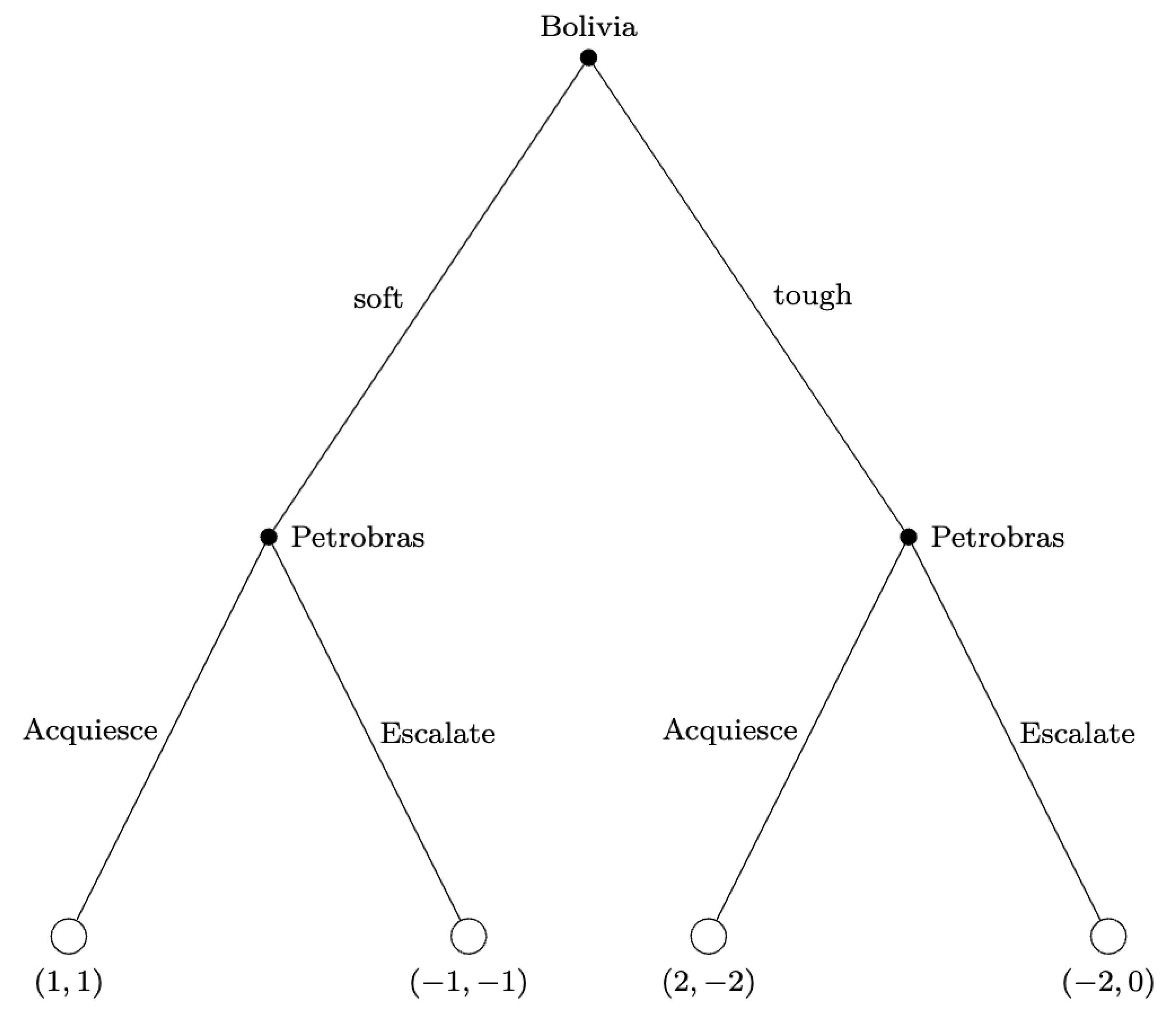
On the first of May, 2006, Supreme Decree No. 28,701 introduced sweeping legal changes in Bolivia’s natural-gas sector: it canceled all existing exploration concessions for natural gas (Petrobras 2007). Petrobras CEO José Sérgio Gabrielli threatened to freeze investments in Bolivia, warning that ‘unilateral measures, made in an unfriendly way, force Brazil to react’ (US Department of State 2006c). The decree by Bolivia constitutes the first move in our model. Bolivia had two options. It could have continued the prior ‘soft’ policy or adopted a tough stance, which it did. Petrobras then enters the game and must decide whether to fight or acquiesce to Bolivia’s position. As we saw, the Brazilian state oil company opted for the former rather than the later action.
If these were the only two players, the game would likely end in a costly dispute: Petrobras would lose access to the Bolivian market, while Bolivia would forgo nearly 18 percent of its GDP and 22 percent of its tax revenue (Duarte et al. 2008). Given Bolivia’s limited capacity to develop the sector, constraints that threatened President Morales’s political agenda (Duarte et al. 2008), this outcome would be inferior to the status quo and therefore irrational for Bolivia.
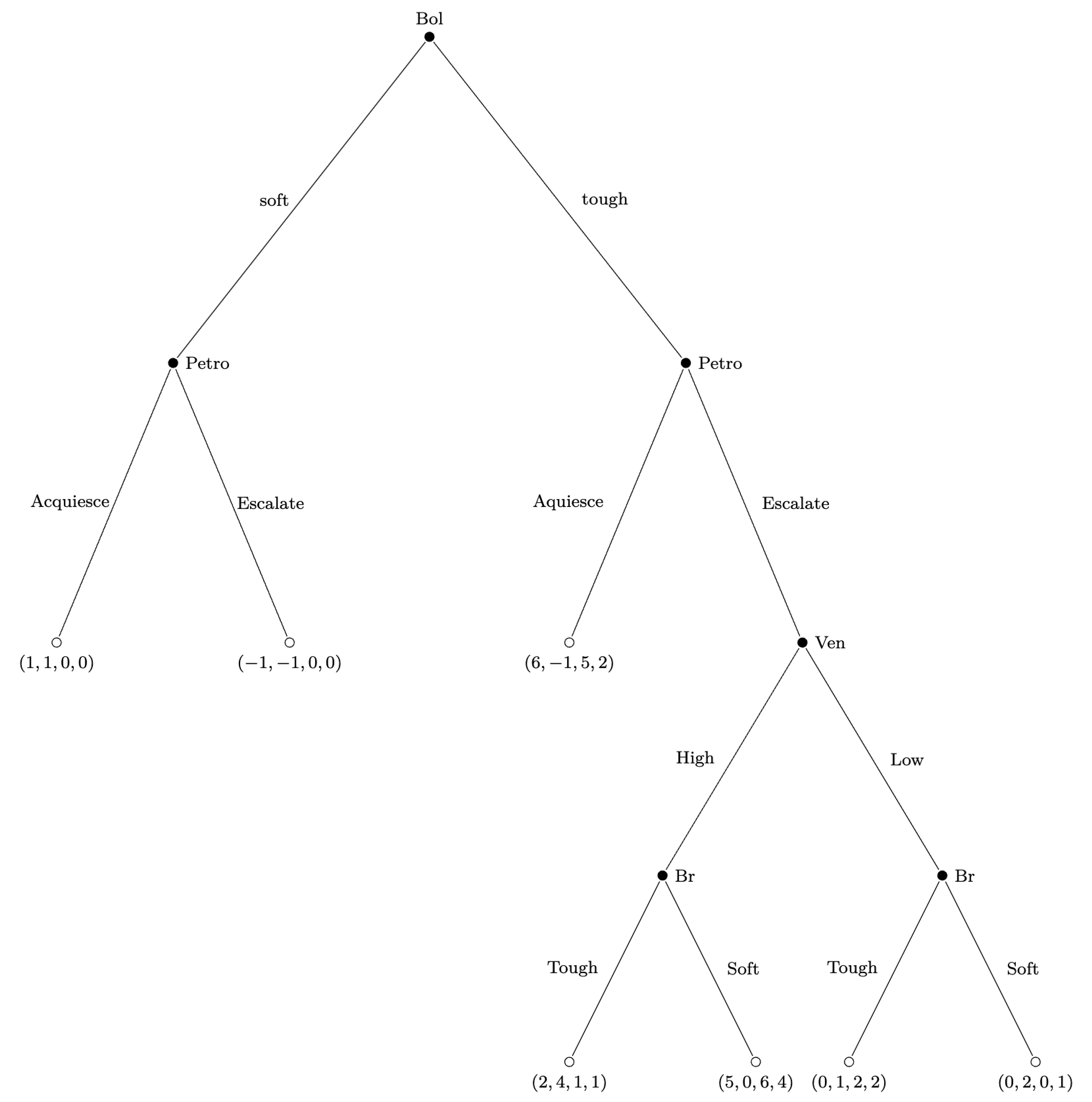
The numerical payoffs displayed in Figures 1 and 2 are ordinal and chosen for expositional clarity: only the ranking of outcomes matters for best responses and equilibrium selection. To make this explicit and reduce any impression of arbitrariness, Appendix A.0.1 provides a simple parametric microfoundation (in terms of tax revenues, sunk investments, and uncertainty) and derives the inequalities that reproduce the ordinal rankings used in the figures.

A simple two-player game of the Bolivia–Petrobras relationship before 2006
Alt-text: [Extensive-form decision tree diagram modelling the Bolivia–Petrobras relationship before 2006. Bolivia moves first, choosing either a Soft (conciliatory) or Tough (nationalization threat) stance. Petrobras then chooses to Acquiesce or Escalate. Each end node displays pay-offs in the order (Bolivia, Petrobras). The equilibrium strategy by backward induction is Soft followed by Acquiesce-Escalate, reflecting the pre-2006 pattern where Bolivia avoided full confrontation despite internal demands. Payoffs are ordinal; Appendix A.0.1 derives an equivalent parametric representation and the inequalities that generate the same equilibrium.]
A four-player game of the post-2006 crisis
Alt-text: [Decision tree diagram of a four-player sequential game modelling the 2006 post-crisis Bolivia–Brazil–Venezuela energy negotiation. Bolivia first chooses between a Soft or Tough strategy. If Tough is chosen, Petrobras decides whether to Acquiesce or Escalate. An escalation leads to Venezuela deciding on High or Low support. Brazil then responds with a Tough or Soft stance. Payoffs for each end node are listed in the order: Bolivia, Petrobras, Venezuela, Brazil. The equilibrium path is Tough → Escalate → High → Soft, replicating real-world events where Brazil accommodated Bolivia’s position and urged Petrobras to settle. Payoffs are ordinal; Appendix A.0.1 derives an equivalent parametric representation and the inequalities that generate the same equilibrium.]
The equilibrium in this simplified game is Bolivia-soft/Petrobras-soft (acquiescence). We contend that this outcome characterizes the pre-Morales period and explains why earlier presidents avoided open conflict with foreign firms despite popular pressure for confrontation (Campodónico Sánchez 2016). The subgame-perfect Nash equilibrium was nonetheless unstable: as Petrobras and other companies invested and enlarged proven reserves, the stakes rose, increasing Bolivia’s incentive to renegotiate the distribution of gas revenues. The extensive form game below describes this dynamic, with payoffs of Bolivia and Petrobras, in that order.
Proposition 2.1 (Simple two-player game, Figure 1)
The game in Figure 1 admits a unique subgame-perfect Nash equilibrium (SPNE). In equilibrium Bolivia plays Soft at the root and Petrobras plays Acquiesce after Soft and Escalate after Tough; the resulting terminal outcome is (1,1). The proof is in the appendix.
After Morales took office, two factors altered the bargaining environment. First, his deep ties to grassroots Indigenous groups raised the political cost of inaction. Second, Venezuela entered the game, pledging technical support and advisory services to Bolivia’s state-owned gas company, YPFB (Arriagada Herrera 2006). Petróleos de Venezuela (PDVSA) sought to become Bolivia’s primary energy partner, displacing Petrobras. This alignment reinforced the strategies of both countries: Venezuelan backing made Bolivia’s threats against foreign firms more credible, while increased Bolivian control of production and exploration expanded PDVSA’s market share. Such strategic complementarities occur when greater support from one actor raises the other’s marginal benefit from adopting a tougher stance, and vice versa (Bacharach 2019; Amir 2018). We model Venezuela as choosing between actions high (H) or low (L) support.
Under high support, a conflict in which Petrobras refused to acquiesce would impose lower costs on Bolivia because PDVSA could offset lost investment. Morales therefore preferred confrontation to inaction that might erode his popularity. Petrobras’s preferences, if anything, hardened, because now it risked losing market share to a regional rival, which is why its CEO opted to escalate.
Following Bolivia’s military occupation of Petrobras facilities in 2006, the Brazilian government had to enter the discussions and forced the company to adopt a strategy of deference, shifting the dispute to the government-to-government level (US Department of State 2006c). At this point the Brazilian government became the pivotal player. Brasília faced two options: play soft (acquiesce to Bolivia’s demands) or tough (refuse and deepen the crisis). Because Venezuelan support made Bolivia’s threat credible, a tough response risked a protracted conflict—costly for President Lula, who was running for re-election amid the Mensalão scandal2 and depended on Bolivian gas supplies to São Paulo state. Brazil therefore chose the soft strategy, publicly affirming Bolivian sovereignty and urging Petrobras to accept the deal. The game is modeled as in the figure below, with payoffs of Bolivia, Petrobras, Venezuela and Brazil, in that order3.
The sequence of moves in Figure 2 is kept consistent with the two-player baseline game (Figure 1) to highlight that the equilibrium change results from the introduction of a third-party actor, not from a reordering of decisions. As shown in Appendix A.3, reversing the sequence of moves yields the same subgame-perfect equilibrium, confirming that the model’s results are driven by the altered incentive structure rather than by temporal sequencing.
Proposition 2.2 (Four-player game with added Venezuela and Brazil, Figure 2)
Let the ordinal pay-off vector at every terminal node be ordered (Bolivia, Petrobras, Venezuela, Brazil). The extensive-form game depicted in Figure 2 possesses a unique subgame-perfect Nash equilibrium (SPNE). In equilibrium:
-
Bolivia plays Tough at the root;
-
Petrobras plays Acquiesce after (Soft) and Escalate after (Tough);
-
Venezuela plays High after Escalate;
-
Brazil plays Soft after (High) and Tough after (Low).
In game theory parlance, the SPNE is (tough; acquiesce-escalate; High, Soft-Tough), which yields the terminal pay-offs (5, 0, 6, 4). The counterfactual analysis underscores that strategic complementarities between Bolivia and Venezuela were indispensable to the observed equilibrium. Absent Venezuelan backing, the Bolivian president would have faced a dilemma: strong domestic pressure to extract concessions yet no credible threat in negotiations with Brazil. A more plausible outcome would have been symbolic posturing—publicly claiming concessions without substantive gains—or, if conflict ensued, Petrobras could have invoked arbitration before the International Centre for Settlement of Investment Disputes (ICSID). Without President Chávez’s involvement, Brazil’s President Lula could more easily have distanced himself from the dispute, allowing Petrobras to negotiate unencumbered.
It is worthwhile to briefly consider the case of Ecuador as it is closer to our counterfactual scenario. There, companies decided to go to ICSID, which did not happen in the Bolivian case (Campodónico Sánchez 2016). The key difference is that there is no Petrobras involved, they were mostly American companies. Then, there is no role for Venezuela to get the political leadership of the foreign country involved. There are no strategic complementarities.
Ecuador’s experience more or less around the same period illustrates this counterfactual. There, foreign firms, primarily U.S. companies, pursued claims at ICSID, whereas no such arbitration arose in Bolivia (Campodónico Sánchez 2016). In Ecuador, Petrobras was absent and Venezuela lacked leverage to draw the foreign government into the fray, eliminating any strategic complementarities.
Before Morales’s election, Bolivian demands lacked credibility: Petrobras would escalate, Brazil would remain disengaged, Venezuela would stay out, and Bolivia, acting tough in isolation, would be worse off than under cooperation. Consequently, no major bargaining crises erupted in the pre-Morales era; Bolivia risked only a loss of face. Supermodularity therefore did not apply.
Morales’s victory, combined with Brazil’s domestic audience costs under Lula, made the game supermodular. With mutual gains from coordination, Venezuelan support bolstered Bolivia’s threat, and vice versa. In this setting, Petrobras could not simply acquiesce; the resulting diplomatic crisis compelled Brazil to intervene, effectively forcing its state oil company to absorb the costs of cooperation with Bolivia and Venezuela. The next section presents our case study in detail, guided by this theoretical framework.
Narrative of the 2006 Bolivian gas crisis
Brazilian industries have long perceived their dependence on Bolivian natural gas as a structural vulnerability due to Bolivia’s unstable supply history (Camioto et al. 2006), a concern that intensified in the 1990s when underinvestment in hydroelectric power increased Brazil’s reliance on imported gas. In response, Petrobras undertook an ambitious investment strategy in Bolivia, committing over $1.5 billion between 1996 and 2006 (Pautasso 2018), ultimately becoming Bolivia’s largest enterprise and contributing nearly 20% to its GDP, tax revenue, and foreign direct investment by the mid-2000s (Duarte et al. 2008), thereby establishing a classic case of economic interdependence typically expected by traditional theories to foster cooperation.
By the mid-1990s, Petrobras Bolivia had become the country’s largest company, contributing 18% of GDP, 20% of direct investments, and 22% of tax revenues by 2005, while Brazil’s energy sector remained heavily dependent on Bolivian gas, importing 7.27 million cubic meters daily in 2006—23.4% of Bolivia’s total exports (Petrobras 2007; Duarte et al. 2008). This mutual dependence initially sustained a stable cooperative equilibrium, with Bolivia and Brazil pursuing Soft strategies and Venezuela remaining inactive; however, the equilibrium destabilized following Evo Morales’ January 2006 election, as his nationalist agenda emphasized not only economic but also political and ideological objectives through the assertion of state sovereignty over natural resources.
The political significance of Bolivia’s natural gas intensified after the 2003 Gas War, which led to President Gonzalo Sánchez de Lozada’s ousting and the enactment of the 2005 General Hydrocarbon Law by his successor, Carlos Mesa, imposing stricter controls on foreign oil companies and paving the way for Evo Morales’ 2006 election on a platform to redistribute national resources. Once in office, Morales renegotiated gas contracts, escalating diplomatic tensions, and issued Supreme Decree No. 28,701 on May 1, 2006, canceling all existing exploration concessions and introducing sweeping legal, tax, operational, and financial reforms to a sector historically dominated by foreign firms from Brazil, Canada, South Korea, Spain, Argentina, and the UK (Petrobras 2007).
This decree marked a definitive rupture, as Morales nationalized Bolivia’s hydrocarbon sector and militarized Petrobras facilities, representing in our game-theoretic model a rational shift to a Tough strategy, bolstered by anticipated third-party support, notably from Venezuela. The move provoked regional political backlash and investor distrust, particularly from Brazil, whose Petrobras was Bolivia’s largest foreign operator, accounting for 18% of GDP, 22% of tax revenues, and 20% of FDI in 2005 (Duarte et al. 2008). The risks were significant, as by 2006, 50% of Brazil’s natural gas supply relied on Bolivian reserves operated by Petrobras, Total, and Repsol via the Bolivia-Brazil pipeline.
Table 1 highlights the critical role of Bolivian natural gas in Brazil’s energy matrix in 2008, with Paraná, Santa Catarina, Mato Grosso do Sul, and Mato Grosso entirely dependent on Bolivian gas, while São Paulo sourced 75% and Rio Grande do Sul 70% of their supply from Bolivia, making Brazil highly vulnerable to changes in Bolivia’s energy policy. This vulnerability materialized following Morales’ nationalization of Petrobras’ assets, leading to gas price increases from $5.67 to $6.31 per million BTU between April 2006 and October 2007, an 11.3% rise, that directly impacted Petrobras, contributing to a 17% decline in its 2007 profits compared to the previous year4 (Duarte et al. 2008).
Despite Bolivia’s significant natural gas production and exports to Brazil, President Evo Morales recognized the country’s limited technical and financial capacity to sustain production without foreign partnerships, as it lacked investment in research, exploration, and workforce training, threatening the viability of his political agenda (Duarte et al. 2008). In response, Venezuelan President Hugo Chávez offered technical and financial support through PDVSA, which bolstered Bolivia’s state-owned YPFB and facilitated the nationalization of the entire hydrocarbon sector (Cosío 2007). Venezuela’s rapid involvement transformed the strategic landscape by increasing Bolivia’s marginal payoff for adopting a Tough stance, a hallmark of strategic complementarity in a supermodular game, as each action, from solidarity declarations to opening a PDVSA office in La Paz, further incentivized Bolivia’s escalation.
Evo Morales’ election marked a pivotal moment for Venezuela’s regional ambitions, as his commitment to reform Bolivia’s gas policies and renegotiate contracts created a strategic opening for PDVSA to expand its influence in the Southern Cone. Between 2002 and 2005, PDVSA’s total revenue doubled, reflecting a significant shift in Venezuela’s energy strategy that some analysts described as the emergence of a ‘new PDVSA’ (US Securities and Exchange Commission 2005; Mares and Altamirano 2007). By expanding into this market, PDVSA sought to maximize its natural gas asset value and influence regional gas prices and supply, thereby enhancing Venezuela’s trade balance, driving economic growth (Souza et al. 2008), funding social programs (Mares and Altamirano 2007), and advancing the 2006 National Development Plan (US Securities and Exchange Commission 2005).
In 2006, PDVSA cemented its presence in Bolivia by opening a commercial office in La Paz and making its first direct investment in the Bolivian hydrocarbons sector, alongside the signing of five energy agreements between Evo Morales and Hugo Chávez that laid the groundwork for joint ventures between YPFB and PDVSA (Pautasso 2018). According to Hugo del Granado Cosío, this political alliance enabled broader cooperation beyond joint ventures, including developing service station networks, constructing gas separation plants, producing petrochemical goods, and providing Bolivia with monthly diesel supplies of 200,000 barrels under preferential terms to mitigate fuel shortages (Cosío 2007; US Securities and Exchange Commission 2005).
Bolivian natural gas held strategic importance for Venezuela, as PDVSA sought to become Bolivia’s primary energy partner by offering technical support and advisory services to YPFB, effectively displacing Petrobras (Arriagada Herrera 2006). Gaining influence over Bolivia’s gas resources would bolster Venezuela’s own energy supplies while expanding PDVSA’s access to the Southern Cone’s oil and gas markets. By 2006, PDVSA’s investment in natural gas peaked at 28% of its portfolio, maintaining a historically high level of 21.5% in 2007, coinciding with Bolivia’s renegotiations with Brazil and creating a strategic opportunity for PDVSA to enhance its regional influence and support Chávez’s expansionist fiscal policies (Mares and Altamirano 2007). Venezuela rapidly extended support, becoming Bolivia’s primary fuel provider through countertrade agreements and credit facilities, especially as Bolivia struggled to meet its domestic diesel demand, a role previously filled by Petrobras in the late 1990s (Pautasso 2018).
Venezuela’s political involvement in Bolivia’s energy policies can be traced through six key pieces of evidence. First, Morales’ nationalization announcement on May 1 occurred immediately after a meeting with Chávez and Castro in Cuba. Second, just 48 hours after that meeting, Chávez convened a new summit in Puerto Iguazú, inviting Argentine President Néstor Kirchner, Brazilian President Luiz Inácio Lula da Silva, and Morales to discuss Bolivia’s nationalization policy. The day before the summit, Chávez publicly expressed full support for Morales, pledging technical assistance from PDVSA (Carra 2014; Guimarães and Maitino 2019).
Petrobras’ Director of International Affairs, Nestor Cerveró, later reported that Chávez saw Bolivia as an opportunity to expand Venezuela’s influence in South America by positioning PDVSA as a replacement for Petrobras in Bolivia. Cerveró recalled attending multiple meetings with Bolivian officials where PDVSA representatives were frequently present, actively advising the Bolivian government (US Department of State 2006c). As an additional supplier of natural gas, Venezuela further shaped the regional power dynamics by positioning itself closer to Bolivia, thereby influencing Brazil’s leverage in energy negotiations.
Third, Chávez arranged for a private flight to transport Morales the night before the nationalization announcement. Fourth, he dispatched Venezuelan lawyers to assist and advise Bolivia’s state-owned energy company, YPFB, throughout the nationalization process. As a result, the contracts offered by the Morales administration to foreign companies operating in Bolivia closely resembled those that PDVSA had established with international firms in Venezuela. Fifth, just twenty days after the nationalization decree, Chávez announced his intention to invest $1.5 billion in Bolivia’s energy sector (Arriagada Herrera 2006). Finally, Chávez consistently defended Bolivia’s nationalization policy in international forums, arguing that foreign private companies should contribute to the country’s energy development, just as PDVSA had committed to doing (Cosío 2007).
Regarding Chávez’s political influence, PDVSA President Rafael Ramírez emphasized that Venezuela was not ‘playing with any country’ but investing in South American integration to unite ‘sister countries’ through complementarity, solidarity, and reciprocity, with PDVSA playing a crucial role aligned with Venezuela’s sovereign interests and citizen welfare, forging an unprecedented relationship between the company and the nation (Ministério de Relações Exteriores do Brasil 2006). Behind the scenes, however, Venezuela actively engaged in negotiations between Petrobras and YPFB, with both companies serving as key models for YPFB’s development. This was underscored by YPFB’s CEO, Jorge Alvarado, who stated during his inauguration his ambition to elevate YPFB’s corporate management to the standards set by Petrobras and PDVSA (Ministério de Relações Exteriores do Brasil 2006).
Venezuela’s actions did not simply provide external support but reconfigured the internal incentives of both Bolivia and Brazil. By treating this alignment as part of a broader coalition logic, the analysis demonstrates how third-party engagement can emerge endogenously from pre-existing political and economic ties, consistent with the model’s emphasis on strategic complementarities.
Simultaneously, Brazil’s potential for retaliation was constrained by domestic political costs. Lula’s administration was engulfed in the Mensalão scandal and approaching a tight re-election campaign. Supporting Petrobras too aggressively risked alienating Lula’s left-wing base, which sympathized with Morales’s anti-imperialist agenda. In the model, this maps onto Brazil being structurally unable to credibly play Tough in the nationalist branch. Lula’s preference ordering was dominated by the need to avoid regional conflict and maintain ideological cohesion (“Petrobras vai absorver alta do gás, diz Lula.” 2006; “Bolívia quer renegociar contratos.” 2006; “Base sindical e aliados apoiam Bolívia.” 2006; “Caem aprovação a Lula e a Alckmin na cidade de São Paulo.” 2005).
Following Bolivia’s nationalization decree, the Brazilian government issued what Carra (2014, 207) described as a ‘stunningly bland public statement,’ in which President Lula da Silva acknowledged Bolivia’s sovereign right to act but simultaneously reaffirmed Brazil’s commitment to protecting Petrobras’s interests (US Department of State 2006c). Given Petrobras’s dominant role in Bolivia’s oil and gas sector, the company held a strong bargaining position at the outset of negotiations (Pautasso 2018). Moreover, Petrobras was Bolivia’s largest foreign investor, with $1.5 billion in investments. Its operations in Bolivia generated $1.2 billion in annual revenue, accounting for approximately 15% of the country’s GDP (US Department of State 2006c, 1).
At the very beginning of negotiations, Petrobras remained firm in its stance, insisting that it would not accept exclusion from commercialization activities (Ministério de Relações Exteriores do Brasil 2005). Petrobras CEO José Sérgio Gabrielli went so far as to threaten a freeze on investments in Bolivia, warning that ‘unilateral measures, made in an unfriendly way, force Brazil to react’ (US Department of State 2006c, 1). Petrobras viewed PDVSA’s investments in Argentina, Bolivia, Ecuador, Paraguay, and Peru as a direct political maneuver by Hugo Chávez to interfere in Petrobras’s regional operations (Goes and Schüffner 2007; 2006c; 2006b; 2006a). If PDVSA succeeded in gaining control over Bolivia’s gas supply, it would effectively dominate the majority of South America’s natural gas resources. From the outset of negotiations, Morales actively sought to involve Lula in the discussions. Both Morales and Chávez believed that Lula’s direct participation would serve Bolivia’s and Venezuela’s interests, given his political alignment with their governments (Pautasso 2018).
Diplomatic cables reveal that the Brazilian government had been aware of and concerned about the possibility of Bolivia seizing Petrobras’s assets since 2005. For instance, the Brazilian ambassador closely monitored the new regulations governing the taxation and distribution of hydrocarbon revenues. In one assessment, he noted that ‘despite the political language of one of the regulations, there is no provision for the occupation of fields and company facilities’ (Ministério de Relações Exteriores do Brasil 2005). However, the Brazilian government also recognized that freezing investments in the short term could provoke political instability in Bolivia and strengthen opposition leaders (US Department of State 2006b). Maintaining Petrobras’s presence in Bolivia was therefore seen as essential to mitigating this risk. Consequently, Lula urged Petrobras to moderate its rhetoric and adopt a more measured approach.
Following the military occupation of Petrobras’s facilities in 2006, the company adopted a strategy of deference, allowing the dispute to be handled at the government-to-government level. Employees were instructed to ‘stay put, shut up, keep their heads down, and let the Brazilian government negotiate with the Bolivian government’ (US Department of State 2006c, 1). A forceful response from Lula could have fueled anti-Brazilian sentiment in Bolivia, further complicating negotiations. Brazilian diplomats were particularly concerned about the role of the Bolivian media, noting that ‘unfortunately, in this country, subterfuge, nuances, and diplomatic language are not always understood. They are often interpreted in a lopsided way’ (Ministério de Relações Exteriores do Brasil 2005, 3). A case in point occurred before the nationalization decree when Bolivian media falsely reported that Brazilian Minister Dilma Rousseff had stated that the nationalization of the hydrocarbon sector would not pose a problem for Brazil (Ministério de Relações Exteriores do Brasil 2005).
The sequence of strategic decisions followed the structure of our extensive-form game. Morales escalated, Petrobras initially resisted, but soon de-escalated in deference to Brasília. Venezuela then reinforced its support, both materially and symbolically, which in turn locked Bolivia into its Tough stance. Brazil, having lost the ability to credibly threaten escalation, defaulted to Soft. This evolving structure is one of increasing differences: as one actor raises its commitment, others are incentivized to follow suit. The result was an endogenous transition to a contested equilibrium.
Empirical evidence from diplomatic cables confirms this interpretation. Venezuelan lawyers were dispatched to assist Bolivia’s state-owned energy company, YPFB, in drafting new nationalization contracts, resulting in agreements that closely mirrored PDVSA’s own contractual templates (Ministério de Relações Exteriores do Brasil 2006; US Department of State 2006b). PDVSA also pledged $1.5 billion in energy investments shortly after the May 1st nationalization decree (Arriagada Herrera 2006; Cosío 2007).
Morales received substantial logistical and political support from Chávez, including a private flight to announce the nationalization and coordinated summitry with regional leaders to legitimize Bolivia’s position (Carra 2014; Guimarães and Maitino 2019). Simultaneously, Petrobras executives disclosed in conversations with U.S. diplomats that Bolivia urgently required $1 billion in budgetary support, which PDVSA was prepared to help supply, thereby increasing Bolivia’s bargaining leverage ( US Department of State 2006c). Under these conditions, PDVSA’s expanding role as Bolivia’s primary energy partner not only displaced Petrobras but fundamentally redefined the structure and dynamics of the negotiation. This interaction between Bolivia, Venezuela, and Brazil exemplifies the broader coalition logic underlying the model: third-party involvement operates within, not outside, the strategic structure of alliances.
At this juncture, high-ranking officials from Brazil’s Ministries of Energy and Foreign Relations joined the negotiations, alongside direct involvement from both Lula and Morales. During a conversation with the U.S. Consul General in Brazil, Petrobras executive Nestor Cerveró disclosed that President Evo Morales urgently needed $1 billion by the end of the year for ‘budget support.’ Failure to secure this funding, he warned, could result in Morales being forced out of office before completing his term, as had happened to previous Bolivian presidents. Petrobras, aware of Bolivia’s precarious fiscal situation, proactively proposed a price increase as part of the negotiations. However, the presence of armed Bolivian military personnel at Petrobras facilities fundamentally altered the dynamics, transforming what was initially a commercial dispute into a full-fledged diplomatic and political crisis (US Department of State 2006a).
To counter perceptions that Lula had been ‘caught asleep at the switch and unwilling to stand up forcefully for vital Brazilian interests’ (US Department of State 2006a), Brazil convened an emergency summit with Bolivia, Venezuela, and Argentina. The Brazilian government faced a dilemma: a strong retaliation risked validating Bolivia’s portrayal of Brazil as an imperial power, while a passive stance could harm Lula’s image months before the presidential election. Petrobras expressed willingness to remain in Bolivia’s refining sector only if it retained technical and administrative control; otherwise, it preferred to sell its stake (Cosío 2007). In a confidential discussion with the U.S. Embassy, a Brazilian official outlined Petrobras’s options: temporarily maintain operations while preparing a legal exit, unilaterally withdraw, or seek international arbitration (US Department of State 2006a). Petrobras categorically rejected a significant price increase or operating solely as a service provider, leading Brazil’s Ambassador to La Paz, Marcel Biato, to conclude that:
‘This is a high-stakes poker game in which Brazil has significant interests, but Bolivia stands to lose far more. However, as in poker—and diplomatic negotiations—players must operate under the assumption that their opponents are acting with logic and rationality. At this stage, the Brazilian government has lost confidence that Morales embodies these qualities. There is a prevailing sense within the Brazilian administration that Morales simply acted on his own political motivations, put the issue on the table, and now expects the rest of us to deal with the consequences.’ (US Department of State 2006a, 1).
Although Bolivia faced a much greater risk of economic loss, President Evo Morales insisted on raising the tax on hydrocarbons from 50% to 82%. According to Nestor Cerveró, the Bolivian government had access to Petrobras’s pricing formula and was aware that the company could still operate profitably under the higher tax rate. Cerveró further asserted that the nationalization decree was intended to intimidate Petrobras (and other oil companies) at the negotiating table, making them more inclined to accept Bolivia’s terms (US Department of State 2006a).
At the time, Lula faced significant domestic constraints that shaped Brazil’s response to Bolivia’s nationalization decree; the Mensalão scandal placed immense political pressure on his administration by implicating senior Workers’ Party (PT) members (Fuser 2014), making overt support for Morales, closely aligned with Chávez, politically costly. Consequently, Brazil could not adopt the conciliatory posture anticipated by Morales and Chávez, instead adopting a firmer stance, as seen in Lula’s CBN interview where he emphasized Brazil’s demand for compensation for Petrobras’s investments, openness to Bolivia’s gas price hike, and commitment to achieving energy independence by 2008 (Cosío 2007; Ministério de Relações Exteriores do Brasil 2006). Approaching the 2006 elections, Lula also had to balance distancing himself from controversial regional allies to mitigate domestic fallout, while preserving ideological cohesion within his PT base, many of whom opposed a confrontational stance against Chávez.
As negotiations progressed, Bolivian Minister Solíz Rada, who had been leading the discussions, resigned, and Vice President Álvaro García Linera assumed control of the talks on Bolivia’s behalf. Simultaneously, the Brazilian government softened its stance, with Lula stating at a MERCOSUR summit that ‘we must be aware that we have to help Bolivia, we have to work on joint projects, and we have to promote development’ (Guimarães and Maitino 2019).
The final terms of the negotiation were: (1) the contractual agreement between YPFB and Petrobras for natural gas purchases remained unchanged, with no modifications to volume or pricing formula (Petrobras 2006); (2) Petrobras’s operations in Bolivia were restructured to focus exclusively on exploration, production, and the gas and energy sectors. As part of this, Petrobras sold the Guillermo Elder Bell and Gualberto Villarroel refineries to YPFB for $112 million—an amount considered below market value. Furthermore, due to new contracts in Bolivia, Petrobras’s international proved reserves increased to 1.09 billion barrels of oil equivalent (boe), representing a 14% decrease from 2006 and accounting for 7.3% of its total reserves (Petrobras 2007).
Outstanding issues were resolved at a meeting between Petrobras and YPFB, particularly the $100 million payment for noble liquids in 2007. This meeting, held at Petrobras’s headquarters, was led by YPFB President Santos Ramírez and Petrobras presidential advisor André Ghirardi (Ministério de Relações Exteriores do Brasil 2008). The successful resolution was largely due to Lula’s pressure on Petrobras to accept a higher price for Bolivian gas. Lula publicly affirmed Brazil’s solidarity with Bolivia and acknowledged Morales’ claims over national resources (Pautasso 2018), a position echoed by Brazil’s Minister of Energy and Spain’s Secretary of State, who respectively declared that ‘it is good business to remain in Bolivia’ and ‘We are going to invest a similar amount in the coming years ($1 billion) to ensure, above all, compliance with supply commitments to Argentina’ (Cosío 2007).
The negotiated resolution confirmed the supermodular structure’s implications. Bolivia achieved higher prices and sovereignty over its resources; Venezuela deepened its regional energy footprint; and Brazil acquiesced, preserving regional stability but at significant economic cost. In game-theoretic terms, the contested equilibrium became self-reinforcing: Bolivia’s Tough stance paid off due to Venezuela’s High investment and Brazil’s constrained Soft response. The Bolivia-Brazil gas crisis thus serves as a compelling illustration of how supermodular dynamics can explain escalation in international bargaining, as we explain in the next section.
Findings and discussion
Although Brazil adopted a firmer stance following Bolivia’s nationalization decree, especially amid the Mensalão scandal (Cosío 2007), this assertiveness did not prevent a conciliatory outcome favorable to Bolivia, as Petrobras was ultimately compelled to accept a higher price for Bolivian gas. Simultaneously, Lula sought to maintain diplomatic equilibrium by expressing solidarity with the Bolivian people while acknowledging Morales’ claims over Bolivia’s natural resources.
At equilibrium, two dominant scenarios emerge: (1) a cooperative equilibrium, where Bolivia adopts a softer stance, Venezuela remains passive, and Brazil also pursues a conciliatory approach, leading to regional stability and sustained economic interdependence, and (2) a contested equilibrium, where Bolivia escalates its demands, Venezuela actively reinforces Bolivia’s position, and Brazil, constrained by internal political concerns, remains passive. The latter scenario reflects the strategic constraints faced by the Lula administration, where domestic political turbulence limited Brazil’s ability to exert pressure, ultimately shaping a negotiation outcome that, despite initial resistance, resulted in Petrobras conceding to Bolivia’s price demands.
A central premise of the audience costs literature is that domestic political institutions impose constraints on leaders, thereby enhancing the credibility of their threats in international bargaining (Tomz 2007; Schultz 2001). However, this body of work often struggles to account for conflict escalation in scenarios where uncertainty is minimal or absent altogether. Many scholars treat the resolution of uncertainty as leading inevitably to peaceful outcomes, a view that is frequently taken for granted and left theoretically underdeveloped.
As Mesquita et al. (1997, 16) argue, ‘[without uncertainty] the strong would demand, and the weak generally would comply, saving both sides the costs of the conflict.’ Consequently, such models tend to overlook cases of sustained escalation or the presence of positive feedback loops during crises (Mesquita et al. 1997). One explanatory path lies in audience cost theory. Kydd’s (1997) fear-spiral model, grounded in Jervis’s (2017) security dilemma, which retains uncertainty as a core element but introduces a more dynamic framework for understanding how misperceptions and strategic distrust can fuel escalation (Kydd 2007; Jervis 2017).
While the literature on deterrence has traditionally focused on the role of power and alliance strength, the case of Brazil suggests that domestic audience costs, particularly in electoral periods and ideologically sensitive contexts, may impose internal constraints that prevent escalation, even in the face of material asymmetry. In settings of strategic complementarity, third-party support not only emboldens the weaker actor but also transforms the cost-benefit calculus of stronger states. In this case, Venezuela’s alignment with Bolivia reduced Brazil’s retaliatory space, shifting the likely equilibrium from cooperative to contested.
In Brazil’s case, this restraint was not merely strategic but politically necessary. During an election year marked by scandal (Mensalão), President Lula faced pressure from a domestic audience ideologically sympathetic to Morales, making escalation politically costly. These audience costs, rather than lack of capacity, help explain Brazil’s calculated passivity (Regan 1996; Benson 2011). In such contexts, deterrence by weaker coalitions becomes plausible not through coercive parity but through the manipulation of signaling, institutional costs, and strategic ambiguity.
Bolivia’s nationalization of its hydrocarbons sector was driven by economic goals and political promises, with Morales relying on Venezuela’s support to counteract potential backlash from Brazil and multinational firms. This backing encouraged Bolivia’s tough stance, raising its expected payoff to 5, while Brazil’s constrained response yielded 0. As Bolivia’s main gas customer and with Petrobras investing $1.5 billion, Brazil faced a strategic dilemma: diplomatic engagement or economic retaliation. However, Lula’s re-election concerns made accommodation the best option, resulting in an equilibrium payoff of 2 for Bolivia and 0 for Brazil.
Venezuela, under Chávez, played a strategic role in shifting the negotiation equilibrium by offering Bolivia financial and technical support through PDVSA, thereby altering the bargaining dynamics. Chávez aimed to weaken Petrobras’ regional dominance, bolster Bolivia’s energy independence, and expand Venezuela’s influence in South America’s energy sector, effectively reinforcing Bolivia’s tough stance by mitigating risks of Brazilian retaliation.
While Brazil preferred a cooperative equilibrium, Venezuela’s backing forced it into a suboptimal outcome, whereas Bolivia and Venezuela favored the contested equilibrium as it maximized their political and economic payoffs. This case exemplifies how external actors can reshape international negotiations by altering payoff structures, with the integration of supermodular game theory and traditional negotiation theories offering a more nuanced understanding of how economic interdependence can sometimes exacerbate, rather than mitigate, conflicts.
Conclusions
This study has shown how a supermodular game-theoretic framework enhances our understanding of bargaining crises in international negotiations. By applying this approach to the 2006 Bolivian gas crisis, we have shown that economic interdependence between Brazil and Bolivia (often assumed to foster stability and cooperation) can, under specific conditions (the alliance between Bolivia and Venezuela), lead to more rigid bargaining positions, escalating disputes rather than mitigating them. It explains why a weaker state could get a better deal with a stronger party.
The application of this model to the 2006 Bolivia–Brazil gas crisis reveals the limitations of standard theories that presume economic interdependence and institutionalized linkages promote cooperation. Although Brazil and Bolivia were deeply interconnected through energy trade and Petrobras’s substantial investment, these conditions did not prevent the onset of a diplomatic crisis. Instead, the entry of Venezuela as a politically aligned third party transformed interdependence from a stabilizing factor into a strategic liability. Venezuela’s investment promises and political backing shifted Bolivia’s expected payoffs, making defiance more profitable. At the same time, Brazil’s potential for retaliation was sharply constrained by domestic audience costs arising from Lula’s re-election campaign and ideological affinities with Morales, which made escalation politically unviable.
Lula’s domestic constraints, linked to his re-election campaign and public opinion, further limited Brazil’s strategic options, compelling Petrobras to adopt a conciliatory stance despite its economic leverage. From a game-theoretic perspective, this case illustrates how heightened commitment by one actor can incentivize a tougher stance by others, diverging from traditional models that emphasize uncertainty as the cause of bargaining crises. Venezuela’s role as a third-party actor transformed the interaction from a bilateral to a trilateral negotiation, with Bolivia benefiting from sustained Venezuelan backing and Brazil forced to consider both Bolivia’s demands and Venezuela’s broader regional ambitions.
The result was a bargaining structure with two locally stable equilibria: a cooperative one marked by accommodation and a contested one defined by rigidity and prolonged deadlock. Our supermodular game explains why the latter prevailed. Venezuela’s alignment and Brazil’s internal constraints triggered positive feedback loops that reinforced Bolivia’s tough posture and Brazil’s conciliation, despite the latter’s material superiority. This dynamic is not well captured by models of strategic substitutability, which predict convergence once preferences and capabilities are revealed. Instead, the escalation observed here emerges from mutually reinforcing incentives that are internal to the game structure.
This analysis also reframes the role of third-party influence in negotiation theory. While most accounts treat third parties as mediators or formal participants, our model shows that indirect, informal alignments can have a profound impact on bargaining outcomes, particularly in asymmetrical relationships. Venezuela’s role was not to facilitate dialogue but to strategically empower Bolivia and shift the regional balance, complicating Brazil’s cost–benefit calculus and reducing its strategic options. In so doing, the third party did not de-escalate but co-produced the crisis.
Furthermore, the concept of audience costs, typically used to enhance the credibility of threats in international relations, functions differently under conditions of strategic complementarity. In this case, audience costs constrained action rather than enabling resolve. Lula’s political imperatives did not allow for escalation, even when Brazilian firms faced major financial losses. This inversion of the audience cost logic further strengthens the need for models that go beyond binary assumptions about power and credibility.
All in all, the study advances the literature on alliance and coalition formation by offering a framework capable of endogenizing escalation dynamics in trilateral bargaining situations. External actors can reshape coalition equilibria through mechanisms of strategic complementarity, transforming interdependence into escalation. By conceptualizing third-party involvement as an endogenous feature of alliance dynamics rather than an exogenous mediating factor, the paper contributes to a more integrated understanding of how strategic alignment and domestic constraints interact to generate bargaining crises.
Acknowledgements
This study was financed, in part, by the São Paulo Research Foundation (FAPESP), Brazil. Process Number #18/19289-4. The authors thank the anonymous reviewers and participants at the seminar of the Center for the Study of International Negotiations (Caeni–IEA/USP) for their valuable comments and suggestions.
References
-
Amir, R. Chapter 3 On the Cournot and Bertrand Oligopolies and the Theory of Supermodular Games.In Handbook of Game Theory and Industrial Organization Volume I Theory, edited by L. C. Corchón, and M. A. Marini, 40-65. Cheltenham: Edward Elgar, 2018. https://china.elgaronline.com/edcollchap/edcoll/9781785363276/9781785363276.00009.xml
» https://china.elgaronline.com/edcollchap/edcoll/9781785363276/9781785363276.00009.xml - Arriagada Herrera, G. Oil and gas in Latin America: an analysis of politics and international relations from the perspective of Venezuelan policy. Madrid: Real Instituto Elcano, 2006.
-
Arunachalam, V., W. Dilla, M. Shelley, and C. Chan. "Market alternatives, third party intervention, and third party informedness in negotiation." Group Decision and Negotiation 7, no. 2 (1998): 81-107. doi: https://doi.org/10.1023/A:1008606709761
» https://doi.org/10.1023/A:1008606709761 -
Azevedo, A., and D. A. Paxson. "Developing real option game models." Social Science Research Network, February 9, 2014. https://doi.org/10.2139/ssrn.2393174
» https://doi.org/10.2139/ssrn.2393174 -
Bacharach, M. Economics and the theory of games. London: Routledge, 2019. https://www.routledge.com/Economics-and-the-Theory-of-Games/Bacharach/p/book/9780367171742
» https://www.routledge.com/Economics-and-the-Theory-of-Games/Bacharach/p/book/9780367171742 -
Bak, D. "Alliance proximity and effectiveness of extended deterrence." International Interactions 44, no. 1 (2018): 107-131. doi: https://doi.org/10.1080/03050629.2017.1320995
» https://doi.org/10.1080/03050629.2017.1320995 - Barbieri, K. The liberal illusion: does trade promote peace? Ann Arbor: University of Michigan Press, 2002
-
"Base sindical e aliados apoiam Bolívia." Folha de S.Paulo, May 3, 2006. https://www1.folha.uol.com.br/fsp/dinheiro/fi0305200615.htm
» https://www1.folha.uol.com.br/fsp/dinheiro/fi0305200615.htm -
Bates, R., A. Greif, M. Levi, J.-L. Rosenthal, and B. Weingast. Analytic narratives. Princeton: Princeton University Press, 1998. https://press.princeton.edu/books/paperback/9780691001296/analytic-narratives?srsltid=AfmBOooH_ACVrl_pwugXHm2YGbOkRsqCstDGdOlUOwLemM0esmJtmWqh
» https://press.princeton.edu/books/paperback/9780691001296/analytic-narratives?srsltid=AfmBOooH_ACVrl_pwugXHm2YGbOkRsqCstDGdOlUOwLemM0esmJtmWqh -
Beersma, B., and C. K. W De Dreu. "Integrative and distributive negotiation in small groups: effects of task structure, decision rule, and social motive." Organizational Behaviour and Human Decision Processes 87, no. 2 (2002): 227-252. https://doi.org/10.1006/obhd.2001.2964
» https://doi.org/10.1006/obhd.2001.2964 -
Benson, B. V. "Unpacking alliances: deterrent and compellent alliances and their relationship with conflict, 1816--2000." The Journal of Politics 73, no. 4 (2011): 1111-1127. https://doi.org/10.1017/S0022381611000867
» https://doi.org/10.1017/S0022381611000867 -
"Bolívia quer renegociar contratos." Folha de S.Paulo, May 7, 2006b. https://www1.folha.uol.com.br/fsp/brasil/fc0705200611.htm
» https://www1.folha.uol.com.br/fsp/brasil/fc0705200611.htm -
"Caem aprovação a Lula e a Alckmin na cidade de São Paulo." Datafolha, April 13, 2005. https://datafolha.folha.uol.com.br/opiniaopublica/2005/04/1222914-caem-aprovacao-a-lula-e-a-alckmin-na-cidade-de-sao-paulo.shtml
» https://datafolha.folha.uol.com.br/opiniaopublica/2005/04/1222914-caem-aprovacao-a-lula-e-a-alckmin-na-cidade-de-sao-paulo.shtml - Camioto, F. C., A. Périgo, L. Goulart, M. Lima, and D. Rebelatto. "Reflexões sobre a nacionalização do gás natural boliviano: falha no planejamento energético brasileiro ou injustiça da bolívia?" Paper presented at Simpósio de Engenharia de Produção, Bauru, SP, Brazil, 2006.
-
Campodónico Sánchez, H. Recovering sovereignty over natural resources: the cases of Bolivia and Ecuador. Research Report 71. Geneva: South Centre, 2016. https://www.econstor.eu/handle/10419/232189
» https://www.econstor.eu/handle/10419/232189 -
Caputo, A. "The third who joins a negotiation: a systematic review of the literature." International Journal of Business and Globalisation 10 no. 3 (2013): 256-277. doi: https://doi.org/10.1504/IJBG.2013.052987
» https://doi.org/10.1504/IJBG.2013.052987 - Carra, M. A Petrobras e a integração da América do Sul: as divergências com o governo brasileiro (1995-2010). Paper. 2014
- Cosío, H. G. La situación energética en Bolivia Madrid: Real Instituto Elcano, 2007.
- Duarte, B. P. M. C., T. C. Saraiva, and R. B. Boné. "Impacto na relação Brasil-Bolívia, com a nacionalização dos hidrocarbonetos bolivianos, em 2006." Indicadores Econômicos FEE 36, no. 1 (2008): 1-11.
-
"Ecuador seizes oxy operations." Los Angeles Times, May 17, 2006. https://www.latimes.com/archives/la-xpm-2006-may-17-fi-oxy17-story.html
» https://www.latimes.com/archives/la-xpm-2006-may-17-fi-oxy17-story.html -
Fells, R. "Managing deadlocks in negotiation." Employee Relations 8, no. 2 (1986): 2-7. doi: https://doi.org/10.1108/eb055067
» https://doi.org/10.1108/eb055067 -
Fuser, I. "O mito da 'generosidade' no contencioso Brasil-Bolívia do gás natural." Tensões Mundiais 10, no. 18-19 (2014): 1-24. doi: https://doi.org/10.33956/tensoesmundiais.v10i18,19.478
» https://doi.org/10.33956/tensoesmundiais.v10i18,19.478 -
Goes, F., and C. Schüffner. "'Petrocaridade' de Chávez afeta negócios da petrobras." Valor Econômico, August 21, 2006c. http://infoener.iee.usp.br
» http://infoener.iee.usp.br -
Goes, F., and C. Schüffner. 'Concentração Na Distribuição de Combustíveis Preocupa Mercado'. Valor Econômico, March 20, 2007. http://infoener.iee.usp.br
» http://infoener.iee.usp.br -
Goes, F., and C. Schüffner. "Ideologia ajuda na hora de disribuir ajuda." Valor Econômico, August 21, 2006a. http://infoener.iee.usp.br
» http://infoener.iee.usp.br - Goes, F., and C. Schüffner. "PDVSA é considerada pouco transparente." Valor Econômico, August 21, 2006b.
-
Guimarães, F. S., and M. E. Maitino. "Socializing Brazil into regional leadership: the 2006 Bolivian gas crisis and the role of small powers in promoting master roles transitions." Foreign Policy Analysis 15, no. 1 (2019): 1-20. doi: https://doi.org/10.1093/fpa/orx010
» https://doi.org/10.1093/fpa/orx010 -
Huth, P., and B. Russett. "Deterrence failure and crisis escalation." International Studies Quarterly 32, no. 1 (1988): 29-45. doi: https://doi.org/10.2307/2600411
» https://doi.org/10.2307/2600411 -
Jervis, R. Perception and misperception in international politics. Cambridge: Harvard University, 2017. https://press.princeton.edu/books/hardcover/9780691177434/perception-and-misperception-in-international-politics
» https://press.princeton.edu/books/hardcover/9780691177434/perception-and-misperception-in-international-politics -
Kumar, R., and G. Patriotta. "Culture and international alliance negotiations: a sensemaking perspective." International Negotiation 16, no. 3 (2011): 511-533. https://doi.org/10.1163/157180611X592978
» https://doi.org/10.1163/157180611X592978 -
Kydd, A. H. "Game theory and the spiral model." World Politics 49, no. 3 (1997): 371-400. doi: https://doi.org/10.1353/wp.1997.0012
» https://doi.org/10.1353/wp.1997.0012 - Kydd, A. H. Trust and mistrust in international relations 3 ed. Princeton: Princeton University, 2007.
-
Langlois, C. C. "Power and deterrence in alliance relationships." Conflict Management and Peace Science 29, no. 2 (2012): 148-169. https://doi.org/10.1177/0738894211433163
» https://doi.org/10.1177/0738894211433163 -
Latinobarómetro Corporation. Latinobarómetro study 2006: 2006 wave: aggregated version Santiago: JD Systems Institute, 2006. https://www.latinobarometro.org/latinobarometro-2006
» https://www.latinobarometro.org/latinobarometro-2006 -
Leeds, B. A. "Do alliances deter aggression? The influence of military alliances on the initiation of militarized interstate disputes." American Journal of Political Science 47, no. 3 (2003): 427-439. doi: https://doi.org/10.1111/1540-5907.00031
» https://doi.org/10.1111/1540-5907.00031 -
Levi, M. "An analytic narrative approach to puzzles and problems." In Problems and methods in the study of politics, edited by I. Shapiro, T. Masoud, and R. M. Smith, 201-226. Cambridge: Cambridge University Press, 2004. doi: https://doi.org/10.1017/CBO9780511492174.010
» https://doi.org/10.1017/CBO9780511492174.010 -
Levi, M., and B. R. Weingast. "Analytic narratives, case studies, and development." Social Science Research Network, September 6, 2016. https://doi.org/10.2139/ssrn.2835704
» https://doi.org/10.2139/ssrn.2835704 -
Maoz, Z. "The effects of strategic and economic interdependence on international conflict across levels of analysis." American Journal of Political Science 53, no. 1 (2009): 223-240. doi: https://doi.org/10.1111/j.1540-5907.2008.00367.x
» https://doi.org/10.1111/j.1540-5907.2008.00367.x - Mares, D. R., and N. Altamirano. Venezuela's PDVSA and world energy markets: corporate strategies and political factors determining its behaviour and influence. Houston: Rice University, 2007.
- Mesquita, B. B., J. D. Morrow, and E. R. Zorick. "Capabilities, perception, and escalation." The American Political Science Review 91, no. 1 (1997): 15-27.
- Ministério de Relações Exteriores do Brasil. Telegram 00069. From SERE to Brasemb Caracas. Brasília, January 17, 2006.
- Ministério de Relações Exteriores do Brasil. Telegram 00080. From Brasemb Caracas to SERE. Brasília, January 13, 2005.
- Ministério de Relações Exteriores do Brasil. Telegram 00182. From Brasemb Caracas to SERE. Brasília, February 27, 2008.
-
Pautasso, A. "Bolivia, Brasil y Venezuela: relaciones comerciales y de inversión en el sector gasífero y petrolero (2006-2010)." Thesis Doc., Universidad Nacional de Rosario,2018. https://rephip.unr.edu.ar/items/9881d315-fe26-465e-9282-23b2f022defa
» https://rephip.unr.edu.ar/items/9881d315-fe26-465e-9282-23b2f022defa -
"Petrobras vai absorber alta do gás, diz Lula." Folha de S.Paulo, May 6 2006. https://www1.folha.uol.com.br/fsp/dinheiro/fi0605200602.htm
» https://www1.folha.uol.com.br/fsp/dinheiro/fi0605200602.htm -
Petrobras. 2006 Financial Report Brasília, 2006. https://www.annualreports.com/HostedData/AnnualReportArchive/p/NYSE_PBR_2006.pdf
» https://www.annualreports.com/HostedData/AnnualReportArchive/p/NYSE_PBR_2006.pdf -
Petrobras. 2007 Financial Report Brasília, 2007. https://www.annualreports.com/HostedData/AnnualReportArchive/p/NYSE_PBR_2007.pdf
» https://www.annualreports.com/HostedData/AnnualReportArchive/p/NYSE_PBR_2007.pdf -
"Putin's power play." New Yorker, March 24, 2014. https://www.newyorker.com/magazine/2014/03/24/putins-power-play
» https://www.newyorker.com/magazine/2014/03/24/putins-power-play -
Regan, P. M. "Conditions of successful third-party intervention in intrastate conflicts." Journal of Conflict Resolution 40, no. 2 (1996): 336-359. doi: https://doi.org/10.1177/0022002796040002006
» https://doi.org/10.1177/0022002796040002006 - Schultz, K. A. Democracy and coercive diplomacy. Cambridge: Cambridge University Press, 2001.
-
Sebenius, J. K. "Negotiation arithmetic: adding and subtracting issues and parties." International Organization 37, no. 2 (1983): 281-316. doi: https://doi.org/10.1017/S002081830003438X
» https://doi.org/10.1017/S002081830003438X -
Smith, A. 'Alliance Formation and War'. International Studies Quarterly 39, no. 4 (1995): 405-425. doi: https://doi.org/10.2307/2600800
» https://doi.org/10.2307/2600800 -
Sorokin, G. L. "Alliance formation and general deterrence: a game-theoretic model and the case of Israel." The Journal of Conflict Resolution 38, no. 2 (1994):298-325. doi: https://doi.org/10.1177/0022002794038002006
» https://doi.org/10.1177/0022002794038002006 -
Souza, R. B. L., N. J. Souza, and S. Florissi. "A indústria petrolífera na visão da nova economia institucional: o caso da petróleos de Venezuela (PDVSA)." Revista de Economia 34, no. 1 (2008): 101-111. doi: https://doi.org/10.5380/re.v34i1.11553
» https://doi.org/10.5380/re.v34i1.11553 -
Tomz, M. "Domestic audience costs in international relations: an experimental approach." International Organization 61, no. 4 (2007): 825-844. doi: https://doi.org/10.1017/S0020818307070282
» https://doi.org/10.1017/S0020818307070282 - Topkis, D. M. Supermodularity and complementarity. Princeton: Princeton University Press, 1998.
-
Uetake, K., and Y. Watanabe. "Estimating supermodular games using rationalizable strategies." In Structural econometric models, vol. 31, edited by P. C. Reiss, and F. A. Wolak, 4277-4415. Leeds: Emerald, 2013. https://doi.org/10.1108/S0731-9053(2013)0000032008
» https://doi.org/10.1108/S0731-9053(2013)0000032008 -
US Department of State. 06RIODEJANEIRO446_a. Unclassified. Argentina Buenos Aires, Bolivia La Paz, Brazil Brasilia, Brazil Recife, Brazil São Paulo, Chile Santiago, Colombia Bogotá, Department of Commerce, Department of Energy, Department of the Treasury, Ecuador Quito, National Security Council, Paraguay Asunción, Peru Lima, Secretary of State, Uruguay Montevideo, Venezuela Caracas. September 6, 2006b. http://wikileaks.org/plusd/cables/06RIODEJANEIRO446_a.html
» http://wikileaks.org/plusd/cables/06RIODEJANEIRO446_a.html -
US Department of State. Telegram 06CARACAS3413_a. Confidential. From Venezuela Caracas to Group Destinations Bureau of Western Hemisphere Affairs, Group Destinations European Political Collective, National Security Council, Secretary of State, United Nations (New York), United States Southern Command (Miami). November 15, 2006c. http://wikileaks.org/plusd/cables/06CARACAS3413_a.html
» http://wikileaks.org/plusd/cables/06CARACAS3413_a.html -
US Department of State. Telegram 06LIMA461_a. Confidential. From Peru Lima to Argentina Buenos Aires, Bolivia La Paz, Brazil Brasilia, Chile Santiago, Colombia Bogotá, Ecuador Guayaquil, National Security Council, Paraguay Asunción, Secretary of Defense, Secretary of State, United States Southern Command (Miami), Uruguay Montevideo, Venezuela Caracas. February 3, 2006a. http://wikileaks.org/plusd/cables/06LIMA461_a.html
» http://wikileaks.org/plusd/cables/06LIMA461_a.html -
US Securities and Exchange Commission. FORM 20-F: securities and exchange commission. Washington, 2005 https://www.sec.gov/Archives/edgar/data/906424/000114036106016747/form20-f.htm
» https://www.sec.gov/Archives/edgar/data/906424/000114036106016747/form20-f.htm -
Vives, X., and O. Vravosinos. "Strategic complementarity in games." Journal of Mathematical Economics 113, (2024): 1-10. https://doi.org/10.1016/j.jmateco.2024.103005
» https://doi.org/10.1016/j.jmateco.2024.103005 -
Wilson, P. "U.S. halts Ecuador talks as occidental field seized." Amazon Watch, May 17, 2006. https://amazonwatch.org/news/2006/0517-us-halts-ecuador-talks-as-occidental-field-seized
» https://amazonwatch.org/news/2006/0517-us-halts-ecuador-talks-as-occidental-field-seized
1
2
3
4
5
Data Availability Statement
Appendix A.0
We present here a simplified version of the dynamic model in static form. To keep things simple, we removed Petrobras as an actor and changed the payoffs a bit to reflect a game with three players.
The game involves three players (Bolivia, Venezuela, and Brazil) and payoffs are always listed in that order. For example, a payoff of (2, 0, 5) means that Bolivia receives 2, Venezuela 0, and Brazil 5. Bolivia and Brazil each have two strategies: Soft (S) and Tough (T). Venezuela can choose between two investment levels in Bolivia: High (H) or Low (L). The game is represented in a normal-form payoff matrix. Since this is a supermodular game, we assume that higher (i.e. more aggressive) strategies by Venezuela increase Bolivia’s payoffs, and similarly, Bolivia’s higher strategies boost Venezuela’s payoffs5.
Preferences
Bolivia seeks to maximize revenue from its natural gas exports. The main risk in demanding higher payments from companies operating within its territory is that these firms may withdraw or reduce investment in future extraction, thereby lowering long-term revenues. As Bolivia lacks the technical capacity to operate its gas fields independently, it remains reliant on foreign corporations such as Petrobras. Venezuela, by contrast, possesses the operational capacity to take over such activities should it choose to intervene. Caracas aims to expand its regional influence in oil and gas production. Consequently, Bolivia and Venezuela display strategic complementarities: the more assertive Bolivia becomes in demanding greater returns from foreign companies, the higher the marginal utility for Venezuela in supporting Bolivia’s position. This interaction is characteristic of supermodular games.
Brazil faces two conflicting objectives. On the one hand, it seeks to maximize Petrobras’s profits; on the other, during election periods, President Lula wishes to avoid undermining left-leaning governments in Latin America, which is a stance strongly favored by his core constituency. As a result, Brazil’s preference is to maintain the pre-Morales status quo, in which gas prices remained low and both Bolivia and Venezuela pursued a cooperative stance towards Brazil.
For analytical simplicity, we model each country’s strategic options in binary form. It is therefore reasonable to assume that both Bolivia and Venezuela prefer an outcome in which Bolivia chooses Tough and Venezuela chooses High over one where Bolivia chooses Soft and Venezuela chooses Low, regardless of Brazil’s strategy. Moreover, they prefer (T, H, S) to (T, H, T) because Brazil’s acquiescence (choosing Soft rather than Tough) yields them a higher payoff. Likewise, Bolivia would prefer (S, H, ?) to (T, L, ?), as it avoids the costs associated with adopting a tough stance when Venezuela provides low investment or limited support. By similar reasoning, Venezuela would favor (T, L, ?) over (S, H, ?). These orderings hold regardless of Brazil’s behavior.
For Brazil, the most desirable outcome is one in which both neighboring states cooperate - namely, (S, L, S). If full cooperation proves unattainable, Brazil prefers equilibria in which at least one neighbor remains cooperative, such as (S, H, S) or (T, L, S). Should Bolivia and Venezuela coordinate on (T, H, ?), Brazil would rather acquiesce than confront, meaning that (T, H, S) is preferable to (T, H, T). Based on this ordinal ranking, numerical values can be assigned in the payoff matrix to represent each player’s preferences, with best-response payoffs underlined.
Game matrix
The model produces two pure-strategy Nash equilibria. The first is (S, L, S), in which no active dispute arises: Bolivia adopts a Soft strategy (S), Venezuela opts for Low investment (L), and Brazil also plays Soft (S). This outcome is preferred by Brazil, as it yields a higher payoff relative to the alternative equilibrium. The second equilibrium is (T, H, S), where a dispute emerges - Bolivia adopts a Tough stance (T), Venezuela chooses High investment (H), and Brazil again plays Soft (S). This outcome is favored by Bolivia and Venezuela, as it provides them with higher payoffs. Hence, while Brazil prefers the peaceful equilibrium (S, L, S), both Bolivia and Venezuela gain more from the disputed equilibrium (T, H, S).
The payoffs reflect the intuition that unilateral defiance by either Bolivia or Venezuela against Brazil is not advantageous. However, when both act in concert, Brazil’s strategic choices become constrained by President Lula’s electoral considerations, thereby reinforcing the conditions for a bargaining crisis.
Appendix A.0.1
This appendix clarifies that the integer payoffs displayed in Figures 1 and 2 are ordinal and can be generated by simple, interpretable components. The goal is not to claim precise measurement, but to show that the ordering used in the figures follows from reasonable assumptions about revenues, sunk investments, disruption costs, and uncertainty.
Primitives (interpretation)
We use the following primitives:
-
t: Bolivia’s fiscal take under the status quo arrangement (tax/royalty revenue). Assume t is positive.
-
r: Petrobras’ operating revenue from continued access to the Bolivian market. Assume r is positive.
-
i: Petrobras’ sunk investments (asset-specific investments) in Bolivia. Assume i is positive.
-
cB: Bolivia’s disruption cost under escalation (economic disruption, administrative costs, political costs). Assume cB is positive.
-
cP: Petrobras’ disruption cost under escalation (losses from exit, legal/operational costs). Assume cP is positive.
-
u: Bolivia’s operational/technical capacity to convert infrastructure into profits, between 0 and 1.
-
p: the gross profit potential associated with controlling the infrastructure or extracting higher rents. Assume p is positive.
-
tau: Petrobras’ loss from acquiescing under tougher terms while staying in Bolivia (i.e., reduced profitability under the new terms). Assume tau is positive.
For Figure 2 we add:
-
sH and sL: the extent to which Venezuelan involvement can insure/offset Bolivia’s losses under escalation, with High involvement providing more insurance than Low involvement (so sH is larger than sL).
-
aH and aL: Brazil’s domestic/political cost of playing Tough when Venezuelan involvement is High versus Low. The core assumption is that playing Tough is more costly under High involvement (aH positive and substantively larger than under Low).
Figure 1 (Bolivia–Petrobras):
Normalise the status quo outcome (Soft, Acquiesce) to “0 for Bolivia, 0 for Petrobras”. Consider the following interpretation of each cell:
-
Soft, Acquiesce (status quo): Bolivia keeps fiscal take t; Petrobras keeps r and i. By normalization, this cell is represented as (0, 0) in the figure.
-
Soft, Escalate: Bolivia loses fiscal take (a loss of t). Petrobras loses access to revenue r and also loses the value of sunk investment i, so its loss is r plus i. Since t, r, and i are positive, this cell is strictly worse than the status quo for both actors.
-
Tough, Acquiesce: Bolivia gives up fiscal take t but expects to gain profit from infrastructure/control; however, this gain depends on capacity u, so the expected gain is u times p. Net, Bolivia’s payoff is “u times p minus t”. This can be higher or lower than zero depending on whether u times p is larger or smaller than t. Petrobras acquiesces but at a cost: it remains in Bolivia under tougher terms, losing tau relative to the status quo.
-
Tough, Escalate: escalation generates disruption losses. For Bolivia, the loss is t plus an additional disruption cost cB. For Petrobras, the loss is cP.
These components generate a simple set of conditions that justify the ordinal ranking used in Figure 1:
-
Petrobras prefers to acquiesce after Soft because “0” is better than losing r plus i.
-
Petrobras prefers to escalate after Tough when the cost of staying under tougher terms (tau) is larger than the cost of exit/escalation (cP).
-
Bolivia prefers Soft at the root when escalation under Tough is sufficiently costly (t plus cB), and when the Tough–Acquiesce outcome is uncertain because u times p may or may not exceed t.
Under these conditions, the equilibrium logic in the main text follows, and the integer payoffs in Figure 1 can be seen as a compact ordinal representation of these components.
Figure 2 (Bolivia–Petrobras–Venezuela–Brazil): equilibrium-relevant branch
For Figure 2, we microfound only the equilibrium-relevant branch to show how third-party involvement can change the ordinal ranking without requiring arbitrary numbers. Consider the subgame in which Bolivia chooses Tough and Petrobras responds by escalating. At this point, Venezuela chooses the level of involvement (High or Low), and Brazil chooses whether to play Soft or Tough.
Brazil’s choice is driven by domestic/political costs. The key assumption is:
-
If Venezuelan involvement is High, playing Tough is politically costly for Brazil (cost aH). In that case, Brazil prefers Soft.
-
If Venezuelan involvement is Low, the political cost of playing Tough is lower and Brazil can prefer Tough (this can be expressed as Soft carrying a cost aL under Low involvement, or equivalently Tough being less costly than Soft under Low involvement).
Venezuela’s choice (High versus Low) can be represented by a simple preference for High involvement when the net benefits of High exceed those of Low. The exact components are not critical; what matters is that High involvement is optimal for Venezuela given the strategic environment described in the paper.
Finally, Bolivia’s incentives under escalation depend on whether Venezuelan involvement provides insurance/offsets. Let sH denote the insurance under High involvement and sL under Low involvement, with sH larger than sL. Then Bolivia’s continuation payoff under the “Tough–Escalate” branch is less negative under High involvement because sH partially compensates for the loss of t and for disruption costs.
A sufficient condition for Bolivia to prefer initiating Tough (despite the risk of escalation) is that the political benefit of toughness plus the expected insurance under High involvement exceeds the fiscal and disruption losses associated with escalation. In plain terms: if the expected protection/insurance from High involvement is large enough, Tough becomes attractive at the root even when escalation is costly.
This explains why the integer payoffs in Figure 2 are not arbitrary, as they compactly represent how third-party insurance (sH versus sL) and Brazil’s domestic/political costs (aH versus aL) shift the ordinal ranking of terminal outcomes and therefore equilibrium selection.
In both figures, the integers are used for readability. Any strictly increasing transformation of the underlying components would preserve the ranking, best responses, and equilibrium logic discussed in the main text.
Appendix A.1 Game with generic payoffs
The main game can be depicted in more generic terms using variables instead of numbers. Denote the payoffs as follow:
In the left branch of the game, If Bolivia = Soft (S), Petrobras = Acquiesce (A) and the game ends. Denote the payoffs as (B_sa, P_sa, V_sa, R_sa), in which ‘B_sa’ means the payoff of Bolivia when it chooses soft and Petrobras acquiesce and so on for Petrobras, Venezuela and Brazil (using R_sa to denote Brazil’s payoff in that scenario). The rest of the payoffs, following the branches from left to right, are:
If Bolivia = Soft (S), Petrobras = Escalate (E): _se, P_se, V_se, R_se)
If Bolivia = Tough (T), Petrobras = Acquiesce (A): (B_ta, P_ta, V_ta, R_ta)
If Bolivia = Tough (T), Petrobras = Escalate (E), Venezuela = High (H), Brazil = Soft (S): (B_tehs, P_tehs, V_tehs, R_tehs) ← equilibrium leaf
If Bolivia = Tough (T), Petrobras = Escalate (E), Venezuela = High (H), Brazil = Tough (T): (B_teht, P_teht, V_teht, R_teht)
If Bolivia = Tough (T), Petrobras = Escalate (E), Venezuela = Low (L), Brazil = Soft (S): (B_tels, P_tels, V_tels, R_tels)
If Bolivia = Tough (T), Petrobras = Escalate (E), Venezuela = Low (L), Brazil = Tough (T): (B_telt, P_telt, V_telt, R_telt)
Brazil (last mover):
After Venezuela moves H: R_tehs > R_teht (Brazil prefers Soft to Tough when Venezuela invests High.)
After L: R_telt > R_tels (Brazil prefers Tough to Soft when Venezuela invests Low.)
Venezuela (moves after Petrobras = E):
High dominates Low: V_tehs > V_telt (I.e., Venezuela’s payoff with H followed by Brazil’s Soft is higher than with L followed by Brazil’s Tough.)
Petrobras:
After Bolivia = S: Acquiesce dominates Escalate: P_sa > P_se.
After Bolivia = T: Escalate dominates Acquiesce given downstream best replies: P_tehs > P_ta.
Bolivia (root):
Anticipating the path, T dominates S: B_tehs > B_sa.
The ordinal restrictions outlined above are the symbolic counterparts of the arguments and proofs already presented in the text. They are sufficient to reproduce the same subgame-perfect Nash equilibrium (SPNE), namely (T → E → H → S). To demonstrate this, note first that any finite extensive-form game has a single SPNE when all payoffs are unique—that is, when no indifference or ties exist between terminal nodes. By eliminating dominated nodes, the only remaining ones are those satisfying the strict inequality constraints specified above. Consequently, the terminal nodes are unique, and a single SPNE emerges.
To verify that the SPNE corresponds to the one described in the main text, observe that in the final stage of the game Brazil prefers to play Soft (S) when Venezuela invests High (H). Anticipating this, Venezuela chooses High (H). Petrobras consistently chooses to escalate (E) along the right branch, and Bolivia, anticipating this sequence, opts for Tough (T), thereby reproducing the same equilibrium as before.
Appendix A.2 Proof for the main game.
Proof of proposition 2.1 (by backward induction)
-
1. Petrobras’s decision following Bolivia = soft.
Petrobras chooses between
(1,1) if it plays acquiesce and (−1,−1) if it plays escalate.
Because 1 > −1, its best reply in this subgame is Acquiesce.
-
2. Petrobras’s decision following Bolivia = tough.
Here Petrobras chooses between
(2,−2) if it plays acquiesce and (−2,0) if it plays escalate.
Because 0 > −2, its best reply in this subgame is Escalate.
-
3. Bolivia’s initial decision (anticipating steps 1–2). Because 1>-2, Bolivia’s optimal action at the root is Soft.
If Bolivia plays soft, the continuation payoff is 1.
If Bolivia plays tough, the continuation payoff is −2.
-
4. Subgame perfection.
The strategy profile (Bolivia: Soft; Petrobras: (Soft after Soft, Tough after Tough)) specifies a Nash equilibrium in every proper subgame identified in steps 1–2, hence it is subgame-perfect. No other profile satisfies steps 1–3, so the equilibrium is unique.
Proof of proposition 2.2 (by backward induction)
1. Brazil’s decisions (last stage).
-
Subgame following Venezuela High
-
Tough: (2,4,1,1) → Brazil’s pay-off = 1
-
Soft: (5,0,6,4) → Brazil’s pay-off = 4
-
Because 4 > 1, Brazil’s best reply in this subgame is Soft.
-
Subgame following Venezuela Low
-
Tough: (0,1,2,2) → Brazil’s pay-off = 2
-
Soft: (0,2,0,1) → Brazil’s pay-off = 1
-
Because 2 > 1, Brazil’s best reply in this subgame is Tough.
-
-
2. Venezuela’s decision.
Anticipating Brazil’s responses derived in Step 1, Venezuela compares its own expected pay-offs:
-
High → continuation outcome (5,0,6,4) → Venezuela’s pay-off =6
-
Low → continuation outcome (0,1,2,2) → Venezuela’s pay-off =2
Because 6>2, Venezuela chooses High.
3. Petrobras’s decision (after Bolivia = Tough).
Petro now weighs:
Because 0 > −1, Petrobras chooses to Escalate.
-
Acquiesce → (6,−1,5,2) → Petrobras pay-off =−1
-
Escalate→ outcome from Steps 1–2, namely (5,0,6,4)→ Petrobras pay-off = 0
4. Petrobras’s decision (after Bolivia = Soft).
Because 1 > −1, Petrobras chooses Soft in this subgame.
-
acquiesce: (1,1,0,0)→ Petrobras pay-off = 1
-
escalate: (−1,−1,0,0) → Petrobras pay-off =−1
5. Bolivia’s initial decision.
Anticipating Petrobras’s optimal continuations:
-
Soft → outcome (1,1,0,0)→ Bolivia’s pay-off =1
-
Tough → outcome from Steps 1-2–3-4, namely (5,0,6,4) → Bolivia’s pay-off =5
6. Because 5>1, Bolivia’s optimal action at the root is Tough.
7. Subgame perfection and uniqueness.
The strategy profile specified above constitutes a Nash equilibrium in every proper subgame identified in Steps 1–4; hence it is subgame-perfect.
All inequalities are strict, so each player’s best reply at each information set is unique; therefore the SPNE is unique.
Appendix A.3 Sequence of moves
The sequence of moves in Figure 2 follows the same sequence as in the baseline two-player game (Bolivia → Petrobras → Venezuela → Brazil) to maintain homology with the initial structure and to emphasize that the analytical gain derives from the introduction of the third-party actor rather than from any reordering of decisions. Nonetheless, one might argue that, unlike in the counterfactual model, the actual sequence of events in reality differed (Bolivia → Venezuela → Petrobras → Brazil).
We demonstrate here that altering the sequence of moves—so that Venezuela plays immediately after Bolivia—does not change the equilibrium. Along the right branch, once Bolivia chooses Tough (T), Petrobras’s preferences remain unaffected (Escalate continues to strictly dominate Acquiesce), so it suffices to verify that Brazil’s and Venezuela’s choices remain consistent.
As the final mover, Brazil’s optimization problem is unchanged: if Venezuela chooses High support, Brazil prefers to play Soft; if Venezuela chooses Low support, Brazil prefers Tough. Anticipating these best responses, Venezuela strictly prefers High to Low support. Given Tough by Bolivia and High by Venezuela, Petrobras chooses Escalate and Brazil chooses Soft. Hence, the equilibrium path remains identical.
It is important to emphasize that this result is driven by the strategic complementarity (supermodularity) between Bolivia’s toughness and Venezuela’s level of support: once Bolivia adopts Tough, Venezuela’s best response is High support under the assumed ordinal ranking, rendering the timing change outcome-equivalent. This confirms that the resulting equilibrium stems from the altered incentive structure introduced by third-party support, not from the temporal sequence of actions.