 A small step, giant savings: the impact of physical activity on dementia cases and economic costs in Brazil
Abstract
Objective: To estimate the potential impact of physical activity (PA) on the forecast prevalence and economic cost of dementia among Brazilian adults.
Methods: We analyzed data from the 2019 Brazilian National Health Survey to estimate PA levels. Dementia-related costs in 2019 were combined with prevalence data from the Global Burden of Disease Study. We estimated dementia cases and costs that could be averted if physical inactivity (< 150 min/week of moderate-to-vigorous PA) were eliminated. A counterfactual scenario assessed the effect of small increases in moderate (MPA) or vigorous (VPA) activity per week in adults who currently engage in zero min/week of PA.
Results: In 2019, 14.9% of dementia cases in Brazil were attributable to physical inactivity, corresponding to 569,548 preventable cases by 2050. This would translate into an avoidable economic burden of R$ 23.1 billion (US$ 9.3 billion), of which R$ 20.2 billion are direct healthcare costs. In adults with zero minutes of PA, increasing MPA or VPA by 10 min/day could prevent 219,412 and 420,180 cases of dementia and save R$ 8.5 and R$ 16.2 billion by 2050, respectively.
Conclusion: In Brazil, one in seven dementia cases is linked to physical inactivity. Modest increases in PA could yield major health and economic benefits.
Keywords:
Exercise; dementia; cost of illness
Introduction
Dementia is one of the most significant global health and social care challenges of the 21st century. As the global population ages, the number of people living with dementia is projected to rise dramatically, with profound societal and economic implications.1 However, this increase is not distributed equally worldwide. By 2050, approximately two-thirds of dementia cases will occur in low- and middle-income countries (LMICs).1 For example, the age-standardized incidence rates between 2019 and 2050 are expected to be 192% higher in low than in high sociodemographic index regions.1 This disproportionate growth is especially alarming in countries already grappling with economic instability and fragile healthcare systems,2,3 amplifying the urgency for targeted policy and prevention strategies.
The economic burden of dementia is substantial, encompassing direct medical costs (e.g., hospitalization, medication, physician visits), direct non-medical costs (e.g., social care services, informal care), and indirect costs (e.g., lost productivity for patients and caregivers).4-8 In 2015, the estimated global cost of dementia was US$ 818 billion, projected to reach US$ 2 trillion by 2030 and US$ 9.1 trillion by 2050.6 However, these scenarios reflect data primarily from high-income countries.7 This creates a major knowledge gap, given that 70% of future dementia cases are expected to arise in LMICs. Costs in these countries are likely to differ due to variations in healthcare infrastructure, availability of formal care, and cultural perceptions of aging and dementia.2,3,7,9 For example, over 70% of the hours dedicated to informal caregiving globally occur in LMICs.10 These differences underscore the need for country-specific data to guide planning and resource allocation tailored to the unique challenges of LMICs.
Brazil exemplifies this looming crisis. In 2019, approximately 1.9 million Brazilians were living with dementia, a number expected to reach 5.7 million by 2050.1 The economic cost of dementia in Brazil is substantial. In 2019, the total estimated cost was US$ 35.3 billion, of which 78% were indirect costs, primarily informal care provided by family members.5 Notably, the monthly per-person cost of dementia increases with disease progression: from US$ 843.04 in the initial stage to US$ 1,576.15 in the advanced stage.5 These findings show that families face significant financial challenges and emphasize the need for effective strategies to reduce these costs.
Encouragingly, nearly half of dementia cases in Brazil are potentially attributable to modifiable risk factors. Among them, physical inactivity (< 150 min/week of moderate-to-vigorous physical activity [PA]11) stands out as a major contributor, accounting for 11% of dementia cases in Brazil.12 Substantial evidence confirms the protective effect of PA against dementia.13,14 However, Brazil, like most countries worldwide, is currently off track to meet the World Health Organization (WHO) global target of a 15% reduction in physical inactivity by 2030.15 In 2022, the prevalence of inactivity in Brazil was 40.4%, an increase from 35% in 2010. If the trend from 2010 to 2022 persists, the projected prevalence for 2030 is 44.1%.15 Eliminating physical inactivity is unrealistic, but even small, incremental increases in activity levels could significantly reduce the number of cases and cost of dementia. Therefore, understanding the impact of modest improvements, such as increasing activity levels to less than the recommended 150 min per week, is necessary to inform feasible and scalable public health strategies.
Despite the growing body of evidence on the protective benefits of PA, especially during leisure time, there is a need to quantify the potential cost savings associated with reducing the number of dementia cases through increased PA.13,16 Therefore, this study aims to estimate the economic burden of dementia in 2050 that could be prevented through small increases in PA in Brazil.
Methods
Study design
This study aggregated data from three distinct sources to estimate the economic burden of dementia that could be prevented by increased PA in 2050. The approach involved projecting the prevalence of dementia and its associated costs, identifying PA levels, determining the relative risk (RR) of dementia at different levels of PA, and then calculating population attributable fractions (PAFs) to quantify the preventable costs.
Data sources
Dementia prevalence and forecasts
The prevalence of dementia in Brazil for 2019 and the forecasted prevalence for 2050 were primarily sourced from analyses for the Global Burden of Disease Study (GBD).1,17 These forecasts incorporated trends in population aging, population growth, and the influence of selected risk factors. Although the GBD Study provided the prevalence of dementia in 2023, we opted to use the prevalence for 2019 as that year represents the latest nationally representative data on PA in Brazilian adults. In 2019, 1.7 million people were living with dementia in Brazil (men: 0.67; women: 1.01 million).17 Between 2019 and 2050, the GBD Study projected 3.98 million new cases (men: 1.37; women: 2.00 million), totaling 5.7 million people living with dementia by 2050 in Brazil.
Dementia cost data
Direct (health-related expenses only) and indirect (i.e., informal care) dementia-related costs in 2019 were obtained from existing literature using data from the National Report on Dementia in Brazil, considering both a social and a health system perspective.5 Briefly, the study used data from public databases, such as the Brazilian Unified Health System Database (DATASUS), the Procedures, Medications, Orthotics/Prosthetics, and Special Materials Pricing Management System (Sistema de Gerenciamento da Tabela de Procedimentos, Medicamentos e OPM do SUS, SIGTAP), and the Health Prices Databank System (Sistema Banco de Preços em Saúde, BPS), to estimate unit costs.5 The study also included information from 140 patient-caregiver dyads to collect data on the frequency and type of services/products the patients used, as well as on the care provided by the caregivers.
Direct costs referred exclusively to health-related expenditures, such as spending on health services and medications, while indirect costs encompassed productivity lost due to illness and informal caregiving. Based on da Mata et al.,5 we estimated the annual per-patient cost of dementia in Brazil by dividing the total cost of dementia in 2019 (US$ 26.5 billion) by the number of dementia cases reported by the GBD Study for the same year (1.7 million), resulting in an average cost of US$ 15,743 (R$ 38,540) per patient. Of this total, da Mata et al.5 estimated that 87.5% was borne by the Unified Health System (Sistema Único de Saúde, SUS), corresponding to an estimated annual cost of US$ 13,781 (R$ 33,736) per patient. Because these estimates were derived from aggregated national data, they represent an average across all stages of dementia severity rather than stage-specific costs. Costs were projected to 2050 by combining forecasted dementia prevalence with per-patient cost estimates. Monetary values reported as US$ by da Mata et al.5 were converted to Brazilian reais (R$) using the 2023 purchasing power parity (PPP) conversion factor (US$ 1.00 = R$ 2.448) extracted from the Instituto de Pesquisa Econômica Aplicada.18 Projected costs for 2050 were reported in both US$ and R$, applying the 2024 PPP conversion factor (US$ 1.00 = R$ 2.481). A full description of the cost estimation methodology is available elsewhere.5
Relative risk of dementia
The RR of dementia associated with PA was obtained from systematic reviews and meta-analyses of observational studies. We estimated the RR for individuals engaging in varying PA levels compared to those reporting no PA (0 min/week). To extract RR values across a continuum of PA levels (expressed in metabolic equivalent of task [MET]-min/week), we used the PlotDigitizer web application (https://plotdigitizer.com/app) to digitize a published figure (i.e., Figure 1) presenting predicted RRs for dementia.13 To reduce measurement error and improve reliability, each data point was extracted three times using the application’s built-in automated tool to accurately determine MET-min/week. The mean of the three measurements was used in the final analysis.
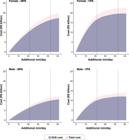
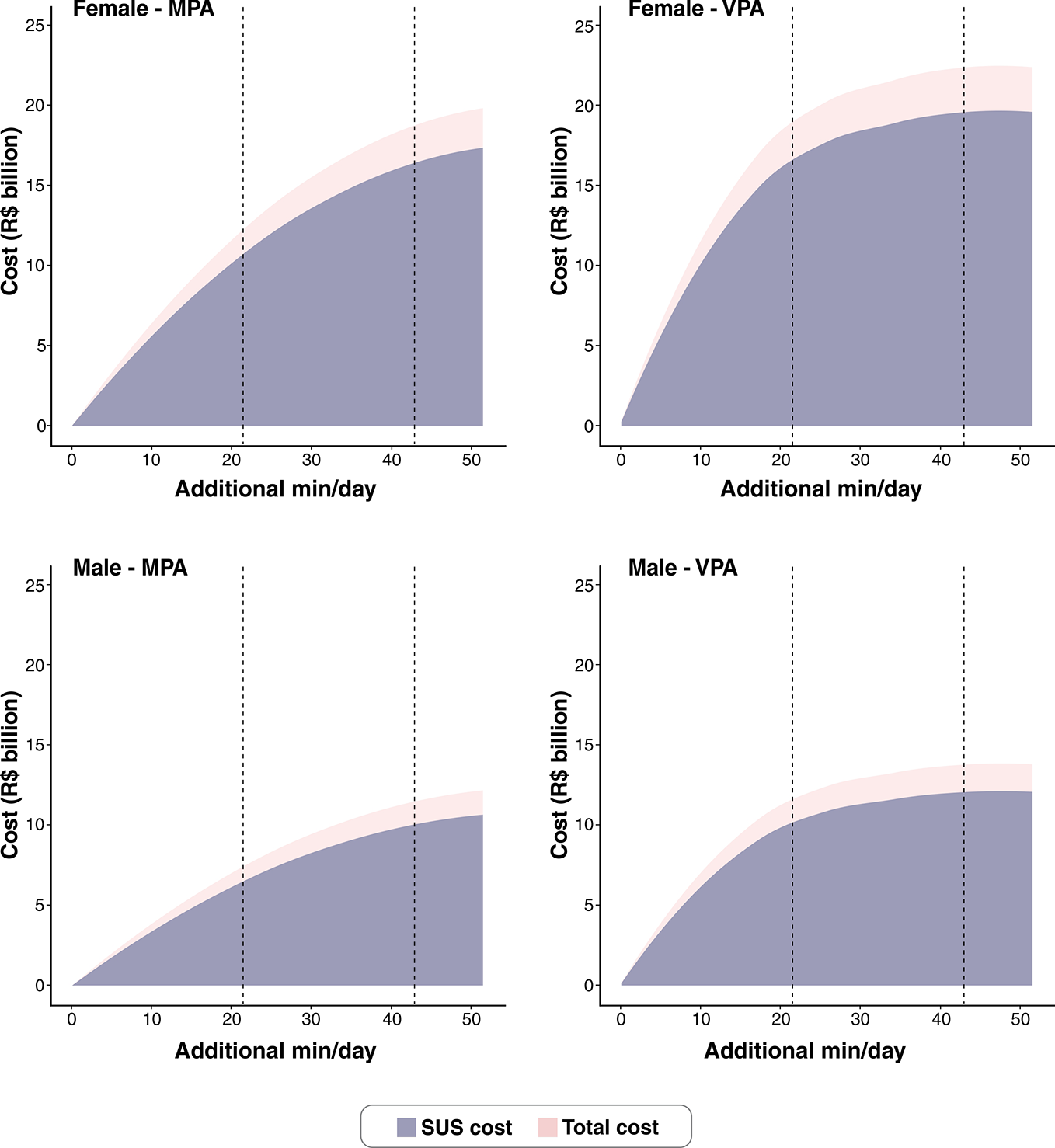
Economic costs (in R$ billions) due to dementia could be prevented until 2050 through progressive increases in time spent in MPA and VPA by sex. 2024 purchasing power parity (PPP) conversion factor: US$ 1.00 = R$ 2.481. MPA = moderate physical activity; SUS = Sistema Único de Saúde (Brazilian Unified Health System); VPA = vigorous physical activity.
To convert MET-min/week into hours/week, we used standard MET values from the 2024 Adult Compendium of Physical Activities: 3.5 METs for moderate-intensity and 7.5 METs for vigorous-intensity activities.19 We extracted the RR and corresponding 95%CIs for each point of interest from the figure. For example, to estimate the RR for 2 hours of vigorous PA (VPA) per week (900 MET-min/week), we derived a composite RR using two values: the RR for 900 vs. 203.64 MET-min/week (reference value at the meta-analysis) (0.79; 95%CI 0.73-0.85) and the RR for 0 vs. 203.64 MET-min/week (1.059; 95%CI 1.039-1.079). The composite RR was calculated as 0.79/1.059 = 0.746. Standard errors were calculated by summing the variances of the natural logarithms of the RRs (see Supplementary Methods for details). We also extracted the lower and upper limits of the 95%CI for each RR to calculate uncertainty intervals for the PAFs. The meta-analysis used 203.64 MET-min/week as a reference for the dose-response analyses, as this value was equivalent to the average MET-min/week value of the reference groups in the included studies.
Physical activity levels
We analyzed nationally representative data from 90,846 adults in the 2019 Brazilian National Health Survey to estimate PA levels.20 The survey assessed the frequency of PA during leisure time in the last 3 months.17,20 First, we identified the proportion of adults not meeting the WHO recommendation of 150 min/week of moderate-to-vigorous PA during leisure time (i.e., physical inactivity). Next, we estimated the proportion of participants reporting zero min/week of any PA during leisure time to estimate the theoretical effect of adding 1 hour per week of moderate PA (MPA) and VPA on dementia cases and economic costs. We focused on PA in the leisure-time domain, which is more susceptible to influence by public health policies and yields a stronger association with health outcomes than PA in other domains (i.e., occupational, household, and commuting).21 The prevalence of physical inactivity in 2019 was 69.9% (95%CI 69.3-73.6), higher in women (73.6%, 95%CI 72.9-74.3) than in men (65.8%, 95%CI 64.9-66.7).20
Population attributable fractions
We calculated the PAF for PA using the semi-adjusted PAF formula,22,23 as illustrated below, where Pexposure is the prevalence of physical inactivity and the proportion of adults with zero min/week of leisure-time PA. PAFs were estimated overall and stratified by sex.20
The formula estimates the PAF with low bias when using RR adjusted for confounders and other risk factors.24 PAFs quantify the proportion of dementia cases attributable to physical inactivity, allowing for the estimation of preventable cases and costs if physical inactivity were reduced.
Statistical analysis
To estimate the theoretical impact of PA increases on dementia burden, we calculated PAFs and applied them to forecasted dementia prevalence and associated economic costs in 2050. We modeled a counterfactual scenario in which adults reporting zero minutes of leisure-time PA increased their activity by 1-hour increments (up to 6 hours per week) of MPA or VPA. To quantify uncertainty, we employed a non-parametric bootstrapping approach with 10,000 resamples. For each iteration, we resampled the distributions of prevalence, RR, and cost estimates to compute 95%CIs for the number of preventable cases and associated economic costs. Analyses were stratified by sex to account for disparities in PA levels.25,26 All R scripts and data are publicly available on the Open Science Framework (https://osf.io/7d6up/?view_only=6bc012497a944fbca646d206fd9e2b18).
Results
Dementia cases and economic costs attributable to physical inactivity
Table 1 describes the total number of dementia cases attributable to physical inactivity in Brazil. We identified that 14.9% (95%CI 11.1-17.3) of dementia cases in Brazil could be attributed to physical inactivity. Sex disparity in PA accounts for a slightly higher PAF for women (15.5%, 95%CI 12.3-18.1) than for men (14.1%, 95%CI 11.1-16.5). Considering only cases from 2019 to 2050, we estimated that 568,803 (95%CI 306,958-852,717) dementia cases could be averted if physical inactivity were eliminated, with 365,094 (95%CI 204,981-540,507) in women and 233,343 (95%CI 140,780-334,993) in men.
Table 2 shows the total and healthcare economic cost of dementia cases from 2019 to 2050. Eliminating physical inactivity in Brazil would translate into R$ 23.1 billion (95%CI R$ 13.3 billion-R$ 33.7 billion), or US$ 9.3 billion, in avoidable economic burden. From this, R$ 20.2 billion (R$ 1.8 million per day) are direct healthcare costs.
Impact of physical inactivity on the total and direct healthcare-related economic cost of dementia cases in 2019 and 2050 in Brazil
Theoretical increases in physical activity
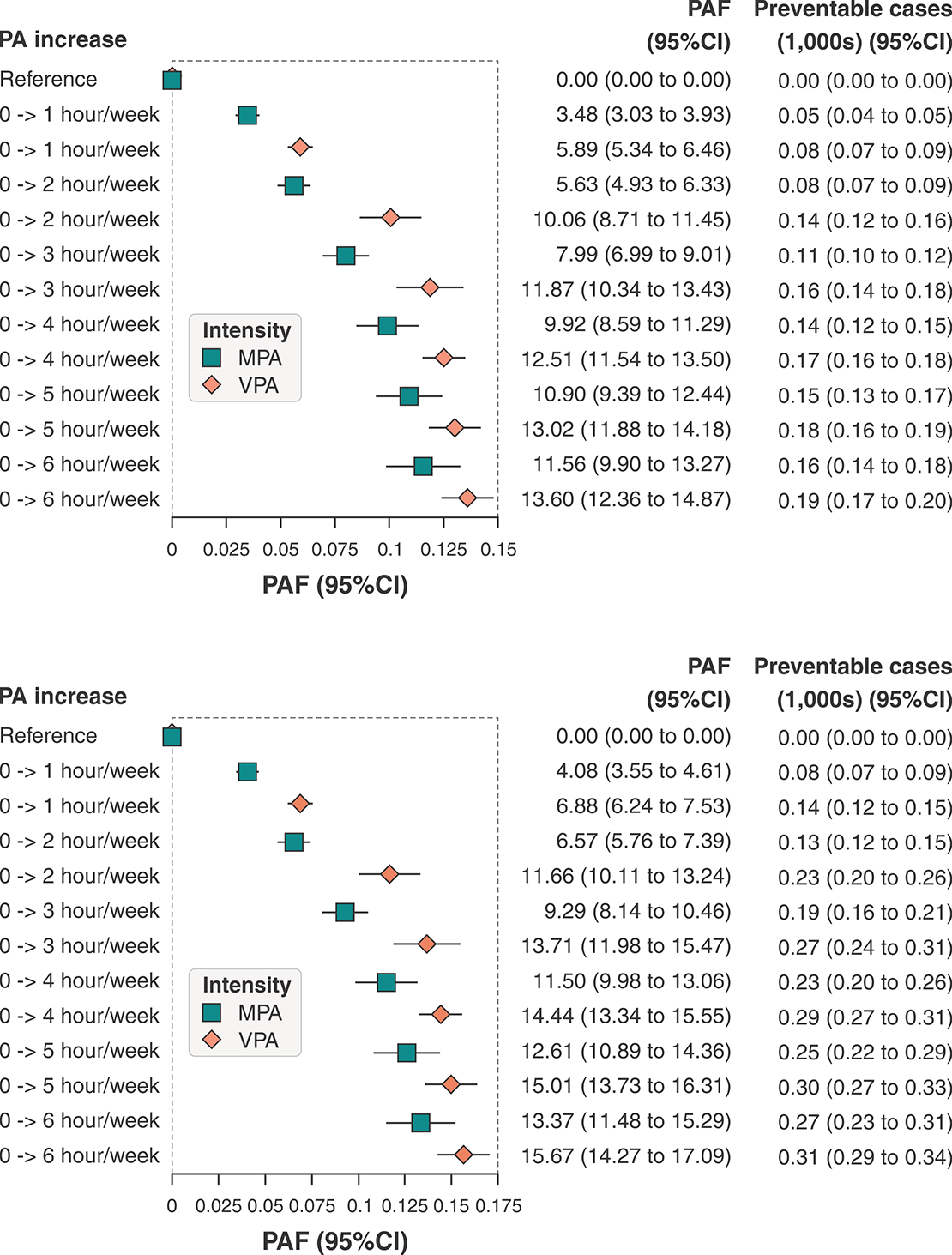
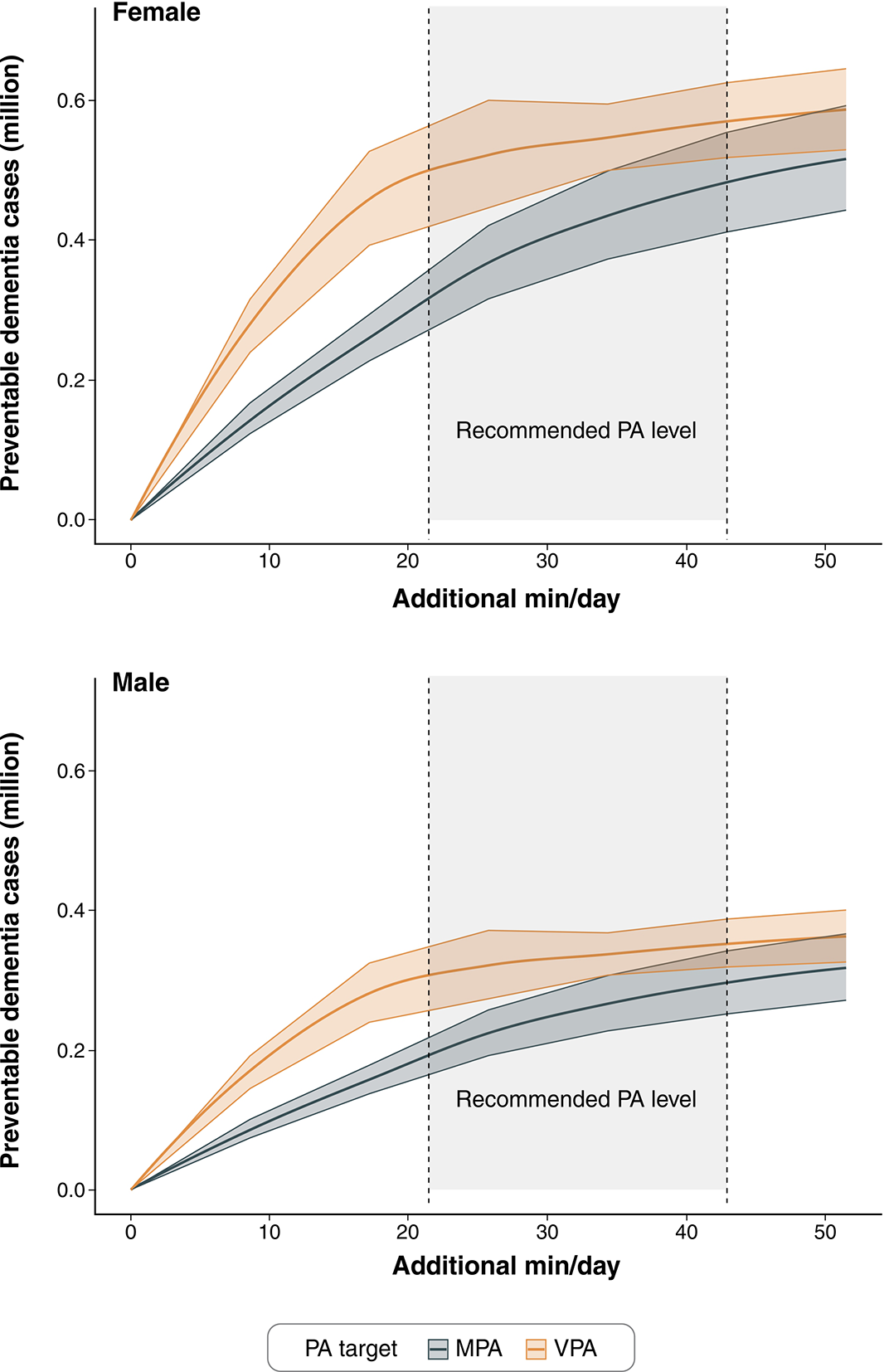
Figure 2 illustrates the absolute and relative number of dementia cases that could be averted by increasing leisure-time PA by 1 hour per week, stratified by PA intensity and sex. In men, increasing PA by 1 hour per week, or 8.6 min/day, of MPA and VPA would reduce 5.7 (95%CI 4.9-6.6) and 11.0 (95%CI 9.5-12.6) cases by 2050. The difference between the theoretical effects of MPA and VPA remains significant up to 4 hours per week, beyond which the differences disappear (Figure 3). In women, the theoretical effect is higher due to the higher proportion of women not engaging in any PA during leisure time (61%, 95%CI 60.2-61.9) compared to men (51.7%, 95%CI 50.7-52.6). The impact on dementia cases and economic costs is more pronounced with increasing PA from 0 to 3 hours per week, at which point the theoretical effect plateaus.
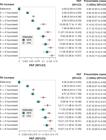
Proportion of dementia cases that could be prevented in 2050 through progressive increases in time spent in MPA and VPA in men (top) and women (bottom). MPA = moderate physical activity; PA = physical activity; PAF = population attributable fraction; VPA = vigorous physical activity.
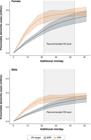
Number (in millions) of dementia cases that could be prevented in 2050 through progressive increases in time spent in MPA and VPA in men (top) and women (bottom). MPA = moderate physical activity; PA = physical activity; VPA = vigorous physical activity.
Figure 1 visually represents the potential cost savings (in R$ billion) across different levels of additional daily PA (MPA and VPA). Increasing MPA or VPA during leisure time by 1 hour per week (i.e., 8.6 min/day) would save R$ 8.5 billion (95%CI R$ 7.2 billion-9.7 billion) and R$ 16.2 billion (95%CI R$ 14.0 billion-18.5 billion) by 2050, respectively. The economic impact of promoting small doses of PA is more pronounced in up to approximately 50 min/day for MPA and 30 min/day of VPA. After that, the economic benefits plateau, especially for VPA.
Discussion
This study demonstrates that physical inactivity is a major modifiable risk factor for dementia in Brazil, with one in seven dementia cases from 2019 to 2050 attributable to physical inactivity. Our findings suggest that even modest increases in PA levels, particularly among those currently not engaging in any PA during leisure time, could prevent hundreds of thousands of dementia cases and save billions in healthcare costs. Notably, the economic benefits plateau after 3 to 4 hours of MPA or VPA per week, suggesting a point of diminishing returns. By demonstrating the economic benefits of PA, this study strengthens the rationale for investing in PA promotion as a key public health strategy to mitigate the future societal and economic impact of dementia.
The potential to avert R$ 23 billion of dementia-related costs by 2050, of which R$ 20 billion corresponds to direct healthcare expenditures, highlights the urgent economic case for promoting PA as a preventive strategy. This projected savings amounts to 9.4% of Brazil’s total public health budget for 2025 (R$ 245 billion),27 emphasizing the substantial fiscal implications of dementia prevention. These findings reflect the escalating economic burden of dementia in Brazil,5 a pattern echoed across LMICs, which collectively account for over 60% of the global dementia burden.1,28 Despite this, LMICs receive only a fraction of global research funding and preventive interventions targeting dementia.3,7,9 The economic strain is exacerbated by limited access to formal care infrastructure and a heavy dependence on informal caregiving. In Brazil, approximately 73% of dementia-related costs are indirect, primarily due to unpaid care provided by family members or friends.5 In other words, nearly two-thirds of the financial responsibility for dementia care in Brazil falls directly on individuals with dementia and their families.5,7 Similar trends are observed in other LMICs, where indirect costs can comprise up to 94% of the total economic burden.7 Addressing this challenge requires comprehensive, multisectoral strategies integrating health promotion, sustainable financing, and robust social support systems.
Our findings indicate that one in seven cases of dementia in Brazil can be attributable to physical inactivity. This proportion is similar to that found in previous studies,12,29 especially when defining physical inactivity based on the WHO guidelines.30 Previous studies, however, have estimated lower PAF for physical inactivity. Suemoto et al.31 estimated a PAF for physical inactivity of 5.6%. These differences likely reflect methodological choices, including the use of different data sources and PAF formulae. A unique contribution of our study lies in evaluating realistic, incremental increases in PA rather than assuming the complete elimination of physical inactivity, a utopian scenario reflected in traditional PAF calculations.23 By modeling achievable changes, such as increasing PA by 10 min/day, we demonstrate that meaningful health and economic gains are attainable through small, scalable interventions. While previous studies have emphasized the substantial health benefits of eliminating physical inactivity,29 our approach provides practical and policy-relevant evidence that even partial improvements can substantially reduce dementia risk and related costs. This distinction is crucial for translating research into public health action, especially in settings with limited resources.
These findings have significant implications for national and global health policy. Small, feasible behavior changes should be central to dementia prevention frameworks and integrated into broader strategies targeting non-communicable diseases. Public awareness campaigns, supportive urban design, school- and workplace-based interventions, and integrating PA counseling into primary healthcare are all promising strategies. Brazil should prioritize PA promotion as a central component of its national dementia plan.32 Such investments are not only beneficial for health but represent a sound economic strategy to alleviate long-term pressures on healthcare systems.
A key strength of this study lies in its forward-looking perspective, providing projections for 2050, which is crucial for long-term public health planning. The use of robust methodologies, including the derivation of composite RRs and the application of PAFs, strengthens the quantitative estimates of preventable costs. Furthermore, integrating data from various sources, including global prevalence forecasts, country-specific cost data, and comprehensive meta-analyses on PA and dementia, contributes to the comprehensiveness of the analysis.
This study has some limitations. First, the assumption of a causal relationship between PA and dementia is based on observational data and the reliance on self-reported PA, which may be subject to recall bias. Nevertheless, the triangulation of nationally representative data, robust cost estimates, and bootstrapped uncertainty intervals strengthens the reliability of our projections. Second, relying solely on leisure-time PA may underestimate total PA levels in the Brazilian population, given that a substantial proportion of daily PA occurs in other domains such as occupational and commuting-related activities.33 However, we chose to focus exclusively on leisure-time PA because it has been consistently associated with a reduced risk of dementia,34 whereas evidence for other domains remains inconclusive.16,35 Third, the economic costs of dementia in Brazil, estimated by da Mata et al.,5 did not include direct, non-medical social costs due to limited data availability. Consequently, direct costs in our analysis reflect only health-related expenses, which may lead to an underestimation of the avertable economic burden of dementia. Finally, projections of dementia prevalence are based on extrapolations of current trends, which may not account for recent advances, including early-stage Alzheimer’s disease diagnosis and potential disease-modifying treatments, which could significantly alter future trajectories. Moreover, these projections rely on assumptions that may oversimplify the complex interplay of social, behavioral, and environmental factors that shape the adoption of active lifestyles.
Importantly, our findings may be conservative. Using GBD Study estimates, we projected 1.68 million dementia cases in Brazil in 2019.1 However, a recent Delphi consensus involving 15 dementia researchers from all five regions of the country estimated 2.5 million cases in 2023,36 suggesting that both the overall economic burden of dementia and the share attributable to physical inactivity may be significantly higher.
Our findings offer compelling evidence that small steps can yield massive savings. Promoting even modest increases in PA represents a powerful and cost-effective strategy to reduce the future burden of dementia in Brazil. Dementia poses an escalating global health and economic crisis. A considerable portion of the projected economic burden of dementia in 2050 is preventable through small but achievable increases in PA. The quantified cost savings, spanning billions in healthcare and societal expenditures, underscore the immense value of investing in PA promotion as a fundamental public health strategy. By prioritizing and implementing effective interventions to enhance PA across the lifespan, societies can mitigate the future economic and social toll of dementia, fostering healthier populations and more sustainable healthcare systems.
Supplementary Materials
Supplementary Material
Acknowledgements
AR (PQ-2;307147/2022-3) was supported by a Conselho Nacional de Desenvolvimento Científico e Tecnológico (CNPq) Productivity Fellowship (grant 445538/2023-6).
Data availability statement
The data that support this study are available in Open Science Framework at https://osf.io/7d6up/?view_only=6bc012497a944fbca646d206fd9e2b18.
References
- 1 GBD 2019 Dementia Forecasting Collaborators. Estimation of the global prevalence of dementia in 2019 and forecasted prevalence in 2050: an analysis for the Global Burden of Disease Study 2019. Lancet Public Health. 2022;7:e105-25.
- 2 Ferri CP, Jacob KS. Dementia in low-income and middle-income countries: different realities mandate tailored solutions. PLoS Med. 2017;14:e1002271.
- 3 Walker R, Paddick SM. Dementia prevention in low-income and middle-income countries: a cautious step forward. Lancet Glob Health. 2019;7:e538-9.
- 4 Nandi A, Counts N, Bröker J, et al. Cost of care for Alzheimer’s disease and related dementias in the United States: 2016 to 2060. NPJ Aging. 2024;10:13.
- 5 da Mata FAF, Ramos AA, Bertola L, Suarez T, Ferri CP, de Oliveira Júnior HA. The cost of dementia in Brazil. Braz J Psychiatry. 2025;47:e20243611.
- 6 Prince M, Wimo A, Guerchet M, Ali GC, Wu YT, Prina M. World Alzheimer Report 2015 – The global impact of dementia: an analysis of prevalence, incidence, cost and trends. London: Alzheimer’s Disease International;2017.
- 7 Mattap SM, Mohan D, McGrattan AM, et al. The economic burden of dementia in low- and middle-income countries: a systematic review. BMJ Glob Health. 2022;7:e007409.
- 8 Nandi A, Counts N, Chen S, et al. Global and regional projections of the economic burden of Alzheimer’s disease and related dementias from 2019 to 2050: a value of statistical life approach. EClinicalMedicine. 2022;51:101580.
- 9 Kenne Malaha A, Thébaut C, Achille D, Preux PM, Guerchet M, Vandepitte S. Costs of dementia in low- and middle-income countries: a systematic review. J Alzheimers Dis. 2023;91:115-28.
-
10 World Health Organization [Internet]. Global status report on the public health response to dementia Methodology for producing global dementia cost estimates. Geneva: WHO; 2021 [cited 2025 Jun 5]. https://www.who.int/publications/i/item/9789240033245
» https://www.who.int/publications/i/item/9789240033245 -
11 World Health Organization [Internet]. WHO guidelines on physical activity and sedentary behavior. Geneva: WHO; 2020 [cited 2025 Jun 5]. https://www.who.int/publications/i/item/9789240015128
» https://www.who.int/publications/i/item/9789240015128 - 12 Borelli WV, Leotti VB, Strelow MZ, Chaves MLF, Castilhos RM. Preventable risk factors of dementia: Population attributable fractions in a Brazilian population-based study. Lancet Reg Health Am. 2022;11:100256.
- 13 Iso-Markku P, Kujala UM, Knittle K, Polet J, Vuoksimaa E, Waller K. Physical activity as a protective factor for dementia and Alzheimer's disease: systematic review, meta-analysis and quality assessment of cohort and case-control studies. Br J Sports Med. 2022;56:701-9.
- 14 López-Ortiz S, Lista S, Valenzuela PL, et al. Effects of physical activity and exercise interventions on Alzheimer’s disease: an umbrella review of existing meta-analyses. J Neurol. 2023;270:711-25.
- 15 Flaxman S, Semenova E, Health A, et al. National, regional, and global trends in insufficient physical activity among adults from 2000 to 2022: a pooled analysis of 507 population-based surveys with 5. 7 million participants. Lancet Glob Health. 2024 Aug;12:e1232-43.
- 16 Nabe-Nielsen K, Holtermann A, Gyntelberg F, et al. The effect of occupational physical activity on dementia: results from the Copenhagen Male Study. Scand J Med Sci Sports. 2021;31:446-55.
-
17 Institute for Health Metrics and Evaluation. GBD Results Tool. https://vizhub.healthdata.org/gbd-results/
» https://vizhub.healthdata.org/gbd-results/ -
18 Ipeadata [Internet]. [cited 2025 Aug 31]. http://www.ipeadata.gov.br/Default.aspx
» http://www.ipeadata.gov.br/Default.aspx - 19 Herrmann SD, Willis EA, Ainsworth BE, et al. 2024 adult compendium of physical activities: a third update of the energy costs of human activities. J Sport Health Sci. 2024;13:6-12.
- 20 Mielke GI, Stopa SR, Gomes CS, et al. Leisure time physical activity among Brazilian adults: National Health Survey 2013 and 2019. Rev Bras Epidemiol. 2021;24:e210008.
- 21 Holtermann A, Krause N, van der Beek AJ, Straker L. The physical activity paradox: six reasons why occupational physical activity (OPA) does not confer the cardiovascular health benefits that leisure time physical activity does. Br J Sports Med. 2018;52:149-50.
- 22 Santos AC, Willumsen J, Meheus F, Ilbawi A, Bull FC. The cost of inaction on physical inactivity to public health-care systems: a population-attributable fraction analysis. Lancet Glob Health. 2023;11:e32-9.
- 23 Rockhill B, Newman B, Weinberg C. Use and misuse of population attributable fractions. Am J Public Health. 1998;88:15-19.
- 24 Wong BHW, Peskoe SB, Spiegelman D. The effect of risk factor misclassification on the partial population attributable risk. Stat Med. 2018;37:1259.
- 25 Guimarães Lima M, Malta DC, Monteiro CN, et al. Leisure-time physical activity and sports in the Brazilian population: a social disparity analysis. PLoS One. 2019;14:e0225940.
- 26 Wendt A, Ricardo LIC, Costa CS, Knuth AG, Tenorio MCM, Crochemore-Silva I. Socioeconomic and gender inequalities in leisure-time physical activity and access to public policies in Brazil from 2013 to 2019. J Phys Act Health. 2021;18:1503-10.
-
27 Brasil. Senado Federal [Internet]. Orçamento 2025: quase R$ 1 trilhão para Previdência e R$ 245 bilhões para saúde. 2024 Apr 14 [cited 2025 Jun 2025]. https://www12.senado.leg.br/noticias/materias/2025/04/14/orcamento-2025-quase-r-1-trihao-para-previdencia-e-r-245-bilhoes-para-saude
» https://www12.senado.leg.br/noticias/materias/2025/04/14/orcamento-2025-quase-r-1-trihao-para-previdencia-e-r-245-bilhoes-para-saude - 28 Nichols E, Szoeke CEI, Vollset SE, et al. Global, regional, and national burden of Alzheimer’s disease and other dementias, 1990-2016: a systematic analysis for the Global Burden of Disease Study 2016. Lancet Neurol. 2019;18:88-106.
- 29 Stephan BCM, Cochrane L, Kafadar AH, et al. Population attributable fractions of modifiable risk factors for dementia: a systematic review and meta-analysis. Lancet Healthy Longev. 2024;5:e406-21.
- 30 Feter N, Leite JS, da Silva LS, Cassuriaga J, de Paula D, Lopes GW, et al. Systematic review and meta-analysis on population attributable fraction for physical inactivity to dementia. Alzheimers Dement. 2023;19:4688-704.
- 31 Suemoto CK, Borelli WV, Calandri IL, et al. The potential for dementia prevention in Brazil: a population attributable fraction calculation for 14 modifiable risk factors. Lancet Reg Health Am. 2025;49:101209.
-
32 Brasil. Senado Federal [Internet]. Projeto de Lei n° 4364, de 2020. 2020 [cited 2025 Jun 5]. https://www25.senado.leg.br/web/atividade/materias/-/materia/144381
» https://www25.senado.leg.br/web/atividade/materias/-/materia/144381 - 33 Strain T, Wijndaele K, Garcia L, et al. Levels of domain-specific physical activity at work, in the household, for travel and for leisure among 327, 789 adults from 104 countries. Br J Sports Med. 2020;54:1488-93.
- 34 Xu W, Wang HF, Wan Y, Tan CC, Yu JT, Tan L. Leisure time physical activity and dementia risk: a dose-response meta-analysis of prospective studies. BMJ Open. 2017;7:e014706.
- 35 Zotcheva E, Bratsberg B, Strand BH, et al. Trajectories of occupational physical activity and risk of later-life mild cognitive impairment and dementia: the HUNT4 70+ study. Lancet Reg Health Eur. 2023;34:100721.
-
36 Brasil. Ministério da Saúde, Secretaria de Atenção Primária à Saúde, Departamento de Gestão do Cuidado Integral [Internet]. Relatório nacional sobre a demência: epidemiologia, (re)conhecimento e projeções futuras. 2024 [cited 2025 Jun 7]. https://bvsms.saude.gov.br/bvs/publicacoes/relatorio_nacional_demencia_brasil.pdf
» https://bvsms.saude.gov.br/bvs/publicacoes/relatorio_nacional_demencia_brasil.pdf