 Real-world use of classic and non-classic psychedelics in Hispanic/Latino adults with obsessive-compulsive disorder: international findings from the LATINO Study
Abstract
Objective: Despite growing research on the potential mental health benefits of psychedelics, there has been limited study of these drugs in populations with obsessive-compulsive disorder (OCD) and with Hispanic and Latin American (H/L) ancestry.
Methods: Demographic and clinical assessments were conducted as part of the Latin American Trans-Ancestry INitiative for OCD genomics (LATINO) Study in H/L participants with OCD living throughout the Americas. Self-reported data on the prevalence of naturalistic psychedelic use and associated outcomes on OCD symptoms were collected in a subsample of 2,639 adults. Descriptive statistics and regression analyses were used to assess psychedelic use, predictors of use, and predictors of OCD symptom change attributed to psychedelics.
Results: Across 11 countries, 9% of respondents reported using psychedelics or related substances for treatment. Most respondents (72%) had received conventional treatments for OCD (e.g., psychiatric medication and/or psychotherapy). Psilocybin, lysergic acid diethylamide (LSD), and 3,4-methylenedioxymethamphetamine (MDMA) were the most used psychedelics. Psychedelic users compared to non-users were more likely to be male, have received non-exposure and response prevention (ERP) therapy for OCD, and have a comorbid psychiatric diagnosis. Outcomes of psychedelic use for OCD-related symptoms varied widely by drug and were difficult to predict, but were reported as most favorable for “classic” serotonergic psychedelics.
Conclusion: Real-world evidence suggests that H/L adults are exploring psychedelics as a treatment for OCD, though further work is needed to establish the conditions for safe and effective use in this population. Increased research and practical harm reduction in this area is critical as public interest in psychedelic drugs continues to surge.
Keywords:
Psychedelics; psilocybin; MDMA; obsessive-compulsive disorder; Hispanic or Latino
Introduction
The last decade has seen a rapid acceleration of clinical research on psychedelic substances and their potential applications for mental health.1 This drug class comprises highly diverse compounds, with various mechanisms of action, whose most prominent subjective effects include dramatic alterations in perception, cognition, and affect. The prototypical psychedelic drugs are the “classic” serotonin 2A receptor agonists, such as psilocybin and lysergic acid diethylamide (LSD); “non-classic” entactogens such as 3,4-methylenedioxymethamphetamine (MDMA) are commonly included as well.1,2 Dissociative drugs (e.g., ketamine) and cannabinoids (e.g., tetrahydrocannabinol [THC]) can elicit similar alterations in consciousness and are sometimes, but not routinely, considered atypical psychedelic molecules.3,4 When studying how these drugs are used in real-world settings, it can be valuable to group them together – despite their pharmacological differences – because of their converging phenomenology and their interest to the general public as alternatives to conventional treatment.5,6
Psychedelic therapies have been most researched for the treatment of depression, anxiety, substance use disorders, and post-traumatic stress disorder, with several drug development programs in advanced phases of clinical testing for those indications.1 If approved, these drugs could offer relief for individuals who have not responded to or tolerated other interventions. The efficacy of psychedelics for these separate conditions has been attributed to transdiagnostic mechanisms of action, which have been described at biochemical, neural, and psychological levels of analysis.7,8 It is possible that these same mechanisms of action could support the utility of psychedelic therapies for additional mental health indications.
Though there has been considerably less research in this area, emerging data suggest that psychedelic therapies could have a role in the treatment of obsessive-compulsive disorder (OCD).9 OCD is a heterogeneous disorder characterized by the presence of unwanted and recurrent intrusive thoughts (obsessions) and safety and avoidance behaviors (compulsions) that are used to neutralize obsessional distress.10 Approved treatments for OCD include daily serotonergic medications (e.g., serotonin reuptake inhibitors), various neuromodulatory technologies (e.g., transcranial magnetic stimulation), and psychotherapy (e.g., cognitive behavioral therapy [CBT] with exposure and response prevention [ERP]).11,12 However, these approaches may be limited by partial or delayed efficacy, limited tolerability, and low adherence for some patients. For ERP specifically, response rates can be as high as 86% in treatment-completers, but the success of treatment is challenged by factors such as access and logistical concerns.9
While psychedelics may have therapeutic benefits for individuals with OCD or even augment existing psychological therapies,9,13,14 key questions remain. Industry-sponsored drug development trials of psychedelics for OCD are underway, generally involving psilocybin, but are still in the earliest phases of testing.9 As such, the safety and efficacy of psychedelic interventions in this population have not yet been clearly established. Further investigation is also needed to assess what kinds of psychological support are necessary for individuals using psychedelics for the treatment of OCD and whether this differs from psychedelic therapies used for other indications.
As this research develops, parallel work is needed to reduce the potential harms of psychedelic use in non-clinical settings.15 Though psychedelic drug use has been associated with psychological benefits outside of research contexts,16,17 these substances carry various medical and psychological risks, which are expected to increase without adequate supervision.18 Furthermore, the growing “hype” around psychedelics, fueled by media and industry interests, may extend beyond scientific evidence and lead to incorrect public perceptions about what these drugs can reasonably do and how safe they are to use outside of clinical settings.19
Critically, there has also been limited research to date involving psychedelic use in people with Hispanic and Latin American (H/L) ancestry.20 This is concerning, given evidence that such groups may approach psychedelics differently,21-23 may not experience the same types of benefits,24-27 and may have different risk profiles compared to typical White populations.28 For example, psychedelic plants and fungi have an extensive history of ritual and sacramental use in South and Central America that could shape different attitudes toward these drugs than seen in North America.21,29 Cultural factors such as general stigma around mental health and the lack of access to trained specialists in Latin America may also prevent individuals from exploring medically established therapies and lead instead to other avenues for care.30,31
As such, the present investigation was focused on better understanding naturalistic use of psychedelics in H/L adults with OCD living in the Americas. Our specific aims were to: 1) characterize treatment involving psychedelics among people with OCD and H/L ancestry, 2) assess whether psychedelic users differed from non-users based on clinical and demographic variables, and 3) explore predictors of OCD symptom change attributed to psychedelic use.
Methods
This paper describes a secondary investigation conducted in participants enrolled in the Latin American Trans-Ancestry INitiative for OCD genomics (LATINO) Study (https://www.latinostudy.org). Details of the main study are described elsewhere.32 Briefly, LATINO is a 14-country consortium of more than 50 sites recruiting children and adults (ages 7-89) with past or present OCD and H/L ancestry who undergo genomic sequencing and clinical and demographic assessments, both clinician-administered and self-reported. Participants were considered to have H/L ancestry if they had at least one biological grandparent born in Latin America (i.e., Mexico, a Caribbean island, Central America, or South America). As part of a supplemental battery of measures administered on a rotational basis, we included questions to assess whether treatment histories for OCD included use of psychedelics, the prevalence and type of psychedelics used, and the perceived efficacy of use on OCD symptoms. After providing informed consent, participants were assessed in person or via secure video conference. Self-reported questionnaires, including demographic assessments, were administered online via Research Electronic Data Capture (REDCap), a Health Insurance Portability and Accountability Act (HIPAA)-compliant, secure, web-based data collection and database tool. The study was approved by the institutional review board of Baylor College of Medicine (protocol H-49814).
Participants were included in this analysis if they were aged 18 years or older and were administered the relevant measures about psychedelics. We did not exclude individuals based on psychiatric comorbidity, severity, or recent substance use, as our goal was to examine naturalistic patterns of psychedelic use among individuals with OCD in real-world settings with a focus on ecological validity rather than experimental control. Demographic information (age, reported birth sex, country, level of education, and income), diagnostic information (i.e., current OCD symptoms, OCD severity assessed by the Yale-Brown Obsessive Compulsive Scale [Y-BOCS-II],33 and the presence of any other comorbid diagnoses assessed by the Mini International Neuropsychiatric Interview [MINI]34), and information about treatment history (e.g., history of ERP and non-ERP therapies, psychiatric medications, and psychedelic drug use) were explored. Countries of residence were organized by geographic region. The Y-BOCS-II and MINI were used with permission from license holders.
Participants were categorized as “psychedelic users” if in their treatment history they responded Yes to the question “Have you ever taken medications or substances with psychedelic properties (e.g., Ayahuasca, San Pedro, ketamine, psilocybin, MDMA)?” They were then asked to specify use and frequency of use for the following substances: several classic psychedelics (i.e., psilocybin, LSD, N,N-dimethyltryptamine [DMT] [e.g., Ayahuasca], and mescaline [e.g., San Pedro, peyote]), MDMA, ketamine, and THC. Free response was used to capture substances that were not queried specifically. Participants’ perceived effectiveness of use of psychedelic substances was assessed with the prompt: “Please use the following scale to rate how your OCD symptoms were affected by the medication(s) or substance(s) with psychedelic properties that you took for OCD.” Participants responded using a dropdown menu with the following response options: 1 = Much worse; 2 = Somewhat worse; 3 = No change; 4 = Somewhat improved; and 5 = Much improved. For Spanish-speaking participants, this prompt was: “Por favor, valore cómo afectaron a sus síntomas de TOC los medicamentos o sustancias con propiedades psicodélicas que tomó para el TOC.” Response options included: 1 = Mucho Peor; 2 = Un Poco Peor; 3 = Sin Cambios; 4 = Un Poco Peor; 5 = Mucho Mejor.
Data analysis
Analyses were conducted using various R libraries for data processing, statistical analysis, and visualization. Missing data were handled with listwise deletion. Descriptive statistics were computed using the describe function from the psych package. A logistic regression analysis was conducted to examine the relationship between the binary outcome (psychedelic user vs. non-user status) and predictors (age, sex, country, education level, income, history of ERP and non-ERP treatment, presence of any comorbidities, OCD symptoms [MINI], and OCD severity [Y-BOCS-II]). Variance inflation factor (VIF) values ranged from 1.08 to 1.90, indicating no multicollinearity concerns. Multiple regression analyses were also conducted to explore predictors of OCD symptom change attributed to specific psychedelic substances, including age, sex, education level, income, use of any psychiatric medications, history of ERP and non-ERP therapy, presence of any comorbidities, and OCD severity. While psychiatric medication use was examined, we lacked detailed information on medication type, dose, duration, or timing, and thus modeled it as a binary covariate (yes/no). The select function from the dplyr package was used to filter the dataset, ensuring that only relevant cases and variables were included. Two-tailed tests were conducted with a significance level of α = 0.05.
Results
Characterizing treatment involving psychedelics (Aim 1)
Participant demographics are summarized in Table 1. The survey was completed by 2,639 participants from various countries, with the largest representation from Peru (n=521), followed by Mexico (n=469), Chile (n=420), Bolivia (n=338), Colombia (n=320), the United States (n=238), Argentina (n=145), Paraguay (n=105), El Salvador (n=32), Puerto Rico (n=29), and Ecuador (n=14). The majority (72%) had a history of OCD treatment, including psychiatric medication (66%) and/or ERP therapy (32%). Out of total respondents, 225 (9%) reported treatment histories that included use of psychedelics or related substances.
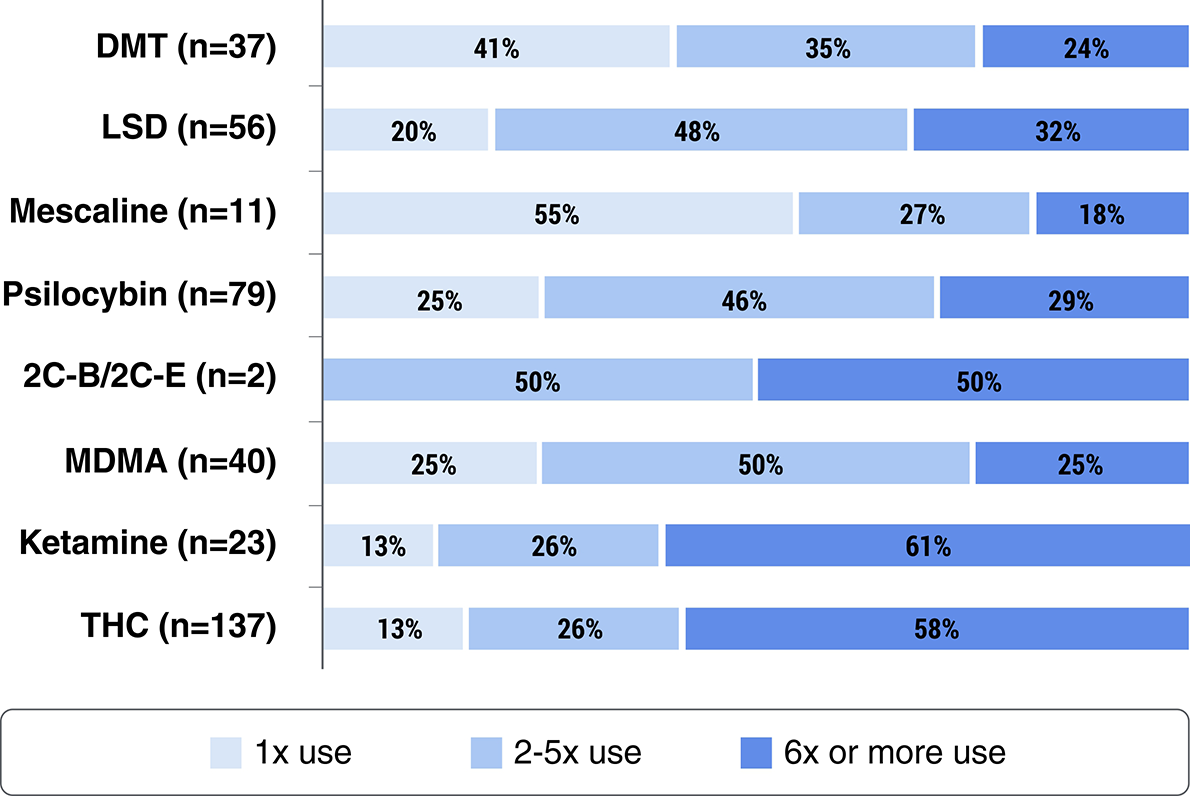
Details of drug use and frequency are shown in Figure 1. In addition to psychedelic use (queried specifically), free-response items indicated use of the synthetic phenethylamines “2C-B” and “2C-E.” The psychedelics most taken were psilocybin (n=79; 3% of total survey population), LSD (n=56; 2.1%), and MDMA (n=40; 1.5%), followed by DMT (n=37; 1.4%), mescaline (n=11; 0.4%), 2C-B (n=1; < 0.1%), and 2C-E (n=1; < 0.1%). Among related substances, frequency of THC use was also high (n=137; 5.2%), while ketamine was less commonly used (n=23; 0.9%).

Frequency of use for each type of substance. Percentages for frequency of use are based on the total reported frequency of use for that substance (e.g., 41% indicating 1x use of DMT is out of n=37 that reported DMT use). DMT = N,N-dimethyltryptamine; LSD = lysergic acid diethylamide; MDMA = 3,4-methylenedioxymethamphetamine; THC = tetrahydrocannabinol.
Comparing psychedelic users and non-users (Aim 2)
Full odds ratios (OR) estimates, confidence intervals, and significance values are presented in Table 2. Data were missing at low rates for all covariates (0-4.3%) and available for 93% of participants across all measures. Based on logistic regression analysis, users of psychedelics and related substances, compared to non-users, were more likely to have received non-ERP therapy for OCD treatment and have a comorbid MINI diagnosis other than OCD. They were more likely to be male, though there were more female than male users overall, suggesting that this finding has low clinical and epidemiological significance. Geographic location in Ecuador also significantly predicted user status, but with a null confidence interval and limited by the small sample size of participants from Ecuador (n=14), suggesting caution in interpreting this finding as significant. Having a MINI diagnosis of OCD trended to but did not significantly predict user status. User status was not predicted by ERP therapy history or OCD severity as measured by Y-BOCS score.
Predictors of obsessive-compulsive disorder symptom change attributed to psychedelic use (Aim 3)
No significant predictors of OCD symptom change were identified in regression analyses for psilocybin, LSD, DMT, mescaline, MDMA, or ketamine. For THC only, participants with comorbid psychiatric diagnoses reported significantly greater improvement (β = 0.7, p = 0.02) compared to those without comorbidity. Due to the very limited sample size for the mescaline model (n=9), including both education and income as covariates led to a model that would not run. Thus, only income was retained to preserve model stability for this regression. Income was not a significant predictor for symptom change with mescaline, and neither socioeconomic variable was statistically significant in any of the models tested. Additional descriptive analyses were conducted to examine symptom change attributed to specific drugs. Participants reporting benefit from psychedelic drugs ranged from 25% for MDMA (n=9/36) to 56% for mescaline (n=5/9). Participants reporting worse outcomes ranged from 0% for mescaline (n=0/9), 2C-B (n=0/1), and 2C-E (n=0/1) to 28% for MDMA (n=10/36). For related substances, 34% of THC users (n=45/134) and 32% of ketamine users (n=7/22) reported benefit from their drug use, compared to 34% (n=45/134) and 18% (n=4/22) reporting deterioration, respectively. These data are presented in Figure 2.

Impact on symptoms by substance. Totals may not add up to 100% due to rounding. DMT = N,N-dimethyltryptamine; LSD = lysergic acid diethylamide; MDMA = 3,4-methylenedioxymethamphetamine; THC = tetrahydrocannabinol.
Discussion
We assessed self-reported, naturalistic use of psychedelics in H/L adults with OCD living in the Americas. This exploratory work adds to the limited literature on behaviors and outcomes related to psychedelic drugs in underrepresented populations. Psychedelic and related substances were used for treatment by a significant minority (9%) of participants, many of whom had tried other interventions for OCD. The percentage of individuals reporting psychedelic use was notably lower than rates of general use obtained from survey data of the United States general population, including H/L (14%), non-H/L (20%), and non-H/L White (22%) adults.35 This aligns with evidence that H/L samples report lower rates of lifetime psychedelic use and less frequent patterns of use than typical English-speaking populations,21,36 highlighting the importance of cultural factors when investigating drug-related behaviors.
It is also worth considering that anxiety in people with OCD could independently decrease their risk for substance use.37 This may be especially true for psychedelic drugs, which can elicit psychologically challenging experiences and transiently increase distress for many users.15,17 From this perspective, the use of psychedelics in this sample should not be minimized and could, for some individuals with refractory OCD, represent a high-stakes undertaking motivated by a desire to experience symptomatic relief.
Participants who reported using psychedelics did not differ in terms of OCD severity from non-users, despite being more likely to have received general treatments for OCD. There were also similar histories of ERP therapy in users (42%) and non-users (31%), though we did not assess factors critical to the success of ERP such as the number of sessions, treatment time, patient adherence, the quality of therapy, and other therapist-related considerations.38 As such, the inclusion of ERP here can be seen as a pragmatic covariate used to reduce confounding rather than to guide inferences about the quality of therapy administered. The fact that the majority of psychedelic users here had not tried ERP, however, suggests a clear opportunity for improved education and dissemination for ERP in H/L populations, given its role as a first-line treatment for OCD capable of yielding durable benefit.31
Psilocybin, LSD, and MDMA were the most commonly used psychedelics in this sample, consistent with other data from Latin American adults21,39 and from non-H/L populations with OCD.40 We did not test the efficacy or causal mechanisms of psychedelics but rather aimed to descriptively characterize their perceived effects. Interestingly, the classic psychedelics were most associated with reported improvement in OCD symptomatology, followed by THC, ketamine, and then MDMA. Conversely, THC and MDMA were most associated with reported deterioration, followed by ketamine and classic psychedelics. While it is challenging to directly compare these observational, self-reported outcomes with existing safety and efficacy data for approved OCD treatments administered with clinical oversight, it is likely that individuals who pursue unsupervised use of psychedelics for treatment are at greater risk for clinical deterioration. For MDMA, it should be noted that a Phase II study (NCT05783817) is assessing the safety and preliminary effectiveness of MDMA-assisted CBT for OCD administered in a controlled setting.
A combination of drug and non-drug factors may be responsible for perceived outcomes in this sample, but the relatively favorable profile seen with classic psychedelics is consistent with data suggesting that this serotonergic drug subclass might be uniquely well-suited for the treatment of OCD.9,40 The therapeutic effects of these drugs are largely determined by 5-HT2A receptor-mediated brain network activity,9 may specifically target the rigidity seen with OCD via neuroplasticity-oriented effects,41 and appear to correlate with the intensity of subjective drug experiences.40
Classic psychedelics are also known to affect belief revision and fear extinction learning in ways that may resemble aspects of exposure-based therapies.42 Experiences of these drugs have been described as a form of spontaneous, “internal” exposure to challenging thoughts and emotions under conditions that can allow for reprocessing.17,42 While drugs like ketamine and MDMA can strengthen extinction learning, they may be more dependent on adjunctive psychotherapy to facilitate this process and yield benefit for the treatment of fear-related disorders.43,44 Psychedelics can also lead to negative clinical outcomes. Psychiatric impairment attributed to psychedelic use has been reported at rates below 15% in healthy, naturalistic samples.16 Here, we observed self-reported rates of clinical deterioration as high as 19% for classic psychedelics (i.e., LSD) and 28% for MDMA. This difference may be explained by OCD history in the present sample and the potential for drug use to exacerbate this illness, as has been described elsewhere.45 Specifically, psychedelic experiences can feature a loss of control or breakdown of defensive functions46 that may be especially difficult for those with OCD to tolerate.
Crucially, no clinical or demographic variables reliably predicted symptom change with psychedelic use. Our findings thus suggest both the potential harm of psychedelic use in adults with OCD and the difficulty in predicting such harm in naturalistic settings. Furthermore, as these substances are not yet legal or approved for medical use in many countries, we do not recommend unsupervised use of psychedelics for OCD. For individuals who may nonetheless choose to explore this option, we recommend a cautious approach that prioritizes research about individual risk profiles along with measures taken to improve safety and the likelihood of positive outcomes. Consultation with trained professionals may be helpful in this regard for discussing the conditions of drug use that reduce harm. Other aspects of psychedelic use could also be monitored with professional support. For example, there may be a tendency for individuals with OCD who benefit from psychedelics in the short-term to resort to frequent drug use to maintain relief,9,14,40 thereby increasing cumulative risk.
This study has several important limitations. We assessed retrospective, self-reported, and non-specific outcomes of psychedelic use, thus increasing the potential for recall and response bias. The lack of information about the timing of psychedelic use relative to measurement adds to this uncertainty. While subjective perceptions do not replace standardized clinical assessments and should not be seen as indicating therapeutic efficacy, they can still provide valuable insight into how individuals interpret and assign meaning to past psychedelic experiences, factors that may shape future treatment-seeking behavior, and the acceptability of emerging interventions. Another limitation was the absence of standardization for variables such as drug dose, frequency, quality, or context (e.g., treatment setting, degree of support) that are thought to be critical for interpreting outcomes with psychedelics and the varieties of use that are possible.47 Similarly, we did not adequately measure variables such as illness duration, psychiatric medication use, or global symptom severity, which could introduce potential confounding.
Analytically, we made the decision to study classic psychedelics alongside other, non-classic substances with hallucinogenic properties. This is a topic of debate, and there are lines of reasoning that both support1,3-5,48 and oppose49,50 this system of grouping. We ultimately decided on a more inclusive approach that would allow us to capture larger patterns of use and explore how individuals are using a variety of related substances for OCD treatment. We were, however, careful to examine drug-specific contributions to outcomes, given the potential for meaningful differences between substances. While we examined effects stratified by country of residence, our study may also have been underpowered to detect meaningful differences in psychedelic use or outcomes influenced by regional culture. The small sample size for some participating countries also limited the possibility of exploring multi-way, cross-national comparisons. As our sample encompasses substantial heterogeneity in cultural norms, healthcare systems, and substance use laws that we were unable to control for in our statistical models, this work should not be seen as representative of all Latin American populations or generalizable across diverse sociocultural contexts. Finally, participant attitudes and motivations surrounding psychedelic use were not assessed here but could be asked more directly and could valuably inform culturally sensitive understandings of drug use.
Promising directions for future research include improved measurement in these areas and within clinical samples that permit standardization of diagnostic, pharmacological, and contextual variables. Controlled, prospective trials are needed to determine whether, and under what conditions, psychedelic use may be helpful or harmful for individuals with OCD. Larger, hypothesis-driven studies could allow for closer examination of cross-contextual modifiers that are relevant to outcomes. Future studies could also benefit from stratifying by or excluding certain high-risk profiles (e.g., active psychosis or recent substance misuse) that might impact psychedelic use.
Ultimately, this study provides insight into real-world, treatment-related behaviors among H/L adults with OCD across 11 different countries. Our findings show that a small but meaningful number of individuals have used psychedelic interventions even when conventional therapies have been explored. While psychedelics and related substances are being explored as a treatment for various mental health conditions and as a tool for optimizing psychotherapy, they should be rigorously tested in OCD-specific populations, particularly those groups underrepresented in current trials. Increased funding support and fewer regulatory barriers for this research are critical as public interest in psychedelic drugs continues to grow. Caution is also recommended in unsupervised use of psychedelics for OCD, given the potentially illegal status of these drugs and evidence provided herein for highly variable outcomes that may be difficult to predict, ranging from substantial improvement to substantial worsening of symptoms. Clinicians should be aware that their patients may be exploring non-medical use of psychedelics for treatment, perhaps in response to public misinformation, and should therefore be informed of current research and strategies for harm reduction. Ongoing work can help guide best practices for psychedelic use in people with OCD, people of H/L ancestry, and people for whom these identities intersect. As this research progresses, evidence-based treatments such as ERP remain a safe and effective first-line option for OCD.
Acknowledgements
Research reported in this publication was supported by the National Institute of Mental Health (NIMH; National Institutes of Health [NIH] award numbers U01MH125062 and U01MH125050); the content is solely the responsibility of the authors and does not necessarily represent the official views of the NIH. This study was also supported by a donation from the Gillson-Longenbaugh Foundation and by the Ancestral Population Network (APN), a NIMH initiative (the APN was established by the NIMH to support data collection and analysis of psychiatric phenotypes across diverse ancestral populations).
LAA is co-founder and chief science officer for Reason for Hope (RFH), a non-profit organization focused on mental health and suicide prevention, with emphasis on ethical and safe access to emerging therapies, and the Veterans Mental Health Leadership Coalition, an offshoot of RFH focused on Veterans’ mental health care. EAS reports receiving research funding to his institution from the Ream Foundation, the International OCD Foundation, and the NIH.
The authors would like to thank all of the participants, clinics, and colleagues who made this project possible. We would like to acknowledge Laura Barón Castano, Sanie Marie Bulsara, Shaun Bulsara, Mabel Carrera-Olivares, María Catano-Cedillo, Kyra Cheung, Duff Dean, José Erazo, Bharathi Gadad, Katy Gathron, Miri Gitik, Letty Guerrero, Imaje Harvey, Carlos Hines, Andrea Horvath Marques, Alexandra Jimenez Reynolds, Rachel Jocson, David Keller, Minjee Kook, Daniel Macioci, María Martínez, Guanpei Ming, Carlos Miranda, Victoria Mora, Mary Beth Morgan, Jhonny Muñoz, Emily O’Bryant, Maria Ochoa Rojas, Darpan Patel, Laura Petty, Uma Ramamurthy, Vivek Ramanathan, Catherine Rast, Bradley Riemann, Juan Rivas, Santiago Romero, Emse Rosario, Brenda Patricia Salcedo Martínez, Elda Yadira Salcedo Martínez, Leanne Scott, Natasha Sefcovic, McKenzie Sluder, Sharron Smart, Keaton Soileau, Andrew Storch, Andres Viana, and Jackie Wynn.
Recruitment for this study was facilitated by the Simons Simplex Collection (SSC). We are grateful to all of the families at the participating SSC sites, as well as the principal investigators (A. Beaudet, R. Bernier, J. Constantino, E. Cook, E. Fombonne, D. Geschwind, R. Goin-Kochel, E. Hanson, D. Grice, A. Klin, D. Ledbetter, C. Lord, C. Martin, D. Martin, R. Maxim, J. Miles, O. Ousley, K. Pelphrey, B. Peterson, J. Piggot, C. Saulnier, M. State, W. Stone, J. Sutcliffe, C. Walsh, Z. Warren, E. Wijsman).
Recruitment for the study included ResearchMatch, a national health volunteer registry that was created by several academic institutions and supported by the NIH as part of the Clinical Translational Science Award (CTSA) program. ResearchMatch has a large population of volunteers who have consented to be contacted by researchers about health studies for which they may be eligible. Review and approval for this study and all procedures were obtained from Baylor College of Medicine.
Data availability statement
Access to materials for research purposes may be granted through a data use agreement on a case-by-case basis by contacting the Latin American Trans-Ancestry INitiative for OCD genomics (LATINO) Study team at latinostudy@bcm.edu.
References
- 1 Yao Y, Guo D, Lu T-S, Liu F-L, Huang S-H, Diao M-Q, et al. Efficacy and safety of psychedelics for the treatment of mental disorders: a systematic review and meta-analysis. Psychiatry Res. 2024;335:115886.
- 2 Wang E, Mathai DS, Gukasyan N, Nayak S, Garcia-Romeu A. Knowledge, attitudes, and concerns about psilocybin and MDMA as novel therapies among U.S. healthcare professionals. Sci Rep. 2024;14:28022.
- 3 Mendes FR, dos Santos Costa C, Wiltenburg VD, Morales-Lima G, Fernandes JAB, Filev R. Classic and non‐classic psychedelics for substance use disorder: a review of their historic, past and current research. Addict Neurosci. 2022;3:100025.
- 4 Mathai DS, Hilbert S, Sepeda ND, Strickland JC, Griffiths RR, Garcia-Romeu A. Double-blind comparison of the two hallucinogens dextromethorphan and psilocybin: experience-dependent and enduring psychological effects in healthy volunteers. P Psychedelic Med (New Rochelle). 2023;1:241-52.
- 5 Wolinsky D, Barrett FS, Vandrey R. The psychedelic effects of cannabis: a review of the literature. J Psychopharmacol. 2024;38:49-55.
- 6 Mathai DS. Learning how to make use of dissociative therapies. Int Rev Psychiatry. 2024;36:856-68.
- 7 van Elk M, Yaden DB. Pharmacological, neural, and psychological mechanisms underlying psychedelics: a critical review. Neurosci Biobehav Rev. 2022;140:104793.
- 8 Neitzke-Spruill L, Devenot N, Sisti D, Averill LA, McGuire AL. Bio-psycho-spiritual perspectives on psychedelics: clinical and ethical implications. Perspect Biol Med. 2024;67:117-42.
- 9 Graziosi M, Rohde JS, Tiwari P, Siev J, Yaden DB. Psychedelics, OCD and related disorders: a systematic review. Journal of Obsessive-Compulsive and Related Disorders. 2024;41:100873.
- 10 American Psychiatric Association. Diagnostic and Statistical Manual of Mental Disorders, Fifth Edition (DSM-5). Arlington: American Psychiatric Publishing; 2013.
- 11 Elsouri KN, Heiser SE, Cabrera D, Alqurneh S, Hawat J, Demory ML. Management and treatment of Obsessive-Compulsive Disorder (OCD): a literature review. Cureus. 2024;16:e60496.
- 12 McCathern AG, Mathai DS, Cho RY, Goodman WK, Storch EA. Deep transcranial magnetic stimulation for obsessive compulsive disorder. Expert Rev Neurother. 2020;20:1029-36.
- 13 Moreno FA, Wiegand CB, Taitano EK, Delgado PL. Safety, tolerability, and efficacy of psilocybin in 9 patients with obsessive-compulsive disorder. J Clin Psychiatry. 2006;67:1735-40.
- 14 Pellegrini L, Fineberg NA, O’Connor S, De Souza AMFLP, Godfrey K, Reed S, et al. Single-dose (10 mg) psilocybin reduces symptoms in adults with obsessive-compulsive disorder: a pharmacological challenge study. Compr Psychiatry. 2025;142:152619.
- 15 Evans J, Aixalà M, Anderson BT, Brennan W, Bremler R, Breeksema JJ, et al. On minimizing risk and harm in the use of psychedelics. Psychiatr Res Clin Pract. 2025;7:4-8.
- 16 Nayak SM, Jackson H, Sepeda ND, Mathai DS, So S, Yaffe A, et al. Naturalistic psilocybin use is associated with persisting improvements in mental health and wellbeing: results from a prospective, longitudinal survey. Front Psychiatry. 2023;14:1199642.
-
17 Mathai DS, Roberts DE, Nayak SM, Sepeda ND, Lehrner A, Johnson MW, et al. Shame, guilt and psychedelic experience: results from a prospective, longitudinal survey of real-world psilocybin use. J Psychoactive Drugs. 2025 Feb 7:1-12. doi: 10.1080/02791072.2025.2461997. Online ahead of print.
» https://doi.org/10.1080/02791072.2025.2461997 - 18 Wolfgang AS, Fonzo GA, Gray JC, Krystal JH, Grzenda A, Widge AS, et al. MDMA and MDMA-assisted therapy. Am J Psychiatry. 2025;182:79-103.
- 19 Yaden DB, Potash JB, Griffiths RR. Preparing for the bursting of the psychedelic hype bubble. JAMA Psychiatry. 2022;79:943-4.
- 20 Hughes ME, Garcia-Romeu A. Ethnoracial inclusion in clinical trials of psychedelics: a systematic review. eClinicalMedicine. 2024;74:102711.
- 21 Véliz-García O, Domic-Siede M. Latin American adults who regularly use macrodoses of psychedelics: a cross-sectional study. Sci Rep. 2024;14:23921.
- 22 Davis AK, Arterberry BJ, Xin Y, Agin-Liebes G, Schwarting C, Williams MT. Race, ethnic, and sex differences in prevalence of and trends in hallucinogen consumption among lifetime users in the United States between 2015 and 2019. Front Epidemiol. 2022;2:876706.
- 23 Neitzke-Spruill L. Race as a component of set and setting: how experiences of race can influence psychedelic experiences. J Psychedelic Stud. 2020;4:51-60.
- 24 Jones GM, Nock MK. Race and ethnicity moderate the associations between lifetime psychedelic use (MDMA and psilocybin) and psychological distress and suicidality. Sci Rep. 2022;12:16976.
- 25 Jones G, Lowe MX, Nayak S, Sepeda N, Kettner H, Carhart-Harris R, et al. Examining differences in the effects and contexts of naturalistic psilocybin use for white participants vs. participants of color: a longitudinal online survey study. J Affect Disord. 2025;370:54-61.
- 26 Jones GM. Race and ethnicity moderate the associations between lifetime psychedelic use (MDMA/ecstasy and psilocybin) and major depressive episodes. J Psychopharmacol. 2023;37:61-9.
- 27 Vina SM. Minorities’ diminished psychedelic returns: income and educations impact on whites, blacks, hispanics, and asians. J Racial Ethn Health Disparities. 2025;12:1937-50.
- 28 Jones GM, Ricard JA, Nock MK. Race and ethnicity moderate the associations between lifetime psilocybin use and past year hypertension. Front Psychiatry. 2024;15:1169686.
- 29 Celidwen Y, Redvers N, Githaiga C, Calambás J, Añaños K, Chindoy ME, et al. Ethical principles of traditional Indigenous medicine to guide western psychedelic research and practice. Lancet Reg Health Am. 2022;18:100410.
- 30 Forcén FE, Flórez MCV, Medina RB, Zambrano J, Pérez JH, Rodríguez AM, et al. Deconstructing cultural aspects of mental health care in hispanic/latinx people. Psychiatr Ann. 2023;53:127-32.
- 31 Morris OJ, Wiese AD, Pinciotti CM, Pacheco R, Mallen MCM, Schweissing EJ, et al. Obsessive compulsive disorder among individuals of hispanic and latin american ancestry: cultural considerations for assessment and psychotherapy. Bull Menninger Clin. 2024;88:148-70.
- 32 Crowley JJ, Cappi C, Ochoa-Panaifo ME, Frederick RM, Kook M, Wiese AD, et al. Latin American trans-ancestry initiative for OCD genomics (LATINO): study protocol. Am J Med Genet B Neuropsychiatr Genet. 2024;195:e32962.
- 33 Storch EA, Rasmussen SA, Price LH, Larson MJ, Murphy TK, Goodman WK. Development and psychometric evaluation of the Yale-Brown Obsessive-Compulsive Scale--second edition. Psychol Assess. 2010;22:223-32.
- 34 Sheehan DV, Lecrubier Y, Sheehan KH, Amorim P, Janavs J, Weiller E, et al. The Mini-International Neuropsychiatric Interview (M.I.N.I.): the development and validation of a structured diagnostic psychiatric interview for DSM-IV and ICD-10. J Clin Psychiatry. 1998;59 Suppl 20:22-33;quiz 34-57.
-
35 National Survey on Drug Use and Health (NSDUH) Releases. CBHSQ data [Internet]. 2023 [cited 2025 Feb 23]. www.samhsa.gov/data/data-we-collect/nsduh-national-survey-drug-use-and-health/national-releases/2023#detailed-tables
» www.samhsa.gov/data/data-we-collect/nsduh-national-survey-drug-use-and-health/national-releases/2023#detailed-tables - 36 Bouso JC, Révész D, Ona G, Rossi GN, Rocha JM, Dos Santos RG, et al. Longitudinal and transcultural assessment of the relationship between hallucinogens, well-being, and post-traumatic growth during the COVID-19 pandemic. Sci Rep. 2023;13:14052.
- 37 Cuzen NL, Stein DJ, Lochner C, Fineberg NA. Comorbidity of obsessive-compulsive disorder and substance use disorder: a new heuristic. Hum Psychopharmacol. 2014;29:89-93.
- 38 Law C, Boisseau CL. Exposure and response prevention in the treatment of obsessive-compulsive disorder: current perspectives. Psychol Res Behav Manag. 2019;12:1167-74.
- 39 Rojas-Hernández J, Borkel LF, Quintana-Hernández DJ, del Pino ÁS, Henríquez-Hernández LA. Pattern of psychedelic substance use: a comparison between populations in Spain and South America using the Psychedelic Use Scale (PUS). Curr Psychol. 2024;43:35083-98.
- 40 Buot A, Pallares C, Oganesyan A, Dauré C, Bonnelle V, Burguière E, et al. Improvement in OCD symptoms associated with serotoninergic psychedelics: a retrospective online survey. Sci Rep. 2023;13:13378.
- 41 O’Connor S, Godfrey K, Reed S, Peill J, Rohani-Shukla C, Healy M, et al. Study protocol for ‘PsilOCD: a pharmacological challenge study evaluating the effects of the 5-HT2A agonist psilocybin on the neurocognitive and clinical correlates of compulsivity’. Cureus. 2025;17:e78171.
- 42 Wolff M, Evens R, Mertens LJ, Koslowski M, Betzler F, Gründer G, et al. Learning to let go: a cognitive-behavioral model of how psychedelic therapy promotes acceptance. Front Psychiatry. 2020;11:5.
- 43 Glavonic E, Mitic M, Adzic M. Hallucinogenic drugs and their potential for treating fear-related disorders: through the lens of fear extinction. J Neurosci Res. 2022;100:947-69.
- 44 Mathai DS, Mora V, Garcia-Romeu A. Toward synergies of ketamine and psychotherapy. Front Psychol. 2022;13:868103.
- 45 Mancebo MC, Grant JE, Pinto A, Eisen JL, Rasmussen SA. Substance use disorders in an obsessive compulsive disorder clinical sample. J Anxiety Disord. 2009;23:429-35.
- 46 Studerus E, Gamma A, Vollenweider FX. Psychometric evaluation of the altered states of consciousness rating scale (OAV). PLoS One. 2010;5:e12412.
- 47 Aday JS, Davis AK, Mitzkovitz CM, Bloesch EK, Davoli CC. Predicting reactions to psychedelic drugs: a systematic review of states and traits related to acute drug effects. ACS Pharmacol Transl Sci. 2021;4:424-35.
- 48 O’Donnell KC, Roberts DE, Ching THW, Glick G, Goldway N, Gukasyan N, et al. What is in a name? The many meanings of “psychedelic”. Psychedelic Med (New Rochelle). 2023;1:187-9.
- 49 Nichols DE, Nichols CD, Hendricks PS. Proposed consensus statement on defining psychedelic drugs. Psychedelic Med (New Rochelle). 2023;1:12-3.
- 50 Kelmendi B, Kaye AP, Pittenger C, Kwan AC. Psychedelics. Curr Biol. 2022;32:R63-7.
-
How to cite this article:
Mathai DS, Robinson JO, Wagner K, Neitzke-Spruill L, Berrones D, Anderberg JL, et al. Real-world use of classic and non-classic psychedelics in Hispanic/Latino adults with obsessive-compulsive disorder: international findings from the LATINO Study. Braz J Psychiatry. 2026;48:e20254316. Epub 2025 Sep 29. http://doi.org/10.47626/1516-4446-2025-4316
Edited by
-
Handling Editor:
Laiana Quagliato