Incidence, risk factors, and severity of retinopathy of prematurity in a university hospital: a retrospective cohort study
ABSTRACT
Objective: To evaluate the incidence, epidemiological profile, risk factors, and severity of retinopathy of prematurity (ROP) in preterm newborns (PTNB) and very low birth weight (VLBW) infants at a university hospital.
Methods: This was a retrospective cohort study using data from newborns admitted to the Neonatal Intensive Care Unit (NICU) between January 2014 and December 2022. Preterm newborns with birth weight ≤1500 g and/or gestational age ≤32 weeks were included. Maternal and neonatal information was analyzed.
Results: A total of 853 newborns were included, of whom 171 (20%) developed ROP, predominantly in mild forms. The main risk factors identified were longer duration of oxygen therapy (RR: 1.016; 95% CI: 1.013–1.019), longer duration of mechanical ventilation (RR: 1.014; 95% CI: 1.009–1.019), use of postnatal corticosteroids for bronchopulmonary dysplasia (RR: 3.182; 95% CI: 2.300–4.402), patent ductus arteriosus (RR: 1.692; 95% CI: 1.219–2.348), and blood transfusion (RR: 1.699; 95% CI: 1.199–2.408).
Conclusion: The incidence of ROP was 20% and was mainly associated with neonatal clinical and therapeutic factors.
Keywords:
Retinopathy of prematurity; Infant, premature; Infant, very low birth weight; Risk factors
RESUMO
Objetivo: Avaliar a incidência, o perfil epidemiológico, os fatores de risco e a gravidade da retinopatia da prematuridade em recém-nascidos pré-termo e de muito baixo peso ao nascer em um hospital universitário.
Métodos: Estudo de coorte retrospectivo com dados de recém-nascidos internados na unidade de terapia intensiva neonatal entre janeiro de 2014 e dezembro de 2022. Foram incluídos recém-nascidos pré-termo com peso ao nascer ≤ 1.500 g e/ou idade gestacional ≤ 32 semanas. Foram analisadas informações maternas e neonatais.
Resultados: Foram incluídos 853 recém-nascidos, dos quais 171 (20%) desenvolveram retinopatia da prematuridade, predominantemente em formas leves. Os principais fatores de risco identificados foram maior tempo de oxigenoterapia (risco relativo de 1,016; IC95% 1,013-1,019), maior duração de ventilação mecânica (risco relativo de 1,014; IC95% 1,009-1,019), uso de corticosteroides pós-natais para broncodisplasia (risco relativo de 3,182; IC95% 2,300-4,402), persistência do canal arterial (risco relativo de 1,692; IC95% 1,219-2,348) e transfusão sanguínea (RR: 1,699; IC95%: 1,199-2,408).
Conclusão: A incidência de retinopatia da prematuridade esteve associada principalmente a fatores clínicos e terapêuticos neonatais.
Descritores:
Retinopatia da prematuridade; Recém-nascido prematuro; Recém-nascido de muito baixo peso; Fatores de risco
INTRODUCTION
According to the World Health Organization (WHO), preterm birth is defined as birth occurring before 37 completed weeks of gestation (GA).(1) In Brazil, approximately 3 million preterm births were recorded between 2011 and 2021, corresponding to an average prevalence of 11%, placing the country among those with the highest number of preterm births worldwide.(1,2)
Prematurity is the leading cause of death in children under five years of age and a major contributor to neonatal mortality.(3) It is also associated with several adverse health outcomes.(4,5) Among the complications affecting very low birth weight (VLBW) preterm neonates (PTN), retinopathy of prematurity (ROP) is one of the main causes of childhood visual impairment and the leading cause of blindness in preterm infants.(6)
Retinopathy of prematurity is a multifactorial disease, and well-established risk factors include low GA (below 30 to 32 weeks) and VLBW (below 1,000 to 1,500 g).(7) Other factors, such as oxygen exposure and prolonged mechanical ventilation, have also been associated with an increased risk of the disease.(8)
Despite the recognition of these risk factors, understanding the epidemiology and management of ROP in public university hospitals remains essential. These institutions may face challenges related to limited resources, access to specialized care, and the implementation of standardized protocols, which can affect early diagnosis and treatment.
Given the increased risks of morbidity and mortality among PTN,(9,10) as well as the associated healthcare costs,(11,12) prematurity represents an important public health concern. Preventive strategies for ROP require a multidisciplinary approach that begins before birth and continues throughout childhood.(13) In addition, advances in neonatal care have improved PTN survival rates, increasing the number of infants at risk for ROP and reinforcing the importance of early detection and timely treatment.
Thus, the present study aimed to evaluate the incidence, epidemiological profile, risk factors, and severity of ROP in PTNB and VLBW infants at a university hospital.
METHODS
Sample and ethical considerations
This is a retrospective cohort study conducted in the Neonatal Intensive Care Unit (NICU) of a university hospital. The study was submitted to the institution's Research Ethics Committee and approved under protocol number 5.852.802.
Data collection
Data were obtained from the NICU database of the hospital for the period from January 2014 and December 2022.
Inclusion and exclusion criteria
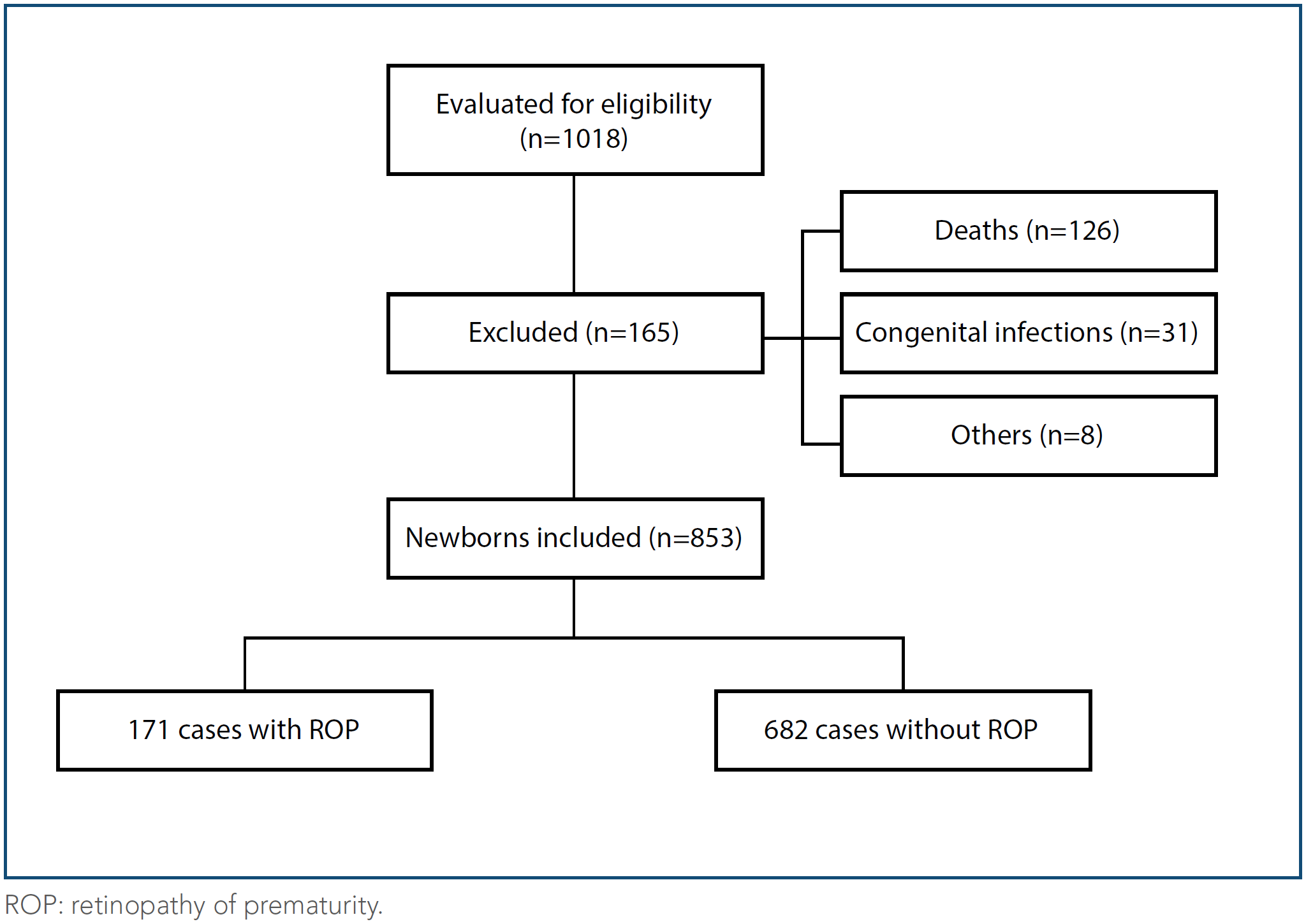
All VLBW PTN (≤ 1,500 g) and/or those with a GA of ≤ 32 weeks were eligible for the study (n = 1018). Neonates who died before undergoing fundoscopic evaluation (n = 126), those diagnosed with congenital infections (n = 31), or those with severe congenital malformations (n = 8) were excluded (Figure 1).

Retinopathy of prematurity screening
At the study site, ROP screening follows the protocol established by the Conselho Brasileiro de Oftalmologia and the Sociedade Brasileira de Pediatria.(14) The first screening exam, called direct fundoscopy, is performed between 4 and 6 weeks of life by an ophthalmologist specialized in retinal evaluation. Subsequent assessments are scheduled based on the findings of the initial examination.
Variables of Interest
The included VLBW PTN were divided into two groups: those who developed ROP and those who did not. Subsequently, maternal data were analyzed, including age, race, education level, lifestyle habits, health conditions, and pregnancy-related factors (such as prenatal care, number of fetuses, type of delivery, occurrence of chorioamnionitis, antenatal corticosteroid use, and magnesium sulfate use). Neonatal data included GA at birth, birth weight, Apgar scores at 1 and 5 minutes, need for neonatal resuscitation, use of positive pressure ventilation, intubation with an endotracheal tube, occurrence of respiratory distress syndrome, surfactant use, duration of oxygen therapy, duration of invasive ventilation, use of non-invasive ventilation, postnatal corticosteroid use for bronchopulmonary dysplasia, oxygen dependency at 28 days and at 36 weeks of corrected age, highest grade of peri-intraventricular hemorrhage, patent ductus arteriosus, occurrence of necrotizing enterocolitis, early-onset sepsis, number of blood transfusions, and use of vasoactive drugs.
Data analysis
Initially, data normality was assessed using the Kolmogorov-Smirnov test. Data were presented as mean ± standard deviation (SD), n (%), or median (interquartile range) (IQR). Student's t-test or the Mann-Whitney test for independent samples (for parametric and non-parametric data, respectively) were used to compare the groups. Pearson's chi-square test was applied to compare proportional variables. The annual incidence of ROP in PTNs was calculated as the ratio of new cases to the total number of neonates included in the study, multiplied by 100. To assess differences in incidence across the years, Pearson's Chi-squared test with Bonferroni post hoc correction was performed. Poisson regression models were used to evaluate risk factors for ROP among neonates. In Model 1, crude analysis was performed, while in Model 2, GA, birth weight, and mechanical ventilation were used as adjustment variables. Results were expressed as relative risk (RR) with a 95% confidence interval (95% CI). Statistical analyses were conducted using Stata software, version 14 (StataCorp, College Station, TX, United States).
RESULTS
Between January 1st, 2014, and December 31st, 2022, 853 VLBW preterm newborns were included in the study, of whom 171 were diagnosed with ROP (Figure 1).
Table 1 presents the characterization data of the groups according to maternal information. The group of newborns diagnosed with ROP had a lower proportion of mothers with systemic arterial hypertension, as well as a higher proportion of vaginal deliveries, chorioamnionitis, and magnesium sulfate use.
Maternal characteristics of very low birth weight preterm newborns according to the diagnosis of retinopathy of prematurity
The characterization of the newborns is presented in table 2. Newborns diagnosed with ROP had a lower gestational age, lower birth weight, and lower Apgar scores (both at 1 and 5 minutes). These individuals also had a greater need for resuscitation, positive pressure ventilation, intubation with an endotracheal tube, occurrence of respiratory distress syndrome, longer oxygen therapy duration, longer invasive ventilation duration, need for non-invasive ventilation, postnatal corticosteroid use for bronchopulmonary dysplasia, oxygen use (both at 28 days and at 36 weeks of corrected age), higher proportions of severe grades of periventricular-intraventricular hemorrhage, patent ductus arteriosus, necrotizing enterocolitis, and blood transfusions compared to newborns without an ROP diagnosis.
Characteristics of very low birth weight preterm newborns according to the diagnosis of retinopathy of prematurity
The average incidence of ROP during the study period was 20%, with the lowest value recorded in 2015 (14.4%). In subsequent years, an increase in ROP incidence was observed, reaching its highest value in 2022 (28.2%) (Figure 2). No significant difference was found between the years studied (p = 0.345).

Incidence of retinopathy of prematurity in very low birth weight preterm newborns between 2014 and 2022.
Among preterm newborns diagnosed with ROP, most cases presented mild retinal impairment (49.1%, stage I), followed by stage II (28.6%) and stage III (22.6%). Of the total 171 diagnoses, four newborns (2.34%) received treatment with anti-vascular endothelial growth factor (VEGF), and 25 (14.6%) underwent retinal surgery (data not presented in tables).
The Poisson regression analysis of sociodemographic characteristics, lifestyle habits, health conditions, pregnancy, and delivery factors associated with ROP is shown in table 3. The possible risk factors for ROP occurrence were systemic arterial hypertension, lower Apgar scores, endotracheal intubation in the delivery room, respiratory distress syndrome, longer oxygen therapy duration, longer mechanical ventilation duration, need for non-invasive ventilation (CPAP), postnatal corticosteroid use for bronchopulmonary dysplasia, higher grades of periventricular-intraventricular hemorrhage, patent ductus arteriosus, necrotizing enterocolitis, and blood transfusion when analyses were performed without adjustments for confounding factors (Model 1). After adjusting for gestational age, birth weight, and mechanical ventilation as covariates in the regression model (Model 2), the risk factors for ROP were longer oxygen therapy duration, longer mechanical ventilation duration, postnatal corticosteroid use for bronchopulmonary dysplasia, patent ductus arteriosus, and blood transfusion. On the other hand, the use of vasoactive drugs was found to be a protective factor against ROP occurrence.
Poisson regression between maternal characteristics, newborn data, and the diagnosis of retinopathy of prematurity.
DISCUSSION
The main findings of this study indicate that prolonged oxygen therapy, longer duration of mechanical ventilation, postnatal corticosteroid use for bronchopulmonary dysplasia, patent ductus arteriosus, and blood transfusion were risk factors for the development of ROP, even after adjustment for confounding variables. In contrast, the use of vasoactive drugs was identified as a protective factor. In addition, an increase in ROP incidence was observed in 2022 compared with previous years.
The average incidence of ROP between 2014 and 2022 was 20%. Although a higher number of cases were observed in the last year evaluated, this difference was not statistically significant and may be related to an increase in the number of preterm births during this period. In the literature, the global incidence of ROP varies considerably according to the region studied. Huang et al.(15) evaluated extremely preterm newborns at a university hospital in Hong Kong between January 2015 and August 2018 and reported an incidence of ROP of 21% among infants with gestational age below 32 weeks. In Brazil, a study conducted at the Santa Casa de Misericórdia de Belo Horizonte (MG) included 236 newborns, of whom 208 (88.1%) underwent ophthalmologic examination during hospitalization, identifying ROP in 62 cases (29.8%).(16) Another Brazilian study reported an incidence of 33.9%.(17) These variations in incidence rates across studies are possibly due to differences in screening protocols, population characteristics, and healthcare conditions.
The main risk factors for the development of ROP described in the literature include low birth weight, lower gestational age, blood transfusions, prolonged oxygen therapy,(18) longer NICU stays, infections,(19,20) and intracranial hemorrhage.(19) The findings of the present study are consistent with previous research and reinforce the importance of carefully evaluating the clinical characteristics of preterm newborns in order to identify those at higher risk for the disease. Early identification of these risk factors may help optimize screening strategies and contribute to timely interventions, potentially reducing the risk of severe complications and preventable blindness.
An interesting finding of this study was the identification of vasoactive drug use as a protective factor for ROP. These medications are essential for restoring tissue perfusion and oxygen delivery in critically ill patients, who would typically be expected to present a higher risk of ROP.(21) One possible explanation is that adequate hemodynamic management may contribute to this protective effect. However, the literature presents inconsistent findings. Mayer et al.(22) identified vasoactive drug use as a risk factor, while Huang et al.(15) found no significant association with ROP development. Therefore, further studies are needed to better understand the relationship between vasoactive drug use and ROP occurrence.
Currently, the only well-established protective factor described in the literature is the use of breast milk in the nutrition of preterm newborns, which was not evaluated in the present study.(23)
Regarding disease severity, most preterm newborns in this study presented mild retinal impairment, with stage I ROP observed in 49.1% of cases. This finding is consistent with previous reports indicating a higher frequency of mild cases. Cestari et al.,(24) for example, observed that stage 1 ROP was the most common presentation (11.9%), followed by stages 2, 3, 4, and 5 (5.8%, 4.1%, 0.4%, and 0.4%, respectively). Although severe cases were less frequent, they remain clinically relevant due to their potential impact on quality of life.
This study has some limitations. Its single-center, retrospective design, based on database records, limits the ability to establish causal relationships. Nevertheless, the study also has important strengths, including the long study period and the large number of variables analyzed.
CONCLUSION
The incidence of retinopathy of prematurity during the study period was 20%, with a predominance of mild cases. The main risk factors identified were prolonged oxygen therapy, longer duration of mechanical ventilation, postnatal corticosteroid use for bronchopulmonary dysplasia, patent ductus arteriosus, and blood transfusion. Retinopathy of prematurity remains a leading cause of childhood blindness among preterm infants. Early detection through screening is essential to prevent severe outcomes. Appropriate management of oxygen therapy and ventilation, combined with timely screening and treatment, can reduce the risk of vision loss. Therefore, comprehensive strategies focusing on prevention, screening, and early treatment are fundamental to minimize the impact of retinopathy of prematurity.
Financial support:
Institution:
Associated Master's dissertation:
Data availability statement:
The data that support the findings of this study are not openly available and are available from the corresponding author upon reasonable request.
REFERENCES
-
1 World Health Organization (WHO). Preterm birth. Geneva: WHO; 2021 [cited 2026 Jul 1]. Available from: https://www.who.int/news-room/fact-sheets/detail/preterm-birth
» https://www.who.int/news-room/fact-sheets/detail/preterm-birth - 2 Alberton M, Rosa VM, Iser BP. Prevalência e tendência temporal da prematuridade no Brasil antes e durante a pandemia de COVID-19: análise da série histórica 2011-2021. Epidemiol Serv Saude. 2023;32(2):e2022603.
- 3 Paula IC, Santos CS, Werneck RI, Araujo CM, Rodrigues AO, Mendes AL, et al. Global prevalence of neonatal mortality in preterm infants: a systematic review and meta-analysis. BMC Pregnancy Childbirth. 2025;25(1):1316.
- 4 Bradley E, Blencowe H, Moller AB, Okwaraji YB, Sadler F, Gruending A, et al. Born too soon: global epidemiology of preterm birth and drivers for change. Reprod Health. 2025;22(Suppl 2):105.
- 5 Ramel S, Rao R. Hyperglycemia in extremely preterm infants. Neoreviews. 2020;21:89-97.
- 6 Hong EH, Shin YU, Cho H. Retinopathy of prematurity: a review of epidemiology and current treatment strategies. Clin Exp Pediatr. 2022;65(3):115-26.
- 7 Al Ali AK, Al Qassimi N, Al Shamsi H, Ali SM, Kar Ms T, Obaid L, et al. Management of retinopathy of prematurity in the United Arab Emirates: a consensus statement from the Emirates Society of Ophthalmology. Cureus. 2026;18(2):e103096.
- 8 Nguyen TT, Bui VT, Pham VP, Pham TN. Retinopathy of prematurity: a study of incidence and risk factors in a tertiary hospital in Vietnam. Clin Ophthalmol. 2022;16:3361-7.
- 9 Bolan N, Cowgill KD, Walker K, Kak L, Shaver T, Moxon S, et al. Human resources for health-related challenges to ensuring quality newborn care in low- and middle-income countries: a scoping review. Glob Health Sci Pract. 2021;9(1):160-76.
- 10 Ahmed AM, Grandi SM, Pullenayegum E, McDonald SD, Beltempo M, Premji SS, et al. Short-term and long-term mortality risk after preterm birth. JAMA Netw Open. 2024;7(11):e2445871.
- 11 Kovács G, Abonyi-Tóth Z, Fadgyas-Freyler P, Kaló Z. Incremental cost of premature birth - a public health care payer perspective from Hungary. BMC Health Serv Res. 2023;23(1):686.
- 12 Rolnitsky A, Unger S, Urbach D, Bell CM. The price of neonatal intensive care outcomes: in-hospital costs of morbidities related to preterm birth. Front Pediatr. 2023;11:1068367.
- 13 Kaur K, Mikes BA. Retinopathy of prematurity. In: StatPearls. Treasure Island (FL): StatPearls Publishing; 2025.
-
14 Associação Médica Brasileira (AMB); Conselho Federal de Medicina (CFM). Projeto Diretrizes Retinopatia da Prematuridade. São Paulo: Conselho Brasileiro de Oftalmologia e Sociedade Brasileira de Pediatria. 2011. chrome-extension://efaidnbmnnnibpcajpcglclefindmkaj/https://amb.org.br/files/_BibliotecaAntiga/retinopatia_da_prematuridade.pdf
» chrome-extension://efaidnbmnnnibpcajpcglclefindmkaj/https://amb.org.br/files/_BibliotecaAntiga/retinopatia_da_prematuridade.pdf - 15 Huang HB, Chen YH, Wu J, Hicks M, Yi YZ, Zhang QS, et al. Early risk factors for retinopathy of prematurity in very and extremely preterm Chinese Neonates. Front Pediatr. 2020;8:553519.
- 16 Castro BR, Martins EM, Alves Júnior JM, Almeida AM. Perfil epidemiológico de recém-nascidos com retinopatia da prematuridade em um hospital de Belo Horizonte. Rev Interdiscip Ciênc Méd. 2021;5:36-43.
- 17 Freitas AM, Mörschbächer R, Thorell MR, Rhoden EL. Incidence and risk factors for retinopathy of prematurity: a retrospective cohort study. Int J Retina Vitreous. 2018;4:20.
- 18 Fu M, Song W, Yu G, Yu Y, Yang Q. Risk factors for length of NICU stay of newborns: A systematic review. Front Pediatr. 2023;11:1121406.
- 19 Chen W, Liu T, Xiang D. Risk factors and prevalence of retinopathy of prematurity in very low birth weight preterm infants: a systematic review and meta-analysis. Transl Pediatr. 2026;15(2):29.
- 20 Shoeibi N, Raoufi F, Abrishami M, Hoseini SM, Ansari-Astaneh MR, Abrishami M, et al. Clinical characteristics and predictive features of neonates with treatment-needed retinopathy of prematurity: a retrospective cohort study. Health Sci Rep. 2025;8(6):e70892.
- 21 Graham JD, Lanspa MJ, Peltan ID. Resuscitation targets, fluids, and vasoactives in septic shock. Clin Chest Med. 2026;47(1):33-43.
- 22 Mayer SM, Mazarollo LK, Okamoto C, Moreira L, Hopker LM. Retinopathy of prematurity: risk factors for its development in two neonatal intensive care units in Paraná-Brazil. Arq Bras Oftalmol. 2021;85:364-9.
- 23 Gates A, Marin T, De Leo G, Waller JL, Stansfield BK. Nutrient composition of preterm mother's milk and factors that influence nutrient content. Am J Clin Nutr. 2021;114(5):1719-28
- 24 Cestari YL, Lima MA, Rezende ML, Fonseca LM. Risk factors for retinopathy of prematurity: a systematic review. Rev Bras Oftalmol. 2021;80:0052.