
 “Three years in Brazil”: images and accounts of a Premonstratensian about the Gymnasium Espírito Santo, in Jaguarão, RS (1901-1904)
Abstract
This article addresses the historical-educational aspects of a Catholic institution established by the Premonstratensian Order in Jaguarão, Rio Grande do Sul, which existed from 1901 to 1914. The aim is to understand aspects of school and regional culture, drawing on the work Three Years in Brazil, written between 1901 and 1904, consisting of travel accounts and images produced by Father Schoenaers. As a theoretical and methodological framework, the Cultural History approach was adopted, with bibliographic research based on written and iconographic sources. As a result, we present the singularity of the photographs and accounts analyzed, which seek to give visibility to a Catholic school, as well as the possibility of eliciting aspects of its history from them.
Keywords:
Catholic educational institution; Premonstratensian Order; photography; travel accounts
Resumo
Este artigo trata de aspectos histórico-educacionais de uma instituição católica criada pela Ordem dos Premonstratenses em Jaguarão, no Rio Grande do Sul, que existiu de 1901 a 1914. O objetivo é compreender aspectos da cultura escolar e regional, a partir da obra ‘Três anos no Brasil’, escrita entre 1901 e 1904, constituída de relatos de viagens e imagens de autoria do Padre Schoenaers. Como referencial teórico-metodológico, adotou-se a abordagem da História Cultural, com pesquisa bibliográfica em fontes escritas e iconográficas. Como resultado, apresentamos a singularidade das fotografias e dos relatos estudados, que buscam dar visibilidade a uma escola católica, bem como a possibilidade de, a partir deles, fazer emergir aspectos de sua história.
Palavras-chave:
instituição educacional católica; Ordem dos Premonstratenses; fotografia; relatos de viagem
Resumen
Este artículo trata de aspectos histórico-educativos de una institución católica creada por la Orden de los Premonstratenses en Jaguarão, en Rio Grande do Sul, que existió de 1901 a 1914. El objetivo es comprender aspectos de la cultura escolar y regional, a partir de la obra Tres años en Brasil, escrita entre 1901 y 1904, constituida por relatos de viaje e imágenes de autoría del Padre Schoenaers. Como marco teórico-metodológico, se adoptó el enfoque de la Historia Cultural, con investigación bibliográfica basada en fuentes escritas e iconográficas. Como resultado, presentamos la singularidad de las fotografías y relatos analizados, que buscan dar visibilidad a una escuela católica, así como la posibilidad de hacer emerger aspectos de su historia a partir de ellos.
Palabras clave:
institución educativa católica; Orden de los Premonstratenses; fotografía; relatos de viaje
Introduction
The present article highlights possibilities for the historical analysis and understanding of the first years of a Catholic educational institution, underlining aspects of its school culture1 and of the region where it is set, using images2 (photographs and one drawing) and written accounts from a member of a religious congregation that is still understudied in the field of History of Brazilian education, the Premonstratensians, who founded the school. We aim at questioning aspects involving the establishment and maintenance of a Catholic secondary education institution at the time of its settlement, underlining its expectations, practices, the public to whom it was meant, and the cultural aspects of its surroundings.
This text is connected to a broader investigation that analyzes the history of Gymnasio Espírito Santo3, built by Premonstratensian priests from Averbode Abbey, in Belgium, in the town of Jaguarão, located at Southern Rio Grande do Sul (RS), at the border between Brazil and Uruguay. This was the only secondary school in the town, but it also offered primary teaching, and it was open between the years 1901 and 1914. We had no access to the ordinary writings of the school (Vidal & Abdala, 2005), its internal written documents, bureaucracy and professional listings that could have signaled the practices and relations established there.4
On the written scholarly practices performed at the institution, in a period later than the one presented here, other studies analyzed ten copies of the school paper O Gymnasial, which was published during the year 1908 (Amaral & Machado, 2025). We could also access results from school activities (students’ grades, curriculum, and school practices, subjects, teachers’ and students’ names, among others) published in local and regional papers (Machado, 2024).
Thus, in face of the scarcity of school documents, one potential source for this research was the book “Three Years in Brazil,” written by Premonstratensian priest Thomas Aquinas Schoenaers, who taught at the Gymnasio Espírito Santo from the beginning. This book, made up of accounts documented by photographs, resulted from 59 letters and 47 photographs sent by him to Averbode Abbey, published in Flemish in two volumes in 1904, by the Abbey’s printing house. The translation to Brazilian Portuguese was only published in 2003.5 The Brazilian edition, analyzed here, has a total of 463 pages, including the preface and notes by the organizer, Eduardo Alvarez de Souza Soares.
Among other subjects, in his work Schoenaers writes about daily life at the Gymnasio Espírito Santo, the space, the people, and the activities around which they gathered. In the analyses, we can see that his photographic perception and his accounts were connected to the expectations of a discourse that highlighted the importance of this catholic construction in the city of Jaguarão. All of which in a period of expansion of the catholic church’s ultramontane project in the emerging republic of Brazil, where education was used as a strategic tool for evangelization and cultural affirmation, and in a spatiality that encompassed the Southern half of RS and the region of the “campanha”. In this region, urban spaces with more modern and republican features began to appear, with the need for secondary schools that would better prepare the economic and political leaders. This was a space that was disputed and colonized since the 18th century by the Portuguese and the Spanish, unlike the Northern half of the state, which was occupied later, mostly by German and Italian immigrants. For that reason, the South and the “campanha” had more people who influenced the public life in the state and in the country. This fact was brought by the dean of Colégio Gonzaga, in Pelotas, an important city in the South of the state, in a letter to the Jesuit congregation that supported this secondary school.
Rio Grande do Sul is third or fourth in influence among the states of Brazil, very revolutionary. The South provides many ministers, generals, etc. and for Rio Grande do Sul, graduated public employees, doctors, lawyers, engineers. There are many landowners. In the German colonies it’s all smallholdings and from there come no people with influence on the public life (Parmagnani & Ruedel, 1995, p. 61, citation translated into English for this article).
As for secondary education in the RS,6 it is interesting to highlight that until the establishing of the Republic, it lay in the hands of the private initiative, with individuals being the owners of schooling establishments aimed at students who would pay for the classes, which meant it was education aimed at the elites. The initiatives for public instruction were limited to the capital, Porto Alegre, with the creation of Liceu D. Afonso and the Atheneu Rio-Grandense, which did not achieve success and stopped working as soon as they appeared. Thus, the state government started to endow the operation of municipalities and the privates in the educational field. Such a fact allowed for rare exceptions “based on merit” for students without financial status to attend private teaching institutions aided by the public investments in private education. This context, in which the gaúcho state was only indirectly involved in the creation of educational institutions, gave way for the Catholic Church to constitute a wide teaching network throughout the state.
The arrival of the Premonstratensians in Jaguarão, a municipality in a region where the Catholic Church was not integrated and the Masonic ideology predominated among the local elites, was justified by the incentive of the Porto Alegre diocese, by the challenges of the Church and the Premonstratensians’ Order in disseminating Catholicism, and by the interest of the local elites in having quality schools for their children. The elite welcomed these priests and, for a while, forgot the ongoing dispute between Catholics and the Freemasonry.
In this context, it is important to remember that the publishing of Schoenaers’ book did not have national or regional repercussion where they settled, for it was written in Flemish. It constituted an artifact of power and representation, giving visibility to the Premonstratensian endeavor for the Order in Europe and beyond the walls of Averbode Abbey. It got to the layman catholic public and those from different religious congregations that could engage financially with the cause of disseminating Catholicism around the world. We must remember that the transnational operation of catholic congregations was promoted and supported by the Rerum Novarum encyclical, published by Pope Leo XIII, in 1891 (Machado, 2024).
These affirmations and other perceptions presented ahead come from inquiries made to this document/monument7 that constitutes a historic source: how does it appear; what does it address; by whom, under what circumstances, and for whom it was produced. These are questions, findings, and referrals that create a narrative inherent to the historiography operation in which we connect ideas to places (Certeau, 2000), turning the document into an object for reflection, a fundamental procedure for the analyses. It becomes necessary to articulate its place of production: “It is as a function of the place that the methods are established, that a topography of interests is outlined, that the documents and the questions they pose are organized” (Certeau, 2000, p. 67).
The photographs presented in this work portray the inaugural phase of the Gymnasio Espírito Santo, occurred between 1901 and 1904.8 With time, the school became one of the main educational institutions in the countryside of Rio Grande do Sul, especially between 1905 and 1911. However, as of the reform derived from the “Rivadavia Corrêa Law,” in force from 1911 to 19159, the Gymnasium started to face financial difficulties which, alongside other factors, resulted in its closing by late 1914. In that year, the Premonstratensians went to the town of Jaú, in the state of São Paulo, where they took over the Colégio Jorge Tibiriçá (Atheneu Jauense).
The epistemological perspective, as well as the theoretical-methodological frame of reference used in this study, is Cultural History (Certeau, 2000; Chartier, 2002; 2006; Burke, 2005), which underpins the study of Educational Institutions (Magalhães, 2004; 2007) and the use of photographs (Kossoy, 1989; Ciavatta, 2009; Mauad, 2010; Oliveira, 2012) and travel accounts (Franco, 2009; Constantino, 2012) as historical sources. In relation to the school culture and to the environment where the school is located, it is important to bring forth Faria Filho (2007), who emphasizes the relevance of taking different institutional cultures into account which may or may not be in accordance with the school, and noticing how the school is shaped and influenced by the urban environment, for “the subjects that weave it have, themselves, many belongings and identities through which the school cultures will be continuously informed” (Faria Filho, 2007, p. 198).
In the analysis developed here, local, regional, and international historical references (Franco, 2001; 2007; Pesavento, 2014; Hobsbawm, 1998) and educational legislation (Tambara, 1996; Amaral, 2023) from the period were fundamental for the writing.
Thus, from the iconography documents and Thomas Schoenaers’ accounts, we will aim at identifying practices and relations (Chartier, 2002; 2006) that signal aspects of the history of the Gymnasio Espírito Santo and the region where it was located. We reiterate that the questioning of the sources is critical to the research, after all they do not appear finished and ready to be read by the historian. They must always be questioned! With that, we understand the importance of searching for significances and signifiants, for a common terrain for cultural historians is “the preoccupation with the symbolic and its interpretations” (Burke, 2005, p. 10).
The Premonstratensians from Averbode in Brazil and the work “Three Years in Brazil”
Aiming to connect ideas to places, we will briefly address the Premonstratensians from Averbode and their intentions in creating schools in Brazil, specifically in Jaguarão, as well as the potentials of the use of the book by Fr. Thomas Schoenaers as a source for historical-educational research. We thus aim at referencing the perspectives in the photographic and written narratives of the author that signal peculiar aspects of the local culture and the Gymnasio Espírito Santo.
The Premonstratensians are members of an order of regular canons who received this name due to their first abbey, established in 1120 at the Soissons diocese, in France, in a valley called Prémontré. They are also called Norbertines, in homage to their founder, Saint Norbert10. They got to Brazil in 1894, with possibilities widened by the policies adopted by the Brazilian state in the newly proclaimed Republic, and due to the ultramontane interest of the Roman Catholic Church in expanding Catholicism via institutionalized education.
Fr. Thomas Schoenaers was bound to the Premonstratensians from Averbode Abbey, located in Scherpenheuvel-Zichem, at the Malines-Brussels archdiocese, in Belgium. In Brazil, in 1897, the group from Averbode funded the Colégio São Norberto in Pirapora do Bom Jesus/SP and, in Jaguarão/RS, the Gymnasio Espírito Santo in 1901. They also took over the Colégio São Vicente de Paulo in Petrópolis/RJ, in 1909, and the Atheneu Jauense in Jaú/SP, in 1915. This order, in general, used to the pedagogical process of seminars, came to Brazil with a double responsibility: taking care of churches (parishes and seminars), but, also, creating a school for a non-seminarian public. This last one was directly linked to the intention of defending catholic preponderance in Brazil, taking advantage of the educational route.11
At Averbode Abbey, Schoenaers directed the publishing house and an informative paper for missionary activities. As stated before, since leaving Belgium, he wrote letters that were initially published in that paper and later grouped to constitute the work “Three years in Brazil.” From the preface of the book, we bring forth an excerpt in which the author justifies the publishing of his “small work”:
They want me to publish a collection of my letters. But who are they, after all? They are, firstly, friends who want to maintain their friendship with me and nourish it through reading about what happened in Rio Grande do Sul. Secondly, the lovers of literature who claim to have found literary value in my letters. Thirdly, my dearly beloved Brazilian Missions, that I hope can extract something useful from this small work (excerpt translated into English for this article).
It is interesting to note that he mentions in the preface that he’s presenting a report of “what happened in Rio Grande do Sul.” It is only as of the seventh letter that he will start writing about the state.
In the first letters he accounts for the journey from Averbode to Brazil, with information about the places he went through, and situations experienced during the trip. Specifically on the journey that leads to Jaguarão, he highlights the maritime, lake, and waterway routes that made the access easier to this important town for the state, with a distinguished border position with Uruguay, but in need of catholic educational establishments and of the presence of the Catholic Church among the congregation. It is worth mentioning that the potential that represents the ease of transportation described by Schoenaers is currently disregarded by regional and national policies, which results in the loss of a possible economic and political protagonism for Jaguarão and the Southern region of the state as a whole.
At the turn of the 19th to the 20th century, we should consider that in the region of the “campanha gaúcha,” with a South border with Uruguay, there were strong connections between liberal, layman, Masonic, and anti-Catholic ideas that were being consolidated in the Uruguayan Republic. This is a time in a Brazilian space where the limits and borders established by nation-states still constituted their cultural identities. And, up until present days, this geographical proximity brings cultural singularities to the southern region of RS. As we will address ahead, according to Schoenaers’ accounts, the Gymnasio Espírito Santo received Uruguayan students, who were given access to the Catholic faith. Therefore, its location corresponded to the expansion of the catholic ideology, with connections that manifest a transnational perspective in education.12 Thus, the Premonstratensians’ choice for Jaguarão to host a secondary school is also justified by the fact that there were students with financial conditions - provided from activities related to livestock - and in need of a formation that would leverage them to higher education or professions fitting the expectations of their wealthy socioeconomic level.
In the letters, the travels are narrated by Thomas Schoenaers with the subtlety of a chronicler enchanted by the situations experienced since his departure from Europe, with the new landscapes and human relations (markedly interracial) established overseas. His work does have the literary value mentioned in the preface, for there is care for the aesthetic lightness of the written narrative of the facts, events, ideas, and feelings, resulting in that many passages pass on knowledge as well as evoke curiosity and emotion in the reader. In that sense, we should make clear that the objective here is to present and engage with the author of the texts, with his narrative, perhaps utilitarian and idealized, with his “topography of interests” (Certeau, 2000), to understand the reality he was living in and what he wanted to present to the reader. In his work there is a strong stance on convincing about the importance of the missionary work carried out.
Loner and Gill (2012) are historians who performed a preliminary study on what is presented in Schoenaers’ work,13 highlighting the importance of its use by historians. According to the authors,
It can be said that Fr. Thomas brings us the vision of another Rio Grande do Sul, the one with the borders, the day-to-day, much more concrete and real, full of the small details that are important for historians. His book is very interesting and easy to read, and it also brings a whiff of fresh air into very arrogant scientific views, by other Europeans, who did not have the eyes to see, as well as he did, the people in its simplicity and joy (Loner & Gill, 2012, p. 267 and 268, citation translated into English for this article).
According to Adriaansen (2007),14 Father Thomas Schoenaers taught Mathematics and Fencing. He had military training and was very fond of literary and artistic activities, leading the group of missionaries that worked in Jaguarão alongside the community and at the Gymnasio Espírito Santo. He mastered an important piece of technology in the turn of the 19th to the 20th century: photography. With his camera, he captured images that illustrate his accounts since his departure from Belgium to Brazil. However, the cover of his work “Three Years in Brazil,” edited in 1904, presents a drawn image which we will analyze and comment on aspects that immediately cause strangeness for those who observe it.

It is very likely that this visual representation was created by Schoenaers himself, given that he was somewhat talented at drawing. But it makes us wonder, the image of a “gaúcho” in the cover of a book with the title “Three Years in Brazil”. However, at the bottom, the name of the author is identified as being bound to the Presmontratensian Mission in Rio Grande do Sul.
When reading Schoenaers’ letters, especially the one dated November 4th, 1901 (the 18th letter), we can understand his perspective on the “gaúcho.” In it, he describes their origins, way of living, hospitality, religion, and aspects of the region they inhabit, which makes it easier to interpret the image that illustrates the cover of the book.
The central image shows a “gaúcho” with features that suggest his indigenous heritage, long hair, and a mustache characteristic of European culture. He is a typical icon of the region of La Plata river, which starts being delimited in the 18th century between the Portuguese and the Spanish and, later, in the 19th century, is constituted by nation-states (Brazil, Uruguay, Argentina, and Paraguay).
In the period studied here, the “gaúcho” represents a skilled horse rider, with activities and characteristics that extrapolate national borders. He appears in the image with a handkerchief tied around his neck, and many instruments essential to his activities in the country, dealing with the cattle - such as the lasso, ropes, knives, and a shotgun on his back. For clothing he wears a shirt and “bombacha,” wide cut clothes that make his work easier. The scene portrays him leaning against his horse, an indispensable companion in his activities. The field in the background evokes the “campanha” region, complemented by a house that combines the simplicity of a shed with the comfort and shade given by the trees nearby. It is worth highlighting in this image the presence of a palm tree (possibly “butiá”), typical of the area, that extends through the Uruguayan plains. The leaves of this palm tree form a contour around the figure represented. This drawing may sound commonplace nowadays, but it was not the case at the time it was produced. The richness of detail presented says much about the reality of this typical inhabitant of the region.
As for the photographic analyses, it is important to clarify that in relation to the Premontratensians’ practice in Jaguarão and the work “Three Years in Brazil,” which indicates aspects of the history of the Gymnasio Espírito Santo, Fr. Thomas Schoenaers is considered as a “photographer subject.” In the words of Mauad (2010)
a photographer subject is a complex historical category that involves the constitution of a historical agent that possesses varied competences associated with the trajectories and the different projects elaborated in each person’s social practice. The photographic record produced by these subjects elaborates a varied and wide interpretation of the visible world when it frames other subjects in varied situations with different purposes, using images to shape contemporary memories - multiple memories. Some of them are elaborated as evidence of facts and events, others as remnants of daily experiences, or even as the residue of reminiscence (Mauad, 2010, p. 147, citation translated to English for this article).
The work by Schoenaers was defined by the engaging in a cause (Mauad, 2008) that is specific: the Premonstratensians’ project of establishing educational institutions in Brazil, and, in the case studied here, the town of Jaguarão. It is with these lenses that the photographer does his work as a “historical agent.” It is a priest and a teacher at the school being created who presents the facts, events, and cutouts from an institutional day-to-day. His intentionality is shaped within the accounts and photographs that let his enthusiasm shine through for the catholic work being done in Jaguarão. His full commitment to the cause and the project in which he is integrated leverages his role as a “photographer subject” who reports on a given historic condition that brings him much delight.
We must make it clear that, in this analysis, when dealing with the written accounts by the photographer himself, we are challenged to go beyond the intentionality proposed by the author of the images. We must raise questions and point to strangenesses that can fill the gap on the history of the Gymnasio Espírito Santo.
In that sense, we should remember the fact that this work, which results from a compilation of letters and photographs, can be classified as a travel account book that presents new spaces to pioneer and new possibilities of expansion of the catholic faith, mostly via educational institutions. Constantino (2012, p. 8) reminds us that “the use of travel accounts as historical sources is ancient and unarguably important” (citation translated into English for this article). However, according to the author, today we must question, referencing Ginzburg when he proposes the strangeness of that which is posed in the text as true, unleashing new understandings on the textual document as a source.
The work of Fr. Schoenaers gives us clues to search for other important information with the intention of understanding the structure and relations of the Gymnasio Espírito Santo with its community. Before the arrival of the Premonstratensians there were no priests at a distance shorter than a 20-hour trip. As Magalhães (2004; 2007) reminds us, in the writing of the history of an educational institution, there’s the need for the collective memory organized by the historian to emerge from the files and chronicles, the texts that account for daily facts in a free and personal manner.
In a thorough way, many times in chronicle style, the blocks and houses of the town, the popular parties and festivities organized by the Gymnasio, some stereotypes and the behavior of the students, among other particularities, are enriched by photographs and reports such as the one shown ahead, on the clothing and social origin of the students, when the use of uniforms was not yet instituted: “Every day the students come to school richly dressed [...] they come from the wealthiest families of Jaguarão and, here, those who can, actually can” (Schoenaers, 2003, p. 148).
The writing of the letters allows us to identify the conflicts of ideas with the freemasonry, as well as the importance of the Premonstratensians to the region:
When my confreres opened the school last February, none of the students knew the common prayers a christian knows [...] Now they are all acquainted with the prayers, some, for the first time, approach the blessed sacraments, and eight of them confess and share the body of Christ monthly. It is certainly not much, but we must work cautiously and slowly, for the masonry has much power over the city (Schoenaers, 2003, p. 149, citation translated to English for this article).
In that sense, he highlights the hard work to be done by the priests, identifying how challenging it is to convert educated individuals who, “are also jammed in sin and unaware of their perverted nature” (Schoenaers, 2003, p. 150, citation translated to English for this article).
Photographs of Jaguarão and the Gymnasio Espírito Santo
We will now present six photographs from the book “Three Years in Brazil,” chosen for the representation of aspects of the subjects and cultural contexts experienced in Jaguarão and the Gymnasio Espírito Santo. We state that the photographs were scanned from the book, which limits their quality, but it still allows us to observe from the point of view of Thomas Schoenaers.
The use of photographs as sources for historical studies must be well based. Photographs start to gain distinction as of the 1960’s, during what was called the “documental revolution” (Kossoy, 1989). This author suggests that the different dimensions of photography, such as memory and representation, be considered. He states that “all photography represents the testimony of creation. On the other hand, it will always represent the creation of a testimony” (Kossoy, 1989, p. 33, citation translated to English for this article). The photographic image is often understood as representation of the real, but not the real itself. Oliveira (2012) highlights that photographs are both reproduction and representation: “Reproduction, for the photography captures a scene that is reproduced; representation, for that scene is a choice and, therefore, it relates to a series of choices that lead to its final result” (Oliveira, 2012, p. 37, citation translated to English for this article).
The observation made by Ciavatta (2009) is pertinent in relation to the times that represent and constitute a photographic image. The author states that “there is a multiplicity of times condensed in the contemplation of a photograph: the present time for the one who contemplates, the time of the things photographed, the time of the photographer” (Ciavatta, 2009, p. 68, citation translated to English for this article).
In the analysis of the photographs represented here, we must deal with this complexity, keeping its multiple interwoven social, economic, and cultural relations in mind. In that sense, as stated by Vidal & Abdala (2005, p. 178), that’s where the importance of the use of photography resides as a source for History and for the History of Education, that is, in the ability of portraying “yesterday and the Other in their outlines of truth” (citation translated to English for this article).
It is important to say that, in the beginning of the 20th century, the popularity of school pictures rose, and they, in turn, were associated to other genres, such as family pictures and images of urban landscapes, among others. Some analyses on the subject, such as Souza’s (2001), suggest that school pictures established significant connections between family memory, such as in family albums, and institutional memory. In these photographs, it is common to identify the façades of the schools, groups of teachers, classrooms in general, all of them looking for special moments of school life, which may serve as portraits of the history of the institution as well as individual memorabilia. However, as we will observe here, there are singularities in Schoenaers’ photographs, which serve as basis for his accounts on an institution being created that needs investment, as well as daily peculiarities that delight him and serve as material for the reflection of cultural historians.
The following pictures, captured outdoors, demonstrate the photographer’s concern with the framing and composition of the images so that all students would appear. The representation of the images of the students (Figures 2 and 3) demonstrates certain spontaneity and singularity, maybe because these were the first pictures taken of them, in the first few months of school. It was a novelty with which they were not yet familiar, with the result being their frozen posed images on a piece of paper. They didn’t even have the uniform they would all wear later. Probably, with time, uniforms, and the effective incorporation of military culture within the educational institution, which was common in the period, school photographs came to be represented differently.
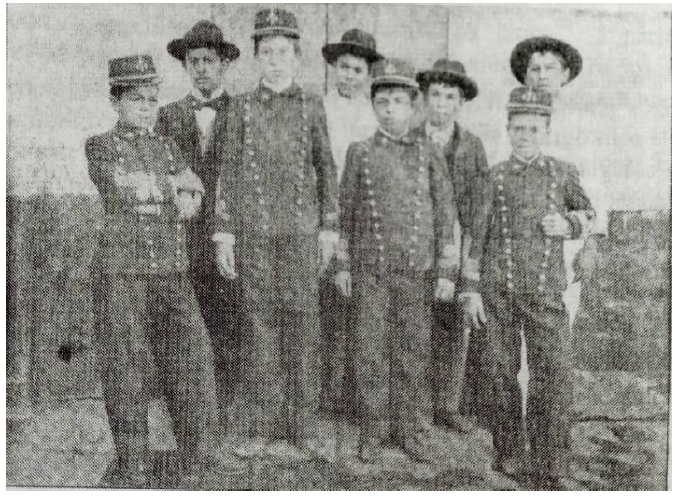
The following image (Figure 2) presents a group of students from the boarding school in front of the school, located in the building that now hosts the Círculo Operário de Jaguarão, which suggests it was captured between the months of May and August of 1902, when the Gymnasio was there.
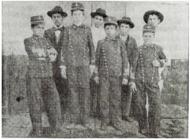
Returning to Oliveira (2012), who states that photography is reproduction and representation, in this photograph we can see that the photographer prioritized that the students wearing a uniform stood in the front, and behind them the ones without uniforms. As is stated in the written account, they were still being made by the tailor (Schoenaers, 2003, p. 259). To resolve questions related to the framing, they do the posing in a terrain that is not plane, to adjust to the different heights of the students. It is possible to have an “archaeological” view (Escolano Benito, 2017) on this image, which presents the use of a materiality - the students’ clothes - in its institutional and social use, which identifies and composes aspects of the school culture of a given social layer.
They all have their heads adorned with the hats or kepis of the uniform, which may have a function of protection as well as status for boarding school students belonging to the local elite, as stated by the author of the book. The hat, in this period, is a distinction of elegance and status of responsibility in the adult world. As the subjects photographed are few, unlike in the following picture (Figure 3), they were allowed to wear their hats. In this picture, a certain air of informality is visible among the students, who don’t do the same pose in the photograph, even among the ones in uniform at the front, although they are standing in an orderly manner. This image, as well as others presented in this work, came supplemented with information that appears at the end of the letter dated July 14th, 1902:
Four of them wear the school uniform, for the others’ are still with the tailor. [...]. Out of the four in uniform, the tallest one is Uruguayan and the other three, cousins and children from Santa Vitória do Palmar, at the far South of Brazil, across the Lagoa Mirim. The second row [...]: the one on the left, with a darker complexion and a choleric expression, is also Uruguayan, very explosive, but also capable of studying even the bricks on walls. By his side, a student in a white coat, the son of a captain who perished in the last revolution, is a typically Brazilian figure. The young man in black represents the town of Arroio Grande, fifteen hours away heading North. Finally, to the right, the son of a colonel of the town, who was in Gent, Belgium, and often comes to talk to me about this passage through our country. The three small ones are very bright and will probably obtain, in competitions with prizes, the best positions. [...]. At school, all goes well and the news is that we shall soon receive help, which makes us excited. Every week new boarding students arrive, and the total number should reach between eighty-five and ninety. We were told that two new students will arrive from Santa Vitória do Palmar. I do not know how certain that is, but I do know we do not dispose of more than two vacancies for accommodation (Schoenaers, 2003, p. 259, citation translated to English for this article).
This narrative offers much information that could be debated, aside from what is observable in the black-and-white image. In it we can assume the intentions of the photographer/rapporteur in identifying the origins of the students, their insertion in the community, their potentials, and the need for continuous support from the Premonstratensians to the work done at the Gymnasio. As we have pointed out, this educational institution gradually started accepting students from Uruguay, a layman country from its creation, where the Catholic Church had trouble practicing. Was the Uruguayan student described by Schoenaers as having “a darker complexion and a choleric expression” of African descent? Probably yes. Maybe a “stepchild” from a wealthy individual who could pay for his studies. But as if to justify his presence among the group, the author signals his exceptional ability in his studies. On his contact with the colonel, father of a student, who had been in Gent, the intention of communicating the contact of the Jaguarense elite with the “civilized European world” is evident.
It is interesting to note that, in Brazil, the military structure - uniforms, badges - was common in schools since the monarchy, and it kept on through republican times. With the Federal Decree-Law n. 6.947 from 05/08/1908, that instituted the mandatory military instruction in Secondary and Higher Educational Institutions, the Gymnasio Espírito Santo assigned a member of the military, appointed by the government, to instruct students over 16 years of age.
Furthermore, from the image associated to Schoenaers’ description, we see that there are students from neighboring towns, such as Santa Vitória do Palmar15 and Arroio Grande (located between Jaguarão and Pelotas). We notice the presence of a student who is a descendant of a captain who fought in the Federalist Revolution,16 as well as another who was the son of a colonel of the Army. It is important to mention that Jaguarão evolved from a military campsite, and, in that time, it hosted three contingents of the Armed Forces. This border region with the countries of the Plata, until today, is characterized by strong military apparatuses, represented in the existence of many military stations.
Schoenaers, in highlighting the growing demand for the Gymnasio among the families from neighboring towns, both Brazilian and Uruguayan, raises an alert regarding the scarcity of vacancies for new boarding students at the school. In many of his letters, he brings elements of the expansion of the Gymnasio and the strategic importance of its location, at the border of Uruguay. Thus, he aimed at raising awareness among the confreres in Belgium to help financially in the implementation of the school, with the purchasing of a large house by the end of 1902 and the future construction of a building specifically made to house an educational institution, among other works related to the Church, such as the building of seven chapels in the town’s rural area. From his accounts we can infer aspects of the school culture associated to the social rank of the students and the fact that they came from other towns, and even from Uruguay. In this initial work at the Gymnasio, articulation with members of the local elite as well as elites abroad was paramount.
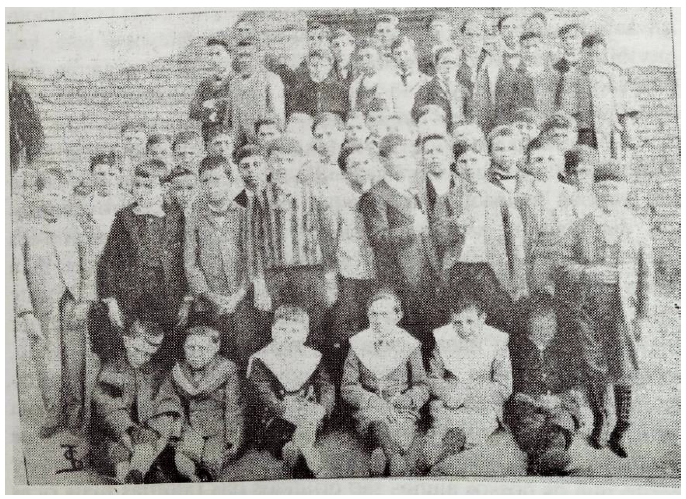
Continuing with the analyses, we present another picture, with a larger number of students, in the schoolyard of the Gymnasio, in July 1901.
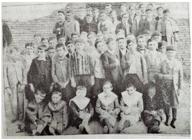
This image, according to Schoenaers (2003, p. 148), does not show all of the students, but the group portrayed significantly represents the beginning of the first semester of 1901, marking the origins of the activities at the Gymnasio. The camera at the time could not capture the indoors of the school. The picture was taken in the yard of the building, with the precariousness of the terrain serving as stimulus for raising resources. In that sense, a picture with many students would have a stronger appeal, visually supporting his accounts. They were possibly organized by grade level and age, the youngest, from the elementary course, in the front.
The students were aligned toward the picture, but they did not wear uniforms and showed a more relaxed and informal attitude. The important part was being in the picture and taking part in this record, a moment that was still new for them. Even with the precarious quality of this photograph, it can be observed that they did what they thought was their best pose for the photographer: their arms are either resting along their bodies, crossed, or their left arm to the chest, demonstrating a certain elegance in their posture. It is worth noticing that Fr. Schoenaers, it seems, would register places, situations, and people without the expectation of freezing a situation that could be fictitious.
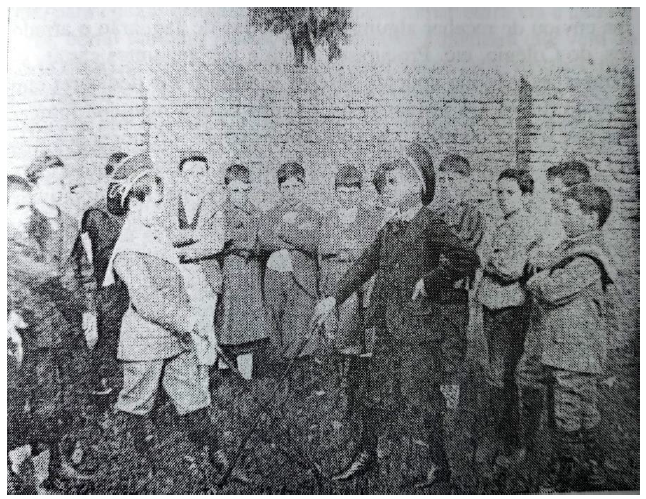
In Figure 4, we see a group of elementary students at a gymnastics class, in a fencing pose.
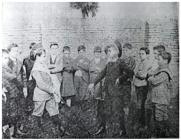
The place of this image is still the yard of the building rented by the Premonstratensians. The dating is close to that of the previous picture, still in the first semester of 1901, therefore the students still had not gotten their uniforms. We see that the students, gathered around the ones practicing fencing, looked observant, with arms crossed. Such posing was probably reinforced by the photographer, in search of a posture that referred to the idea of an attentive military officer. The two fencers, holding “sticks” instead of swords, wore kepis, which also made them stand out during the practice of this exercise.
The fencing teacher was Thomas Schoenaers, whose accounts show was an enthusiast of military practices within the educational process. He comments that the students “work with a stick (as a stand-in for a sword) and, with more time and exercises, they will soon be shaving their beards (or mustaches, for they don't wear beards)” (Schoenaers, 2003, p. 151, citation translated to English for this article). According to him, the students expected to receive a “lieutenant” badge, promised at the end of this activity. This was a way, according to Schoenaers, for them to put effort into more competitive training, to earn the badge that would adorn the sleeve of their uniforms. This approach reflects emulation, prize-giving, and meritocracy that came along with discipline, individual effort, obedience to rules, and outdoor activities, outside of the conventional classroom space. These practices were inspired by the Jesuit ratio studiorum,17 which still influenced educational methodologies and practices in this period, and which highly influenced the school culture of catholic institutions. These are aspects of the school culture of Gymnasio Espírito Santo since its first year of existence. We present fragments of actions, discourses, subjects, and objects that refer to the experience (Benito Escolano, 2017) of the work in this school. In the observation of this photograph, associated with the records of horseback riding with the students and hunting trips taken during summer vacations, there is evidence of the disciplinary character of the group and of outdoor activities.
The next photograph makes us think about the activities proposed at the Gymnasio since its origins, which involved, at that time, the theater, but also the marching band, as reported by Schoenaers (2003). Gradually, a student aggregation appeared (União Gymnasial), created, probably, in 1907, which organized many literary soirées and published at least 10 editions of a student paper, “O Gymnasial,” in 1908. These are practices that were part of the school culture of Catholic secondary schools among the most qualified in the country, and they also aimed at complying with the laws in force to match Colégio Pedro II. All of that while pursuing a Catholic education aimed at educating the ruling elites so that they would cherish the Christian values above all else.
The following photograph shows students who participated in the theater play performed on December 22nd, 1901, at the Republican Center. According to the 21st letter, from December 30th, 1901, the photograph shows the students who acted in the drama, stating that there were none above 17 years of age.
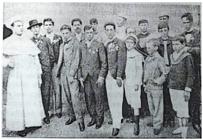
Three of the students, as we can observe and according to Fr. Schoenaers’ account, carry their medals on their chest. With arms extended along the body, an erect posture and gazing toward the camera, they show undisguised pride over the prizes received. They are the protagonists. Alongside them are the vicar from the village of Artigas, in Uruguay (currently Río Branco), the vicar from Jaguarão, Father Josué, the Prior, Canons Raphael Goris and Tomas Schoenaers, and the piano teacher, Mr. David (Schoenaers, 2003, p. 195-196). The photograph was not taken by Schoenaers, who may have aided the photographer in framing them all in the best way.
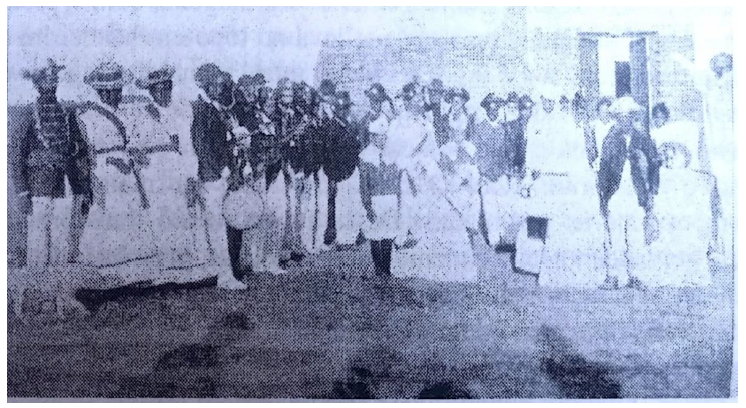
We now show one final photograph that registers the performance of Bumba Meu Boi, in a parade of the black population in Jaguarão. This popular celebration, common in the North and Northeast of Brazil and virtually inexistent in the South, combines music, dancing, and play. It was brought by the Portuguese in the 18th century in commemoration of Three King’s Day and appropriated by the Afro-Brazilian population as a cultural expression of resistance.
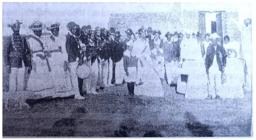
As previously pointed, Schoenaers had an attentive look upon inter-racial and cultural relations present in Brazilian lands, honed under his curiosity and fascination. This photograph and its narration demonstrate his interest in contextualizing the cultural differences experienced within different spaces of the city.
The Bumba Meu Boi presentations were performed by black people at night, at the urban periphery, but this picture was taken at 5pm, at the rehearsal for the nightly presentation (Schoenaers, 2003, p. 322). This population was numerous, representing an important workforce in the construction of the city and in agricultural work. According to him, the participants were very honored and proud to have their picture taken. The Canon even comments that “the group appears to be pleasant and curious, and the dance they perform has roots that are very African and savage, although with a certain cadence and accompanied by delicate choreography that has nothing in common with the foolish European polkas and waltzes” (Schoenaers, 2003, p. 321, citation translated to English for this article). There were several times when the author compared the local manifestations with the ones performed by his compatriots in Belgium. His flattering disposition differed from the views of foreigners that visited Brazil in this period, who would emphasize local customs in a negative and derogatory way and, according to Loner and Gill (2012, p. 261), “saw black people as little more than pack animals, immersed in curses and superstition” (citation translated to English for this article). As it would seem, this was a time when the religiousness and festivities of the black population, newly freed from slavery, did not pose a threat to the implementation and expansion of Catholicism. They may have been an important workforce for the Premonstratensians missionary endeavor. The “dangerous elements” were the freemasons and protestants, considered as enemies of the Catholic Church.
As stated by Schoenaers (2003, p. 165):
If we could, for instance, open a Sunday school or a patronage for black boys who, although marginalized, would attend in high numbers, as they are eager to learn to the highest level. What a great opportunity for teaching and reinforcing religious sentiments in their hearts. [...] The priests in Jaguarão perhaps could not only thoroughly equip their school but also establish a nice foundation for the black boys and thus save many souls from the abyss that would swallow them forever (citation translated to English for this article).
When observing this photograph and Schoenaers’ accounts, we continue to observe his intention of indicating to Europeans that the black people, formerly enslaved, constitute traces of civility in their culture and inter-racial relations. We can observe his intentions of convincing them of investing in the educational work of the Premonstratensians in Jaguarão beyond the Gymnasio, as it was a peaceful place where there was nothing to be feared regarding the insertion of black people in the community. This is a history (another history) about which there is much to say, but that we register here as a characteristic of the local culture, as well as the singularity of the potential action of Premonstratensian missionaries in Jaguarão regarding more vulnerable populations, which was never carried out.
Final remarks
We reiterate the importance of this article on the work of the Premonstratensians in Brazilian education, given that the studies on this religious order, in the field of History of Education, are still scarce. Likewise, we reiterate that this article is a cutout of a wider study that addresses the history of the Gymnasio Espirito Santo in the period from 1901 to 1914.
We observed here that the execution of historical research on a given educational institution on which there are few indications of internal and bureaucratic documents can lead us through interesting paths. Additionally, we've worked here with documents/monuments which historians have appropriated a long time ago, as is the case for travel accounts, as well as with other elements that constitute “novelties” since the mid-20th century, such as photographs.
Based on a bibliographic review on the addressed themes and on the photographs and accounts by Father Thomas Schoenaers, we present the relations between the photographic document and the informational complex of a visible world inscribed and circumscribed in it, as proposed by Kossy (1989). That, based on the intentionality and on the objective of the work of the subject-photographer, author of the document/monument that was the book analyzed here, who was a member of the congregation that created and maintained the Gymnasio Espírito Santo em Jaguarão.
The photographs analyzed presented singularities that signal intentionality and that may differ from school photographs from other institutions of the same period. With the intention of showing the beginnings of the work in Jaguarão and the importance of the Premonstratensians’ investments, the photographer highlights the space and the groups being formed. The precariousness of the installations is notorious for the lack of uniforms for the students and improvised activities, and in the pursuit of uniformity by the students who gather casually for the picture. Some were still suspicious of this new technology that ‘freezes’ reality. It is noticeable that the subject-photographer can ‘freeze’ the reality that is also demonstrated in his accounts: the need for organizing a group with potential, but who have not yet incorporated the necessary organization and discipline resulting from the school environment about to be built.
It is important to highlight that many school photographs throughout the 20th century aimed at portraying and praising an institution previously established, giving visibility to existing educational expectations on teaching that was either lay or confessional, public or private, primary or secondary, technical or regular. They highlight the established order, the group of teachers and students, the school practices, the complementary activities, the spatiality of the institution that singles it out in its building, the classrooms, the administrative spaces, chapels, yards, among others. These are photographs from institutions that aim at giving visibility to the best of each institution. Usually, those are the photographs that we access in personal and institutional collections. But we need to clarify that, both in the case of Gymnasio Espírito Santo’s photographs as well as these more flattering photographs, the intention of the photographic document constructed is present, representing many possibilities for analysis and reflections to the historians of school culture.
The work of Fr. Schoenaers brings us material remnants of the Gymnasio Espirito Santo as “informing objects” (Escolano Benito, 2017) that unveil silences of a past with little access, and intercalate images, characters, and experiences. The accounts and photographs taken, even when directed toward intentions in its production and circulation, tell us about the educational institution, the practices performed by the teachers and students, aspects of the regional culture, as well as the expectations of the consolidation of Catholicism within the community.
It is important to say that although we have presented a small section of a work that is over 400 pages long, with many photographs and 59 letters, we were able to contemplate the questions proposed initially on aspects of the Gymnasio Espírito Santo and its surroundings. And, it seems, the work on the accounts and photographs with descriptions of the schooling and urban daily lives of Jaguarão sent by Schoenaers touched the Premonstratensians and convinced them to invest in the educational project overseas.
With the increase in aid, the Gymnasio, as of 1905, becomes one of the main educational institutions in RS, receiving legal equivalence to the Colégio Pedro II. To house it, in 1910 a three-story construction was built in a palace house style, protected since 2011 by the National Institute for Historic and Artistic Heritage (IPHAN). As of the Rivadávia Correa Reform, in 1911, as we’ve stated, the school begins having problems that, associated to other factors, such as the beginning of World War I, led to its closing by late 1914. Thus, the staff of the Gymnasio travels to Jaú/SP, where they take over the Colégio Jorge Tibiriçá (Atheneu Jauense).
As time went by, in the construction built by the Premonstratensians in Jaguarão, at least three schools appeared that exist to this day, of which two are now in new buildings, and one remains there.
References
- Adriaansen, G. (2007). História dos primeiros vinte e cinco anos dos “Institutos Averbodienses no Brasil”, 1896-1921. In G. Chantrain, História dos premonstratenses averbodienses e jauenses, atuando no Brasil, 1896-2006 (pp. 6-69).
- Amaral, G. L. (2023). Gatos pelados x galinhas gordas: Desdobramentos da educação laica e da educação católica na cidade de Pelotas, RS (décadas de 1930 a 1960) Educs.
- Amaral, G. L. (2024, August). Remarks on secondary education in connections and borders: Uruguay and Rio Grande do Sul (Brazil) at the turn of the 19th and 20th centuries [Paper presentation]. ISCHE 45: International Standing Conference for the History of Education, Natal, Brazil.
-
Amaral, G. L., & Machado, C. J. A. (2025). “O Gymnasial”, periódico do Gymnasio Espírito Santo de Jaguarão, RS: quando o que restam de documentos produzidos pela escola são os impressos estudantis (1908). Momento: Diálogos em Educação, 34(3), 114-137. https://doi.org/10.63595/momento.v34i3.19773
» https://doi.org/10.63595/momento.v34i3.19773 - Azzi, R. (1994). O Estado leigo e o projeto ultramontano Paulus.
- Burke, P. (2005). O que é história cultural? (2nd ed.). Zahar.
- Certeau, M. de. (2000). A escrita da história (2nd ed.). Forense Universitária.
- Chartier, R. (2002). A história cultural: Entre práticas e representações (2nd ed.). DIFEL.
- Chartier, R. (2006). A “nova” história cultural existe? In A. H. Lopes, M. P. Velloso, & S. J. Pesavento (Orgs.), História e linguagens: Texto, imagem, oralidade e representações (pp. 29-43). 7Letras.
-
Ciavatta, M. (2009). A cultura material escolar em trabalho e educação: A memória fotográfica de sua transformação. Educação e Filosofia, 23(46), 37-72. https://doi.org/10.14393/REVEDFIL.v23n46a2009-2188
» https://doi.org/10.14393/REVEDFIL.v23n46a2009-2188 - Constantino, N. S. (Ed.). (2012). Relatos de viagem como fontes à história EdiPUCRS.
- Escolano Benito, A. (2017). A escola como cultura: Experiência, memória e arqueologia Alínea.
- Faria Filho, L. M. de. (2007). Escolarização e cultura escolar no Brasil. In M. L. A. Bencostta (Org.), Culturas escolares, saberes e práticas educativas: Itinerários históricos (pp. 191-211). Cortez.
- Franco, S. D. C. (2001). Gente e coisas da fronteira sul: Ensaios históricos Sulina.
- Franco, S. D. C. (2007). Origens de Jaguarão: 1790-1833 (2nd ed.). Evangraf.
- Franco, S. M. S. (2011). Relatos de viagem: Reflexões sobre seu uso como fonte documental. In M. A. Junqueira & S. M. S. Franco (Orgs.), Cadernos de Seminários de Pesquisa (Vol. 2, pp. 62-86). Humanitas.
-
Gonçalves Neto, W. (2013). Igreja, política e educação no Brasil republicano: A criação do colégio D. Bosco, de Cachoeira do Campo, Minas Gerais (1893-1897). Acta Scientiarum. Education, 35(1), 49-55. https://doi.org/10.4025/actascieduc.v35i1.17150
» https://doi.org/10.4025/actascieduc.v35i1.17150 - Hobsbawm, E. (1998). A era dos impérios: 1875-1914 (5th ed.). Paz e Terra.
- Kossoy, B. (1989). Fotografia & história Ática.
- Le Goff, J. (2013). História e memória (7th ed.). Editora da Unicamp.
-
Loner, B. A., & Gill, L. A. (2012). Rio Grande do Sul no nascer do século XX: Jaguarão e a fronteira brasileira pelos olhos de um padre belga. Estudos Ibero-Americanos, 38(suppl.), 253-268. https://doi.org/10.15448/1980-864X.2012.s.12471
» https://doi.org/10.15448/1980-864X.2012.s.12471 -
Machado, C. J. A. (2024). O Gymnasio Espírito Santo e a atuação da ordem religiosa premonstratense em Jaguarão, RS, Brasil (1901-1914) [Doctoral dissertation, Universidade Federal de Pelotas]. https://guaiaca.ufpel.edu.br/handle/prefix/16390
» https://guaiaca.ufpel.edu.br/handle/prefix/16390 - Magalhães, J. (2004). Tecendo nexos: História das instituições educativas EDUSF.
-
Magalhães, J. (2007). A instituição escolar como objecto historiográfico: Considerações a propósito do Colégio Campos Monteiro, em Moncorvo Palimage. https://repositorio.ulisboa.pt/handle/10451/5786
» https://repositorio.ulisboa.pt/handle/10451/5786 - Mauad, A. M. (2010). Imagens contemporâneas: Experiência fotográfica e memória no século XX. In K. R. Paranhos, L. Lehmkuhl, & A. Paranhos (Orgs.), História e imagens: Textos visuais e práticas de leitura (pp. 145-163). Mercado das Letras.
-
Oliveira, M. A. M. de. (2012). Instituições e práticas escolares como representações de modernidade em Pelotas (1910-1930): Imagens e imprensa [Doctoral dissertation, Universidade Federal de Pelotas]. https://guaiaca.ufpel.edu.br/handle/123456789/1672
» https://guaiaca.ufpel.edu.br/handle/123456789/1672 - Parmagnani, J. J., & Ruedell, O. (1995). Memorial do Colégio Gonzaga: Cem anos de educação Gráfica Editora Pallotti.
- Pesavento, S. J. (2014). História do Rio Grande do Sul (9th ed.). Martins Livreiro.
- Schoenaers, T. A. (2003). Três anos no Brasil: Thomas Aquinas Schoenaers, missionário premonstratense no Rio Grande do Sul EDUCAT.
-
Souza, R. F. de. (2001). Fotografias escolares: A leitura de imagens na história da escola primária. Educar em Revista, 17(18), 75-101. https://doi.org/10.1590/0104-4060.235
» https://doi.org/10.1590/0104-4060.235 -
Vidal, D. G., & Abdala, R. D. (2005). A fotografia como fonte para a história da educação: Questões teórico-metodológicas e de pesquisa. Educação, 30(2), 177-194. https://periodicos.ufsm.br/reveducacao/article/view/3745
» https://periodicos.ufsm.br/reveducacao/article/view/3745 -
Viñao Frago, A. (1995). Historia de la educación e historia cultural: Posibilidades, problemas, cuestiones. Revista de Educación, 306, 245-269. https://www.educacionfpydeportes.gob.es/revista-de-educacion/numeros-revista-educacion/numeros-anteriores/1995/re306/re306-07.html.
» https://www.educacionfpydeportes.gob.es/revista-de-educacion/numeros-revista-educacion/numeros-anteriores/1995/re306/re306-07.html.
-
Peer review rounds:
R1: two invitations; no reviews received.R2: two invitations; one review received.R3: two invitations; one review received.R4: two invitations; one review received.
-
How to cite this article:
Amaral, G. L. do, & Machado, C. J. A. “Three years in Brazil”: images and accounts of a Premonstratensian about the Gymnasium Espírito Santo, in Jaguarão, RS (1901-1904). Revista Brasileira de História da Educação, 26, e410. DOI: https://doi.org/10.4025/rbhe.v26.2026.e410en
-
Funding:
The RBHE has financial support from the Brazilian Society of History of Education (SBHE) and the Editorial Program (Call No. 30/2023) of the National Council for Scientific and Technological Development (CNPq).
-
Licensing:
This article is published under the Creative Commons Attribution 4.0 (CC-BY 4) license.
-
Data availability:
All data generated or analyzed during this study are included in this published article.
-
1
School culture is here understood as a set of practices that allow for the transmission of knowledge that will entail behaviors and productions at a limited space and time (Viñao Frago, 1995; Escolano Benito, 2017).
-
2
We present the expression images considering that photographs and drawings are representations that result from different media and procedures.
-
3
We will use the original spelling, “gymnasio”.
-
4
It is likely that with the closing of the school its documents were sent to Averbode Abbey or to the House of the Premonstratensians in Rome. However, up until now, it was not possible to access them.
-
5
Schoenaers, T. A. (2003). Três Anos no Brasil- Thomas Aquinas Schoenaers: missionário Premonstratense no Rio Grande do Sul. Pelotas: DUCAT.
-
6
On the subject, see, among others, Tambara, Arriada, and Amaral (2021).
-
7
For Le Goff (2013), the document, understood as “proof”, is a monument - all of that which can evoke the past and perpetuate remembrance.
-
8
In 1903, the Premonstratensians acquired a building where now works the Casa de Cultura de Jaguarão. In 1908, the gymnasio was equated to the Colégio D. Pedro II (abiding to federal legislation at the time). In 1910, a three-story structure was built to house the educational institution, a building of high significance, protected by the IPHAN (National Institute for Historic and Artistic Heritage) since 2011, alongside the historic center.
-
9
Rivadávia Correa, born in Santana do Livramento, municipality in the gaúcho “campanha”, at the border with Uruguay, was a minister in the government of Hermes da Fonseca. The law 8.659, from April 5th, 1911, became known as the “Rivadávia Correa Law” and, inspired by positivist postulates, proposed reforming the education in Brazil, establishing free teaching and removing the state from the power to intervene in the educational sector. Education became non-mandatory, diplomas were abolished, and there was the creation of admission exams at colleges, which resulted in the closing of many secondary education institutions in the country and in RS. On the subject, see Tambara (1996) and Amaral (2023).
-
10
Converted in 1115, Saint Norbert was a regular canon in Xanten, at the Cologne diocese, in Germany. He adopted Saint Augustine’s rule as basic inspiration for the common life of eclesiasts. In 1126, he was named archbishop of de Magdeburg, in Germany. The new Order was approved in that same year by Pope Honorius II.
-
11
On the arrival of religious orders in Brazil dedicated to education, see Azzi (1994) and Gonçalves Neto (2013).
-
12
On this subject, see Amaral (2024).
-
13
In the text, the focus is on matters related to the “culture of the borders, such as religion, music, health care and hygiene, as well as the analysis of the relationship between white and black people” (Loner & Gill, 2012, p. 254 e 255).
-
14
A canon from Averbode, who worked and lived in Brazil for almost 50 years, who lived alongside the first priests established here. In 1954, back to Averbode, he wrote a report by request of “Pikkelpoort” magazine, which published Averbode goer’s activities, from inside as well as out of the Abbey. The text was translated into Portuguese by Canon Godofredo Chantrain and published in 2007.
-
15
Located across the Lagoa Mirim, South of Jaguarão, Santa Vitória do Palmar is also at the border with Uruguay. At that time, travelling through these areas was done on steamboats that rode through the lagoon, which qualified them as neighboring towns. Currently, the route is done via roads, and the shortest way goes through Uruguay.
-
16
A conflict that occurred in ther Southern region of Brazil, between the years of 1893 and 1895, characterized by cruelty on both sides, leaving thousands of victims in the state. The dispute around political power was fought betweem two political forces - the “castilhista” republicans (associated to the governor, Júlio de Castilhos) and, on the other side, the federalists, associated to leader Silveira Martins.
-
17
The order of Jesuits or Society of Jesus appeared during the Catholic Counter-Reformation movement in the 16th century. The name “Society” and the hierarchical organization of the “soldiers of Christ,” as they were called, are linked to the military influence in their practice regarding education.
Edited by
All data generated or analyzed during this study are included in this published article.

 Note. From Três anos no Brasil: Thomas Aquinas
 Note From Três anos no Brasil: Thomas Aquinas
 Note. From Três anos no Brasil: Thomas Aquinas
 Note. From Três anos no Brasil: Thomas Aquinas
 Note. From Três anos no Brasil: Thomas Aquinas
 Note. From Três anos no Brasil: Thomas Aquinas