 A cross-level study on the impact of team-based reward allocation on employees’ innovative behavior in manufacturing enterprises
Abstract
Purpose This study aims to investigate the cross-level impact of different team compensation distributions on team members' innovative work behaviors in innovative teams in Chinese manufacturing enterprises, as well as whether team task interdependence has a cross-level moderating effect.
Theoretical framework Cognitive choice theory and the theory of planned behavior are used to elucidate the relationship between team compensation distribution and team members' innovative intentions, as well as the relationship between team members' innovative work behaviors.
Design/methodology/approach The hypotheses are tested using multilevel structural equation modeling (MSEM) with 328 pairs of matched two-stage, two-party data from 12 manufacturing companies in China.
Findings The results show that team-based reward allocation is positively related to employees' innovative behavior by promoting employees' innovative intention. Task interdependence weakened the direct effect of team-based reward allocation on employees' innovative intention and the indirect effect on employees' innovative behavior.
Practical & social implications of research This study reveals that differences in team compensation distribution are one of the important factors affecting team members' innovative behavior. Researchers and managers should consider the degree of interdependence of the tasks undertaken by the team before implementing a particular distribution method.
Originality/value This study provides the first empirical results on how team-based reward allocation affects employees' innovative behavior and examines the mechanisms and pathways of the variables involved in the context of Chinese manufacturing enterprises, contributing to filling a gap in the field of research on team compensation affecting employee innovation and extending cross-level research on team reward allocation.
Keywords:
Manufacturing enterprises; team-based reward allocation; task interdependence; employees’ innovative intention; employees’ innovative behavior
1 Introduction
China's manufacturing industry is an important cornerstone of industrial modernization and an important field of scientific and technological innovation. In order to promote the high-quality development of the manufacturing industry, it is necessary to put innovative technology at the core of the industry's development strategy, and give full play to the innovation and creativity of various talents. Teams are the basic work unit of modern organizations (Zhao et al., 2013), and how to design team incentives is an important topic (Majerczyk et al., 2019). Unreasonably designed team compensation distribution will lead the whole organization into innovation inertia (Wang & Guo, 2020).
Regarding the theoretical framework of this paper, first, team pay allocation is a way for organizations to redistribute overall team performance pay within the team according to certain rules and criteria based on the magnitude of overall team performance or project outcomes (Kirkman & Shapiro, 2000). The relationship between extrinsic rewards and creativity has also been the subject of ongoing debate in the HRM and creativity literature (Lin et al., 2022), with Duan and Pang (2018) finding that fairness in the distribution of team pay is seen as an important factor influencing employee silencing. Other studies have also found that the distribution of team pay encourages employees to engage in knowledge sharing (Zhao & Long, 2012) and citizenship behavior (Zhao et al., 2013). However, there is still a lack of research on how team pay allocation affects employees' willingness to innovate and innovative behavior.
Second, employees' willingness to innovate is a concrete manifestation of individuals' willingness when faced with an innovative job (Cui et al., 2013). Employees' creative behavior is the behavior of employees who autonomously and consciously put innovative ideas into practice at work (Zhang et al., 2016). It has been shown that creativity-related intrinsic motivation mediates the relationship between extrinsic rewards and employee creativity (Lin et al., 2022). From a psychological perspective, motivation and willingness are both related and distinct. Motivation focuses on the “why,” whereas willingness focuses on the “what,” and motivation, when influenced by an individual's beliefs, values, and self-efficacy, may drive the individual to desire something (Wasserman & Wasserman, 2020). However,the effect of the mechanism of team pay allocation through employees' willingness to innovate on psychological behaviors that influence innovative behavior is unclear.
Finally, task interdependence objectively requires team members to cooperate, and it is a key moderator affecting the incentive effect of team pay (Liu et al., 2015). Scholars' research on task interdependence is divided into two levels. At the team level, Zhang et al. (2014) argued that when the degree of task interdependence is high, no member is able to complete his or her own task alone, and when the degree of contribution is not easy to identify in a team, equal distribution has a better incentive effect than fair distribution. At the individual level, some scholars have found that task interdependence has a significant effect on the employee's individual behavior (Wang et al., 2021). Therefore, although the existing literature suggests that task interdependence is an important extrinsic work influencing factor for teams, whether task interdependence has a moderating role in the relationship between team pay allocation and employees' willingness to innovate still needs to be empirically tested.
On the one hand, Kahneman (1973) proposed the cognitive resource allocation model in his publication “Attention and Effort.” He believed that the distribution of attention is primarily constrained by the energy of the cognitive resources that are aroused, the will, the evaluation of the cognitive energy required to complete the task, and the psychological inclination at the time. Cognitive choice theory posits that cognition is selective (including attention, understanding, memory, etc.), and people selectively perceive those things they expect and are willing to see (Gong & Liu, 2021). Cognitive choice theory is more often used to explain the relationship between individual attention and behavioral effort from a psychological perspective, without involving the relationship between compensation incentives and individual innovation willingness and behavior. On the other hand, the theory of planned behavior, initially known as the theory of reasoned action (Ajzen & Fishbein, 1980), posits that behavioral intention is the direct determinant of behavior, influenced by attitudes towards the behavior and subjective norms. This theory has been supported by a substantial amount of empirical research. However, the theory neglected an important variable, namely perceived behavioral control, so Ajzen (1985) incorporated PBC into the theory of reasoned action and renamed it the theory of planned behavior. According to this theory, when individuals perceive complete control over whether to perform a specific action, behavioral intention can directly predict the outcome of the behavior (Ajzen, 1991). Ajzen and Madden (1986) were the first researchers to fully test the theory of planned behavior. Their research results consistently show that attitudes, subjective norms, and PBC affect behavioral intention, and then directly affect behavior. Behavioral intention is the direct determinant of behavior; generally speaking, the stronger the behavioral intention, the greater the likelihood of taking action (Ajzen, 1991). However, the theory does not provide a comprehensive and systematic analysis of the factors influencing behavioral intention, merely suggesting that normative beliefs affect behavioral intention through subjective norms, without considering the motivational factors of compensation. Nevertheless, in order to explore the mechanism by which team-based reward allocation affects the innovative behavior of team members, the issues mentioned above are all theoretically important questions that need to be addressed.
The theoretical contributions are as follows. First, our research enriches the existing body of knowledge on the topic of team-based reward allocation. In particular, it examines the impact of this allocation on innovation intention and addresses the limitations of previous research on the antecedents of behavioral intention in the theory of planned behavior. Second, it elucidates the psychological mechanism by which team-based reward allocation affects team members' innovation intention, ultimately leading to innovative behavior. It integrates cognitive choice theory with the theory of planned behavior. Third, we investigate the conditions that limit the impact of team-based reward allocation on employees' innovation intention and examine whether situational factors of task interdependence exert a moderating influence on the mediating effect. This research not only extends the research field of cognitive choice theory, but also supplements the theoretical boundary conditions. Fourth, unlike previous studies that have focused on the individual level, the mediating mechanism of this study involves a cross-level study that elevates team-based reward allocation to the team level.
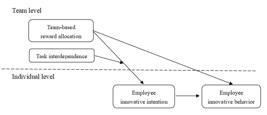
Based on the above analysis, this study intends to construct a theoretical framework containing the research variables mentioned above, take manufacturing enterprises as the research object, propose a cross-level moderated mediation model to reveal the psychological-behavioral influencing mechanism of team salary allocation on employees' innovative behavior, and take innovation willingness as a mediator variable and task interdependence as a moderating variable to investigate whether the moderated mediation effect is established. The research conceptual model of this paper is shown in Figure 1.
The structure of the study is as follows. First, the theoretical framework for analyzing the relationships between team-based reward allocation, task interdependence, employees' willingness to innovate, and employee-oriented innovation behaviors is presented. After outlining the methodological aspects and presenting the findings, the paper concludes with a discussion of the results and the main conclusions and theoretical and practical implications.
2 Literature and hypotheses
2.1 Team-based reward allocation and employees' innovative behavior
Team salary distribution can be divided into equal distribution and fair distribution, where equal distribution is the same distribution to all team members, and fair distribution is distribution according to contribution (Zhao & Long, 2012). According to Zhao et al. (2013), it is difficult for enterprises to determine what is equal or fair in the actual salary allocation. Therefore, this paper adopts the orientation of team salary distribution based on the degree of employee contribution, i.e., the stronger the degree of contribution, the more fair distribution tends to be, and the weaker the degree of contribution, the more equal distribution tends to be.
According to cognitive choice theory, Bamberger and Levi (2008) extend the existing theory of team-based rewards by proposing that how such rewards are distributed has important effects on the degree to which members' cognitive and intentional resources are allocated towards behaviors that consistently show a key impact on workforce performance. Team members will focus on the behaviors and goals that maximize their utility (Zhao & Long, 2012), and they tend to make the realization of their interests in the team a prerequisite for their innovative behavior (Liu et al., 2019b). Therefore, the distribution of compensation within a team affects the innovative behavior of team members, mitigates free-riding problems, and reduces internal vicious competitive behavior (Majerczyk et al., 2019). Related empirical studies also support this view, with Zhao et al. (2013) showing that team-based reward allocation has a positive impact on team citizenship behavior, with both the equal allocation and fair allocation orientations encouraging team members to engage in knowledge sharing behavior (Zhao & Long, 2012). Therefore, team-based reward allocation establishes a link with employees' innovative behavior, which helps to stimulate team members' innovative intention, thus enabling employees to engage in the innovative behavior expected by the organization for the desired pay. In summary, this paper argues that the reward distribution within a team is likely to affect employees' innovative behavior. Accordingly, the following hypothesis is proposed.
H1: Team-based reward allocation positively affects employees’ innovative behavior.
2.2 Mediating role of employees' innovative behavior
Innovative intention is a concrete expression of an individual's will in the area of innovation and is an internal motivation of employees driven by the organizational context (Wang et al., 2017). According to the theory of planned behavior (Ajzen, 1991), increased innovative intention facilitates the acquisition of new knowledge and skills by team members in collaboration, thus promoting the ability of employees to implement innovative behavior. Combined with the cognitive choice theory of motivation, team-based reward allocation affects the allocation of cognitive resources to team members during teamwork, which in turn affects the innovative ideas they use to deal with problems at work (Bamberger & Levi, 2008). At the same time, team members tend to compare their contributions with the rewards they receive and the remuneration of others, which can influence their participation behavior.
The extent and intensity with which employees' innovative intention is translated into innovative behavior depend on the internal motivational factors that employees experience within the team. Research has shown that intrinsic motivation related to innovation has a positive impact on employee creativity (Lin et al., 2022). In the innovation process, the positive feedback provided by the team pay allocation can make innovative work more pleasant and competent (Liu et al., 2019a), and increase employees' innovative intention. After employees' innovative intention reaches a certain level, they will take the initiative to innovate, and the increase in team compensation brought by innovative behavior will in turn strengthen employees' innovative intention, constituting a self-reinforcing virtuous circle that makes team members have continuous innovative behavior (Wang et al., 2017). Based on the above analysis, we propose the following hypothesis.
H2a: Team-based reward allocation positively affects employees' innovative behavior.
H2b: Employees' innovative intention positively influences innovative behavior.
H2: Employees' innovative intention mediates the relationship between team-based reward allocation and employees' innovative behavior.
2.3 Moderating role of task interdependence
Task interdependence is a fundamental characteristic of teamwork that distinguishes it from individual work, and the degree of task interdependence perceived by members of a team with other members determines the way in which their behavioral interactions take place, affecting the cooperative relationship between team members (Liu et al., 2012). Wageman and Baker (1997) found that task interdependence drives employees' collaborative behavior. When task interdependence is high and members' contributions are easily identifiable, employees have a higher perception of fairness when they are paid on a contribution basis than when they are paid equally (Zhao, 2011). In contrast, some scholars have argued that when task interdependence is low, cooperation among team members is not a necessary condition and the cooperation effect of equal allocation is more limited (Zhang & You, 2014). When task interdependence is high, conflicts occur between close cooperation and innovative work behavior, and team member cooperation is better facilitated by equal allocation (Liu et al., 2012). In the context of task interdependence, different approaches to team-based reward allocation can have differential effects on team members' psychological behavior.
Team rewards are distributed according to members' level of contribution, and vague or imprecise performance assessment may lead to a sense of unfairness among members. According to cognitive choice theory, when presented with a new or complex task, employees make full use of their cognitive resources to allocate goals and tasks in the team to maximize their utility (Kanfer & Ackerman, 1989), and members' psychology and behavior are affected as a result.
When task interdependence is high, the complexity and flexibility of the work require coordination and cooperation among members, and individual contributions are not easily distinguishable, which could hurt members' equity psychology (Zhang et al., 2014). Team members will be less motivated and their innovative intention will be lower. When task interdependence is low, contribution-based compensation can better differentiate the contribution of individuals in the team and confirm the value of individual employees, who will be more willing to act for their own benefit to improve their innovative problem-solving skills. Therefore, the higher the degree of task interdependence, the stronger the contribution-based pay distribution, and the lower the willingness of employees to innovate. Based on this, the following hypothesis is proposed.
H3: Task interdependence negatively moderates the relationship between team-based reward allocation and employees' innovative intention.
Combining Hypothesis 2 and Hypothesis 3, the model of the relationship between team-based reward allocation and employees' innovative behavior can be further understood as being moderated by the mediating role. When the degree of task interdependence is high, it will lead team members to cooperate proactively (Hsu, 2018; Mendo Lazaro et al., 2019). According to cognitive choice theory, due to the limited nature of employees' cognitive resources, employees will prioritize accepting resource distribution methods that maximize their individual utility (Zhao & Long, 2012; Liu et al., 2012). Team members' close cooperation does not increase their individual rewards. Team-based reward allocation has a weakening effect on employees' innovative intention, which in turn inhibits their innovative behavior. Innovative intention ultimately transmits the negative effect of team-based reward allocation on employees' innovative behavior. Furthermore, according to the theory of planned behavior, intention is a crucial predictor that explains behavior (Ajzen, 1991), and a weak intention to innovate can inhibit employees' innovative behavior. Conversely, when task interdependence is low and team pay is distributed based on contribution, members' efforts are aligned with what they receive, thus motivating team employees' innovative intention, and employees will show initiative in learning their own work-related innovative skills (Pang & Wen, 2017). Based on this, the following hypothesis is proposed in this paper.
H4: Task interdependence moderates the indirect role of team-based reward allocation in influencing innovative behavior through employees’ innovative intention. Specifically, this role is weaker when task interdependence is higher rather than lower.
3 Methods
3.1 Procedure and participants
Manufacturing is an industry where technological innovation is very important. At present, China is actively promoting the transformation and upgrading of the manufacturing industry in high-end, intelligent, and green directions. This study uses three research teams to conduct separate surveys.
The research team of this project has established cooperative relationships with manufacturing enterprises across the country, and selected typical and representative manufacturing enterprises for the study. Within these enterprises, we randomly selected team leaders and their corresponding employees as the subjects of the study. To reduce common method bias, this study draws on the research of Mittone et al. (2022) and uses convenience sampling to collect data at two different times from two different sources: team leaders and subordinates. In the first survey, we investigated whether the manufacturing enterprises used a team-based reward format and the extent of team task interdependence, based on which a targeted team-based reward allocation questionnaire was administered to team supervisors to collect team-based reward allocation, task interdependence, and personal information data at the team level. One month later, the second survey was conducted with the subordinates of the first team supervisors, in which the subordinates anonymously evaluated their innovative intention, their innovative behavior, and their personal information.
After two questionnaires were administered, the team leaders and subordinates were matched and invalid questionnaires were removed, resulting in 328 fully matched valid questionnaires. Among these participants, team types include production (16.5%), R&D (38.7%), service (10.7%), middle management (29%), and others (5.1%); team size includes 5 people and less (10.7%), 6-10 people (16.8%), 11-15 people (12.2%), 16-20 people (4.9%), and 21 people and more (55.5%); the average length of time the team has been in existence is approximately 4.75 years (M=2.92); the nature of the enterprises include state-owned enterprises (16.2%), private enterprises (71.6%), foreign enterprises (7.6%), joint ventures (1.5%), and mixed enterprises (3%).
3.2 Measures
To ensure the reliability of the measurement of variables, this paper primarily uses established scales from the existing literature, while strictly following the standard process of translation and back-translation. Moreover, all scales involved are measured using a five-point Likert scoring method. The specific scales are referred to in Appendix A.
3.2.1 Team-based reward allocation
We used the team-based reward allocation scale originally developed by Sarin and Mahajan (2001), selecting six equality-based and outcome-based questions. The equality-based questions use reverse scoring of the original scale. A typical item is “The rewards that team members receive for their work in the team are proportional to their contributions to the team.” The Cronbach's alpha for this scale was 0.90.
3.2.2 Task interdependence
We used a three-item scale developed by Campion et al. (1993). A typical item is “In the workplace, team members work closely together to complete tasks”. The Cronbach's alpha for this scale was 0.85.
3.2.3 Employees' innovative intention
We used an eight-item scale developed by Xing and Wang (2015) with reference to research by Western scholars. A typical item is ” I often exchange information between upper and lower level departments”. The Cronbach's alpha for this scale was 0.91.
3.2.4 Employees’ innovative behavior
We used a five-item scale developed by Yuan and Woodman (2010), with a typical item being “I come up with creative ideas.” The Cronbach's alpha for this scale was 0.86.
3.2.5 Control variables
Following Zhao et al. (2013), we controlled for four team-related variables and gender, the former including team type, years since team establishment, team size, and nature of the enterprise. Gender was coded 1 for men and 0 for women. Team type was coded 1 for senior management team,2 for R&D team,3 for production team,4 for management team (in addition to senior management team),5 for service team,6 for project team,7 for marketing team, and 8 for other team types or above. Team size was coded 1 for 5 people or less,2 for 6-10 people,3 for 11-15 people, 4 for 16-20 people, 5 for 21-25 people, and 6 for 26 people or more. Team duration was coded 1 for 1 year or less,2 for 1-3 years (including 3 years), 3 for 3-5 years (including 5 years), and 4 for more than 5 years.
3.3 Data analysis strategy
To test the convergence of employees' innovative intention and innovative behavior, inter-rater agreement (mean Rwg and Rwg(j)) and intra-class correlation (ICC) tests were calculated. The mean Rwg of employees' innovative intention was 0.9, indicating a high level of agreement among members within teams, the ICC(1) was 0.63, and the ICC(2) was 0.92. The mean Rwg of employees' innovative behavior was 0.96, indicating a high level of agreement among members within teams, the ICC(1) was 0.61, and the ICC(2) was 0.91. All data satisfied the criteria of ICC(1) > 0.05, ICC(2) > 0.5, Rwg > 0.7 as proposed by James (1982). Furthermore, according to the aggregation criteria proposed by LeBreton and Senter (2007), the individual level data can be aggregated to the team level for cross-level analysis.
Therefore, the cross-level analysis method can be used for statistical analysis of the data (Supplementary Data 1). We use Mplus8.3 for data analysis and hypothesis testing, apply bootstrap 5000 times in the mediation and moderation hypothesis testing, and test the moderated mediation effect in R 2.11.1 software (Supplementary Data 2).
4 Results
4.1 Confirmatory factor analysis
We used Mplus8.3 to conduct a CFA and assess the discriminability of the key variables team-based reward allocation, task interdependence, employees' innovative intention, and employees' innovative behavior. As shown in Table 1, the proposed four-factor model showed a good overall fit (χ2/ dƒ=2.54, ns, RMSEA=0.079(90% confidence intervals = [0.061, 0.076]), CFI=0.92, TLI=0.91, SRMR=0.05). All factor loadings are significant and greater than 0.5, indicating convergent validity. We confirmed the discriminant validity of the four-factor model by comparing it with other CFA models, and the fit indices in Table 1 show that the proposed four-factor model fit the data better than any other model (Brown, 2015).
4.2 Descriptive statistics
The means, standard deviations, correlation coefficients and AVE for all variables are presented in Table 2. The square root of the AVE value of employees' innovative intention = 0.741, and the square root of the AVE value of employees' innovative behavior = 0.748. The square root of the AVE is greater than the absolute value of the correlation coefficient, which confirms good discriminant validity (Fornell & Larcker, 1981).
4.3 Hypothesis testing
First, we tested the research hypotheses using Mplus8.3 based on the two-level path analysis method proposed by Preacher et al. (2010). The choice to use multilevel structural equation modeling (MSEM) instead of multilevel linear modeling (MLM) for mediation analysis is because MSEM can more finely account for the error terms and avoid confounding within-group and between-group mediating effects, which is its significant advantage (Preacher et al., 2011). We first constructed a multilevel mediated effects model (Model 1) based on the MSEM, centered on the group mean of employees' innovative intention at level 1 and used at level 2, while controlling for gender and years since team establishment at level 1, and team type, team size, years since team establishment and nature of enterprise at level 2. Table 3 presents the unstandardized coefficient estimates for Model 1, and the effects of all control variables are not significant.
The overall effect of team-based reward allocation on employees' innovative behavior is positive and significant (b = 0.48, p < 0.01), so Hypothesis 1 is supported, indicating that team-based reward allocation positively affects employees' innovative behavior. The results of the mediating effect test showed that team-based reward allocation has a significant positive effect on employees' innovative intention (b = 0.32, p < 0.01), and employees' innovative intention also positively influences employees' innovative behavior (b = 0.74, p < 0.001), supporting Hypotheses 2a and 2b. The mediating effect of employees' innovative intention between team-based reward allocation and employees' innovative behavior was significant (b = 0.46, p < 0.01), and the confidence intervals for the mediating effect were calculated in the R software using Monte Carlo simulation, with 95% confidence intervals of [0.121, 0.788]. However, the direct effect of team-based reward allocation on employees' innovative behavior was not significant (b = 0.03, p > 0.05), indicating that employees' innovative intention played a fully mediating role, providing support for Hypothesis 2.
Second, the moderating effect of task interdependence was examined. As shown in Table 4, the results show that the product term coefficient of team reward allocation and task interdependence is significant (β = -0.19,p < 0.01),This shows that task interdependence can regulate the relationship between team reward allocation and employees' innovation intention. Hypothesis 3 was supported.
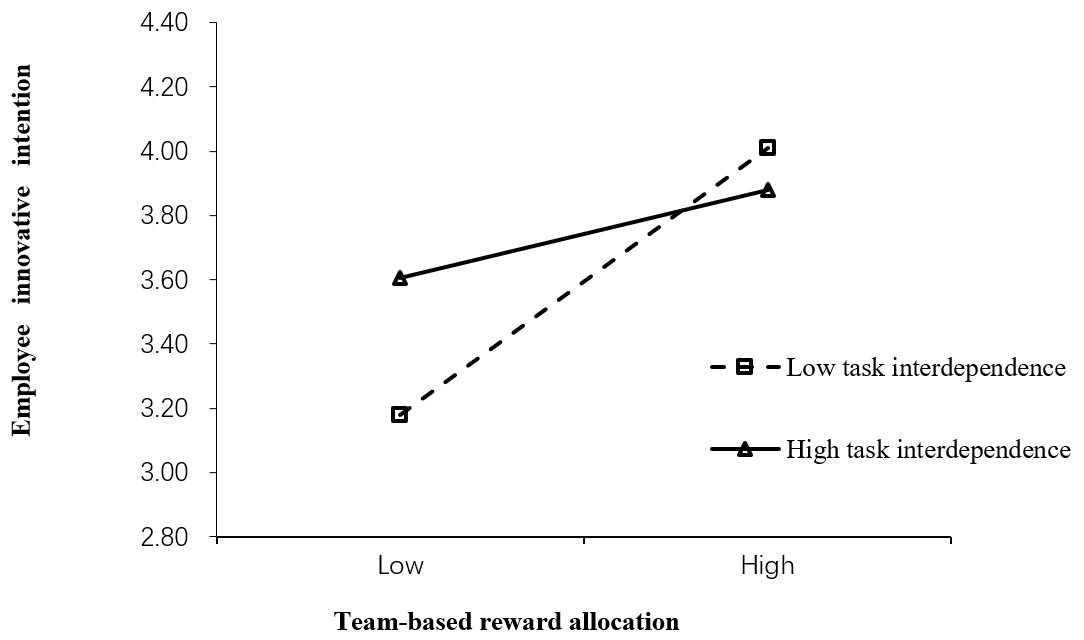
Third, the mediating role of the regulated first stage was tested according to the method of Edwards and Lambert (2007). As shown in Table 4, when task interdependence was high (+1SD), the mediating effect of employees' innovative intention was small and insignificant (estimate = 0.11, SE = 0.10, p > 0.1); when task interdependence was low (-1SD), the mediating effect of employees' innovative intention was large and significant (estimate = 0.33, SE = 0.12, p < 0.05). The differential effect between these two conditions was -0.21 (SE = 0.10, p < 0.05), with a 95% CI of [-0.406, -0.011]. Thus, Hypothesis 4 was supported, indicating that the indirect effect of team-based reward allocation on employees' innovative behavior was moderated by task interdependence. Additionally, the slope chart of the moderating effect of task interdependence in the first stage can be seen in Figure 2.

5 Discussion
The orientation of team-based reward allocation has an impact on employees' innovative behavior. Drawing on cognitive choice theory and the theory of planned behavior, and after a cross-level analysis of the theoretical model, the findings support our hypothesis, indicating that team-based reward allocation has an indirect positive impact on employees' innovative behavior by promoting employees' innovative intention, and that task interdependence attenuates the effect of team-based reward allocation and the mediating mechanism of employees' innovative intention on it.
5.1 Theoretical contributions
By linking team-based reward allocation and employees' innovative behavior, we contribute to the question of whether and how team-based reward allocation affects employee behavior.
In recent years, employees' innovative behavior has been frequently used to analyze organizational behavior issues and phenomena such as leadership, but most studies focus on factors such as leadership style (Akbari et al., 2021), leader-member exchange (Bani-Melhem et al., 2022), risk attitudes (Mittone et al., 2022) and so on. However, the relationship between extrinsic rewards and creativity has been the subject of ongoing debate in the human resource management and creativity literature (Lin et al., 2022). Economic compensation is a factor that influences employees' innovative behavior, but it has not been fully explored and evaluated. Although there have been preliminary studies on how team pay distribution affects employee behavior (Zhao et al., 2013), there are no studies on the cross-level impact of team pay distribution on employee psychological behavior. This paper empirically examines the psychological and behavioral mechanism of team salary distribution on employees' innovative behavior by using cross-level research methods, and the research results are helpful to understand the effect of the intrinsic incentive mechanism of team salary distribution on employees' innovative behavior, and also expand the antecedent variables of employees' innovative behavior research.
Our study also extends the theory of planned behavior by explaining how employees' innovative intention affects the relationship between team-based reward allocation and employees' innovative behavior. The existing literature mostly uses the theory of planned behavior to study the impact of employees' innovative intention on innovative behavior (Yi, 2018; Zhang & You, 2014), but pays less attention to the antecedent variables of team employees' innovative intention. Our findings, based on cognitive choice theory and the theory of planned behavior, are that the conditions under which team pay is allocated can influence individuals' willingness to innovate, and that individuals' willingness to innovate predicts their innovative behavior. This mechanism provides a more detailed and specific explanation of how pay incentives can influence employees' psychological behavior.
Finally, we use task interdependence as a boundary condition to explore the impact of team-based reward allocation. Task interdependence is an important variable in team pay studies (Wageman & Baker, 1997). The impact of individual-level task interdependence on innovative behavior has been explored in the literature (Černe et al., 2017), but the role of task interdependence as a boundary condition for individual employee innovative intentions has not been tested. Therefore, by combining the mediating and moderating roles, our study provides a meaningful and important analysis of the impact of this key teamwork characteristic factor, task interdependence, on the link between team-based reward allocation, employees' innovative intention and employees' innovative behavior.
5.2 Limitations and recommendations for future research
Our study has a number of limitations. First, demographic variables such as age, education level and years of experience at the individual level were not considered in the selection of control variables. Future research will need to examine the impact of team-based reward allocation and employees' innovative behavior in terms of demographic variables.
Second, employees' innovative intention and behavior may be influenced by their individual characteristics, e.g., proactive personalities will be more willing to engage in innovative work. This paper does not take into account individual personality traits, etc. The possible mechanisms at play can be further explored in the future.
5.3 Practical implications
There are many different types of teams in manufacturing enterprises, and this paper focuses on the R&D team, production team and executive team, which are closely related to innovation. And considering the characteristics of manufacturing enterprises, we put forward reference suggestions for team salary allocation practice.
First, R&D teams should adopt different salary allocation methods according to different degrees of task interdependence. Some R&D project teams require several members to cooperate closely in order to tackle the problem, which means high task interdependence and makes it difficult to identify the contribution of team members, so equal distribution can be considered. On the other hand, when the task interdependence of R&D projects is not high and it is easy to distinguish each other's contribution, contribution-based allocation is preferred.
Second, the production team mostly adopts the assembly line operation method in manufacturing enterprises, and the piecework wage system is still the main way of paying salaries in manufacturing enterprises. According to this research, even if the degree of task interdependence is high, the production team will break down the tasks to individual team members as much as possible, which is equivalent to reducing the degree of task interdependence. So, the part of the task that can distinguish the contribution is distributed according to the contribution, and the part of the task that cannot distinguish the contribution is distributed equally.
Finally, in the case of top management teams, some strategic decision-making tasks require close collaboration to accomplish, while others have decision-making authority within their purview, i.e., some tasks are highly interdependent and some are less interdependent. Today's manufacturing enterprises are digitally transforming towards smart manufacturing, and in the smart context, the interdependence of tasks in the executive team becomes less, and many tasks can be judged and decided independently. Therefore, it is appropriate to adopt contribution-based allocation for executive teams in smart manufacturing companies.
In conclusion, regardless of the type of team, as long as the team-based reward allocation method is properly selected in specific situations, it will create a sense of fairness among team members, thus stimulating their willingness to innovate and promoting their innovative behavior.
APPENDIX A Summary of scale items
| Team-based reward allocation | Item name SPSS database abbreviation |
|---|---|
| 1. The best performers in our team receive additional rewards | FP1 |
| 2. All team members receive equal rewards for their work in the team, independent of their individual contributions | FP2 |
| 3. The rewards that team members receive for their work in the team are proportional to their contributions to the team | FP3 |
| 4. Members who perform well in the team receive individual rewards or recognition for their work | FP4 |
| 5. The rewards our team or individual members receive are entirely related to the team's contribution to profits | FP5 |
| 6. Rewards for the team or individual members are deferred until the team's basic outcomes, such as product performance, market share, profitability, and sales, have been achieved | FP6 |
| Task interdependence | |
| 1. In the workplace, team members work closely together to complete tasks | RW1 |
| 2. In the work, team members must frequently communicate and coordinate with each other | RW2 |
| 3. The way individual team members carry out their work can greatly affect the other members | RW3 |
| Employees' innovative intention | |
| 1. I am very confident in my ability to innovate and solve problems | YY1 |
| 2. I believe I can successfully overcome the difficulties and challenges posed by innovative tasks | YY2 |
| 3. I can receive bonuses or pay increases through technological innovation | YY3 |
| 4. I can get additional promotion opportunities through technological innovation | YY4 |
| 5. I often exchange information between internal peer departments | YY5 |
| 6. I often exchange information between upper and lower level departments | YY6 |
| 7. When the company is about to launch a new project, I am usually very proactive | YY7 |
| 8. I am willing to accept training on new technologies or processes | YY8 |
| Employees' innovative behavior | |
| 1. I seek out new technologies, processes, crafts, and product ideas | XW1 |
| 2. I come up with creative ideas | XW2 |
| 3. I promote my ideas to others to gain support | XW3 |
| 4. I investigate and secure the funding needed to implement new ideas | XW4 |
| 5. I make comprehensive plans and schedules for the implementation of new ideas | XW5 |
Supplementary Material
Supplementary material accompanies this paper.
Supplementary Data 1 – SPSS and Mplus database
Supplementary Data 2 – R language
Supplementary data to this article can be found online at https://doi.org/10.7910/DVN/MM7JJV
-
Evaluation process:
Double Blind Review
-
This article is open data
-
How to cite:
Li, T. N., & Wu, S. X. (2024). A cross-level study on the impact of team-based reward allocation on employees' innovative behavior in manufacturing enterprises. Revista Brasileira de Gestão de Negócios, 26(3), e20230195. https://doi.org/10.7819/rbgn.v26i03.4268
-
Financial support:
The 2022 Hunan Social Science Fund Project (Project Number: 22YBA092) phased results.
-
Open Science:
Tiening LI, 2024, "Supplementary Data -A cross-level study on the Impact of team-based reward allocation on employee innovative behavior in manufacturing enterprises", https://doi.org/10.7910/DVN/MM7JJV, Harvard Dataverse, V1, UNF:6:F5uoqei4/+ClB6S9ffGgCw== [fileUNF]
-
Plagiarism analysis:
RBGN performs plagiarism analysis on all its articles at the time of submission and after approval of the manuscript using the iThenticate tool.
References
- Ajzen, I. (1985). From intentions to actions: A theory of planned behavior. Berlin: Springer.
- Ajzen, I. (1991). The theory of planned behavior. Organizational Behavior and Human Decision Processes, 50(2), 179-211. http://doi.org/10.1016/0749-5978(91)90020-T.
- Ajzen, I., & Fishbein, M. (1980). Understanding attitudes and predictiing social behavior Englewood Cliffs: Prentice-Hall.
- Ajzen, I., & Madden, T. J. (1986). Prediction of goal-directed behavior: Attitudes, intentions, and perceived behavioral control. Journal of Experimental Social Psychology, 22(5), 453-474. http://doi.org/10.1016/0022-1031(86)90045-4.
- Akbari, M., Bagheri, A., Imani, S., & Asadnezhad, M. (2021). Does entrepreneurial leadership encourage innovation work behavior? The mediating role of creativity self-efficacy and support for innovation. European Journal of Innovation Management, 24(1), 1-22. http://doi.org/10.1108/EJIM-10-2019-0283.
- Bamberger, P. A., & Levi, R. (2008). Team-based reward allocation structures and the helping behaviors of outcome-interdependent team members. Journal of Managerial Psychology, 24(4), 300-327. http://doi.org/10.1108/02683940910952705.
- Bani-Melhem, S., Al-Hawari, M. A., & Quratulain, S. (2022). Leader-member exchange and frontline employees’ innovative behaviors: The roles of employee happiness and service climate. International Journal of Productivity and Performance Management, 71(2), 540-557. http://doi.org/10.1108/IJPPM-03-2020-0092.
- Brown, T. A. (2015). Confirmatory factor analysis for applied research by Timothy A. Brown. Journal of Management Science, (26), 91-94. http://doi.org/10.5860/choice.44-2769.
- Campion, M. A., Medsker, G. J., & Higgs, A. C. (1993). Relations between work group characteristics and effectiveness: Implications for designing effective work groups. Personnel Psychology, 46(4), 823-847. http://doi.org/10.1111/j.1744-6570.1993.tb01571.x.
- Černe, M., Hernaus, T., Dysvik, A., & Škerlavaj, M. (2017). The role of multilevel synergistic interplay among team mastery climate, knowledge hiding, and job characteristics in stimulating innovative work behavior. Human Resource Management Journal, 27(2), 281-299. http://doi.org/10.1111/1748-8583.12132.
- Cui, N., Cui, Q. N., & Wang, T. (2013). Effect of contextual factors of online retailing on customer patronage intentions. Journal of Management Science, 16(1), 42-58. http://doi.org/10.1016/10.3969/j.issn.1007-9807.2013.01.005.
- Duan, G., & Pang, C. W. (2018). The effectiveness and mechanism of team compensation in dissolving employee silence. Soft Science, 32(3), 102-105. http://doi.org/10.13956/j.ss.1001-8409.2018.03.22.
- Edwards, J. R., & Lambert, L. S. (2007). Methods for integrating moderation and mediation: A general analytical framework using moderated path analysis. Psychological Methods, 12(1), 1-22. http://doi.org/10.1037/1082-989X.12.1.1. PMid:17402809.
- Fornell, C., & Larcker, D. F. (1981). Evaluating structural equation models with unobservable variables and measurement error. Journal of Marketing Research, 18(1), 39-50. http://doi.org/10.1177/002224378101800104.
- Gong, Z. W., & Liu, T. G. (2021). The self-organization mechanisms and constraints of the public in public crises: Taking the fight against the COVID-19 pandemic as an example. Journal of Tianjin Administrative Institute, 23(2), 11-23. http://doi.org/10.16326/j.cnki.1008-7168.2021.02.002.
- Hsu, Y. (2018). Exploring task interdependence and cooperative conflicts among engineering designers. Journal of Engineering Design, 29(12), 709-734. http://doi.org/10.1080/09544828.2018.1542491.
-
James, L. R. (1982). Aggregation Bias in Estimates of Perceptual Agreement. The Journal of Applied Psychology, 67(2), 219-229. http://doi.org/10.1037/0021-9010.67.2.219
» http://doi.org/10.1037/0021-9010.67.2.219 - Kahneman, D. (1973). Attention and effort Englewood Cliffs: Prentice Hall.
- Kanfer, R., & Ackerman, P. L. (1989). Motivation and cognitive abilities: An integrative/aptitude-treatment interaction approach to skill acquisition. The Journal of Applied Psychology, 74(4), 657-690. http://doi.org/10.1037/0021-9010.74.4.657.
- Kirkman, B. L., & Shapiro, D. L. (2000). Understanding why team members won’t share. Small Group Research, 31(2), 175-209. http://doi.org/10.1177/104649640003100203.
-
LeBreton, J. M., & Senter, J. L. (2007). Answers to 20 questions about interrater reliability and interrater agreement. Organizational Research Methods, 11(4), 815-852. http://doi.org/10.1177/1094428106296642
» http://doi.org/10.1177/1094428106296642 - Lin, C. V., Shipton, H., Teng, W., Kitt, A., Do, H., & Chadwick, C. (2022). Sparking creativity using extrinsic rewards: A self‐determination theory perspective. Human Resource Management, 61(6), 723-735. http://doi.org/10.1002/hrm.22128.
- Liu, Y., Zhang, Z. T., & Duan, G. (2015). The effect of team-based rewards on performance: A comprehensive review. Management Review, 27(12), 151-163. http://doi.org/10.14120/j.cnki.cn11-5057/f.2015.12.015.
- Liu, Y., Zhang, Z. T., & Wang, Y. B. (2012). An experimental study on the effect of team-based reward allocation process and task interdependence on team cooperation. Economic Science, (5), 92-103. http://doi.org/10.19523/j.jjkx.2012.05.008.
- Liu, N., Zhang, Z. T., & Zhao, Y. M. (2019a). An empirical study on the influence mechanism of reward for innovation on the innovative behavior of R&D employees. Science Research Management, 40(1), 151-158. http://doi.org/10.19571/j.cnki.1000-2995.2019.01.015.
- Liu, Y., Zou, X., & Shu, X. (2019b). The process whereby organizational identification promotes and prohibits employees’ innovative behavior. Xinli Kexue Jinzhan, 27(7), 1153-1166. http://doi.org/10.3724/SP.J.1042.2019.01153.
- Majerczyk, M., Sheremeta, R., & Tian, Y. (2019). Adding tournament to tournament: Combining between-team and within-team incentives. Journal of Economic Behavior & Organization, 166, 1-11. http://doi.org/10.1016/j.jebo.2019.09.002.
- Mendo Lazaro, S., Leon Del Barco, B., Polo-Del-Río, M. I., & Rasskin-Gutman, I. (2019). Predictive factors of task interdependence in the university context. Sustainability, 12(1), 100. http://doi.org/10.3390/su12010100.
- Mittone, L., Morreale, A., & Vu, T. (2022). What drives innovative behavior? An experimental analysis on risk attitudes, creativity and performance. Journal of Behavioral and Experimental Economics, 98, 101868. http://doi.org/10.1016/j.socec.2022.101868.
- Pang, J. T., & Wen, K. (2017). Effect of proactive personality on employee innovative behavior and its mechanism. Science Research Management, 38(1), 12-20. http://doi.org/10.19571/j.cnki.1000-2995.2017.01.002.
- Preacher, K. J., Zyphur, M. J., & Zhang, Z. (2010). A general multilevel SEM framework for assessing multilevel mediation. Psychological Methods, 15(3), 209-233. http://doi.org/10.1037/a0020141. PMid:20822249.
- Preacher, K., Zhang, Z., & Zyphur, M. J. (2011). Alternative methods for assessing mediation in multilevel data: The advantages of multilevel SEM. Structural Equation Modeling, 18(2), 161-182. http://doi.org/10.1080/10705511.2011.557329.
- Sarin, S., & Mahajan, V. (2001). The effect of reward structures on the performance of cross-functional product development teams. Journal of Marketing, 65(2), 35-53. http://doi.org/10.1509/jmkg.65.2.35.18252.
- Wageman, R., & Baker, G. (1997). Incentives and cooperation: The joint effects of task and reward interdependence on group performance. Journal of Organizational Behavior, 18(2), 128-139. http://doi.org/10.1002/(SICI)1099-1379(199703)18:2<139:AID-JOB791>3.0.CO;2-R.
- Wang, H. H., Du, M., Sun, Q., & Li, Y. (2021). Research on the relationship between interdependence, knowledge acquisition and employees’ innovative behavior: A moderated mediation model. Scientific and Technological Progress and Countermeasures, 38(5), 134-142. http://doi.org/10.6049/kjjbydc.2019110576.
- Wang, J. F., Wu, R. Q., Feng, L. J., & Yue, J. J. (2017). Mechanism study on innovative climate, staff innovation willingness and innovative performance: Empirical analysis of high-tech enterprise. Research on Economics and Management, 38(9), 127-136. http://doi.org/10.13502/j.cnki.issn1000-7636.2017.09.013.
- Wang, Y. L., & Guo, X. C. (2020). Research on the impact of executive team incentive methods on enterprise innovation efficiency of resource-based listed companies: Based on the consideration of innovation value chain and property rights. R&D Management, 32(4), 149-161. http://doi.org/10.13581/j.cnki.rdm.20190008.
- Wasserman, T., & Wasserman, L. (2020). Motivation: State, trait, or both. In T. Wasserman & L. Wasserman (Eds.), Motivation, effort, and the neural network model (pp. 93-101). Cham: Springer. https://doi.org/10.1007/978-3-030-58724-6_8.
- Xing, R., & Wang, G. H. (2015). Entrepreneurial orientation, innovation intention and incubated firms’ innovation performance: The moderating role of incubation environment. R&D Management, 27(1), 100-112. http://doi.org/10.3969/j.issn.1004-8308.2015.01.012.
- Yi, H. (2018). Does entrepreneurial orientation help to stimulate employee innovative behaviour: The mediating role of intention to innovate. Financial Theory and Practice, 39(1), 134-139. http://doi.org/10.3969/j.issn.1003-7217.2018.01.020.
- Yuan, F., & Woodman, R. W. (2010). Innovative behavior in the workplace: The role of performance and image outcome expectations. Academy of Management Journal, 53(2), 323-342. http://doi.org/10.5465/amj.2010.49388995.
- Zhang, Y., & You, D. M. (2014). The empirical study about innovative intention of staff in the science and technology enterprises: Based on the theory of planned behavior. Nankai Business Review, 17(4), 110-119. http://doi.org/10.3969/j.issn.1008-3448.2014.04.012.
- Zhang, Z. G., Yu, C. P., & Li, Y. J. (2016). A study of the relationship between proactive personality, knowledge sharing and employee innovative behaviour. Management Review, 28(4), 123-133. http://doi.org/10.14120/j.cnki.cn11-5057/f.2016.04.013.
- Zhang, Z. T., Liu, Y., & Wang, Y. B. (2014). The effect of team-based rewards and task interdependence on team performance: An experimental study. Nankai Business Review, 17(3), 112-121. http://doi.org/10.3969/j.issn.1008-3448.2014.03.012.
- Zhao, H. X. (2011). Team-based reward allocation rules and perception of distributive justice. Science and Technology Management Research, 31(14), 149-153. http://doi.org/10.3969/j.issn.1000-7695.2011.14.036.
- Zhao, H. X., & Long, L. R. (2012). Study on the effect of team-based reward allocation in team knowledge sharing. Science and Technology Management Research, 32(1), 113-117. http://doi.org/10.3969/j.issn.1000-7695.2012.01.027.
- Zhao, H. X., Zheng, X. X., & Long, L. R. (2013). The study on the effect of team-based reward allocation on team citizenship behavior. Science of Science and Management of S. & T., 34(12), 157-166.
-
Responsible editor:
Prof. Dr. Alex Anlesinya
-
Reviewers:
Romulo de Moraes; Bawulenbeug Zoogah
Tiening LI, 2024, "Supplementary Data -A cross-level study on the Impact of team-based reward allocation on employee innovative behavior in manufacturing enterprises", https://doi.org/10.7910/DVN/MM7JJV, Harvard Dataverse, V1, UNF:6:F5uoqei4/+ClB6S9ffGgCw== [fileUNF]