 A new species of Phanaeus MacLeay, 1819 of the Phanaeus splendidulus species group (Scarabaeidae: Scarabaeinae: Phanaeini) from the Northeastern Atlantic Forest of Brazil
ABSTRACT
The Phanaeus splendidulus species group comprises five valid species, distributed from the eastern slopes of the Andes through the Brazilian Atlantic Forest to Northeastern Argentina. New distribution records of Phanaeus splendidulus (Fabricius, 1781) have been reported, interpreted by some authors as relictual populations of this species. In this study, we describe a new species of the Phanaeus splendidulus species group, collected in the Northeastern Atlantic Forest and in the Brejos de Altitude of Brazil. The description is based on external morphology of males and females, male genitalia and geographic distribution. We also provide photographic plates of Phanaeus nordestinus sp. nov., a distribution map of the species and a revised identification key for the Phanaeus splendidulus species group.
Keywords:
Dung beetles; External morphology; Medial endophallite; Brejos de Altitude; Taxonomy
Introduction
The genus Phanaeus MacLeay, 1819 is a well-studied and diverse group of rainbow dung beetles belonging to the Phanaeini tribe (Edmonds, 1972; Edmonds, 1994; Edmonds and Zídek, 2012). Recently, several new taxa have been described for the genus (Moctezuma and Halffter, 2017; Moctezuma et al., 2017, 2019, 2020, 2021; Arnaud, 2018; Moctezuma and Halffter, 2021; Halffter et al., 2022; Riveira-Duarte et al., 2025), which now comprises 85 valid species (Schoolmeesters, 2025; Riveira-Duarte et al., 2025) and new species might yet be discovered, as some Phanaeus species groups remain unrevised (Moctezuma, 2023).
To date, the Phanaeus splendidulus species group comprises five valid species (Edmonds and Zídek, 2012). Members of this group are distinguished from other species of the genus primarily by the following combination of characters: “Clypeus weakly bidentate medially; clypeal process toothlike; cephalic carina of female distinctly trituberculate; [...] pronotum of larger males concave medially, with a pair of strong, spine-like lateral horns; pronotum finely, sparsely punctured, appearing glassy smooth to unaided eye; puncturing usually stronger, more evenly distributed in female; [...] elytra striae simple, occasionally very weakly punctate; interstriae weakly convex to almost flat, smooth to very weakly punctured; apex of front tibial spur, seen from front, bent mesally.” (Edmonds, 1994).
The first species of the group to be described was Phanaeus splendidulus (Fabricius, 1781), which broadly inhabits the Brazilian Atlantic Forest and Northeastern Argentina (Edmonds, 1994; Edmonds and Zídek, 2012). In the most recent major revision of the genus, the northernmost specimens of P. splendidulus examined were from Southeastern Bahia state, Brazil (Edmonds, 1994). Subsequently, a few individuals were reported from the Atlantic Forest of the Northeastern states of Sergipe, Alagoas and Pernambuco of Brazil, as relictual populations (Arcanjo et al., 2013; Araújo et al., 2020). The species most closely related to P. splendidulus appears to be P. dejeani Harold, 1868, which occurs within the range of the former in the highlands (Serras) of Southeastern Brazil, from Espírito Santo to São Paulo states. Phanaeus dejeani is altitudinally separated from P. splendidulus and is therefore considered to exhibit a parapatric distribution (Edmonds, 1994; Araújo et al., 2022). Recent and earlier molecular and morphological phylogenies are inconclusive about the monophyly of the Phanaeus splendidulus species group (Price, 2007; Price, 2009; Gillett and Toussaint, 2020), often with other species groups of Phanaeus recovered within the former or composing a polytomy with it. Within these analyses, the Atlantic Forest species (P. dejeani and P. splendidulus) form a sister pair, whereas the Andean and Cerrado species (P. haroldi Kirsch, 1871 and P. melibaeus Blanchard, 1843) are recovered as sister species more closely related to other taxa of the genus, rather than to the Atlantic Forest clade. The Venezuelan species, Phanaeus bordoni Arnaud, 1996, has not yet been included in molecular phylogenies, but was recovered in a morphological phylogeny of the genus Phanaeus within the splendidulus species group, but with the bispinus species group in a polytomy with the latter (Price, 2007).
In this study, we describe a new species of the Phanaeus splendidulus species group, from Northeastern Brazil, and compare its morphology with closely related species (P. dejeani and P. splendidulus). We also present a revised identification key for the species of the group, a distribution map for the new species and distribution of P. dejeani and P. splendidulus from literature data occurrences and provide images illustrating its external morphology and male genitalia.
Material and Methods
The specimens studied are deposited in the following collections:
-
CEMT: Coleção Entomológica de Mato Grosso Eurides Furtado, Universidade Federal de Mato Grosso, Cuiabá, Mato Grosso, Brazil (Fernando Zagury Vaz de Mello).
-
CERPE: Coleção Entomológica da Universidade Federal Rural de Pernambuco, Recife, Pernambuco, Brazil (Paschoal Coelho Grossi).
-
CEUFPE: Coleção Entomológica da Universidade Federal de Pernambuco, Recife, Pernambuco, Brazil (Luciana Iannuzzi).
The terminology used for external morphology follows Edmonds (1972) except for the terms referred to the ventral morphology, for which we follow Beutel and Lawrence (2005) and Lawrence et al. (2010). For the components of the male genitalia, we follow Tarasov and Génier (2015), except for the term “medial sclerite”, which is replaced by “medial endophallite” (Génier, 2019). The revised key for the species of the Phanaeus splendidulus species group was adapted from Edmonds and Zídek (2012). Dissection and preservation of the male genitalia were performed following Zunino (1978) and Moctezuma & Halffter (2021). Holotype and Paratype labels are written ipsis litteris in the material analysed, with its respective collection data. Pictures and measurements were taken using a Leica M205C stereomicroscope with image capture system MC 190 HD. A distribution map was generated using the software Qgis 3.38.3 (QGIS Development Team 2024). For species delimitation, we follow the phylogenetic species concept sensuWheeler and Platnick (2000), which, for the purpose of this study, defines species as the smallest aggregation of sexual population lineages diagnosable by a unique combination of characters. This concept emphasizes delimitation at the species level through character combinations rather than a full phylogenetic analysis (Wheeler and Platnick, 2000). It is important to distinguish constant characters from population-level traits, whereas traits are attributes that are not universally distributed among comparable individuals, contrary to characters (Nixon and Wheeler, 1990). In phanaeines, traits may involve variation in external morphology between males and females, as well as color variation.
Results
Identification Key to the species of the Phanaeus splendidulus species group modified from Edmonds and Zídek (2012)
-
Posteromedial pronotal fossae absent or weakly indicated. Elytra shining blue, greenish-blue or dull and variable in coloration. Atlantic Forest from Northeastern Brazil to extreme Northeastern of Argentina. …………………… 2
-
Posteromedial pronotal fossae present and conspicuous (sometimes reduced in P. melibaeus males). Elytra shining green, dark with greenish reflections or completely black. Brazilian Cerrado, Eastern slopes of the Andes and Amazon of Venezuela and Brazil. ………………………………………………………………4
-
-
Elytra fully shining blue, greenish-blue or purpleish-blue. Protibiae tridentate, with fourth basal tooth weakly indicated; third tooth dorsally weakly carinated. Pronotum with yellow reflections, yellow-greenish or violet. Male posterior region of the clypeus metallic shining, female with shining spots. Female pronotum bearing a small macula consisting of two separate spots. Serras of Southeastern Atlantic Forest in Brazil, from Espírito Santo to São Paulo States. ……………………………………………………… Phanaeus dejeani Harold, 1868
-
Elytra dull, shining coloration restricted to the elytral suture and lateral margins; color variable. Protibiae tridentate; third tooth dorsally not carinated. Pronotum color variable. Male posterior region of the clypeus with shining spots of variable size or completely black without sheen; female posterior region of the clypeus always black. Female pronotum with a large black macula. Atlantic Forest from Northeastern Brazil to extreme Northeastern Argentina. ………………………………………………………………… 3
-
-
Apex of the metaventrite anterior process directed forward as an acute tubercle (often worn). Elytra green, brownish-green, blue or blue with green reflections, varying from bright to dark variations of these colors. Male posterior region of the clypeus with shining spots variable in size. Pronotal central antero-median tubercle of female acute (often worn) lacking a weak carina toward the antero-median concavity. Atlantic Forest from Bahia to Northeastern Argentina ……………………………………………… Phanaeus splendidulus (Fabricius, 1781)
-
Apex of the metaventrite anterior process rounded. Elytra brown or blueish-green, always dark. Male posterior region of the clypeus completely black. Pronotal central antero-median tubercle of female always rounded, with a weak carina towards anteromedian concavity in large individuals. Brazil in Northeastern Atlantic Forest from Paraíba to Sergipe States. ……………………………………… Phanaeus nordestinus sp. nov.
-
-
Body completely black. Protibiae tridentate, third tooth lacking a dorsal longitudinal carina. Male cephalic horn in lateral view with a distinct swelling at the middle of the posterior margin. Female pronotum with three small weak tubercles of equal size. Amazon and Highlands of Eastern Venezuela. … Phanaeus bordoni Arnaud, 1996
-
Body either metallic, or dark with some green or blue sheen. Protibiae quadridentate, third tooth with a dorsal longitudinal carina. Male cephalic horn straight in lateral view, without distinct swelling at the middle of the posterior margin. Female pronotum with either three strong tubercles (middle one rectangular) or with two horn-like projections. Eastern slopes of the Andes to Amazon from Peru to Venezuela and Brazil, Brazilian Cerrado and Bolivia. ……………………………………………………………………………… 5
-
-
Body bicolored, usually bright metallic green colored, with or without yellow or cupreus metallic sheen in the pronotum, elytra metallic green, blueish-green or blue. Large male pronotal horn-like projections upright, weakly inclined anteriorly. Pronotum of female with three strong tubercles, the middle one rectangular with a central carina and the other two, smaller. Brazilian Cerrado and Bolivia. ……………………………………………………………………………… Phanaeus melibaeus Blanchard, 1843
-
Body dull and dark, with weak to strong green sheen. Large male pronotal horn-like projections completely forward and anteriorly curved. Pronotum of female with two horn-like tubercles, lacking the middle rectangular tubercle. Eastern slopes of the Andes and Amazon from Peru to Venezuela and Brazil…………………………………………………………….………… Phanaeus haroldi Kirsch, 1871
-
Phanaeus nordestinus de-Moura, Maldaner and Vaz-de-Mello sp. nov.
urn:lsid:zoobank.org:pub:D50657D6-2973-45BD-9018-4117329D9B75
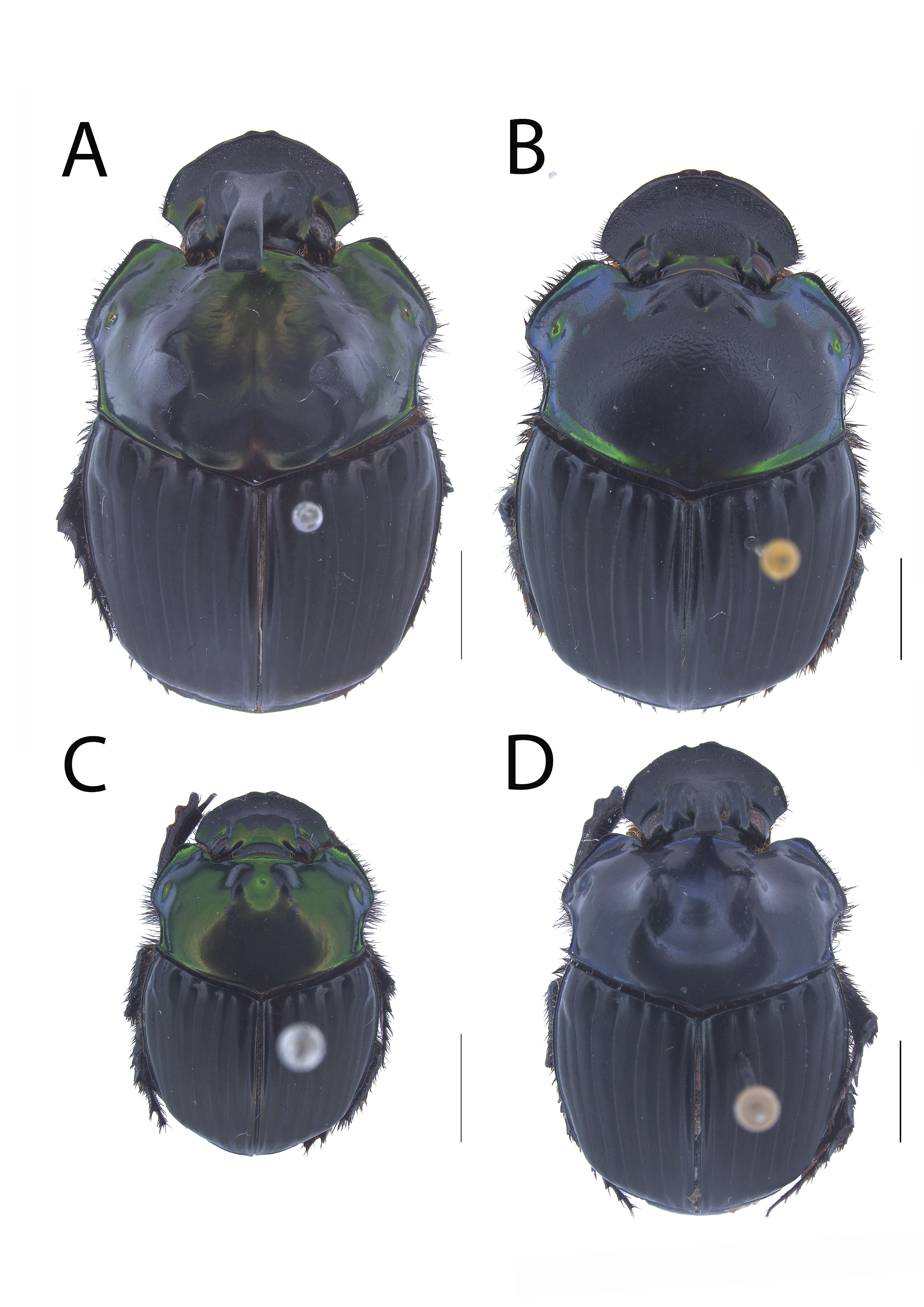
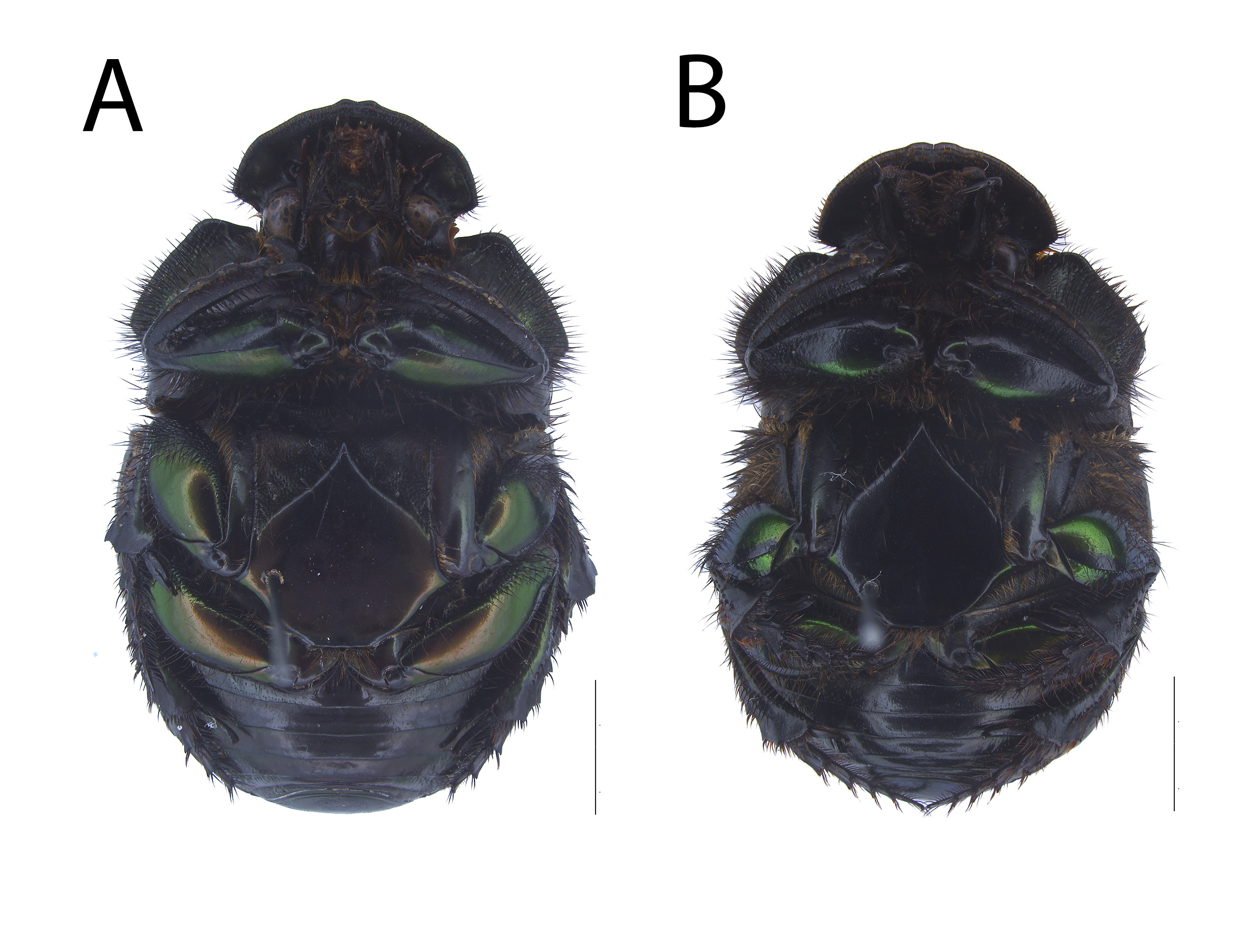
Figures 1A-D, 2A-B, 3A-B, 4A, 5A, 6A, 7A, 8A, 8D, 9

Phanaeus nordestinussp. nov. dorsal view. A) Major male. B) Female. C) Minor male. D) Color variation, male. Scale bars: A-D = 4 mm.


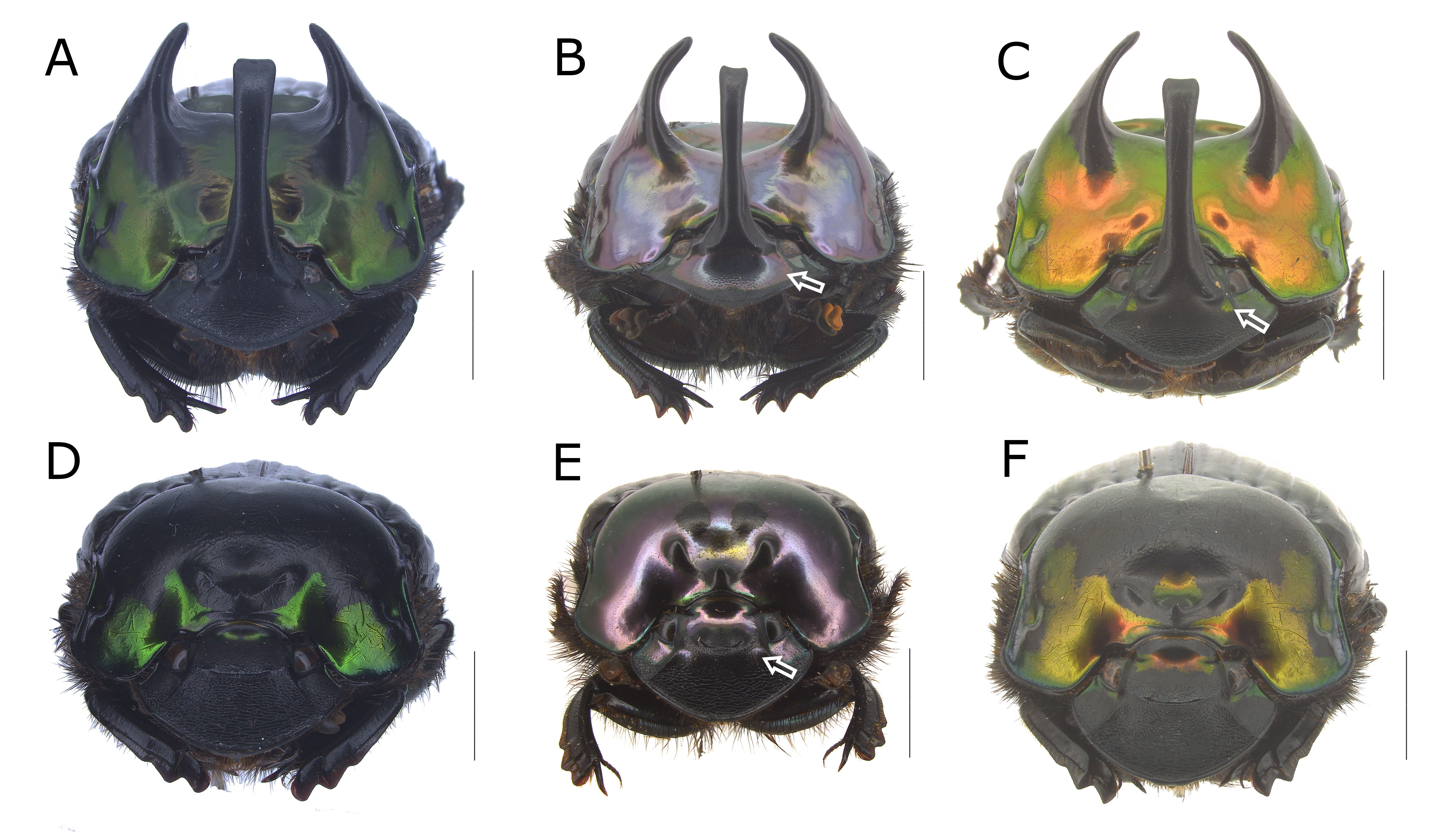
Anterior view of males of A) Phanaeus nordestinus sp. nov., B) P. dejeani and C) P. splendidulus, and D-F) Females, respectively. White arrows indicate bright surface of the posterior region of the clypeus in B), C) and E). Scale bars: A-F = 4mm.

Lateral view of the pronotum of males of A) Phanaeus nordestinus sp. nov., B) P. dejeani and C) P. splendidulus, and D-F) Females, respectively. Arrows indicate antero-median central tubercle of females D-F). Scale bars: A-B = 4 mm.

Posterior lateral concavity of major males. A) Phanaeus nordestinus sp. nov. B) P. dejeani. C) P. splendidulus. White arrows indicate the shape of posterior lateral left side concavity.

Anterior prominence of the metaventrite process. A) Phanaeus nordestinus sp. nov.. B) P. dejeani. C) P. splendidulus. Arrows indicate the tip of anterior prominence of the metaventrite process. Scale bars: A-C = 4 mm.

Male genitalia. A) Aedeagus of Phanaeus nordestinus sp. nov. in dorsal, ventral and lateral view, respectively. B) Same for P. dejeani. C) Same for P. splendidulus. D) Medial endophallite of Phanaeus nordestinus sp. nov., left and right horizontal view, respectively. E) Same for P. dejeani. F) Same for P. splendidulus. Scale bars: A-C = 2mm; D-F = 0.5mm.

Distribution map of Phanaeus nordestinus sp. nov. and closely related species (P. dejeani and P. splendidulus) from the Atlantic Forest.
-
Type material. Holotype. BRASIL: Pernambuco. Caruaru. PEJVS. 04-XI-2007 . FABSilva [1♂; CEMT]. Paratypes. BRASIL. ALAGOAS. Murici. Estação Ecológica do Murici. 06.VIII.2018. 9°14' 40"S, 35°51 ' 18"W, Félix A.P. Mata Atlântica [5♂ 1♀; CERPE]; [1♀; CEMT]. BRASIL. Paraíba: Rio Tinto. Barra do Mamanguape, 18.XII.2016, pitfall, WF Silva [1♂; CEMT]. BRASIL. PE. Bonito, 04.VI.2011 Brejo de Altitude BOM 2 - PH [2♀; CERPE]; 02-04.VI.2011 [1♂; CEMT]. BRASIL. PE. Caruaru. 03.VII.2012. Brejo de Altitude [4♂ 1♀; CERPE]. BRASIL: Pernambuco. Caruaru. PEJVS. 04-XI-2007 . FABSilva [1♀; CEMT]. Brasil: Pernambuco. Caruaru. Parque Ecológico João Vasconcelos Sobrinho Mata Atlântica. 04/XI/2007 Pitfall TD/4F 06Z D. Cavalcante et al. col. [1♂; CEMT] Brasil: Pernambuco. Caruaru. Parque Ecológico João Vasconcelos Sobrinho, 06.XI.2007 Pitfall TD/1F D. Cavalcante et al. col. [1♀; CEMT]. BRASIL: Pernambuco. Caruarú. P Eco João Vasconcelos Sobrinho. 05-V-2008 [1♂ 1♀; CEMT]. BRASIL: PERNAMBUCO. Caruaru - PEJVS 09.V.2008 Brejo de Altitude [1♀; CERPE]. Caruaru- PE 8º42'S 35º15'W, 06.XI.2007, CAVALCANTI, Pitfall Brejo de Altitude [1♂ 2♀; CERPE]. Jurema- PE 8°47'03.76"S, 36°08'32"W, 25.IX.2017 Cruz, G.A.S Pìtfall Brejo de Altitude Elevação de 733m [1♂; CERPE]. BRASIL: Pernambuco, São Vicente Férrer, Mata do Estado, 19.X.2015, WFSilva. [1♀; CEMT]. Timbaúba PE, Mata de Água Azul. 03/IX/2021 7º36.6730'S 35º22.7560'O, Silva, M. V. col. [5♂ 2♀; CEUFPE] Brasil, SE, Santa Luzia do Itanhy, APA Litoral Sul, 11º22’11.1''S, 37º25’12.8''W, 02.ix.2013, Pitfall, Fezes humana, C.M.Q. Costa leg. [2♂ 1♀; CEMT].
-
Description:Major male Holotype. Body length 21 mm; width 13 mm. Head: Clypeus bidentate, posterior region of the clypeus black, paraocular parietals half shining yellowish-green with coppery reflections; anterior paraocular area of the parietals convex; cephalic horn black, apex flat, bent at apical third over pronotum. Pronotum: Shining yellowish green with coppery reflections; anterior margin of pronotum with middle horizontal carina and with vertical fin shaped projection; anterior portion with two convex lobes; middle portion with concave depression, two pronotal horn-like projections laterally arising posteriorly, upright in lateral view, apex rounded with black macula to midlength; posterior medial margin lacking basal fossae. Elytra: Dark brown, dull; metallic reflections along suture and lateral borders. Protibia: Tridentate; third tooth flat; tibial spurs apically bent, protarsomerae absent. Metaventrite: Apex sinuous, not acute. Ventral surface: Black, lower half with bright sheen (Fig. 2A). Pygidium: Yellowish-green with coppery reflections (Fig. 3A). Aedeagus: Paramera apex flat (Fig. 8A). Medial endophallite: Dorsal end triangular, bent laterally, ventral end caudal (Fig. 8D).
-
Variation minor male. Head: cephalic horn short, or with simple carina. Pronotum: anterior portion with longitudinal tubercles, pronotal depression in anterior or medial portion (Fig. 1C).
-
Female. Dorsal habitus (Fig.1B). Females lack the cephalic and pronotal horns and instead have a weakly trituberculate cephalic carina and an antero-median trituberculated “U” shaped pronotal carina, which in lateral view is projected posteriorly to the antero-median concavity of the pronotum (Fig. 5D). The medial and posterior portions of the pronotum possess a large black macula and are convex (Fig. 1B) instead of concave, as in males. Small females have reduced macula and lack the longitudinal antero-median central carina towards the pronotal antero-median concavity. Protarsomerae present and short.
-
Chromatic variation. Some individuals lack coppery sheen and display only a yellowish green pronotum. A few specimens show a dark blue pronotum combined with dark blue-green elytra and pygidium (Fig. 1D.).
-
Diagnosis.Phanaeusnordestinussp. nov. is distinguished from P. dejeani by its geographic distribution, coloration, and pronotal morphology in large males, as well as by the anterior tubercles of the female pronotum and the shape of the central macula. Its closest relative appears to be P. splendidulus, which differs primarily in distribution: Phanaeus nordestinus sp. nov. occurs in the Northeastern Atlantic Forest and in the Brejos de Altitude, surrounded by Caatinga (Fig. 9). In large males of Phanaeus nordestinus sp. nov., the internal base of the pronotal depression at each pronotal process is shallow excavated (Fig. 6A), not rounded and excavated, as in P. splendidulus (Fig. 6C), nor strongly rounded and excavated, as in P. dejeani (Fig. 6B). In females, the anterior central pronotal tubercle of Phanaeus nordestinus sp. nov. is rounded and longitudinally weakly carinated, extending toward the antero-median concavity (Fig. 5D). In contrast, P. splendidulus typically has a central tubercle that is acute at its anterior end (Fig. 5F) (often worn) and not longitudinally carinated. The tip of the metaventrite in Phanaeus nordestinus sp. nov. is rounded in lateral view (Fig. 7A), whereas in P. splendidulus it is generally acute (Fig. 7C), though it may appear conical, anteriorly projected, or even rounded due to soil attrition. Coloration of Phanaeus nordestinus sp. nov. typically consists of green pronotum with yellow and reddish reflections and dark brown and dull elytra with bright metallic brown reflections limited to elytral suture and lateral sides (Fig. 1A), individuals with dark blue pronotum and blueish green dark elytra are rare (Fig. 1D). As observed by Edmonds (1994), some individuals of P. splendidulus from Southeast Brazil have blue or green and almost black elytra, but with bright metallic blue or green reflections in the elytra suture and lateral sides, and lacks any of the external morphological characters presented by Phanaeus nordestinus sp. nov., as discussed above. These dark elytra variations of P. splendidulus, especially those from Bahia, could be mistaken for Phanaeus nordestinus sp. nov., however, these species can be distinguished by the external morphology of large males and females, and by the anterior apex of the metaventrite process. Also, the posterior region of the clypeus is entirely black in males of Phanaeus nordestinus sp. nov., (Fig. 4A), lacking the bright sheen spots characteristic of P. splendidulus (Fig. 4C) and the bright surface of P. dejeani (Fig. 4B).
-
Male genitalia. The aedeagus of both P. splendidulus and P. nordestinus sp. nov. have the apex of the paramera flattened dorsoventrally (Fig. 8A, 8C), and differs from those of P. dejeani, which has the apex of the paramera with a dorsal sulcus at each side and the tips of the paramera rounded (Fig. 8B). Overall, the shape of the medial endophallite of the Atlantic Forest species of the P. splendidulus species group resembles an “axe head” (Fig. 8D,8F), but differs for each species, whereas the anterior margin in P. dejeani has a large sulcus (Fig. 8E), which in both P. splendidulus (Fig. 8F) and P. nordestinus sp. nov. (Fig. 8D) the anterior margin is “complete”. The ventral caudal end of the medial endophallite of P. dejeani (Fig. 8E) is thinner in comparison with the other two species. The medial endophallite of P. splendidulus is similar to that of P. nordestinus sp. nov., but differs in the shape of the ventral caudal end, which is enlarged in P. splendidulus (Fig. 8F) and thinner in P. nordestinus sp. nov. (Fig. 8D).
-
Distribution. This species occurs in Northeastern Atlantic Forest of Brazil, ranging from Paraíba to Sergipe states. It also inhabits the Brejos de Altitude, which are refugial patches of humid Atlantic Forest within the semiarid Caatinga biome (Fig. 9).
-
Biology. Little is known about the biology of the Phanaeus nordestinus sp. nov. Its feeding habits are probably coprophagous based on specimens collected in pitfall traps baited with human feces. This inference is supported by the feeding behavior of other members of the Phanaeus splendidulus species group, all of which are considered coprophagous (Edmonds, 1994).
Discussion
The species described herein share consistent characters with the species of the Phanaeus splendidulus species group. At first glance, Phanaeus nordestinus sp. nov. resembles P. splendidulus and they could be sister species, although phylogenetic studies are needed to test this hypothesis and confirm its placement within the Phanaeus splendidulus species group. We found it necessary to describe this species right now as it has been wrongly referred to as “P. splendidulus” in Ecological literature (Arcanjo et al., 2013; Dantas et al., 2018; Araújo et al., 2020; Barretto et al., 2021).
The species occurs in the Atlantic Forest of Northeastern Brazil and in the Brejos de Altitude (Fig. 9), which are montane islands of humid Atlantic Forest embedded within the semiarid Caatinga biome of Northeastern Brazil (Tabarelli and Santos, 2004). These Brejos de Altidude are important refuges of humid forest in the semiarid region, hosting significant biodiversity and providing essential ecosystem services (Pôrto et al., 2004; Pinto et al., 2025). Unfortunately, the Northeastern Atlantic Forest of Brazil has been degraded by logging and agricultural expansion (Tabarelli and Santos, 2004; Pereira-Filho and Montingelli, 2011; Zwiener et al., 2017) which contributes to local deforestation, habitat loss, and changes in mammal and vertebrate communities, leading to negative effects upon the dung beetle fauna in general (Estrada et al., 1999; Nichols et al., 2007). As a result, populations Phanaeus nordestinus sp. nov. may already be affected by fragmentation and habitat loss, even before its description, a reality faced by many undescribed species under the pressures of the Anthropocene (Liu et al., 2022). No overlap has been recognized between the distribution of the new species and populations of other members of the Phanaeus splendidulus species group, which may be plausible for the Northeastern Atlantic Forest of Bahia, with Phanaeus splendidulus.
Recently, molecular phylogenies have hypothetised the non-monophyly of the Phanaeus splendidulus species group (Price, 2007, 2009; Gillett and Toussaint, 2020). These results suggest the need for further investigation of either molecular or morphological characters of all the species within the Phanaeus splendidulus species group, which might indicate significant differences between its taxa and respective phylogenetic relationship.
Acknowledgements
We thank Paschoal Coelho Grossi, Luciana Iannuzzi and Fábio Correia Costa for kindly providing specimens and photographs for this study. We also thank Geane Brizzola dos Santos, Jorge Armando Arias-Buriticá, Mario Cupello, Paschoal Coelho Grossi and Paulo Roberto Duarte Marinho for their valuable suggestions in previous versions of this manuscript. We are grateful to Gimo Mazembe Daniel for revising the text and providing helpful comments and suggestions to this work.
Data statement
The specimens examined in this study and their associated data are deposited in the public collections listed in the Material and Methods section. Additional data are available from the corresponding author upon request.
-
Funding
HSM receives scholarship from Coordenação de Aperfeiçoamento de Pessoal de Nível Superior (CAPES, code 001; nº 23108.021416/2025-25) and acknowledges Programa de Pós-graduação em Zoologia of Universidade Federal do Mato Grosso (UFMT) for mediate the provision. This work was developed with support from the Mato Grosso Research Foundation (FAPEMAT-PRO.0002206/2025), within the scope of activities conducted by researchers of the National Institute of Coleoptera (INCol/CNPq 408430/2024-9). MEM receives a PDJ scholarship sponsored by CNPq (152670/2024-6). FZVM is a CNPq fellow (CNPq 313397/2021-0). We acknowledge subproject EECBio UFMT/Finep nº 01.12.0359.00 and subproject Peixes de Mato Grosso INCT - Peixes, funded by MCTI/CNPq (Process 405706/2022-70) for the photography system.
References
-
Araújo, J. F., Silva, F. A. B., Moura, R. C., 2020. New records of relictual populations of dung beetle species (Coleoptera, Scarabaeidae) in the Atlantic Forest of the Brazilian Northeast. Check List 16 (5), 1289-1303. https://doi.org/10.15560/16.5.1289
» https://doi.org/10.15560/16.5.1289 -
Araújo, C. O., Weber, M. M., Araújo, R. O., Dufrayer, R., Monteiro, R. F., Macedo, M. V., 2022. Parapatry of Phanaeus splendidulus and P. dejeani (Coleoptera: Scarabaeidae: Scarabaeinae) in two mountain ranges in the Atlantic Forest. Austral Ecol. 47 (8), 1578-1590. https://doi.org/10.1111/aec.13245
» https://doi.org/10.1111/aec.13245 -
Arcanjo, A., Cabral-de-Mello, D. C., Martins, C., Moura, R. C., Souza, M. J., 2013. Chromosomal diversification of diploid number, heterochromatin and rDNAs in two species of Phanaeus beetles (Scarabaeidae, Scarabaeinae). Genet. Mol. Biol. 36 (3), 341-346. https://doi.org/10.1590/S1415-47572013005000031
» https://doi.org/10.1590/S1415-47572013005000031 - Arnaud, P., 2018. Description d’une nouvelle espèce de Phanaeus d’Équateur et revalidation de l’espèce Coprophanaeus (C.) edmondsi Arnaud (Coleoptera: Scarabaeidae, Scarabaeinae). Besoiro. 26, 3-7.
-
Barretto, J., Cunha, J. C. S., Silva, F., Moura, R. C., 2021. Dung beetle communities of altitudinal Atlantic Forest remnants: diversity and composition. Int. J. Trop. Insect Sci. 41 (4), 2873-2881. https://doi.org/10.1007/s42690-021-00471-1
» https://doi.org/10.1007/s42690-021-00471-1 - Beutel, R. G., Lawrence, J. F., 2005. Coleoptera, morphology Volume 1: morphology and systematics (Archostemata, Adephaga, Myxophaga, Polyphaga partim). In: Beutel, R.G., Leschen, R.A.B. (Eds.), Handbuch der Zoology: Eine Naturgeschichte der Stämme des Tierreiches. Vol. IV, Arthropoda: insecta, n. 38, Walter de Gruyter, Berlin/New York, pp. 23–28.
-
Dantas, J. O., Ferreira, A. N., Oliveira, I. R. P., Alves, M. O., Ribeiro, G. T., Araújo-Piovezan, T. G., 2018. Edge effects on beetle assemblages in an Atlantic forest fragment and pastures in Sergipe, Brazil. EntomoBrasilis 11 (1), 26-32. https://doi.org/10.12741/ebrasilis.v11i1.739
» https://doi.org/10.12741/ebrasilis.v11i1.739 - Edmonds, W. D., 1972. Comparative skeletal morphology, systematics and evolution of the phanaeine dung beetles (Coleoptera: scarabaeidae). Univ. Kans. Sci. Bull. 49, 731-874.
-
Edmonds, W. D., 1994. Revision of Phanaeus MacLeay, a New World genus of scarabaeine dung beetles (Coleoptera: Scarabaeidae, Scarabaeinae). Contrib. Sci. 443, 1-105. https://doi.org/10.5962/p.208079
» https://doi.org/10.5962/p.208079 - Edmonds, W. D., Zídek, J., 2012. Taxonomy of Phanaeus revisited: Revised keys to and comments on species of the New World dung beetle Phanaeus MacLeay, 1819 (Coleoptera: Scarabaeidae: Scarabaeinae: Phanaeini). Insecta Mundi 0274, 1-108.
-
Estrada, A., Anzures, A., Coates-Estrada, R., 1999. Tropical rain forest fragmentation, howler monkeys (Alouatta palliata), and dung beetles at Los Tuxtlas, Mexico. Am. J. Primatol. 48 (4), 253-262. https://doi.org/10.1002/(SICI)1098-2345(1999)48:4<253::AID-AJP1>3.0.CO;2-D
» https://doi.org/10.1002/(SICI)1098-2345(1999)48:4<253::AID-AJP1>3.0.CO;2-D -
Génier, F., 2019. Endophallites: a proposed neologism for naming the sclerotized elements of the insect endophallus (Arthropoda: Insecta). Ann. Soc. Entomol. Fr. (N.S.). 55, 482–484. https://doi.org/10.1080/00379271.2019.1685907
» https://doi.org/10.1080/00379271.2019.1685907 -
Gillett, C. P. D. T., Toussaint, E. F. A., 2020. Macroevolution and shifts in the feeding biology of the New World scarab beetle tribe Phanaeini (Coleoptera: Scarabaeidae: Scarabaeinae). Biol. J. Linn. Soc. Lond. 130 (4), 661-682. https://doi.org/10.1093/biolinnean/blaa058
» https://doi.org/10.1093/biolinnean/blaa058 -
Halffter, G., Moctezuma, V., Nogueira, G., 2022. A New Species of Phanaeus MacLeay, 1819 (Coleoptera: Scarabaeidae: Scarabaeinae) from the Mountains of Jalisco, Mexico. Coleopt. Bull. 76 (3), 329-335. https://doi.org/10.1649/0010-065X-76.3.329
» https://doi.org/10.1649/0010-065X-76.3.329 -
Lawrence, J. F., Beutel, R. G., Leschen, R. A. B., Ślipiński, A., 2010. Glossary of morphological terms. In: Leschen, R.A.B., Beutel, R.G., Lawrence, J.F. (Eds), Handbook of Zoology: Morphology and Systematics (Elateroidea, Bostrichiformia, Cucujiformia partim). Vol. 2, Arthropoda: Insecta, Walter de Gruyter, Berlin/New York, pp. 9–20. https://doi.org/10.1515/9783110911213.9
» https://doi.org/10.1515/9783110911213.9 -
Liu, J., Slik, F., Zheng, S., Lindenmayer, D., 2022. Undescribed species have higher extinction risk than known species. Conserv. Lett. 15 (3), e12876. https://doi.org/10.1111/conl.12876
» https://doi.org/10.1111/conl.12876 -
Moctezuma, V., Halffter, G., 2017. A New Species of Phanaeus MacLeay (Coleoptera: Scarabaeidae: Scarabaeinae) from Los Chimalapas, Oaxaca, Mexico. Coleopt. Bull. 71 (1), 47-56. https://doi.org/10.1649/0010-065X-71.1.47
» https://doi.org/10.1649/0010-065X-71.1.47 -
Moctezuma, V., Sánchez-Huerta, J., Halffter, G., 2017. Two new species of the Phanaeus endymion species group (Coleoptera, Scarabaeiade, Scarabaeinae). ZooKeys 702, 113-135. https://doi.org/10.3897/zookeys.702.14728
» https://doi.org/10.3897/zookeys.702.14728 -
Moctezuma, V., Deloya, C., Sánchez-Huerta, J., Halffter, G., 2019. A new species of the Phanaeus endymion species group (Coleoptera: Scarabaeidae: Scarabaeinae), with commentes on ecology and distribution. Ann. Soc. Entomol. Fr. 55 (3), 249-254. https://doi.org/10.1080/00379271.2019.1577170
» https://doi.org/10.1080/00379271.2019.1577170 - Moctezuma, V., Nogueira, G., Halffter, G., 2020. A revalidation and a new species in the genus Phanaeus (Coleoptera: Scarabaeoidea: Scarabaeidae: Scarabaeinae). Besoiro. 30, 3-11.
-
Moctezuma, V., Halffter, G., 2021. Taxonomic revision of the Phanaeus endymion species group (Coleoptera: Scarabaeidae), with the descriptions of five new species. Eur. J. Taxon. 747, 1-71. https://doi.org/10.5852/ejt.2021.747.1333
» https://doi.org/10.5852/ejt.2021.747.1333 -
Moctezuma, V., Halffter, G., Lizardo, V., 2021. The Phanaeus trindens species group (Coleoptera: Scarabaeoidea) a dung beetle group with genital morphological stasis but changing ecological niche. Acta Entomol. Mus. Natl. Pragae 61 (2), 447-482. https://doi.org/10.37520/aemnp.2021.025
» https://doi.org/10.37520/aemnp.2021.025 -
Moctezuma, V., 2023. Overcoming the linnean and Wallacean shortfalls in the progress of the knowledge of the diversity of dung beetles: the case of the genera Onthophagus Latreille, 1802 and Phanaeus MacLeay, 1819 (Coleoptera: Scarabaeidae). Dugesiana. 30 (2), 177-201. https://doi.org/10.32870/dugesiana.v30i2.7284
» https://doi.org/10.32870/dugesiana.v30i2.7284 -
Nichols, E., Larsen, T., Spector, S., Davis, A. L., Escobar, F., Favila, M., Vulinec, K., 2007. Global dung beetle response to tropical forest modification and fragmentation: a quantitative literature review and meta-analysis. Biol. Conserv. 137 (1), 1-19. https://doi.org/10.1016/j.biocon.2007.01.023
» https://doi.org/10.1016/j.biocon.2007.01.023 -
Nixon, K. C., Wheeler, Q. D., 1990. An amplification of the phylogenetic species concept. Cladistics 6 (3), 211-223. https://doi.org/10.1111/j.1096-0031.1990.tb00541.x
» https://doi.org/10.1111/j.1096-0031.1990.tb00541.x -
Pereira-Filho, G. A., Montingelli, G. G., 2011. Check list of snakes from the Brejos de Altitude of Paraíba and Pernambuco, Brazil. Biota Neotrop. 11 (3), 145-151. https://doi.org/10.1590/S1676-06032011000300011
» https://doi.org/10.1590/S1676-06032011000300011 -
Pinto, A.S., Monteiro, F.K.S., Rodrigues, E.M., Gomes, D.R.F.L., Medeiros, M.C., Lopes, S.F., 2025. Phylogenetic diversity and conservation challenges in Brejos de Altitude: assessing threatened areas of the Brazilian Atlantic Forest. Reg Environ Change. 25, 15. https://doi.org/10.1007/s10113-024-02353-x
» https://doi.org/10.1007/s10113-024-02353-x - Pôrto, K. C., Cabral, J. J. P., Tabarelli, M., 2004. Brejos de Altitude em Pernambuco e Paraíba: história natural, ecologia e conservação. Ministério do Meio Ambiente, Brasília.
-
Price, D., 2007. A phylogenetic analysis of the dung beetle genus Phanaeus (Coleoptera: Scarabaeidae) based on morphological data. Insect Syst. Evol. 38 (1), 1-18. https://doi.org/10.1163/187631207788784058
» https://doi.org/10.1163/187631207788784058 -
Price, D., 2009. Phylogeny and biogeography of the dung beetle genus Phanaeus (Coleoptera: scarabaeidae). Syst. Entomol. 34 (1), 137-150. https://doi.org/10.1111/j.1365-3113.2008.00443.x
» https://doi.org/10.1111/j.1365-3113.2008.00443.x -
QGIS Development Team, 2024. QGIS Geographic Information System. Version 3.38.3. Available in: https://qgis.org (accessed 10 November 2025).
» https://qgis.org -
Riveira-Duarte, J. D., Salomão, R. P., Solís, Á., Michel, M., Matamoros, M., Kohlmann, B., 2025. The Bolboceratidae, Geotrupidae (Coleoptera, Scarabaeoidea), and Scarabaeinae (Coleoptera, Scarabaeoidea, Scarabaeidae) fauna of Honduras: taxonomy and distribution. ZooKeys 1255, 127-206. https://doi.org/10.3897/zookeys.1255.150586
» https://doi.org/10.3897/zookeys.1255.150586 - Schoolmeesters, P., 2025. Scarabaeidae Database. Catalogue of Life Foundation, Amsterdam.
- Tabarelli, M., Santos, A. M. M., 2004. Uma breve descrição sobre a história natural dos brejos nordestinos. In: Pôrto, K.C.; Cabral, J. J. P.; Tabarelli, M. (Eds.), Brejos de altitude em Pernambuco e Paraíba: história natural, ecologia e conservação. Ministério do Meio Ambiente, Brasília, DF, pp. 17–24.
-
Tarasov, S., Génier, F., 2015. Innovative Bayesian and Parsimony Phylogeny of Dung Beetles (Coleoptera, Scarabaeidae, Scarabaeinae) Enhanced by Ontology-Based Partitioning of Morphological Characters. PLoS One 10 (3), e0116671. https://doi.org/10.1371/journal.pone.0116671
» https://doi.org/10.1371/journal.pone.0116671 - Wheeler, Q. D., Platnick, N. I., 2000. The Phylogenetic Species Concept. In: Wheeler, Q.D., Meir, R. (Eds.), Species Concepts and Phylogenetic Theory. Columbia University Press, New York, pp. 55–69.
- Zunino, M., 1978. L’armatura Genitale Negli Ontophagini: Tecniche di Preparazione e Criteri di Studio. L'informatore del Giovane Entomologo. 90, 21–26.
-
Zwiener, V. P., Padial, A. A., Marques, M. C. M., Faleiro, F. V., Loyola, R., Townsend Peterson, A., 2017. Planning for conservation and restoration under climate and land use in the Brazilian Atlantic Forest. Divers. Distrib. 23 (8), 955-966. https://doi.org/10.1111/ddi.12588
» https://doi.org/10.1111/ddi.12588
Edited by
-
Associate Editor:
Adriana Marvaldi