 New nests of Zethus reveal unexpected architecture variation in the olmecus species group (Hymenoptera, Vespidae)
ABSTRACT
Zethus Fabricius is the largest known genus in Vespidae, but very little is known about their nesting behavior. Belonging to the Z. olmecus species group, Zethus miniatus is widely known for its subsocial behavior, where females build together aerial nests comprised of a cluster of several cells. Nests of closely related species of the same species group, Z. notatus, Z. schadei and Z. thoracicus, collected in the Amazon basin, are here described and illustrated. Nests of Z. notatus and Z. thoracicus reveal architectures very distinct from those of Z. miniatus. Although examined nests are all aerial and comprised of at least four cells, the orientation and maceration of vegetable matter vary among these species. Finally, notes on social behavior and progressive provisioning of Z. schadei and Z. thoracicus are provided.
Keywords:
Nest structure; Communal nesting; Zethus (Zethoides)
Introduction
Although Vespidae have probably originated from a stem-group of wasps with a fossorial nesting habit (Melo et al., 2011; Mauss et al., 2019), the more derived aerial forms of nesting stand out as they are more easily found. The nests of social vespids have intrigued naturalists for some time, with de Saussure (1853-1858) already separating nests into categories. Comprehension of nest architecture has advanced since then, with finer examination leading to the possibility of identifying genera (Wenzel, 1998) and even mapping the evolution of nest structures (Noll et al., 2021). However, the same cannot be said for the solitary vespids, whose nests are mostly subterraneous or in pre-existing cavities (Mauss et al., 2019) and therefore, only seldomly observed.
ZethusFabricius (1804) is the genus with the highest number of species in Vespidae, reaching 299 worldwide, of which 239 occur in the New World and are, so far, divided into six subgenera (Lopes et al., 2021a). Despite its great diversity, very little is known from the nesting biology and behavior of these wasps, as only 22 species from the New World have some sort of published information on nesting (Bohart & Stange, 1965; Stange, 1969; Garcete-Barrett & Klassen Dück, 2010; Cooper, 2014, 2016; Lopes et al., 2019, 2021b; Lopes, 2023). While most of its representatives nest in pre-existing cavities, six species stand out for building aerial nests: Z. (Wettsteinia) fabricator Stange, 1969, with the nest described in the same study where the species was described (Stange, 1969); Z. (Zethoides) matzicatzinde Saussure, 1857b, with the nest described by Rau (1933); Z. (Zethoides) binodis (Fabricius, 1798), by Ducke (1914); Zethus (Zethoides) schadei Bohart & Stange, 1965, with notes of the nest by W. Weyrauch published by Bohart and Stange (1965); Z. (Zethoides) miniatusde Saussure (1858), also by Ducke (1914); and Z. nodosusZavattari (1912), with the nest described by Lopes (2023).
Belonging to the Z. olmecus species group, Z. miniatus is perhaps the most renowned species in the genus. The depiction of communal behavior portrayed by Ducke (1914) led researchers to mistakenly believe Zethus displayed an intermediate stage between solitary and social behaviors (Hines et al., 2007). This has already been dismissed, as this group is derived and this social trait is clearly independent from eusociality (Lopes & Noll, 2018; Piekarski et al., 2018; Lopes et al., 2021b). Although the nest of Z. schadei, which also belongs to this species group, is already described (Bohart & Stange, 1965), no notes on behavior have been presented to date.
Nests assigned to Z. notatusFox (1899) and Z. thoracicusFox (1899), which also belong to Z. olmecus group, are herein examined and described. Also, notes suggesting communal social behavior of Z. thoracicus and Z. schadei are provided.
Methodology
We studied here five nests of Zethus belonging to species of the olmecus group, all collected manually by the second author in 1991 and 1999 in different sites within the Amazon basin, in Brazil. After being collected, each nest was placed in a bag with a piece of soft paper extending from the bottom of the bag all the way through the opening. Bags were sealed through an overhand knot with the piece of soft paper entwined. The porosity of the paper connected the inside of the bag with the external environment assuring gas diffusion and avoiding moisture from accumulating inside the bag. For storage, each nest was individually preserved, wrapped in soft paper, placed within a tightly knotted plastic bag and gathered in plastic containers holding several bags. Nests and specimens are deposited in the Coleção de Entomologia “Padre J. S. Moure”, Departamento de Zoologia, Universidade Federal do Paraná (DZUP). The studied nests were collected in four locations:
-
Reserva Ducke, Manaus
-
Rio Marié (left margin near the mouth at River Rio Negro): 0.4343°S, 66.4062°W, 55 m (03.vii.1999, G.A.R. Melo, ninho RN37)
-
Rio Puraquequara, Amazon Village Hotel: 2.9735°S, 59.8373°W, 30 m.
-
Plano, Rio Negro (left margin): 0.3099°S, 65.9901°W, 51 m (9.vii.1999, G. Melo)
The examination was carried out with the aid of a Leica M125 stereoscope. Pictures were taken either with a Leica DFC295 camera attached to the stereoscope through the Helicon Focus 8 software or with a Canon camera with a macro-objective.
Measurements were taken with a digital caliper, except for cell diameter and leaf fragment sizes, for which the eyepiece ruler of the stereoscope was used. Cell depth of the nests of Z. schadei and Z. thoracicus was measured by inserting a pin in the cell until it hit the bottom, marking the depth in the pin and finally measuring with the pachymeter. Leaf fragments were measured from material that detached from the nest, using those that had little or no warping, being as straight as possible for accurate measuring. Brood cell and leaf fragment measurements are presented by average and standard deviation values and individual measurements are provided in the Supplementary Material.
Specimens collected from the nests were identified following the identification key from Lopes and Noll (2024).
Results
Three of the collected nests belong to three species in the Zethus olmecus species-group: Z. notatus Fox, 1899, Z. schadei Bohart & Stange, 1965 and Z. thoracicus Fox, 1899. The other two nests were abandoned and are tentatively assigned to Z. notatus and Z. thoracicus based on similarities in nest architecture. The nests of Z. notatus and Z. thoracicus were hereto unknow, while as for the nest of Z. schadei it was known in the literature only from drawings in Bohart and Stange (1965). The nests are described and illustrated below.
Zethus (Zethoides) notatus Fox, 1899
Nest 1
Collecting data: Translated from field notes of the second author: “RN37 – Zethus, nest constructed around filamentous fungus (same set of fibers that RN36 [belonging to a species of Trypoxylon] was hanging). No adult present. Four cells, three open and one closed. Marié River, 03.vii.1999. In 15.vii.1999, there was a dead adult in the plastic bag. Nest was probably being provisioned at the time of collecting, because there is a live larva in one of the cells. I was able to extract the larva and it is relatively small. Species most likely of progressive provisioning. The larva was placed in fixative with the adult”.
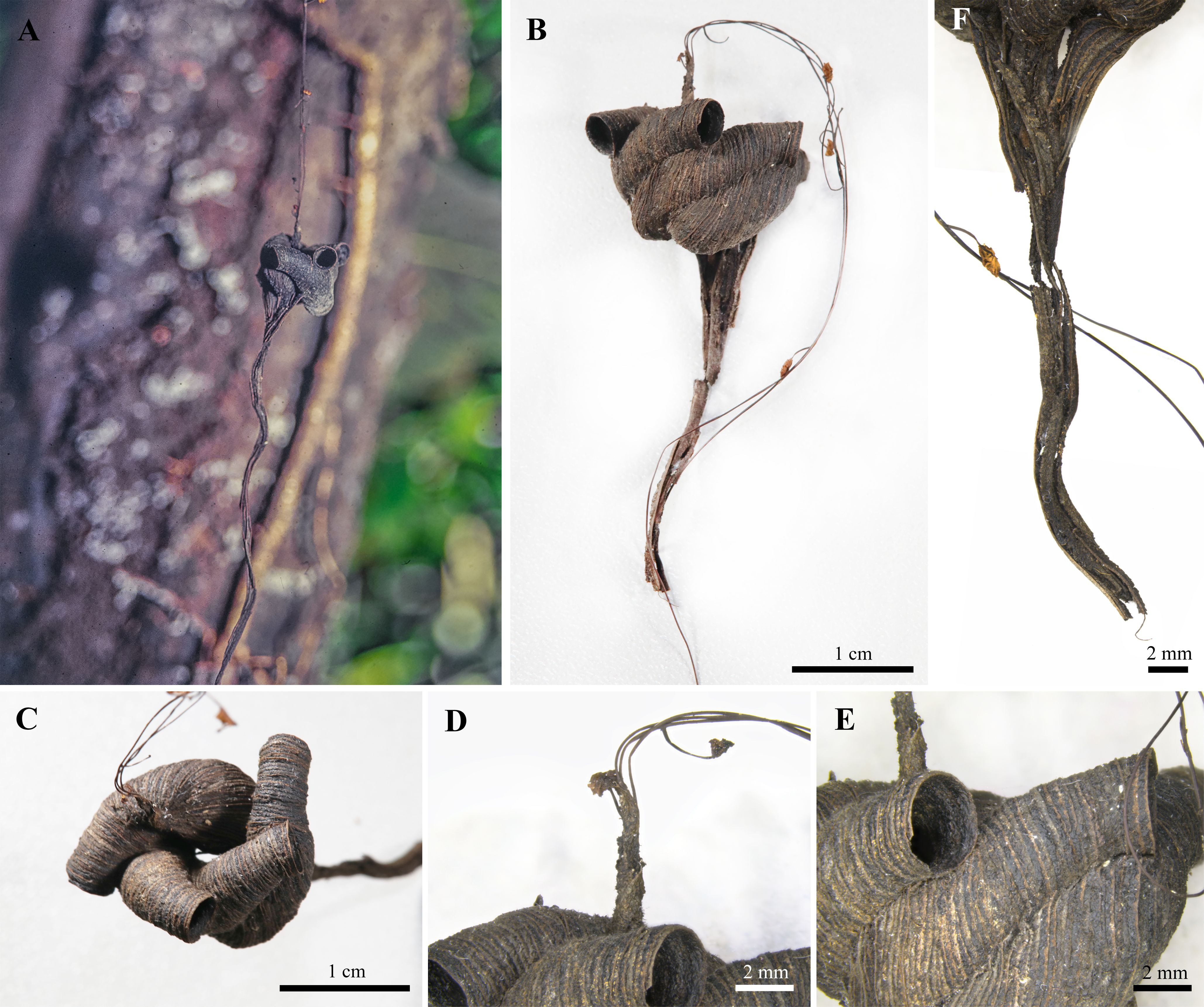
Overall aspect (Fig. 1C): the nest is composed of four exposed cells that close a circle, following a counter-clockwise direction (when observed from above), around the fungus. A very long “ornament” (a lower prolongation) made of vegetable matter extends downwards following the fungus filament.

Nest of Zethus notatus. A) Nest in collecting site. B) Lateral view of nest. C) Overhead view of nest. D) Area of fixation of the nest, revealing the leaf threads wrapping around the fungus. E) Closeup on the arrangement of strips used to build cells. F) Detailed view of the ornament.
Fixation: the nest is firstly attached through long strips of cut foliage and resinous matter that wrap around three filaments of a Marasmius fungus in a downward spiral (Fig. 1D) that is then fixed in the basolateral side of what probably is the first cell. The following cells are fixed adjacently on the underside of the previous cell.
Brood cells: The set of four cells were disposed in a circular pattern. Each cell spirals upward, with the fungus filament as a central axis. Each cell makes an approximate 160° turn, leaving the opening facing almost in the opposite direction of the bottom, giving a J-shape to the cell. The cells are more robust at the bottom, narrowing along the curvature and becoming cylindrical on the apical straight half. The cells are built in a manner that the bottom of each cell begins at approximately the same height in lateral view. The heights of the openings are also at the same level. Each cell is built adjacently on the underside of the previous one, where there is contact until about half of the cell length. Although very close, the fourth cell closes the circle but does not touch the first cell. The cells are made of long strips of cut leaves, tightly glued together, that spiral towards the opening (Fig. 1E). While it is possible to discern each layer, it is difficult to stablish the end and beginning of each strip. The space between each strip is coated with a blackish resinous matter, leaving the light-brown apical margin of the strip free.
Ornament (Fig. 1F): projecting from the underside of each cell, a series of long leaf strips converge centrally towards the fungus filament, with six strips originating from under the first cell, seven from the second, two from the third and two from the fourth. These cuttings, once converged, lie parallel to the axis of the fungus filament, fixed to it. The spaces between leaf strips are also coated in dark resinous material, with the light uncoated margin outwards oriented. Other cuttings are placed along the ornament but only four form at the apical end. One fragment was broken off.
Measurements: Length of fungus filament above nest = 85,75 mm. Nest: height = 12.16 mm; width = 19.75 mm. Ornament = 29.39 mm. Cells: length = 8.43 mm ± 0.38mm; distance between bottom of adjacent cells = 4.27 mm ± 0.35 mm; distance between bottom of cell and opening of previous cell = 11.24 mm ± 0.50 mm; opening diameter = 3.80 mm± 0.10 mm.
Nest 2
Collecting data: unknown. Stored with another nest collected in 1991 in the Reserva Ducke, so it is probably from this site or from nearby areas north of Manaus.
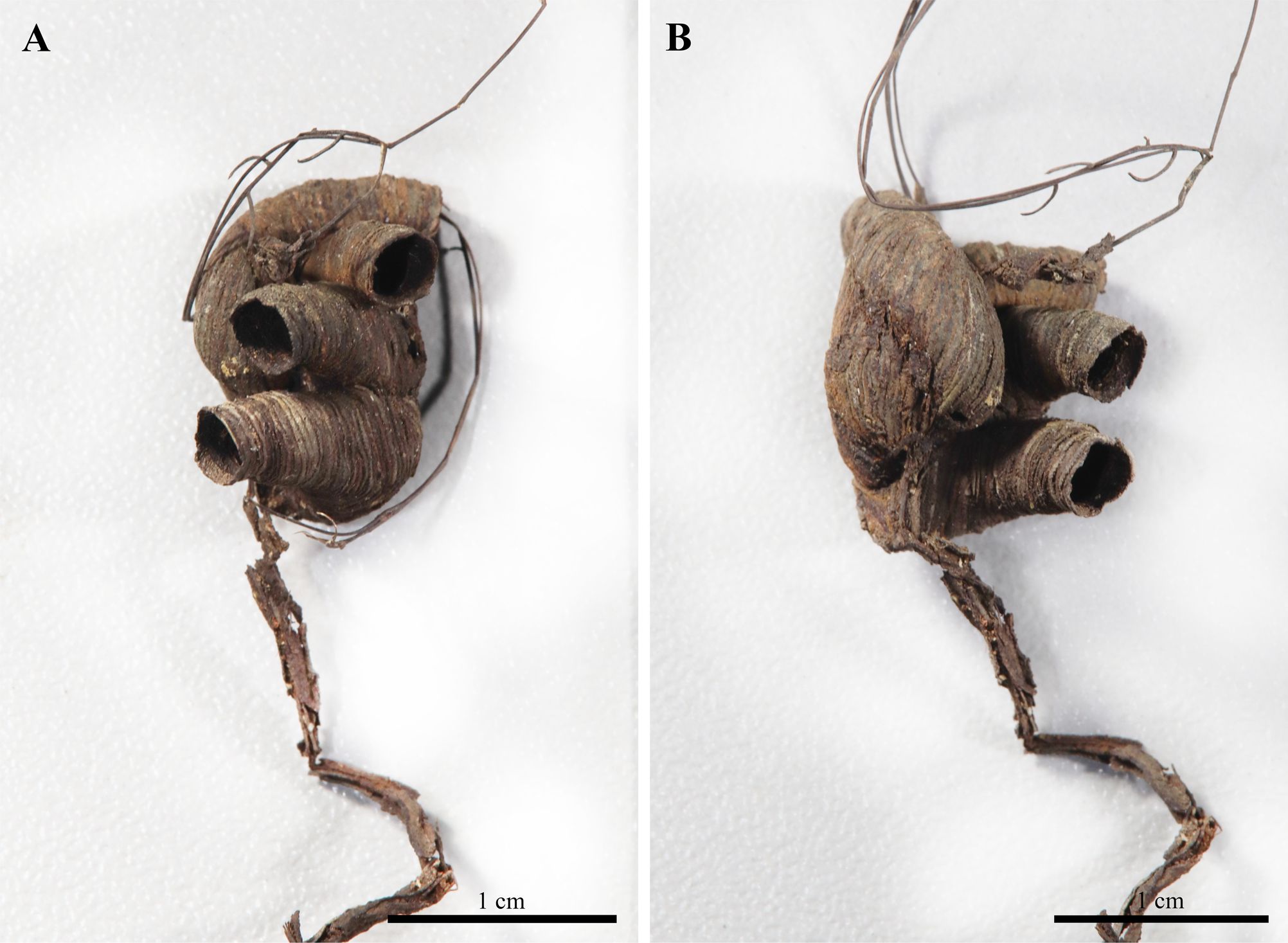
Overall aspect (Figs. 2A, 2B): similar to the first nest, also with four cells and it is also built using a Marasmius fungus as substrate. Most other traits are similar, except for orientation of cells and formation of the ornament. The cells follow a similar pattern spiraling upwards with a curvature around the fungus, however in a clockwise manner. Also, the cells are not leveled, with each subsequent cell lower than the previous, with the bottom built below the bottom of the previous cell. A small circular orifice on the bottom of the first cell suggests emergence of a parasitoid. There is also an orifice of irregular shape on the side of the third cell but does not remind those left behind by parasitoids. The ornament is also similar but seems to originate from a single spot, rather than the bottom of each cell like in the previously described nest. Also, its strips are all dark without any lighter colored margins. Measurements: Nest: height = 15.72 mm; width = 14.32. Ornament = 28.65 mm.
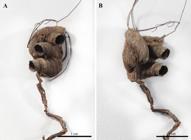
Abandoned nest tentatively assigned to Z. notatus. A) View exposing openings. B) View exposing bottom of brood cells.
Zethus (Zethoides) schadei Bohart & Stange, 1965
Collecting data: Translated from field notes of the second author: “RN126 – Zethus miniatus (?). Nest built on a piece of straw on the margin of straw roof. Four adults present. 14 cells: 3 open (all with larvae; one of them still without the collar and with its walls still green). Amazon Village Hotel, Rio Puraquequara, 31.vi.1999: (nest recorded in 05.viii.1999: another cell had the cap partially open and has an apparently dead adult inside; I finished opening it and found out that it contained a female, which was alive; it was removed and sacrificed)”.
Overall aspect (Figs. 3A, 3B): The nest was fixed hanging on a fine piece of straw and is comprised of a cluster of fourteen adjacent exposed cells that are perpendicular to the substrate.

Nest of Z. schadei. A) View of the openings. B) Lateral view. C) Closeup showing examples of nest entrances: completely closed (triangle); completely open (arrowhead); and partially open (arrow). D) Close up of leaf fragments on external surface of cells.
Fixation: a single piece of straw runs adjacent to the lateral walls of the first cells of rows one, two and four and is partially englobed by a mixture of vegetable and resinous matter.
Brood cells: there are fourteen cells, all barrel-shaped of similar height, aligned and arranged in five rows: four rows of three cells each and one row of two cells. The left lowermost cell is incomplete, empty and its color is now brownish instead of green like described in the journal. The first cell of rows three to five are completely open and empty (Fig. 3C). The first cell of rows one and two and the second cell of rows two and three are completely sealed (Fig. 3D). The remaining cells present different degrees of incomplete opening of the cap, each one with a developed adult inside (Fig. 3D). External cell walls are comprised by irregular-shaped cuttings of leaves intercalated by dark resinous substance, giving it a scale-like appearance (Figs. 3B, 3D). Internal walls and the border of the openings are made of finely macerated vegetable matter, giving a more regular appearance.
Measurements: Nest: length = 20.40 mm; width = 15.54 mm; height = 12.30. Cell opening diameter = 2.89 mm ± 0.22 mm.
Zethus (Zethoides) thoracicus Fox, 1899
Nest 1
Collecting data: collected in 24.viii.1991 in the Reserva Ducke, Manaus. The nest was found suspended by a fine root in a small earth bank. There were six females in the nest at the time of collecting. Cell content was not examined.
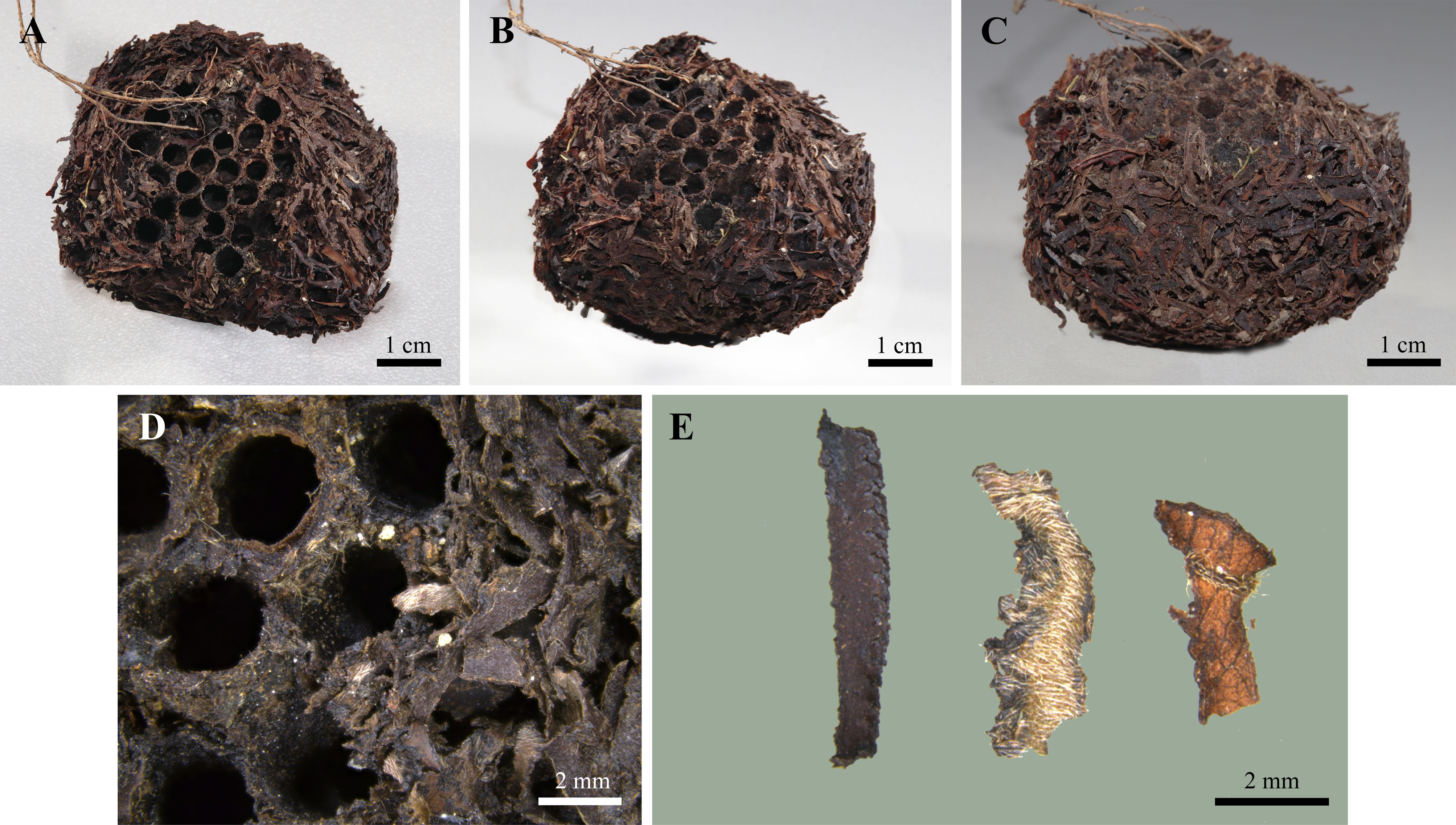
Overall aspect (Figs. 4A-4C): The nest consisted of an approximate spherical structure, bearing a dome made of cut leaves on the upper part. Unfortunately, no details about the dome were taken at the time of collecting and desiccation of the leaves led to its rapid fragmentation. The lower portion of the nest remained mostly intact and comprised a group of vertically oriented and adjacent brood cells, all aligned parallel to the root, with their opening directed upwards. Laterally and in the bottom, the cell set was surrounded by layers of leaf fragments, similar to those making up the dome.

Nest of Zethus thorcacicus. A) Overhead view. B) Oblique view. C) Lateral view. D) Closeup of nest, showing finely macerated matter comprisinf cells (left) and larger leaf fragments comprising the cover (right). E) Examples of leaf fragments detached from the nest: without trichomes (left); completely covered in trichomes (middle); trichomes only on midrib (right).
Fixation: the nest used a ramified root as substrate, with two more robust segments and several thin, more delicate segments which were broken, but previously continued into the nest. The more robust portions appear to be the main support of the nest, one in each side of an outermost cell of the cluster (third cell of the second row). The root reemerged from the nest below, making a loop under it.
Brood cells: total of 25 cells, arranged in six rows with 3, 3, 7, 5, 4 and 3 cells. This arrangement in rows is indicated here simply for mapping purpose and does not imply the order in which they were built. The second row presents a cavity that superficially resembles a cell, but closer examination reveals it is not, as it does not possess the typical concentric walls and it is much shallower than the cells. Cell openings are circular to ellipsoid. Cell walls are built with a finely macerated material (Fig. 4D), which is impossible to determine foliar structure beyond some sparse trichomes. Borders of some openings may present small leaf fragments.
Cover: we refer here basically to the layers covering the lower portion of the nest around the cell set. It comprised of cuttings of foliage arranged in several layers. Leaf fragments were majorly strips with few fragments presenting short and/or irregularly shapes (Fig. 4E). The material presents leaves of different morphology regarding trichomes, which when present can be restricted to veins or along the whole fragment. Also, coloration and vein pattern of leaves vary. Most fragments present one serrated margin, usually along the length of the fragment, that indicates where the leaves were cut by the wasp. The “teeth” of these serrations are curved. Leaf fragments appear to be randomly arranged, glued together only at some points, rather than the entire extent and so leaving wide spaces between each strip.
Measurements: Root: length above nest = 9 cm; ramification until nest attachment = 4.43 cm; length inside nest = 2.61 cm. Nest: greatest length = 47.53 mm; greatest height = 37.49 mm. Cell area: greatest length = 51.94 mm; greatest width = 29.43 mm. Cell depth = 18.16 mm ± 2.16 mm; cell opening diameter = 3.92 mm ± 0.27 mm. Leaf cover of variable width: greatest width = 18.07 mm; smallest width = 3.36 mm. Leaf fragments: greatest length 9.1mm; smallest length = 3.3 mm; greatest width = 2.9 mm; smallest width = 0.8 mm. Length/width ratio of leaf fragments: greatest = 9.1; smallest = 2.5.
Nest 2
Collecting data: Translated from field notes of the second author: “RN58 – Zethus(?) Nest built with pieces of cut leaves fixed to a thin root on a bank formed by a fallen tree. (Terra firme forest). No adult present. Nest will not be dissected (no signs of wasps exiting from the nest; also, cannot know if there are built cells). Plano, 09.vii.1999.”
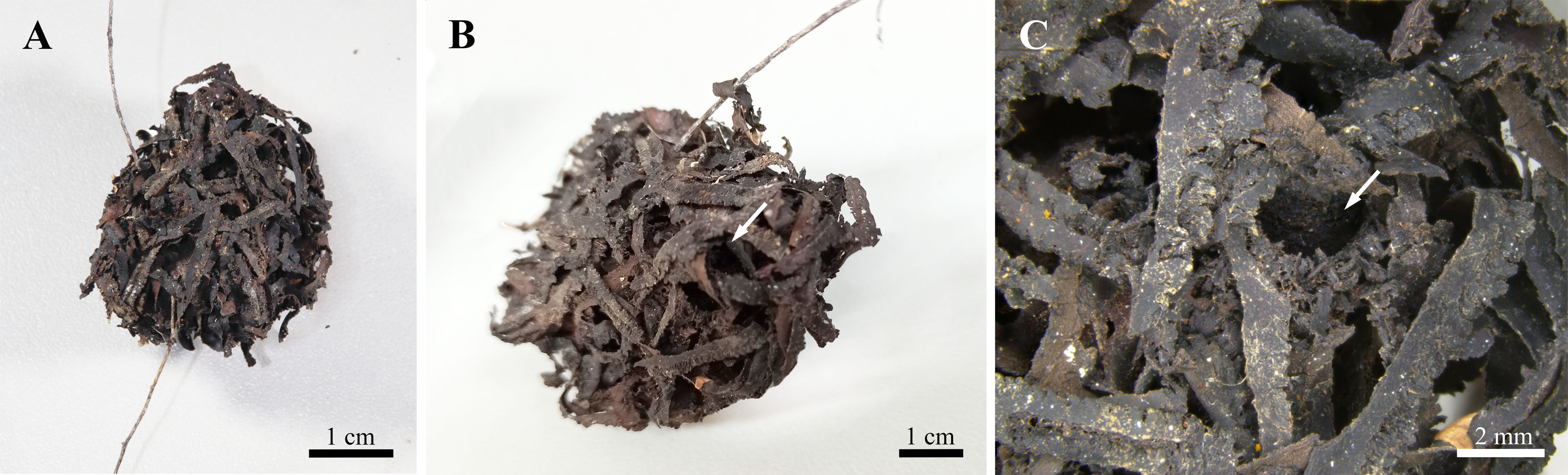
Overall aspect (Fig. 5A): this abandoned nest showed great similarity with the one described above. It was smaller in size and presented an intact dome. The dome is of a rough cone shape. The complex arrangement of leaf fragments seems to be more loosely mounted on the dome and a circular opening directed upwards can be seen near the top (Fig. 5B). This is speculated to be the nest entrance, but it is uncertain since the loose arrangement of the dome may leave other spaces that the wasps apparently can crawl through. Among the spaces between the leaves of the dome, two cells can be observed (Fig. 5C), but there may be more since these cells are far from the fixation to the root. There is no clear external definition between the dome and the inferior portion containing the cells. Height = 33.34 mm; length = 29.25 mm; width = 19.26 mm.

Abandoned nest tentatively assigned to Zethus thoracicus. A) Lateral view. B) Oblique view showing probable main entrance (arrow). C) Closeup showing cell amidst fragments of leaves.
Discussion
Nesting behavior in New World Zethus is still poorly known. The aerial nests, although probably convergent between different species groups, seem to be frequent among species groups of Z. (Zethoides) Fox, 1899, specifically the Z. binodis and Z. olmecus species groups. This makes the subgenus the one with, proportionally, the highest number of species with information of nesting behavior.
Curiously, Lopes and Noll (2024) report examining specimens of Z. luederwaldti (von Ihering, 1911), Z. toltecus segmentalis (von Ihering, 1911) and Z. utingensis Lopes, 2024 collected from trap nests, indicating that not all species in the olmecus species group build aerial nests. Bohart and Stange (1965) briefly describe a cell of Z. luederwaldti, but no other traits of the nest are given, leaving us without knowing whether the nest is aerial or in a cavity.
The use of fungal rhizomorphs of the genus Marasmius for nest construction is widely reported among birds (Elliott et al., 2019). These rhizomorphs have also been previously reported in Vespidae as substrate for nest fixation. Starr (1988) translates Jacobson’s (1935) “Aanteekeningen over Stenogastrinae” where it is stated that Parischnogaster mellyi (de Saussure, 1852) uses Marasmius equicrinus or another species of Marasmius as a petiole for the comb of the nest. In a similar manner, Turillazzi (1990) also reports the use of Marasmius for the suspension of Metischnogaster drewseni (de Saussure, 1857a) nests.
A convergence of such distantly related organisms using the same material for nesting should have its benefits. Recently, Oliveira and Ishikawa (2019) described M. yanomami, that was being used for basket manufacturing by the indigenous Yanomami people from Brazil. The mechanical resistance of the rhizomorph is considerable and although considered as reason for selection, studies of bird nests indicate occurrence of more resistant alternative materials in the area. Therefore, a hypothesis that justifies its selection based on strength alone could be dismissed (Rana et al., 2021). Another fact that helps dismiss this criterion for wasp nests is that their nests are usually very light, not requiring a very resistant material. Other studies indicate that there are antibiotic and antiteratogenic properties in Marasmius fungi (Rosa et al., 2009; Ramesh & Pattar, 2010), from which the animals that use it as building material could benefit from, as the fungi become both a resource for nest support and biochemical combatant of pathogens (Aubrecht et al., 2013).
The nest of Z. thoracicus is remarkable in size, with 25 cells and at least six adult females (more could be away from the nest at the time of collecting). However, brood cell inspection revealed them to be empty without any larvae or pupae. Hence, there is reason to believe the nest would be in the end of its cycle and that the captured females were probably newly emerged and/or would soon leave the nest.
The nest of Z. schadei here observed agrees with the description brought by Bohart and Stange (1965), although with a smaller number of cells and different cell arrangement. Nevertheless, this nest was apparently in a moment of sharp growth, evidenced by the large number of closed cells at the time of collecting (many recorded as partially open at present examination) and cells that were still being built. Furthermore, this nest is very similar to the nest of Z. nodosus and the more widely known nest of Z. miniatus, from which it differs mainly in cell orientation. Nevertheless, the architecture of the newly described nests of Z. notatus and Z. thoracicus greatly vary from each other and from Z. miniatus, Z. nodosus and Z. schadei, revealing great difference of nest architecture in this species group.
If looking into similarity between these aerial nests, we can form three groups: one composed of Z. miniatus, Z. nodosus and Z. schadei; one by Z. thoracicus; and the last by Z. notatus. The miniatus-type nests will have cells fixed transversely to the substrate, cell walls made of finely macerated material and covered by tightly glued leaf fragments. The thoracicus-type group shares with the latter the cell walls of finely processed material, but its cells are parallel to the substrate and the leaf fragments covering are loosely fixed. Although loosely fixed, the leaf-dome and cover may act as a barrier against predators and parasitoids, serving as a maze to hinder attempts to approach brood through the opening or cell walls. Finally, the notatus-type nests share no common traits other than being aerial and made of foliage. Their cells are made from tightly glued leaf strips without any cover layer and follow a circumcentric orientation regarding the substrate. The nests from trap nests will probably form a fourth group. These similarities and differences require deeper exploration but are plausible characters to be explored in the advent of phylogenetic analysis.
Although no ethological observations on nest building were made, collecting four and six adult females inside the nests of, respectively, Z. schadei and Z. thoracicus indicate communal nesting. This classification of subsocial behavior, where two or more females nest together, but each tends to its own brood, has been reported previously for Z. miniatus by Ducke (1914), who mistakenly identified as Z. lobulatus. Observing this trait for species with so distinct nest architectures raises the question of where communal nesting originated in the Z. olmecus species group. However, this question can only be answered through a proper phylogenetic study.
Conclusion
The yet unknown nests of Z. notatus and Z. thoracicus were described along with reports of several females nesting together in Z. schadei and Z. thoracicus. These are valuable additions to the large gap in the knowledge of nesting in Zethus. The notorious diversity of architecture and the alternation of solitary and subsocial behavior within very closely related species is intriguing and deserves a phylogenetic study (Lopes et al., in prep.) to better understand the evolution of this group.
Supplementary Material
The following online material is available for this article:
Table S1 -
Figure S1 -
Figure S2 -
Table S2 -
Table S3 -
Figure S3 -
Table S4 -
Acknowledgements
GARM thanks Marcos Vinicius Bastos Garcia for his help and support during the collecting trip to Manaus in 1991 and 1999. The collecting trip along the Rio Negro river in 1999 was organized by the late professor João Maria Franco de Camargo. Both authors thank Caio A. Leal-Dutra for identifying the filamentous fungus and Marcos Fianco for digitizing the slide of the nest of Zethus notatus (RN37)
-
Funding
São Paulo Research Foundation (FAPESP) grants #2021/00766-0 and #2019/09215-6.
References
-
Aubrecht, G., Huber, W., Weissenhofer, A., 2013. Coincidence or Benefit? The use of Marasmius (Horse-Hair Fungus) Filaments in Bird Nests. Avian Biol. Res. 6 (1), 26-30. http://doi.org/10.3184/175815512X13531739538638
» http://doi.org/10.3184/175815512X13531739538638 - Bohart, R. M., Stange, L. A., 1965. A Revision of the genus Zethus Fabricius in the Western Hemisphere (Hymenoptera: eumenidae). Univ. Calif. Pub. Entomol. 40, 1-208.
- Cooper, M., 2014. Two new species of Zethus Fabricius in the coeruleopennis group (Hymenoptera: Vespidae, Eumeninae). Entomol. Mon. Mag. 150, 39-42.
- Cooper, M., 2016. A new species and new records of Zethus Fabricius in the pallidus-group (Hymenoptera: Vespidae, Eumeninae). Entomol. Mon. Mag. 152, 207-210.
-
de Saussure, H., 1852. Études sur la Famille des Vespides 1. V. Masson, J. Cherbuliez, Paris, 286 pp. http://doi.org/10.5962/bhl.title.39973
» http://doi.org/10.5962/bhl.title.39973 - de Saussure, H., 1853-1858. Études sur la Famille des Vespides 2. V. Masson, J. Kessmann, Paris, 256 pp.
- de Saussure, H., 1857a. Description de quelques Vespides nouveaux. Ann. Soc. Entomol. Fr. 3 (50), 315-319.
- de Saussure, H., 1857b. Nouveaux vespides de Mexique et de l’Amérique septentrionale. Rev. Mag. Zool. Pure Apliquee 9 (2), 269-280.
- de Saussure, H., 1858. Note sur la famille des Vespides. Rev. Mag. Zool. Pure Apliquee 10, 63-66.
- Ducke, A., 1914. Über Phylogenie und Klassifikation der sozialen Vespiden. Zool. Jahrb. 36, 303-330.
-
Elliott, T. F., Jusino, M. A., Trappe, J. M., Lepp, H., Ballard, G.-A., Bruhl, J. J., Vernes, K., 2019. A global review of the ecological significance of symbiotic associations between birds and fungi. Fungal Divers. 98 (1), 161-194. http://doi.org/10.1007/s13225-019-00436-3
» http://doi.org/10.1007/s13225-019-00436-3 -
Fabricius, J.C., 1798. Supplementum Entomologiae Systematicae. Apud Proft et Storch, Hafniae, 572 pp. http://doi.org/10.5962/bhl.title.65803
» http://doi.org/10.5962/bhl.title.65803 - Fabricius, J.C., 1804. Systema Piezatorum : Secundum Ordines, Genera, Species, Adiectis Synonymis, Locis, Observationibus, Descriptionibus. Christ. Fabricii. Carolum Reichard, Brunsvigae, 439 pp. http://doi.org/10.5962/bhl.title.10490
-
Fox, W. J., 1899. Contributions to a knowledge of the Hymenoptera of Brazil. No. 7 - Eumenidae (Genera Zethus, Labus, Zethoides, Eumenes, Montezumia and Nortonia). Proc. Acad. Nat. Sci. Philadelphia 51, 318-318. http://doi.org/10.1093/nq/s5-VI.146.318i
» http://doi.org/10.1093/nq/s5-VI.146.318i - Garcete-Barrett, B. R., Klassen Dück, C. H., 2010. Biological observations on the genus Ceramiopsis (Insecta: Hymenoptera: Vespidae: Masarinae). Bol. Mus. Nac. Hist. Nat. Parag. 16, 8-17.
-
Hines, H. M., Hunt, J. H., O’Connor, T. K., Gillespie, J. J., Cameron, S. A., 2007. Multigene phylogeny reveals eusociality evolved twice in vespid wasps. Proc. Natl. Acad. Sci. USA 104 (9), 3295-3299. http://doi.org/10.1073/pnas.0610140104
» http://doi.org/10.1073/pnas.0610140104 -
Lopes, R. B., Noll, F. B., 2018. Cladistic analysis of the Zethus (Zethoides) (Hymenoptera, Vespidae, Eumeninae) species groups with insights on the current subgeneric classification of Zethus Fabricius, 1804. Insect Syst. Evol. 49 (2), 103-129. http://doi.org/10.1163/1876312X-00002165
» http://doi.org/10.1163/1876312X-00002165 -
Lopes, R. B., Brozoski, F., Buschini, M. L. T., 2019. Zethus (Zethus) pilosus Zavattari, 1912 (Hymenoptera: Vespidae: Eumeninae) from Southern Brazil: description of the female, the male genitalia, its nest and notes on biology. Zootaxa 4648 (1), 187-193. http://doi.org/10.11646/zootaxa.4648.1.11
» http://doi.org/10.11646/zootaxa.4648.1.11 -
Lopes, R. B., Brozoski, F., Buschini, M. L. T., 2021a. Description of the male, nest architecture and biology notes of Zethus plaumanni Bohart & Stange, 1965 (Hymenoptera, Vespidae) in southern Brazil. Zootaxa 5060 (4), 566-574. http://doi.org/10.11646/zootaxa.5060.4.5
» http://doi.org/10.11646/zootaxa.5060.4.5 -
Lopes, R. B., Carpenter, J. M., Noll, F. B., 2021b. Cladistic analysis of Zethus Fabricius, 1804 (Hymenoptera, Vespidae): a new subgeneric classification. J. Hymenopt. Res. 82, 253-283. http://doi.org/10.3897/jhr.82.65760
» http://doi.org/10.3897/jhr.82.65760 -
Lopes, R. B., 2023. The unknown house of an old neighbor: the nest of Zethus (Zethoides) nodosus Zavattari (Hymenoptera: Vespidae). Pap. Avulsos Zool. 63, e202363039. http://doi.org/10.11606/1807-0205/2023.63.039
» http://doi.org/10.11606/1807-0205/2023.63.039 -
Lopes, R. B., Noll, F. B., 2024. Taxonomic notes on the Zethus olmecus de Saussure, 1875 species group (Hymenoptera, Vespidae, Eumeninae), with the description of five new species. Zootaxa 5437 (3), 363-383. http://doi.org/10.11646/zootaxa.5437.3.3
» http://doi.org/10.11646/zootaxa.5437.3.3 -
Mauss, V., Kuba, K., Krenn, H. W., 2019. Evolution of the multifunctional mouthparts of adult Vespidae. In: Krenn, H.W. (Ed.), Insect Mouthparts: Form, Function, Development and Performance, Zoological Monographs. Springer International Publishing, Cham, pp. 443–478. http://doi.org/10.1007/978-3-030-29654-4_14
» http://doi.org/10.1007/978-3-030-29654-4_14 - Melo, G. A. R., Hermes, M. G., Garcete-Barrett, B. R., 2011. Origin and occurrence of predation among Hymenoptera: a phylogenetic perspective. In: Polidori, C. (Ed.) Predation in the Hymenoptera: an Evolutionary Perspective. Transworld Research Network, Kerala, pp. 1–22.
-
Noll, F. B., da Silva, M., Soleman, R. A., Lopes, R. B., Grandinete, Y. C., Almeida, E. A., Wenzel, J. W., Carpenter, J. M., 2021. Marimbondos: systematics, biogeography, and evolution of social behaviour of neotropical swarm‐founding wasps (Hymenoptera: Vespidae: Epiponini). Cladistics 37 (4), 423-441. http://doi.org/10.1111/cla.12446
» http://doi.org/10.1111/cla.12446 - Oliveira, J. J. S., Ishikawa, N. K., 2019. Përɨsɨ, uma nova espécie para a ciência. In: Yanomami, F.C.P.; Vieira, M.A.R.M., Ishikawa, N.K. (Eds.), Përɨsɨ, Marasmius yanomami, Saberes da Floresta Yanomami. Vol. 18. Instituto Socioambiental; Associação das Mulheres Yanomami Kumirãyõma, São Paulo, pp. 54–67.
-
Piekarski, P. K., Carpenter, J. M., Lemmon, A. R., Moriarty Lemmon, E., Sharanowski, B. J., 2018. Phylogenomic evidence overturns current conceptions of social evolution in wasps (Vespidae). Mol. Biol. Evol. 35 (9), 2097-2109. http://doi.org/10.1093/molbev/msy124
» http://doi.org/10.1093/molbev/msy124 -
Ramesh, Ch., Pattar, M. G., 2010. Antimicrobial properties, antioxidant activity and bioactive compounds from six wild edible mushrooms of western ghats of Karnataka, India. Phcog. Res. 2, 107. http://doi.org/10.4103/0974-8490.62953
» http://doi.org/10.4103/0974-8490.62953 -
Rana, H., Smithson, S., Jackson, J., Kannan, R., 2021. Bird usage of black Marasmius fibers as nest material. J. Ark. Acad. Sci. 75, http://doi.org/10.54119/jaas.2021.7511
» http://doi.org/10.54119/jaas.2021.7511 - Rau, P., 1933. Jungle Bees and Wasps of Barro Colorado Island, Panama. Phil Rau, Kirkwood, Mo.
-
Rosa, L. H., Machado, K. M. G., Rabello, A. L. T., Souza-Fagundes, E. M., Correa-Oliveira, R., Rosa, C. A., Zani, C. L., 2009. Cytotoxic, immunosuppressive, trypanocidal and antileishmanial activities of Basidiomycota fungi present in Atlantic Rainforest in Brazil. Antonie van Leeuwenhoek 95 (3), 227-237. http://doi.org/10.1007/s10482-009-9306-y
» http://doi.org/10.1007/s10482-009-9306-y - Stange, L. A., 1969. Una especie nueva de Zethus F. de Bolivia, con notas biologicas (Hymenoptera: eumenidae). Acta Zool. Lilloana 25, 161-170.
- Starr, C. K., 1988. Translation of Jacobson, 1935. Sphecos 16, 16.
-
Turillazzi, S., 1990. Notes on the biology, social behaviour and nest architecture of Metischnogaster drewseni (Saussure) (Hymenoptera, Stenogastrinae). Boll. Zool. 57 (4), 331-339. http://doi.org/10.1080/11250009009355716
» http://doi.org/10.1080/11250009009355716 - von Ihering, R., 1911. Algumas espécies novas de Vespas solitárias (Eumenidae). Rev. Mus. Paul. 8, 462-475.
- Wenzel, J. W., 1998. A generic key to the nests of hornets, yellowjackets, and paper wasps worldwide (Vespidae: Vespinae, Polistinae). Am. Mus. Novit. 3224, 1-39.
- Zavattari, E., 1912. Materialien für eine Monographie der Neotropischen Eumeniden. Arch. Naturgesch. 78A, 1-272.
Edited by
-
Associate Editor: Luiz Roberto Faria Jr.