
 Current susceptibility status and resistance mechanisms to pyrethroids and organophosphates in Aedes aegypti (Diptera, Culicidae) from Atlantico, Colombia
ABSTRACT
Insecticide resistance in Aedes aegypti is a growing concern for vector control programs in Colombia. Monitoring resistance and associated mechanisms is essential to guide timely and effective chemical control strategies. The susceptibility of Ae. aegypti populations from Soledad, Puerto Colombia, and Juan de Acosta in the Atlantico Department was evaluated against organophosphates (temephos, malathion, and pirimiphos-methyl) and pyrethroids (lambda-cyhalothrin, permethrin, and deltamethrin), using standardized WHO and CDC methodologies. The activity of detoxifying enzymes and the frequency and distribution of the kdr mutations V1016I, F1534C, and V410L in the voltage-gated sodium channel (VGSC) gene were also analyzed. All populations were susceptible to malathion and pirimiphos-methyl. The population from Juan de Acosta exhibited moderate resistance to temephos. In contrast, all populations were resistant to the three pyrethroids tested. Biochemical assays revealed altered α-esterase activity in all populations and altered β-esterase activity in the Soledad population. Kdr mutations were detected in all populations, occurring at variable frequencies. The co-occurrence of V410L, V1016I, and F1534C was confirmed, and eight trilocus haplotypes were detected. The most frequent were VL/VI/CC, VV/VV/CC, and LL/II/CC. These results indicate that resistance to pyrethroids in Ae. aegypti from Atlantico is widespread and likely mediated by both metabolic mechanisms, particularly altered α-esterases, and target-site resistance conferred by kdr mutations. The continued susceptibility to organophosphates suggests these compounds remain viable alternatives. Our findings highlight the importance of ongoing monitoring to inform evidence-based vector control strategies in the region.
Keywords:
Detoxification enzymes; Insecticide resistance monitoring; Knockdown mutations; Susceptibility
Introduction
Dengue is a significant public health concern in Colombia, primarily due to its high incidence and mortality rates. According to the National Epidemiological Surveillance System (SIVIGILA) of the Colombian National Institute of Health, the disease has shown an increasing trend with epidemic peaks recorded in 2010 (157,202 cases; 666 cases per 100,000 inhabitants), 2013 (125,554 cases; 476.2 cases per 100,000 inhabitants), 2019 (127,553 cases; 475.4 cases per 100,000 inhabitants), and 2024 (308,142 cases; 923.9 cases per 100,000 inhabitants) (Gutiérrez-Barbosa et al., 2020; INS, 2023, 2024). The Caribbean region accounts for approximately 20% of cases nationwide, and within this region, the department of Atlantico reports about 45% of the cases. Historically, the district of Barranquilla and the municipalities in its metropolitan area have reported the highest number of cases in this department (Padilla et al., 2015).
In Colombia, insecticides have been the primary strategy for controlling dengue. Among those used are DDT (banned in the late 1970s); pyrethroids, primarily lambda-cyhalothrin and deltamethrin; and the organophosphates temephos (for larvae), malathion, fenitrothion, and pirimiphos-methyl (for adults) (INS, 2022). This selection pressure has led to the emergence of insecticide-resistant Ae. aegypti populations, particularly to DDT and pyrethroids, and to a lesser extent to organophosphates. The main resistance mechanisms identified in these populations include knockdown resistance (kdr) mutations and overexpression of detoxifying enzymes. To date, no target-site resistance mechanisms have been reported for organophosphates in Colombia (Maestre-Serrano et al., 2014; Granada et al., 2018; INS, 2022; Atencia-Pineda et al., 2024). Specifically, in the department of Atlantico over the past decade, pyrethroid insecticides such as deltamethrin, lambda-cyhalothrin, alpha-cypermethrin, and cypermethrin have been used, along with organophosphates such as malathion, pirimiphos-methyl, and temephos for larval control (unpublished data; Atlantico Health Secretariat).
Monitoring insecticide susceptibility and resistance mechanisms in Ae. aegypti populations is a routine component of vector control programs, aimed at evidence-based decision-making for the rational and effective use of insecticides. In the department of Atlantico, such surveillance activities began in 2007 and have yielded valuable findings into the resistance status of local mosquito populations. Among the most frequently monitored areas are the municipalities of Soledad, Puerto Colombia, and Juan de Acosta, where resistance to multiple insecticide classes, including organochlorines, pyrethroids, and organophosphates, has been documented. These populations have exhibited both metabolic and target-site resistance mechanisms, including the overexpression of detoxification enzymes such as esterases, cytochrome P450 monooxygenases (P450s), and glutathione S-transferases (GSTs), as well as the presence of kdr mutations, including V1016I, V410L, and F1534C (Maestre-Serrano et al., 2009, 2019; Maestre et al., 2010; INS, 2022; Atencia-Pineda et al., 2025).
This study aimed to determine the current susceptibility status of Ae. aegypti populations from the municipalities of Juan de Acosta, Puerto Colombia, and Soledad (Atlantico, Colombia) to the larvicide temephos, the organophosphate adulticides malathion and pirimiphos-methyl, and the pyrethroids permethrin, deltamethrin, and lambda-cyhalothrin, as well as to identify the associated resistance mechanisms.
Methodology
Biological material
Ae. aegypti collections were conducted in the department of Atlantico, located in northern Colombia, during the second half of 2023. Mosquito populations were sampled from the municipalities of Juan de Acosta (10°49′43″ N; 75°02′06″ W), Puerto Colombia (10°59′32″ N; 74°57′10″ W), and Soledad (10°54′35″ N; 74°47′09″ W), selected based on previous reports of insecticide resistance in local populations (Figure 1) (Maestre-Serrano et al., 2009, 2019; Maestre et al., 2010; INS, 2022; Atencia-Pineda et al., 2025). In Juan de Acosta, collections were conducted in the neighborhoods Las Flores, Las Delicias, Bellavista, Las Moras, Santa Teresita, and Cementerio. In Puerto Colombia, samples were obtained from 7 de Agosto and Pastrana. In Soledad, collections were made in La Floresta, San Antonio, and Juan Dominguez Romero.

Geographical location of the department of Atlantico in northern Colombia (highlighted in red on the inset map) and the municipalities of Juan de Acosta (JA), Puerto Colombia (PC), and Soledad (SO), where Aedes aegypti populations were collected. Yellow triangles indicate collection points.
Immature stages of Ae. aegypti were collected through entomological inspections of water-holding containers located in the peridomestic areas of households in selected neighborhoods of the three municipalities in the department of Atlantico. Informed consent was obtained from residents prior to mosquito collection. Containers inspected included drums, cans, tires, and bottles. The collected material was transported to the insectary in containers of approximately 5 L, where the F1 generation was obtained under controlled conditions of temperature (28 ± 2 °C), relative humidity (60 ± 10%), and 12:12 h light: dark photoperiod.
Bioassays
Larval bioassays were conducted following the methodology recommended by the World Health Organization (WHO, 1981). Third-instar larvae from each studied population, as well as from the susceptible reference strain Rockefeller, were used.
Technical-grade temephos (ChemService, West Chester, PA, USA) diluted in ethanol (Merck) was used to prepare a stock solution at 100 mg/mL. From this stock, the WHO-recommended diagnostic concentration (DC) of 0.012 mg/L (WHO, 1992) was prepared in 250 mL of distilled water. For each population, four replicates of 20–25 third-instar larvae were tested per concentration, and four control replicates with ethanol (Merck®) diluted in water were included. Mortality was recorded 24 h post-exposure, and larvae were considered dead if they did not respond to gentle prodding with a glass rod.
In addition to DC, susceptibility was further assessed by determining LC50, LC90, and resistance ratios (RRs). Five to eight concentrations of temephos were tested on each field population and the Rockefeller susceptible strain, producing mortalities ranging from 2% to 98%. Three replicates were performed for each concentration, including corresponding controls. For each replicate, 15 to 25 third-instar larvae were exposed; this variation in number reflected the need to maintain homogeneous cohorts of the same developmental stage while also ensuring sufficient individuals for parallel assays performed with the same populations. Mortality was recorded 24 h post-exposure. All assays were conducted under the same insectary conditions described above. The concentration ranges tested were 0.0005–0.0012 mg/L for Rockefeller, 0.0015–0.0060 mg/L for Soledad, 0.0025–0.0070 mg/L for Juan de Acosta, and 0.0015–0.0045 mg/L for Puerto Colombia.
The results of the bioassays with the temephos DC were interpreted according to WHO (2016) criteria: mortality rates ≥98% indicate susceptibility, 90–97% suggest possible resistance, and <90% indicate confirmed resistance. LC50 and LC90 values, with 95% confidence intervals (CI), were estimated using QCal software through logistic regression (Lozano-Fuentes et al., 2012). Differences between LC50 and LC90 values were considered significant when their CI did not overlap. Resistance ratios (RR50 and RR90) were calculated by dividing the LC50 and LC90 values of each field population by those of the Rockefeller strain. Resistance ratios were interpreted according to the criteria proposed by Mazzarri and Georghiou (1995): susceptible (<5-fold), moderate resistance (5–10-fold), and high resistance (>10-fold).
Adult bioassays were conducted using 3–5-day-old, non-blood-fed F1 females from each population. Malathion (50 µg/bottle; 30 minutes) was tested following the CDC bottle bioassay protocol (CDC, 2012). For pirimiphos-methyl (75 µg/bottle; 45 minutes), the DC established for the Rockefeller strain by the Instituto Nacional de Salud of Colombia through the national insecticide resistance surveillance network was used (INS, 2018). Technical-grade insecticides (ChemService, West Chester, PA, USA) were used. Pyrethroids were evaluated using impregnated papers at the diagnostic concentrations of permethrin (0.40%), deltamethrin (0.03%), and lambda-cyhalothrin (0.05%) (WHO, 2022).
Knockdown was recorded at the end of the exposure period, and mortality was evaluated 24 h post-exposure. As with larval bioassays using the DC of temephos, mortality results for adulticides were interpreted according to WHO (2016).
In all bioassays, tests with control mortality > 10% were discarded. When control mortality was between 5% and 10%, data were corrected using Abbott’s formula (Abbott, 1925).
Kdr genotyping
Thirty F0 females of Ae. aegypti from each population were analyzed using allele-specific PCR with SYBR Green and melt-curve analysis to detect the kdr mutations V1016I, F1534C, and V410L. Allele and genotype frequencies were subsequently calculated for each locus. Each mosquito was processed in duplicate, and every run included three positive controls (homozygous susceptible, homozygous resistant, and heterozygous) along with a no-template control negative control.
Genomic DNA was individually extracted from each mosquito using the Extracta™ Kit (Quanta Biosciences, Beverly, MA, USA), following the manufacturer’s instructions. DNA concentration and purity were measured with a NanoDrop ND-ONE-W spectrophotometer (Thermo Scientific, Waltham, MA, USA). PCR reactions were carried out on a CFX96 Real-Time System C1000 thermal cycler (Bio-Rad, Hercules, CA, USA). Amplification of the V1016I mutation was performed following the protocol described by Saavedra-Rodriguez et al. (2007) with minor modifications. The total reaction volume was 20 μL, consisting of 9.2 μL of deionized water (ddH2O), 10 μL of iQ™ SYBR® Green Supermix (Bio-Rad, Hercules, CA, USA), 0.1 μL of each specific primer, V1016f, I1016f, and I1016r, at a concentration of 50 μM, and 0.5 μL of DNA. The primer sequences were: V1016(f): 5´-CGGGCAGGGCGGCGGGGGCGGGGCCACAAATTGTTTCCCACCCGCACCGG-3´; I1016(f): 5´-GCGGGCACAATTGTTTCCCACCCGCACTGA-3´; and I1016(r): 5´-GGATGAACCGAAATTGGACAAAAGC-3´.
The thermal cycling program consisted of an initial denaturation at 95 °C for 3 min, followed by 40 cycles of 95 °C for 10 s, 60 °C for 10 s, and 72 °C for 30 s, with a final extension at 72 °C for 10 min. Melt curves were generated using a dissociation step from 65 °C to 95 °C, increasing the temperature by 0.2 °C every 10 s.
Detection of the F1534C mutation was performed using the primers reported by Yanola et al. (2011). Each 20 μL reaction contained 6 μL of ddH2O, 9 μL of iQ™ SYBR® Green Supermix (Bio-Rad), 0.8 μL of primer C1534f, 0.6 μL each of primers F1534f and F1534r (10 μM), and 3 μL of DNA template. Primer sequences were: C1534(f): 5´-GCGGGCAGGGCGGCGGGGGCGGGGCCTCTACTTTGTGTTCTTCATCATGTG-3´; F1534(f): 5´-GCGGGCTCTACTTTGTGTTCTTCATCATATT-3´; and F1534(r): 5´-TCTGCTCGTTGAAGTTGTCGAT-3´.
The thermal cycling program consisted of an initial denaturation at 95 °C for 3 min, followed by 37 cycles of 95 °C for 10 s, 57 °C for 30 s, and 72 °C for 30 s, with a final extension at 72 °C for 4 min. Melt curves were generated by a dissociation step from 65 °C to 95 °C, with a temperature increase of 0.5 °C every 5 s.
Detection of the V410L mutation was identified using the primers reported by Haddi et al. (2017). The final reaction volume was 21 μL, consisting of 9.6 μL of ddH2O, 10 μL of iQ™ SYBR® Green Supermix (Bio-Rad), 0.1 μL each of primers L410f and V410f, 0.2 μL of primer L410r (all at 50 μM), and 1.0 μL of DNA. Primer sequences were as follows: V410(f):5´GCGGGCAGGGCGGCGGGGGCGGGGCCATCTTCTTGGGTTCGTTCTACCGTG-3´; L410(f):5´-GCGGGCATCTTCTTGGGTTCGTTCTACCATT-3´; and L410(r): 5′-TTCTTCCTCGGCGGCCTCTT-3′.
Thermal cycling conditions included an initial denaturation at 95 °C for 3 min, followed by 39 cycles of 95 °C for 10 s, 60 °C for 10 s, and 72 °C for 30 s, with a final extension at 72 °C for 30 s. Melt curves were generated with a dissociation step from 65 °C to 95 °C, increasing by 0.2 °C every 10 s.
Interpretation of melt curves was performed using the Precision Melt Analysis™ Software (Bio-Rad). For the V410L mutation, a peak at 80 °C indicated a homozygous mutant (L/L), a peak at 83 °C indicated a homozygous wild type (V/V), and the presence of both peaks (80 °C and 83 °C) indicated a heterozygote (V/L). For the V1016I mutation, a peak at 77 °C indicated a homozygous mutant (I/I), a peak at 82 °C indicated a homozygous wild-type (V/V), and the presence of both peaks (77 °C and 82 °C) indicated a heterozygote (V/I). For the F1534C mutation, a peak at 82 °C indicated a homozygous mutant (C/C), a peak at 78 °C indicated a homozygous wild type (F/F), and both peaks (78 °C and 82 °C) indicated a heterozygote (F/C).
Allele and genotype frequencies for each kdr mutation were calculated for each field population. Additionally, the frequency of trilocus genotypes combining the three kdr mutations was determined in the F0 populations.
Enzyme activity assays
Enzymatic activity was assessed in 30 unfed Ae. aegypti females from the F0 generation, no older than 24 h post-emergence, from each field population, as well as from the Rockefeller reference strain. Assays were performed following the methodologies described by Brogdon and Barber (1987), Brogdon (1989), Brogdon and Barber (1990), Brogdon et al. (1997). The activities of α- and β-esterases, cytochrome P450 monooxygenases (P450s), glutathione S-transferases (GSTs), and insensitive acetylcholinesterase (AChEI) were evaluated.
Individual mosquitoes were homogenized in 200 μL of 0.05 M potassium phosphate buffer (KPO4, pH 7.2). An additional 1800 μL of the same buffer was then added to reach a final volume of 2 mL. From each homogenate, 100 μL was pipetted into flat-bottom 96-well microplates in triplicate. Each plate included three positive and three negative control wells.
Total protein content in each population, 20 μL of each mosquito homogenate was added in triplicate to a 96-well microplate. Then, 80 μL of KPO4 buffer and 200 μL of protein dye reagent (Protein Dye; Bio-Rad), previously diluted 1:5 in distilled water, were added to each well. Absorbance was measured immediately (T0) at a wavelength of 620 nm using an ELISA plate reader (Multiskan™, Thermo Fisher Scientific®, Waltham, MA, USA).
For α- and β-esterase activity, 100 μL of the corresponding substrate was added to each well containing 100 μL of mosquito homogenate. For α-esterases, α-naphthyl acetate was used (prepared by dissolving 0.056 g of α-naphthyl acetate (Sigma, St. Louis, MO, USA) in 20 mL of acetone and diluting in 80 mL of 0.05 M potassium phosphate buffer [KPO4], pH 7.2). For β-esterases, β-naphthyl acetate (Sigma) was prepared similarly using 0.056 g of the substrate. The mixture was incubated for 20 min at room temperature. Then, 100 μL of dianisidine (prepared by dissolving 0.1 g of O-dianisidine tetrazotized (Sigma) in 100 mL of distilled water) was added to each well. After a 4-minute incubation at room temperature, absorbance was measured at 540 nm. For positive controls, 40 μL of diluted α-naphthol or β-naphthol (depending on the esterase being evaluated) was added; for negative controls, 100 μL of KPO4 buffer was used.
For cytochrome P450 monooxygenase (P450) activity, 100 μL of each mosquito homogenate was added in triplicate to a 96-well microplate. To each well, 200 μL of tetramethylbenzidine dihydrochloride (TMBZ, Sigma) solution was added. This solution was prepared by dissolving 0.05 g of TMBZ in 25 mL of methanol (PanReac Applichem, Barcelona, Spain) and diluting it in 75 mL of 0.25 M acetate buffer pH 5 (Sigma). Subsequently, 25 μL of 3% hydrogen peroxide (H2O2) (PanReac Applichem) was added to each well. The mixture was incubated for 10 min at room temperature, and absorbance was measured at 620 nm. As a positive control, a diluted solution of cytochrome C from bovine heart (Sigma) was prepared by dissolving 0.01 g in 100 mL of 0.25 M acetate buffer (pH 5), and 100 μL of this solution was added to the corresponding wells. The negative control consisted of 100 μL of 0.05 M potassium phosphate buffer (KPO4), pH 7.2.
For GST activity, 100 μL of each mosquito homogenate was dispensed in triplicate into a 96-well microplate. To each well, 100 μL of reduced glutathione (GSH; Sigma) was added. This reagent was prepared by dissolving 0.061 g of GSH in 100 mL of 0.05 M potassium phosphate buffer (KPO4, pH 7.2). An additional 100 μL of 1-chloro-2,4-dinitrobenzene (CDNB; Sigma, St. Louis, MO, USA) was then added. CDNB was prepared by dissolving 0.02 g of the compound in 10 mL of acetone and then diluting it in 90 mL of KPO4 buffer. Absorbance was measured at 340 nm immediately after the addition of reagents (T0) and again after 10 min of incubation at room temperature (T10). Final absorbance values were obtained by subtracting the initial reading (T0) from the later reading (T10).
For total acetylcholinesterase (AChE) and insensitive acetylcholinesterase (AChEI) activity, 100 μL of mosquito homogenate was pipetted in triplicate into two separate 96-well microplates. For total AChE, 100 μL of acetylthiocholine iodide (ACTH; Sigma) and 100 μL of 5,5′-dithiobis (2-nitrobenzoic acid) (DTNB; Sigma) were added to each well. For AChEI, 100 μL of acetylthiocholine iodide containing propoxur (Chem Service, West Chester, PA, USA) as an inhibitor was added. Absorbance was measured at 414 nm immediately after reagent addition (T0) and again after 20 minutes of incubation at room temperature (T20). Enzyme activity was calculated by subtracting the T0 reading from the T20 reading. The remaining acetylcholinesterase activity (AChEI) was expressed as a percentage, calculated as the difference in enzyme activity in the presence and absence of the inhibitor.
Calibration curves were constructed for α- and β-esterases, P450s, and total protein following the methodology of Valle et al. (2006), with some modifications. α- and β-Naphthol reagents were used for α- and β-esterases, cytochrome C for P450 activity, and bovine serum albumin (BSA) for total protein. Each curve was generated from an initial concentration of 1 mg/μL, followed by a series of decreasing concentrations. The absorbance values obtained, along with protein quantities and the slope of each calibration curve, were used to transform absorbance readings into enzymatic activity values corresponding to each enzyme analyzed.
Mean enzymatic activity values were compared among populations using the Kruskal–Wallis test, followed by Dunn’s post hoc test (α = 0.05) (GraphPad Software, Inc., version 8, La Jolla, CA, USA).
The 99th percentile (P99) of enzymatic activity values from the Rockefeller strain was calculated as the cutoff point to identify field individuals exhibiting elevated enzyme activity compared to the reference strain. Enzyme activity levels were categorized according to the criteria proposed by Montella et al. (2007): <15% as unaltered, 15–50% as incipiently altered, and >50% as altered.
Results
Bioassays
All evaluated populations were susceptible to temephos at the DC of 0.012 mg/L, within 100% mortality. Based on RR50 and RR90 values, the populations from Soledad and Puerto Colombia were confirmed as susceptible, with resistance ratios ranging from 3 to 4, while the Juan de Acosta population exhibited moderate resistance, with RR values from 5 to 7 (Table 1). No significant differences in susceptibility (LC50 and LC90) were observed between the Soledad and Puerto Colombia populations, as indicated by overlapping confidence intervals (CIs). However, significant differences were observed between these two populations and the Juan de Acosta population, as well as between all three field populations and the susceptible Rockefeller strain (Table 1).
Lethal concentrations (LC50 and LC90) and resistance ratios (RR50 and RR90) for temephos in Aedes aegypti populations from the municipalities of Juan de Acosta, Puerto Colombia, and Soledad in the department of Atlantico, Colombia.
All evaluated populations were susceptible to malathion and pirimiphos-methyl, resulting in 100% mortality with malathion (50 µg/bottle; 30 minutes) and pirimiphos-methyl (75 µg/bottle; 45 minutes) (Figure 2).
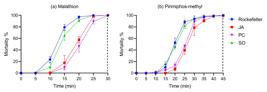
Mortality percentage in adults of Aedes aegypti populations from the municipalities of Juan de Acosta (JA), Puerto Colombia (PC), and Soledad (SO) in the department of Atlantico, Colombia, compared to the susceptible Rockefeller strain after exposure to (a) malathion (50 µg/bottle; 30 minutes) and (b) pirimiphos-methyl (75 µg/bottle; 45 minutes).
All evaluated populations were classified as resistant to the tested pyrethroids, as none reached 90% mortality. For permethrin, mortality rates ranged from 0% to 21%, indicating the highest levels of resistance among the three insecticides. In the case of lambda-cyhalothrin, mortality ranged from 10% to 56%, and for deltamethrin, mortality rates ranged from 5% to 85%. Overall, the populations exhibited the greatest resistance to permethrin, followed by lambda-cyhalothrin and deltamethrin (Figure 3).

Mortality percentage in Aedes aegypti populations from the municipalities of Juan de Acosta (JA), Puerto Colombia (PC), and Soledad (SO) in the department of Atlantico, Colombia, compared to the susceptible Rockefeller strain (RO), after exposure to permethrin (0.4%), deltamethrin (0.03%), and lambda-cyhalothrin (0.05%) following the WHO methodology. The dashed line indicates the 90% mortality threshold.
kdr mutations
The kdr mutations evaluated in Ae. aegypti populations showed differences in both allele and genotype frequencies (Table 2). For the V410L mutation, genotypes VV410, VL410, and LL410 were detected in Puerto Colombia and Soledad, while only VV410 and VL410 were present in Juan de Acosta. The highest frequency of the mutant L410 allele was found in Soledad (0.57), followed by Puerto Colombia (0.27) and Juan de Acosta (0.18).
Allelic and genotypic frequencies for the V410, V1016I, and F1534C mutations in Aedes aegypti populations from the municipalities of the department of Atlantico, Colombia.
For the V1016I mutation, all three genotypes (VV1016, VI1016, and II1016) were detected in the Puerto Colombia and Soledad populations, while only VV1016 and VI1016 were found in Juan de Acosta. The highest frequency of the mutant I1016 allele was observed in Soledad (0.60), followed by Puerto Colombia (0.30) and Juan de Acosta (0.20).
For the F1534C mutation, all three genotypes (FF1534, FC1534, and CC1534) were identified in all evaluated populations. The mutant C1534 allele showed high frequencies in Puerto Colombia and Soledad (0.98 in both), followed by Juan de Acosta with a frequency of 0.92.
Eight mutant trilocus haplotype combinations were identified (Figure 4). In the Puerto Colombia population, the mutant trilocus haplotype LL/II/CC was detected at a frequency of 0.03, whereas this same haplotype was more prevalent in the Soledad population, with a frequency of 0.27. The triple heterozygous haplotype VL/VI/FC was found only in Puerto Colombia at a frequency of 0.03, whereas the wild type trilocus haplotype VV/VV/FF was exclusively observed in the Juan de Acosta population, also at a frequency of 0.03.

Trilocus haplotype frequencies in Aedes aegypti populations from the municipalities of Juan de Acosta (JA), Puerto Colombia (PC), and Soledad (SO) in the department of Atlantico, Colombia. Haplotype order: 410/1016/1534.
The most frequent haplotype was VL/VI/CC, which reached a frequency of 0.60 in the Soledad population. In Puerto Colombia, the most frequent haplotype was VV/VV/CC (0.50), which was also the only haplotype detected in all three populations. In contrast, the haplotypes VL/VI/CC, VL/VV/FC, and VV/VV/FF were identified exclusively in the Juan de Acosta population, with frequencies of 0.33, 0.03, and 0.30, respectively (Figure 4).
Enzymes
Enzymatic activity in Ae. aegypti populations from the department of Atlantico, Colombia, showed significant differences compared to the susceptible Rockefeller strain (p < 0.05).
For α-esterases, all field populations exhibited significantly higher enzymatic activity compared to the Rockefeller strain (p < 0.05). Based on the P99 of the Rockefeller strain (3.50), 100% of individuals from Juan de Acosta and Soledad, and 87% from Puerto Colombia exceeded this threshold.
For β-esterases, the Soledad population exhibited significantly higher activity than the other field populations and the Rockefeller strain (p < 0.05), with 100% of individuals classified as altered (>50%) based on the P99 (18.48). In contrast, the populations from Juan de Acosta and Puerto Colombia were classified as unaltered (<15%), with only 7% and 0% of individuals, respectively, exceeding the P99.
P450 activity was significantly lower in all field populations compared to the susceptible strain (p < 0.05). Based on P99 (54.91), 0% of individuals from Juan de Acosta and Puerto Colombia, and 7% from Soledad, exceeded this threshold. All populations were therefore classified as unaltered (<15%).
For GSTs, the populations from Puerto Colombia and Soledad exhibited significantly higher activity than the Rockefeller strain (p < 0.05), while the Juan de Acosta population showed no significant difference. GST activity was classified as unaltered in Juan de Acosta, with only 3% of individuals exceeding the P99. In contrast, activity was classified as incipiently altered in Puerto Colombia and Soledad, with 27% and 17% of individuals, respectively, exceeding the P99.
Mean values of acetylcholinesterase remaining activity (AChEI) indicate the level of enzyme insensitivity to inhibition by propoxur. Compared with the Rockefeller strain, the field populations from Juan de Acosta, Puerto Colombia, and Soledad showed significantly lower values (p < 0.05). AChEI activity was classified as unaltered in all field populations, as none exceeded 15% of the P99. The proportion of individuals exceeding this threshold was 3% in Juan de Acosta, 10% in Puerto Colombia, and 0% in Soledad (Table 3).
Enzymatic activity quantification in Aedes aegypti populations from the Department of Atlantico, Colombia.
Discussion
This study evaluated the insecticide susceptibility status and resistance mechanisms in Ae. aegypti populations from three municipalities in the Atlantico department, Colombia. Both the larvicide and the adulticides, representing different chemical classes, were tested, and resistance mechanisms were explored through the analysis of kdr mutations and detoxification enzyme activity.
Susceptibility to temephos was confirmed in all tested populations, except for Juan de Acosta, which exhibited moderate resistance. Earlier studies conducted between 2009 and 2018 had already reported resistance to this larvicide in Ae. aegypti populations from the same municipalities (Pareja-Loaiza, 2019; INS, 2022; Atencia-Pineda et al., 2025). In the present study, Soledad and Puerto Colombia were classified as susceptible, which contrasts with the previous reports. This difference suggests a possible reduction of resistance in these populations, potentially associated with the decreased use of temephos in recent years and its replacement by insect growth regulators such as diflubenzuron, along with intensified source reduction campaigns. Nevertheless, as our results represent a single time-point, these findings should be interpreted cautiously, and long-term monitoring would be required to confirm whether resistance reversion has indeed occurred.
Temporal fluctuations temephos resistance have been documented in populations within the same department (INS, 2022) and in other regions of Colombia (Suárez et al., 1996; Conde et al., 2015). Similar patterns have also been observed in Ae. aegypti from Cuba. For example, a laboratory-maintained strain showed decreased resistance after six generations without exposure to the larvicide (Bisset et al., 2020). Moreover, during the COVID-19 pandemic, the suspension of temephos use for two years in previously characterized resistant populations (RRLC50 > 10) from various locations in Havana led to a reduction in resistance levels in two out of five populations, although all remained highly resistant (Piedra et al., 2024). These findings highlight the relevance of reducing selection pressure, either through insecticide rotation or withdrawal, to preserve susceptibility in vector populations.
Similarly, extensive use of temephos without interruption has been associated with widespread resistance. A recent study of 23 Ae. aegypti populations across Mexico revealed widespread resistance to temephos, with 22 populations showing mortality rates ranging from 3% to 93% when exposed to the DC of 0.012 mg/L. Resistance intensity was classified as moderate or high in 78% and 30% of the populations, respectively (Davila-Barboza et al., 2024). The authors attributed this widespread resistance to the extensive and prolonged use of temephos in national vector control programs over the past five decades.
In Colombia, as in other countries across the Americas, temephos resistance has primarily been associated with metabolic mechanisms (Bellinato et al., 2016). To date, there are no reports of target-site resistance due to mutations in the Ace-1 gene (Atencia-Pineda et al., 2025), although mutations in this gene have been documented in temephos-resistant Ae. aegypti populations from Asia (Rahayu et al., 2022).
The results obtained for malathion and pirimiphos-methyl confirm that the evaluated populations remain susceptible to these organophosphates, in line with previous reports from the same municipalities (INS, 2022). At the national level, most Ae. aegypti populations in Colombia have also been described as susceptible to these insecticides (Fonseca-González et al., 2011; Ocampo et al., 2011; Ardila-Roldán et al., 2013). However, resistance to pirimiphos-methyl has been documented in populations from the departments of Caldas and Sucre (Conde et al., 2015; INS, 2022) and, more recently, in Cordoba (Atencia-Pineda et al., 2025), highlighting the need for continued surveillance. Beyond Colombia, resistance to these organophosphates has been reported in Ae. aegypti populations from other countries in the Americas. For instance, resistance to malathion has been observed in Mexico (López-Solís et al., 2020) and Venezuela (Rubio-Palis et al., 2023), while resistance to pirimiphos-methyl has been reported in Panama (Carrera et al., 2024). These cases highlight the potential for resistance development under sustained selection pressure and the importance of maintaining susceptibility through integrated management strategies.
It should be noted that the DC of pirimiphos-methyl used in Colombia (75 µg/bottle; 45 min exposure) was established by the National Institute of Health through the national insecticide resistance surveillance network (INS, 2018). This differs from the later CDC recommendation of 25 µg/bottle for 30 min (CDC, 2025), which was published after the present assays were completed. When mortality is examined at 30 min, as suggested in the CDC protocol, the Juan de Acosta (<80%) and Puerto Colombia (<90%) populations did not reach the WHO (2016) threshold for confirmed susceptibility. However, under the diagnostic time established in Colombia (45 min), both populations exceeded 98% mortality, supporting their classification as susceptible in the local operational context. These methodological differences should be taken into account when comparing results across studies, as they can affect interpretation without altering the internal consistency of our findings.
In summary, the INS protocol (75 µg/bottle for 45 min) involves a higher dose and longer exposure period than the CDC protocol (25 µg/bottle for 30 min), which explains the higher mortality rates observed under the INS diagnostic conditions.
In contrast to the organophosphates, the findings of this study confirm resistance to the pyrethroids lambda-cyhalothrin, deltamethrin, and permethrin in all evaluated Ae. aegypti populations. This resistance has been consistently associated with the presence of kdr mutations (V1016I, F1534C, and V410L) and increased activity of detoxifying enzymes, previously reported in different regions of Colombia (Maestre-Serrano et al., 2019, 2023 Atencia-Pineda et al., 2024). Moreover, kdr mutations were widespread in the evaluated Ae. aegypti populations, with differences in allele and haplotype frequencies between locations. The kdr mutations V1016I, V410L, and F1534C had been previously reported in these populations, except for the V410L, which had not been detected in Soledad and Puerto Colombia. The present study shows an increase in the allelic frequencies of these mutations compared to earlier reports (Maestre-Serrano et al., 2019; Pareja-Loaiza et al., 2020).
Specifically, compared with data reported by Pareja-Loaiza et al. (2020), all three populations showed an increase in kdr allele frequencies. For the V410L locus, the L410 allele frequency remained nearly unchanged in Juan de Acosta (0.18 vs. 0.16). In contrast, at the V1016I locus, the I1016 allele increased from 0.24 to 0.30 in Puerto Colombia, from 0.35 to 0.60 in Soledad, and from 0.16 to 0.20 in Juan de Acosta. A similar trend was observed at the F1534C locus, with the C1534 allele rising from 0.63 to 0.98 in Puerto Colombia, from 0.81 to 0.98 in Soledad, and from 0.76 to 0.92 in Juan de Acosta.
The increased frequencies of kdr mutations observed in this study may be explained by sustained selection pressure exerted by pyrethroids such as alpha-cypermethrin, cypermethrin, lambda-cyhalothrin, and deltamethrin, which have been used by local health authorities over the past decade in response to dengue outbreaks, particularly those recorded in 2010, 2013, and 2019 (Gutiérrez-Barbosa et al., 2020), as well as the emergence of chikungunya and Zika viruses in the region (INS, 2019).
Similar increases in kdr mutation frequencies have been documented in other regions of Colombia. For instance, in Monteria (Cordoba department), the frequency of the I1016 allele increased from 0.30 to 0.60, and that of the C1534 allele from 0.88 to 1.0, between 2010 and 2023, in populations resistant to lambda-cyhalothrin, deltamethrin, and permethrin (Maestre-Serrano et al., 2014; Atencia-Pineda et al., 2024).
This sustained increase in kdr mutation frequencies has also been reported in other countries. In Mexico, a long-term monitoring study documented a progressive rise in the frequencies of V410L, V1016I, and F1534C over a 16-year period, along with evidence of linkage disequilibrium and the co-occurrence of triple-resistant genotypes. These patterns were attributed to the intense use of pyrethroids in vector control programs (Saavedra-Rodriguez et al., 2018). Similarly, in Burkina Faso, a study reported fixation of the C1534 mutation and significant increases in I1016 and L410 frequencies within just three years in populations resistant to permethrin and deltamethrin (Yaméogo et al., 2024). These findings support that continuous selection pressure favors the emergence and persistence of resistant haplotypes.
Regarding the co-occurrence of the V410L, V1016I, and F1534C mutations, our findings are consistent with previous reports from the Caribbean region of Colombia. In Riohacha, Department of La Guajira, individuals carrying the VI/CC/VL haplotype were detected at high frequencies, along with the triple heterozygous VI/FC/VL and the triple homozygous mutant II/CC/LL haplotypes at low frequencies (Granada et al., 2018; Maestre-Serrano et al., 2023), both of which were also identified in our study. Furthermore, in Ae. aegypti populations from 14 municipalities in Cordoba, the predominant haplotypes included VV/CC/VV and VL/VI/CC, while the LL/II/CC haplotype was detected in several localities (Atencia-Pineda et al., 2024). These observations, combined with our results, suggest that multilocus resistance haplotypes, which combine mutations at all three loci, are becoming increasingly common in northern Colombia.
Specifically, for the Atlantico department, a previous study that included the Juan de Acosta population reported the presence of the V410L, V1016I, and F1534C mutations. In that study, the triple homozygous wild-type haplotype VV/VV/FF was observed at a frequency of 0.04 (Pareja-Loaiza et al., 2020), closely matching our current finding of 0.03 for the same population. Additionally, our study detected the haplotypes VV/VI/CC and VV/VV/FC, both at a frequency of 0.07. This contrasts with the previous report, where the haplotype VV/FC/VV was found at a higher frequency (0.33) (Pareja-Loaiza et al., 2020).
In the present study, the most frequent haplotype in Juan de Acosta was VV/VV/CC (0.47), indicating an increased prevalence of the F1534C resistant allele. For Soledad and Puerto Colombia, no prior studies had reported the co-occurrence of all three kdr mutations. However, previous research had documented the presence of V1016I and F1534C in both populations. In Puerto Colombia, the most frequent haplotypes were VV/FC and VI/FC, with frequencies of 0.28 and 0.22, respectively, while in Soledad, VI/CC and VV/CC were predominant, with frequencies of 0.36 and 0.22, respectively (Maestre-Serrano et al., 2019).
The co-occurrence of the kdr mutations V1016I, F1534C, and V410L in Ae. aegypti populations has been reported in diverse geographic regions, including the Americas (Saavedra-Rodriguez et al., 2018; Hernandez et al., 2023; Barrera-Illanes et al., 2024) and West Africa (Ablorde et al., 2023; Maiga et al., 2024). In Mexico, a longitudinal study analyzed the temporal dynamics of trilocus haplotype frequencies from 2000 to 2016. Initially, the homozygous susceptible haplotype VV/VV/FF was predominant, with a frequency of 0.99. Over time, however, this haplotype declined, and 20 novel trilocus haplotype combinations emerged. The most frequent haplotypes between 2012 and 2016 included VV/VV/CC (0.20), VL/VV/FC (0.18), VL/VI/CC (0.26), and the triple homozygous resistant haplotype LL/II/CC (0.18) (Saavedra-Rodriguez et al., 2018). These results illustrate the dynamic evolution of resistance genotypes under constant pyrethroid pressure.
In Harris County, located in southern Texas (USA), the co-occurrence of the kdr mutations V1016I, F1534C, and V410L has also been reported in Ae. aegypti, despite vector control activities being primarily directed at Culex quinquefasciatus. Indirect selection pressure from pyrethroid use has led to the emergence of 17 different trilocus haplotype combinations across various areas of the county. Among these, the triple homozygous resistant haplotype LL/II/CC was the most prevalent, with frequencies ranging from 35.9% to 96.4%. Other frequent haplotypes included VL/II/CC (19.1%), VV/II/CC (10.1%), VL/VI/FC (3.8%), and VL/VI/CC (3.4%) (Hernandez et al., 2023). These findings from Harris County are particularly relevant when compared with the current results from the Atlantico department. In both regions, multiple trilocus kdr haplotypes were detected, including the triple homozygous resistant haplotype LL/II/CC. Although this haplotype was found at lower frequencies in the Colombian populations, especially in Juan de Acosta, its presence confirms the circulation of highly resistant genotypes in the region. The diversity of haplotypes reported in Harris County, driven by indirect selection pressure from control activities targeting other mosquito species, reflects the situation in Colombia, where continuous use of pyrethroids for Ae. aegypti control may be selecting for similar resistant genotypes. This parallel suggests that even in areas where vector control is not specifically targeting Ae. aegypti, resistance can still intensify due to shared environmental pressures, highlighting the need for coordinated resistance management strategies.
Similarly, in Buenos Aires Province, Argentina, 19 trilocus haplotype combinations were detected in Ae. aegypti populations resistant to pyrethroids. The most frequent haplotypes included VV/VV/CC (17%), VL/VI/CC (15.4%), VV/VV/FC (13.8%), and VL/VV/FC (13.7%). Although less frequent, the triple heterozygous (VL/VI/FC), triple homozygous wild-type (VV/VV/FF), and triple homozygous mutant (LL/II/CC) haplotypes were also detected, with frequencies ranging from 2.5% to 7.75% (Barrera-Illanes et al., 2024).
These findings further highlight the widespread emergence of diverse resistance genotypes in response to pyrethroid selection pressure across the Americas. In contrast to previous reports, only eight trilocus haplotypes were identified in the populations analyzed in this study: six in Juan de Acosta, four in Puerto Colombia, and five in Soledad. The observed variation in haplotype diversity and frequency likely reflects differences in the intensity and duration of insecticide selection pressure exerted by local vector control programs.
The enzymatic activity profiles observed in Ae. aegypti populations from the department of Atlantico revealed distinct patterns that partially contrast with previous reports from the Caribbean region of Colombia. Earlier studies had documented incipient alterations in enzyme activity for populations such as Puerto Colombia and Soledad (Maestre-Serrano et al., 2014), whereas the present study detected altered α-esterase activity in both populations, with all individuals from Soledad and Juan de Acosta, and 87% from Puerto Colombia, exceeding the P99 threshold.
In contrast to prior findings that reported incipient β-esterase activity in Juan de Acosta (Pareja-Loaiza, 2019), our results indicate no significant alteration in this enzyme for that population. Instead, β-esterase activity was only elevated in Soledad, where 100% of individuals were classified as altered. This marked difference suggests potential temporal fluctuations in enzyme expression, likely influenced by variations in insecticide exposure or other environmental factors (Ocampo et al., 2011).
Cytochrome P450 monooxygenase activity was consistently lower in all field populations compared to the Rockefeller strain, indicating that this detoxification pathway is not playing a major role in the resistance phenotype observed. In Juan de Acosta, where altered P450 activity had been previously reported (Pareja-Loaiza, 2019), the present results showed uniformly low levels. Only 7% of individuals from Soledad exceeded the threshold, and none from Juan de Acosta or Puerto Colombia. Similar findings have also been documented in other regions. In Colombia, oxidase activity was elevated in only some populations, while it was absent in others (Ocampo et al., 2011). In Peru, mean MFO values were below the alteration threshold, with no increase in enzymatic activity (Pinto et al., 2019). Biochemical assays in Brazil likewise suggested a negligible role of P450s in temephos-resistant larvae, despite transcriptomic evidence of gene-specific overexpression (Strode et al., 2012). Proteomic analyses in French Guiana further showed that some CYP proteins were expressed at lower levels in resistant than in susceptible strains (Epelboin et al., 2021). Previous studies have also reported reduced CYP expression following insecticide selection. For example, David et al. (2014) found several CYP genes underexpressed in Ae. aegypti selected with permethrin, and Saavedra-Rodriguez et al. (2012) detected CYP downregulation after only one generation of exposure to the same insecticide. More recently, transcriptomic analyses in Mexican populations after deltamethrin selection revealed both up- and downregulation of P450 genes, with CYP6AG4, CYP6M5, and CYP307A1 being overexpressed, while multiple other CYPs were downregulated (Contreras-Perera et al., 2025). The consistently low P450 activity detected in our biochemical assays is therefore consistent with this transcriptomic evidence, as the downregulation of several CYP members likely contributes to the absence of elevated monooxygenase activity in these populations. Collectively, these results demonstrate that the involvement of P450s in resistance is highly variable, gene-specific, and insecticide-dependent, and in the populations analyzed here, resistance is more likely mediated by target-site mechanisms and esterase activity rather than by P450-driven detoxification.
GST activity showed moderate increases in the Puerto Colombia and Soledad populations, which were classified as incipiently altered. These findings are consistent with previous observations in Ae. aegypti from Sincelejo (Sucre Department), where similar incipient alterations in GST activity were reported (Maestre-Serrano et al., 2014).
Regarding ACHEI, no evidence of target-site insensitivity was detected in any of the populations. Although a few individuals exceeded the threshold in Juan de Acosta (3%) and Puerto Colombia (10%), the overall activity remained within the range classified as unaltered. This aligns with previous studies from Colombia, where no mutations in the Ace-1 gene have been reported in Ae. aegypti (Atencia-Pineda et al., 2025).
The overexpression of esterases, particularly α-esterases in all three populations and β-esterases in Soledad, may be related to the sustained use of organophosphates and pyrethroids over the last decade in the region. Similar patterns of esterase overexpression have been documented in resistant populations from the other regions of Colombia (Fonseca-González, et al., 2011; Ocampo et al., 2011; Santacoloma et al., 2010; Aponte et al., 2019), as well as in several countries across the Americas (Rodríguez et al., 2004; Harris et al., 2010; Polson et al., 2011; Flores et al., 2005, 2006; Alvarez et al., 2013). A recent study from Panama reported elevated esterase levels in deltamethrin- and lambda-cyhalothrin-resistant populations, with α-esterases more frequently altered than β-esterases (Carrera et al., 2024), a trend also observed in our study.
These findings emphasize the importance of continued biochemical monitoring to complement genetic surveillance, as fluctuations in enzyme activity may reflect changing insecticide selection pressures and could serve as early indicators of resistance evolution in vector populations.
Conclusions
The Ae. aegypti populations analyzed were susceptible to the tested organophosphates, except for the Juan de Acosta population, which exhibited moderate resistance to temephos. In contrast, all populations were resistant to pyrethroids, with the highest resistance levels observed in Puerto Colombia and Soledad, where the trilocus haplotypes VL/VI/CC, VV/VV/CC, and LL/II/CC were the most frequently detected. Altered α-esterase activity was observed in all populations, while β-esterase activity was additionally altered in the Soledad population.
These findings emphasize the need to strengthen insecticide resistance surveillance in the region and support the implementation of rotation strategies and alternative vector control tools to mitigate the spread of resistance.
Acknowledgments
We thank Robinson Martínez Castro, María Claudia Atencia Pineda, Sergio Goenaga Olaya, and Diana Díaz Ortiz for their support with field and laboratory activities. We also acknowledge Yerson Javier García Leal for his assistance in designing the map.
-
Funding
This research was funded by Universidad Libre, Barranquilla campus; Universidad del Atlantico; and Universidad Simon Bolívar in Colombia, as well as Universidad Autonoma de Nuevo Leon in Mexico.
References
-
Abbott, W. S., 1925. A method of computing the effectiveness of an insecticide. J. Econ. Entomol. 18 (2), 265-267. https://doi.org/10.1093/jee/18.2.265a
» https://doi.org/10.1093/jee/18.2.265a -
Ablorde, A., Ayettey, J., Kroidl, I., Wieser, A., Kudom, A. A., 2023. Co-occurrence of multiple kdr mutations (F1534C, V1016I, V410L) in Aedes aegypti from coastal areas in Ghana and assessment of the role of mosquito coil in causing pyrethroid resistance. Acta Trop. 243, 106937. PMid:37146863. https://doi.org/10.1016/j.actatropica.2023.106937
» https://doi.org/10.1016/j.actatropica.2023.106937 -
Alvarez, L. C., Ponce, G., Oviedo, M., Lopez, B., Flores, A. E., 2013. Resistance to malathion and deltamethrin in Aedes aegypti (Diptera: Culicidae) from western Venezuela. J. Med. Entomol. 50 (5), 1031-1039. PMid:24180108. https://doi.org/10.1603/ME12254
» https://doi.org/10.1603/ME12254 -
Aponte, A., Penilla, R. P., Rodríguez, A. D., Ocampo, C. B., 2019. Mechanisms of pyrethroid resistance in Aedes (Stegomyia) aegypti from Colombia. Acta Trop. 191, 146-154. PMid:30552882. https://doi.org/10.1016/j.actatropica.2018.12.021
» https://doi.org/10.1016/j.actatropica.2018.12.021 -
Ardila-Roldán, S., Santacoloma, L., Brochero, H., 2013. Estado de la sensibilidad a los insecticidas de uso en salud pública en poblaciones naturales de Aedes aegypti (Diptera: Culicidae) del departamento de Casanare, Colombia. Biomedica 33 (3), 446-458. PMid:24652181. https://doi.org/10.7705/biomedica.v33i3.1534
» https://doi.org/10.7705/biomedica.v33i3.1534 -
Atencia-Pineda, M. C., Diaz-Ortiz, D., Pareja-Loaiza, P., García-Leal, J., Hoyos-López, R., Calderón-Rangel, A., Fragozo-Castilla, P., Pacheco-Lugo, L., Flores, A. E., Maestre-Serrano, R., 2024. Assessing pyrethroid resistance in Aedes aegypti from Cordoba Colombia: implications of kdr mutations. PLoS One 19 (8), e0309201. PMid:39172980. https://doi.org/10.1371/journal.pone.0309201
» https://doi.org/10.1371/journal.pone.0309201 -
Atencia-Pineda, M. C., García-Leal, J., Diaz-Ortiz, D., Pareja-Loaiza, P., Pacheco-Lugo, L., Hoyos-López, R., Calderón-Rangel, A., Fragozo-Castilla, P., Gutiérrez-Rodríguez, S. M., Flores, A. E., Maestre-Serrano, R., 2025. Susceptibility to organophosphate insecticides in Aedes aegypti (Diptera: Culicidae) from northern Colombia and associated resistance mechanisms. Parasit. Vectors 18 (1), 7. PMid:39810253. https://doi.org/10.1186/s13071-024-06624-8
» https://doi.org/10.1186/s13071-024-06624-8 -
Barrera-Illanes, A. N., Ledesma, L., Alvarez-Costa, A., Balsalobre, A., Toloza, C. J., Hernandez-Maiztegui, A., Jait, A., Sierra, I., Micieli, M. V., Manteca-Acosta, M., Ons, S., 2024. Monitoring of pyrethroid resistance in Aedes aegypti: first report of double and triple kdr mutations in Buenos Aires Province. Parasit. Vectors 17 (1), 458. PMid:39522041. https://doi.org/10.1186/s13071-024-06547-4
» https://doi.org/10.1186/s13071-024-06547-4 -
Bellinato, D. F., Viana-Medeiros, P. F., Costa, S. A., Martins, A. J., Pereira, J. B. L., Valle, D., 2016. Resistance status to the insecticides temephos, deltamethrin, and diflubenzuron in Brazilian Aedes aegypti populations. BioMed Res. Int. 8603263, 12. PMid:27419140. https://doi.org/10.1155/2016/8603263
» https://doi.org/10.1155/2016/8603263 -
Bisset, J. A., Rodríguez, M. M., Piedra, L. A., Cruz, M., Gutiérrez, G., Ruiz, A., 2020. Reversal of resistance to the larvicide temephos in an Aedes aegypti (Diptera: Culicidae) laboratory strain from Cuba. J. Med. Entomol. 57 (3), 801-806. PMid:31788689. https://doi.org/10.1093/jme/tjz206
» https://doi.org/10.1093/jme/tjz206 -
Brogdon, W. G., Barber, A. M., 1987. Microplate assay of acetylcholinesterase inhibition kinetics in single-mosquito homogenates. Pestic. Biochem. Physiol. 29 (3), 252-259. https://doi.org/10.1016/0048-3575(87)90155-6
» https://doi.org/10.1016/0048-3575(87)90155-6 -
Brogdon, W. G., 1989. Biochemical resistance detection: an alternative to bioassay. Parasitol. Today 5 (2), 56-60. PMid:15463180. https://doi.org/10.1016/0169-4758(89)90192-0
» https://doi.org/10.1016/0169-4758(89)90192-0 -
Brogdon, W. G., Barber, A. M., 1990. Microplate assay of glutathione s-transferase activity for resistance detection in single-mosquito triturates. Comp. Biochem. Physiol. B 96 (2), 339-342. PMid:2361364. https://doi.org/10.1016/0305-0491(90)90385-7
» https://doi.org/10.1016/0305-0491(90)90385-7 - Brogdon, W. G., McAllister, J. C., Vulule, J., 1997. Heme peroxidase activity measured in single mosquitoes identifies individuals expressing an elevated oxidase for insecticide resistance. J. Am. Mosq. Control Assoc. 13 (3), 233-237. PMid:9383763.
-
Carrera, L. C., Piedra, L., Torres-Cosme, R., Castillo, A. M., Bruno, A., Ramírez, J. L., Martínez, D., Rodríguez, M. M., Bisset, J. A., 2024. Insecticide resistance status and mechanisms in Aedes aegypti and Aedes albopictus from different dengue endemic regions of Panama. Trop. Med. Health 52 (1), 69. PMid:39385264. https://doi.org/10.1186/s41182-024-00637-w
» https://doi.org/10.1186/s41182-024-00637-w -
Center for Global Health - CDC, 2012. Division of Parasitic Diseases and Malaria. Guideline for Evaluating Insecticide Resistance in Vectors Using the CDC Bottle Bioassay. Available in: https://stacks.cdc.gov/view/cdc/21777 (accessed 13 January 2024).
» https://stacks.cdc.gov/view/cdc/21777 -
Center for Global Health - CDC, 2025. Global Manual for Evaluating Insecticide Resistance Using the CDC Bottle Bioassay. Available in: https://www.cdc.gov/mosquitoes/media/pdfs/2024/04/CDC-Global-Bottle-Bioassay-Manual-508.pdf (accessed 20 September 2025).
» https://www.cdc.gov/mosquitoes/media/pdfs/2024/04/CDC-Global-Bottle-Bioassay-Manual-508.pdf -
Conde, M., Orjuela, L. I., Castellanos, C. A., Herrera-Varela, M., Licastro, S., Quiñones, M. L., 2015. Evaluación de la sensibilidad a insecticidas en poblaciones de Aedes aegypti (Diptera: Culicidae) del departamento de Caldas, Colombia, en 2007 y 2011. Biomedica 35 (1), 43-52. https://doi.org/10.7705/biomedica.v35i1.2367
» https://doi.org/10.7705/biomedica.v35i1.2367 -
Contreras-Perera, Y., Mackenzie-Impoinvil, L., Derilus, D., Lenhart, A., Rodriguez-Sanchez, I. P., Manrique-Saide, P., Flores, A. E., 2025. Deltamethrin selection drives transcriptomic changes in detoxification, immune, and cuticle genes in Aedes aegypti. Trop. Med. Infect. Dis. 10 (6), 171. PMid:40559738. https://doi.org/10.3390/tropicalmed10060171
» https://doi.org/10.3390/tropicalmed10060171 -
David, J. P., Faucon, F., Chandor-Proust, A., Poupardin, R., Riaz, M. A., Bonin, A., Navratil, V., Reynaud, S., 2014. Comparative analysis of response to selection with three insecticides in the dengue mosquito Aedes aegypti using mRNA sequencing. BMC Genomics 15 (1), 174. PMid:24593293. https://doi.org/10.1186/1471-2164-15-174
» https://doi.org/10.1186/1471-2164-15-174 -
Davila-Barboza, J. A., Gutierrez-Rodriguez, S. M., Juache-Villagrana, A. E., Lopez-Monroy, B., Flores, A. E., 2024. Widespread resistance to temephos in Aedes aegypti (Diptera: Culicidae) from Mexico. Insects 15 (2), 120. PMid:38392539. https://doi.org/10.3390/insects15020120
» https://doi.org/10.3390/insects15020120 -
Epelboin, Y., Wang, L., Giai Gianetto, Q., Choumet, V., Gaborit, P., Issaly, J., Guidez, A., Douché, T., Chaze, T., Matondo, M., Dusfour, I., 2021. CYP450 core involvement in multiple resistance strains of Aedes aegypti from French Guiana highlighted by proteomics, molecular and biochemical studies. PLoS One 16 (1), e0243992. PMid:33428654. https://doi.org/10.1371/journal.pone.0243992
» https://doi.org/10.1371/journal.pone.0243992 -
Flores, A. E., Albeldaño-Vásquez, W., Salas, I. F., Badii, M. H., Becerra, H. L., García, G. P., Fuentes, S. L., Brogdon, W. G., Black, W. C., Beaty, B., 2005. Elevated α-esterase levels associated with permethrin tolerance in Aedes aegypti (L.) from Baja California, México. Pestic. Biochem. Physiol. 82 (1), 66-78. https://doi.org/10.1016/j.pestbp.2004.12.007
» https://doi.org/10.1016/j.pestbp.2004.12.007 -
Flores, A. E., Grajales, J. S., Salas, I. F., Fernandez, I., Ponce, G., Loaiza, M. A., Lozano, S., Brogdon, W. G., Black 4th, W. C., Beaty, B., 2006. Mechanisms of insecticide resistance in field populations of Aedes aegypti (L.) from Quintana Roo, Southern Mexico. J. Am. Mosq. Control Assoc. 22 (4), 672-677. PMid:17304936. https://doi.org/10.2987/8756-971X(2006)22[672:MOIRIF]2.0.CO;2
» https://doi.org/10.2987/8756-971X(2006)22[672:MOIRIF]2.0.CO;2 -
Fonseca-González, I., Quiñones, M. L., Lenhart, A., Brogdon, W. G., 2011. Insecticide resistance status of Aedes aegypti (L.) from Colombia. Pest Manag. Sci. 67 (4), 430-437. PMid:21394876. https://doi.org/10.1002/ps.2081
» https://doi.org/10.1002/ps.2081 -
Granada, Y., Mejía-Jaramillo, A. M., Strode, C., Triana-Chávez, O., 2018. A point mutation V419L in the sodium channel gene from natural populations of Aedes aegypti is involved in resistance to λ -cyhalothrin in Colombia. Insects 9 (1), 23. PMid:29443870. https://doi.org/10.3390/insects9010023
» https://doi.org/10.3390/insects9010023 -
Gutiérrez-Barbosa, H., Medina-Moreno, S., Zapata, J. C., Chua, J. V., 2020. Dengue infections in Colombia: epidemiological trends of a hyperendemic country. Trop. Med. Infect. Dis. 5 (4), 156. PMid:33022908. https://doi.org/10.3390/tropicalmed5040156
» https://doi.org/10.3390/tropicalmed5040156 -
Haddi, K., Tomé, H. V. V., Du, Y., Valbon, W. R., Nomura, Y., Martins, G. F., Dong, K., Oliveira, E. E., 2017. Detection of a new pyrethroid resistance mutation (V410L) in the sodium channel of Aedes aegypti: a potential challenge for mosquito control. Sci. Rep. 7 (1), 46549. PMid:28422157. https://doi.org/10.1038/srep46549
» https://doi.org/10.1038/srep46549 -
Harris, A. F., Rajatileka, S., Ranson, H., 2010. Pyrethroid resistance in Aedes aegypti from Grand Cayman. Am. J. Trop. Med. Hyg. 83 (2), 277-284. PMid:20682868. https://doi.org/10.4269/ajtmh.2010.09-0623
» https://doi.org/10.4269/ajtmh.2010.09-0623 -
Hernandez, J. R., Liu, S., Fredregill, C. L., Pietrantonio, P. V., 2023. Impact of the V410L kdr mutation and co-occurring genotypes at kdr sites 1016 and 1534 in the VGSC on the probability of survival of the mosquito Aedes aegypti (L.) to Permanone in Harris County, TX, USA. PLoS Negl. Trop. Dis. 17 (1), e0011033. PMid:36689414. https://doi.org/10.1371/journal.pntd.0011033
» https://doi.org/10.1371/journal.pntd.0011033 -
Instituto Nacional de Salud - INS, 2018. Red de vigilancia de la resistencia a insecticidas de uso en salud pública en Colombia, año 2018. Available in: https://www.ins.gov.co/BibliotecaDigital/red-de-vigilancia-de-la-resistencia-a-insecticidas-de-uso-en-salud-publica-en-colombia-a%C3%B1o-2018.pdf (accessed 12 January 2024).
» https://www.ins.gov.co/BibliotecaDigital/red-de-vigilancia-de-la-resistencia-a-insecticidas-de-uso-en-salud-publica-en-colombia-a%C3%B1o-2018.pdf -
Instituto Nacional de Salud - INS, 2019. Informe de evento enfermedad por virus Zika y Chikungunya. Available in: https://www.ins.gov.co/buscador-eventos/Informesdeevento/chikungunya%20y%20enfermedad%20por%20virus%20Zika_2019.pdf (accessed 18 June 2024).
» https://www.ins.gov.co/buscador-eventos/Informesdeevento/chikungunya%20y%20enfermedad%20por%20virus%20Zika_2019.pdf -
Instituto Nacional de Salud - INS, 2022. Vigilancia de la resistencia a insecticidas de uso en salud pública en Colombia 2022. Available in: https://www.ins.gov.co/BibliotecaDigital/informe-de-vigilancia-de-la-resistencia-a-insecticidas-de-uso-en-salud-publica-en-colombia-2022.pdf (accessed 18 June 2024).
» https://www.ins.gov.co/BibliotecaDigital/informe-de-vigilancia-de-la-resistencia-a-insecticidas-de-uso-en-salud-publica-en-colombia-2022.pdf -
Instituto Nacional de Salud - INS, 2023. Sistema Nacional de Vigilancia en Salud Pública (SIVIGILA). Informe de evento dengue 2023. https://doi.org/10.33610/infoeventos.4
» https://doi.org/10.33610/infoeventos.4 -
Instituto Nacional de Salud - INS, 2024. Sistema Nacional de Vigilancia en Salud Pública (SIVIGILA). Informe de evento dengue primera parte 2024. Available in: https://www.ins.gov.co/buscador-eventos/Informesdeevento/DENGUE%20PE%20I%202024.pdf (accessed 13 January 2025).
» https://www.ins.gov.co/buscador-eventos/Informesdeevento/DENGUE%20PE%20I%202024.pdf -
López-Solís, A. D., Castillo-Vera, A., Cisneros, J., Solís-Santoyo, F., Penilla-Navarro, R. P., Black 4th, W. C., Torres-Estrada, J. L., Rodriguez, A. D., 2020. Resistencia a insecticidas en Aedes aegypti y Aedes albopictus (Diptera: Culicidae) de Tapachula, Chiapas, México. Salud Publica Mex. 62 (4), 439-446. PMid:32549085. https://doi.org/10.21149/10131
» https://doi.org/10.21149/10131 -
Lozano-Fuentes, S., Saavedra-Rodriguez, K., Black 4th, W. C., Eisen, L., 2012. QCal: a software application for the calculation of dose–response curves in insecticide resistance bioassays. J. Am. Mosq. Control Assoc. 28 (1), 59-61. PMid:22533088. https://doi.org/10.2987/11-6192.1
» https://doi.org/10.2987/11-6192.1 -
Maestre, R. S., Rey, V. G., De Las Salas, A. J., Vergara, C. S., Santacoloma, V. L., Goenega, O. S., Carrasquilla, F. M. C., 2010. Susceptibility status of Aedes aegypti to insecticides in Atlántico (Colombia). Rev. Colomb. Entomol. 36 (2), 242-248. https://doi.org/10.25100/socolen.v36i2.9153
» https://doi.org/10.25100/socolen.v36i2.9153 -
Maestre-Serrano, R., Rey-Guevara, G., De las Salas, J., Vergara, S., Santacoloma, V., Goenaga, S., Carrasquilla, M. C., 2009. Susceptibility of Aedes aegypti (Diptera: Culicidae) to temephos in Atlántico-Colombia. Rev. Colomb. Entomol. 35 (2), 202-205. https://doi.org/10.25100/socolen.v35i2.9220
» https://doi.org/10.25100/socolen.v35i2.9220 -
Maestre-Serrano, R., Gomez-Camargo, D., Ponce-Garcia, G., Flores, A. E., 2014. Susceptibility to insecticides and resistance mechanisms in Aedes aegypti from the Colombian Caribbean Region. Pestic. Biochem. Physiol. 116, 63-73. PMid:25454522. https://doi.org/10.1016/j.pestbp.2014.09.014
» https://doi.org/10.1016/j.pestbp.2014.09.014 -
Maestre-Serrano, R., Pareja-Loaiza, P., Gomez Camargo, D., Ponce-García, G., Flores, A. E., 2019. Co-occurrence of V1016I and F1534C mutations in the voltage-gated sodium channel and resistance to pyrethroids in Aedes aegypti (L.) from the Colombian Caribbean region. Pest Manag. Sci. 75 (6), 1681-1688. PMid:30520256. https://doi.org/10.1002/ps.5287
» https://doi.org/10.1002/ps.5287 -
Maestre-Serrano, R., Flórez-Rivadeneira, Z., Castro-Camacho, J. M., Ochoa-Bohórquez, L., Gómez-Camargo, D., Pareja-Loaiza, P., Ponce-García, G., Flores, A. E., 2023. Evaluación de la sensibilidad a organofosforados en poblaciones de Aedes aegypti (L.) (Diptera: Culicidae) del departamento de La Guajira, Colombia. Biomedica 43 (2), 296-304. PMid:37433166. https://doi.org/10.7705/biomedica.6677
» https://doi.org/10.7705/biomedica.6677 -
Maiga, A. A., Sombié, A., Zanré, N., Yaméogo, F., Iro, S., Testa, J., Sanon, A., Koita, O., Kanuka, H., McCall, P. J., Weetman, D., Badolo, A., 2024. First report of V1016I, F1534C and V410L kdr mutations associated with pyrethroid resistance in Aedes aegypti populations from Niamey, Niger. PLoS One 19 (5), e0304550. PMid:38809933. https://doi.org/10.1371/journal.pone.0304550
» https://doi.org/10.1371/journal.pone.0304550 - Mazzarri, M. B., Georghiou, G. P., 1995. Characterization of resistance to organophosphate, carbamate, and pyrethroid insecticides in field populations of Aedes aegypti (L) from Venezuela. J. Am. Mosq. Control Assoc. 11 (3), 315-322. PMid:8551300.
-
Montella, I. R., Martins, A. J., Viana-Medeiros, P. F., Pereira, J. B. L., Braga, I. A., Valle, D., 2007. Insecticide resistance mechanisms of Brazilian Aedes aegypti populations from 2001 to 2004. Am. J. Trop. Med. Hyg. 77 (3), 467-477. PMid:17827362. https://doi.org/10.4269/ajtmh.2007.77.467
» https://doi.org/10.4269/ajtmh.2007.77.467 -
Ocampo, C. B., Salazar-Terreros, M. J., Mina, N. J., McAllister, J., Brogdon, W., 2011. Insecticide resistance status of Aedes aegypti in 10 localities in Colombia. Acta Trop. 118 (1), 37-44. PMid:21300017. https://doi.org/10.1016/j.actatropica.2011.01.007
» https://doi.org/10.1016/j.actatropica.2011.01.007 -
Padilla, J. C., Rojas, D. P., Sáenz-Gómez, R., 2015. Dengue en Colombia: epidemiología de la reemergencia a la hiperendemia. Rev. Salud. Bosque 5 (1), 81-83. https://doi.org/10.18270/rsb.v5i1.186
» https://doi.org/10.18270/rsb.v5i1.186 -
Pareja-Loaiza, P., 2019. Mutaciones KDR y enzimas de resistencia en poblaciones de Aedes aegypti (Diptera: Culicidae) de la región Caribe colombiana. Doctoral thesis, Universidad de Cartagena. Available in: https://hdl.handle.net/11227/15507 (accessed 18 February 2024).
» https://hdl.handle.net/11227/15507 -
Pareja-Loaiza, P. X., Santacoloma, V. L., Rey, V. G., Gómez-Camargo, D., 2020. Mechanisms associated with pyrethroid resistance in populations of Aedes aegypti (Diptera: Culicidae) from the Caribbean coast of Colombia. PLoS One 15 (10), e02228695. PMid:33022007. https://doi.org/10.1371/journal.pone.0228695
» https://doi.org/10.1371/journal.pone.0228695 -
Piedra, L. A., Martinez, Y., Camacho, E., Garcia, I., Rodriguez, D., Vanlerberghe, V., Marquetti, M. D. C., 2024. Temephos resistance status of Aedes aegypti populations from Havana, Cuba. J. Am. Mosq. Control Assoc. 40 (2), 117-120. PMid:38666434. https://doi.org/10.2987/23-7164
» https://doi.org/10.2987/23-7164 -
Pinto, J., Palomino, M., Mendoza-Uribe, L., Sinti, C., Liebman, K. A., Lenhart, A., 2019. Susceptibility to insecticides and resistance mechanisms in three populations of Aedes aegypti from Peru. Parasit. Vectors 12 (1), 494. PMid:31640810. https://doi.org/10.1186/s13071-019-3739-6
» https://doi.org/10.1186/s13071-019-3739-6 -
Polson, K. A., Brogdon, W. G., Rawlins, S. C., Chadee, D. D., 2011. Characterization of insecticide resistance in Trinidadian strains of Aedes aegypti mosquitoes. Acta Trop. 117 (1), 31-38. PMid:20858454. https://doi.org/10.1016/j.actatropica.2010.09.005
» https://doi.org/10.1016/j.actatropica.2010.09.005 -
Rahayu, R., Melta, D., Hasmiwati, 2022. Detection of Ace-1 mutation in temephos-resistant Aedes aegypti L. in West Sumatra, Indonesia. Pak. J. Biol. Sci. 25 (9), 816-821. PMid:36098083. https://doi.org/10.3923/pjbs.2022.816.821
» https://doi.org/10.3923/pjbs.2022.816.821 - Rodríguez, M. M., Bisset, J. A., Fernández, D., Pérez, O., 2004. Resistencia a insecticidas en larvas y adultos de Aedes aegypti: prevalencia de la esterasa A4 asociada con la resistencia a temefos. Rev. Cubana Med. Trop. 56 (1), 54-60. PMid:15849910.
-
Rubio-Palis, Y., Dzuris, N., Sandi, C., Vizcaino-Cabarrus, R. L., Corredor-Medina, C., González, J. A., Lenhart, A. E., 2023. Insecticide resistance levels and associated mechanisms in three Aedes aegypti populations from Venezuela. Mem. Inst. Oswaldo Cruz 118, e220210. PMid:37377253. https://doi.org/10.1590/0074-02760220210
» https://doi.org/10.1590/0074-02760220210 -
Saavedra-Rodriguez, K., Urdaneta-Marquez, L., Rajatileka, S., Moulton, M., Flores, A. E., Fernandez-Salas, I., Bisset, J., Rodriguez, M., McCall, P. J., Donnelly, M. J., Ranson, H., Hemingway, J., Black 4th, W. C., 2007. A mutation in the voltage-gated sodium channel gene associated with pyrethroid resistance in Latin American Aedes aegypti. Insect Mol. Biol. 16 (6), 785-798. PMid:18093007. https://doi.org/10.1111/j.1365-2583.2007.00774.x
» https://doi.org/10.1111/j.1365-2583.2007.00774.x -
Saavedra-Rodriguez, K., Suarez, A. F., Salas, I. F., Strode, C., Ranson, H., Hemingway, J., Black 4th, W. C., 2012. Transcription of detoxification genes after permethrin selection in the mosquito Aedes aegypti. Insect Mol. Biol. 21 (1), 61-77. PMid:22032702. https://doi.org/10.1111/j.1365-2583.2011.01113.x
» https://doi.org/10.1111/j.1365-2583.2011.01113.x -
Saavedra-Rodriguez, K., Vera, F. M., Campbell, C. L., Garcia-Rejon, J., Lenhart, A., Penilla, P., Rodriguez, A., Acero, A. S., Flores, A. E., Ponce, G., Lozano, S., Black 4th, W. C., 2018. Parallel evolution of vgsc mutations at domains IS6, IIS6 and IIIS6 in pyrethroid resistant Aedes aegypti from Mexico. Sci. Rep. 8 (1), 6747. PMid:29712956. https://doi.org/10.1038/s41598-018-25222-0
» https://doi.org/10.1038/s41598-018-25222-0 -
Santacoloma, L. V., Chaves, B. C., Brochero, H. L., 2010. Susceptibilidad de Aedes aegypti a DDT, deltametrina y lambdacialotrina en Colombia. Rev. Panam. Salud Publica 27 (1), 66-73. PMid:20209234. https://doi.org/10.1590/S1020-49892010000100010
» https://doi.org/10.1590/S1020-49892010000100010 -
Strode, C., de Melo-Santos, M., Magalhães, T., Araújo, A., Ayres, C., 2012. Expression profile of genes during resistance reversal in a temephos selected strain of the dengue vector, Aedes aegypti. PLoS One 7 (8), e39439. PMid:22870187. https://doi.org/10.1371/journal.pone.0039439
» https://doi.org/10.1371/journal.pone.0039439 - Suárez, M. F., González, R., Morales, C., 1996. Temephos resistance to Aedes aegypti in Cali, Colombia. In 45ª Annual meeting of the American Society of Tropical Medicine and Hygiene. Am. J. Trop. Med. Hyg. 55, 257.
-
Valle, D., Montella, I. R., Ribeiro, R. A., Medeiros, P. F. V., Martins, A. J., Lima, J. B. P., 2006. Quantification Methodology for Enzyme Activity Related to Insecticide Resistance in Aedes aegypti Available in: https://bvsms.saude.gov.br/bvs/publicacoes/manual_novo_protocolo_dengue.pdf (accessed 13 January 2024).
» https://bvsms.saude.gov.br/bvs/publicacoes/manual_novo_protocolo_dengue.pdf -
World Health Organization – WHO, 1981. Instructions for Determining the Susceptibility or Resistance of Mosquito Larvae to Insecticides. Available in: https://iris.who.int/handle/10665/69615 (accessed 07 January 2024).
» https://iris.who.int/handle/10665/69615 -
World Health Organization – WHO, 1992. Vector Resistance to Pesticides: Fifteenth Report of the WHO Expert Committee on Vector Biology and Control. Available in: http://www.who.int/iris/handle/10665/37432 (accessed 07 January 2024).
» http://www.who.int/iris/handle/10665/37432 -
World Health Organization – WHO, 2016. Monitoring and managing insecticide resistance in Aedes mosquito populations: Interim guidance for entomologists. Available in: https://iris.who.int/bitstream/handle/10665/204588/WHO_ZIKV_VC_16.1_eng.pdf (accessed 07 January 2024).
» https://iris.who.int/bitstream/handle/10665/204588/WHO_ZIKV_VC_16.1_eng.pdf -
World Health Organization – WHO, 2022. Standard Operating Procedure for Testing Insecticide Susceptibility of Adult Mosquitoes in WHO Tube Test. Available in: https://www.who.int/publications/i/item/9789240043831 (accessed 07 January 2024).
» https://www.who.int/publications/i/item/9789240043831 -
Yaméogo, F., Sombié, A., Oté, M., Saiki, E., Sakurai, T., Wangrawa, D. W., McCall, P. J., Weetman, D., Kanuka, H., Badolo, A., 2024. Three years of insecticide resistance evolution and associated mechanisms in Aedes aegypti populations of Ouagadougou, Burkina Faso. PLoS Negl. Trop. Dis. 18 (12), e0012138. PMid:39621769. https://doi.org/10.1371/journal.pntd.0012138
» https://doi.org/10.1371/journal.pntd.0012138 -
Yanola, J., Somboon, P., Walton, C., Nachaiwieng, W., Sonwang, P., Prapanthadara, L. A., 2011. High-throughput assays for detection of the F1534C mutation in the voltage-gated sodium channel gene in permethrin-resistant Aedes aegypti and the distribution of this mutation throughout Thailand. Trop. Med. Int. Health 16 (4), 501-509. PMid:21342372. https://doi.org/10.1111/j.1365-3156.2011.02725.x
» https://doi.org/10.1111/j.1365-3156.2011.02725.x
Edited by
-
Associate Editor:
Maria Sallum


